
 Download PDF
Market Overview
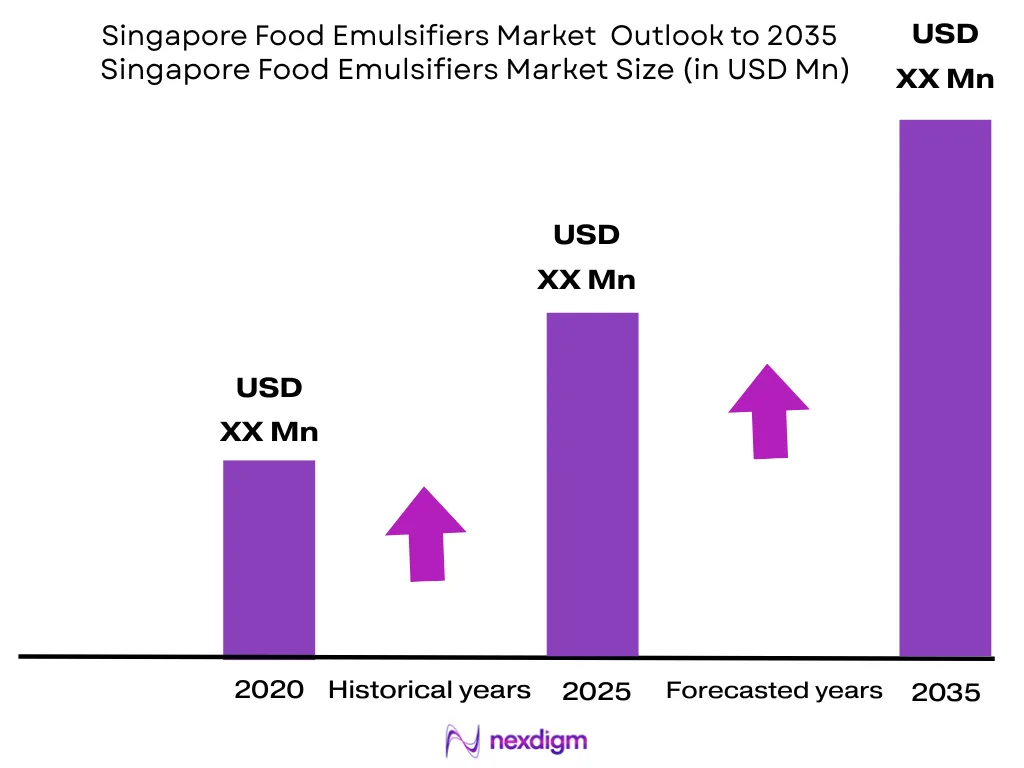
The Singapore Food Emulsifiers Market is valued at USD ~ million, based on a five-year historical analysis, and is forecast to grow at % CAGR during the forecast period. Demand is driven by bakery, confectionery, dairy, frozen desserts, beverages, sauces, central kitchens, alternative protein and foodservice. Food, beverage and tobacco manufacturing output increased from S$16,123.4 million to S$16,742.9 million, supporting ingredient use in processed foods. The Singapore Food Emulsifiers Market is dominated by Tuas, Jurong, Woodlands, Senoko, Bedok, Tampines, Changi, Pasir Panjang and One-North. Tuas and Jurong dominate through manufacturing and specialty ingredient logistics; Woodlands and Senoko support food processing; Bedok and Tampines support bakery and central kitchen demand; Changi supports catering and logistics; One-North supports food innovation. Singapore imports more than 90 units out of every 100 units of food and sources from 187 countries and regions.
Market Segmentation
By Emulsifier Type
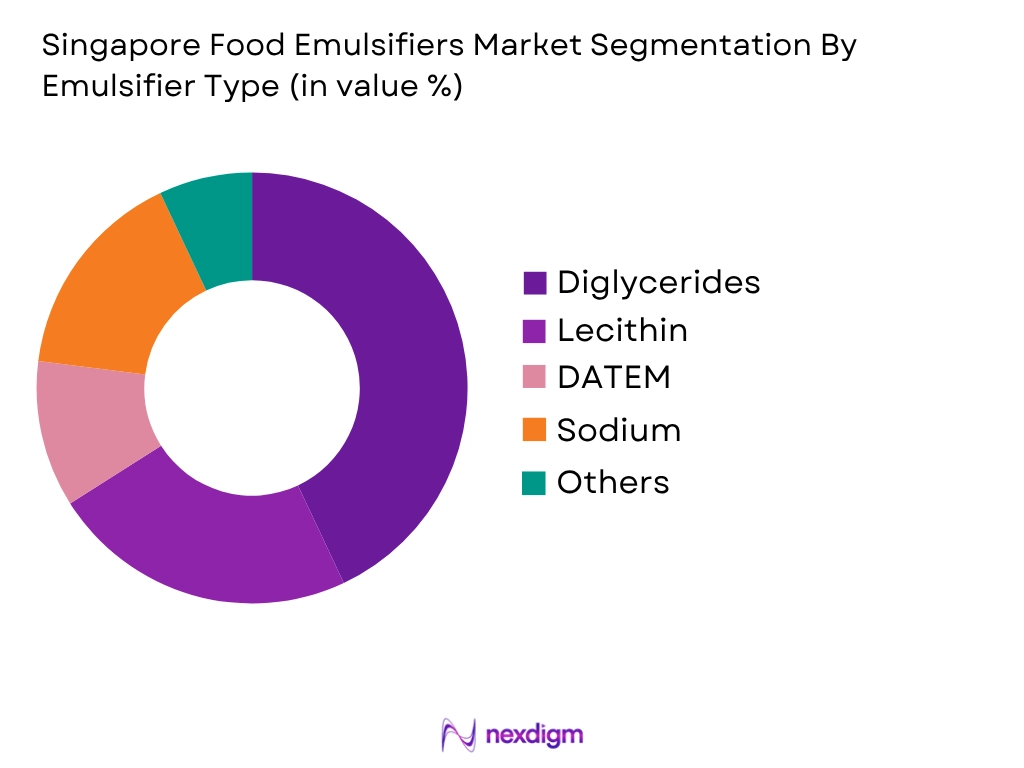
Singapore Food Emulsifiers Market is segmented by emulsifier type into mono- and diglycerides, lecithin, DATEM, sodium stearoyl lactylate, calcium stearoyl lactylate, polysorbates, sorbitan esters, PGPR, sucrose esters, polyglycerol esters and customized emulsifier blends. Recently, mono- and diglycerides have a dominant market share in Singapore under the emulsifier type segmentation because they are used across bakery, cakes, pastries, margarine, spreads, frozen desserts, whipped toppings, foodservice premixes and packaged foods. Their dominance is linked to cost-in-use efficiency, broad compatibility with fats and oils, and multifunctional performance in dough conditioning, aeration, crumb softness, fat dispersion, anti-staling and emulsion stability. These functions are important in Singapore because food processors operate in a high-cost, import-dependent and quality-sensitive market where manufacturers require consistent performance across central kitchens, retail distribution, chilled logistics and ASEAN-oriented product development.
By Application
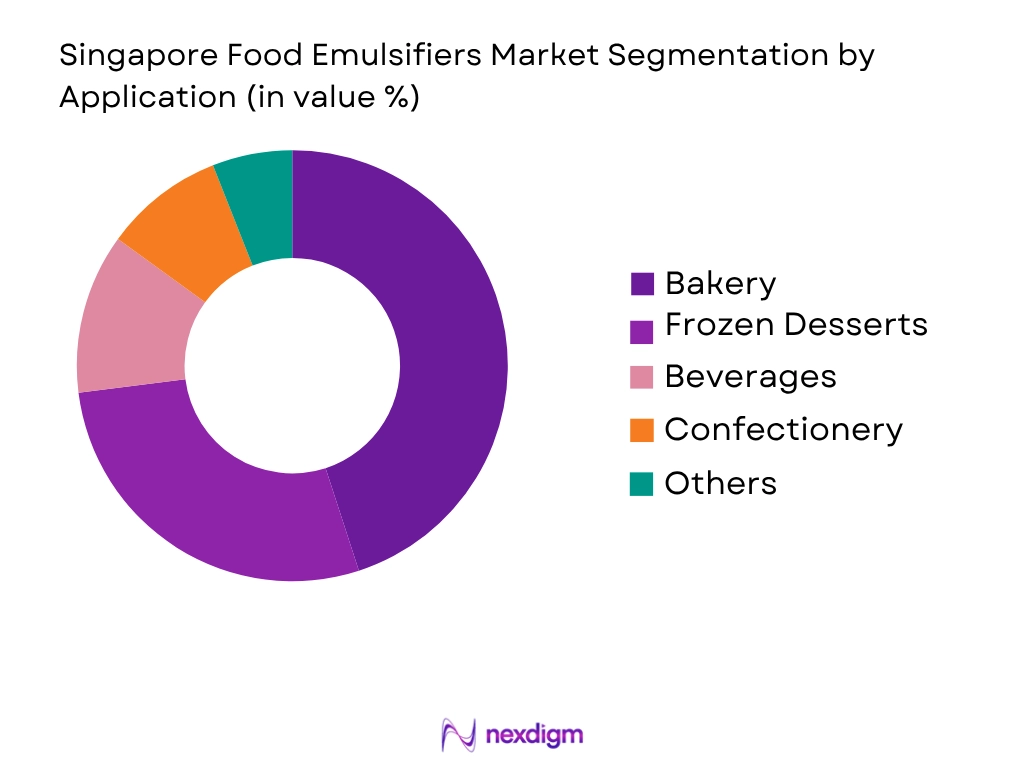
Singapore Food Emulsifiers Market is segmented by application into bakery, cakes, sweet bakery, dairy, ice cream, frozen desserts, confectionery, chocolate, beverages, sauces, dressings, spreads, foodservice premixes, central kitchen products, plant-based foods, alternative protein foods, nutritional products and powdered mixes. Recently, bakery, cakes and sweet bakery have a dominant market share in Singapore under the application segmentation because industrial bakeries, foodservice suppliers, hotels, convenience retail and central kitchens require emulsifiers for dough tolerance, cake aeration, softness, moisture retention and shelf-life stability. Mono- and diglycerides, DATEM, SSL, CSL, lecithin and enzyme-emulsifier systems help maintain quality in bread, buns, cakes, pastries, frozen bakery and sweet goods. Food, beverage and tobacco manufacturing output of S$16,742.9 million reinforces demand for functional ingredients used in consistent packaged and prepared foods.
Competitive Landscape
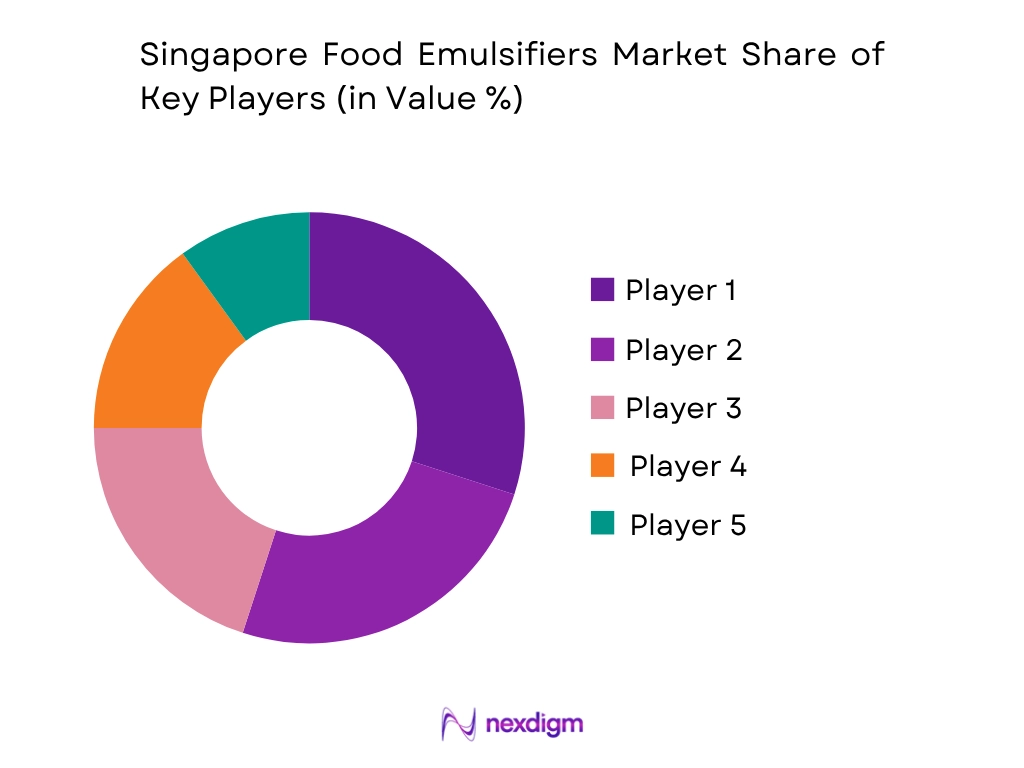
The Singapore Food Emulsifiers Market is served by global ingredient companies, specialty distributors, food additive importers, bakery ingredient suppliers, dairy stabilizer providers, alternative protein formulation partners and regional trading hubs. The market is import-led and technically service-driven because local manufacturers require SFA-compliant ingredient documentation, allergen files, halal certificates, clean-label support, batch traceability and pilot-trial assistance. Large food manufacturers and regional R&D teams prefer suppliers with Singapore warehousing, ASEAN documentation capability, rapid sampling, formulation support and access to mono- and diglycerides, lecithin, DATEM, SSL, CSL, polysorbates, PGPR and customized blends.
| Company | Establishment Year | Headquarters | Core Emulsifier Focus | Singapore Market Role | Key Applications | Distribution Strength | Compliance Capability | Market-Specific Capability |
| Cargill Asia Pacific | 1865 | Wayzata, USA | ~ | ~ | ~ | ~ | ~ | ~ |
| Palsgaard Singapore | 1917 | Juelsminde, Denmark | ~ | ~ | ~ | ~ | ~ | ~ |
| Kerry Ingredients Singapore | 1972 | Tralee, Ireland | ~ | ~ | ~ | ~ | ~ | ~ |
| Brenntag Singapore | 1874 | Essen, Germany | ~ | ~ | ~ | ~ | ~ | ~ |
| DKSH Singapore | 1865 | Zurich, Switzerland | ~ | ~ | ~ | ~ | ~ | ~ |
Singapore Food Emulsifiers Market Analysis
Growth Drivers
Food manufacturing output and regional formulation demand
Singapore Food Emulsifiers Market is driven by the country’s high-value food manufacturing base, where mono- and diglycerides, lecithin, DATEM, SSL, CSL, PGPR, polysorbates and sorbitan esters are used for dough conditioning, aeration, emulsion stability, fat dispersion, viscosity control, crystal control and mouthfeel improvement. Department of Statistics data published through data.gov.sg recorded food, beverage and tobacco manufacturing output of S$16,742.9 million, compared with S$16,123.4 million previously, showing continued industrial demand for functional ingredients. World Bank data recorded Singapore GDP at USD 547.39 billion and GDP per capita at USD 90,674.1, while Reuters reported that Singapore’s economy expanded 4.0 units per 100 after expanding 1.1 units per 100 in the previous year. These indicators support emulsifier usage because manufacturers serving bakery, confectionery, dairy, beverages, sauces, nutrition and central kitchens need technical ingredients that maintain texture, stability and shelf life in a high-cost production environment.
Import-led food security model and central kitchen ecosystem
Singapore Food Emulsifiers Market is supported by the country’s import-led food supply model and dense foodservice ecosystem because processors, central kitchens and foodservice suppliers require stable ingredient systems for bakery, sauces, dairy desserts, frozen foods, beverages, plant-based products and ready meals. SFA reported that Singapore imports more than 90 units out of every 100 units of food and sources food from 187 countries and regions, compared with 140 around two decades earlier. SFA also stated that an estimated 45,000 retail and non-retail SFA-licensed food establishments will come under the SAFE framework from 19 January 2026. These numbers matter directly for emulsifier suppliers because import dependence requires multi-origin sourcing, batch traceability, regulatory documentation and stock continuity. Emulsifiers help central kitchens and food manufacturers manage humid distribution, chilled storage, aeration, anti-staling, sauce separation, oil-soluble flavour dispersion, freeze-thaw performance and plant-protein mouthfeel across Singapore’s compact but technically demanding market.
Market Challenges
SFA compliance, technological justification and documentation burden
Singapore Food Emulsifiers Market faces a regulatory challenge because emulsifiers must satisfy Singapore Food Regulations, SFA additive permissions, technological justification, label declaration, allergen documentation, import records and customer-specific specifications. The compliance burden is commercially relevant because food, beverage and tobacco manufacturing output reached S$16,742.9 million, while Singapore imports more than 90 units out of every 100 units of food from 187 countries and regions. This creates a market where ingredient origin, use level, finished-food category, food-grade status and batch certificates are scrutinized before food manufacturers approve emulsifiers. Mono- and diglycerides, lecithin, DATEM, SSL, CSL, polysorbates, sorbitan esters and PGPR must be backed by certificates of analysis, technical data sheets, allergen statements, halal documentation where required and application-specific guidance. The SAFE framework also brings an estimated 45,000 licensed food establishments under a food safety framework, reinforcing pressure on suppliers to support clearer documentation, traceability and finished-application compliance.
Import dependency, high operating intensity and formulation risk
Singapore Food Emulsifiers Market is constrained by specialty ingredient import dependence and high technical expectations because most emulsifiers are sourced through international channels while manufacturers operate in a high-cost, high-specification environment. SFA reported that Singapore imports more than 90 units out of every 100 units of food, and diversification reached 187 source countries and regions. World Bank data recorded GDP per capita at USD 90,674.1, indicating a premium, quality-sensitive consumer and foodservice base, while food, beverage and tobacco manufacturing output reached S$16,742.9 million. This makes reformulation risk material: changing an emulsifier can affect bread softness, cake volume, frozen dessert meltdown, sauce stability, beverage clouding, chocolate viscosity, plant-based juiciness and nutritional powder instantization. Import lead times, minimum order quantities, multi-origin approvals and customer validation cycles can slow product changes. Suppliers must therefore provide pilot-trial support, shelf-life testing, humid-climate validation, SFA-ready documentation and stable Singapore warehousing to prevent formulation failures in bakery, dairy, beverage and alternative protein applications.
Market Opportunities
Clean-label, non-GMO and alternative protein emulsifier systems
Singapore Food Emulsifiers Market has a clear opportunity in clean-label, non-GMO, palm-free and alternative protein emulsifier systems because Singapore combines high-income consumption, import diversification and food innovation activity. World Bank data recorded Singapore GDP at USD 547.39 billion and GDP per capita at USD 90,674.1, while food, beverage and tobacco manufacturing output reached S$16,742.9 million. These indicators support demand for premium bakery, dairy desserts, functional beverages, plant-based foods, nutritional products and foodservice formats requiring superior mouthfeel, stability and label compatibility. Suppliers can target sunflower lecithin, non-GMO soy lecithin, palm-free mono- and diglyceride alternatives, enzyme-supported bakery blends, plant-protein emulsification systems and clean-label dairy stabilizer-emulsifier blends. The opportunity is current because manufacturers already operate in an import-dependent system sourcing from 187 countries and regions, giving them access to specialized inputs but also creating demand for traceability. Emulsifier suppliers that provide SFA documentation, allergen files, halal certificates and application testing can support premium and ASEAN-facing product development.
ASEAN-ready formulation, central kitchen and foodservice premix solutions
Singapore Food Emulsifiers Market has a growth opportunity in application-specific systems for bakery, dairy, beverages, sauces, nutritional products, central kitchens and ASEAN-facing food development. SFA reported that Singapore sources food from 187 countries and regions and imports more than 90 units out of every 100 units of food, making local ingredient distributors and formulation suppliers central to resilient supply. SFA’s SAFE framework will cover an estimated 45,000 licensed food establishments from 19 January 2026, supporting demand for safer, better-documented food preparation and supply chains. Food, beverage and tobacco manufacturing output of S$16,742.9 million creates a processing base for bakery improvers, sauce stabilizers, beverage cloud emulsions, frozen dessert systems and plant-based texture solutions. Suppliers can build future growth by offering central kitchen premixes, SFA-ready specification packs, halal-compatible emulsifiers, pilot-trial support, humid-climate shelf-life validation and ASEAN export documentation. These systems help processors maintain crumb softness, sauce stability, frozen dessert smoothness, beverage dispersion and plant-based mouthfeel while reducing reformulation delays.
Future Outlook
Over the forecast period, the Singapore Food Emulsifiers Market is expected to grow through food manufacturing output, specialty ingredient importation, bakery and confectionery demand, dairy and frozen desserts, beverages, sauces, central kitchens, foodservice and alternative protein development. Emulsifiers will remain critical for emulsion stability, dough conditioning, aeration, fat dispersion, anti-staling, crystal control, viscosity management, instantization and mouthfeel improvement.
Major Players
- Cargill Asia Pacific
- ADM Asia-Pacific Trading
- Palsgaard Singapore
- Corbion Asia Pacific
- BASF Singapore
- Kerry Ingredients Singapore
- Ingredion Singapore
- International Flavors & Fragrances Singapore
- AAK Singapore
- Bunge Asia
- Stern Ingredients Asia Pacific
- Lasenor Singapore
- Riken Vitamin Singapore
- Brenntag Singapore
- DKSH Singapore
Key Target Audience
- Food emulsifier manufacturers
- Bakery, confectionery and chocolate manufacturers
- Dairy, ice cream and beverage manufacturers
- Alternative protein and plant-based food manufacturers
- Foodservice, central kitchen and contract food manufacturers
- Ingredient distributors and specialty ingredient importers
- Investments and venture capitalist firms
- Government and regulatory bodies
Research Methodology
Step 1: Identification of Key Variables
The initial phase involves constructing an ecosystem map covering emulsifier manufacturers, importers, specialty ingredient distributors, bakery ingredient suppliers, dairy stabilizer suppliers, alternative protein formulation companies, foodservice suppliers and food processors. This step uses desk research, regulatory review, trade indicators and company-level mapping. The objective is to define variables such as emulsifier type, source, form, functionality, application, end user and distribution channel.
Step 2: Market Analysis and Construction
In this phase, historical data is compiled across food manufacturing output, foodservice activity, import dependence, bakery demand, dairy and frozen dessert processing, beverage production, alternative protein development and ingredient distribution. The top-down approach evaluates macro and food-sector indicators, while the bottom-up approach assesses emulsifier usage across bakery, dairy, chocolate, beverages, sauces, plant-based foods and central kitchens. This supports value, volume and segment-level modelling.
Step 3: Hypothesis Validation and Expert Consultation
Market hypotheses are validated through computer-assisted telephone interviews with emulsifier suppliers, importers, bakery technologists, dairy formulators, beverage specialists, plant-based food developers, foodservice manufacturers and ingredient distributors. These consultations help verify mono- and diglycerides dominance, lecithin demand, SFA documentation requirements, import dependency and application-level usage. Expert inputs refine segmentation, competitive positioning and future outlook.
Step 4: Research Synthesis and Final Output
The final phase integrates secondary research, SFA regulatory review, company benchmarking, import-channel analysis, distributor checks and expert consultations into a consolidated market model. Data triangulation is applied across manufacturer demand, distributor movement, application usage and functional requirements. The final output includes market size, segmentation, competitive landscape, future outlook and strategic recommendations for Singapore Food Emulsifiers Market participants.

- Executive Summary
- Research Methodology (Market Definitions and Assumptions, Abbreviations, INS/E-Number Mapping, Singapore Food Regulations Mapping, SFA Food Additive Permission Review, SFA Regulatory Limits for Food Additives Mapping, Halal Ingredient Compliance Mapping, HS Code Mapping, Market Sizing Approach, Top-Down Analysis, Bottom-Up Analysis, Demand-Side Assessment, Supply-Side Assessment, Import-Export Assessment, Food Processor Procurement Checks, Bakery and Dairy Formulator Interviews, Alternative Protein Formulator Interviews, Ingredient Distributor Interviews, Primary Industry Interviews, Data Triangulation, Forecasting Framework, Limitations and Future Conclusions

- Definition and Scope
- Market Evolution and Industry Genesis
- Timeline of Major Industry Developments
- Role of Emulsifiers in Singapore Packaged Food Manufacturing
- SFA Food Additive Regulatory Framework

- Growth Drivers (Food Manufacturing Output Expansion, Import-Dependent Ingredient Trading Hub, Bakery and Confectionery Demand, Dairy and Frozen Dessert Manufacturing, Beverage and RTD Demand, Foodservice and Central Kitchen Demand, Alternative Protein and Plant-Based Food Innovation, Texture and Shelf-Life Requirements in Humid Distribution)
- Market Challenges (SFA Food Additive Compliance Complexity, Technological Justification Requirements, Import Dependency for Specialty Emulsifiers, Clean-Label Pressure on Synthetic Emulsifiers, Soy Allergen and GMO Sensitivity, Palm-Based Emulsifier Sustainability Concerns, High Operating Cost Environment, Application-Specific Technical Validation Requirements)
- Market Opportunities (Sunflower Lecithin and Non-GMO Emulsifier Expansion, Clean-Label Bakery and Dairy Systems, Enzyme-Based Bakery Emulsifier Replacement, Alternative Protein Texture Systems, Plant-Based Dairy and Meat Emulsification, ASEAN Export Documentation-Ready Emulsifiers, Foodservice and Central Kitchen Premix Solutions, Regional Formulation Lab Services)
- Market Trends (Shift from Commodity Emulsifiers to Customized Blends, Clean-Label Replacement of Synthetic Emulsifiers, Increased Use of Enzyme-Based Dough Systems, Growth of Alternative Protein Texture Solutions, Demand for SFA-Ready Documentation, Premium Dairy and Frozen Dessert Stabilization, Lecithin Source Differentiation, Technical Service-Led Ingredient Selling)
- SWOT Analysis
- Porter’s Five Forces Analysis
- PESTLE Analysis

- By Market Value (2020-2025)
- By Consumption Volume (2020-2025)
- By Domestic Production Demand (2020-2025)

- By Emulsifier Type (In Value %)
Mono- and Diglycerides
Lecithin
DATEM
Sodium Stearoyl Lactylate
Calcium Stearoyl Lactylate
Polysorbates - By Application (In Value %)
Bakery Products
Cakes and Sweet Bakery
Confectionery and Chocolate
Dairy and Frozen Desserts
Beverages and RTD Drinks - By Distribution Channel (In Value %)
Direct Sales to Food Manufacturers
Ingredient Distributors
Specialty Chemical Distributors
Bakery Ingredient Suppliers
Dairy Ingredient Suppliers
Confectionery Ingredient Suppliers - By Import Origin (In Value %)
Europe Specialty Emulsifier Imports
United States Ingredient Imports
China Food Additive Imports
Malaysia Palm-Derived Emulsifier Imports
Indonesia Palm-Derived Emulsifier Imports

- Market Share of Major Players (By Value, Volume, Emulsifier Type, Source Type, Application, End User, Demand Cluster, Distribution Channel, Domestic vs Imported Portfolio)
- Cross Comparison Parameters (Emulsifier Portfolio Breadth, Lecithin Source Diversity, SFA Documentation Strength, Clean-Label and Non-GMO Product Range, Bakery and Confectionery Application Expertise, Dairy and Beverage Formulation Capability, Singapore Warehousing and ASEAN Distribution Footprint, Technical Support and Pilot Trial Capability)
- SWOT Analysis of Major Players
- Detailed Profiles of Major Companies
Cargill Asia Pacific
ADM Asia-Pacific Trading
Palsgaard Singapore
Corbion Asia Pacific
BASF Singapore
Kerry Ingredients Singapore
Ingredion Singapore
International Flavors & Fragrances Singapore
AAK Singapore
Bunge Asia
Stern Ingredients Asia Pacific
Lasenor Singapore
Riken Vitamin Singapore
Brenntag Singapore
DKSH Singapore

- Industrial Bakery Manufacturer Analysis
- Confectionery and Chocolate Manufacturer Analysis
- Dairy and Ice Cream Manufacturer Analysis
- Beverage Manufacturer Analysis
- Meat, Seafood and Plant-Based Food Manufacturer Analysis

- By Market Value (2026-2035)
- By Consumption Volume (2026-2035)
- By Domestic Production Demand (2026-2035)


 Request a Sample
 Ask for Customization
 Get a Quote
 Enquire Now