

 Download PDF
Market Overview
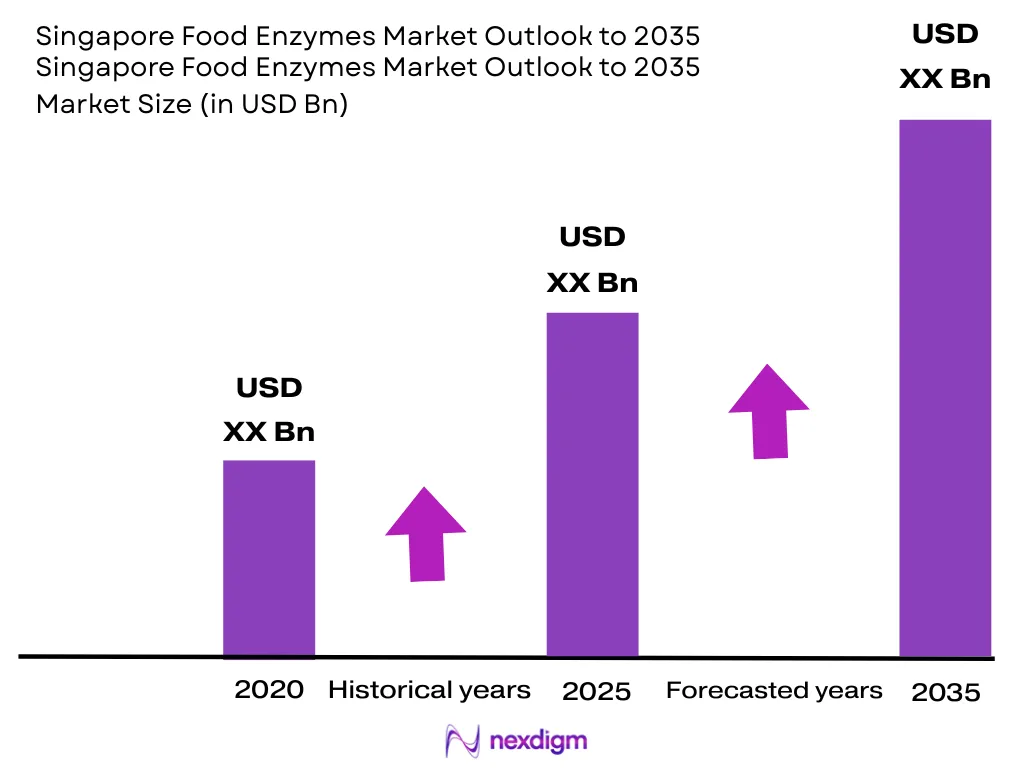
The Singapore Food Enzymes Market was valued at USD ~ Billion in 2024 and is anticipated to expand at a CAGR of ~% during 2026–2035. The market is primarily driven by Singapore’s position as a regional food innovation and agrifood technology hub, its national food security agenda, and the country’s growing base of enzyme engineering and precision fermentation startups. According to Singapore’s Department of Statistics, food manufacturing output increased by 3.5% in 2023, while the broader food and beverage industry, which employs more than 220,000 workers representing about 5% of the total workforce, was projected to generate revenue of approximately SGD 40 billion in 2024. Singapore’s “30 by 30” food security goal, which aims for the country to produce 30% of its nutritional needs domestically by 2030, continues to catalyse investment in food technology, alternative proteins, and precision fermentation, all of which rely heavily on enzymatic processing.
Market Segmentation
By Source
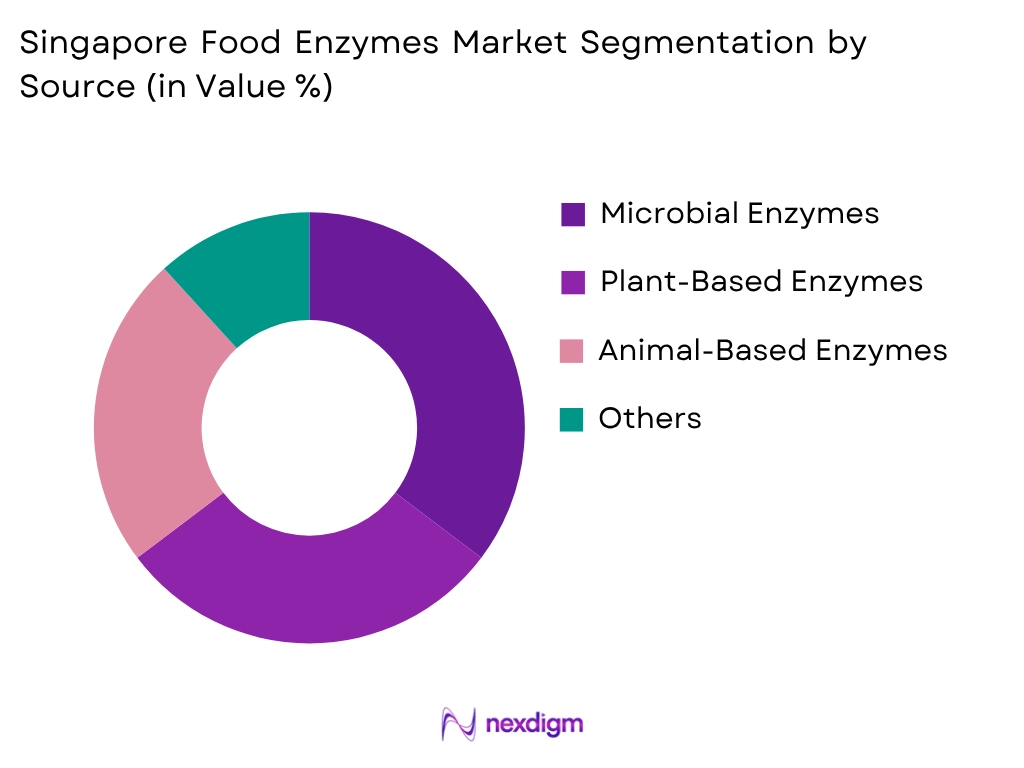
Among these, Microbial Enzymes dominate the Singapore Food Enzymes Market, reflecting both global industry patterns and Singapore’s specific strength in enzyme engineering and synthetic biology. Singapore-based enzyme engineering companies such as Allozymes, a spin-out from research conducted at the National University of Singapore, use proprietary microfluidics technology to screen and develop novel microbial enzyme variants at significantly higher throughput than conventional methods, serving food, chemical, and biopharma applications across the region. This local enzyme engineering capability, combined with Singapore’s Biopolis research ecosystem and government-backed agrifood innovation funding, positions microbial and precision-fermentation-derived enzymes as the fastest-growing source segment, supporting the country’s broader “30 by 30” food security and alternative protein ambitions.
By Application
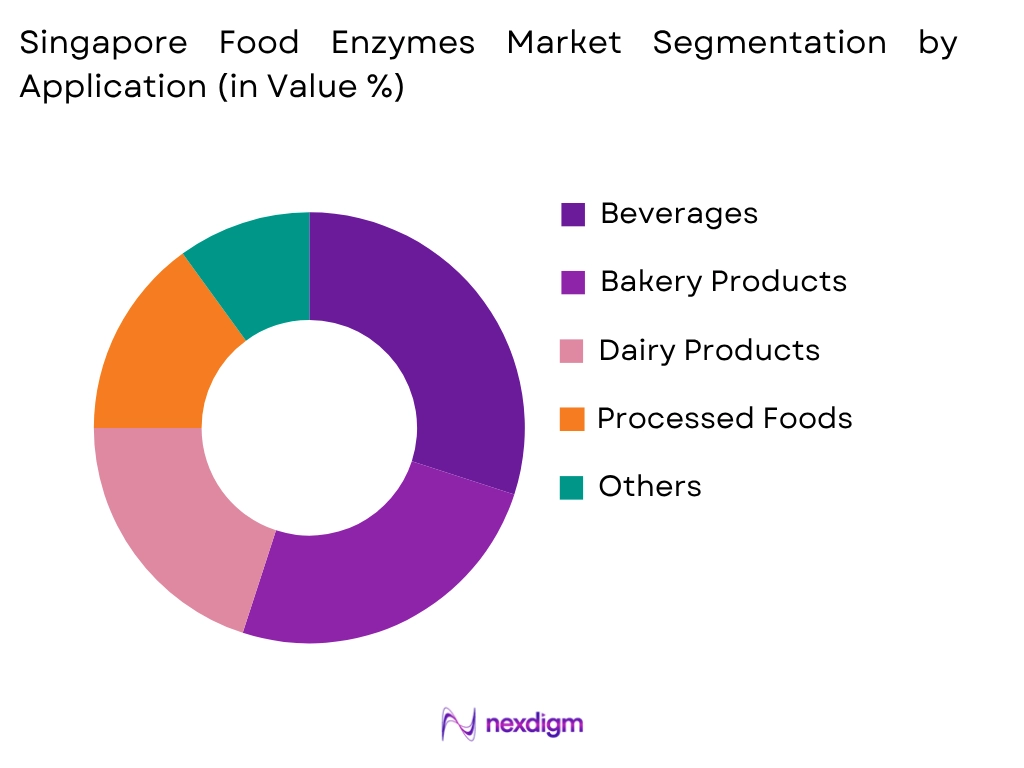
The Bakery and Beverages segments hold a substantial share of the Singapore Food Enzymes Market, reflecting the country’s established food manufacturing base concentrated around the Jurong food industrial cluster and its role as a regional hub for packaged food and beverage production destined for both domestic consumption and export across Southeast Asia. The Meat, Poultry, Seafood and Alternative Protein Products segment is emerging as a particularly fast-growing application area, supported by Singapore’s global leadership in alternative protein innovation and its status as the first country to approve the sale of cultivated meat, creating demand for specialised enzymes used in structuring, texturising, and processing novel protein products. Ace Ingredients, a Singapore-headquartered food additive specialist, supplies transglutaminase-based enzyme solutions widely used to bind and structure both conventional meat and emerging plant-based and cultivated protein products across the region.
Competitive Landscape
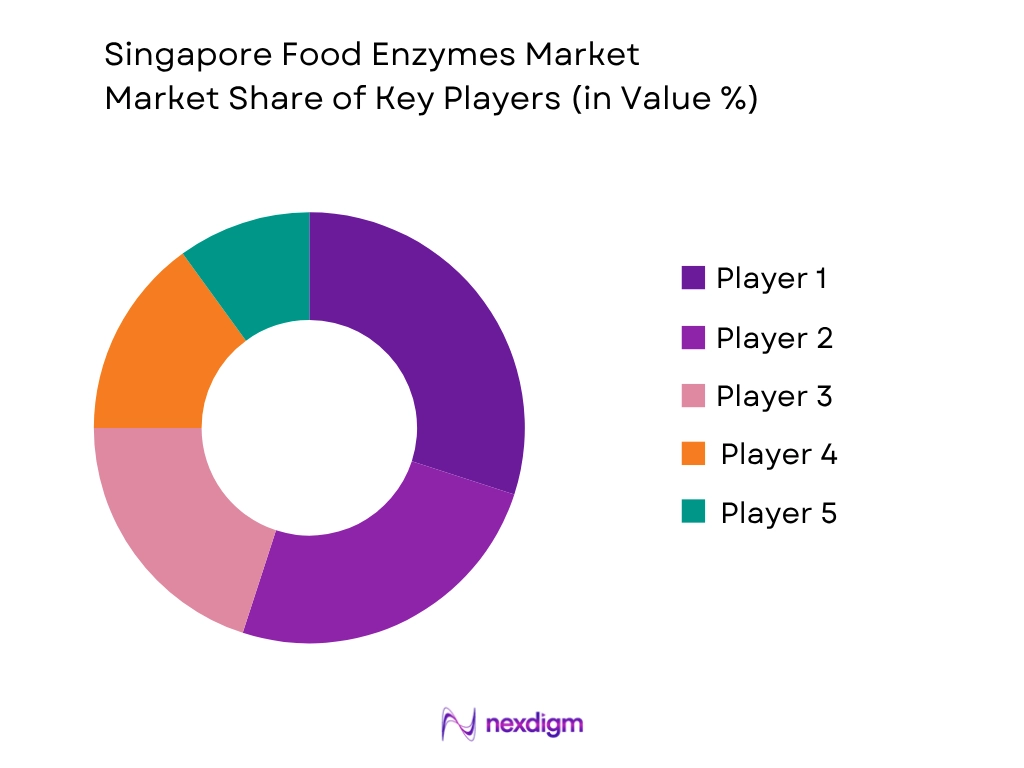
The Singapore Food Enzymes Market is moderately fragmented, combining a small but high-value base of domestic enzyme engineering companies with multinational suppliers that maintain regional offices, distribution hubs, or research collaborations in the country. Global players such as Novonesis, DSM-Firmenich, and Associated British Foods plc, through its AB Enzymes division which operates a regional office in Singapore, compete on enzyme portfolio breadth and established regulatory track records, while Singapore-based companies such as Allozymes and Ace Ingredients compete on custom enzyme engineering speed, novel protein application expertise, and proximity to the country’s fast-growing alternative protein and precision fermentation ecosystem. Competition is increasingly shaped by access to Singapore’s Biopolis research infrastructure, government agrifood innovation grants, and the ability to support both the domestic “30 by 30” food security agenda and export-oriented enzyme manufacturing serving the wider ASEAN region.
| Company | Establishment Year | Headquarters | Primary Product Portfolio | Enzyme Portfolio
|
Manufacturing Presence | Major End-Use Industries | Key Strategic Focus | Certifications & Compliance |
| Ace Ingredients Co., Ltd. | 2020 | ~ | ~ | ~ | ~ | ~ | ~ | ~ |
| Allozymes Pte Ltd | 2019 | ~ | ~ | ~ | ~ | ~ | ~ | ~ |
| Novonesis (Novozymes A/S) | 2000 | ~ | ~ | ~ | ~ | ~ | ~ | ~ |
| DSM-Firmenich (Koninklijke DSM N.V.) | 1902 | ~ | ~ | ~ | ~ | ~ | ~ | ~ |
| AB Enzymes | 1935 | ~ | ~ | ~ | ~ | ~ | ~ | ~ |
Singapore Food Enzymes Market Analysis
Growth Drivers
Singapore’s 30-by-30 Food Security Agenda and AgriFood Innovation Investment
The Singapore food enzymes market is experiencing sustained growth due to the country’s “30 by 30” food security goal, which aims to build the capability and capacity of the agrifood industry to sustainably produce 30% of Singapore’s nutritional needs domestically by 2030. This national agenda has catalysed significant government investment in agrifood technology, alternative proteins, and precision fermentation, all of which depend heavily on enzymatic processing to convert raw feedstocks into functional food ingredients. Singapore’s Biopolis research hub, established as part of the country’s broader biomedical and biotechnology strategy, continues to attract enzyme engineering companies and provides shared R&D infrastructure that lowers the barrier to entry for enzyme-focused agrifood startups. According to Singapore’s Department of Statistics, food manufacturing output increased by 3.5% in 2023, reflecting the tangible impact of this sustained policy and investment focus on the country’s food processing base.
Growth of Enzyme Engineering Startups and Precision Fermentation
Singapore has emerged as a regional hub for enzyme engineering and precision fermentation startups, a trend that directly supports growth in the food enzymes market. Allozymes, a Singapore-based synthetic biology company founded in 2019 by researchers from the National University of Singapore, has raised a total of USD 20 million in funding, including a USD 15 million round in 2024, to develop its proprietary microfluidics-based enzyme engineering platform, which can screen more than 20 million enzyme variants per day for applications spanning food, pharmaceuticals, and personal care. Singapore’s status as the world’s first country to approve the commercial sale of cultivated meat has further catalysed demand for specialised food processing enzymes used in structuring and texturising novel protein products. Combined with strong government support through agencies such as Enterprise Singapore and the Singapore Economic Development Board, this innovation ecosystem continues to attract both domestic startups and multinational enzyme producers seeking regional research and commercialisation partnerships.
Market Challenges
High Dependence on Imported Enzymes and Limited Domestic Manufacturing Scale
Singapore’s food enzymes market remains heavily dependent on imported enzyme products, as the country’s small land area and high operating costs limit the feasibility of large-scale domestic enzyme fermentation and manufacturing relative to regional peers such as Malaysia, Thailand, and Vietnam. Most global enzyme suppliers maintain only regional sales, distribution, or research offices in Singapore rather than full-scale production facilities, meaning the country functions more as a research, testing, and regional distribution hub than a manufacturing base. This structure exposes Singapore-based food and beverage manufacturers to global supply chain disruptions, import logistics costs, and currency fluctuations affecting the price and availability of specialty enzymes sourced from producers in Europe, the United States, and elsewhere in Asia.
High Operating Costs and Regulatory Complexity for Novel Enzyme Products
Singapore’s high commercial rents, land costs, and labour costs present a persistent challenge for enzyme suppliers and food manufacturers seeking to scale domestic production, particularly relative to lower-cost manufacturing hubs elsewhere in Southeast Asia. In addition, enzymes derived from novel sources or genetically modified microorganisms, particularly those associated with precision fermentation and alternative protein applications, must undergo the Singapore Food Agency’s (SFA) novel food safety assessment framework before commercialisation, a process that requires extensive safety and toxicological documentation. While Singapore’s regulatory environment is generally regarded as innovation-friendly relative to many other markets, the combination of high operating costs and rigorous novel food approval requirements can extend product development timelines and increase costs for smaller enzyme engineering companies bringing new formulations to market.
Market Opportunities
Alternative Protein and Precision Fermentation Enzyme Solutions
Singapore’s global leadership in alternative protein innovation, underscored by its position as the first country in the world to approve the commercial sale of cultivated meat, presents a substantial opportunity for enzyme suppliers specialising in protein structuring, texturising, and precision fermentation applications. Domestic enzyme engineering companies such as Allozymes are well positioned to capture this opportunity, having already expanded their platform capabilities to screen and engineer enzymes specifically for food applications beyond their original biopharma focus. As global food companies increasingly look to Singapore as a testbed and regional headquarters for alternative protein innovation, enzyme suppliers with strong technical capabilities in this space stand to benefit from both domestic demand and the country’s role as a gateway for commercialisation across the broader Asia-Pacific region.
Regional Distribution and Research Hub Potential
Singapore’s established position as a regional trade, logistics, and research hub presents a significant opportunity for enzyme suppliers to use the country as a base for serving the broader ASEAN food and beverage manufacturing industry. Associated British Foods plc’s AB Enzymes division, which operates one of its global regional offices in Singapore alongside offices in Germany, the USA, Brazil, and China, exemplifies this model of using Singapore as a customer service and technical support base for the wider region. As global enzyme producers continue to value Singapore’s strong intellectual property protections, research infrastructure, and connectivity to Southeast Asian markets, opportunities exist for both multinational and domestic enzyme engineering companies to expand research collaborations, technical service capabilities, and regional distribution infrastructure centred in Singapore.
Future Outlook
The Singapore Food Enzymes Market is expected to witness steady expansion over the forecast period, supported by continued government investment in the country’s “30 by 30” food security agenda, sustained growth in alternative protein and precision fermentation innovation, and Singapore’s ongoing evolution as a regional agrifood technology and research hub. Growing investment in domestic enzyme engineering capabilities, exemplified by companies such as Allozymes, will further accelerate market development even as the country remains reliant on imports for bulk enzyme supply. The market is also likely to benefit from Singapore’s role as a regional distribution and research base for global enzyme producers, even as manufacturers and startups continue to navigate high operating costs, limited domestic manufacturing scale, and an evolving novel food regulatory framework overseen by the Singapore Food Agency.
Major Players
- Novonesis (Novozymes A/S)
- DSM-Firmenich (Koninklijke DSM N.V.)
- Chr. Hansen A/S (Novonesis Group)
- Associated British Foods plc (AB Enzymes)
- Kerry Group plc
- IFF (International Flavors & Fragrances)
- BASF SE
- Amano Enzyme Asia Pacific Co., Ltd.
- Advanced Enzyme Technologies Ltd.
- Dyadic International Inc.
- Codexis, Inc.
- EnginZyme AB
- Allozymes Pte Ltd
- Ace Ingredients Co., Ltd.
- Specialty Enzymes & Probiotics, Inc.
Key Target Audience
- Food Enzyme Manufacturers
- Food & Beverage Processing Companies
- Alternative Protein and Precision Fermentation Companies
- Bakery and Beverage Manufacturers
- Dairy Product Manufacturers
- Investment and Venture Capitalist Firms
- Government and Regulatory Bodies (Singapore Food Agency (SFA), Enterprise Singapore, Singapore Economic Development Board (EDB))
- Food Ingredient Distributors and Industrial Raw Material Suppliers
Research Methodology
Step 1: Identification of Key Variables
The research process begins with identifying the complete ecosystem of the Singapore Food Enzymes Market, including raw material and fermentation feedstock suppliers, enzyme manufacturers, ingredient distributors, food processors, retailers, and regulatory authorities. Extensive secondary research is conducted using company annual reports, government publications, trade associations, customs statistics, industry journals, and proprietary databases to determine the variables influencing market demand, pricing, production, consumption, and technological developments.
Step 2: Market Analysis and Construction
Historical market information is collected and analysed to estimate market size, production volumes, import-export activity, application-wise demand, and pricing trends. A combination of top-down and bottom-up approaches is used to estimate market revenues and validate segment-level performance. Consumption patterns across bakery, dairy, beverages, confectionery, processed foods, and nutraceuticals are evaluated to establish an accurate representation of the industry.
Step 3: Hypothesis Validation and Expert Consultation
The preliminary findings are validated through Computer-Assisted Telephone Interviews (CATIs) and structured discussions with enzyme manufacturers, procurement managers, distributors, food technologists, regulatory experts, and senior executives operating within the Singapore food industry. These interviews help verify market assumptions, competitive developments, technology adoption trends, pricing dynamics, and future investment opportunities while refining the overall market estimates.
Step 4: Research Synthesis and Final Output
The final stage integrates insights obtained from primary interviews with quantitative information collected through secondary sources. Data triangulation techniques are applied to reconcile differences between supply-side and demand-side estimates, ensuring robust market forecasting. The report is then reviewed through multiple quality assurance checkpoints to deliver a comprehensive analysis covering market size, segmentation, competitive landscape, future outlook, and strategic recommendations for industry stakeholders.

- Executive Summary
- Research Methodology (Market Definitions and Assumptions, Abbreviations, Market Sizing Approach, Top-Down Analysis, Bottom-Up Analysis, Demand-Side Assessment, Supply-Side Assessment, Primary Industry Interviews, Secondary Research Validation, Data Triangulation, Forecasting Framework, Limitations and Future Conclusions)

- Definition and Scope
- Market Evolution and Industry Genesis
- Timeline of Major Industry Developments
- Food Enzymes Industry Value Chain Analysis
- Supply Chain Analysis

- Growth Drivers (Growing Clean Label Food Demand, Rising Consumption of Processed Foods, Expansion of Alternative Protein Manufacturing, Singapore’s 30-by-30 Food Security Goal, Growth of Precision Fermentation Startups, Government Support for AgriFood Innovation)
- Market Challenges (High Dependence on Imported Enzymes, Small Domestic Manufacturing Base, High Operating and Land Costs, Regulatory Novel Food Approval Complexity, Limited Raw Material Cultivation, Competition from Regional Manufacturing Hubs)
- Market Opportunities (Precision Fermentation and Enzyme Engineering, Alternative Protein Enzyme Solutions, Regional Distribution Hub Potential, Functional Food Innovation, Export-Oriented Specialty Enzyme Manufacturing, Clean Label Reformulation Projects)
- Market Trends (Rise of Enzyme Engineering Startups, Growth of Microfluidics-Based Enzyme Discovery, Custom Enzyme Development, Precision Fermentation Investment, Enzymes for Sugar and Additive Reduction, Multi-Functional Enzyme Blends)
- Government Regulations (SFA Food Enzyme Regulations, Novel Food Safety Assessment Framework, Food Labelling Requirements, Maximum Permitted Usage Levels, Import Compliance, Halal Certification Requirements)
- Import and Export Analysis (Trade Volume, Major Import Sources, Re-Export Destinations, HS Code Analysis, Trade Balance)
- Raw Material Availability Analysis (Fermentation Feedstocks, Imported Cereal and Grain Substrates, Milk-Derived Substrates, Plant Protein Substrates, Microbial Strains)
- Technology Landscape (Microfluidics-Based Enzyme Screening, Submerged Fermentation, Enzyme Immobilisation, Protein Engineering, AI-Assisted Enzyme Design)
- Sustainability Assessment (Renewable Fermentation Feedstocks, Carbon Footprint Reduction, Waste Valorisation, Energy-Efficient Manufacturing, Alignment with 30-by-30 Food Security Goal)
- PESTLE Analysis
- SWOT Analysis
- Porter’s Five Forces Analysis
- Stakeholder Ecosystem
- Competition Ecosystem

- By Market Value (2020-2025)
- By Volume Consumption (2020-2025)
- By Average Selling Price (2020-2025)

- By Type (In Value %)
Carbohydrases
Proteases
Lipases
Phytases
Lactases
Pectinases - By Source (In Value %)
Microbial Enzymes
Plant-Based Enzymes
Animal-Based Enzymes - By Application (In Value %)
Bakery
Dairy
Beverages (Brewing and Juice Processing)
Confectionery
Meat, Poultry, Seafood and Alternative Protein Products
Processed Foods
Nutraceuticals and Functional Foods - By Distribution Channel (In Value %)
Direct Sales to Food Manufacturers
Ingredient Distributors
Industrial Ingredient Suppliers
Online B2B Ingredient Platforms
Specialty Ingredient Suppliers - By Region (In Value %)
West Region (Jurong Food Manufacturing Hub)
North Region (Woodlands and Sembawang)
Central Region
East and North-East Regions

- Market Share of Major Players (By Value, Volume, Enzyme Type, Application Industry, Product Category)
- Cross Comparison Parameters (Enzyme Portfolio Breadth, Custom Enzyme Development Capability, Thermal and pH Stability Performance, Application Technical Support Capability, R&D and Manufacturing Presence, Regulatory Compliance & Certifications, Food & Beverage Customer Base, Innovation & New Product Launch Frequency)
- SWOT Analysis of Major Players
- Pricing Analysis by Product Category and SKU
- Production Capacity Analysis
- Manufacturing Footprint Analysis
- Distribution Network Analysis
- Innovation Benchmarking
- Detailed Profiles of Major Companies
Novonesis (Novozymes A/S)
DSM-Firmenich (Koninklijke DSM N.V.)
Chr. Hansen A/S (Novonesis Group)
Associated British Foods plc (AB Enzymes)
Kerry Group plc
IFF (International Flavors & Fragrances)
BASF SE
Amano Enzyme Asia Pacific Co., Ltd.
Advanced Enzyme Technologies Ltd.
Dyadic International Inc.
Codexis, Inc.
EnginZyme AB
Allozymes Pte Ltd
Ace Ingredients Co., Ltd.
Specialty Enzymes & Probiotics, Inc.

- Consumption Pattern Analysis (Industrial Usage, Batch Size, Product Category Penetration, Seasonal Demand, Reformulation Activity)
- Purchasing Criteria (Enzyme Activity Consistency, Regulatory Compliance, Cost Efficiency, Thermal Stability, pH Stability, Shelf Life)
- Procurement and Supplier Selection Analysis
- Clean Label Adoption Assessment
- Premium vs Conventional Product Demand
- Product Attribute Preference Analysis (Activity Consistency, Dosage Efficiency, Thermal Tolerance, Substrate Specificity, Novel Food Approval Status, Label Friendliness)
- Consumer Health & Wellness Influence on Product Development
- Pain Point Analysis
- Decision-Making Process

- By Market Value (2026-2035)
- By Volume Consumption (2026-2035)
- By Average Selling Price (2026-2035)


 Request a Sample
 Ask for Customization
 Get a Quote
 Enquire Now