
 Download PDF
Market Overview
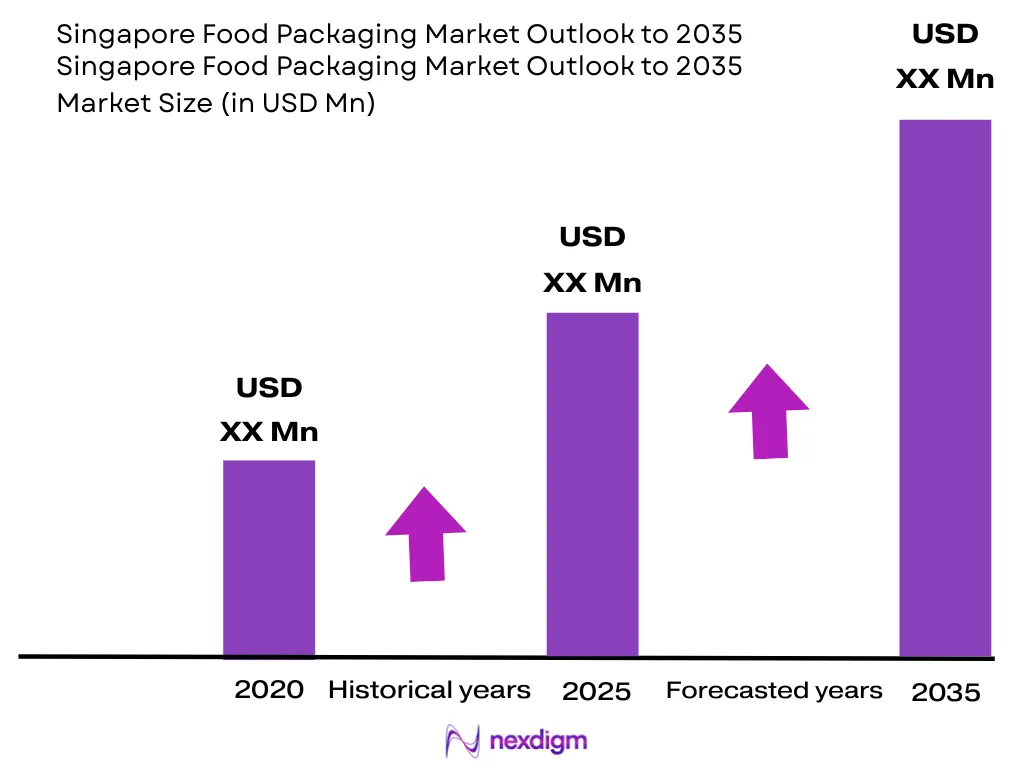
The Singapore Food Packaging Market was valued at USD ~ Million in 2024 and is anticipated to expand at a CAGR of ~% during 2026–2035. The market is primarily driven by the country’s deeply embedded food delivery and hawker culture, ongoing regulatory transition toward Extended Producer Responsibility (EPR), and Singapore’s role as a regional food packaging trade and re-export hub. The Asia-Pacific Food Packaging Market, within which Singapore operates as an advanced and highly regulated node, is projected to grow at a CAGR of 4.31% during 2025-2030, according to Mordor Intelligence, with Sealed Air Corporation, Berry Global, Huhtamaki Group, Amcor, and Crown Holdings recognized as major regional players. Singapore’s Mandatory Packaging Reporting (MPR) framework, in effect under the Resource Sustainability Act since July 2020, requires companies with annual turnover above S$10 million to report detailed packaging data to the National Environment Agency (NEA) annually, with the next submission deadline set for March 31, 2026. This reporting regime is laying the foundation for a broader EPR scheme for packaging waste, with a nationwide beverage container return scheme featuring deposit-refund mechanisms for plastic and metal drink containers set to roll out from April 2026, reshaping packaging design and collection infrastructure across bakery, dairy, beverages, and foodservice applications.
Market Segmentation
By Material
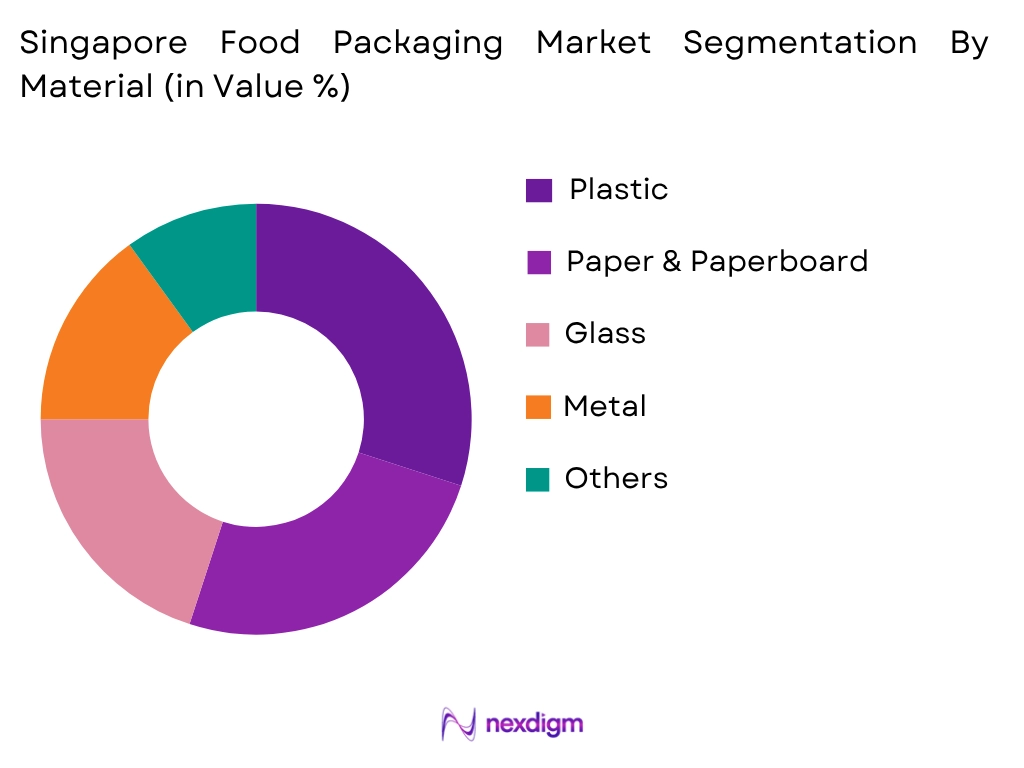
Among these, Plastic holds a leading share of the Singapore Food Packaging Market, reflecting its widespread use across flexible pouches, rigid containers, and foodservice ware serving the country’s hawker centres, food courts, and food delivery ecosystem. Metal packaging retains a significant niche, anchored by domestic manufacturers such as MC Packaging, which began operations in the early 1970s manufacturing metal cans and closures for Singapore’s edible oils industry before expanding into a broader range of metal containers serving the food and beverage and dairy products industries across Asia. Paper & Paperboard is the fastest-growing material category, driven by the National Environment Agency’s ongoing public consultation on single-use item management, which is expected to introduce new regulatory frameworks for takeaway packaging materials by 2025, including minimum sustainability requirements and stricter labeling for recyclable or compostable materials, prompting food delivery and foodservice operators to transition away from conventional plastic formats.
By End User
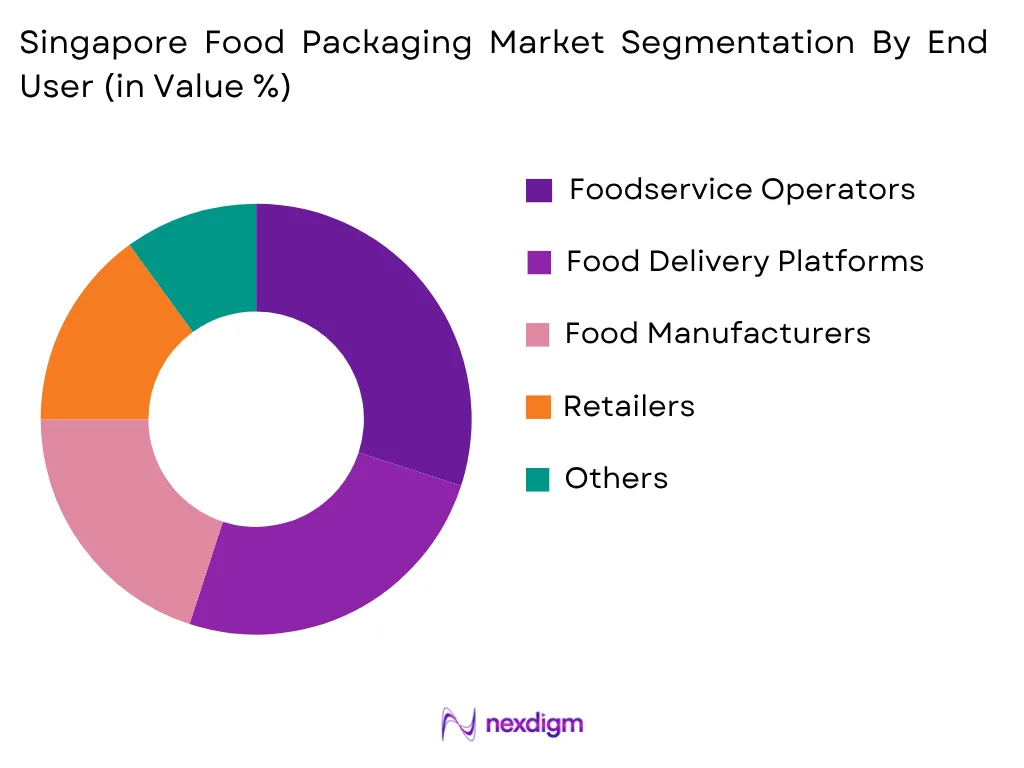
The Foodservice Operators segment, encompassing hawker centres, food courts, restaurants, and cafes, holds the largest share of the Singapore Food Packaging Market, reflecting the reality that food is not just culture in Singapore but core infrastructure, powering the nation’s eating habits through an extensive network of hawker centres, bubble tea shops, and cafes. Ban Teck Han Enterprise, established in 1981 with manufacturing bases and distribution centres in Singapore and Malaysia, has built a customer base exceeding 2,000 clients by providing end-to-end 360-degree food packaging solutions spanning plastics, biodegradable options, and paper, all food-safe and retail-ready. The Food Delivery Platforms segment represents the fastest-growing end-user category, as the National Environment Agency’s regulatory focus increasingly targets single-use plastic products used specifically in food delivery and takeout services, requiring platforms and their restaurant partners to adopt more sustainable packaging formats.
Competitive Landscape
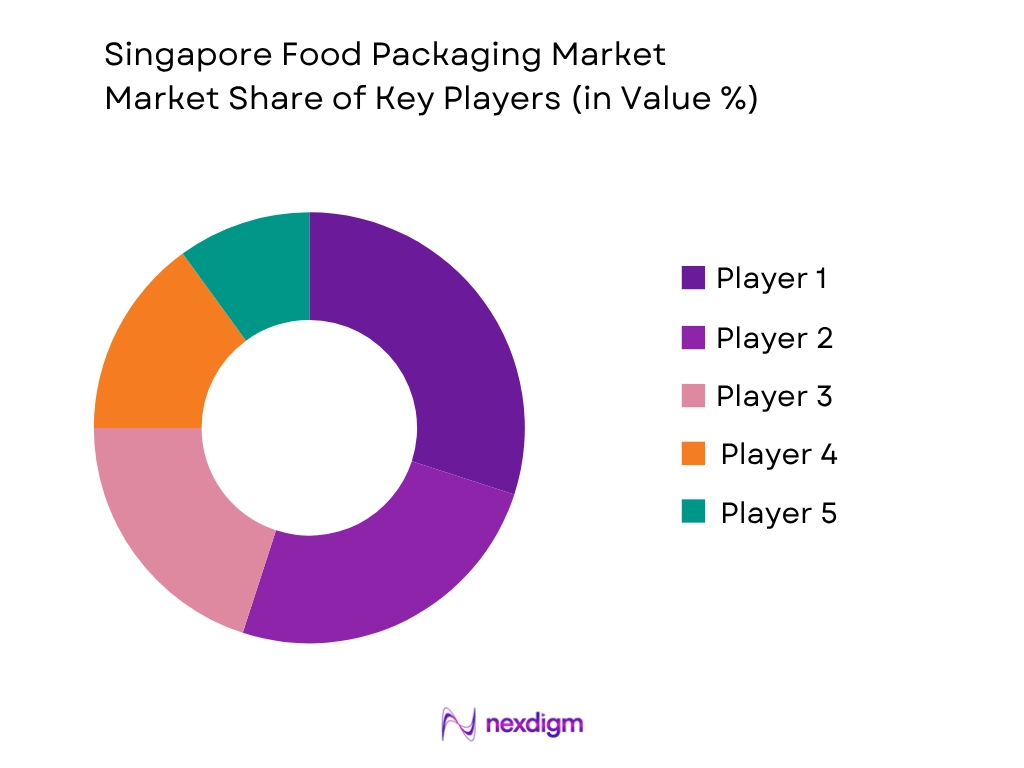
The Singapore Food Packaging Market is moderately fragmented, with established domestic packaging manufacturers operating alongside multinational packaging conglomerates that maintain regional headquarters or distribution operations in the city-state. Competition is primarily based on manufacturing capacity, material innovation, regulatory compliance with NEA’s Mandatory Packaging Reporting and emerging EPR requirements, supply chain reliability given Singapore’s land constraints, and the ability to serve the country’s dense hawker, foodservice, and food delivery ecosystem. MC Packaging Pte Ltd, tracing its origins to the early 1970s, has grown into one of the leading suppliers of metal packaging in Asia, supporting the food and beverage and dairy products industries from its original Gul Circle facility. Ban Teck Han Enterprise, established in 1981, has developed manufacturing bases and distribution centres across both Singapore and Malaysia, positioning the company to serve customers regionally despite Singapore’s limited domestic manufacturing land. Multinational players including Huhtamaki, Sealed Air, and Amcor continue to compete on the strength of global fiber packaging, barrier film, and sustainable packaging portfolios, cited by Mordor Intelligence among the major companies operating across the broader Asia-Pacific food packaging market.
| Company | Establishment Year | Headquarters | Primary Product Portfolio | Food Packaging Portfolio
|
Manufacturing Presence | Major End-Use Industries | Key Strategic Focus | Certifications & Compliance |
| MC Packaging Pte Ltd | 1970 | ~ | ~ | ~ | ~ | ~ | ~ | ~ |
| Ban Teck Han Enterprise | 1981 | ~ | ~ | ~ | ~ | ~ | ~ | ~ |
| Huhtamaki Group | 1920 | ~ | ~ | ~ | ~ | ~ | ~ | ~ |
| Sealed Air Corporation | 1960 | ~ | ~ | ~ | ~ | ~ | ~ | ~ |
| Amcor plc | 1860 | ~ | ~ | ~ | ~ | ~ | ~ | ~ |
Singapore Food Packaging Market Analysis
Growth Drivers
Food Delivery and Hawker Culture Driving Foodservice Packaging Demand
The Singapore Food Packaging Market is experiencing sustained growth due to the country’s deeply embedded food delivery and hawker culture, where food functions as core infrastructure powering the nation’s eating habits through hawker centres, food courts, bubble tea shops, and cafes. The National Environment Agency’s ongoing public consultation on single-use item management specifically targets a broad range of plastic products used in food delivery and takeout services, reflecting the scale of packaging consumption within this channel. As Singapore’s food delivery ecosystem continues to expand alongside its dense network of foodservice outlets, demand for takeaway containers, cups, lids, and delivery-specific packaging formats capable of maintaining food quality and temperature integrity continues to grow, creating sustained demand across both conventional plastic and emerging compostable packaging formats.
NEA Mandatory Packaging Reporting Building Toward Full EPR System
Singapore’s Mandatory Packaging Reporting (MPR) framework, in effect under the Resource Sustainability Act since July 2020, requires companies with annual turnover above S$10 million that import or use packaging in Singapore to record and report detailed packaging data to the National Environment Agency and submit 3R (reduce, reuse, recycle) plans. This reporting regime, developed in partnership with the Singapore Manufacturing Federation through the Packaging Partnership Programme, is explicitly designed to lay the foundation for a broader Extended Producer Responsibility scheme for packaging waste. Regulatory momentum continues to build, with Singapore set to roll out a nationwide beverage container return scheme from April 2026, introducing deposit-refund mechanisms for plastic and metal drink containers, directly creating new demand for compliant container designs and reverse logistics infrastructure across the country’s beverage packaging value chain.
Market Challenges
Impending EPR and Single-Use Packaging Restrictions
The Singapore Food Packaging Market faces increasing regulatory complexity as the National Environment Agency progresses toward implementing a full Extended Producer Responsibility scheme for packaging waste, expected to be introduced alongside new regulatory frameworks governing takeaway packaging materials by 2025. While not expected to be an outright ban, these frameworks are likely to include minimum sustainability requirements, producer responsibility systems, and stricter labeling laws for recyclable or compostable materials, requiring food manufacturers, foodservice operators, and packaging suppliers to reassess product formulations and documentation. Given that requirements in the food sector are much stricter than other categories due to hygiene and food safety considerations, compliance costs are expected to disproportionately affect smaller hawker stalls and independent foodservice operators relative to larger, better-resourced multinational chains.
Land-Scarce Domestic Manufacturing Constraints
Singapore’s limited land area continues to constrain large-scale domestic food packaging manufacturing capacity, requiring companies to adopt regional manufacturing strategies to remain cost-competitive. Ban Teck Han Enterprise’s establishment of manufacturing bases and distribution centres in both Singapore and Malaysia exemplifies this structural adaptation, allowing the company to serve its wide customer base while managing land and labor cost constraints inherent to operating purely within Singapore. This land scarcity creates an inherent dependency on imported packaging materials and components from regional manufacturing hubs, exposing Singapore-based converters and brand owners to cross-border supply chain risk and currency fluctuation, particularly for high-volume commodity packaging formats where domestic production is not economically viable.
Market Opportunities
Compostable and Biodegradable Packaging Innovation
Singapore’s strong research and innovation base presents significant opportunities for compostable and biodegradable food packaging development. In December 2021, a team of scientists from Nanyang Technological University (NTU Singapore) and the Harvard T.H. Chan School of Public Health developed a biodegradable, sustainable food packaging material capable of killing microbes harmful to humans, extending the shelf life of fresh fruit by two to three days. This research illustrates the potential for Singapore-based innovation to address both the National Environment Agency’s sustainability mandates and practical food safety and shelf-life challenges simultaneously, creating opportunities for domestic and multinational packaging companies to commercialize antimicrobial, compostable packaging technologies developed within Singapore’s research ecosystem for both domestic use and regional export.
Beverage Container Deposit-Refund Scheme Creating Reverse Logistics Opportunities
Singapore’s nationwide beverage container return scheme, set to roll out from April 2026 with deposit-refund mechanisms for plastic and metal drink containers, presents substantial opportunities for companies specializing in reverse vending machines, collection infrastructure, and container redesign for recyclability. As beverage manufacturers and packaging suppliers adapt container designs to support efficient collection and processing under the new scheme, opportunities will emerge for material recovery facilities, logistics providers, and packaging engineering firms capable of supporting Singapore’s transition toward a more circular beverage packaging system, consistent with the broader Zero Waste Masterplan’s target of a 70% national recycling rate by 2030.
Future Outlook
The Singapore Food Packaging Market is expected to witness sustained expansion over the forecast period, supported by continued growth in food delivery and foodservice channels, progressive implementation of the country’s EPR framework, and the April 2026 launch of the beverage container return scheme. Continued investment in compostable and antimicrobial packaging innovation, building on Singapore’s strong research base, is expected to strengthen the market’s ability to meet evolving sustainability regulations. The market is also likely to benefit from Singapore’s continued positioning as a regional food packaging trade hub, supporting long-term growth across foodservice, bakery, dairy, beverage, and ready-to-eat food packaging applications.
Major Players
- MC Packaging Pte Ltd
- Ban Teck Han Enterprise
- Huhtamaki Group
- Sealed Air Corporation
- Amcor plc
- Berry Global Inc.
- Crown Holdings Inc.
- Packman SG
- The Packaging People SG
- Sunningdale Tech Ltd
- Tetra Pak International
- Mondi Group
- Sonoco Products Company
- DS Smith
- Genpak Corporation
Key Target Audience
- Food Packaging Manufacturers and Converters
- Food & Beverage Manufacturers
- Foodservice Operators and Hawker Centre Stallholders
- Food Delivery Platforms
- Supermarkets and Retail Chains
- Recycling and Waste Management Companies
- Investment and Venture Capitalist Firms
- Government and Regulatory Bodies (National Environment Agency (NEA), Singapore Manufacturing Federation (SMF), Singapore Food Agency (SFA))
- Raw Material Suppliers and Resin Distributors
Research Methodology
Step 1: Identification of Key Variables
The research process begins with identifying the complete ecosystem of the Singapore Food Packaging Market, including raw material suppliers, packaging manufacturers, converters, brand owners, foodservice operators, and regulatory authorities. Extensive secondary research is conducted using company annual reports, government publications, trade associations, customs statistics, industry journals, and proprietary databases to determine the variables influencing market demand, pricing, production, consumption, and technological developments.
Step 2: Market Analysis and Construction
Historical market information is collected and analyzed to estimate market size, production volumes, import-export activity, application-wise demand, and pricing trends. A combination of top-down and bottom-up approaches is used to estimate market revenues and validate segment-level performance. Consumption patterns across foodservice, bakery, dairy, beverages, and ready-to-eat foods are evaluated to establish an accurate representation of the industry.
Step 3: Hypothesis Validation and Expert Consultation
The preliminary findings are validated through Computer-Assisted Telephone Interviews (CATIs) and structured discussions with food packaging manufacturers, procurement managers, converters, foodservice operators, regulatory experts, and senior executives operating within the Singapore packaging industry. These interviews help verify market assumptions, competitive developments, technology adoption trends, pricing dynamics, and future investment opportunities while refining the overall market estimates.
Step 4: Research Synthesis and Final Output
The final stage integrates insights obtained from primary interviews with quantitative information collected through secondary sources. Data triangulation techniques are applied to reconcile differences between supply-side and demand-side estimates, ensuring robust market forecasting. The report is then reviewed through multiple quality assurance checkpoints to deliver a comprehensive analysis covering market size, segmentation, competitive landscape, future outlook, and strategic recommendations for industry stakeholders.

- Executive Summary
- Research Methodology (Market Definitions and Assumptions, Abbreviations, Market Sizing Approach, Top-Down Analysis, Bottom-Up Analysis, Demand-Side Assessment, Supply-Side Assessment, Primary Industry Interviews, Secondary Research Validation, Data Triangulation, Forecasting Framework, Limitations and Future Conclusions)

- Definition and Scope
- Market Evolution and Industry Genesis
- Timeline of Major Industry Developments
- Food Packaging Industry Value Chain Analysis
- Supply Chain Analysis

- Growth Drivers (Food Delivery and Hawker Culture Driving Foodservice Packaging Demand, NEA Mandatory Packaging Reporting Building Toward Full EPR System, Rising Consumption of Ready-to-Eat Foods, Growth in Modern Retail, Premiumization of Food Products, Regional Export Hub Positioning)
- Market Challenges (Impending EPR and Single-Use Packaging Restrictions, Land-Scarce Domestic Manufacturing Constraints, Import Dependency, High Compliance Costs for SMEs, Regulatory Compliance Complexity)
- Market Opportunities (Compostable and Biodegradable Packaging Innovation, Beverage Container Deposit-Refund Scheme Creating Reverse Logistics Opportunities, Smart Packaging Technologies, Export-Oriented Manufacturing, Recycled-Content Development)
- Market Trends (Shift Toward Compostable Takeaway Packaging, Growth of Reverse Vending Infrastructure, Antimicrobial Packaging Research, Digital Printing Adoption, Circular Economy Partnerships)
- Government Regulations (Resource Sustainability Act, Mandatory Packaging Reporting (MPR), Extended Producer Responsibility (EPR) Framework, Beverage Container Return Scheme, Zero Waste Masterplan)
- Import and Export Analysis (Trade Volume, Major Import Sources, Export Destinations, HS Code Analysis, Trade Balance)
- Raw Material Availability Analysis (Polyethylene, Polypropylene, Paperboard, Aluminum, Recycled PET (rPET))
- Technology Landscape (Barrier Film Technology, Antimicrobial Packaging, Molded Fiber Technology, Digital Printing, Reverse Vending Machine Technology)
- Sustainability Assessment (Recycled Content Adoption, Compostable Material Development, Carbon Footprint Reduction, Circular Economy Partnerships, Waste Valorization)
- PESTLE Analysis
- SWOT Analysis
- Porter’s Five Forces Analysis
- Stakeholder Ecosystem
- Competition Ecosystem

- By Market Value (2020-2025)
- By Volume Consumption (2020-2025)
- By Average Selling Price (2020-2025)

- By Material (In Value %)
Plastic (Rigid & Flexible)
Paper & Paperboard
Metal
Glass - By Packaging Type (In Value %)
Flexible Packaging (Pouches, Films & Bags)
Rigid Packaging (Bottles, Cans, Trays & Containers) - By Application (In Value %)
Ready-to-Eat & Foodservice
Bakery & Confectionery
Dairy Products
Beverages
Meat, Poultry & Seafood
Fruits, Vegetables & Sauces - By Distribution Channel (In Value %)
Supermarkets & Hypermarkets
Foodservice & HORECA
E-Commerce & Food Delivery
Convenience Stores - By End User (In Value %)
Food Manufacturers
Foodservice Operators (Hawker Centres, Restaurants & Cafes)
Food Delivery Platforms
Retailers

- Market Share of Major Players (By Value, Volume, Material, Application Industry, Product Category)
- Cross Comparison Parameters (Product Portfolio Breadth, Barrier Film Capability, Application Technical Support Capability, Manufacturing Capacity, Regulatory Compliance & Certifications, Food & Beverage Customer Base, Innovation & New Product Launch Frequency)
- SWOT Analysis of Major Players
- Pricing Analysis by Product Category and SKU
- Production Capacity Analysis
- Manufacturing Footprint Analysis
- Distribution Network Analysis
- Innovation Benchmarking
- Detailed Profiles of Major Companies
MC Packaging Pte Ltd
Ban Teck Han Enterprise
Huhtamaki Group
Sealed Air Corporation
Amcor plc
Berry Global Inc.
Crown Holdings Inc.
Packman SG
The Packaging People SG
Sunningdale Tech Ltd
Tetra Pak International
Mondi Group
Sonoco Products Company
DS Smith
Genpak Corporation

- Consumption Pattern Analysis (Industrial Usage, Order Size, Product Category Penetration, Seasonal Demand, Reformulation Activity)
- Purchasing Criteria (Barrier Performance, Regulatory Compliance, Cost Efficiency, Recyclability, Shelf Life, Supply Reliability)
- Procurement and Supplier Selection Analysis
- Sustainable Packaging Adoption Assessment
- Premium vs Conventional Packaging Demand
- Product Attribute Preference Analysis (Barrier Consistency, Print Quality, Seal Integrity, Recyclability, Shelf Appeal, Tamper Evidence)
- Consumer Sustainability Preference Influence on Product Development
- Pain Point Analysis
- Decision-Making Process

- By Market Value (2026-2035)
- By Volume Consumption (2026-2035)
- By Average Selling Price (2026-2035)


 Request a Sample
 Ask for Customization
 Get a Quote
 Enquire Now