

 Download PDF
Market Overview
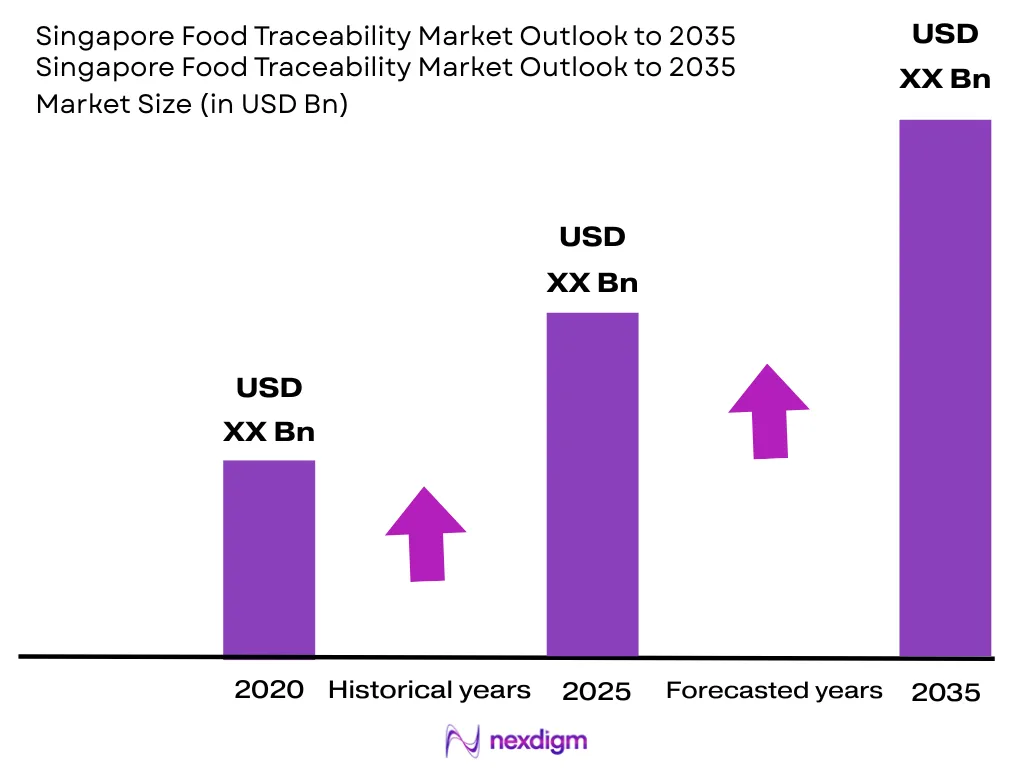
The Singapore Food Traceability Market was valued at USD ~ Billion in 2024 and is anticipated to expand at a CAGR of ~% during 2026–2035. The market is primarily driven by Singapore’s extreme reliance on food imports, sourcing more than 90% of its food supply from over 180 countries, which makes robust digital verification of origin, safety, and authenticity a national food security priority rather than a discretionary compliance exercise. The Singapore Food Agency (SFA), formed in April 2019 by consolidating the food-related functions of the former Agri-Food and Veterinary Authority, the National Environment Agency, and the Health Sciences Authority, oversees this system under its mandate to ensure a resilient supply of safe food from farm to fork. Government-backed programs including the SGD 309 million Singapore Food Story R&D programme launched in 2020 and the Future Ready Food Safety Hub (FRESH), launched in 2021 in partnership with A*STAR and NTU, continue to anchor investment in traceability-enabling food safety science, while GovTech Singapore’s TradeTrust blockchain framework for digital trade documents is increasingly used by both government agencies and private technology providers to digitize the country’s entrepôt food trade.
Market Segmentation
By Technology Type
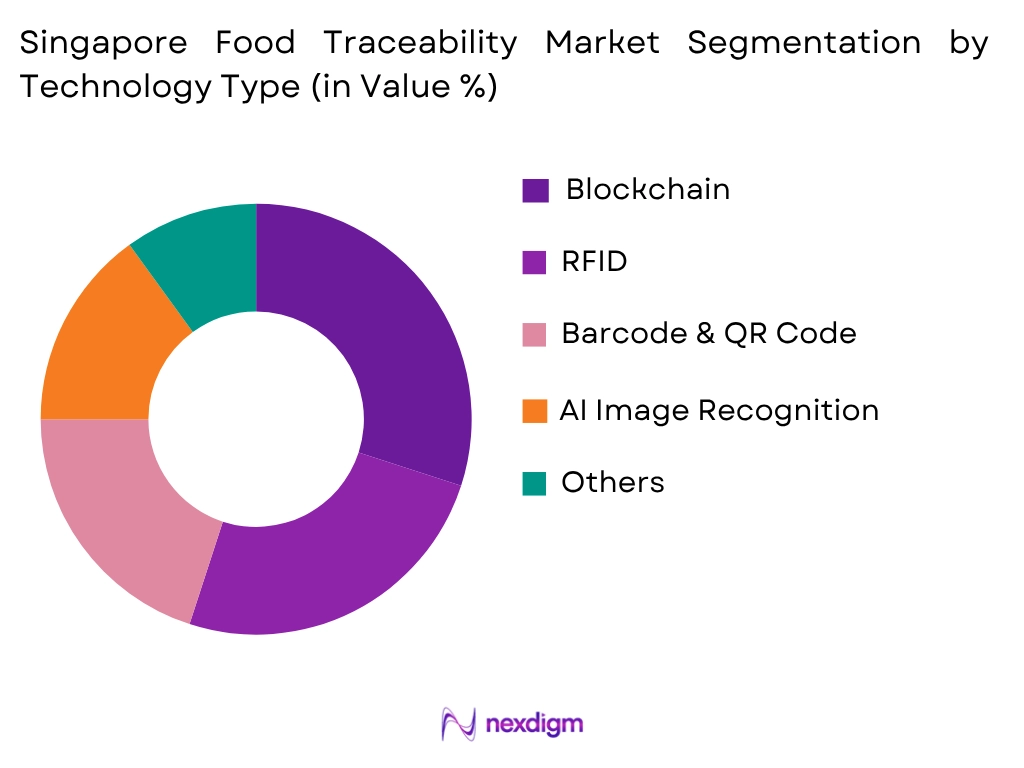
Blockchain holds a rapidly growing share of the Singapore Food Traceability Market, anchored by GovTech Singapore’s TradeTrust, an open-source blockchain-based utility that businesses worldwide can use to create verifiable digital trade documents. Singapore-based agritech DiMuto has built its Track & Trace platform on a combination of blockchain and AI image recognition, tagging and photographing produce at the point of packing to create tamper-proof digital assets; in one notable deployment, DiMuto digitized around four million durians for Thailand’s largest durian exporter, tracking each fruit from farm to distribution across China, Japan, and other Asian markets. AI Image Recognition is an increasingly distinctive feature of Singapore-developed traceability platforms, reflecting the country’s broader strength in applied AI and smart nation technology, while IoT Sensors & Cold-Chain Monitoring remain essential given Singapore’s role as a tropical transshipment hub where maintaining cold-chain integrity for imported perishables is critical to both food safety and quality.
By Application
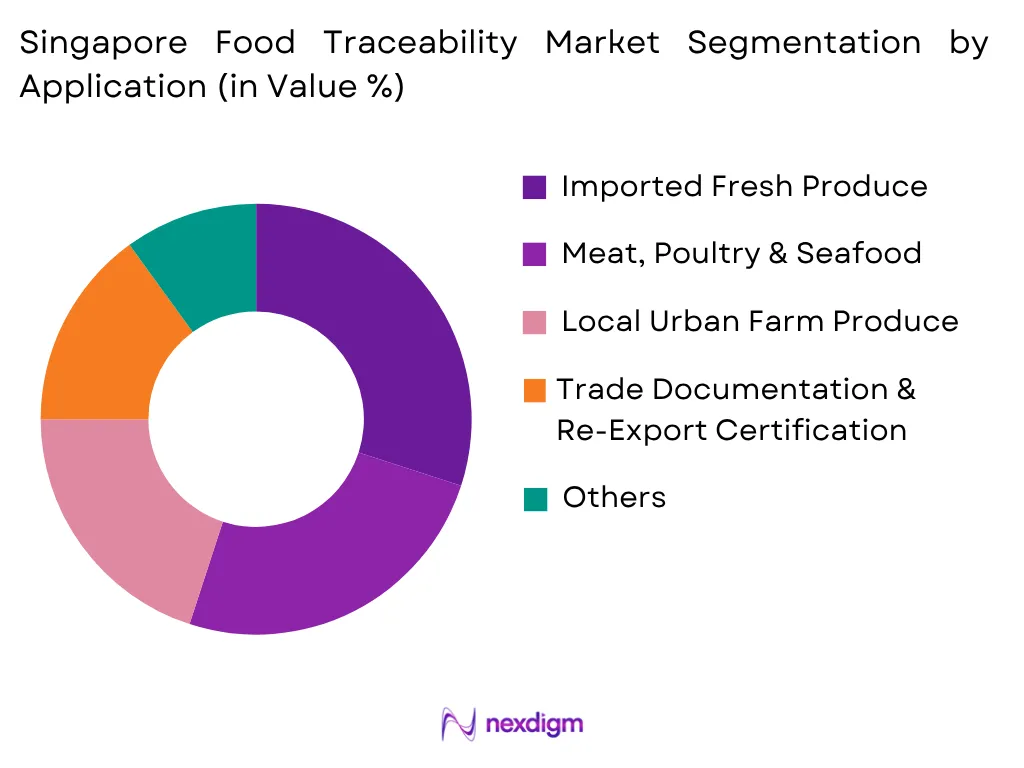
Imported Fresh Produce (Fruits & Vegetables) and Meat, Poultry & Seafood together account for the largest share of the Singapore Food Traceability Market, reflecting the reality that Singapore imports the substantial majority of its food supply and must verify safety and origin at scale; SFA testing has previously identified meaningful shares of imported produce and meat failing quality and safety benchmarks, underscoring the stakes of robust import verification. Trade Documentation & Re-Export Certification represents a distinctive and fast-growing application segment unique to Singapore’s position as a global trade and logistics hub, where blockchain-based digital trade documents reduce the risk of fraud and paperwork delays for goods transiting through the country’s ports. Local Urban Farm Produce and Novel & Cultured Foods remain smaller but strategically important segments, supported by Singapore’s 30 by 30 food security goal and its status as the first country in the world to approve the commercial sale of cultured meat.
Competitive Landscape
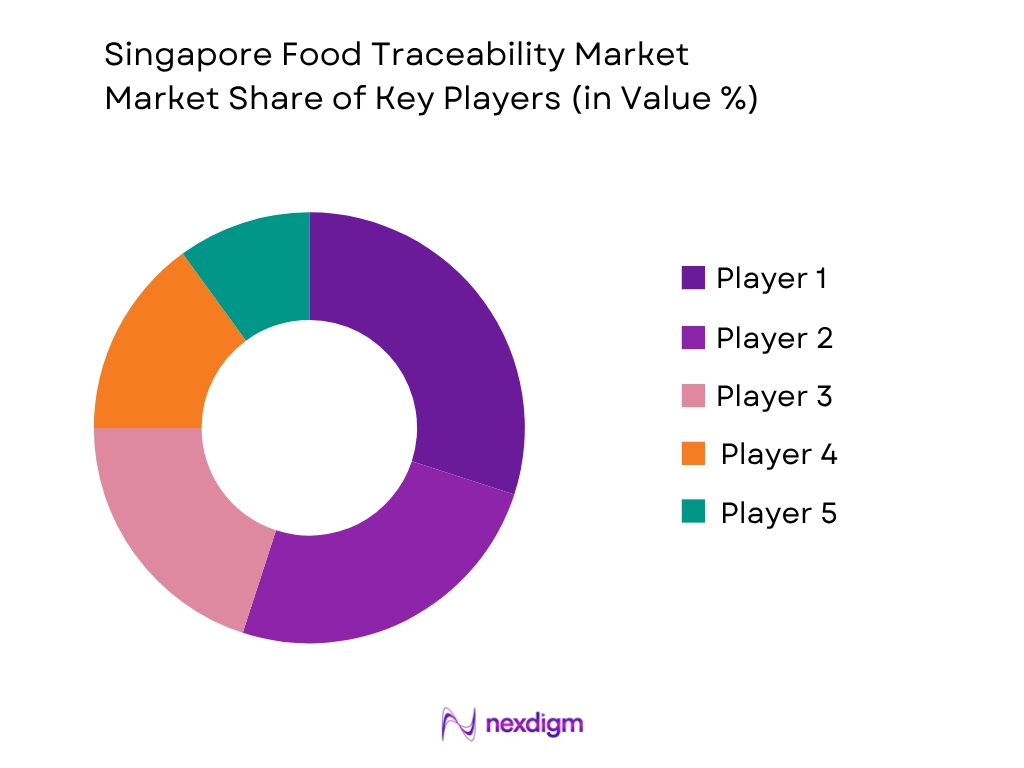
The Singapore Food Traceability Market is shaped by a distinctive combination of homegrown government digital infrastructure, agile local startups, and global technology majors serving the country’s trade and logistics hub role. GovTech Singapore, the lead agency driving the country’s Smart Nation initiative, developed TradeTrust as foundational public digital infrastructure that both government agencies and private companies, including DiMuto, build upon. DiMuto, founded in 2018 and headquartered in Singapore, has established a global network spanning more than seven countries, combining blockchain and AI image analysis to track produce for grower-exporters, traders, and retailers, with notable deployments across Thailand, Indonesia, Australia, and the Americas. ST Engineering has partnered with the Singapore Food Agency on blockchain-enabled food safety initiatives, while global players such as IBM, through its Food Trust platform, and Zebra Technologies, a leading supplier of RFID and barcode scanning hardware, serve Singapore’s food importers and logistics operators as part of their broader Asia-Pacific supply chain technology footprint. Competitive dynamics are increasingly shaped by the ability to integrate with TradeTrust’s national digital trade document standards and to demonstrate compliance-ready verification across Singapore’s more than 180 source countries.
| Company | Establishment Year | Headquarters | Primary Product Portfolio | Traceability Solution Portfolio
|
Deployment Presence | Major End-Use Industries | Key Strategic Focus | Certifications & Compliance |
| DiMuto | 2018 | ~ | ~ | ~ | ~ | ~ | ~ | ~ |
| GovTech Singapore (TradeTrust) | 2016 | ~ | ~ | ~ | ~ | ~ | ~ | ~ |
| ST Engineering | 1997 | ~ | ~ | ~ | ~ | ~ | ~ | ~ |
| IBM | 1911 | ~ | ~ | ~ | ~ | ~ | ~ | ~ |
| Zebra Technologies | 1969 | ~ | ~ | ~ | ~ | ~ | ~ | ~ |
Singapore Food Traceability Market Analysis
Growth Drivers
Extreme Food Import Dependency Elevating Traceability to a National Priority
Singapore’s food traceability market is fundamentally shaped by the country’s reliance on imports for more than 90% of its food supply, sourced from over 180 countries, making verification of origin, safety, and authenticity a matter of national food security rather than discretionary brand assurance. The Singapore Food Agency’s own testing programs have historically identified meaningful failure rates among imported goods; in one nine-month monitoring period, close to 13% of tested fruit and vegetable units failed inspection due to excessive chemical or pesticide residues, while a portion of tested meat products also failed to meet quality guidelines. This scale of import verification, spanning highly heterogeneous exporting countries with varying levels of documentation and regulatory rigor, has made blockchain-based and AI-assisted traceability tools an increasingly central part of Singapore’s food safety infrastructure, administered by the SFA under its mandate to secure a resilient, safe food supply from farm to fork.
Government-Led Blockchain Trade Digitization and Smart Nation Investment
Singapore’s Smart Nation initiative, driven by GovTech Singapore, has produced TradeTrust, an open-source blockchain-based utility for creating verifiable digital trade documents that is now used by businesses globally, including Singapore-based agritech DiMuto. Government funding has been substantial and sustained: the Singapore Food Story R&D programme, jointly developed by the SFA and ASTAR in 2020, carries SGD 309 million in funding directed at aquaculture, urban agriculture, future foods, and food safety research, while the Future Ready Food Safety Hub (FRESH), launched in 2021 with ASTAR and NTU, builds food safety science and risk assessment capabilities to support Singapore’s growing food innovation ecosystem. Singapore’s proactive, risk-based regulatory approach, exemplified by its position as the first country in the world to approve the commercial sale of cultured meat, continues to create favorable conditions for traceability technology providers seeking to pilot novel verification tools within a supportive government framework.
Market Challenges
High Cost and Complexity of Verifying Diverse Source Countries
Sourcing food from more than 180 countries with widely varying levels of digital infrastructure, documentation standards, and regulatory rigor creates substantial complexity for Singapore’s food traceability ecosystem. Industry practitioners have noted that a central limitation in scaling blockchain-based traceability lies in corroborating data recorded on the blockchain with the physical goods it represents in the real world, since blockchain technology itself cannot verify that the underlying physical product genuinely matches its digital record at the point of origin. This challenge is compounded when dealing with smaller, less digitally mature exporting countries or informal supply chains overseas, where the exporting party may lack the infrastructure or incentive to participate fully in Singapore-mandated digital verification systems.
Limited Domestic Production Base Constrains Farm-Level Traceability Scope
Unlike major agricultural exporting nations, Singapore’s minimal land area and correspondingly small domestic agricultural sector mean that food traceability efforts are necessarily weighted toward import verification and trade documentation rather than farm-level production tracking. Even as the country pursues its 30 by 30 goal of producing 30% of its nutritional needs locally by 2030, current local production remains a small fraction of total consumption, limiting the near-term scale of farm-to-fork traceability deployments compared to major food-producing markets. This structural reality requires traceability technology providers operating in Singapore to prioritize interoperability with a wide range of foreign data systems and international logistics networks over the kind of farm-level identification infrastructure that dominates traceability markets in large agricultural exporting countries.
Market Opportunities
Regional Export of Singapore-Developed Blockchain Trade Frameworks
Singapore’s early investment in TradeTrust and related digital trade infrastructure positions the country to export its blockchain trade-document frameworks and expertise across the wider Southeast Asian region as an extension of its long-standing role as a regional trade and logistics hub. DiMuto’s own expansion, from an initial Singapore base to a network spanning more than seven countries with further plans for Europe, Africa, and South America, illustrates the kind of regional and global scaling opportunity available to traceability technology developed and proven within Singapore’s rigorous regulatory environment. As neighboring ASEAN markets face their own rising food safety and export compliance pressures, Singapore-based providers with established TradeTrust integration and blockchain expertise are well positioned to capture cross-border deployment opportunities.
Growth in Local Urban Farming and Novel Food Traceability
Singapore’s 30 by 30 food security goal is driving sustained investment in vertical farming, aquaculture, and other local urban production methods, creating a new and growing addressable market for traceability tools tailored to controlled-environment and non-traditional agriculture. Singapore’s status as the first country to approve the commercial sale of cultured meat, achieved through close collaboration between the SFA and companies such as Eat Just, further signals substantial upside for traceability and safety documentation providers as the cultured and novel food sector scales beyond initial regulatory approval into broader commercial production. The Future Ready Food Safety Hub’s ongoing work on new approach methodologies and risk assessment frameworks for novel foods is expected to generate parallel demand for verification and documentation tools that can keep pace with Singapore’s fast-evolving food innovation landscape.
Future Outlook
The Singapore Food Traceability Market is expected to witness sustained expansion over the forecast period, supported by continued government investment in blockchain trade digitization through TradeTrust, ongoing food safety science funding under the Singapore Food Story programme and FRESH, and Singapore’s persistent structural reliance on food imports from a highly diverse base of source countries. Growing investment in local urban farming and cultured food production under the 30 by 30 goal, alongside the country’s expanding role as a regional blockchain and digital trade hub, will further diversify demand for traceability solutions beyond pure import verification. The market is also likely to benefit from Singapore-developed technology providers scaling their platforms regionally and globally, exporting the country’s rigorous, government-backed approach to food traceability to other markets across Asia and beyond.
Major Players
- DiMuto
- GovTech Singapore (TradeTrust)
- ST Engineering
- IBM
- Zebra Technologies
- NULS
- SGInnovate-Backed AgriTech Ventures
- SAP SE
- Microsoft
- Thermo Fisher Scientific
- C.H. Robinson
- Bureau Veritas
- SGS
- Wilmar International
- Olam Agri
Key Target Audience
- Food Traceability Technology Providers
- Food Importers and Trading Companies
- Food Processors and Manufacturers
- Retailers and Supermarket Chains
- Urban and Local Farm Operators
- Investment and Venture Capitalist Firms
- Government and Regulatory Bodies (Singapore Food Agency – SFA, GovTech Singapore, Agency for Science, Technology and Research – A*STAR)
- Logistics Providers and Port Authorities
Research Methodology
Step 1: Identification of Key Variables
The research process begins with identifying the complete ecosystem of the Singapore Food Traceability Market, including blockchain and digital trade document providers, food importers, processors, retailers, logistics operators, and regulatory authorities. Extensive secondary research is conducted using company reports, government publications, trade associations, customs statistics, industry journals, and proprietary databases to determine the variables influencing market demand, pricing, deployment, adoption, and technological developments.
Step 2: Market Analysis and Construction
Historical market information is collected and analyzed to estimate market size, deployment volumes, application-wise demand, and pricing trends. A combination of top-down and bottom-up approaches is used to estimate market revenues and validate segment-level performance. Adoption patterns across imported produce, meat, dairy, local urban farm output, and trade documentation applications are evaluated to establish an accurate representation of the industry.
Step 3: Hypothesis Validation and Expert Consultation
The preliminary findings are validated through Computer-Assisted Telephone Interviews (CATIs) and structured discussions with technology distributors, import compliance managers, food safety experts, regulatory officials, and senior executives operating within the Singapore food and logistics industry. These interviews help verify market assumptions, competitive developments, technology adoption trends, pricing dynamics, and future investment opportunities while refining the overall market estimates.
Step 4: Research Synthesis and Final Output
The final stage integrates insights obtained from primary interviews with quantitative information collected through secondary sources. Data triangulation techniques are applied to reconcile differences between supply-side and demand-side estimates, ensuring robust market forecasting. The report is then reviewed through multiple quality assurance checkpoints to deliver a comprehensive analysis covering market size, segmentation, competitive landscape, future outlook, and strategic recommendations for industry stakeholders.

- Executive Summary
- Research Methodology (Market Definitions and Assumptions, Abbreviations, Market Sizing Approach, Top-Down Analysis, Bottom-Up Analysis, Demand-Side Assessment, Supply-Side Assessment, Primary Industry Interviews, Secondary Research Validation, Data Triangulation, Forecasting Framework, Limitations and Future Conclusions)

- Definition and Scope
- Market Evolution and Industry Genesis
- Timeline of Major Industry Developments
- Food Traceability Industry Value Chain Analysis
- Supply Chain Analysis

- Growth Drivers (Extreme Food Import Dependency, Government-Led Blockchain Trade Digitization, Rising Food Safety Testing and Enforcement, Growth of Novel and Cultured Foods, Smart Nation Digital Infrastructure Investment, Consumer Demand for Import Provenance)
- Market Challenges (High Cost and Complexity of Verifying 180+ Source Countries, Limited Domestic Production Base, Data Standardization Across Disparate National Systems, Corroborating Digital Records with Physical Goods, Fragmented Adoption Among Small Importers, Interoperability Between Public and Private Platforms)
- Market Opportunities (Regional Export of Singapore-Developed Blockchain Frameworks, Growth in Local Urban Farming and Aquaculture Traceability, Cultured and Novel Food Safety Documentation, Trade Finance-Linked Traceability Platforms, Public-Private Traceability Partnerships, ASEAN Digital Trade Hub Positioning)
- Market Trends (Rise of Blockchain-Based Digital Trade Documents, AI Image Recognition for Produce Verification, Integration of Traceability with Trade Financing, Consolidation of Traceability Platforms, Government-Backed Food Safety Digitization, Growing Use of Consumer-Facing QR Code Transparency)
- Government Regulations (Singapore Food Agency (SFA) Import and Licensing Requirements, Sale of Food Act, Food Regulations, Environmental Public Health Act, GovTech TradeTrust Digital Trade Document Standards, 30 by 30 Food Security Policy)
- Import and Export Analysis (Trade Volume, Major Import Source Countries, Re-Export Trade Flows, HS Code Analysis, Trade Balance)
- Technology Infrastructure Availability Analysis (Blockchain Platform Availability, National Digital Trade Infrastructure, Cold-Chain and IoT Sensor Availability, Cloud Computing Infrastructure, Port and Logistics Digital Connectivity)
- Technology Landscape (Blockchain Platforms, AI Image Recognition and Analytics, IoT Cold-Chain Monitoring, Digital Trade Document Frameworks, Cloud-Based Traceability Platforms)
- Sustainability Assessment (Food Waste Reduction Through Traceability, Local Urban Farm Carbon Footprint Tracking, Supply Chain Resilience Planning, Novel Food Safety Verification, Circular Economy Alignment)
- PESTLE Analysis
- SWOT Analysis
- Porter’s Five Forces Analysis
- Stakeholder Ecosystem
- Competition Ecosystem

- By Market Value (2020-2025)
- By Volume of Deployments (2020-2025)
- By Average Selling Price (2020-2025)

- By Technology (In Value %)
Blockchain
RFID (Radio Frequency Identification)
Barcode & QR Code
IoT Sensors & Cold-Chain Monitoring
AI Image Recognition - By Component (In Value %)
Hardware
Software
Services - By Application (In Value %)
Imported Fresh Produce (Fruits & Vegetables)
Meat, Poultry & Seafood
Dairy & Processed Foods
Local Urban Farm Produce (Vertical Farming & Aquaculture)
Novel & Cultured Foods
Trade Documentation & Re-Export Certification - By End User (In Value %)
Food Importers & Trading Companies
Food Processors & Manufacturers
Retailers & Supermarkets
Government & Regulatory Agencies
Urban & Local Farm Operators - By Region (In Value %)
Central Region
East Region
West Region
North Region
North-East Region

- Market Share of Major Players (By Value, Deployment Volume, Technology Type, Application Industry, Product Category)
- Cross Comparison Parameters (Blockchain Platform Capability, AI/Image Recognition Integration, Trade Document Digitization Capability, Application Technical Support, Deployment Scale, Regulatory Compliance & Certifications, Customer Base, Innovation & New Product Launch Frequency)
- SWOT Analysis of Major Players
- Pricing Analysis by Solution Type and Application
- Deployment Capacity Analysis
- Geographic Footprint Analysis
- Distribution and Partnership Network Analysis
- Innovation Benchmarking
- Detailed Profiles of Major Companies
DiMuto
GovTech Singapore (TradeTrust)
ST Engineering
IBM
Zebra Technologies
NULS
SGInnovate-Backed AgriTech Ventures
SAP SE
Microsoft
Thermo Fisher Scientific
C.H. Robinson
Bureau Veritas
SGS
Wilmar International
Olam Agri

- Consumption Pattern Analysis (Platform Usage Intensity, Deployment Scale, Application Penetration, Seasonal Demand, Import Verification Volume)
- Purchasing Criteria (Regulatory Compliance, Data Accuracy, Cost Efficiency, System Interoperability, Speed of Customs Clearance, Audit Readiness)
- Procurement and Supplier Selection Analysis
- Blockchain and Digital Trade Document Adoption Assessment
- Premium Import-Grade vs Standard-Grade Traceability Demand
- Product Attribute Preference Analysis (Data Immutability, Real-Time Visibility, Integration Capability, Reporting Accuracy, Certification Compatibility, Cross-Border Interoperability)
- Sustainability & ESG Influence on Procurement Decisions
- Pain Point Analysis
- Decision-Making Process

- By Market Value (2026-2035)
- By Volume of Deployments (2026-2035)
- By Average Selling Price (2026-2035)


 Request a Sample
 Ask for Customization
 Get a Quote
 Enquire Now