
 Download PDF
Market Overview
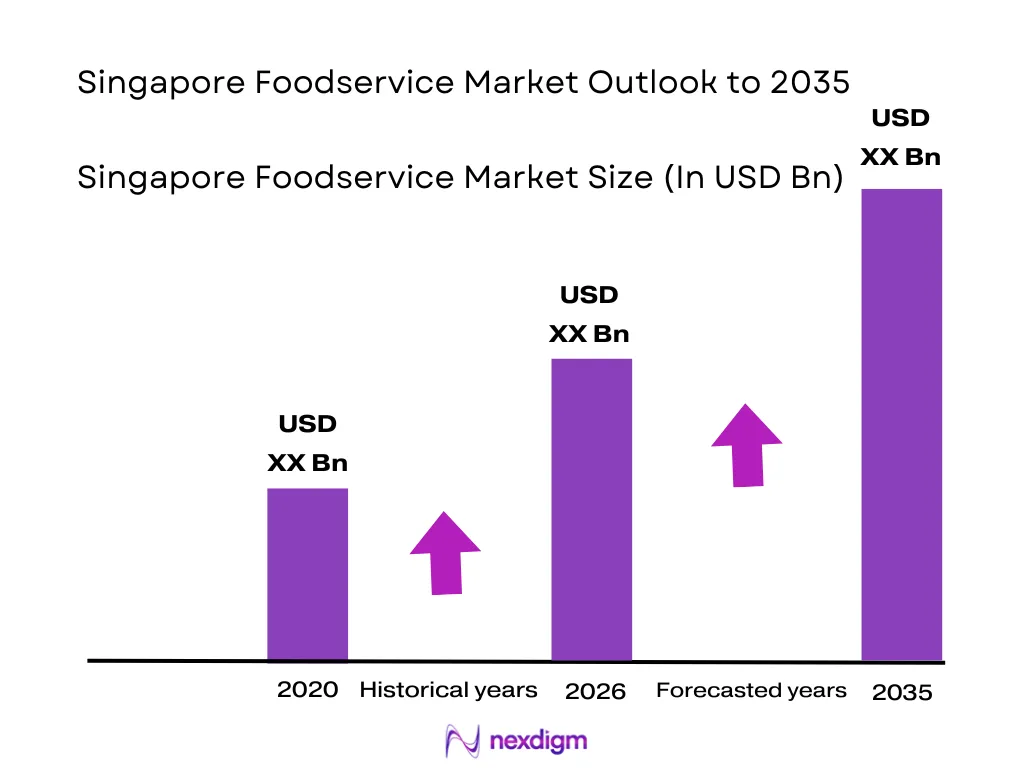
The Singapore Foodservice Market is supported by strong tourism activity, high urban consumer spending, and rapid adoption of digital food ordering ecosystems. The market generated nearly USD ~ billion in revenue, driven by increasing demand for convenienc -oriented dining, premium experiential restaurants, and app-based food delivery services. More than 16 million international visitors and over 67 million airport passenger movements strengthened demand across restaurants, cafés, and transit dining outlets. Cloud kitchens, quick-service restaurant expansion, and contactless ordering technologies continue improving consumer accessibility and operational efficiency across Singapore’s highly urbanized foodservice ecosystem.
Central Singapore dominates the Singapore Foodservice Market due to its concentration of office districts, luxury retail hubs, tourism infrastructure, and premium hospitality establishments. Areas such as Marina Bay, Orchard Road, Clarke Quay, and Sentosa attract substantial dining traffic because of higher tourist activity, integrated resorts, and nightlife-driven food consumption. Changi Airport remains a major foodservice demand center due to strong transit passenger volumes and international tourism recovery. Residential districts across East and North-East Singapore are also witnessing rapid growth in food delivery demand because of increasing digital ordering adoption and rising dual-income urban households.
Market Segmentation
By Foodservice Format
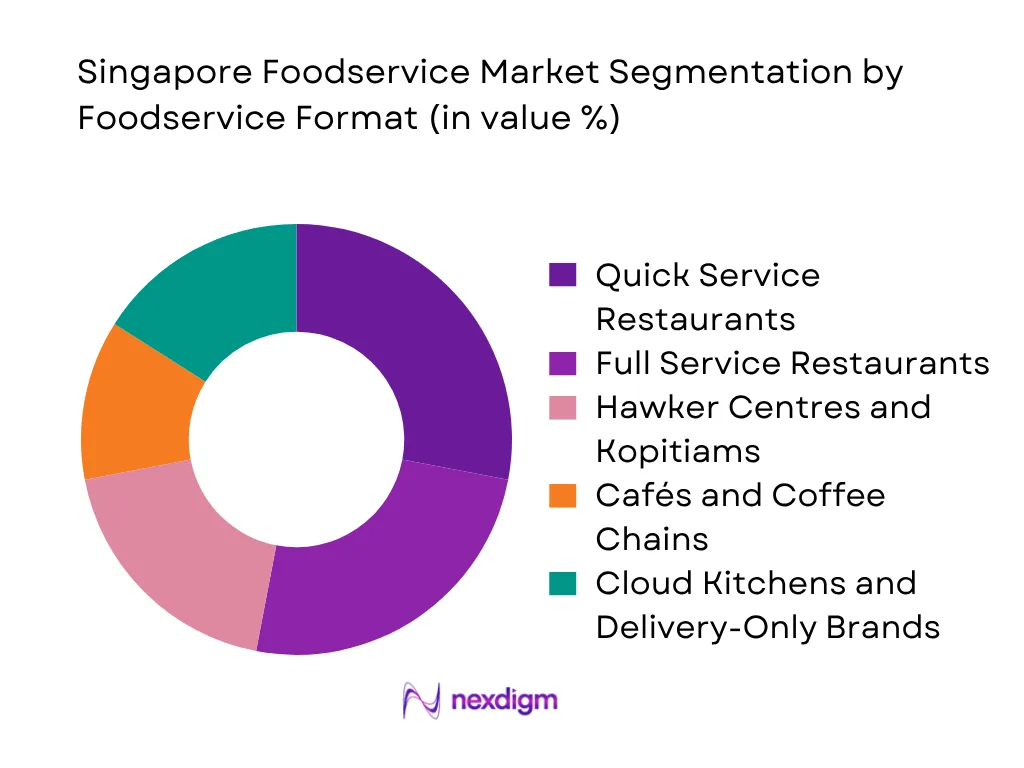
The Singapore Foodservice Market is segmented by foodservice format into quick service restaurants, full service restaurants, cafés and coffee chains, hawker centres and kopitiams, cloud kitchens and delivery-only brands, bakery and dessert chains, and institutional catering. Quick service restaurants dominate the Singapore Foodservice Market under the foodservice format segmentation due to their affordability, convenience, and extensive integration with food delivery platforms. Urban consumers increasingly prefer fast meal fulfilment because of long working hours and busy lifestyles. The segment benefits from strong outlet density across malls, transport hubs, and residential districts, enabling higher transaction frequency and stronger accessibility. Self-order kiosks, contactless payment systems, and app-based loyalty programs continue improving customer retention and operational efficiency. In addition, quick service restaurant operators maintain strong delivery partnerships with aggregator platforms, enabling faster fulfilment and higher digital order penetration. The format also benefits from lower average dining costs compared to premium restaurants, making it highly attractive for office workers, students, and transit consumers across Singapore’s densely populated urban ecosystem.
By Cuisine Type
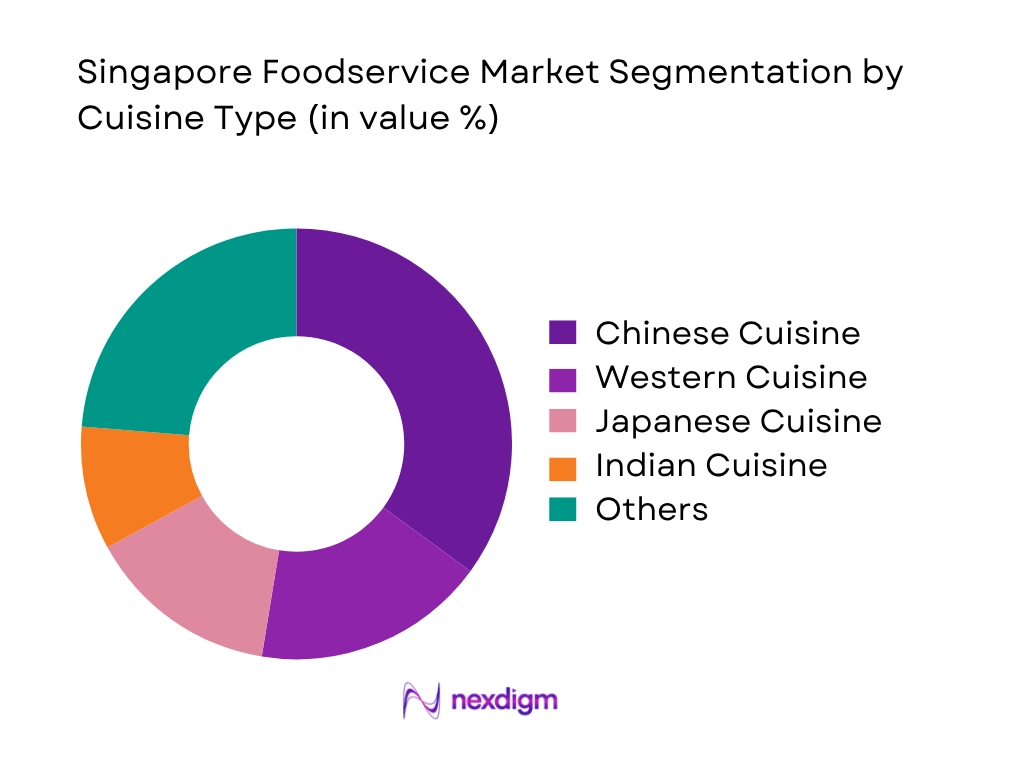
The Singapore Foodservice Market is segmented by cuisine type into Chinese cuisine, Western cuisine, Japanese cuisine, Indian cuisine, Korean cuisine, Malay cuisine, Thai and Vietnamese cuisine, and fusion Asian cuisine. Chinese cuisine dominates the Singapore Foodservice Market under the cuisine segmentation because of its strong cultural integration, high consumer familiarity, and extensive representation across hawker centres, casual dining outlets, and premium restaurants. Consumers frequently associate Chinese cuisine with daily dining occasions, family gatherings, and festive consumption, resulting in consistently high transaction volumes across multiple price categories. The segment benefits from broad menu diversity including noodle dishes, roasted meat, seafood, dim sum, and hotpot concepts, enabling stronger demographic appeal. Chinese cuisine operators also maintain extensive penetration within food delivery platforms because menu items are highly compatible with takeaway and delivery formats. In addition, the multicultural consumer base in Singapore supports wider acceptance of regional Chinese dining variations, strengthening the cuisine’s dominance across both local residents and international tourists visiting major commercial and hospitality districts.
Competitive Landscape
The Singapore Foodservice Market is moderately consolidated with large multinational restaurant chains, regional foodservice operators, food delivery aggregators, and institutional catering providers competing for urban consumer spending. Major operators are strengthening market positioning through digital ordering integration, menu innovation, premium dining experiences, and expansion of delivery-focused formats. The market is also witnessing increasing investment in cloud kitchens, automation technologies, and AI-based operational systems to improve productivity and customer retention. Companies with diversified cuisine portfolios, strong delivery infrastructure, and high outlet density continue maintaining competitive advantages within Singapore’s rapidly evolving foodservice ecosystem.
| Company | Establishment Year | Headquarters | Core Segment | Outlet Presence | Delivery Integration | Digital Ordering Capability | Expansion Strategy | Operational Strength |
| McDonald’s | 1940 | Chicago, USA | Quick Service Restaurant | ~ | ~ | ~ | ~ | ~ |
| Koufu Group | 2002 | Singapore | Hawker and Food Court Operations | ~ | ~ | ~ | ~ | ~ |
| BreadTalk Group | 2000 | Singapore | Bakery and Café Chains | ~ | ~ | ~ | ~ | ~ |
| Grab Holdings | 2012 | Singapore | Food Delivery Aggregator | ~ | ~ | ~ | ~ | ~ |
| SATS Ltd. | 1972 | Singapore | Institutional Catering | ~ | ~ | ~ | ~ | ~ |
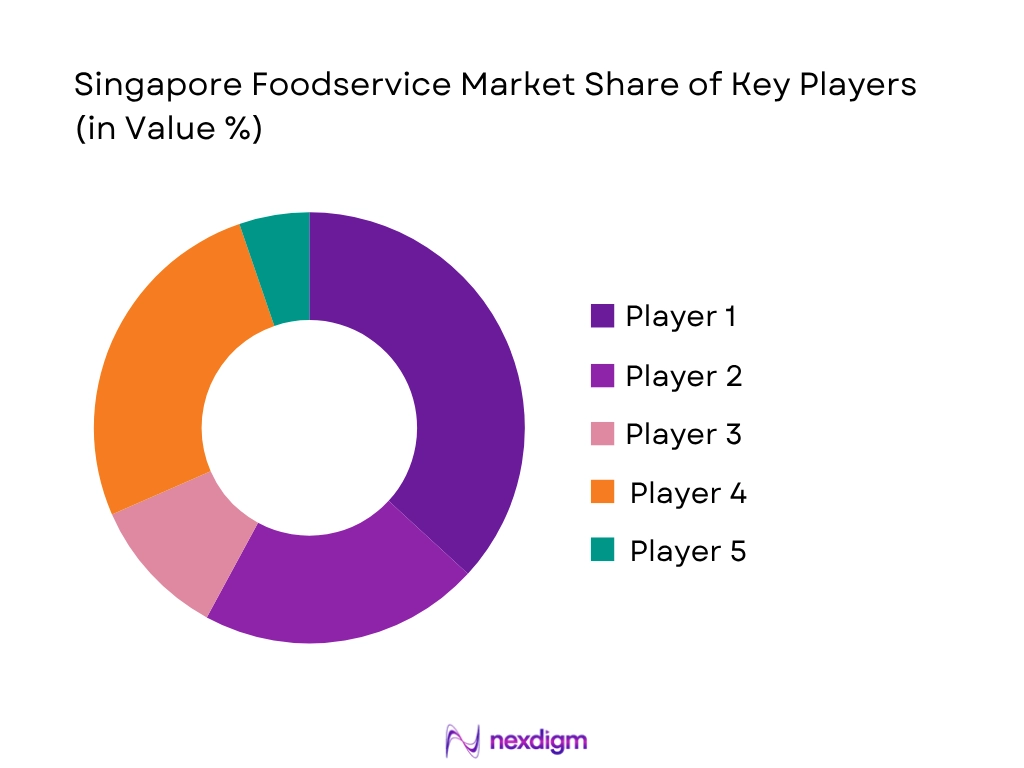
Singapore Foodservice Market Analysis
Growth Drivers
Rising International Tourism and Hospitality Consumption
Singapore’s foodservice industry is strongly supported by increasing international tourism and hospitality-linked dining expenditure. International visitor arrivals exceeded 16 million while airport passenger movements crossed 67 million, strengthening demand across restaurants, cafés, airport dining outlets, and integrated resorts. Hotel room revenue exceeded SGD 5 billion, reflecting higher spending across hospitality foodservice operations. Strong GDP per capita levels above USD 89,000 continue supporting premium dining consumption and discretionary food spending. Tourism clusters such as Marina Bay, Orchard Road, and Sentosa generate high restaurant traffic because of integrated entertainment, nightlife, and luxury retail concentration. Cruise tourism and business travel activities further strengthen demand for quick-service and premium dining formats.
Expansion of Digital Ordering and Food Delivery Ecosystem
Singapore’s advanced digital infrastructure and high internet penetration continue driving growth in app-based food ordering and delivery services. Internet penetration exceeded 96% while smartphone subscriptions crossed 9 million, supporting strong adoption of mobile food ordering applications and digital payment ecosystems. Digital payment transactions exceeded 5 billion annually, accelerating adoption of QR payments and contactless restaurant transactions. Long working-hour urban lifestyles and high employed population levels continue increasing demand for convenience-based dining formats such as takeaway and delivery. Dense urban infrastructure also enables efficient last-mile delivery fulfilment, improving order speed and customer satisfaction across foodservice operators integrated with digital ordering platforms.
Market Challenges
High Labor Dependency and Workforce Constraints
Singapore’s foodservice market faces operational pressure due to labor shortages, rising wage structures, and dependency on foreign workforce hiring. Employment within accommodation and foodservice sectors exceeded 250,000 workers, while vacancy rates across food preparation and service occupations remained elevated. Tight labor market conditions and foreign worker restrictions continue increasing staffing challenges for restaurants and catering providers. Median monthly wages exceeded SGD 5,500, raising manpower-related operational costs for outlet operators. Aging demographics and lower workforce availability are further impacting service efficiency, operating hours, and expansion capabilities, particularly among small independent restaurants and traditional hawker operators lacking automation infrastructure.
Rising Food Inflation and Import Dependency
Singapore imports over 90% of its food supply, exposing the foodservice industry to global commodity price fluctuations and logistics disruptions. Elevated food inflation and imported raw material costs continue affecting restaurant profitability across meat, seafood, edible oil, dairy, and vegetable categories. Merchandise import expenditure exceeded SGD 600 billion, reflecting strong dependency on international supply chains and imported food commodities. Shipping disruptions and energy market instability continue increasing logistics and warehousing expenses for foodservice operators. Smaller restaurant operators face higher vulnerability because of limited procurement bargaining power and reduced flexibility in adjusting menu pricing within Singapore’s highly competitive dining environment.
Market Opportunities
Growth of Cloud Kitchens and Delivery-Only Infrastructure
Singapore’s dense urban population and advanced digital ecosystem create strong opportunities for cloud kitchens and delivery-only restaurant models. Nationwide connectivity coverage exceeded 99%, supporting seamless digital ordering and app-based meal fulfilment. Increasing demand for convenience-led dining and limited commercial space availability encourage operators to adopt delivery-focused kitchen infrastructure instead of traditional dine-in formats. Central business districts and residential clusters continue generating high food delivery traffic because of busy urban lifestyles and increasing dual-income households. AI-based delivery routing systems, centralized commissary kitchens, and virtual restaurant concepts continue improving operational scalability and order fulfilment efficiency for foodservice operators.
Rising Demand for Sustainable and Health-Focused Dining
Increasing public focus on wellness, preventive healthcare, and sustainable food consumption is creating strong growth opportunities within Singapore’s foodservice market. Healthcare expenditure exceeded SGD 18 billion, strengthening consumer awareness regarding healthier eating habits and nutritional lifestyles. Government initiatives promoting food resilience and urban farming continue encouraging restaurants to adopt locally sourced ingredients and sustainable menu concepts. Sustainability regulations around food waste reduction and eco-friendly packaging are also accelerating adoption of recyclable packaging and environmentally responsible dining operations. Higher-income urban consumers increasingly prefer plant-based meals, low-calorie menus, and organic food offerings, creating long-term growth opportunities for health-focused restaurant concepts.
Future Outlook
The Singapore Foodservice Market is expected to witness significant transformation over the coming years due to rising digital food consumption, increasing tourism activity, and expansion of convenience-oriented dining models. Growing adoption of cloud kitchens, AI-enabled kitchen management systems, and automated food preparation technologies is expected to improve operational efficiency across restaurants and delivery-focused operators. Premium dining experiences, specialty cafés, and sustainable food concepts are also expected to gain stronger traction among urban consumers. The expansion of digital ordering ecosystems and loyalty-based delivery platforms is likely to increase transaction frequency and customer retention across quick-service restaurants and cafés. Foodservice operators are expected to focus increasingly on health-focused menu innovation, eco-friendly packaging, and halal-certified dining concepts to capture evolving consumer preferences. Investments in robotics, smart kitchens, and centralized commissary operations are also expected to strengthen long-term scalability and profitability across Singapore’s foodservice ecosystem.
Major Players
- McDonald’s
- Koufu Group
- BreadTalk Group
- Jollibee Foods Corporation
- Starbucks
- Yum! Brands
- Grab Holdings
- Foodpanda
- Deliveroo
- Paradise Group
- Din Tai Fung
- The Soup Spoon
- Minor Food Group
- SATS Ltd.
- Compass Group
Key Target Audience
- Restaurant Chain Operators
- Cloud Kitchen and Delivery-Only Brand Operators
- Food Delivery Aggregators and Technology Platforms
- Commercial Kitchen Equipment Manufacturers
- Hospitality and Integrated Resort Operators
- Institutional Catering and Facility Management Companies
- Investments and Venture Capitalist Firms
- Government and Regulatory Bodies
Research Methodology
Step 1: Identification of Key Variables
The initial phase involved identifying critical variables influencing the Singapore Foodservice Market, including tourism activity, digital food ordering adoption, outlet density, consumer dining frequency, and delivery ecosystem penetration. Extensive secondary research was conducted using government databases, foodservice publications, hospitality reports, and operational disclosures to understand market structure and value chain dynamics.
Step 2: Market Analysis and Construction
Historical market analysis was conducted through assessment of restaurant transaction volumes, consumer spending behaviour, food delivery activity, and hospitality-linked dining demand. Revenue estimations were derived through bottom-up calculations based on foodservice formats, cuisine penetration, outlet distribution, and regional consumption patterns across Singapore.
Step 3: Hypothesis Validation and Expert Consultation
Preliminary findings were validated through interviews with restaurant operators, catering companies, food delivery executives, franchise owners, and commercial kitchen solution providers. These consultations provided operational insights regarding digital ordering trends, labor challenges, customer preferences, and future expansion strategies across Singapore’s foodservice industry.
Step 4: Research Synthesis and Final Output
The final phase involved consolidating qualitative and quantitative findings to generate a comprehensive market assessment. Cross-validation was conducted using trade statistics, hospitality indicators, tourism activity data, and operator-level disclosures to ensure consistency and reliability of market estimates, segmentation analysis, and future outlook projections.

- Executive Summary
- Research Methodology (Market Definitions and Assumptions, Abbreviations, Research Framework, Bottom-Up Market Estimation, Top-Down Validation, Consumer Spending Mapping, Outlet Density Analysis, Food Delivery Ecosystem Assessment, Primary Interviews with Restaurant Operators and Aggregators, Forecasting Model, Limitations and Assumptions)

- Definition and Scope
- Evolution of Singapore’s Foodservice Industry
- Industry Ecosystem and Stakeholder Mapping
- Supply Chain and Value Chain Analysis
- Commercial Kitchen and Commissary Ecosystem
- Food Delivery and Aggregator Landscape

- Growth Drivers
Rising International Tourism and Hospitality Consumption
Expansion of Digital Ordering and Food Delivery Ecosystem
Growth in Premium Experiential Dining
Increasing Urban Convenience Consumption
Expansion of Franchise-Led Restaurant Chains - Market Challenges
High Labor Dependency and Workforce Constraints
Rising Food Inflation and Import Dependency
High Commercial Rental Costs
Aggregator Commission Pressure on Restaurant Margins
Food Safety and Regulatory Compliance Complexity - Market Opportunities
Growth of Cloud Kitchens and Delivery-Only Infrastructure
Rising Demand for Sustainable and Health-Focused Dining
Expansion of AI-Driven Smart Kitchens
Growth in Halal and Muslim-Friendly Foodservice
Increasing Adoption of Automation and Robotics in Restaurants - Market Trends
QR-Based Ordering and Contactless Dining
Premium Café and Specialty Beverage Expansion
Rise of Virtual Restaurant Brands
Sustainable Packaging Adoption
Subscription-Based Meal Plans
Kitchen Automation and Robotics Integration - Government Regulations
Singapore Food Agency Food Licensing Standards
Halal Certification Compliance Framework
Food Hygiene and Safety Regulations
Foreign Workforce and Employment Policies
Food Waste Management and Sustainability Regulations - Porter’s Five Forces Analysis
- PESTLE Analysis
- Pricing Analysis
- Competition Ecosystem

- By Revenue, 2020-2025
- By Transaction Volume, 2020-2025
- By Number of Foodservice Outlets, 2020-2025
- By Average Ticket Size, 2020-2025
- By Online Food Delivery GMV, 2020-2025

- By Foodservice Format (in Value %)
Outlet Density
Average Ticket Size
Consumer Footfall
Delivery Penetration Rate - By Cuisine Type (in Value %)
Consumer Preference
Dining Frequency
Average Spend per Visit
Menu Penetration - By Service Model (in Value %)
Order Fulfilment Time
Delivery Adoption
Convenience Usage
Transaction Frequency - By Location Type (in Value %)
Footfall Density
Rental Yield
Tourist Traffic
Commercial Occupancy - By Ordering Platform (in Value %)
Digital Ordering Penetration
Monthly Active Users
Order Frequency
Platform Retention Rate - By Consumer Demographics (in Value %)
Per Capita Dining Spend
Dining-Out Frequency
Digital Payment Adoption
Lifestyle Spending Behaviour - By Price Positioning (in Value %)
Average Spend per Pax
Premium Dining Penetration
Discount Sensitivity
Consumer Affordability - By Region (in Value %)
Central Singapore
East Singapore
North Singapore
North-East Singapore
West Singapore

- Market Share Analysis of Major Players on the Basis of Revenue and Outlet Presence
- Cross Comparison Parameters (Company Overview, Cuisine Portfolio Breadth, Number of Outlets, Delivery Integration Strength, Average Ticket Size, Digital Ordering Capability, Kitchen Automation Adoption, Loyalty Program Strength, Foodservice Partnerships, Expansion Strategy, Operational Efficiency, Customer Ratings, Sustainability Initiatives, Menu Innovation, Regional Presence, Profitability Margins)
- Competitive Benchmarking Matrix
- SWOT Analysis of Major Players
- Pricing Analysis by Foodservice Format and Cuisine Category
- Detailed Profiles of Major Companies
McDonald’s
Koufu Group
BreadTalk Group
Jollibee Foods Corporation
Starbucks
Yum! Brands
Grab Holdings
foodpanda
Deliveroo
Paradise Group
Din Tai Fung
The Soup Spoon
Minor Food Group
SATS Ltd.
Compass Group

- Consumption Frequency Analysis
- Consumer Spending and Basket Analysis
- Dining Preference Mapping
- Digital Ordering Behaviour
- Customer Retention and Loyalty Analysis
- Purchase Decision Parameters

- By Revenue, 2026-2035
- By Transaction Volume, 2026-2035
- By Number of Foodservice Outlets, 2026-2035
- By Average Ticket Size, 2026-2035
- By Online Food Delivery GMV, 2026-2035


 Request a Sample
 Ask for Customization
 Get a Quote
 Enquire Now