
 Download PDF
Market Overview
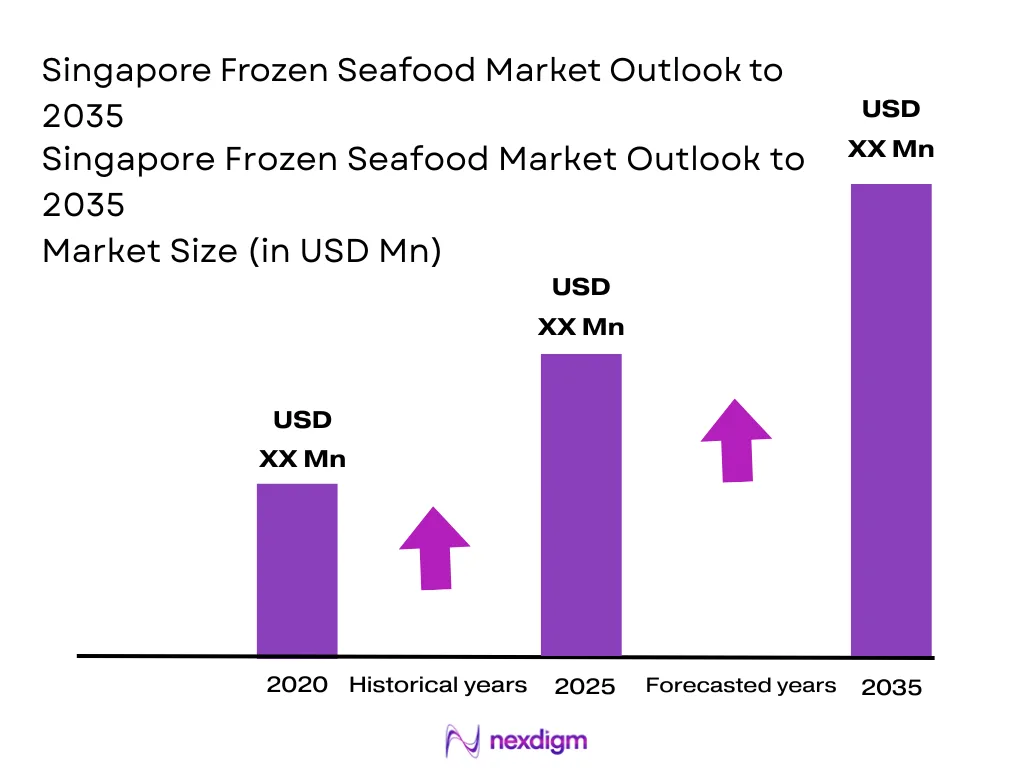
Singapore Frozen Seafood Market is estimated at USD ~ million, normalized from a published USD 160.88 million country benchmark. Demand is driven by frozen salmon, cod, prawns, scallops, crab, lobster, squid, surimi products and ready-to-cook seafood. Singapore imports more than 90% of its food and maintains food sources from 187 countries/regions. Local seafood production fell by 14%, with productivity moving from 38.6 tonnes per hectare to 40.7 tonnes per hectare.
Singapore is a single-city national market, with demand concentrated across Central Region, Jurong, Tampines, Woodlands, Bedok, Pasir Panjang, Tuas and Changi because these locations connect supermarkets, wet markets, cold stores, HoReCa kitchens, port cargo and airport logistics. Population rose from ~ million to ~ million, strengthening household and foodservice consumption. Local seafood farms supplied 7.3% of consumption before declining to 6.1%, reinforcing dependence on imported frozen seafood.
Market Segmentation
By Product Type
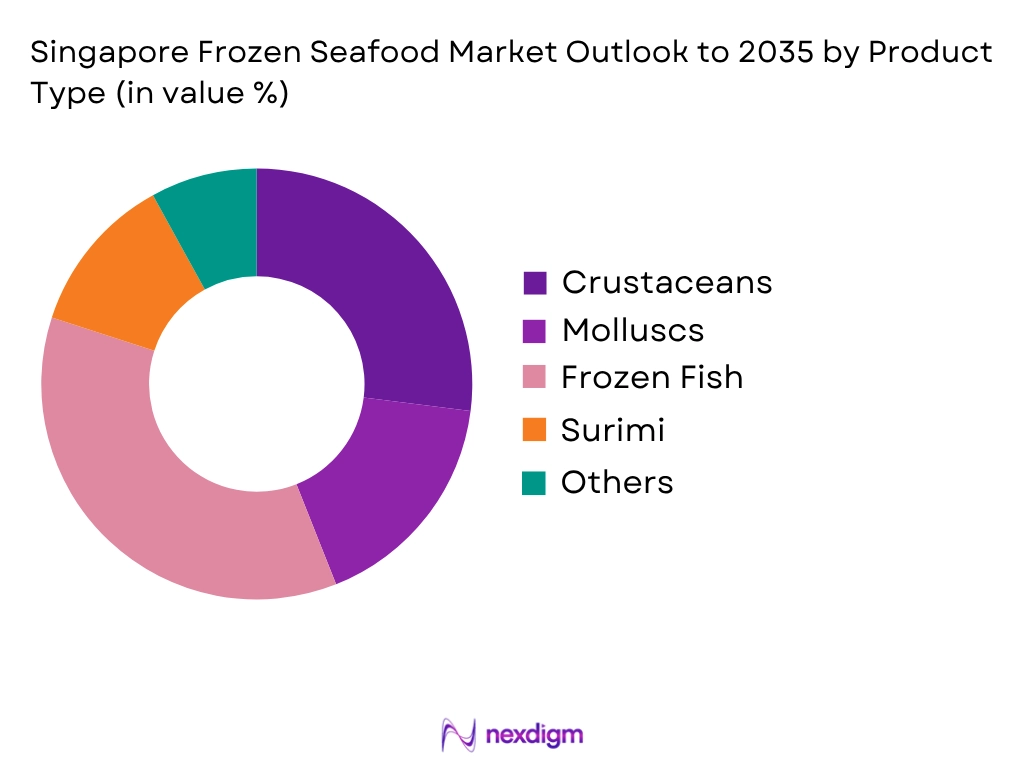
Singapore Frozen Seafood Market is segmented by product type into frozen fish, frozen crustaceans, frozen molluscs, surimi and fish-based products, and ready-to-cook frozen seafood. Recently, frozen fish has a dominant market share in Singapore under the segmentation product type, driven by the high household and HoReCa acceptance of salmon, cod, barramundi, sea bass, mackerel, tuna and whitefish portions. The sub-segment benefits from supermarket freezer visibility, online grocery listing depth, restaurant procurement consistency and broad usage across Japanese, Chinese, Western and home-dining formats. Frozen fish also travels efficiently across Singapore’s import-led food system because fillets and portions are easier to store, label, portion and distribute than live or fresh seafood. Premium fish such as salmon and cod drive higher-value demand, while regional whitefish and barramundi support mid-market consumption. Frozen crustaceans are also important but are more occasion-led and concentrated in prawns, crab and lobster.
By Distribution Channel
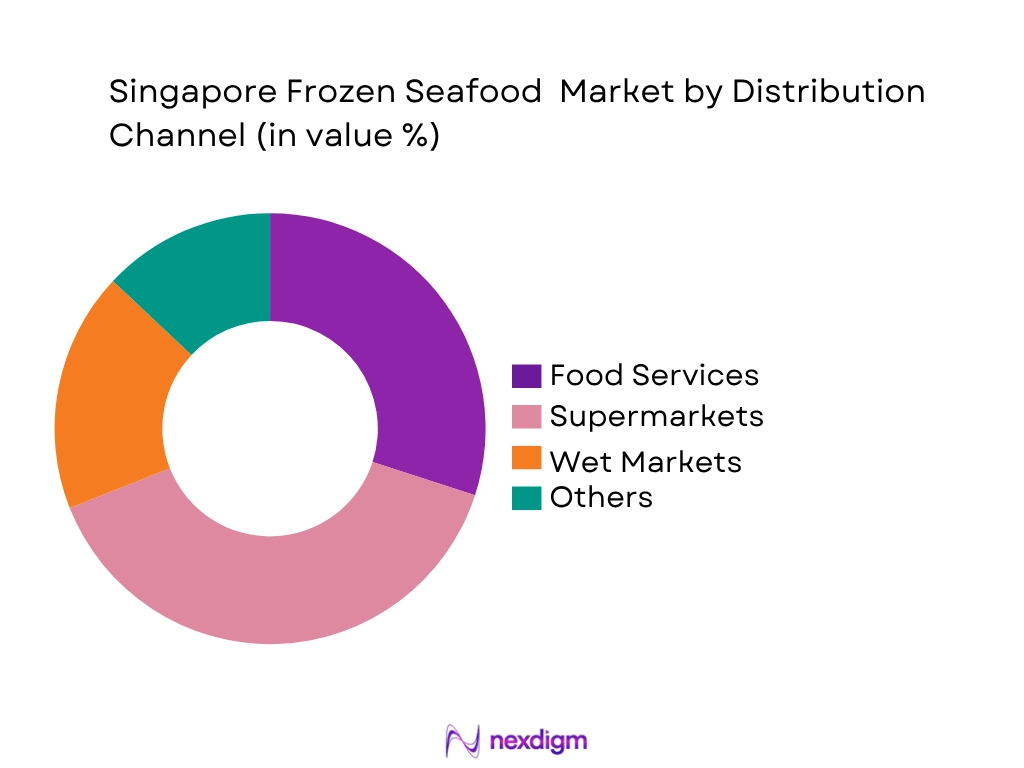
Singapore Frozen Seafood Market is segmented by distribution channel into supermarkets and hypermarkets, foodservice distributors, wet markets, specialty seafood stores and online grocery/direct-to-consumer platforms. Recently, supermarkets and hypermarkets have a dominant market share in Singapore under the segmentation distribution channel, because frozen seafood is a planned grocery category requiring freezer infrastructure, product labelling, country-of-origin visibility, branded trust and consistent SKU replenishment. Chains such as NTUC FairPrice, Cold Storage, Giant and Sheng Siong help formalize demand for salmon fillets, prawns, squid rings, fish balls, seafood mixes and ready-to-cook packs. Foodservice distributors remain significant because restaurants, hotels, caterers and central kitchens buy frozen seafood in bulk for portion control and menu consistency. Online grocery is expanding, but last-mile frozen delivery requires insulated packaging, cold-chain assurance and scheduled fulfilment, making it a secondary but fast-developing channel.
Competitive Landscape
Singapore Frozen Seafood Market is competitive and import-led, with seafood importers, processors, supermarket chains, local aquaculture brands, online seafood platforms and HoReCa-focused distributors competing on source-country access, SFA compliance, cold-chain reliability, premium species range and delivery capability. Song Fish Dealer, Fassler Gourmet, Lee Fish, The Fish Farmer and NTUC FairPrice are important because they represent the market’s main operating models: wholesale distribution, value-added processing, chef-grade supply, local farm positioning and national supermarket access. Competition is shaped by country-of-origin credibility, frozen quality retention, portion consistency, retail freezer access, online fulfilment and traceable seafood claims.
| Company | Establishment Year | Headquarters | Core Frozen Seafood Portfolio | Channel Strength | Cold-Chain Capability | Species Focus | Market Position | Strategic Advantage |
| Song Fish Dealer | 1980s | Singapore | ~ | ~ | ~ | ~ | ~ | ~ |
| Fassler Gourmet | 1991 | Singapore | ~ | ~ | ~ | ~ | ~ | ~ |
| Lee Fish | 1999 | Singapore | ~ | ~ | ~ | ~ | ~ | ~ |
| The Fish Farmer | 2007 | Singapore | ~ | ~ | ~ | ~ | ~ | ~ |
| NTUC FairPrice | 1973 | Singapore | ~ | ~ | ~ | ~ | ~ | ~ |
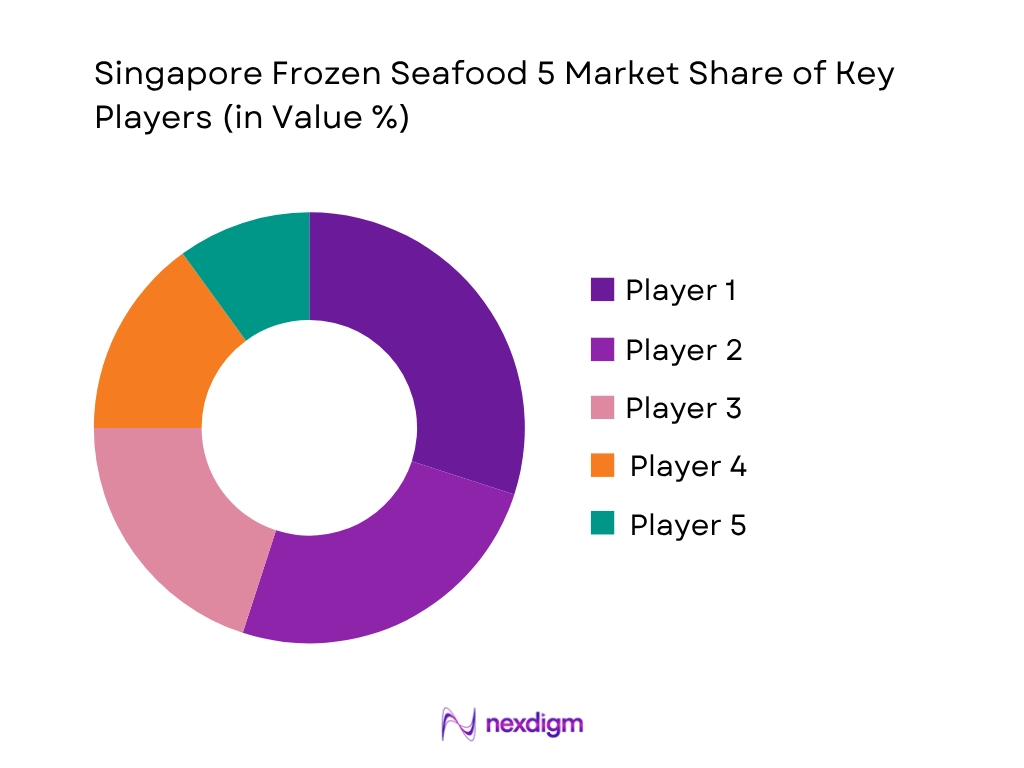
Singapore Frozen Seafood Market
Growth Drivers
Import Diversification Supporting Frozen Seafood Availability
Singapore Frozen Seafood Market is supported by an import-led food system where frozen seafood plays a practical role in stabilizing supply across supermarkets, foodservice distributors, specialty seafood retailers and online grocery. The Singapore Food Agency records 187 food supply countries/regions in 2024, compared with 140 around two decades earlier, showing the scale of Singapore’s sourcing network for food resilience. This matters for frozen seafood because salmon, cod, prawns, squid, scallops, crab, lobster and surimi products are sourced from multiple overseas origins and can be shipped, stored and redistributed through cold-chain networks. The World Bank records Singapore’s population at 6,036,860 in 2024, GDP at USD 547.39 billion, GDP per capita at USD 90,674.1, and GDP growth at 4.4 in 2024, indicating a compact but high-income consumption base for premium imported seafood. IMF also records Singapore’s country population at 6.121 million in 2026, reinforcing the need for reliable seafood supply channels for households, restaurants, hotels, caterers and central kitchens.
High-Income Urban Demand and Digital Retail Readiness
Singapore Frozen Seafood Market benefits from a dense city-state demand structure where frozen seafood can be distributed through centralized cold stores, supermarket freezers, HoReCa suppliers, wet-market-linked wholesalers and online platforms. The World Bank records Singapore’s population at 6,036,860 in 2024 and GDP per capita at USD 90,674.1, supporting demand for higher-value seafood such as salmon portions, cod fillets, scallops, prawns, lobster, crab and sashimi-grade frozen products. The same World Bank data records 94 individuals using the internet per 100 people in 2024, indicating strong digital readiness for e-grocery and direct-to-consumer seafood delivery. This is market-specific because frozen seafood delivery requires consumers to trust online ordering, scheduled fulfilment, insulated packaging and cold-chain handling. GDP of USD 547.39 billion in 2024 and IMF’s 2026 country population of 6.121 million support a large formal retail and foodservice base within a small geographic area. This creates efficient logistics economics for frequent replenishment of frozen fish, shellfish, surimi products, hotpot packs and ready-to-cook seafood SKUs.
Market Challenges
Limited Local Seafood Production Increases Import Reliance
Singapore Frozen Seafood Market faces a structural challenge from limited domestic seafood production, which keeps frozen seafood importers, distributors and retailers exposed to overseas supply conditions. The Singapore Food Agency states that seafood production declined in 2024 due to restructuring among fish farms, while seafood farm productivity moved from 38.6 tonnes per hectare per year in 2023 to 40.7 tonnes per hectare per year in 2024. SFA’s 2025 statistics also show productivity rising further from 40.7 tonnes per hectare per year to 51.5 tonnes per hectare per year between 2024 and 2025, but this productivity improvement still starts from a constrained local production base. For frozen seafood suppliers, this means salmon, cod, prawns, crab, lobster, squid and scallops remain dependent on import sourcing, health certificates, cold-chain continuity and international freight reliability. The World Bank records Singapore’s GDP at USD 547.39 billion and population at 6,036,860 in 2024, creating steady demand that domestic aquaculture alone cannot satisfy. The market challenge is therefore not weak demand, but limited local replacement capacity.
Strict Import Compliance and High-Risk Seafood Inspection Requirements
Singapore Frozen Seafood Market faces compliance intensity because imported fish and fish products require regulatory licensing, import permits and SFA inspection exposure. Singapore Customs states that importers and exporters of fish and fish products must apply for an SFA licence for import/export and transhipment of meat and fish products, and that an SFA import permit is required for every consignment of fish products. The same official source states that each consignment of live/frozen oysters, frozen blood cockle meat, frozen cooked prawns and frozen raw/cooked crab meat must be accompanied by a health certificate from the exporting authority. High-risk frozen seafood products can also be placed on “hold and test” before sale, affecting release timelines for products such as frozen cooked prawns, frozen crabmeat and frozen oysters. This is commercially important in a market with 6,036,860 people, GDP of USD 547.39 billion, and GDP per capita of USD 90,674.1 in 2024, because premium seafood buyers expect both safety and availability. Operators must maintain documentation, traceability, cold-chain records and product-specific compliance systems.
Market Opportunities
Local Aquaculture-Backed Frozen Seafood Differentiation
Singapore Frozen Seafood Market has a future opportunity in local aquaculture-backed frozen seafood, especially barramundi, sea bass, grouper and other farmed fish positioned around freshness-to-frozen conversion, traceability and controlled production. SFA records seafood farm productivity at 40.7 tonnes per hectare per year in 2024, rising to 51.5 tonnes per hectare per year in 2025, showing that local aquaculture productivity is improving even though total domestic seafood output remains constrained. This gives processors and retailers a basis for differentiated Singapore-grown frozen fish portions, fillets, meal kits and chef-grade packs. The opportunity is supported by Singapore’s compact consumption geography: World Bank records population at 6,036,860 in 2024, GDP at USD 547.39 billion, and GDP per capita at USD 90,674.1, creating a concentrated buyer base for premium traceable seafood. IMF records country population at 6.121 million in 2026, adding continued demand pressure for protein supply resilience. Local aquaculture cannot replace imports fully, but it can support premium branding, shorter supply chains and reliable sourcing for supermarkets, restaurants and e-grocery platforms.
Premium Ready-to-Cook and Online Frozen Seafood Expansion
Singapore Frozen Seafood Market has a growth opportunity in premium ready-to-cook seafood, hotpot packs, frozen shellfish, marinated fish portions and online seafood delivery. The opportunity is supported by a high-income, digitally connected consumer base: World Bank records GDP per capita at USD 90,674.1, GDP at USD 547.39 billion, population at 6,036,860, and internet use at 94 individuals per 100 people in 2024. This environment supports online ordering of frozen salmon, cod, prawns, scallops, squid rings, crab, lobster, surimi products and meal kits because consumers can purchase through supermarket apps, e-grocery platforms and direct seafood brands. SFA records 187 food supply countries/regions in 2024, giving importers a broad sourcing network for premium and value-added seafood SKUs. IMF records Singapore’s 2026 country population at 6.121 million, reinforcing demand continuity for household consumption and foodservice channels. The opportunity is strongest for players that combine SFA-compliant imports, reliable frozen last-mile delivery, smaller pack sizes, clear country-of-origin labelling and convenient cooking formats for households, caterers, restaurants and central kitchens.
Future Outlook
Over the next phase, Singapore Frozen Seafood Market is expected to expand through premium imported seafood, ready-to-cook products, HoReCa procurement recovery, e-grocery delivery and supermarket freezer expansion. Growth will be supported by Singapore’s import-diversified food system, high-income consumer base, advanced cold-chain infrastructure and demand for convenient seafood protein. Frozen salmon, cod, prawns, scallops, crab, lobster, squid, fish balls, seafood mixes and marinated seafood packs will remain priority categories. The market will continue to depend on SFA-regulated imports, source-country diversification, reliable cold stores, last-mile temperature control and limited but strategically important local aquaculture production.
Major Players
- Song Fish Dealer
- Hong Seafood
- Fassler Gourmet
- The Seafood Company
- Lee Fish
- The Fish Farmer
- Kuhlbarra
- Ah Hua Kelong
- Tankfully Fresh
- Ocean Mart
- Snow Treasures
- All Big Frozen Food
- CCF Singapore
- NTUC FairPrice
- RedMart
Key Target Audience
- Seafood importers and frozen seafood distributors
- Supermarket and hypermarket category teams
- HoReCa procurement teams
- Specialty seafood retailers and gourmet food retailers
- Online grocery and direct-to-consumer seafood platforms
- Cold-chain logistics and temperature-controlled warehousing companies
- Investments and venture capitalist firms
- Government and regulatory bodies, including
Research Methodology
Step 1: Identification of Key Variables
The initial phase involves constructing an ecosystem map of Singapore Frozen Seafood Market, covering importers, SFA-licensed traders, supermarkets, HoReCa distributors, wet-market retailers, online seafood platforms, processors, cold stores and local farms. The primary objective is to identify variables such as source-country mix, species demand, channel structure, cold-chain capability and regulatory compliance.
Step 2: Market Analysis and Construction
In this phase, historical data is compiled for Singapore Frozen Seafood Market using import-led market references, SFA food statistics, company information, retail freezer audits and foodservice distribution checks. The analysis includes frozen fish, crustaceans, molluscs, surimi products, premium shellfish, ready-to-cook seafood and local aquaculture-based frozen products.
Step 3: Hypothesis Validation and Expert Consultation
Market hypotheses are developed and validated through computer-assisted interviews with seafood importers, supermarket buyers, HoReCa distributors, chefs, cold-chain operators and online seafood retailers. These consultations are used to verify product dominance, channel movement, source-country dependence, SKU performance, frozen quality concerns and margin-sensitive product flows.
Step 4: Research Synthesis and Final Output
The final phase involves integrating top-down food import and seafood consumption indicators with bottom-up company, SKU, channel and product-level intelligence. This synthesis validates the segmentation, competitive landscape, market outlook and strategic recommendations for Singapore Frozen Seafood Market stakeholders, including investors, importers, retailers, foodservice suppliers and local producers.

- Executive Summary
- Research Methodology (Market Definitions and Assumptions, Abbreviations, Market Sizing Approach, Import-Source Mapping, Retail Freezer Audit, Distributor and HoReCa Channel Checks, Bottom-Up SKU Mapping, Top-Down Seafood Consumption Approach, Primary Research with Importers/Processors/Retail Buyers/Foodservice Distributors, Data Triangulation, Limitations and Forecast Assumptions)

- Definition and Scope
- Market Genesis
- Business Cycle
- Supply Chain and Value Chain Analysis

- Growth Drivers (High Import Dependence, Premium Seafood Consumption, Dense Urban Demand, Supermarket Freezer Penetration, HoReCa Procurement, Food Supply Diversification, Online Grocery Convenience, Ready-to-Cook Seafood Adoption)
- Market Challenges (Limited Domestic Production, High Operating Costs, Import Disruption Risk, SFA Inspection Requirements, Cold-Chain Energy Cost, Premium Seafood Volatility, Shelf-Life Management, Small Land Area)
- Market Opportunities (Controlled-Environment Aquaculture, Premium Imported Seafood, Ready-to-Cook Products, Hotpot Seafood Packs, E-Commerce Seafood Delivery, Re-Export Hub Services, Traceable Seafood, Sustainable Sourcing)
- Market Trends (Traceability, Premiumization, Online Seafood Delivery, Hotpot Consumption, Imported Salmon Demand, Sashimi-Grade Seafood, Retail Private Label, Local Farm Branding, Sustainable Sourcing)
- Government Regulation (SFA Licensing, Food Import Requirements, TradeNet Declaration, Import Permits, Inspection and Sampling, Hold-and-Test Products, Food Safety and Security Act, Labelling Compliance)
- SWOT Analysis
- Stakeholder Ecosystem
- Porter’s Five Forces Analysis
- PESTLE Analysis
- Competition Ecosystem

- By Value (2020-2025)
- By Volume (2020-2025)
- By Imported Frozen Seafood Value (2020-2025)

- By Product Type (In Value %)
Frozen Fish
Frozen Crustaceans
Frozen Molluscs
Frozen Surimi and Fish-Based Products
Frozen Ready-to-Cook Seafood - By Product Format (In Value %)
Frozen Fillets and Portions
Shell-On and Peeled Crustaceans
Frozen Squid and Cuttlefish Formats
Hotpot and Steamboat Seafood Packs
Marinated and Ready-to-Cook Packs - By Distribution Channel (In Value %)
Supermarkets and Hypermarkets
Foodservice Distributors
Wet Markets and Traditional Seafood Retail
Specialty Seafood Stores
Online Grocery and D2C Seafood
- By End User (In Value %)
Households
Hotels and Restaurants
Japanese Restaurants
Chinese Restaurants and Seafood Restaurants
Caterers and Central Kitchens

- Market Share of Major Players (Value Share, Volume Share, Retail Share, Foodservice Share, Online Share, Premium Seafood Share, Local Farmed Seafood Share)
- Cross Comparison Parameters (Salmon/Cod/Prawns/Crab/Lobster/Squid/Scallops/Barramundi; Import and Source-Country Network: Norway/Japan/Vietnam/Indonesia/Malaysia/China/Australia; Cold-Chain Capability: Cold Stores/Reefer Trucks/Ultra-Low Freezers/Last-Mile Delivery; Channel Presence: Supermarkets/HoReCa/Wet Markets/E-Grocery/Specialty Retail/Re-Export; Processing and Value Addition
- Filleting/Portioning/Marination/IQF/Repacking/Private Label; Regulatory
- Compliance: SFA Licence/TradeNet Permit/Hold-and-Test Readiness/Traceability;
- Premium Product Strength: Sashimi Grade/Shellfish/Gourmet Seafood/Restaurant
- Supply; Digital and D2C Capability: Online Store/Islandwide Delivery/Subscription Packs/Cold-Pack Packaging)
- SWOT Analysis of Major Players
- Pricing Analysis Basis SKUs
- Detailed Profiles of Major Companies
Song Fish Dealer
Hong Seafood
Fassler Gourmet
The Seafood Company
Lee Fish
The Fish Farmer
Kuhlbarra
Ah Hua Kelong
Tankfully Fresh
Ocean Mart
Snow Treasures
All Big Frozen Food
CCF Singapore
NTUC FairPrice
RedMart

- Household Demand Analysis
- Supermarket Buyer Analysis
- HoReCa Procurement Analysis
- Japanese Restaurant Buyer Analysis
- Chinese Restaurant and Banquet Buyer Analysis

- By Value (2026-2035)
- By Volume (2026-2035)
- By Imported Frozen Seafood Value (2026-2035)


 Request a Sample
 Ask for Customization
 Get a Quote
 Enquire Now