
 Download PDF
Market Overview
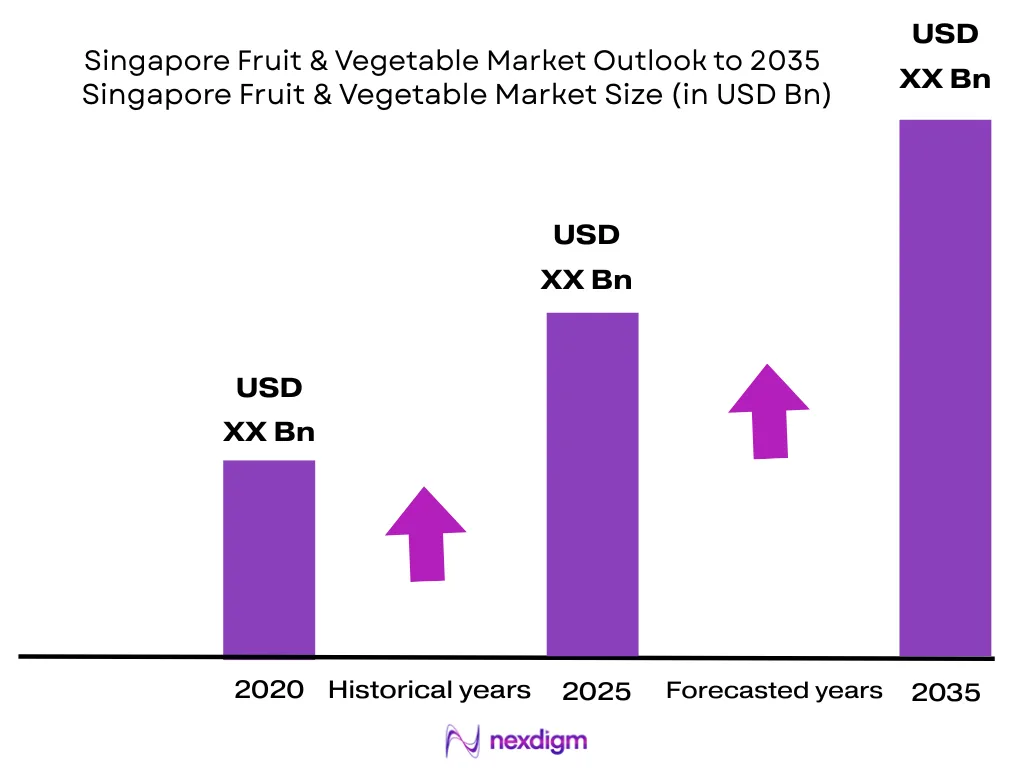
Singapore Fruit & Vegetable Market is valued at USD ~ billion, based on the latest country-specific market benchmark, and is forecast to grow at 4.67% CAGR across the 2026-2035 outlook period, aligned with the available 2026-2034 forecast benchmark. The market is driven by import-led availability, high-income households, premium grocery demand, wet markets, foodservice and online grocery. Singapore’s GDP reached USD 547.39 billion, while GDP per capita reached USD 90,674.1, supporting premium fresh produce consumption. Singapore Fruit & Vegetable Market is dominated by Pasir Panjang, Jurong, Changi, Tuas, Central Region and major neighbourhood wet-market corridors because they combine wholesale handling, cold-chain warehousing, air-sea logistics, supermarket distribution and foodservice procurement. Malaysia, China, Australia, Thailand, Vietnam, Indonesia, India, South Africa, Japan and New Zealand dominate sourcing because Singapore imports more than 90 parts of every 100 parts of food supply, with supply sources expanded to 187 countries and regions.
Market Segmentation
By Product Type
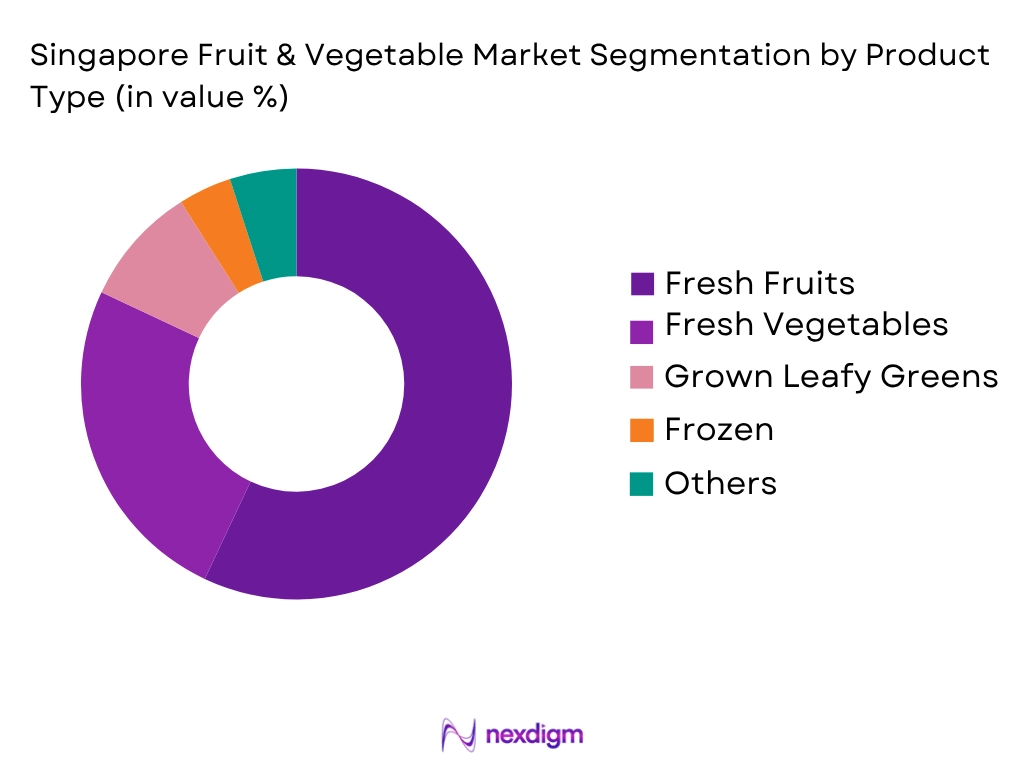
Singapore Fruit & Vegetable Market is segmented by product type into fresh fruits, fresh vegetables, locally grown leafy greens, frozen/canned/ambient produce, and fresh-cut/salad kits/ready-to-cook produce. Recently, fresh fruits have a dominant market share in Singapore under the segmentation product type, it is due to high import diversity, premium household demand, strong supermarket merchandising and foodservice usage. Apples, bananas, oranges, mandarins, grapes, berries, avocados, kiwifruit, mangoes, dragon fruit, melons and stone fruits are high-rotation SKUs across FairPrice, Cold Storage, Sheng Siong, Giant, Little Farms, RedMart and wet-market retailers. Fresh fruits also benefit from gifting, snacking, hotel buffets, airline catering and premium imported seasonal assortments. SFA’s food resilience strategy relies heavily on import diversification, reinforcing year-round availability.
By Distribution Channel
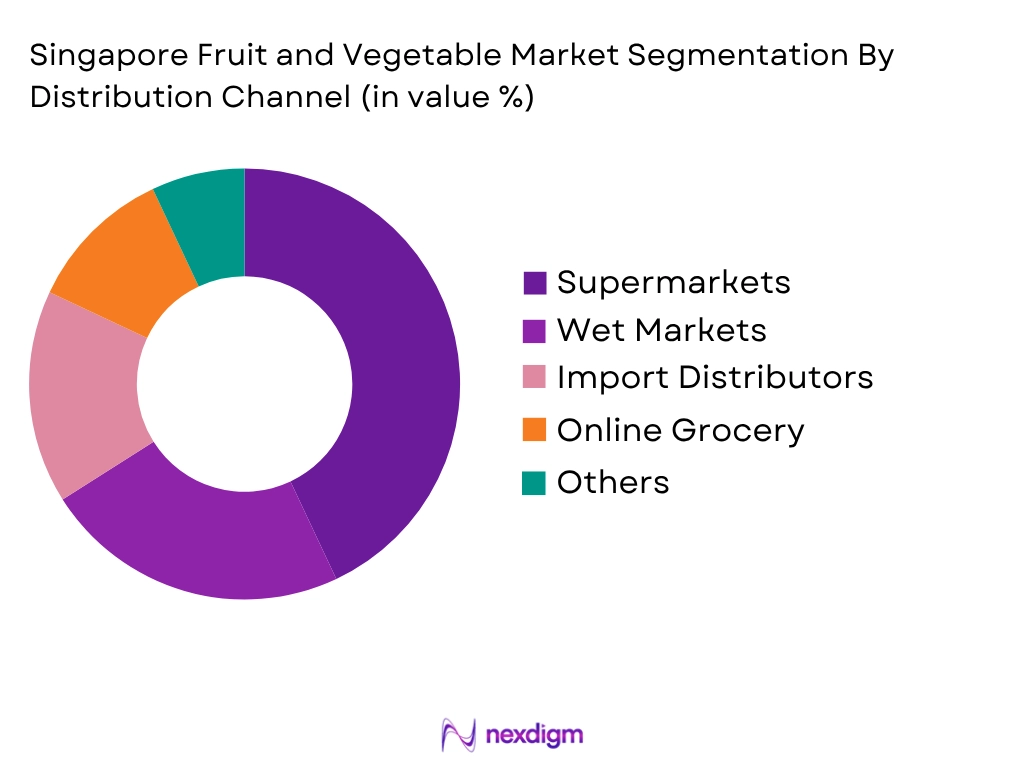
Singapore Fruit & Vegetable Market is segmented by distribution channel into supermarkets and hypermarkets, wet markets and neighbourhood fresh retailers, Pasir Panjang wholesale and import distributors, online grocery/fresh delivery platforms, and foodservice/central kitchens/institutional buyers. Recently, supermarkets and hypermarkets have a dominant market share in Singapore under the segmentation distribution channel, it is due to their broad assortment, imported fruit displays, local leafy green shelves, chilled produce sections, private-label packs and integrated online fulfilment. NTUC FairPrice, Cold Storage, Sheng Siong, Giant and CS Fresh operate dense urban grocery networks that capture weekly basket demand and premium fresh produce purchases. Their dominance is reinforced by trusted food safety standards, convenient store access, promotions, loyalty programmes, fresh-cut SKUs and omnichannel models. Wet markets remain relevant for Asian vegetables, but modern grocery leads packaged and higher-value produce.
Competitive Landscape
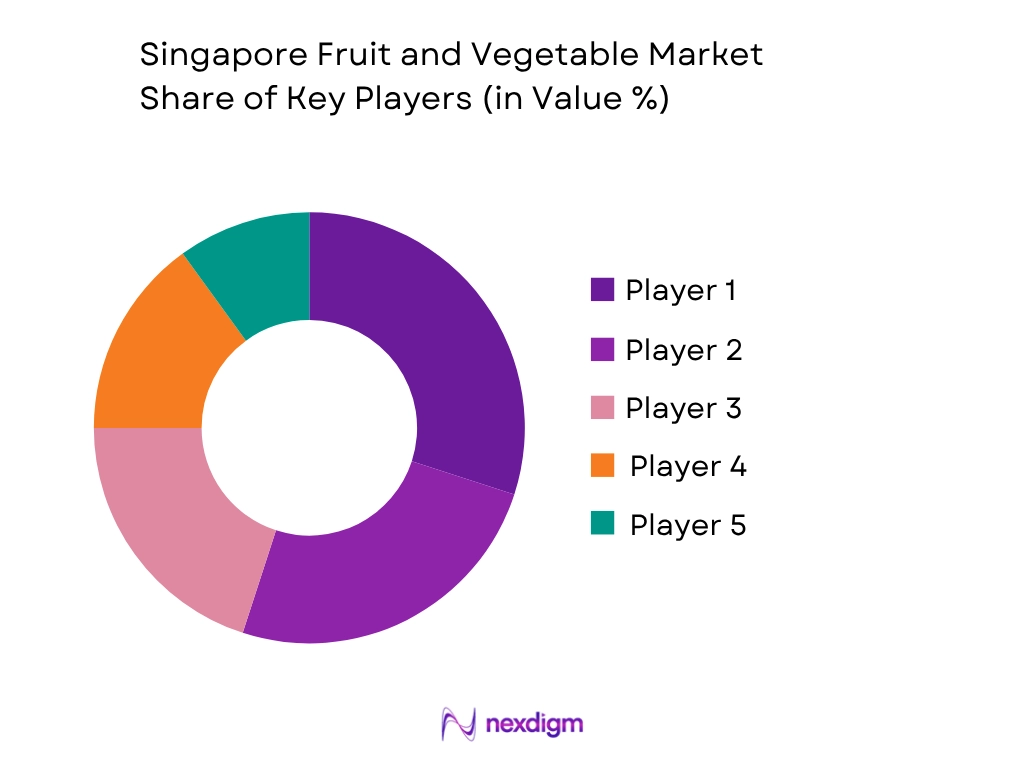
Singapore Fruit & Vegetable Market is dominated by a combination of grocery retailers, importers, wet-market wholesalers, online grocery platforms and local controlled-environment farms. NTUC FairPrice, Cold Storage, Sheng Siong, Ban Choon Marketing and Sustenir Agriculture are influential because they control either high-frequency consumer access, import-distribution capability or local leafy-green production. Competition is shaped by import origin diversity, SFA compliance, cold-chain reliability, Pasir Panjang wholesale reach, premium fruit assortment, e-grocery fulfilment, local-farm branding and convenience-oriented SKUs.
| Company | Establishment Year | Headquarters | Key Categories | Business Model | Key Channel | Supply Footprint | Market-Specific Capability | Competitive Advantage |
| NTUC FairPrice | 1973 | Singapore | ~ | ~ | ~ | ~ | ~ | ~ |
| Cold Storage Singapore | 1903 | Singapore | ~ | ~ | ~ | ~ | ~ | ~ |
| Sheng Siong Group | 1985 | Singapore | ~ | ~ | ~ | ~ | ~ | ~ |
| Ban Choon Marketing | 1988 | Singapore | ~ | ~ | ~ | ~ | ~ | ~ |
| Sustenir Agriculture | 2013 | Singapore | ~ | ~ | ~ | ~ | ~ | ~ |
Singapore Fruit Vegetable Market Analysis
Growth Drivers
Import Diversification Supports Year-Round Fruit and Vegetable Availability
Singapore Fruit Vegetable Market is structurally supported by broad import diversification, which enables retailers, wet markets, hotels, central kitchens and online grocery platforms to maintain year-round supply of bananas, apples, citrus, grapes, berries, leafy vegetables, mushrooms, potatoes, onions and salad vegetables. World Bank data records Singapore’s GDP at USD 547.39 billion, GDP per capita at USD 90,674.1, GDP growth at 4.4, and population at 6,036,860 people in 2024, supporting high-value fresh produce consumption and stable urban demand. SFA states that Singapore imports more than 90 parts of every 100 parts of its food supply and increased food supply sources to 187 countries and regions in 2024, up from about 140 around two decades earlier. This is market-specific because fruit and vegetable importers rely on Malaysia, China, Australia, Thailand, Vietnam, Indonesia, India, South Africa, Japan and New Zealand to manage seasonality, weather shocks and origin concentration.
High-Income Urban Consumption Drives Premium, Fresh-Cut and Convenience Produce
Singapore Fruit Vegetable Market benefits from high-income, dense urban consumption, where households, supermarkets, hotels, hawker suppliers and foodservice buyers demand imported fruits, washed greens, salad kits, cut fruit, berries, avocados, mushrooms and ready-to-cook vegetable packs. World Bank data records GDP per capita at USD 90,674.1, GDP at USD 547.39 billion, GDP growth at 4.4, and internet users at 94 parts of every 100 people in 2024, supporting premium retail, e-grocery ordering and convenience-led food purchases. Singapore’s population reached 6,036,860 people in 2024, creating concentrated demand across wet markets, supermarkets, online platforms and central kitchens. SFA also reported local vegetable farm productivity rising from 227.2 tonnes per hectare per year in 2023 to 231.4 tonnes per hectare per year in 2024, showing that domestic leafy-green farms are improving output efficiency for locally grown vegetables.
Market Challenges
Heavy Import Dependence Creates Supply-Chain and Origin-Risk Exposure
Singapore Fruit Vegetable Market remains vulnerable to overseas supply disruptions because fruit and vegetable availability depends on cross-border trucking, sea freight, air freight, source-country weather, phytosanitary controls and importer licensing. World Bank data records Singapore’s population at 6,036,860 people, GDP at USD 547.39 billion, and GDP per capita at USD 90,674.1 in 2024, showing a large, high-income consumer base that requires uninterrupted fresh produce inflow. SFA states that Singapore imports more than 90 parts of every 100 parts of its food supply, making diversification a core food resilience strategy. The same source notes food supply came from 187 countries and regions in 2024, which reduces single-origin risk but also increases documentation, supplier auditing, residue testing, route planning and cold-chain coordination requirements for fresh fruits and vegetables. This challenge affects bananas, leafy vegetables, berries, citrus, grapes, mushrooms and premium imported fruit most directly.
Limited Local Vegetable Contribution and Food Safety Controls Raise Operating Complexity
Singapore Fruit Vegetable Market faces a structural local-production limitation because land scarcity and farm economics restrict the scale of locally grown vegetables. World Bank data records Singapore’s GDP per capita at USD 90,674.1, GDP growth at 4.4, and population at 6,036,860 in 2024, indicating strong demand but limited domestic agricultural space in a dense city-state. SFA reported that local vegetable farms contributed around 3 parts of every 100 parts of total vegetable consumption in 2024, despite productivity improving from 227.2 to 231.4 tonnes per hectare per year. Food safety also adds operating complexity: SFA recorded 22.8 major foodborne illness cases per 100,000 population in 2024, with catered food accounting for more than half of cases under investigation and targeted checks. This increases compliance pressure for fresh-cut suppliers, central kitchens, foodservice distributors, online grocery platforms and wet-market-linked produce handlers.
Market Opportunities
Local Leafy Greens, Mushrooms and Urban Farming Can Strengthen Food Resilience
Singapore Fruit Vegetable Market has an opportunity to scale local leafy greens, fruited vegetables, beansprouts and mushrooms through hydroponics, vertical farming, rooftop farming and controlled-environment agriculture. World Bank data records Singapore’s GDP at USD 547.39 billion, GDP per capita at USD 90,674.1, and population at 6,036,860 in 2024, supporting investment capacity and consumer demand for premium local produce. SFA reported that local vegetable productivity rose from 227.2 tonnes per hectare per year in 2023 to 231.4 tonnes per hectare per year in 2024, and then from 231.4 to 253.3 tonnes per hectare per year in 2025. SFA also stated that local farms contributed about 8 parts of every 100 parts of local fibre consumption in 2025, covering fresh leafy and fruited vegetables, beansprouts and mushrooms. These figures support future growth in farm-branded greens, local mushrooms, microgreens, salad vegetables and supermarket-linked local sourcing.
Import Source Diversification Creates Scope for Premium Produce and B2B Supply Platforms
Singapore Fruit Vegetable Market has an opportunity to expand premium imported fruit, B2B produce procurement, e-grocery fulfilment and foodservice supply because current sourcing networks are already broad and regulated. World Bank data records Singapore’s GDP per capita at USD 90,674.1, GDP at USD 547.39 billion, population at 6,036,860, and internet users at 94 parts of every 100 people in 2024, supporting digital grocery, premium fruit baskets and high-frequency restaurant procurement. SFA reported food supply sources from 187 countries and regions in 2024 and from more than 180 countries and regions in 2025, confirming sustained import diversification. SFA also requires registered and licensed traders to comply with import requirements for commercial food imports, while Singapore Customs notes that SFA regulates importation and transhipment of fresh fruits and vegetables through permits and TradeNet declarations. This creates scope for compliant importers, cold-chain distributors and digital B2B platforms serving supermarkets, hotels, central kitchens and online grocery.
Future Outlook
Over the next five years, Singapore Fruit & Vegetable Market is expected to grow through import diversification, premium produce demand, online grocery penetration, foodservice recovery, local leafy-green farming and fresh convenience formats. Fresh fruits will remain the largest product category because Singapore consumers have high exposure to imported apples, citrus, bananas, grapes, berries, avocados, kiwifruit, mangoes and seasonal Japanese, Korean, Australian and New Zealand fruits.
Fresh vegetables will remain critical for wet markets, hawker centres, households, central kitchens and foodservice operators. Asian leafy vegetables, cabbage, broccoli, mushrooms, onions, potatoes, tomatoes and salad vegetables will continue to anchor everyday consumption. Local vegetable farming will remain strategically relevant but structurally limited. SFA reported that vegetable farms contributed around 3 parts of every 100 parts of total vegetable consumption, while local vegetable productivity increased from 227.2 tonnes per hectare per year to 231.4 tonnes per hectare per year. SFA also stated that vegetable production declined by about 3 parts of every 100 parts, showing that productivity gains are not yet translating into major domestic share expansion.
Singapore’s policy direction is shifting toward targeted local food resilience. SFA’s 2025 update states that local fibre, covering fresh leafy and fruited vegetables, beansprouts and mushrooms, contributed about 8 parts of every 100 parts of local fibre consumption, and vegetable farm productivity rose from 231.4 to 253.3 tonnes per hectare per year from 2024 to 2025. The strongest opportunities will be in premium imported fruit, washed greens, salad bowls, fresh-cut fruit, local hydroponic vegetables, B2B foodservice supply, wet-market digitization, cold-chain handling, recyclable packaging and e-grocery fulfilment. Importers and retailers that combine diverse sourcing, SFA compliance, traceability, chilled logistics and consumer-ready packaging will be better positioned as Singapore’s produce market becomes more quality-led and convenience-led.
Major Players
- NTUC FairPrice
- Cold Storage Singapore
- Sheng Siong Group
- Giant Singapore
- Little Farms
- RedMart
- Zenxin Organic
- Ban Choon Marketing
- Loh Ee Seng Trading
- SunMoon Food Company
- Sustenir Agriculture
- ComCrop
- Sky Greens
- Edible Garden City
- VertiVegies
Key Target Audience
- Fresh fruit and vegetable importers
- Pasir Panjang wholesalers and wet-market traders
- Supermarkets, hypermarkets and premium grocery retailers
- Online grocery and fresh delivery platforms
- Foodservice, hawker-centre, airline catering and central-kitchen suppliers
- Hydroponic, rooftop and vertical farming companies
- Investments and venture capitalist firms
- Government and regulatory bodies (Singapore Food Agency, Enterprise Singapore, Singapore Customs, Ministry of Sustainability and the Environment, Singapore Department of Statistics, National Environment Agency)
Research Methodology
Step 1: Identification of Key Variables
The initial phase involves constructing an ecosystem map encompassing all major stakeholders within the Singapore Fruit Vegetable Market. This includes importers, Pasir Panjang wholesalers, wet-market traders, supermarkets, online grocery platforms, foodservice distributors, local farms, cold-chain operators and regulators. The objective is to identify import dependence, local production, channel mix, foodservice demand and food safety variables.
Step 2: Market Analysis and Construction
In this phase, historical data is compiled and analyzed for Singapore Fruit Vegetable Market revenue, import flow, local vegetable production, wholesale activity, retail demand and foodservice procurement. The model combines top-down market sizing with bottom-up segmentation by product type and channel. Particular attention is given to imported fruits, leafy vegetables, wet-market flow and e-grocery growth.
Step 3: Hypothesis Validation and Expert Consultation
Market hypotheses are validated through computer-assisted telephonic interviews with importers, wholesalers, supermarket buyers, wet-market operators, urban farms, foodservice distributors and online grocery managers. These consultations provide operational insight into sourcing decisions, freshness requirements, shrinkage, SFA compliance, premium fruit demand and local-produce adoption.
Step 4: Research Synthesis and Final Output
The final phase integrates secondary research, official statistics, company profiling and expert validation into a structured market report. The output provides market size, segmentation, competitive landscape, future outlook, target audience mapping and strategic recommendations. This ensures that the Singapore Fruit Vegetable Market analysis reflects import-led realities and local food resilience priorities.

- Executive Summary
- Research Methodology (Market Definitions and Assumptions, Fresh and Processed Produce Classification, Import and Domestic Production Valuation, Wholesale and Retail Valuation, Singapore Food Agency Statistics Review, Enterprise Singapore Trade Mapping, Customs Import Data Mapping, Top-Down Consumption Model, Bottom-Up Import and Local Production Model, Primary Interviews with Importers, Wholesalers, Supermarkets, Wet Market Traders, Foodservice Buyers, Urban Farms, Cold-Chain Operators and Fresh Delivery Platforms, Limitations and Forecast Assumptions)

- Definition and Scope
- Market Genesis and Evolution
- Singapore Fresh Produce Demand Landscape
- Role of Imports in Year-Round Availability
- Role of Pasir Panjang Wholesale Centre in Fresh Produce Distribution

- Growth Drivers (High Import Connectivity, Dense Urban Consumption, Supermarket and Online Grocery Penetration, Foodservice Demand, Local Leafy Green Farming, Food Resilience Agenda, Premium Produce Demand, Cold-Chain Maturity)
- Market Challenges (High Import Dependence, Land Scarcity, Local Farm Economics, Energy Cost, Cold-Chain Disruption, Food Safety Compliance, Shelf-Life Loss, Wet Market Modernization Pressure)
- Market Opportunities (Vertical Farming, Hydroponic Greens, Import Diversification, Premium Fruits, Fresh-Cut Produce, Online Grocery, Foodservice Supply, Sustainable Packaging)
- Trends (Local Farm Branding, Traceability, Organic and Premium Produce, Wet Market Digitalization, Sustainable Packaging, Urban Farming Technology, Import Source Diversification, Fresh Convenience)
- SWOT Analysis
- Porter’s Five Forces

- By Value (2020-2025)
- By Volume (2020-2025)
- By Average Realization (2020-2025)

- By Product Category (In Value %)
Fresh Fruits
Fresh Vegetables
Locally Grown Leafy Greens
Frozen, Canned and Ambient Produce - By Fruit Type (In Value %)
Bananas and Tropical Fruits
Citrus Fruits
Apples, Pears and Stone Fruits
Berries, Grapes and Avocados
Premium and Seasonal Fruits - By Distribution Channel (In Value %)
Supermarkets and Hypermarkets
Wet Markets
Pasir Panjang Wholesale Centre
Online Grocery
Convenience Stores
Foodservice Distributors, Specialty Grocers, Direct Farm Supply, B2B Fresh Platforms
- By Geography (In Value %)
Central Region
North-East Region
East Region
West Region
North Region

- Market Share of Major Players (Value Share, Volume Share, Import Share, Local Production Share, Retail Channel Share, Foodservice Channel Share)
- Cross Comparison Parameters (Import Sourcing Footprint, Local Farm and CEA Production Capacity, Pasir Panjang Wholesale and Wet Market Reach, Cold-Chain and Ripening Infrastructure, Supermarket and E-Grocery Channel Penetration, Foodservice and Central Kitchen Account Reach, SFA Compliance and Traceability Infrastructure, Premium/Organic/Hydroponic Product Portfolio)
- SWOT Analysis of Major Players
- Pricing and SKU Benchmarking of Major Players
- Detailed Profiles of Major Companies
NTUC FairPrice
Cold Storage Singapore
Sheng Siong Group
Giant Singapore
Little Farms
RedMart
Zenxin Organic
Ban Choon Marketing
Loh Ee Seng Trading
SunMoon Food Company
Sustenir Agriculture
ComCrop
Sky Greens
Edible Garden City
VertiVegies

- Household Consumers
- Wet Market Stallholders
- Supermarkets and Hypermarkets
- Hotels, Restaurants and Hawker Centres
- Airline Catering and Institutional Buyers

- By Value (2026-2035)
- By Volume (2026-2035)
- By Average Realization (2026-2035)


 Request a Sample
 Ask for Customization
 Get a Quote
 Enquire Now