
 Download PDF
Market Overview
The Singapore Gas Genset Market is valued at approximately ~ million, supported by electricity-generation capacity moving from 13,072 MW to 12,445 MW, while national electricity consumption reached 58 TWh. Gas-based gensets benefit from Singapore’s mature natural-gas infrastructure, mission-critical facilities, industrial operations and growing digital infrastructure. Combined-cycle, cogeneration and trigeneration capacity totals 10,115 MW, reinforcing technical familiarity with gaseous-fuel power systems and associated maintenance infrastructure. Jurong Island, Tuas, Jurong, Changi and major data-centre corridors represent the principal demand clusters for gas-based gensets because they concentrate petrochemicals, manufacturing, logistics, aviation, utilities and digital infrastructure. Singapore already hosts more than 70 operational data centres with approximately 1.4 GW of capacity, while authorities announced at least 300 MW of additional capacity, potentially supplemented by another 200 MW for qualifying green-energy operators. These high-availability facilities strengthen demand for resilient backup and distributed-generation systems.
Market Segmentation
By Power Rating
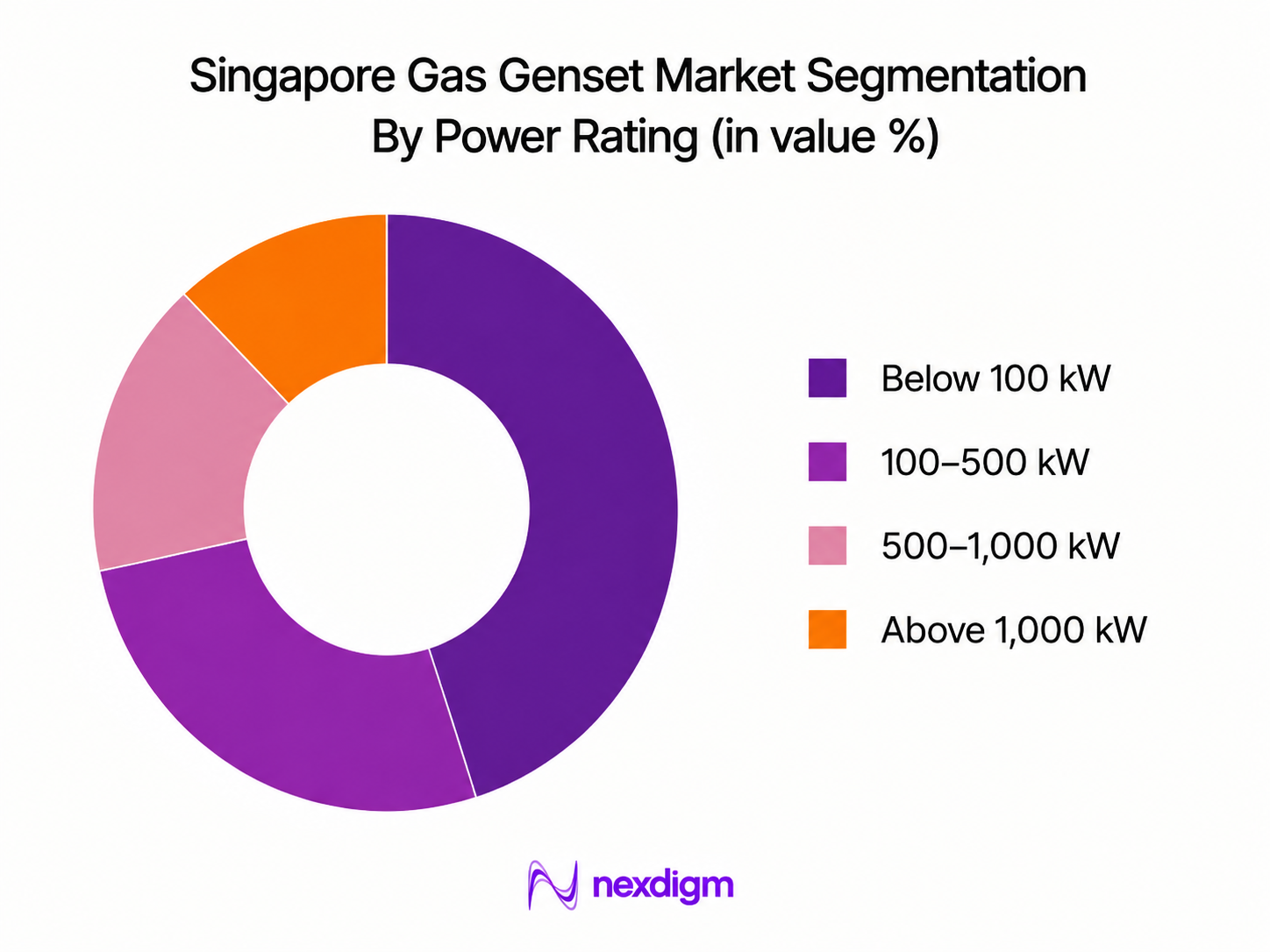
The Singapore Gas Genset Market is segmented into below 100 kW, 100–500 kW, 500–1,000 kW and above 1,000 kW systems. Recently, the 100–500 kW segment holds the dominant market position because this capacity range balances compact installation requirements with sufficient output for commercial buildings, automotive workshops, logistics facilities, warehouses, small industrial plants and distributed backup applications. Singapore’s constrained land availability favours generators with relatively high output density, particularly where facilities need dedicated emergency circuits instead of full-site generation. Gas units in this range can also be incorporated into parallel configurations, allowing users to build redundancy while matching load fluctuations. The segment benefits from Singapore’s extensive natural-gas ecosystem, where total natural-gas supply reached 453,040 TJ, including 393,748 TJ used for electricity generation. This established gas infrastructure lowers technical barriers to gaseous-fuel generation and supports expertise in fuel handling, control systems, maintenance and emissions management.
By Application
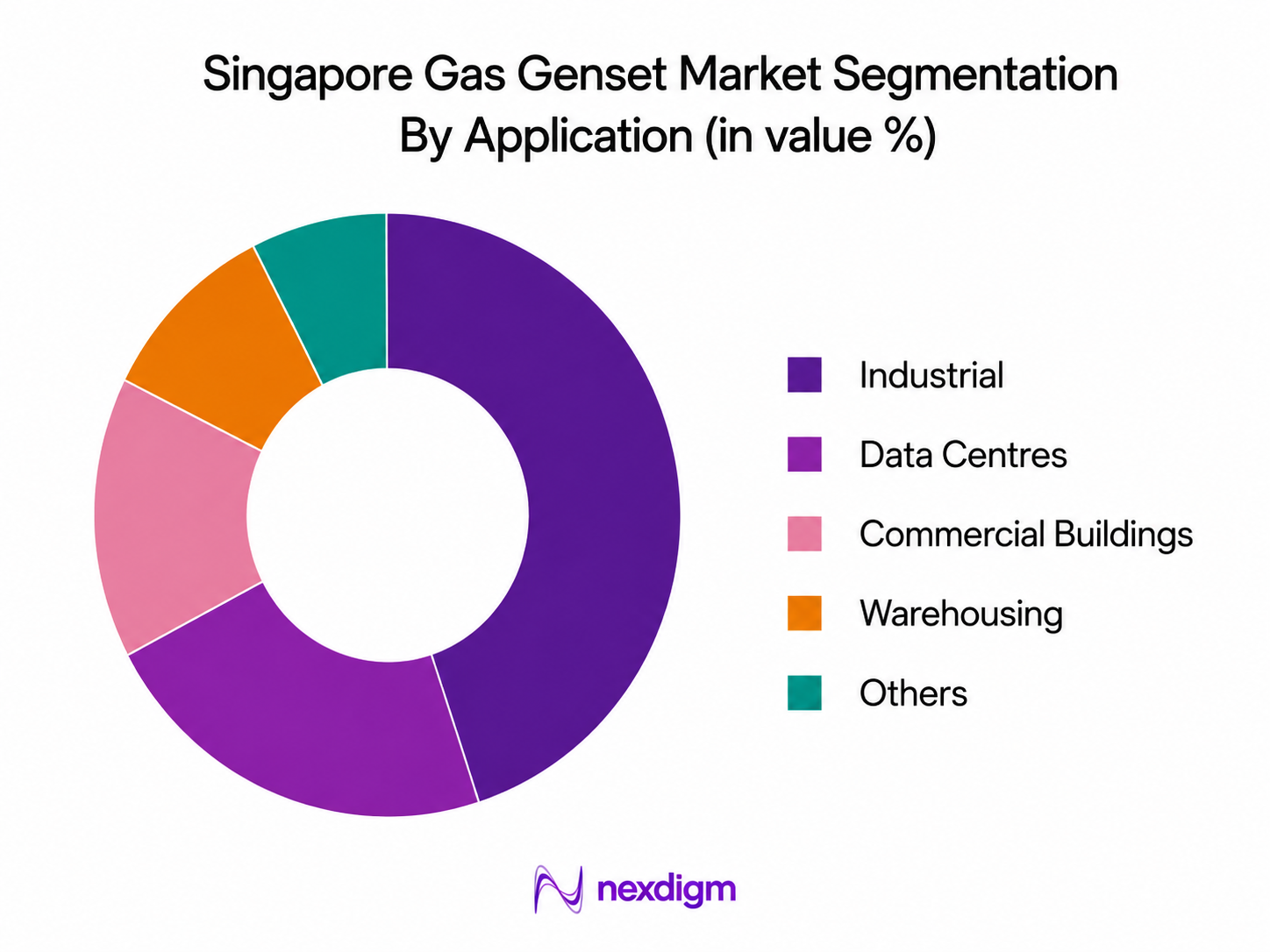
The Singapore Gas Genset Market is segmented into commercial buildings, industrial and manufacturing facilities, data centres and telecom, automotive workshops and mobility facilities, logistics and warehousing, and institutional infrastructure. Recently, industrial and mission-critical commercial applications dominate demand because users in these categories place greater emphasis on continuous power, controlled transfer times, operational reliability and redundancy. Singapore generated approximately 60 TWh of electricity, while electricity consumption reached 58 TWh, reflecting the scale of national power dependence across a dense industrial and service economy. Data centres provide an especially attractive niche because more than 70 facilities with roughly 1.4 GW of existing capacity operate in Singapore and significant additional capacity has been authorised. Gas gensets can complement grid supply, energy storage and other backup technologies where operators seek lower local particulate emissions than conventional diesel systems and access to established gas infrastructure.
Competitive Landscape
The Singapore Gas Genset Market is characterised by international power-equipment manufacturers supported by regional distributors, engineering contractors and system integrators. Competition centres on rated output, fuel flexibility, gas-engine efficiency, emission performance, load-acceptance capability, parallel operation, remote monitoring and after-sales support. Cummins, Caterpillar, Rehlko and Generac have established global power-generation portfolios, while specialised gas-engine suppliers compete more strongly in larger industrial, cogeneration and continuous-duty installations. Cummins, for example, operates across diesel, natural-gas, electric and hybrid power technologies, while Caterpillar markets dedicated natural-gas generator systems for CHP and distributed-power applications.
| Major Player | Establishment Year | Headquarters | Gas Genset Focus | Typical Application Range | Fuel Capability | CHP Capability | Digital Controls / Monitoring | Service Network Strength |
| Caterpillar Inc. | 1925 | Irving, Texas, USA | ~ | ~ | ~ | ~ | ~ | ~ |
| Cummins Inc. | 1919 | Columbus, Indiana, USA | ~ | ~ | ~ | ~ | ~ | ~ |
| Generac Holdings | 1959 | Waukesha, Wisconsin, USA | ~ | ~ | ~ | ~ | ~ | ~ |
| Rehlko Power Systems | Kohler power heritage | Wisconsin, USA | ~ | ~ | ~ | ~ | ~ | ~ |
| INNIO Jenbacher | 1959 heritage | Jenbach, Austria | ~ | ~ | ~ | ~ | ~ | ~ |
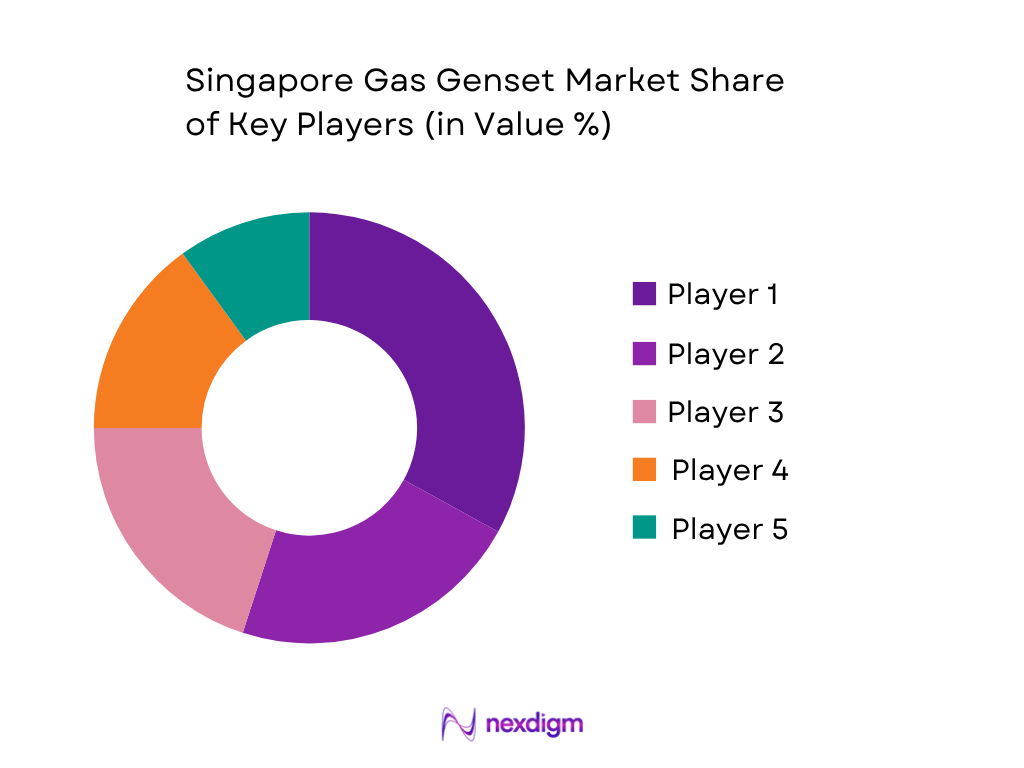
Singapore Gas Genset Market Analysis
Growth Drivers
Expanding Electricity Demand from Data Centres and Digital Infrastructure
Singapore’s Gas Genset Market is being supported by rapidly increasing electricity requirements from data centres, digital infrastructure, advanced manufacturing and other power-sensitive facilities where gas-fired standby and distributed generation can provide resilience. The Energy Market Authority recorded 60 TWh of electricity generation in 2024, while electricity consumption reached 58 TWh; commerce and services consumed about 23 TWh, and industrial users consumed another 23 TWh. Total generation increased by 2,232 GWh compared with the preceding year, while system peak demand increased by 184 MW, demonstrating that additional reliable capacity is becoming increasingly important. The digital-economy component is particularly relevant for gas gensets because data centres require uninterrupted electricity and generally maintain independent backup generation systems. IMDA reported an installed Singapore data-centre capacity exceeding 1.4 GW across more than 70 facilities, and its Green Data Centre Roadmap initiated the addition of at least 300 MW of new capacity. Another 200 MW was subsequently made available under a further allocation framework, while a 20 MW data-centre facility broke ground in 2025 for commissioning beginning in 2026. These additions directly enlarge the installed base of critical-load facilities requiring emergency or supplementary generation. Although diesel gensets remain common in backup applications, gas-powered units gain relevance where operators seek lower local emissions, reduced particulate formation, lower noise configurations and compatibility with long-term lower-carbon fuel strategies. Singapore’s existing power infrastructure also strongly favours gaseous-fuel technologies: natural gas accounted for 94% of the national electricity-generation fuel mix in 2024, showing that operating expertise, fuel-handling infrastructure and gas-fired generation capability are already deeply established. Macroeconomic conditions reinforce the underlying demand base. World Bank data records Singapore’s nominal GDP at approximately USD 603.87 billion in 2025, while the IMF reported that output expanded strongly during 2025 after the technology-led rebound that began in 2024. For gas genset suppliers, the most commercially relevant demand therefore comes from high-value facilities rather than broad rural electrification: hyperscale and colocation data centres, semiconductor operations, telecommunications infrastructure, hospitals, logistics hubs and commercial buildings where even short interruptions can halt mission-critical operations. The combination of 58 TWh of annual electricity consumption, 1.4 GW-plus data-centre capacity, at least 300 MW of newly targeted data-centre additions, and an electricity system overwhelmingly accustomed to natural gas establishes a strong operating environment for high-reliability gas gensets, particularly units designed for standby, prime-power supplementation, microgrid participation and low-emission distributed generation.
Natural-Gas-Based Power Ecosystem and Increasing Requirement for Flexible Generation
Singapore’s established dependence on natural gas creates a favourable technical ecosystem for gas gensets because gaseous-fuel generation is already the dominant form of thermal electricity production, supported by LNG infrastructure, gas transmission systems, experienced operators and established power-generation standards. According to the Energy Market Authority, natural gas supplied 94% of the electricity-generation fuel mix in 2024, and Singapore produced approximately 60 TWh of electricity during the same period. The country is therefore structurally different from markets where gaseous-fuel backup generation must develop without an established gas-based electricity system. Another relevant indicator is the rapid expansion of flexible gas-fired capacity. During the first half of 2025, open-cycle gas-turbine generation capacity increased from 260 MW to 1,042 MW, reflecting the system operator’s emphasis on flexible thermal generation that can respond quickly when electricity demand changes or other resources are unavailable. While these utility-scale turbines are not automotive gensets, the underlying grid requirement—fast-starting, dispatchable generation—supports the same operational logic for smaller gas generator sets deployed at industrial and commercial facilities. EMA also introduced a Demand-Side Flexibility Roadmap in 2025 that explicitly recognises that electricity consumers may maintain generators and battery systems on standby and that these assets can potentially contribute additional system services while continuing to fulfil their primary backup function. This creates a pathway for larger gas gensets equipped with synchronisation controls, automatic transfer systems and digital load-management platforms to evolve from purely emergency equipment toward more flexible behind-the-meter assets. Singapore’s economic structure makes this particularly relevant. The country’s corporate sector held approximately S$14.373 trillion in total assets at end-2024, while foreign direct investment stock reached S$3.130 trillion, illustrating the concentration of capital-intensive businesses that depend on high-quality power availability. At the macroeconomic level, the World Bank records GDP at USD 603.87 billion in 2025, and the IMF reported strong 2025 output growth driven partly by AI-related exports and domestic demand. These economic conditions support investment in backup-power assets at semiconductor plants, laboratories, data centres, logistics installations, hotels, hospitals and high-rise commercial complexes. Gas gensets can also be positioned as bridging assets between conventional internal-combustion generation and lower-carbon fuels. Several modern gas-engine platforms can be engineered for renewable natural gas, hydrogen blending or other lower-carbon gases subject to equipment specification. Singapore’s broader generation strategy is moving in the same direction: new major thermal plants are increasingly being designed as hydrogen-ready facilities. The presence of an established gas-based system, more than 1 GW of rapidly deployable open-cycle gas generation, and regulatory recognition of customer-owned standby generators therefore creates a technically mature environment in which gas gensets can serve resilience, peak-support, microgrid and distributed-energy applications rather than operating solely as emergency equipment.
Market Challenges
Carbon-Tax Escalation and Tightening Emissions Compliance for Fossil-Fuel Generation
The principal structural challenge facing the Singapore Gas Genset Market is the tightening regulatory economics of fossil-fuel combustion. Although natural gas produces lower carbon dioxide and local pollutant emissions than many conventional liquid fuels, gas gensets remain combustion-based equipment and therefore face increasing scrutiny as Singapore progresses toward lower-emission electricity generation. The National Environment Agency raised Singapore’s carbon tax to S$25 per tonne of CO2-equivalent for 2024 and 2025, followed by S$45 per tonne beginning in 2026 for covered industrial facilities. The tax applies to facilities producing at least 25,000 tonnes of direct greenhouse-gas emissions annually. This matters directly for large industrial and campus-level gas-generation installations because the economics of operating fossil-fuelled equipment increasingly depend on generation efficiency, annual operating hours and overall site emissions. Gas gensets used only for emergency standby may have limited annual fuel consumption, but units marketed for continuous, prime-power or peak-shaving operation face greater exposure to carbon-related operating constraints. Singapore’s Energy Market Authority has also established an emissions-standard framework for new and repowered fossil-fuel generation equipment under its generation-licensing regime. The framework sets a Tier 1 emissions-intensity benchmark of 0.355 tCO2e per MWh for applicable new and repowered units, reinforcing the policy direction toward high-efficiency thermal technology. At the same time, Singapore’s electricity system remains highly reliable. EMA reported that an average electricity customer experienced only 0.006 interruptions lasting 0.26 minutes during 2024. This exceptional grid performance creates an additional commercial challenge: many customers purchase gensets primarily as insurance against low-frequency but high-impact outages rather than as equipment that operates routinely. Suppliers must therefore justify gas gensets on resilience, business-continuity and mission-critical availability instead of relying on poor grid reliability as a demand catalyst. The macroeconomic context further raises customer expectations around efficiency. The IMF reported Singapore’s economy expanding strongly through 2025, while World Bank data places GDP at approximately USD 603.87 billion, creating a sophisticated customer base that increasingly evaluates standby systems using lifecycle emissions, reliability, digital controls and decarbonisation compatibility rather than basic generating capacity alone. Consequently, conventional gas genset suppliers face pressure to improve combustion efficiency, incorporate lean-burn technology, reduce methane slip, integrate selective catalytic reduction where required, support remote monitoring and demonstrate compatibility with renewable gases or hydrogen blends. Gas gensets that cannot provide a credible emissions-performance pathway risk losing applications to battery energy-storage systems or hybrid configurations. Singapore’s regulatory environment therefore does not eliminate gas genset demand, but it raises the technological threshold for participation, particularly for large-capacity and high-utilisation systems.
Competition from Battery Storage, Grid Reliability and Imported Low-Carbon Electricity
Gas gensets face increasing competition from non-combustion resilience technologies as Singapore expands battery energy storage, electricity imports, demand response and renewable generation. This challenge is particularly significant because Singapore starts from an already highly reliable electricity network. The Energy Market Authority reported only 0.006 customer interruptions with an average duration of 0.26 minutes during 2024, reducing the frequency with which conventional standby generators are required for ordinary grid failures. At the same time, Singapore is broadening the range of alternatives that can support critical loads. The country’s cross-border power integration expanded in September 2024 when electricity-trading capability under the Lao PDR-Thailand-Malaysia-Singapore project doubled from 100 MW to 200 MW. Demand-response resources also expanded substantially; EMA reported that registered demand-response capability increased from 46 MW to 103 MW, allowing commercial and industrial users to reduce or shift consumption during stressed grid conditions rather than automatically relying on onsite generation. These developments increasingly position gas gensets within a broader resilience ecosystem rather than allowing them to function as the default backup technology. Battery systems have important advantages in data centres and commercial buildings because they respond almost instantaneously, produce no onsite combustion emissions during operation and can participate in load-management applications without fuel-storage requirements. Hybrid architectures combining batteries with gas gensets can still be commercially attractive, but they reduce generator operating hours and change equipment-sizing requirements. Singapore’s rapidly growing solar base adds another competitive layer. Installed solar photovoltaic capacity reached 1,211 MWac in 2024 and increased to 1,367 MWac in the first half of 2025, according to EMA. Solar cannot independently replace long-duration backup generation, particularly at night or during prolonged disruptions, but when paired with batteries it can reduce the runtime required from combustion-based standby equipment. Gas genset vendors therefore increasingly compete on duration and fuel resilience rather than simple availability. The carbon-tax trajectory intensifies this substitution pressure: taxable emissions were subject to S$25 per tonne in 2024–2025 and S$45 per tonne from 2026, strengthening the economic incentive for large facilities to minimise fossil-fuel runtime. Macroeconomic sophistication accelerates adoption of these alternatives. Singapore recorded S$3.130 trillion of foreign direct investment stock at end-2024, while the World Bank reports USD 603.87 billion of GDP in 2025, supporting investment by multinational companies that frequently impose internal carbon-reduction requirements alongside government policy. Gas genset suppliers must consequently redesign their value proposition around hybrid power systems, long-duration emergency capability, black-start functionality and gas-engine efficiency. The challenge is no longer simply competing against diesel generators; it is competing against an expanding portfolio of batteries, demand response, cross-border electricity imports and renewable resources.
Market Opportunities
High-Efficiency Gas Gensets for Data Centres and Mission-Critical Facilities
Singapore’s continued expansion of data centres presents one of the strongest forward opportunities for high-efficiency gas gensets because digital infrastructure requires multiple layers of redundancy even within one of the world’s most reliable power systems. The opportunity is supported by present capacity rather than speculative future market statistics. IMDA and the Economic Development Board reported that Singapore already operates more than 70 data centres with approximately 1.4 GW of computing capacity. The Green Data Centre Roadmap introduced in 2024 opened a pathway for at least 300 MW of additional capacity, while a subsequent allocation process in 2025 provided at least another 200 MW for qualifying developments. A concrete example of development activity came in July 2025 when construction began on a 20 MW, approximately 40,000-square-metre data-centre facility scheduled to begin entering service in 2026. These facilities require uninterrupted electricity to servers, cooling systems, pumps, network equipment and security systems, making backup generation a mandatory design consideration irrespective of average grid reliability. Gas gensets can capture part of this requirement where operators want to reduce particulate matter and local air pollutants compared with conventional liquid-fuel generator fleets. Gas engines can also be integrated into combined cooling, heat and power configurations, microgrids or hybrid systems alongside batteries, allowing operators to optimise generator startup frequency and operating load. Singapore’s power-system structure reduces technological barriers because natural gas already supplied 94% of electricity generation in 2024, and approximately 60 TWh of electricity was generated nationally. Data-centre operators can therefore source technical talent and service capabilities from an economy already familiar with gas turbines, gas engines, LNG and gas-system safety. The macroeconomic environment further supports investment in resilient digital infrastructure. World Bank data records GDP at USD 603.87 billion in 2025, while the IMF attributed strong 2025 economic expansion partly to AI-related exports and technology-linked demand. For genset manufacturers, the strongest opportunity is not commodity equipment sales but engineered systems providing high availability, fast starting, paralleling capability, N+1 redundancy, digital monitoring and integration with battery storage. Natural-gas gensets can also provide longer-duration operation than battery-only solutions where pipeline gas remains available, giving them a resilience advantage during extended interruptions. Suppliers that offer packaged generator modules, automatic transfer equipment, switchgear, emissions controls, predictive-maintenance software and multi-year service contracts can address data centres as a complete critical-power system rather than as an isolated equipment transaction. As Singapore adds hundreds of megawatts of computing capacity while simultaneously tightening sustainability standards, high-efficiency gas gensets positioned as part of hybrid low-emission resilience systems represent a technically credible route for future market development.
Hybrid Gas-Battery Systems and Hydrogen-Ready Distributed Generation
The second major opportunity is the evolution of gas gensets from conventional standby machines into digitally controlled hybrid and fuel-flexible distributed-energy systems. Singapore’s energy transition is creating conditions in which customers increasingly need dispatchable power but simultaneously face tighter carbon constraints. This favours gas engines capable of operating alongside batteries and potentially adapting to lower-carbon gaseous fuels. Current infrastructure developments demonstrate the relevance of this transition. In the first half of 2025, Singapore’s open-cycle gas-turbine capacity expanded from 260 MW to 1,042 MW, showing growing reliance on flexible gas-fired resources that can respond quickly when the system requires additional output. At the distributed level, EMA’s 2025 Demand-Side Flexibility Roadmap specifically recognises that businesses may maintain generators and battery energy-storage systems on standby and indicates that such equipment can potentially support grid services in addition to backup-power requirements. This creates an opening for gas gensets equipped with advanced controllers, synchronisation systems and remote dispatch functionality. A hybrid installation can use batteries for instantaneous ride-through and short-duration power, while the gas genset starts only when an interruption extends beyond the battery’s economical discharge duration. This architecture reduces engine starts, lowers fuel consumption and allows a generator to run closer to its efficient operating range. Singapore’s expanding renewable base strengthens the case: installed solar capacity reached 1,211 MWac in 2024 and 1,367 MWac during the first half of 2025. Gas gensets can provide dispatchable backup when solar output is insufficient, particularly for industrial microgrids and mission-critical commercial campuses. Fuel flexibility creates a second opportunity. Singapore’s major new generation projects increasingly incorporate hydrogen-ready designs, establishing a broader national engineering ecosystem around future gaseous fuels. A PacificLight project announced in 2025 involves a thermal generating unit of at least 600 MW designed initially to burn a mixture containing at least 30 units of hydrogen per 100 units of fuel composition on the stated project basis, with eventual conversion capability toward full hydrogen operation. Although utility-scale plants differ technically from reciprocating gensets, this policy and infrastructure direction encourages generator manufacturers to develop engines compatible with hydrogen blends, renewable natural gas and other lower-carbon gaseous fuels. Carbon economics further strengthen the incentive: Singapore’s applicable carbon-tax rate increased from S$25 per tonne in 2024–2025 to S$45 per tonne in 2026, meaning customers have a direct economic reason to reduce fossil-gas consumption per unit of useful electricity. The commercial opportunity therefore lies in efficiency and integration rather than simply increasing genset runtime. Manufacturers that combine lean-burn engines, high electrical efficiency, low-NOx aftertreatment, battery integration, predictive maintenance and fuel-flexibility controls can position gas gensets as transition assets compatible with Singapore’s reliability and decarbonisation objectives.
Future Outlook
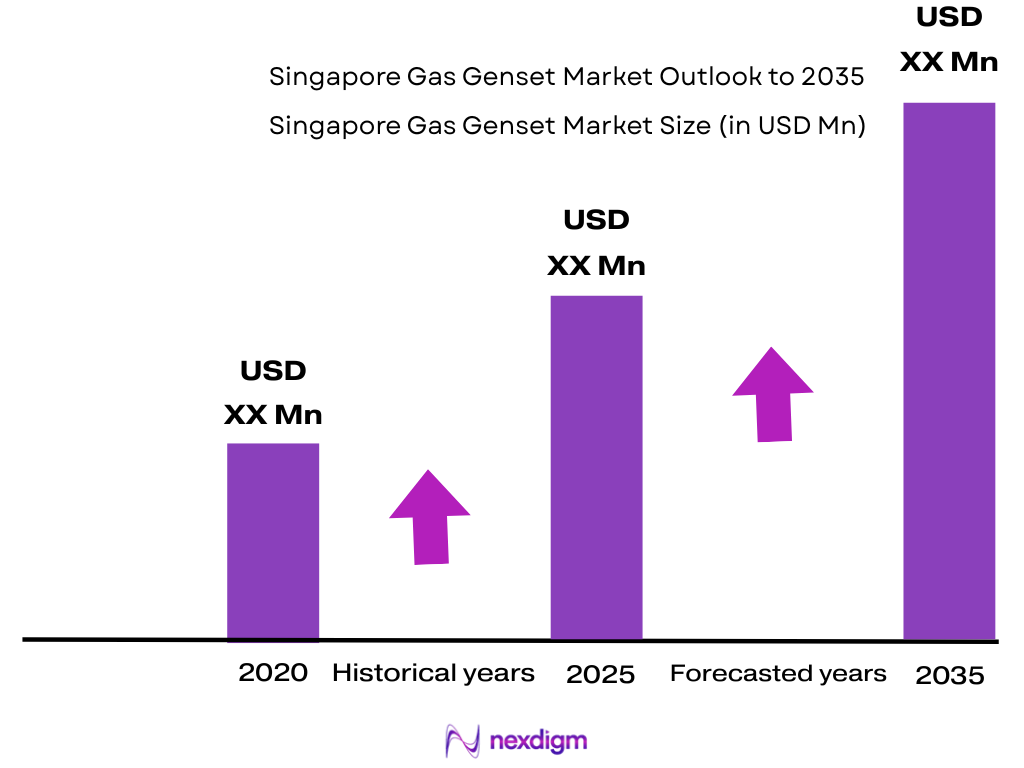
The Singapore Gas Genset Market is expected to expand at approximately ~ CAGR during 2026–2035, supported by digital infrastructure expansion, distributed-energy requirements and demand for resilient lower-emission backup systems. Natural gas will remain strategically relevant because approximately 95% of Singapore’s electricity is currently generated using imported natural gas, creating extensive technical expertise and infrastructure around gas utilisation. Future installations will increasingly compete on efficiency, emissions, hydrogen compatibility, remote condition monitoring and integration with battery energy-storage systems rather than on generator output alone. The expansion of data centres will create specialised demand for high-availability power systems. Singapore has announced at least 300 MW of additional data-centre capacity, with another 200 MW potentially available to projects satisfying green-energy requirements. Gas gensets will nevertheless face competition from battery storage, imported low-carbon electricity and increasingly stringent decarbonisation requirements. Suppliers offering hybrid gas-plus-storage systems and hydrogen-ready engines should therefore be better positioned than conventional standalone genset providers.
Major Players
- Caterpillar Inc.
- Cummins Inc.
- Rehlko Power Systems
- Generac Holdings Inc.
- INNIO Jenbacher
- MWM
- Rolls-Royce Power Systems / mtu
- Wärtsilä
- MAN Energy Solutions
- Mitsubishi Heavy Industries
- Yanmar Energy System
- HIMOINSA
- Baudouin
- Clarke Energy
- Aggreko
Key Target Audience
- Gas genset manufacturers and engine OEMs
- Generator distributors and power-system integrators
- Data centre developers and operators
- Industrial, petrochemical and manufacturing facility operators
- Logistics, warehousing and automotive infrastructure operators
- Natural-gas suppliers and distributed-energy developers
- Investments and venture capitalist firms
- Government and regulatory bodies (Energy Market Authority, National Environment Agency, Economic Development Board, Building and Construction Authority)
Research Methodology
Step 1: Identification of Key Variables
The initial phase constructs the ecosystem of the Singapore Automotive Gas Genset Market across engine manufacturers, generator assemblers, distributors, gas suppliers, system integrators and end users. Variables include installed kW capacity, standby versus prime operation, annual operating hours, fuel consumption, natural-gas availability, data-centre capacity, industrial load profiles, CHP utilisation, emission requirements and generator replacement cycles.
Step 2: Market Analysis and Construction
Historical demand is evaluated using a bottom-up approach based on generator installations across data centres, manufacturing plants, logistics facilities, commercial buildings and automotive-service infrastructure. The supply-side model assesses imported equipment, dealer inventories, installed power ratings, generator configurations and service networks. Singapore’s electricity consumption of 58 TWh, generation of approximately 60 TWh, gas availability and major infrastructure additions provide macro-level checks for market construction.
Step 3: Hypothesis Validation and Expert Consultation
Market hypotheses are validated through CATIs and direct interviews with genset distributors, facility managers, engineering contractors, data-centre operators, gas-system specialists and industrial users. Interviews assess typical generator sizing, duty cycles, redundancy requirements, gas availability, load acceptance, emissions considerations, service-contract preferences and purchasing criteria. The findings are used to test assumptions derived from installed-base and end-user analysis.
Step 4: Research Synthesis and Final Output
The final phase reconciles top-down energy infrastructure indicators with bottom-up generator demand. Particular attention is given to Singapore’s 12,445 MW generation capacity, 453,040 TJ natural-gas supply, 58 TWh electricity consumption and expanding data-centre ecosystem. Supplier portfolios, project activity and end-user interviews are triangulated to build validated segment estimates, competitive positioning and long-term demand scenarios.

- Executive Summary
- Research Methodology (Market Definitions and Assumptions, Natural Gas Genset Scope, Power Rating Classification, Top-Down Market Sizing, Bottom-Up Unit Assessment, Installed Base Analysis, Demand-Side Assessment, Supply-Side Assessment, Import and Distribution Mapping, End-User Interviews, EPC and Facility Manager Interviews, Data Triangulation, Forecasting Framework, Scenario Analysis, Limitations and Future Conclusions)

- Definition and Scope
- Market Evolution and Industry Genesis
- Evolution of Gas-Based Distributed Power Systems
- Natural Gas Supply and Distribution Ecosystem
- Singapore Electricity Generation and Gas Infrastructure Landscape

- Growth Drivers (Natural Gas Infrastructure, Critical Power Demand, Digital Infrastructure Expansion, Industrial Reliability)
- Market Challenges (Capital Intensity, Gas Availability at Site, Equipment Footprint, Emission Compliance, Grid Reliability)
- Market Opportunities (Data Centres, CHP, Microgrids, Hydrogen Readiness, Battery Integration, Distributed Energy)
- Market Trends (Digitalisation, Hybridisation, Emission Reduction, Fuel Flexibility, Energy Optimisation)
- SWOT Analysis
- Porter’s Five Forces Analysis
- PESTLE Analysis

- By Market Value (2020-2025)
- By Unit Installations (2020-2025)
- By Installed Power Capacity (2020-2025)

- By Fuel Configuration (In Value %)
Pipeline Natural Gas Gensets
LNG-Fed Gas Gensets
Biogas-Compatible Gensets
Hydrogen-Ready Gas Gensets
Dual-Fuel Gas Gensets - By Power Rating (In Value %)
Below 100 kVA
100–250 kVA
251–500 kVA
501–1,000 kVA
1,001–2,000 kVA
Above 2,000 kVA - By End User (In Value %)
Data Centres
Automotive Manufacturing and Component Facilities
Automotive Workshops and Service Centres
EV Charging and Mobility Hubs
Commercial Buildings - By Distribution Channel (In Value %)
OEM Direct Sales
Authorised Generator Dealers
Engineering, Procurement and Construction Contractors
Mechanical and Electrical Contractors
Power-System Integrators


- Data Centre Power Demand Analysis
- Automotive and Mobility Facility Demand
- Industrial Manufacturing Demand
- Commercial Building Demand
- Healthcare Facility Demand

- By Market Value (2026-2035)
- By Unit Installations (2026-2035)
- By Installed Power Capacity (2026-2035)


 Request a Sample
 Ask for Customization
 Get a Quote
 Enquire Now