

 Download PDF
Market Overview
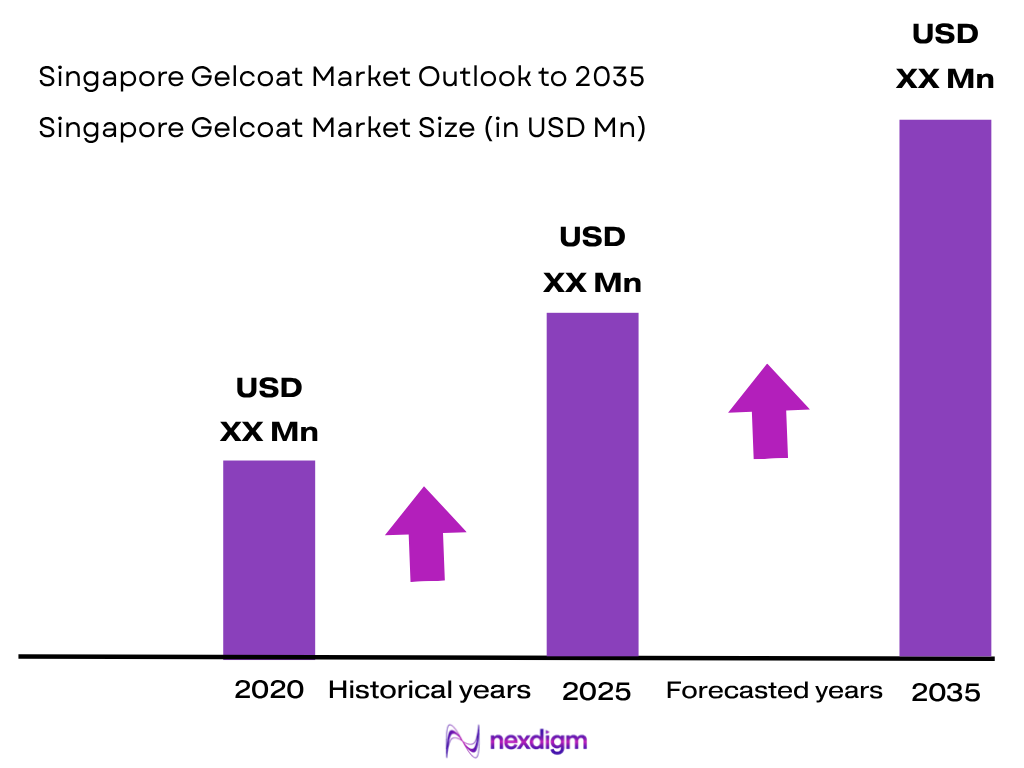
The Singapore Gelcoat Market is valued at USD ~ million, based on the historical market assessment, with demand primarily supported by Singapore’s marine and offshore engineering ecosystem, composite component manufacturing, aerospace activities, and industrial applications requiring corrosion-resistant and durable surface finishes. The market is further influenced by demand for polyester, vinyl ester, epoxy, and specialty gelcoat systems used in boatbuilding, ship repair, offshore components, architectural composites, and industrial equipment. Singapore’s position as a regional maritime and manufacturing hub reinforces recurring demand for technically specialized gelcoat products.
Singapore’s gelcoat consumption is concentrated around its established marine, offshore, aerospace, industrial, and advanced-manufacturing clusters. The Tuas and Jurong Island industrial zones support chemical, petrochemical, offshore, and engineering activities, while Seletar Aerospace Park strengthens demand from aerospace manufacturing and maintenance activities. Marine and ship-repair activities around Singapore’s major maritime facilities create additional demand for marine-grade gelcoats. The country’s role as a Southeast Asian logistics and distribution hub also enables suppliers to serve regional composite manufacturers and marine customers.
Market Segmentation
By Resin Type
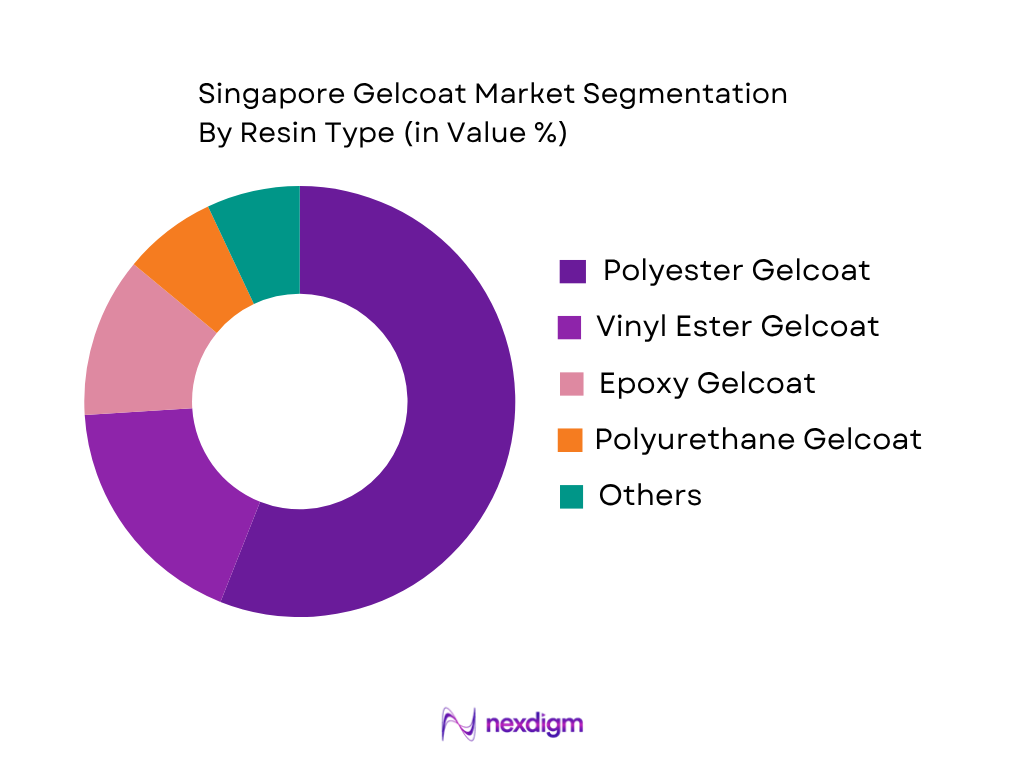
The Singapore Gelcoat Market is segmented by resin type into polyester gelcoat, vinyl ester gelcoat, epoxy gelcoat, polyurethane gelcoat, and hybrid/other resin gelcoats. Polyester gelcoat is expected to account for the dominant share of the market because of its established use in marine composites, recreational boats, architectural components, sanitaryware, and general industrial applications. Its compatibility with conventional fiberglass-reinforced plastic manufacturing processes supports broad adoption among composite fabricators. Polyester systems are also widely used in hand lay-up and spray-up production, two processes relevant to marine and industrial composite manufacturing. Vinyl ester gelcoat maintains strong demand where higher chemical resistance, corrosion resistance, and durability are required, particularly for offshore and industrial applications. Epoxy systems serve more specialized tooling and high-performance composite requirements. The overall resin mix is therefore influenced by the technical specifications of Singapore’s marine, offshore, aerospace, and industrial customers, with conventional polyester systems retaining an important position because of their application familiarity and compatibility with established composite production workflows.
By End-Use Industry
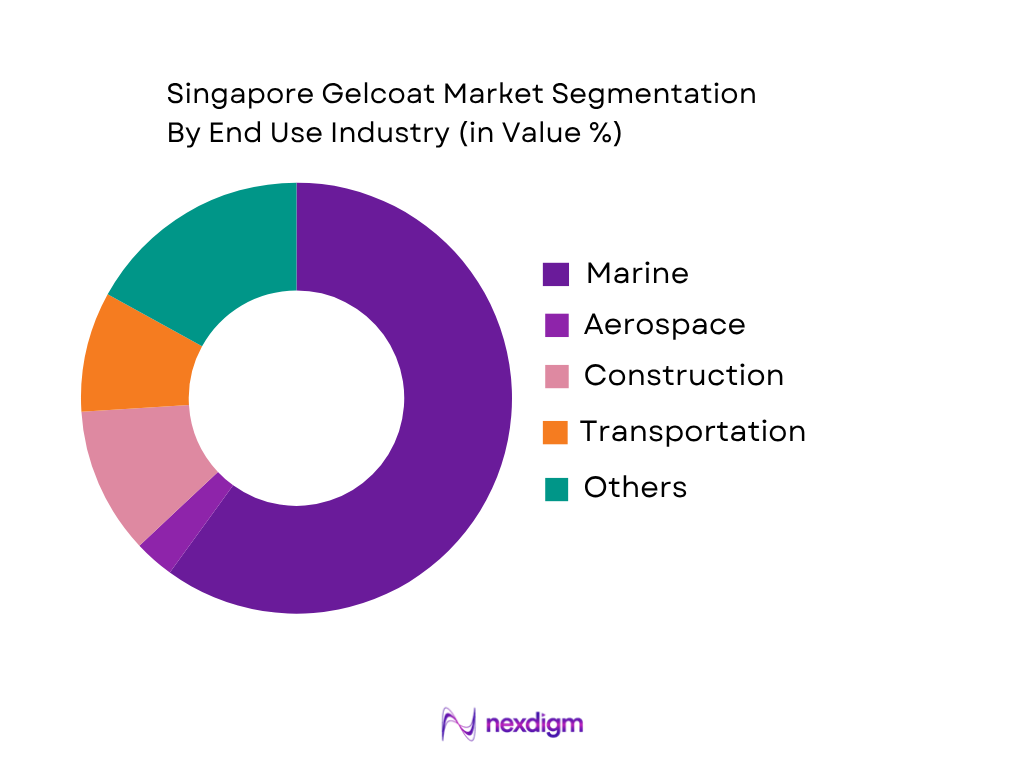
The Singapore Gelcoat Market is segmented by end-use industry into marine, aerospace, construction, transportation, oil & gas and offshore, electrical & electronics, renewable energy, and industrial equipment. The marine segment is expected to maintain the dominant position because Singapore has a highly developed shipbuilding, ship-repair, offshore engineering, and maritime-services ecosystem. Gelcoats are extensively relevant to fiberglass-reinforced plastic components requiring water resistance, weatherability, surface protection, and aesthetic finishing. Applications include boat hulls, decks, marine structures, recreational vessels, and composite repair activities. Offshore engineering additionally supports demand for higher-performance surface systems with chemical and corrosion resistance. Aerospace represents a technically demanding application where lightweight composite structures require controlled surface characteristics and specialized materials. Construction applications include architectural composites, sanitaryware, pools, and decorative components. Industrial equipment applications benefit from gelcoat’s ability to provide protective surfaces on composite tanks, pipes, equipment housings, and other components. The resulting demand structure reflects Singapore’s concentration of maritime and industrial activities alongside its expanding advanced-manufacturing ecosystem.
Competitive Landscape
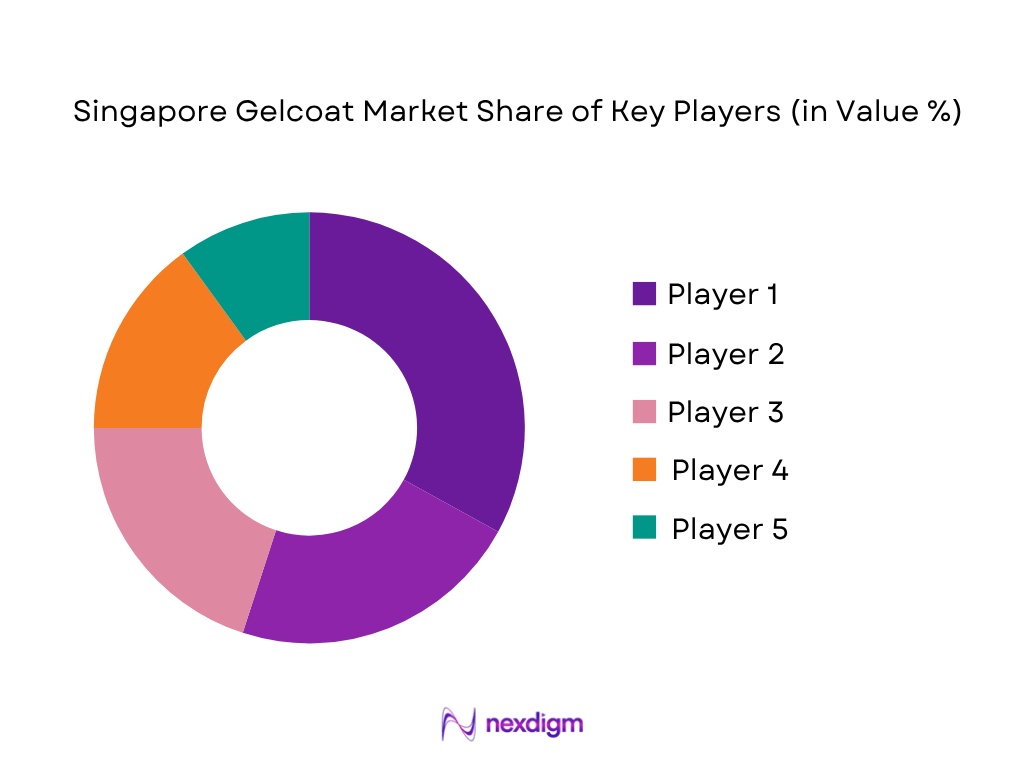
The Singapore Gelcoat Market is characterized by the presence of international specialty chemical and composite-material suppliers serving marine, industrial, aerospace, construction, and advanced composite applications. Competition is influenced by product performance, formulation expertise, technical support, regional distribution capabilities, resin compatibility, application technology, and the ability to supply specialty systems such as low-styrene, fire-retardant, UV-resistant, and chemical-resistant gelcoats. Major suppliers typically compete through broad composite-material portfolios and established distribution networks rather than through Singapore-only manufacturing footprints.
| Company | Establishment Year | Headquarters | Key Product Coverage | Marine Applications | Specialty Gelcoat Capability | Regional Distribution | Technical Support |
| Scott Bader | 1921 | UK | ~ | ~ | ~ | ~ | ~ |
| INEOS | 1998 | UK | ~ | ~ | ~ | ~ | ~ |
| Polynt Group | 1955 | Italy | ~ | ~ | ~ | ~ | ~ |
| BÜFA Composite Systems | 1950 | Germany | ~ | ~ | ~ | ~ | ~ |
| Gurit | 1835 | Switzerland | ~ | ~ | ~ | ~ | ~ |
Singapore Gelcoat Market Analysis
Growth Drivers
Marine and Offshore Composite Demand
Singapore’s position as a global maritime hub directly supports demand for gelcoat systems used on fiberglass-reinforced plastic components, marine structures, vessel interiors, decks, covers, and repair applications. The Port of Singapore handled 622.67 million tonnes of cargo and 41.12 million TEUs of containers, while annual vessel arrivals reached 3.11 billion gross tonnes, creating a substantial installed base of vessels and offshore-related assets requiring composite maintenance and surface protection. Singapore also recorded 54.92 million tonnes of marine-fuel sales, reinforcing the scale of its maritime operating ecosystem. Maritime Singapore is supported by more than 200 international shipping groups, while the 2024 maritime manpower census covered an industry requiring expanding technical and sustainability capabilities. These conditions strengthen recurring requirements for corrosion-resistant and weather-resistant gelcoats across vessel construction, refurbishment and maintenance. The broader economic backdrop is also supportive: Singapore’s GDP reached US$547.39 billion, with GDP growth of 4.4 in 2024 according to the World Bank. The combination of high vessel activity, extensive transshipment operations, marine services and offshore asset maintenance provides a market-specific foundation for polyester, vinyl ester and higher-performance gelcoat applications.
Aerospace Composite Manufacturing
Singapore’s aerospace manufacturing and maintenance ecosystem creates demand for specialized surface-coating and composite-material applications, particularly where lightweight structures, dimensional stability, durability and resistance to demanding operating environments are required. Singapore’s aerospace industry generated more than S$18 billion of output in 2024 and recorded 19 of year-on-year growth, according to Singapore Economic Development Board. The country hosts more than 130 aerospace companies across manufacturing, research and development, maintenance, repair and overhaul, supported by approximately 22,000 workers. Singapore also accounts for about 10 of global MRO output and close to 20 of global engine MRO output, demonstrating the concentration of aerospace maintenance activity within the country. This ecosystem supports consumption of composite materials and associated finishing systems in aircraft components, engine-related applications, maintenance facilities and aerospace manufacturing processes. The wider manufacturing environment further reinforces this demand: Singapore’s manufacturing sector expanded by 4.3 in 2024 after contracting by 4.2 in 2023, with electronics, transport engineering and general manufacturing contributing to the recovery. The resulting concentration of precision manufacturing, aerospace MRO and advanced engineering capabilities supports demand for technically specified gelcoat and composite surface systems. Sources: Singapore Economic Development Board; Singapore Department of Statistics.
Market Challenges
Dependence on Imported Resin Feedstocks
Singapore’s limited domestic chemical-resource base makes gelcoat manufacturers and composite fabricators structurally exposed to international supply chains for polyester, vinyl ester, epoxy, polyurethane and specialty additives. This exposure is particularly relevant because gelcoat formulations require controlled combinations of resins, pigments, fillers, catalysts and performance additives, making substitution difficult when specific grades are unavailable. Singapore’s highly trade-dependent industrial structure amplifies this vulnerability. The World Bank records US$547.39 billion of GDP and a population of 6,036,860 for 2024, illustrating an advanced but relatively small domestic market that cannot independently support the complete upstream feedstock chain required for every specialty resin formulation. Singapore’s manufacturing sector nevertheless expanded by 4.3 in 2024, increasing the importance of reliable material supply for advanced manufacturing applications. Meanwhile, the Port of Singapore processed 622.67 million tonnes of cargo and 41.12 million TEUs in 2024, demonstrating both the scale of inbound industrial logistics and the country’s dependence on international trade flows. For gelcoat suppliers, disruptions in petrochemical production, shipping schedules, regional chemical availability or specialty additive supply can therefore affect formulation continuity and lead times. Sources: World Bank; Singapore Department of Statistics; Maritime and Port Authority of Singapore.
Environmental and Styrene Compliance
Environmental requirements create an important technical challenge for conventional gelcoat systems because many polyester and vinyl ester formulations rely on styrene-containing chemistry, while Singapore is progressively strengthening environmental performance expectations across industrial activity. The challenge is particularly relevant for composite fabrication, repair and finishing operations where resin handling can involve volatile organic compounds and occupational exposure controls. Singapore’s economy generated US$547.39 billion of GDP in 2024 and recorded 4.4 GDP growth, while manufacturing expanded by 4.3, increasing the importance of maintaining industrial productivity alongside environmental controls. The country also recorded S$13.5 billion in fixed-asset investment commitments in 2024, including S$11.1 billion directed to manufacturing, according to Singapore Economic Development Board. This investment is concentrated in advanced sectors such as semiconductors, biomedical manufacturing, specialty chemicals and aerospace, raising expectations for controlled production environments and higher-performing materials. Gelcoat producers consequently face the need to develop low-emission formulations without sacrificing cure behavior, adhesion, gloss, weather resistance and surface durability. Compliance requirements can also increase formulation-development complexity and require investment in ventilation, handling procedures and process controls.
Market Opportunities
Low-Styrene and Zero-Styrene Formulations
The transition toward lower-emission composite manufacturing creates an opportunity for Singapore’s gelcoat market to shift toward low-styrene, zero-styrene and alternative-reactive formulations without relying solely on conventional polyester systems. Singapore’s advanced manufacturing base provides a suitable customer environment because manufacturing expanded by 4.3 in 2024, while fixed-asset investment commitments reached S$13.5 billion, including S$11.1 billion for manufacturing. The aerospace ecosystem alone generated more than S$18 billion of output and includes more than 130 aerospace companies, creating technically demanding applications where material performance and controlled processing are important. Maritime activity provides another immediate application base: Singapore handled 41.12 million TEUs and 622.67 million tonnes of cargo in 2024, while vessel arrival tonnage reached 3.11 billion gross tonnes. These conditions create opportunities for suppliers offering lower-emission gelcoat systems for marine repair, aerospace composites, industrial equipment and architectural applications. Product development can focus on reducing styrene emissions while maintaining surface hardness, colour stability, UV resistance, chemical resistance and interlaminar compatibility. Suppliers capable of combining environmental performance with established application characteristics can therefore address Singapore’s highly specialized composite-processing ecosystem and potentially serve neighboring Southeast Asian fabrication markets through Singapore’s established logistics infrastructure.
High-Performance Marine Gelcoats
Singapore’s maritime concentration creates a strong platform for advanced marine gelcoats designed for demanding vessel, offshore and marine-maintenance applications. The Port of Singapore recorded 3.11 billion gross tonnes of vessel arrivals and 622.67 million tonnes of cargo throughput in 2024, while container throughput reached 41.12 million TEUs. Marine-fuel sales also reached 54.92 million tonnes, demonstrating the scale of vessel activity and associated maintenance requirements. Singapore is additionally home to more than 200 international shipping groups, providing access to shipowners, operators, maritime-service providers and technical-management companies. These conditions create opportunities for gelcoats engineered for high UV exposure, saltwater resistance, hydrolysis resistance, abrasion resistance, low water absorption and extended surface durability. Higher-performance formulations can target hull and deck components, superstructures, marine interiors, tanks, covers and composite repair applications. The opportunity extends beyond new vessel construction because Singapore’s role as a major transshipment and bunkering hub generates a large installed base of vessels requiring periodic maintenance and refurbishment. Suppliers can therefore differentiate through faster curing, improved adhesion, colour retention and compatibility with modern composite repair systems. The country’s established maritime logistics infrastructure also provides a practical platform for distributing specialized marine gelcoat products throughout Southeast Asia.
Future Outlook
Over the forecast period, the Singapore Gelcoat Market is expected to demonstrate sustained development as composite materials become increasingly important across marine, offshore, aerospace, transportation, construction, and industrial applications. Demand is expected to shift toward higher-performance formulations offering improved UV resistance, chemical resistance, weatherability, fire performance, and lower emissions. The increasing emphasis on sustainable composite manufacturing is also expected to encourage development of low-styrene, reduced-emission, and bio-based resin systems. Singapore’s role as a maritime and advanced-manufacturing hub should support continued demand for specialized gelcoat technologies and technical application services.
Major Players
- Scott Bader Company Limited
- INEOS
- Interplastic Corporation
- Polynt Group
- BÜFA Composite Systems GmbH & Co. KG
- Allnex
- AOC
- Gurit
- Mäder Group
- Ashland
- 3M
- Sika AG
- AkzoNobel
- HK Research Corporation
- Reichhold / Polynt-Reichhold
Key Target Audience
- Marine and shipbuilding manufacturers
- Offshore engineering and composite-component manufacturers
- Aerospace composite manufacturers and MRO operators
- Construction and architectural composite manufacturers
- Industrial composite equipment manufacturers
- Specialty chemical and composite-material distributors
- Investments and venture capitalist firms
- Government and regulatory bodies (Maritime and Port Authority of Singapore, Enterprise Singapore, Singapore Economic Development Board, National Environment Agency)
Research Methodology
Step 1: Identification of Key Variables
The initial stage involves mapping the Singapore Gelcoat Market ecosystem across resin suppliers, gelcoat manufacturers, distributors, composite fabricators, shipyards, aerospace manufacturers, offshore engineering companies, and industrial end users. Key variables include resin type, application method, consumption volume, end-use industry, import dependence, product specifications, and distribution structure.
Step 2: Market Analysis and Construction
Historical market information is compiled through a combination of trade data, industry databases, manufacturer information, distributor assessments, composite-industry statistics, and company disclosures. The market is constructed using both value and volume indicators, with separate assessment of domestic supply, imports, applications, resin systems, and end-use industries.
Step 3: Hypothesis Validation and Expert Consultation
Market hypotheses are validated through interviews with manufacturers, distributors, composite fabricators, marine-industry participants, and industrial users. Discussions focus on product selection criteria, application processes, demand patterns, procurement structures, formulation requirements, supplier relationships, and changes in composite manufacturing technology.
Step 4: Research Synthesis and Final Output
The final analysis integrates top-down and bottom-up estimates and reconciles manufacturer, distributor, trade, and end-user information. Market data are triangulated across resin type, product type, application, manufacturing process, and end-use industry to establish a consistent market structure and forecast framework.

- Executive Summary
- Research Methodology (Market Definition and Scope, Gelcoat Product Boundary, Market Sizing Framework, Top-Down Market Construction, Bottom-Up Market Construction, Demand-Side Assessment, Supply-Side Assessment, Import-Export Reconciliation, Primary Industry Interviews, Manufacturer Validation, Distributor Assessment, End-User Interviews, Data Triangulation, Forecasting Framework, Scenario Analysis, Research Limitations)

- Definition and Scope
- Gelcoat Product Architecture and Functional Role in Composite Manufacturing
- Singapore Gelcoat Industry Evolution
- Gelcoat Industry Value Chain
- Gelcoat Supply Chain Structure
- Singapore Composite Manufacturing Ecosystem

- Growth Drivers (Marine and Offshore Composite Demand, Aerospace Composite Manufacturing, Advanced Manufacturing Expansion, Construction and Architectural Composites, Transportation Lightweighting, Wind and Renewable Energy Components, Industrial Corrosion Protection, Expansion of Composite Repair and Maintenance Activities)
- Market Challenges (Dependence on Imported Resin Feedstocks, Volatility in Polyester and Vinyl Ester Inputs, Environmental and Styrene Compliance, Limited Domestic Gelcoat Manufacturing Depth, Skilled Composite Application Requirements, Small Domestic Production Base, Alternative Coating Technologies, Supply Chain Exposure to Global Chemical Markets)
- Market Opportunities (Low-Styrene Gelcoats, Zero-Styrene Formulations, High-Performance Marine Gelcoats, Fire-Retardant Gelcoats, Aerospace-Grade Surface Systems, Sustainable Composite Coatings, Bio-Based Resin Systems, Advanced In-Mould Gelcoats, Regional Export and Distribution Hub Development)
- Market Trends (Low-Emission Formulations, Sustainable Composite Materials, High-Weatherability Gelcoats, Spray Application Adoption, Advanced Marine Composites, Lightweight Composite Structures, Digitalized Composite Processing, High-Performance Tooling Systems)
- SWOT Analysis
- Porter’s Five Forces Analysis
- PESTLE Analysis

- By Market Value (2020-2025)
- By Consumption Volume (2020-2025)
- By Domestic Supply Volume (2020-2025)
- By Imported Gelcoat Volume (2020-2025)
- By Resin Consumption (2020-2025)
- By End-Use Consumption (2020-2025)

- By Resin Type (In Value %)
Polyester Gelcoat
Vinyl Ester Gelcoat
Epoxy Gelcoat
Polyurethane Gelcoat
Hybrid and Other Resin Gelcoats - By Product Type (In Value %)
Standard Gelcoat
Specialty Gelcoat
Tooling Gelcoat
Fire-Retardant Gelcoat
Low-Styrene Gelcoat
UV-Resistant Gelcoat
Chemical-Resistant Gelcoat
Marine-Grade Gelcoat - By Application Method (In Value %)
Spray Application
Brush Application
Roller Application
In-Mould Gelcoat Application
Doctor-Blade and Other Specialized Application - By End-Use Industry (In Value %)
Marine
Wind Energy
Transportation
Construction
Aerospace
Oil & Gas and Offshore
Electrical & Electronics
Industrial Equipment
Sanitaryware and Recreational Products - By Application (In Value %)
Boat Hulls and Decks
Yacht and Recreational Marine Components
Ship Repair and Maintenance
Offshore Composite Components
Wind Turbine Blade Surfaces
Automotive and Transportation Composite Parts
Architectural and Construction Components
Aerospace Composite Components
Sanitaryware and Swimming Pools
Industrial Tanks, Pipes and Equipment - By Composite Manufacturing Process (In Value %)
Hand Lay-Up
Spray-Up
Resin Transfer Molding
Vacuum Infusion
Compression Molding
Pultrusion
Filament Winding
Other Composite Processing Methods

- Market Share Analysis of Major Players (By Resin Type, Product Type, Application Method, End-Use Industry, Application, Domestic Supply)
- Cross Comparison Parameters (Gelcoat Product Portfolio Breadth, Polyester and Vinyl Ester Formulation Capability, Low-Styrene Product Availability, Marine-Grade Product Coverage, Fire-Retardant Gelcoat Capability, Aerospace and High-Performance Composite Coverage, Technical Application Support Capability, Singapore and Southeast Asia Distribution Network)
- SWOT Analysis of Major Players
- Detailed Profiles of Major Companies
Scott Bader Company Limited
INEOS
Interplastic Corporation
Polynt Group
BÜFA Composite Systems GmbH & Co. KG
Allnex
AOC
Gurit
Mäder Group
Ashland
3M
Sika AG
AkzoNobel
HK Research Corporation
Reichhold / Polynt-Reichhold

- Marine and Shipbuilding Demand Assessment
- Aerospace Demand Assessment
- Construction Demand Assessment
- Transportation Demand Assessment
- Industrial Demand Assessment
- Renewable Energy Demand Assessment

- By Market Value (2026-2035)
- By Consumption Volume (2026-2035)
- By Domestic Supply Volume (2026-2035)
- By Imported Gelcoat Volume (2026-2035)
- By Resin Consumption (2026-2035)
- By End-Use Consumption (2026-2035)


 Request a Sample
 Ask for Customization
 Get a Quote
 Enquire Now