

 Download PDF
Market Overview
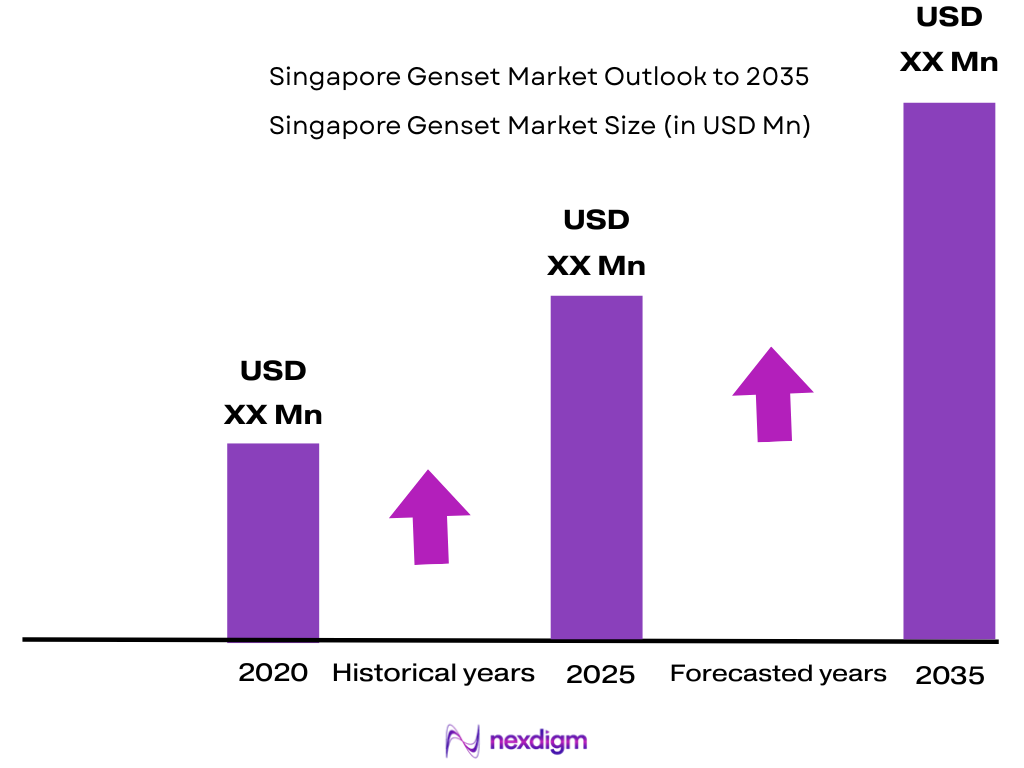
The Singapore Genset Market is valued at approximately ~ million, supported by construction contracts increasing from S$33.8 billion to S$44.2 billion and electricity output reaching approximately 60 TWh, compared with about 59 TWh previously. Infrastructure construction, temporary-site electricity, industrial backup requirements, transport facilities and mission-critical installations sustain genset procurement even within Singapore’s highly reliable electricity system. Tuas, Jurong, Changi and major central redevelopment corridors dominate Singapore Automotive Genset deployment because they contain industrial plants, logistics facilities, port infrastructure, construction sites and critical commercial properties. Construction activity expanded from S$33.8 billion to S$44.2 billion, while Singapore maintained approximately 1.01 million registered motor vehicles, including 167,057 goods and other vehicles. Major infrastructure development at Tuas Port and Changi further supports mobile and standby power requirements.
Market Segmentation
By Power Rating
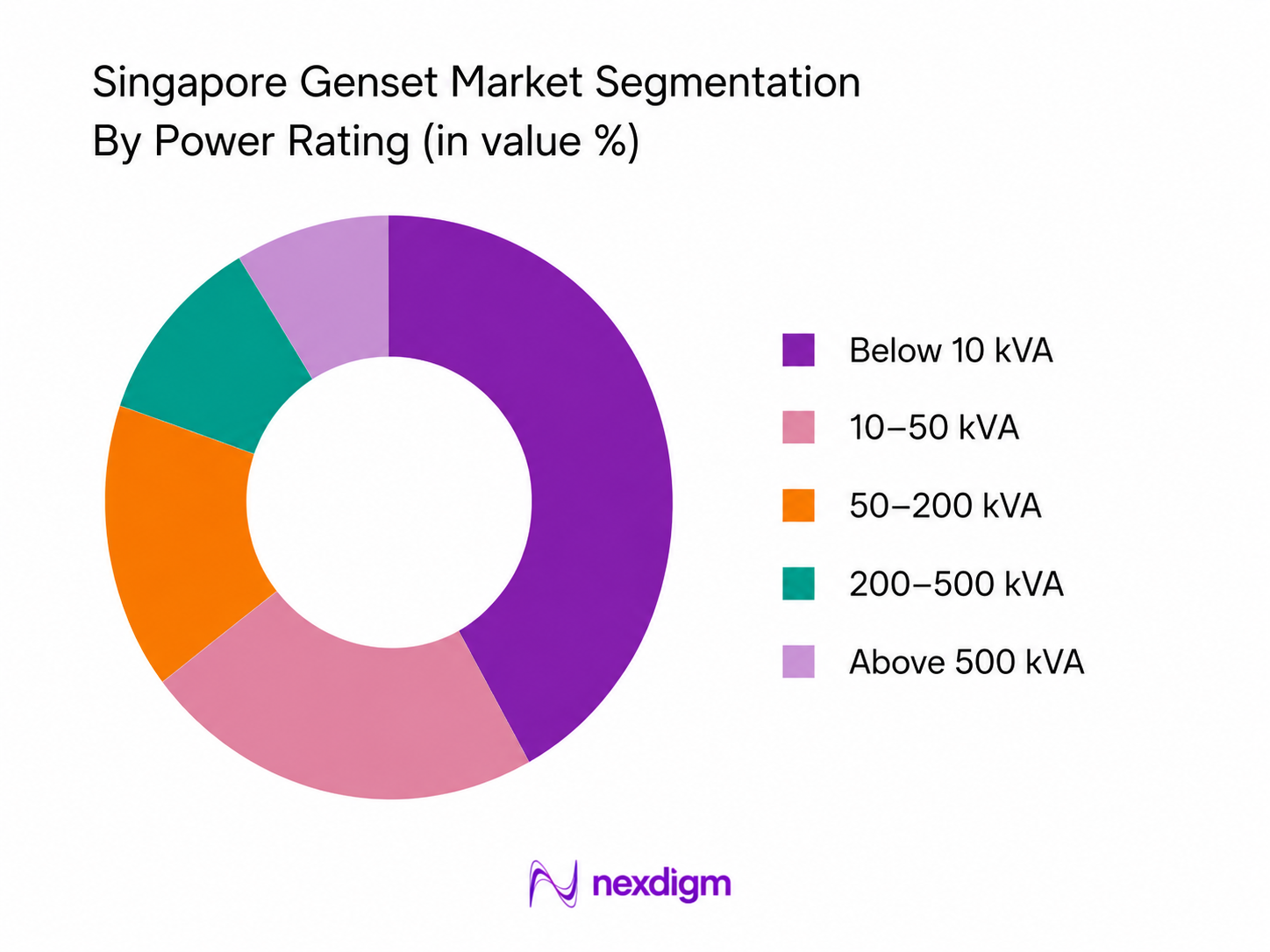
The Singapore Genset Market is segmented by power rating into below 10 kVA, 10–50 kVA, 50–200 kVA, 200–500 kVA and above 500 kVA systems. Recently, the 10–50 kVA category has a dominant market share within the power-rating segmentation because it provides a practical combination of mobility, output and installation flexibility for construction contractors, automotive workshops, temporary facilities, small commercial operations and event-support applications. Singapore’s construction pipeline reinforces this requirement, with actual construction demand reaching S$44.2 billion and continuing infrastructure development involving housing, rail, airport and port projects. Compact mobile generators can be transported between worksites more easily than large stationary units and can support power tools, lighting, pumps, compressors, service equipment and temporary site offices. This segment also benefits from increasing demand for acoustic enclosures, automatic voltage regulation, compact footprints and fuel-efficient engines, particularly because Singapore’s dense urban environment places strong constraints on equipment noise and operating space.
By Application
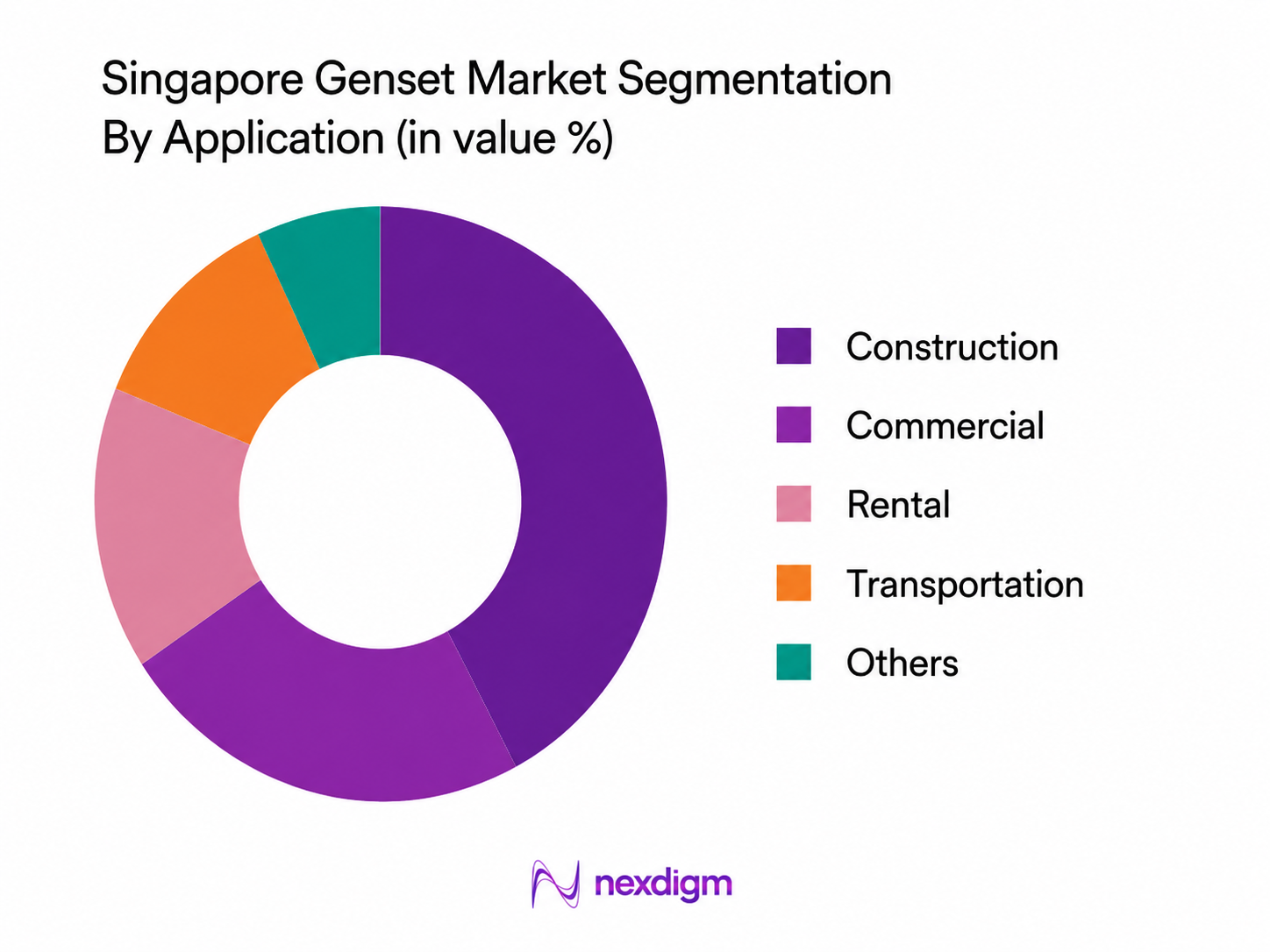
The Singapore Genset Market is segmented into construction and infrastructure, commercial and industrial backup, transport and automotive facilities, rental and event power, and emergency/other applications. Construction and infrastructure represent the dominant application segment because Singapore maintains a large pipeline of public housing, rail, airport, port, institutional and urban-development projects. Construction demand reached S$44.2 billion, supported by public institutional developments and public and private housing, while upcoming works include Changi Airport Terminal 5, Cross Island Line extensions, Tuas Port, healthcare developments and industrial estates. These projects require temporary electricity for site equipment, worker facilities, lighting, pumping, testing, commissioning and emergency backup before permanent electrical connections are established. Mobile and sound-attenuated gensets are particularly relevant because worksites frequently operate close to residential or commercial districts. Rental companies also rotate generators between projects, supporting demand for robust mobile systems with simplified controls, remote monitoring, low-noise enclosures and reliable parts availability.
Competitive Landscape
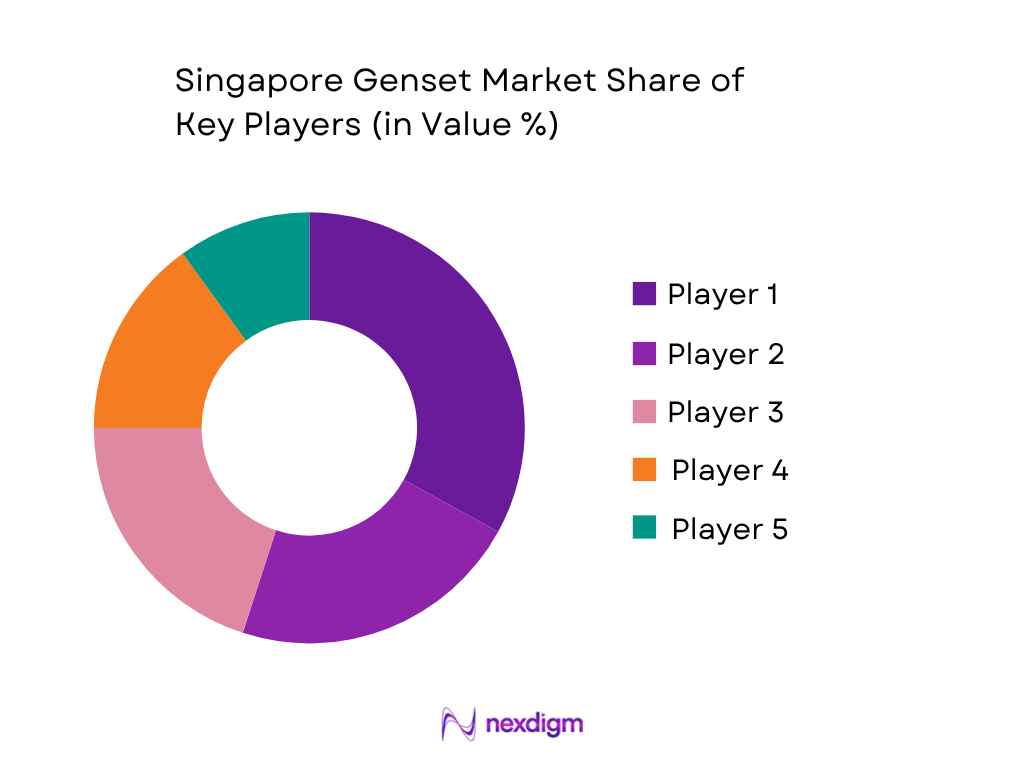
The Singapore Genset Market includes global power-generation manufacturers and specialist generator suppliers serving construction, industrial, infrastructure and standby-power applications. Competition centres on equipment reliability, kVA coverage, acoustic performance, footprint, fuel efficiency, remote monitoring, local parts availability and after-sales service. Denyo maintains Singapore as its Asia-Pacific regional centre, while Cummins, Caterpillar, FG Wilson and Atlas Copco compete through broad power-generation portfolios and dealer or distribution networks.
| Major Player | Establishment Year | Headquarters | Power Portfolio | Mobile Gensets | Standby Capability | Acoustic Solutions | Remote/Smart Controls | Key Singapore Applications |
| Denyo Co., Ltd. | 1948 | Tokyo, Japan | ~ | ~ | ~ | ~ | ~ | ~ |
| Cummins Inc. | 1919 | Indiana, USA | ~ | ~ | ~ | ~ | ~ | ~ |
| Caterpillar Inc. | 1925 | Texas, USA | ~ | ~ | ~ | ~ | ~ | ~ |
| FG Wilson | 1966 | Northern Ireland, UK | ~ | ~ | ~ | ~ | ~ | ~ |
| Atlas Copco | 1873 | Nacka, Sweden | ~ | ~ | ~ | ~ | ~ | ~ |
Singapore Genset Market Analysis
Growth Drivers
Strong Construction and Infrastructure Project Pipeline
Singapore’s sustained construction and infrastructure pipeline is a major growth driver for the Genset Market because mobile and transportable generator sets are required at construction sites, civil-engineering projects, temporary facilities, equipment yards and locations where permanent grid connections are unavailable or not yet commissioned. The Building and Construction Authority recorded S$44.2 billion of construction demand in 2024, while preliminary actual construction demand increased to S$50.5 billion in 2025. BCA subsequently indicated that construction demand during 2026 is expected to remain within a S$47 billion–S$53 billion range, underlining the scale of ongoing building and civil-engineering activity. These projects support requirements for mobile diesel gensets powering cranes, lighting towers, pumps, welding equipment, site offices, ventilation systems, testing equipment and auxiliary construction machinery. Temporary generation is particularly relevant during early project stages, underground works, road projects and infrastructure upgrading where grid access can be constrained or where independent redundancy is required. Singapore’s underlying macroeconomic base also supports high construction intensity: World Bank data places national GDP at USD 547.39 billion in 2024, with a population of 6,036,860, reflecting the economic density concentrated within a geographically compact city-state. Gross fixed capital formation reported by the Singapore Department of Statistics reached S$161.04 billion in 2024 and increased to S$174.36 billion in 2025, demonstrating continued capital deployment into buildings, machinery, transport infrastructure and productive assets. This capital formation is particularly relevant for generator suppliers because mobile power demand is connected to the pace of physical asset creation rather than simply final electricity consumption. Large public-sector projects, housing programmes, rail and transport upgrades, institutional developments and commercial construction create recurring rental and procurement opportunities for gensets covering small portable units through larger trailer-mounted systems. At the same time, Singapore’s dense built environment creates demand for compact, acoustically enclosed and lower-emission gensets rather than basic open-frame equipment. Contractors operating near residential or noise-sensitive premises must manage generator noise alongside other construction machinery. The National Environment Agency requires construction sites located within 150 metres of noise-sensitive premises to closely monitor noise, while daytime construction noise affecting nearby residential buildings is subject to limits including 90 dBA over 5 minutes and 75 dBA over 12 hours. This encourages demand for sound-attenuated canopies, remote generator placement, load optimisation and lower-speed or hybridized generating systems. Consequently, continuing construction activity supports not only unit demand but also technological upgrading toward quieter and more fuel-efficient equipment. For suppliers, rental companies and fleet operators, the combination of S$50.5 billion of recent construction demand, S$174.36 billion in gross fixed capital formation and Singapore’s USD 547.39 billion economic base creates a substantial addressable environment for temporary and mobile generating equipment.
Expansion of Data Centres, Digital Infrastructure and Critical Backup Loads
Singapore’s rapidly expanding digital infrastructure creates another major driver for the Genset Market because data centres, telecommunications sites, logistics facilities and other critical-load environments require dependable backup power even though the national grid itself is highly reliable. The Infocomm Media Development Authority identifies Singapore as a major regional data-centre hub with installed capacity exceeding 1.4 GW. Under the Green Data Centre Roadmap, the government initiated plans for at least 300 MW of additional capacity, followed by another allocation of at least 200 MW announced through the subsequent data-centre development call. Each new data-centre campus creates demand for layered resilience architecture involving grid supply, UPS systems, energy storage and standby generating assets. Automotive and mobile gensets also participate indirectly through construction, commissioning, temporary power, maintenance shutdowns and emergency deployments around these facilities. Singapore’s electricity system illustrates why backup equipment functions as an insurance and resilience asset rather than compensation for an unreliable grid. The Energy Market Authority reported electricity consumption of approximately 58 TWh in 2024, while commerce and services consumed approximately 23 TWh and industrial users consumed another 23 TWh. Total electricity generation increased by 2,232 GWh from the preceding year, and system peak demand increased by 184 MW. Despite this rising load, each electricity customer experienced only 0.006 sustained interruptions, lasting an average of just 0.26 minutes across the year. Such high reliability does not remove generator demand among critical facilities because data centres, hospitals, telecom infrastructure, financial facilities and process industries frequently design for continuity even during low-probability outages, voltage disturbances or internal distribution failures. The scale of Singapore’s economy intensifies the value of continuity. World Bank data records GDP of USD 547.39 billion in 2024 for a population of 6,036,860, meaning substantial economic output and digital activity are concentrated within a small physical area. Information- and communications-intensive facilities therefore carry large operational consequences when power is disrupted. Singapore’s electricity demand structure reinforces this relationship: commerce, services and industrial activities together consumed approximately 46 TWh in 2024, creating a large pool of business-critical electrical loads. Generator suppliers can address this environment through high-availability diesel sets, mobile emergency units, synchronized generator packages, paralleling control systems and temporary replacement gensets during maintenance. Mobile units are particularly valuable when installed standby generators undergo overhaul, load-bank testing or fuel-system maintenance because temporary units can maintain redundancy without altering the facility’s permanent power architecture. Data-centre expansion additionally raises performance expectations. Customers increasingly require fast-starting engines, remote monitoring, digital controllers, automatic transfer interfaces, low-noise enclosures and fuel-efficient operation under variable load. The sector is also creating demand for lower-emission alternatives because the Green Data Centre Roadmap links capacity expansion with improved sustainability. This favors generator systems compatible with cleaner fuels, hybrid battery integration and intelligent dispatch. Therefore, Singapore’s combination of a 1.4-GW-plus data-centre base, planned additions of hundreds of megawatts, 58 TWh of annual electricity consumption and a USD 547.39 billion economy establishes critical-load resilience as a durable demand driver for genset manufacturers, rental providers and power-system integrators.
Market Challenges
Exceptional Grid Reliability Limits Routine Standby Generator Utilisation
One of the most significant structural challenges facing Singapore’s Genset Market is the exceptional reliability of the national electricity grid. Generator sets are normally attractive where customers face frequent grid failures, prolonged interruptions or weak transmission networks; Singapore operates under almost the opposite conditions. The Energy Market Authority reported that electricity customers experienced an average of only 0.006 sustained interruptions in 2024, while the average interruption duration was approximately 0.26 minutes per customer across the entire year. This reduces the economic justification for purchasing generators solely to address routine utility outages, especially among small commercial establishments and residential users. Singapore nevertheless consumed approximately 58 TWh of electricity in 2024, with peak electricity demand increasing by 184 MW over the previous year, showing that grid reliability has been maintained even as system utilisation increased. The challenge for genset suppliers is therefore not inadequate electricity access but persuading end users that backup systems are necessary for business-continuity, safety or regulatory reasons despite a highly dependable grid. World Bank data reinforces the unusual structure of this market: Singapore generated USD 547.39 billion of GDP in 2024 with a population of only 6,036,860, making it a high-income, infrastructure-intensive economy with strong utility coverage. In such an environment, many users can rely on grid redundancy, UPS equipment or building-level electrical architecture instead of maintaining independent generating assets. The Energy Market Authority has also continued investing in system resilience and additional power-generation capacity, further limiting any narrative based on chronic electricity shortages. This places greater pressure on genset vendors to target applications where an interruption of even seconds can create unacceptable operational consequences. Data centres, hospitals, transport infrastructure, marine facilities, semiconductor plants and financial infrastructure remain attractive because backup systems form part of risk-management architecture. By contrast, routine offices, retail establishments and smaller commercial facilities may have little reason to deploy independent generator capacity beyond legally required emergency loads. High grid reliability also lowers actual annual run-hours for standby gensets. Equipment can remain idle for long periods except during periodic testing and maintenance, complicating customer perceptions of asset utilisation. Suppliers therefore compete less on generating hours and more on assurance, maintenance availability, rapid-start capability, reliability and compliance. Rental fleets face a related issue: demand can become concentrated around construction projects, planned shutdowns, special events and emergency contingencies instead of recurring outage-driven operation. Market participants must consequently build diversified revenue streams around rentals, maintenance contracts, load-bank testing, temporary power and emergency mobilisation. Grid reliability also increases competitive pressure from battery energy-storage systems because short-duration backup requirements can increasingly be addressed without combustion engines. Singapore’s high digital and electricity intensity still supports genset demand, but it is concentrated in mission-critical rather than broad-based outage applications. The 0.26-minute annual interruption duration is therefore both evidence of infrastructure quality and a fundamental market restraint. Successful suppliers must position gensets as resilience infrastructure for high-consequence applications rather than as basic substitutes for unreliable utility power.
Noise, Fuel Storage and Environmental Compliance Constraints
Singapore’s compact urban form creates demanding operating conditions for combustion-based gensets because equipment must comply with strict controls covering noise, fuel handling, fire safety and environmental performance. Noise is particularly important for mobile generators used on construction sites and industrial premises. The National Environment Agency limits construction noise affecting residential buildings within 150 metres of a site to 90 dBA over a 5-minute period and 75 dBA across the daytime 12-hour measurement period. Evening and nighttime limits become substantially more restrictive. Industrial premises are also subject to boundary noise controls; equipment affecting residential premises must remain within prescribed levels that include 70 dBA over a 5-minute period during daytime and 65 dBA during evening hours. Generators therefore cannot be treated simply as mechanical power sources. Their acoustic enclosures, exhaust systems, installation locations, ventilation design and operating schedules become important purchasing parameters. The challenge is magnified in a city-state with 6,036,860 residents and GDP of USD 547.39 billion in 2024, according to the World Bank, because residential, commercial, industrial and infrastructure uses coexist within limited land area. Fuel management adds a second layer of compliance. The Singapore Civil Defence Force controls petroleum and flammable-material imports, transportation and storage under the Fire Safety framework, and operators exceeding stipulated exemption quantities require appropriate licences. Fuel tanks associated with generating equipment must therefore be designed and managed within prescribed safety requirements, affecting installations at factories, data centres, temporary construction sites and commercial facilities. SCDF’s Fire Code also explicitly recognises emergency generators within secondary power-supply arrangements, demonstrating the technical and fire-safety obligations attached to genset installations. For mobile or rental fleets, moving diesel fuel between sites creates additional operating considerations involving approved containers, licensed transportation and safe storage. Environmental policy creates another constraint. Singapore is progressively tightening energy-efficiency and carbon-management requirements across industrial and commercial sectors. Although fuel used solely for emergency standby generators receives specific treatment within certain industrial energy-reporting provisions, the broader regulatory direction favours lower emissions and improved energy efficiency. Generator manufacturers must consequently invest in engines, exhaust treatment, enclosure design and control systems capable of meeting customer sustainability requirements. Construction customers face especially visible pressure because sites close to residential and noise-sensitive buildings can be required to install noise meters and maintain records for regulatory enforcement. This raises demand for super-silent generators but can simultaneously increase equipment complexity and reduce the attractiveness of older rental fleets. Space constraints also matter because effective acoustic attenuation and fuel storage occupy valuable site area. Unlike less densely populated markets where generators can be placed far from buildings, Singapore projects often require compact footprints alongside strict ventilation and access conditions. Suppliers therefore face higher technical expectations in enclosure engineering, exhaust routing, fire protection, vibration isolation and remote monitoring. The resulting compliance burden can lengthen installation and commissioning processes, while creating additional responsibilities for operators. Singapore’s genset market consequently favours modern, low-noise, compact and professionally maintained fleets, while older or basic open-frame generating equipment becomes progressively less suitable for many urban applications.
Market Opportunities
Hybrid Gensets, Battery Integration and Intelligent Power Management
Singapore’s energy and sustainability transition creates a significant opportunity for suppliers of hybrid gensets that combine internal-combustion generators with batteries, digital power controls and remote monitoring. Conventional generator sets are often oversized to accommodate peak loads, meaning engines can spend long operating periods below their efficient loading range. Hybrid systems can instead use batteries to manage transient loads, provide short-duration power and allow the engine to operate only when required. This architecture is particularly relevant in Singapore because construction sites, temporary facilities, logistics yards and events frequently have variable load profiles involving lighting, pumps, tools, site offices and intermittent machinery. The scale of electricity usage demonstrates the broader opportunity for intelligent power management: Singapore consumed approximately 58 TWh of electricity in 2024, while peak demand increased by 184 MW. Commerce and services consumed approximately 23 TWh, industrial users consumed another 23 TWh, households consumed approximately 8 TWh and transportation consumed around 3 TWh. These figures indicate an increasingly electrified economy in which temporary and backup power solutions must integrate with sophisticated electrical loads. Singapore’s macroeconomic resources also support adoption of higher-technology equipment. World Bank data places national GDP at USD 547.39 billion in 2024, with GDP per capita of approximately USD 90,674, giving businesses the financial capacity to prioritise lifecycle efficiency, reliability and emissions performance rather than selecting equipment solely on basic generator capacity. The opportunity is strengthened by the construction pipeline. Actual construction demand reached approximately S$50.5 billion in 2025, following S$44.2 billion in 2024, creating a large pool of projects where temporary power equipment can be introduced. Hybrid generators are especially attractive at urban construction sites because reduced engine run-hours can decrease noise and local exhaust emissions, helping operators work within National Environment Agency requirements. Digital controls provide another source of value. Remote telemetry can track operating hours, load, fuel consumption, battery state, faults and maintenance requirements across dispersed rental fleets. This enables suppliers to optimise deployment, avoid unnecessary engine operation and schedule preventive maintenance based on actual machine condition. Generator rental companies can therefore shift from simple equipment leasing toward managed temporary-power services. Data centres represent an additional opportunity for hybrid technology, particularly for temporary redundancy, commissioning and ancillary applications. Singapore’s data-centre capacity already exceeds 1.4 GW, with government programmes supporting hundreds of megawatts of additional capacity. While large permanent standby plants will continue requiring highly reliable engine-based generation, battery systems can support bridging, peak management and control optimisation. Similar hybrid architectures can serve telecommunications sites, events and marine operations. Cleaner fuels may further extend the opportunity where engine platforms support alternatives to conventional diesel. The important market shift is therefore from “generator sales” toward integrated resilient-power systems combining generators, batteries, transfer systems, software and service contracts. Singapore’s dense environment and strict noise requirements make this shift especially valuable because customers can reduce engine operating hours without sacrificing power availability.
Critical Infrastructure, Data Centres and High-Availability Rental Power
Expansion of Singapore’s critical digital and physical infrastructure creates a major future opportunity for high-availability genset suppliers, even though the country’s electricity grid is exceptionally reliable. The opportunity is driven by the economic consequences of interruption rather than the frequency of utility failures. Singapore’s data-centre installed capacity exceeds 1.4 GW, and the Green Data Centre Roadmap initially targeted at least 300 MW of additional capacity. A subsequent government data-centre allocation announced at least another 200 MW, supporting continued development of AI computing, cloud infrastructure and digital services. These facilities require multiple layers of power resilience, generating demand for permanent standby systems as well as temporary and mobile gensets used during commissioning, maintenance, testing and redundancy upgrades. Singapore’s overall economic scale reinforces the importance of business continuity. World Bank data shows GDP of USD 547.39 billion in 2024 for a population of just 6,036,860, while Singapore Department of Statistics data records gross fixed capital formation of S$161.04 billion in 2024 and S$174.36 billion in 2025. These investments cover buildings, equipment and infrastructure that increasingly incorporate digital systems and uninterrupted electrical loads. The construction sector provides a second route to expansion. BCA recorded S$44.2 billion in construction demand in 2024 and approximately S$50.5 billion in preliminary demand during 2025, with another substantial pipeline continuing into 2026. Temporary generator rental fleets can serve these projects without requiring each contractor to purchase equipment, making rental penetration particularly attractive for short-duration works and projects where kVA requirements change throughout construction stages. Transport and infrastructure projects also create demand for trailer-mounted generators supporting tunnel work, rail systems, road construction, pumping, lighting and emergency operations. Singapore’s electricity statistics illustrate how large critical loads have become. Consumption reached approximately 58 TWh in 2024, with commercial/services and industrial consumers together accounting for roughly 46 TWh. Even though the grid delivered average interruptions lasting only 0.26 minutes, facilities such as hospitals, data centres, airports, transport systems and advanced manufacturing plants cannot assume that grid availability alone is sufficient. Genset suppliers can therefore focus on applications requiring defined redundancy levels, automatic transfer capability, synchronization, rapid deployment and guaranteed service response. The opportunity extends beyond equipment itself. High-availability customers require preventive maintenance, fuel management, load-bank testing, temporary replacement equipment and 24-hour emergency support. Rental companies able to position equipment rapidly can monetize infrequent but high-value shutdown and contingency events. Remote monitoring provides additional differentiation by enabling technicians to identify faults before scheduled tests or emergency operation. Compact and acoustically enclosed equipment is particularly valuable because of Singapore’s dense development pattern. Consequently, market growth can come from greater service intensity and system sophistication even where the number of generator operating hours remains limited. Singapore’s 1.4-GW-plus data-centre base, hundreds of megawatts of planned digital capacity, S$174.36 billion in recent fixed capital formation and large construction pipeline create a substantial opportunity for companies offering generators as part of managed resilience platforms rather than standalone machines.
Future Outlook
The Singapore Genset Market is projected to expand at approximately ~ CAGR during 2026–2035, supported primarily by infrastructure construction, critical backup requirements, data-intensive commercial activity and continuing demand for mobile temporary power. Growth will increasingly favour compact, low-noise and electronically controlled generators rather than conventional open-frame equipment, particularly because Singapore operates under strict industrial and construction noise requirements. Remote monitoring, predictive maintenance, automatic transfer systems, hybrid genset-battery configurations and telematics are expected to become increasingly relevant for rental fleets and mission-critical operators. At the same time, Singapore’s exceptionally reliable electricity grid and accelerating electrification will push generator manufacturers toward specialised emergency, construction and resilience applications rather than routine distributed electricity generation. EMA reported an average interruption duration of only 0.26 minutes per customer and 0.006 interruptions per customer during the latest reporting period. Construction will remain an important opportunity. Singapore’s Building and Construction Authority recorded S$44.2 billion in construction demand, with major projects involving Changi Airport Terminal 5, rail extensions, hospitals, housing programmes, industrial estates and Tuas Port. These developments create requirements for mobile generators during site development, commissioning and temporary-power phases. Environmental requirements will also reshape product specifications. NEA imposes progressively tighter boundary noise limits according to land use and time of day, creating advantages for acoustic enclosures, low-speed engines, improved exhaust systems and hybrid systems capable of reducing genset operating hours.
Major Players
- Denyo Co., Ltd.
- Cummins Inc.
- Caterpillar Inc.
- FG Wilson
- Atlas Copco
- Rehlko / KOHLER Power Systems
- Generac Power Systems
- Mitsubishi Heavy Industries
- Yanmar Holdings
- Honda Power Products
- Yamaha Motor Power Products
- Kubota Corporation
- HIMOINSA
- PRAMAC
- Doosan Bobcat
Key Target Audience
- Generator manufacturers and power-equipment suppliers
- Generator rental and temporary-power companies
- Construction and infrastructure contractors
- Automotive workshops, transport depots and logistics operators
- Industrial facilities and mission-critical power users
- Electrical equipment distributors and system integrators
- Investments and venture capitalist firms
- Government and regulatory bodies (Energy Market Authority, National Environment Agency, Building and Construction Authority, Land Transport Authority, Ministry of Manpower)
Research Methodology
Step 1: Identification of Key Variables
The initial phase involves constructing an ecosystem map encompassing manufacturers, distributors, rental companies, construction contractors, transport operators, electrical installers and industrial users within the Singapore Automotive Genset Market. Research variables include kVA rating, prime versus standby operation, engine technology, fuel type, acoustic performance, runtime, mobility, enclosure type, automatic transfer capability and after-sales network.
Step 2: Market Analysis and Construction
Historical demand is assessed through construction activity, temporary-power requirements, transport infrastructure, industrial facilities, equipment-rental utilisation and critical backup installations. Top-down assessment uses Singapore construction, electricity, transport and industrial indicators, while bottom-up analysis evaluates generator units by kVA class, application, operating profile and replacement cycle. Government infrastructure programmes are incorporated to determine the underlying addressable demand environment.
Step 3: Hypothesis Validation and Expert Consultation
Market hypotheses are validated through CATIs and structured interviews with generator dealers, equipment rental companies, construction contractors, facilities managers, fleet operators and electrical engineering companies. Discussions evaluate equipment utilisation, preferred kVA bands, sound-level requirements, standby versus prime-power demand, maintenance intervals, remote monitoring adoption and the transition toward hybrid battery-generator configurations.
Step 4: Research Synthesis and Final Output
Demand-side findings are reconciled against supplier portfolios, generator specifications, construction activity and regulatory requirements. Manufacturer evidence from Denyo, Cummins, Caterpillar, FG Wilson and Atlas Copco is triangulated with BCA, EMA, NEA and LTA statistics. The final model incorporates construction pipelines, generator replacement requirements, temporary-power intensity, acoustic-compliance requirements and technological substitution from battery energy storage.

- Executive Summary
- Research Methodology (Market Definition and Scope, Genset Classification Framework, Primary and Secondary Research, Top-Down Market Sizing, Bottom-Up Installed-Base Assessment, Import and Distribution Analysis, End-User Demand Assessment, Power Rating Mapping, Fleet and Facility Interviews, Distributor and Rental Company Interviews, Data Triangulation, Forecasting Framework, Scenario Analysis, Research Limitations)

- Definition and Scope
- Industry Evolution and Market Genesis
- Generator Set Ecosystem and Stakeholder Mapping
- Genset Supply Chain and Value Chain Analysis
- Import, Distribution and System Integration Ecosystem

- Growth Drivers (Data Centre Backup Capacity, Mission-Critical Infrastructure Expansion, Construction and Infrastructure Activity, Logistics and Transport Facility Development, Business Continuity Requirements)
- Market Challenges (High Grid Reliability, Emission Compliance, Noise Constraints, Space Limitations, Fuel Storage Restrictions, Decarbonisation Pressure)
- Market Opportunities (Hybrid Gensets, Battery Integration, HVO-Compatible Engines, Low-Emission Systems, Data Centre Solutions, Digital Monitoring)
- Market Trends (Hybridisation, Remote Monitoring, Modular Gensets, Containerisation, High-Horsepower Systems, HVO Adoption, Energy Storage Integration)
- Government Regulations (NEA Off-Road Diesel Engine Standards, Construction Noise Regulations, SCDF Fire Safety Requirements, EMA Embedded Generation Requirements, Electrical Installation Standards)
- SWOT Analysis
- Porter’s Five Forces Analysis
- PESTLE Analysis

- By Market Value (2020-2025)
- By Units Sold (2020-2025)
- By Installed Power Capacity (2020-2025)

- By Power Rating (In Value %)
Below 30 kVA
30–75 kVA
75–200 kVA
200–500 kVA
500–1,000 kVA - By Application (In Value %)
Emergency Standby Power
Prime Power
Continuous Power
Temporary and Rental Power
Peak and Demand-Support Applications - By End User (In Value %)
Data Centres and Digital Infrastructure
Automotive Workshops and Dealerships
Fleet Depots and Transport Operators
Logistics and Warehousing Facilities
Commercial Buildings - By Regional Demand Cluster (In Value %)
Central Business District and Central Region
Jurong–Tuas Industrial Corridor
Changi and Airport Logistics Cluster
Punggol–Loyang Digital and Industrial Cluster
Woodlands and Northern Industrial Cluster

- Market Share of Major Genset Suppliers
- Cross Comparison Parameters (Power Rating Range, Diesel and Gas Genset Portfolio, Data Centre Genset Capability, Fuel Efficiency and HVO Compatibility, Noise Attenuation Capability, Remote Monitoring and Controls, Singapore Service and Spare-Parts Network, Hybrid/BESS Integration Capability)
- SWOT Analysis of Major Players
- Detailed Profiles of Major Companies
Cummins Inc.
Caterpillar Inc.
Rehlko Power Systems
Rolls-Royce Power Systems – mtu
Atlas Copco
FG Wilson
Mitsubishi Heavy Industries Engine & Turbocharger
Yanmar Holdings
Denyo Co., Ltd.
HIMOINSA
Aggreko
Pramac
Baudouin
Doosan Bobcat
PowerLink

- Data Centre Power Redundancy Requirements
- Automotive Workshop and Dealership Backup Requirements
- Transport Depot and Fleet Maintenance Facility Requirements
- Warehouse and Logistics Hub Backup Power Requirements
- Commercial Building Emergency Power Requirements

- By Market Value (2026-2035)
- By Units Sold (2026-2035)
- By Installed Power Capacity (2026-2035)


 Request a Sample
 Ask for Customization
 Get a Quote
 Enquire Now