
 Download PDF
 Download PDF
Market Overview
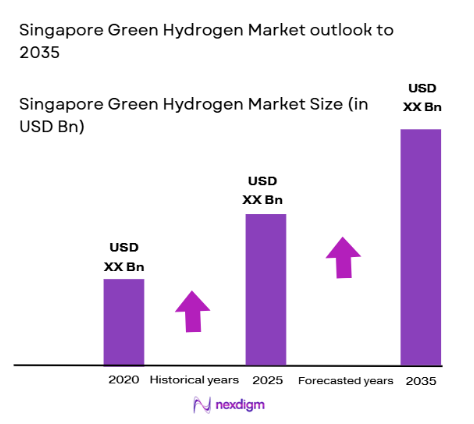
The Singapore Green Hydrogen Market is poised for significant growth, driven by substantial government investments in clean energy solutions and a rising demand for sustainable fuel alternatives. The market is valued at approximately USD ~ billion, reflecting the nation’s strategic push towards renewable energy adoption, particularly in decarbonizing the industrial and transportation sectors. The government’s focus on advancing green hydrogen technology, including supporting large-scale hydrogen production and infrastructure, contributes to this market’s ongoing expansion. The integration of hydrogen solutions into various sectors is accelerating the overall market development.
Singapore is emerging as a leader in the green hydrogen sector in Southeast Asia due to its strong commitment to clean energy. The country’s strategic location and robust infrastructure provide a conducive environment for green hydrogen development. With support from both the private and public sectors, Singapore has positioned itself as a hub for green hydrogen innovation and export in the region. Its commitment to meeting net-zero emissions targets further strengthens its dominance in this growing market, driving technological advancements and investment in the hydrogen space.
Market Segmentation
By Product Type:
Singapore Green Hydrogen Market is segmented by product type into electrolyzers, fuel cells, storage solutions, and transport solutions. Recently, electrolyzers have emerged as a dominant sub-segment due to advancements in electrolyzer technology, which significantly reduces production costs and improves efficiency. These systems are vital in producing green hydrogen, making them essential for large-scale hydrogen projects. The growing adoption of electrolyzers in both industrial and energy sectors has propelled their dominance, supported by government incentives and a strong focus on renewable energy production. 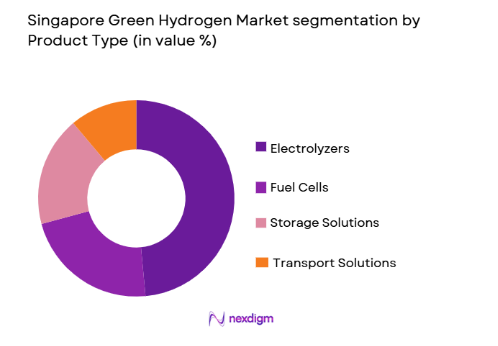
By End-Use:
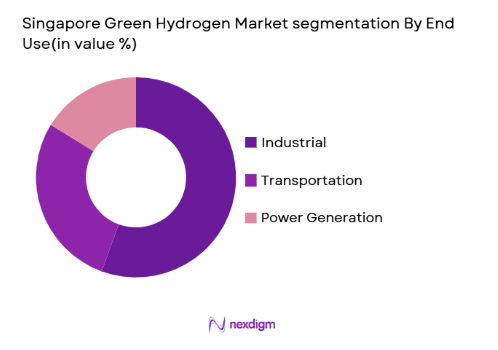
The market is also segmented by end-use, including industrial, transportation, and power generation applications. The industrial sector has a dominant market share, driven by the demand for sustainable and low-emission fuel solutions in heavy industries such as steel manufacturing, chemical processing, and refining. This sector’s increasing adoption of green hydrogen for decarbonization is a key factor contributing to its dominance. Singapore’s push towards green hydrogen in industries aligns with its broader goals of achieving a net-zero emissions economy.
Competitive Landscape
The competitive landscape of the Singapore Green Hydrogen Market is characterized by significant involvement from both international players and local startups. The market has seen several mergers and partnerships aimed at enhancing technological capabilities and expanding production capacity. Major players have been consolidating their positions through collaborations with governmental bodies and other private sector entities, enabling them to tap into emerging opportunities in the green hydrogen ecosystem. The strong presence of multinational corporations alongside innovative local firms ensures a dynamic and competitive market environment.
| Company Name | Establishment Year | Headquarters | Technology Focus | Market Reach | Key Products | Revenue (USD Billion) | Market-Specific Parameter |
| Shell | 1907 | The Hague, NL | ~ | ~ | ~ | ~ | ~ |
| Siemens Energy | 1847 | Munich, DE | ~ | ~ | ~ | ~ | ~ |
| Air Products | 1940 | Allentown, US | ~ | ~ | ~ | ~ | ~ |
| Linde | 1906 | Guildford, UK | ~ | ~ | ~ | ~ | ~ |
| Plug Power | 1997 | Latham, US | ~ | ~ | ~ | ~ | ~ |
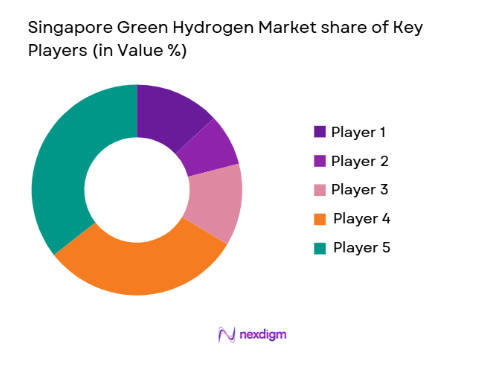
Singapore Green Hydrogen Market Analysis
Growth Drivers
Government Policy and Support:
The growth of the Singapore Green Hydrogen Market is heavily supported by proactive government policies. The Singaporean government has committed to reducing carbon emissions and achieving net-zero by 2050, with green hydrogen identified as a key pillar of this strategy. Government-backed funding and incentives have made the development of hydrogen infrastructure economically viable, while regulatory frameworks have been streamlined to support green hydrogen production, transport, and storage. These efforts have accelerated the deployment of green hydrogen projects across sectors such as industrial manufacturing and energy, driving further market growth.
Technological Advancements in Hydrogen Production:
Technological advancements, particularly in electrolysis, are another key growth driver for the Singapore Green Hydrogen Market. The development of more efficient, cost-effective electrolyzers has significantly lowered the production cost of green hydrogen, making it more competitive compared to fossil fuel-based alternatives. As technological innovations continue to emerge, green hydrogen’s scalability and commercial viability are improving, which is expected to further boost its adoption across industries. With advancements in storage and distribution technologies, the overall efficiency and affordability of green hydrogen are enhancing, increasing its attractiveness as a sustainable energy solution.
Market Challenges
High Capital Investment for Infrastructure Development:
One of the primary challenges facing the Singapore Green Hydrogen Market is the substantial capital investment required for infrastructure development. The installation of hydrogen production facilities, storage systems, and transportation networks requires significant financial resources. While government incentives have helped mitigate some of these costs, the initial capital required remains a barrier to rapid market expansion. The long-term return on investment in hydrogen infrastructure is still uncertain for some stakeholders, creating hesitancy in market entry and expansion.
Limited Hydrogen Distribution and Storage Networks:
Another challenge is the limited development of hydrogen storage and distribution infrastructure. Despite advancements in production technology, the market is hindered by the lack of a comprehensive hydrogen distribution network, both domestically and regionally. Without a robust system to transport and store hydrogen, the full potential of green hydrogen cannot be realized. While Singapore’s government is making strides in this area, developing a national and regional hydrogen infrastructure that ensures reliable delivery to end-users remains a significant challenge.
Opportunities
Green Hydrogen for Decarbonization of Heavy Industries:
A major opportunity for the Singapore Green Hydrogen Market lies in its application for decarbonizing heavy industries, such as steel, cement, and chemicals. These industries are traditionally large carbon emitters and have limited options for transitioning to clean energy sources. Green hydrogen offers an ideal solution, providing a low-emission fuel for processes that require high heat or energy density. Singapore’s industrial base is positioning itself to leverage green hydrogen to meet emission reduction targets, creating long-term growth opportunities for hydrogen adoption in industrial applications.
Export of Green Hydrogen to Regional Markets:
Another promising opportunity is the export of green hydrogen from Singapore to regional markets. Given its strategic location and port infrastructure, Singapore is well-positioned to become a leading exporter of green hydrogen to neighboring countries in Southeast Asia, which are increasingly focusing on renewable energy solutions. As demand for clean hydrogen rises in these countries, Singapore can capitalize on its production capabilities to serve as a regional supplier. This can further bolster its role in the global green hydrogen supply chain, supporting its economic and environmental goals.
Future Outlook
The future of the Singapore Green Hydrogen Market is optimistic, with expected growth driven by government policies, technological advancements, and increasing regional demand. Over the next five years, the market is likely to see significant advancements in hydrogen production and storage technologies, making it a more viable energy solution. Regulatory support and continued infrastructure investment will play a crucial role in expanding hydrogen usage, particularly in industrial and transport sectors. As the market matures, the regional export potential of green hydrogen will become a key factor in shaping Singapore’s role in the global energy transition.
Major Players
- Shell
- Siemens Energy
- Air Products
- Linde
- Plug Power
- Thyssenkrupp
- McPhy
- Engie
- Nel ASA
- Iwatani Corporation
- Hyundai
- Ballard Power Systems
- Toshiba Energy Systems
- Cummins
- Air Liquide
Key Target Audience
- Investments and venture capitalist firms
- Government and regulatory bodies
- Energy solution providers
- Industrial manufacturers
- Energy technology developers
- Hydrogen infrastructure developers
- Renewable energy companies
- Logistics and transportation companies
Research Methodology
Step 1: Identification of Key Variables
Identify the key market variables, including technological developments, regulatory trends, and demand-side factors.
Step 2: Market Analysis and Construction
Conduct comprehensive data collection, involving both primary and secondary research methods. Analyze market trends, drivers, and challenges.
Step 3: Hypothesis Validation and Expert Consultation
Validate the findings with industry experts, ensuring accuracy and reliability in predictions and models.
Step 4: Research Synthesis and Final Output
Synthesize the research data into actionable insights, producing the final market report with forecasts and analysis.

- Executive Summary
- Research Methodology (Definitions, Scope, Industry Assumptions, Market Sizing Approach, Primary & Secondary Research Framework, Data Collection & Verification Protocol, Analytic Models & Forecast Methodology, Limitations & Research Validity Checks)

- Market Definition and Scope
- Value Chain & Stakeholder Ecosystem
- Regulatory / Certification Landscape
- Sector Dynamics Affecting Demand
- Strategic Initiatives & Infrastructure Growth

- Growth Drivers
Government Initiatives in Renewable Energy
Technological Advancements in Hydrogen Production
Increasing Demand for Clean Energy
Private Sector Investments in Green Technologies
Rising Environmental Regulations - Market Challenges
High Capital Investment for Infrastructure
Limited Hydrogen Storage and Transport Infrastructure
Regulatory and Policy Uncertainty
Lack of Standardization in Technology
High Operational Costs - Market Opportunities
Partnerships with International Hydrogen Firms
Development of Large-Scale Hydrogen Projects
Technological Innovations in Hydrogen Production - Trends
Growth of Green Hydrogen Production Projects
Integration with Renewable Energy Sources
Increasing Focus on Energy Storage Solutions
Policy and Government Support for Green Hydrogen
Collaborations Between Public and Private Sectors - Government Regulations & Defense Policy
Hydrogen Economy Development Policies
Government Subsidies and Tax Incentives
Standards for Green Hydrogen Production and Use - SWOT Analysis
- Stakeholder and Ecosystem Analysis
- Porter’s Five Forces Analysis
- Competition Intensity and Ecosystem Mapping

- By Market Value, 2020-2025
- By Installed Units, 2020-2025
- By Average System Price, 2020-2025
- By System Complexity Tier, 2020-2025

- By System Type (In Value%)
Electrolysis Systems
Storage Systems
Fuel Cells
Transport Solutions
Grid Integration Systems - By Platform Type (In Value%)
Onshore Platforms
Offshore Platforms
Hybrid Platforms
Mobile Platforms
Modular Platforms - By Fitment Type (In Value%)
Standalone Solutions
Integrated Solutions
Modular Systems
Centralized Systems
Distributed Systems - By EndUser Segment (In Value%)
Industrial Users
Power Generators
Transport Sector
Government & Municipalities
Private Sector / Tech Firms - By Procurement Channel (In Value%)
Direct Procurement
Government Tenders
Private Sector Procurement
Online Bidding Platforms
Third-party Distributors - By Material / Technology (in Value%)
Electrolyzers
Hydrogen Storage Materials
Fuel Cells
Power-to-X Solutions
Renewable Energy Integration Systems

- Market structure and competitive positioning
- Market share snapshot of major players
- CrossComparison Parameters (System Type, Platform Type, Procurement Channel, EndUser Segment, Fitment Type, Material/Technology, Regulatory Compliance, Cost of Production, Distribution Network, Innovation Capacity)
- SWOT Analysis of Key Players
- Pricing & Procurement Analysis
- Key Players
Shell
Siemens Energy
Air Products and Chemicals
Linde
Plug Power
ThyssenKrupp
Nel ASA
Iwatani Corporation
Uniper
McPhy
BASF
H2 Global
ENGIE
EDF
Honda Motor Co.

- Industrial Use of Hydrogen for Decarbonization
- Government’s Role in Hydrogen Policy and Subsidies
- Private Sector Adoption of Hydrogen Technologies
- Transportation Sector’s Shift Toward Hydrogen Fuel

- Forecast Market Value, 2026-2035
- Forecast Installed Units, 2026-2035
- Price Forecast by System Tier, 2026-2035
- Future Demand by Platform, 2026-2035


 Request a Sample
 Ask for Customization
 Get a Quote
 Enquire Now