
 Download PDF
Market Overview
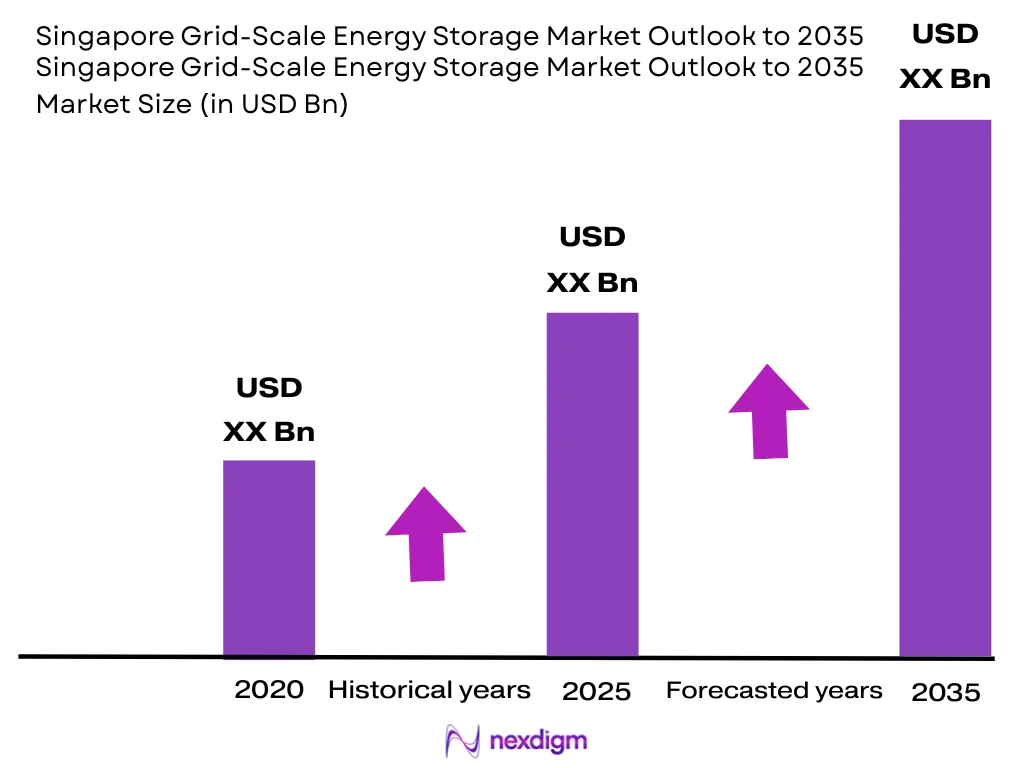
The Singapore Grid-Scale Energy Storage Market was valued at USD ~ Billion in 2024 and is anticipated to expand at a CAGR of ~% during 2026–2035. Unlike larger markets where grid-scale storage growth is driven by vast new-build renewable capacity, Singapore’s market is fundamentally shaped by the country’s severe land constraints, its reliance on imported and intermittent solar generation, and its accelerating strategy to import low-carbon electricity from neighboring countries. Sembcorp Industries’ 200MW/285MWh energy storage system on Jurong Island, commissioned in just six months in 2023, single-handedly met and exceeded Singapore’s national deployment target of 200MWh by 2025, three years ahead of schedule, and stood as Southeast Asia’s largest battery energy storage system at the time of its launch. In October 2025, Sembcorp successfully piloted a battery-stacking solution at the same Jurong Island site, expanding capacity from 285MWh to 326MWh through the first vertical expansion of an operational energy storage system without increasing its physical footprint, illustrating the land-efficient innovation that increasingly defines Singapore’s approach to grid-scale storage deployment.
Market Segmentation
By Deployment Model
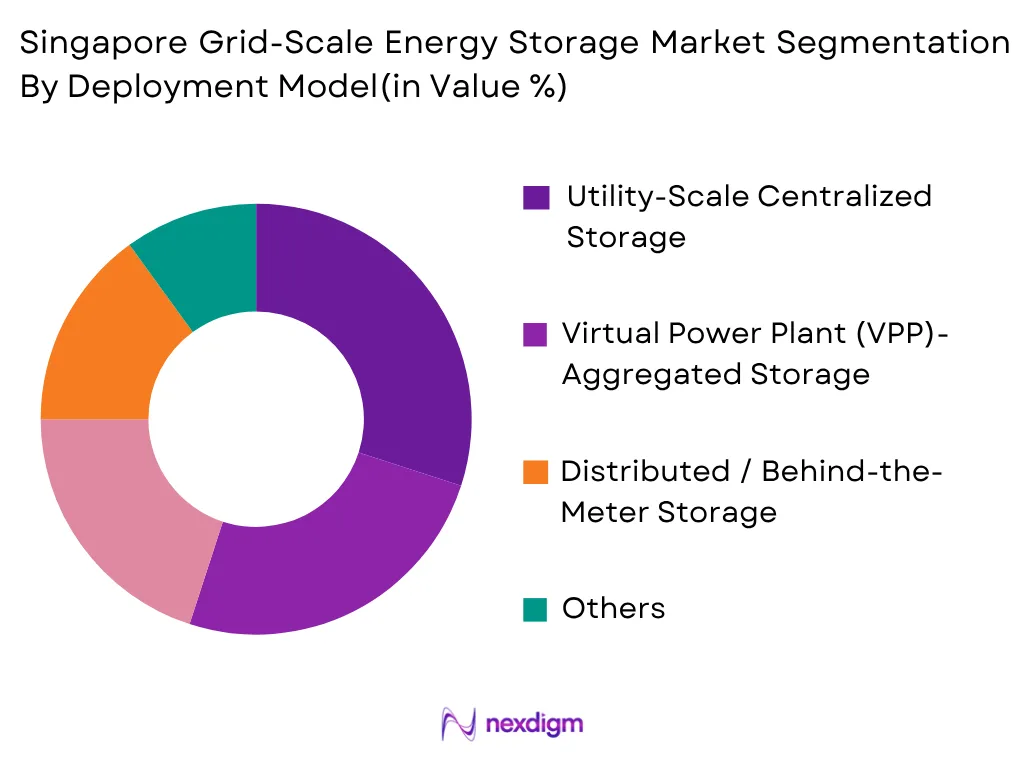
Utility-Scale Centralized Storage dominates the Singapore Grid-Scale Energy Storage Market, anchored overwhelmingly by Sembcorp’s Jurong Island energy storage system, which remains the country’s flagship grid-scale asset and a model for land-efficient deployment through its rail-guided vertical battery-stacking method. Virtual Power Plant (VPP)-Aggregated Storage represents an emerging and increasingly important deployment model, supported by the Energy Market Authority’s launch of a regulatory sandbox for VPP platforms alongside a call for proposals for projects to enhance grid planning, both introduced under the EMA’s Future Grid Capabilities Roadmap developed in partnership with state-owned SP Group. Distributed / Behind-the-Meter Storage remains comparatively limited given Singapore’s dense urban footprint, though industry sources note that proposing new BESS projects remains challenging given the general lack of available space across the country’s urban areas, reinforcing why centralized, land-efficient deployment models continue to dominate the market’s overall structure.
By Application
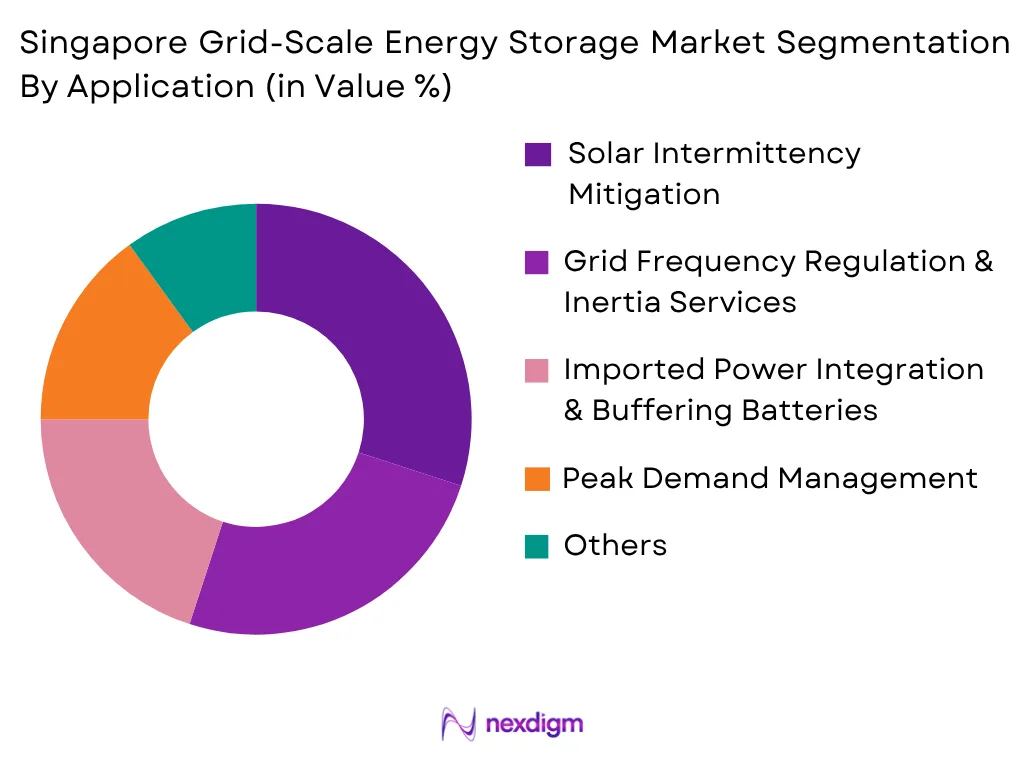
Solar Intermittency Mitigation represents the largest application within the Singapore Grid-Scale Energy Storage Market, directly reflecting the Jurong Island system’s core purpose of counteracting sharp and unexpected drops in solar energy generation as the country scales solar capacity, which has already surpassed 700 MWp of installations, more than double its earlier 350 MWp milestone, toward a 2030 target of at least 3 GWp. Grid Frequency Regulation & Inertia Services represents a fast-emerging application, with Sembcorp and the EMA collaborating to test the Jurong Island system’s ability to provide inertia, a function traditionally supplied by rotating thermal generators and essential to maintaining grid stability during sudden disruptions. Imported Power Integration & Buffering is expected to become an increasingly significant application as Singapore scales up cross-border electricity imports; in May 2025, the EMA awarded TotalEnergies and RGE’s joint venture, Singa Renewables, a conditional licence to import 1 GW of renewable power from Indonesia, a development that is expected to require complementary battery storage capacity to firm and buffer this imported, intermittent clean power supply.
Competitive Landscape
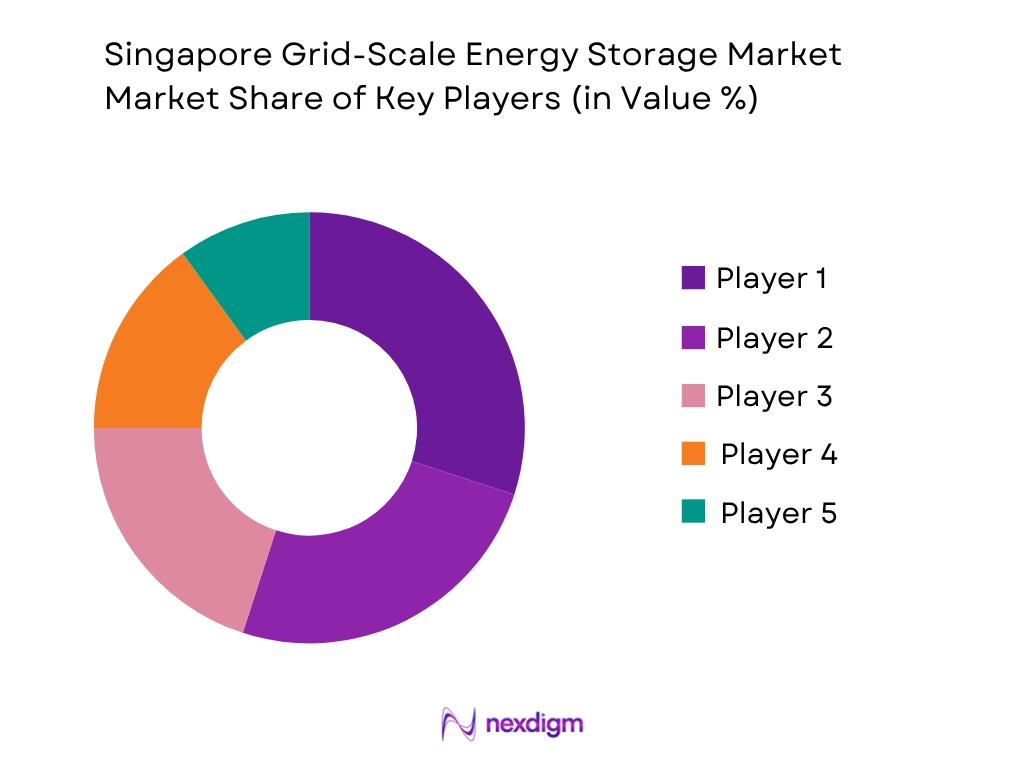
The Singapore Grid-Scale Energy Storage Market remains fairly concentrated, with large infrastructure and utility-linked players such as Sembcorp and SP Group positioned at the front of the market given their capital access, project pipeline access, and regulatory familiarity built through direct engagement with the EMA. Sembcorp Industries, headquartered in Singapore, has deployed just over a gigawatt of solar capacity across the country in ground-mount, rooftop, and floating photovoltaic systems, and operates the Jurong Island energy storage system won through a competitive EMA solicitation under the Accelerating Energy Storage Access for Singapore (ACCESS) programme. SP Group, Singapore’s state-owned electricity and gas distribution company, co-develops the Future Grid Capabilities Roadmap alongside the EMA, shaping the regulatory and technical framework within which storage providers must operate. The market is not entirely closed to smaller players, however; flow battery specialist VFlowTech and Advario have both expressed interest in scaling battery energy storage system deployment on Jurong Island, while Wärtsilä supplied Singapore’s first grid-scale BESS project, a 2.4MWh system switched on in 2020, and Envision Digital leads the EMA- and PSA-awarded consortium developing a smart grid management system integrating storage and solar at one of Singapore’s port terminals. Industry analysts note that in a market like Singapore, small technical advantages in areas such as thermal management, software, and engineering often matter more than sheer scale, creating genuine competitive opportunity beyond the two dominant incumbents.
| Company | Establishment Year | Headquarters | Grid-Scale BESS Portfolio | Domestic Manufacturing Portfolio
|
Manufacturing Presence | Major End-Use Industries | Key Strategic Focus | Certifications & Compliance |
| Sembcorp Industries | 1998 | ~ | ~ | ~ | ~ | ~ | ~ | ~ |
| SP Group (Singapore Power) | 1995 | ~ | ~ | ~ | ~ | ~ | ~ | ~ |
| VFlowTech | 2018 | ~ | ~ | ~ | ~ | ~ | ~ | ~ |
| Envision Digital | 2016 | ~ | ~ | ~ | ~ | ~ | ~ | ~ |
| Wärtsilä | 1834 | ~ | ~ | ~ | ~ | ~ | ~ | ~ |
Singapore Grid-Scale Energy Storage Market Analysis
Growth Drivers
Solar Intermittency Mitigation as the Primary National Deployment Driver
Singapore’s grid-scale energy storage market continues to be driven primarily by the need to manage the intermittency of the country’s growing solar capacity, which has surpassed 700 MWp of installations, more than double its earlier 350 MWp benchmark, as Singapore progresses toward a 2030 target of at least 3 GWp of solar deployment. Sembcorp’s Jurong Island energy storage system, commissioned in just six months in 2023 as a 200MW/285MWh facility, single-handedly met and exceeded Singapore’s national energy storage deployment target of 200MWh by 2025, three years ahead of schedule, directly addressing the challenge of sharp and unexpected drops in solar energy generation. In October 2025, Sembcorp expanded this capacity to 326MWh through a pioneering battery-stacking pilot, the first vertical expansion of an operational energy storage system on the same land area, demonstrating a land-efficient deployment model increasingly essential to scaling storage capacity within Singapore’s severe spatial constraints.
Grid Services Diversification Through Frequency Regulation and Inertia
Singapore’s Energy Market Authority continues to expand the scope of services expected from grid-scale battery storage beyond simple solar smoothing, launching a collaboration with Sembcorp in late 2025 to test the expanded Jurong Island system’s ability to provide inertia, a grid-stabilizing function traditionally supplied by rotating thermal generators. This initiative sits within the EMA’s broader Future Grid Capabilities Roadmap, developed in partnership with SP Group, which has also produced a regulatory sandbox for virtual power plant platforms and a call for proposals to enhance grid planning capabilities. As EMA Chief Executive Puah Kok Keong has noted, battery energy storage systems have the potential to provide a wide range of energy services including frequency regulation, and the knowledge gained from these trials is expected to help EMA plan for a grid that is cleaner, smarter, and more resilient, creating sustained demand for storage capacity beyond pure renewable energy integration.
Market Challenges
Severe Land Scarcity Constraining Utility-Scale Deployment
Singapore’s fundamental land constraint represents the most persistent structural challenge facing the grid-scale energy storage market, with industry sources describing the proposal of new BESS projects as challenging given the general lack of available space across the country’s densely populated urban areas. This scarcity has directly shaped the market’s technical evolution, driving Sembcorp’s pioneering rail-guided vertical battery-stacking approach at Jurong Island, which safely positioned additional battery capacity without requiring additional land, expanding the facility from 285MWh to 326MWh entirely through vertical rather than horizontal expansion. This land constraint continues to limit the pool of viable project sites to a small number of industrial zones, such as Jurong Island, reinforcing the market’s overall concentration among incumbents with established access to these limited locations.
Market Economics as the Core Barrier Rather Than Demand
Industry analysis of Singapore’s battery energy storage system market in 2026 identifies economics, rather than underlying demand, as the biggest challenge facing continued market expansion. The market remains fairly concentrated, with large infrastructure and utility-linked players such as Sembcorp and SP Group positioned at the front of the market specifically because they possess the capital, project access, and regulatory familiarity required to compete for EMA-awarded contracts, creating meaningful barriers to entry for smaller or newer market participants. This capital-intensive dynamic, combined with Singapore’s high land and construction costs, continues to shape a market where technical differentiation and specialized capability increasingly matter more than raw scale for participants seeking to compete against the two dominant incumbents.
Market Opportunities
Battery Buffering for Cross-Border Clean Power Imports
Singapore’s accelerating strategy to import low-carbon electricity from neighboring countries is creating a substantial new opportunity for grid-scale energy storage capacity designed to buffer and firm intermittent imported renewable power. In May 2025, the Energy Market Authority awarded TotalEnergies and RGE’s equally-owned joint venture, Singa Renewables, a conditional licence to import 1 GW of renewable power from a solar and battery storage project in Indonesia, illustrating the scale of cross-border clean power integration now underway as part of Singapore’s broader multi-gigawatt import strategy spanning Indonesia, Malaysia, and Australia. As these cross-border power import projects continue to scale, storage providers capable of offering grid-side buffering and firming capacity are well positioned to capture significant new demand tied directly to Singapore’s clean power import strategy rather than purely domestic solar generation.
Flow Battery and Niche Technology Specialization on Jurong Island
Singapore’s grid-scale energy storage market, while concentrated among capital-rich incumbents, remains genuinely open to specialized technology providers capable of solving specific technical problems within the country’s uniquely space- and safety-constrained environment. Flow battery specialists VFlowTech and Advario have both expressed interest in scaling battery energy storage system deployment on Jurong Island, reflecting growing recognition that Jurong Island’s varied industrial loads and planned renewable resources make it a prime candidate to testbed smart grid operations and energy management beyond conventional lithium-ion technology. As industry analysts note, small technical advantages in thermal management, software, and engineering increasingly matter more than sheer scale in a market like Singapore, creating a genuine and growing opportunity for battery integrators, software providers, and specialized engineering firms alongside the market’s dominant incumbents.
Future Outlook
The Singapore Grid-Scale Energy Storage Market is expected to witness sustained expansion over the forecast period, supported by continued solar capacity growth toward the 2030 target of at least 3 GWp, ongoing grid services diversification through frequency regulation and inertia trials, and accelerating cross-border clean power import integration requiring complementary battery buffering capacity. Growing adoption of land-efficient deployment models, exemplified by Sembcorp’s vertical battery-stacking approach, alongside continued development of the EMA’s Future Grid Capabilities Roadmap and virtual power plant regulatory sandbox, will further shape the market’s technical and regulatory evolution. The market is also likely to benefit from Singapore’s structural need for flexible systems capable of smoothing supply, absorbing imported clean power, and supporting an increasingly complex grid, as battery energy storage systems continue their transition from a supplementary technology to core national energy infrastructure through 2035.
Major Players
- Sembcorp Industries
- SP Group (Singapore Power)
- VFlowTech
- Envision Digital
- Wärtsilä
- Advario
- TotalEnergies
- RGE (Singa Renewables)
- PSA International
- Keppel Corporation
- Sunseap Group
- Shell Energy Singapore
- Tesla Energy
- Fluence Energy
- Samsung SDI
Key Target Audience
- Battery and Energy Storage System Manufacturers
- Power Generation and Grid Operators
- Industrial and Petrochemical Facility Operators
- Port and Logistics Infrastructure Operators
- Cross-Border Renewable Power Developers
- Investment and Venture Capitalist Firms
- Government and Regulatory Bodies (Energy Market Authority – EMA, SP Group, National Environment Agency – NEA)
- Grid Modernization and Systems Integration Firms
Research Methodology
Step 1: Identification of Key Variables
The research process begins with identifying the complete ecosystem of the Singapore Grid-Scale Energy Storage Market, including battery and component suppliers, systems integrators, power generation and grid operators, cross-border power developers, and regulatory authorities. Extensive secondary research is conducted using company reports, government publications, trade associations, tender documentation, industry journals, and proprietary databases to determine the variables influencing market demand, pricing, capacity deployment, and technological developments.
Step 2: Market Analysis and Construction
Historical market information is collected and analyzed to estimate market size, installed capacity figures, application-wise demand, and pricing trends. A combination of top-down and bottom-up approaches is used to estimate market revenues and validate segment-level performance. Deployment patterns across solar intermittency mitigation, grid services, imported power buffering, and port and industrial applications are evaluated to establish an accurate representation of the industry.
Step 3: Hypothesis Validation and Expert Consultation
The preliminary findings are validated through Computer-Assisted Telephone Interviews (CATIs) and structured discussions with battery and storage technology providers, grid operators, regulatory experts, and senior professionals operating within Singapore’s energy storage and power sector. These interviews help verify market assumptions, competitive developments, technology adoption trends, pricing dynamics, and future investment opportunities while refining the overall market estimates.
Step 4: Research Synthesis and Final Output
The final stage integrates insights obtained from primary interviews with quantitative information collected through secondary sources. Data triangulation techniques are applied to reconcile differences between supply-side and demand-side estimates, ensuring robust market forecasting. The report is then reviewed through multiple quality assurance checkpoints to deliver a comprehensive analysis covering market size, segmentation, competitive landscape, future outlook, and strategic recommendations for industry stakeholders.

- Executive Summary
- Research Methodology (Market Definitions and Assumptions, Abbreviations, Market Sizing Approach, Top-Down Analysis, Bottom-Up Analysis, Demand-Side Assessment, Supply-Side Assessment, Primary Industry Interviews, Secondary Research Validation, Data Triangulation, Forecasting Framework, Limitations and Future Conclusions)

- Definition and Scope
- Market Evolution and Industry Genesis
- Timeline of Major Industry Developments
- Energy Storage Industry Value Chain Analysis
- Supply Chain Analysis

- Growth Drivers (Solar Intermittency Mitigation as the Primary National Deployment Driver, Grid Services Diversification Through Frequency Regulation and Inertia, Cross-Border Clean Power Import Integration, Virtual Power Plant and DERMS Rollout, Rising Solar Capacity Toward the 2030 Target, Port and Industrial Microgrid Digitalization)
- Market Challenges (Severe Land Scarcity Constraining Utility-Scale Deployment, Market Economics as the Core Barrier Rather Than Demand, High Capital Requirements Favoring Incumbent Players, Regulatory and Project Access Barriers for New Entrants, Grid Interconnection Complexity in a Dense Urban Environment, Thermal and Safety Management in Space-Constrained Sites)
- Market Opportunities (Battery Buffering for Cross-Border Clean Power Imports, Flow Battery and Niche Technology Specialization on Jurong Island, Vertical Battery Stacking and Land-Efficient Deployment Models, Virtual Power Plant Aggregation Services, Smart Port and Terminal Energy Management Systems, Public-Private Grid Modernization Partnerships)
- Market Trends (Vertical Battery Stacking to Maximize Land-Constrained Sites, Growth of Inertia and Ancillary Grid Services Trials, Expansion of Cross-Border Renewable Power Import Licensing, Rise of Flow Battery Pilot Projects, Virtual Power Plant Regulatory Sandbox Adoption, Integration of AI-Based Energy Management Platforms)
- Government Regulations (EMA Accelerating Energy Storage Access for Singapore (ACCESS) Programme, EMA Future Grid Capabilities Roadmap, Virtual Power Plant (VPP) Regulatory Sandbox, Singapore Green Plan 2030 Solar Deployment Targets, Cross-Border Electricity Import Licensing Framework, NEA Mandatory Packaging and Emissions-Adjacent Compliance Requirements)
- Import and Export Analysis (Cross-Border Electricity Import Volume, Major Import Source Countries, HS Code Analysis for Battery Components, Trade Balance, Regional Power Grid Interconnection Flows)
- Raw Material Availability Analysis (Imported Battery Cell and Component Feedstocks, Domestic Land Availability for Storage Siting, Power Electronics and Inverter Supply Chain, Cross-Border Renewable Power Supply Access, Regional ASEAN Component Supply Chain)
- Technology Landscape (Vertical Battery Stacking Technology, Flow Battery Technology, AI-Based Energy Management and Forecasting Platforms, Grid Inertia and Frequency Regulation Technology, DERMS and Virtual Power Plant Aggregation Technology)
- Sustainability Assessment (Solar Intermittency Mitigation Impact, Grid Decarbonization Enablement, Land-Efficient Deployment Innovation, Cross-Border Clean Power Integration, Circular Economy Alignment for Battery Components)
- PESTLE Analysis
- SWOT Analysis
- Porter’s Five Forces Analysis
- Stakeholder Ecosystem
- Competition Ecosystem

- By Market Value (2020-2025)
- By Installed Capacity (2020-2025)
- By Average Cost Per MWh (2020-2025)

- By Technology (In Value %)
Lithium-Ion Battery Storage
Flow Battery Storage
Hybrid & Battery-Stacked Systems
Emerging Storage Technologies - By Application (In Value %)
Solar Intermittency Mitigation
Grid Frequency Regulation & Inertia Services
Peak Demand Management
Imported Power Integration & Buffering
Port & Industrial Microgrid Storage - By Deployment Model (In Value %)
Utility-Scale Centralized Storage
Distributed / Behind-the-Meter Storage
Virtual Power Plant (VPP)-Aggregated Storage - By End User (In Value %)
Power Generation & Grid Operators
Industrial & Petrochemical Facilities (Jurong Island)
Port & Logistics Infrastructure
Commercial & Data Center Operators
Government & Regulatory Programs - By Region (In Value %)
Central Region
East Region
West Region
North Region
North-East Region

- Market Share of Major Players (By Value, Installed Capacity, Technology Type, Application, End User)
- Cross Comparison Parameters (Project Execution Track Record, Land-Efficient Deployment Capability, Grid Services Technology Portfolio, Application Technical Support, Regulatory Access and EMA Contract History, Regulatory Compliance & Certifications, Customer Base, Innovation & New Technology Pilot Frequency)
- SWOT Analysis of Major Players
- Pricing Analysis by Technology Type and Application
- Production Capacity Analysis
- Manufacturing Footprint Analysis
- Distribution Network Analysis
- Innovation Benchmarking
- Detailed Profiles of Major Companies
Sembcorp Industries
SP Group (Singapore Power)
VFlowTech
Envision Digital
Wärtsilä
Advario
TotalEnergies
RGE (Singa Renewables)
PSA International
Keppel Corporation
Sunseap Group
Shell Energy Singapore
Tesla Energy
Fluence Energy
Samsung SDI

- Consumption Pattern Analysis (Installed Capacity Penetration, Land-Use Efficiency, End-User Segment Adoption, Seasonal and Peak-Demand Impact, Grid Services Utilization Patterns)
- Purchasing Criteria (Cost Per MWh, Land Footprint Efficiency, Regulatory and EMA Contract Eligibility, Reliability and Grid Services Capability, Deployment Speed, Technology Maturity)
- Procurement and Supplier Selection Analysis
- Vertical Stacking and Land-Efficient Technology Adoption Assessment
- Utility-Scale vs Distributed/VPP-Aggregated Demand Comparison
- Product Attribute Preference Analysis (Land Footprint Efficiency, Cycle Life, Round-Trip Efficiency, Safety and Thermal Management, Grid Compatibility, Deployment Speed)
- Sustainability & ESG Influence on Procurement Decisions
- Pain Point Analysis
- Decision-Making Process

- By Market Value (2026-2035)
- By Installed Capacity (2026-2035)
- By Average Cost Per MWh (2026-2035)


 Request a Sample
 Ask for Customization
 Get a Quote
 Enquire Now