
 Download PDF
Market Overview
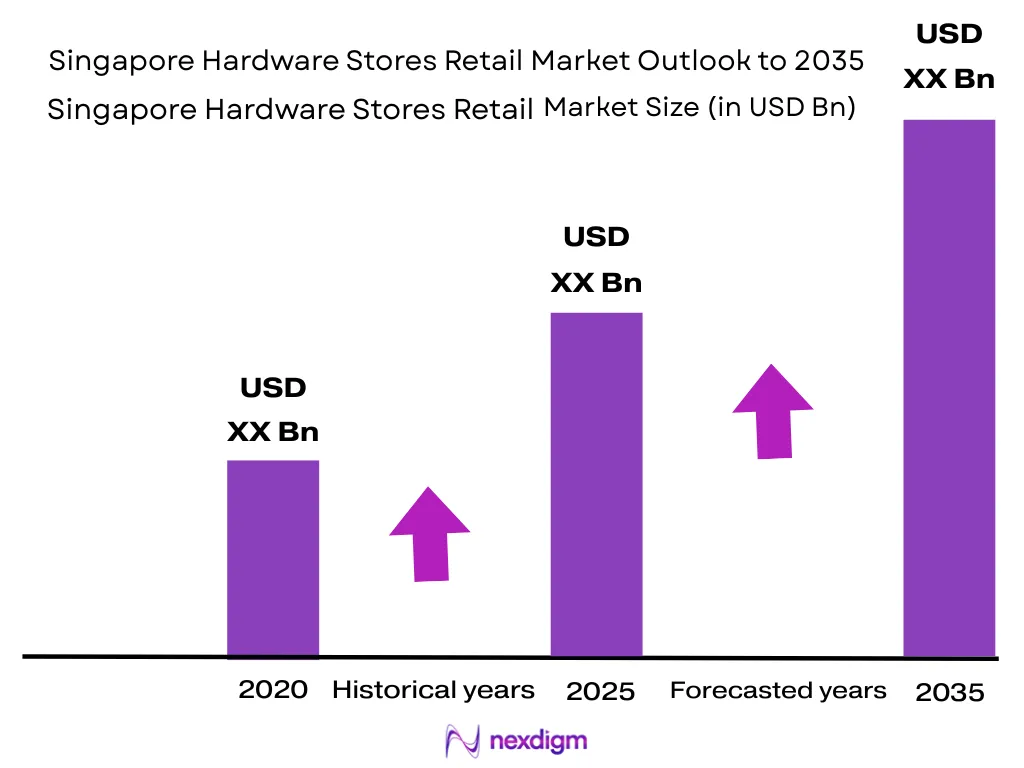
The Singapore Hardware Stores Retail Market is valued at approximately USD ~ billion, assessed through DIY, hardware, tools, paint, bathroom, sanitaryware, hand tools and power tools retail categories within the ASEAN home improvement framework. ASEAN home improvement is valued at USD ~ billion, with Singapore included as one of the analysed markets. Central Region, East Region, West Region, North Region and North-East Region dominate the Singapore Hardware Stores Retail Market because each cluster serves different demand pockets. Central Region is driven by commercial buildings and condominiums; East Region by Changi, aviation and marine-linked maintenance; West Region by Jurong, Tuas and industrial MRO; North and North-East by HDB heartland repairs. BCA reported S$19.5 billion public-sector construction demand and S$14.3 billion private-sector construction demand in the preceding benchmark period, supporting broad hardware demand across residential, institutional and industrial clusters. The Singapore Hardware Stores Retail Market is forecasted to grow at an estimated CAGR of 4.6% during 2026-2035, supported by construction demand, HDB renovation cycles, industrial maintenance, MRO procurement, smart home hardware, green building products, e-commerce adoption and B2B digital procurement.
Market Segmentation
By Product Type
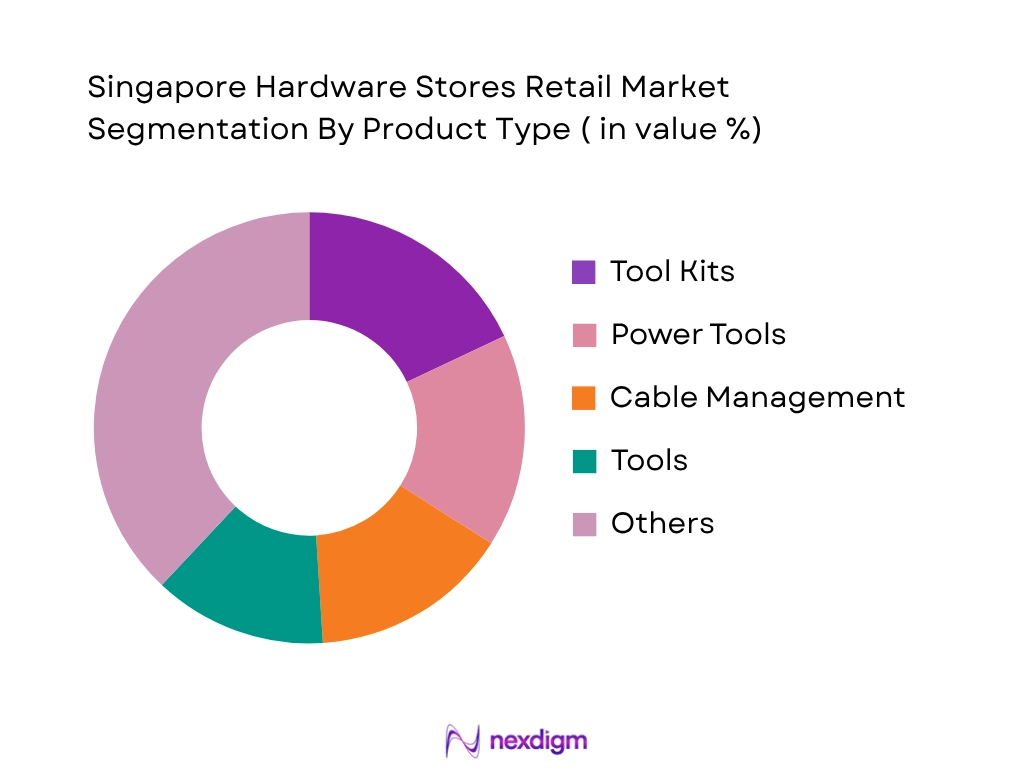
Singapore Hardware Stores Retail Market is segmented by product category into hand tools, power tools, electrical hardware, plumbing supplies, fasteners, paints, sealants, safety products and industrial consumables. Hand tools and tool kits hold the dominant market share because they serve both household repair and professional maintenance use cases. HDB residents, facility technicians, renovation contractors and industrial workshops purchase screwdrivers, pliers, wrenches, cutters, measuring tools and small tool kits for recurring repair work. Compared with bulky building materials, hand tools fit Singapore’s compact retail format and are easier to stock across neighbourhood stores, industrial suppliers and online catalogues. Their dominance is also supported by emergency household repairs, small DIY tasks, contractor replenishment and replacement cycles in MRO-heavy clusters such as Ubi, Kaki Bukit, Woodlands, Jurong and Tuas.
By Store Format
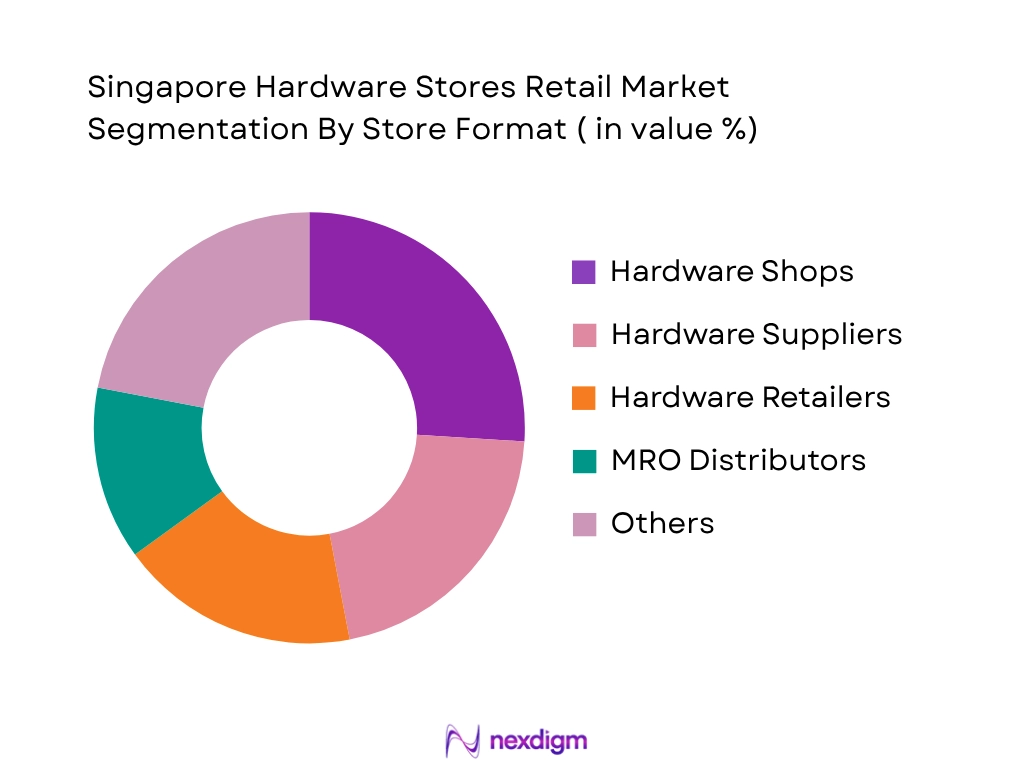
Singapore Hardware Stores Retail Market is segmented by store format into neighbourhood hardware shops, industrial suppliers, chain retailers, B2B MRO distributors, specialist tool stores, online hardware retailers and marketplace sellers. Neighbourhood hardware shops hold the dominant market share because Singapore’s housing structure creates frequent small-basket repair demand close to residential estates. HDB households often require immediate access to plumbing spares, door locks, hinges, hooks, screws, adhesives, electrical accessories, paint supplies and basic hand tools. These stores also benefit from proximity, product advice and small-quantity availability, which are important when consumers need one exact replacement part rather than bulk quantities. Industrial suppliers and B2B MRO distributors are also significant, particularly in Jurong, Tuas, Woodlands and Ubi, but neighbourhood shops remain highly relevant for household maintenance and urgent repair purchases.
Competitive Landscape
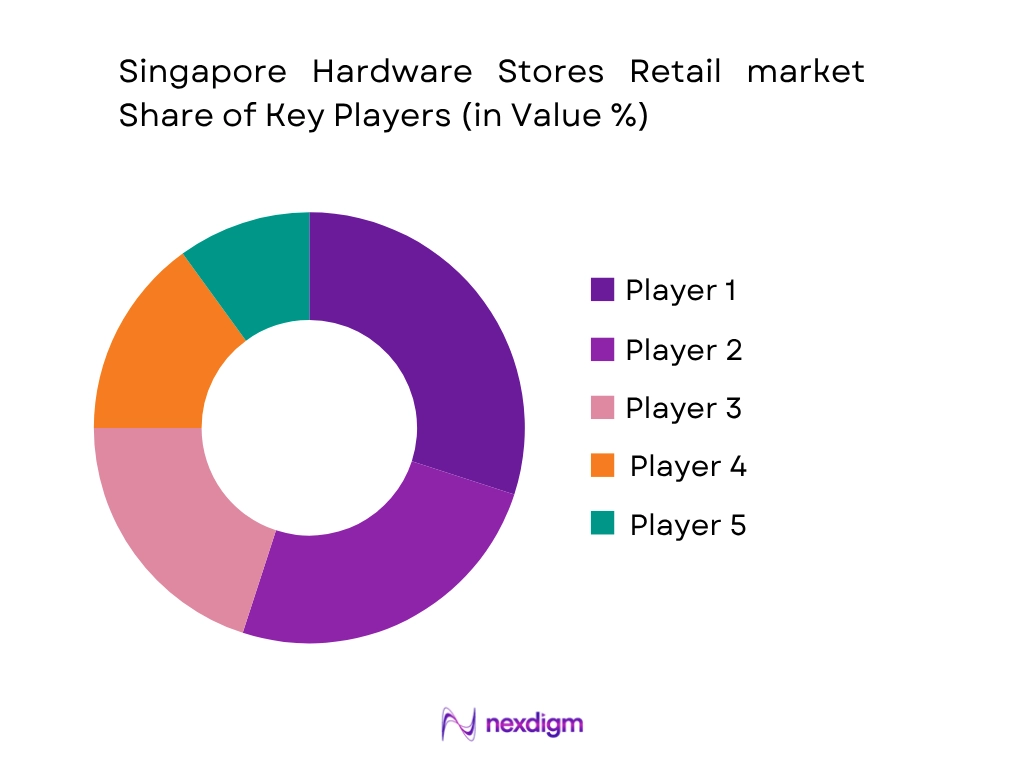
Singapore Hardware Stores Retail Market is fragmented across neighbourhood shops, chain DIY retailers, industrial suppliers, specialist tool distributors and online platforms. HardwareCity, Horme Hardware, Selffix DIY, MR.DIY and Teck Cheong Hardware compete through different formats. HardwareCity and Horme serve both DIY and B2B customers with broad catalogues, while Selffix and MR.DIY focus more on consumer DIY and household hardware. Specialist players such as Teck Cheong Hardware and Hup Hong Machinery serve professional tool, machinery and industrial demand. Online channels are gaining relevance as Singapore Department of Statistics tracks online retail proportions by industry, reflecting wider retail digitalization.
| Major Player | Establishment Year | Headquarters | Store / Format Positioning | Core Product Strength | Primary Customer Base | Sales Channel | Delivery / Fulfilment | Market-Specific Differentiator |
| HardwareCity Singapore | 1979 | Singapore | ~ | ~ | ~ | ~ | ~ | ~ |
| Horme Hardware | 1997 | Singapore | ~ | ~ | ~ | ~ | ~ | ~ |
| Selffix DIY | 2004 | Singapore | ~ | ~ | ~ | ~ | ~ | ~ |
| MR.DIY Singapore | 2005 group establishment | Malaysia / Singapore operations | ~ | ~ | ~ | ~ | ~ | ~ |
| Teck Cheong Hardware / TC Hub | 1970s legacy positioning | Singapore | ~ | ~ | ~ | ~ | ~ | ~ |
Singapore Hardware Stores Retail Market Analysis
Growth Drivers
HDB Maintenance, Renovation and Household Repair Demand
Singapore Hardware Stores Retail Market is supported by recurring housing maintenance because hardware stores supply door locks, hinges, wall plugs, screws, plumbing spares, extension cords, adhesives, sealants, paint accessories and hand tools used in HDB and private residential repairs. Singapore’s total population stood at 6.04 million as at June 2024, while the citizen population increased from 3.61 million in June 2023 to 3.64 million in June 2024, creating a dense household base for repeat repair and replacement purchases. HDB completed 20,294 flats in FY2024 and handed over 17,633 flats, which supports downstream demand for renovation hardware, installation consumables, bathroom fittings, electrical accessories and small tools after keys are issued. Hardware retailers benefit because new flats, resale flats and ageing units require continuing purchases rather than one-time demand. Neighbourhood hardware shops remain relevant because consumers often need immediate access to exact replacement parts in small quantities.
Construction and Fit-Out Activity Supporting Trade Purchases
Singapore Hardware Stores Retail Market is driven by contractor and MRO-linked procurement because construction, renovation and fit-out activity generate demand for fasteners, power tools, drill bits, ladders, PPE, cable management, plumbing fittings, sealants, adhesives and electrical accessories. BCA reported preliminary construction demand of S$44.2 billion in 2024, mainly attributed to public institutional projects, public housing projects and private housing projects. The construction pipeline strengthened further, with preliminary construction demand reaching S$50.5 billion at end-2025, supported by institutional and housing projects. This directly supports hardware-store retail because contractors and subcontractors replenish consumables frequently across project stages, from rough-in work to finishing and defect rectification. The demand is concentrated in renovation contractors, MEP contractors, HDB works, commercial fit-outs and industrial estate maintenance. Hardware retailers with trade counters, bulk ordering, product specifications and delivery scheduling are positioned to capture repeat purchases from professional buyers.
Market Challenges
Import Dependence and Supply-Chain Exposure
Singapore Hardware Stores Retail Market faces import dependence because the country has limited domestic production for power tools, hand tools, tool accessories, specialist fasteners, electrical accessories, PPE and branded MRO consumables. Singapore’s merchandise trade statistics are compiled by Enterprise Singapore using import and export permits submitted to Singapore Customs, reflecting the central role of cross-border goods movement in the local retail supply chain. Imports of machinery and transport equipment reached S$24,456.95 million in January 2024 and S$21,862.58 million in February 2024, showing the scale of equipment-linked imports relevant to hardware, tools and industrial procurement. Hardware retailers are exposed because many SKUs must be sourced through distributors representing Japan, Europe, China, Malaysia and the United States. Delays or allocation issues affect exact products such as drill bits, batteries, switches, fittings, cable accessories and safety items. Retailers must maintain availability while managing thousands of small SKUs across limited store and warehouse space.
Labour Tightness and Technical Counter-Sales Capability
Singapore Hardware Stores Retail Market is constrained by labour tightness because hardware retail requires counter staff who can identify exact parts, advise on fittings, recommend tool accessories, process B2B quotations and handle warranty claims. MOM reported total employment growth of 44,500 in 2024, with resident employment increasing by 8,800 and non-resident employment increasing by 35,700. Job vacancies rebounded to 77,500 in December 2024 after falling to 61,500 in September 2024, while the labour market remained tight. This affects hardware retailers because product advice is a key differentiator against marketplaces, especially for plumbing spares, electrical ratings, fasteners, sealants, power-tool accessories and PPE. Small neighbourhood stores face difficulty replacing experienced staff who understand HDB repair needs and contractor purchasing habits. Industrial suppliers also require staff who can read specifications and support corporate accounts. Labour constraints therefore limit service quality, store productivity and B2B fulfilment capacity.
Market Opportunities
B2B MRO and Facility Management Procurement
Singapore Hardware Stores Retail Market has an opportunity in B2B MRO procurement because commercial buildings, factories, logistics facilities, schools, hospitals, malls and industrial estates require recurring supplies of tools, fasteners, PPE, adhesives, abrasives, electrical accessories, plumbing spares and maintenance consumables. UNData records Singapore’s construction value added at S$26,063.8 million in 2024 and manufacturing value added at S$119,463.3 million, reflecting a large built-environment and industrial base requiring maintenance inputs. BCA also reported S$50.5 billion preliminary construction demand at end-2025, reinforcing the operational base that will require ongoing repairs after completion. Hardware retailers can expand through corporate accounts, digital RFQs, scheduled delivery, monthly replenishment packs, invoice billing and industrial-estate trade counters. The opportunity is strongest in Jurong, Tuas, Woodlands, Ubi, Kaki Bukit, Changi and Seletar, where industrial users value fast availability and specification accuracy. Retailers with searchable catalogues and reliable stock visibility can serve facility managers more efficiently.
Green Building and Certified Maintenance Product Retailing
Singapore Hardware Stores Retail Market has an opportunity in certified, sustainability-linked maintenance products such as low-VOC paints, water-efficient plumbing fixtures, energy-efficient lighting accessories, compliant sealants, safer adhesives, certified PPE and smart building maintenance tools. BCA’s Green Building Masterplan shows that, as of December 2025, close to 66 out of every 100 units of Singapore’s building stock by gross floor area had been greened under the national green-building pathway. The Green Mark Buildings dataset on Data.gov.sg covers certifications from January 2005 to February 2026, showing a long-running government-backed certification framework for sustainable buildings. This creates a market opportunity because certified buildings need compliant replacement products during maintenance, renovation and facility upgrades. Hardware retailers can differentiate by stocking documented, standards-compliant SKUs for contractors, facility managers and property owners. Demand is especially relevant for commercial properties, HDB town-council maintenance, healthcare facilities, schools and industrial buildings where procurement documentation and product traceability are important.
Future Outlook
Over the next decade, Singapore Hardware Stores Retail Market is expected to grow steadily, supported by HDB maintenance, private renovation activity, public housing works, industrial MRO procurement and e-commerce-enabled product discovery. The forecasted CAGR for 2026-2035 is estimated at 4.6%, reflecting a mature but resilient market where demand is driven more by maintenance, repair and replacement than by large-scale DIY expansion. Construction demand will remain a structural support. BCA reported preliminary construction demand of S$44.2 billion, while preliminary construction demand reached S$50.5 billion in the next benchmark year, mainly driven by institutional and housing projects. This supports demand for electrical hardware, plumbing fittings, fasteners, sealants, PPE, ladders, abrasives and contractor tools. The market will remain hybrid. Neighbourhood hardware stores will continue to serve urgent HDB repairs, while industrial suppliers will serve Jurong, Tuas, Ubi, Kaki Bukit and Woodlands MRO demand. Online catalogues will grow because Singapore hardware buyers often search for exact SKUs, specifications and compatibility before purchase. Future growth pockets include B2B MRO platforms, smart locks, digital door viewers, cable management, water-saving plumbing fittings, low-VOC paints, professional cordless tools and facility maintenance kits. Competitive advantage will depend on stock accuracy, delivery speed, staff technical knowledge, authorized brand partnerships and warranty handling.
Major Players
- HardwareCity Singapore
- Horme Hardware
- Selffix DIY
- MR.DIY Singapore
- Teck Cheong Hardware / TC Hub
- HardwareStore Singapore
- Hup Hong Machinery
- Kian Huat Metal
- Lian Cheong Hardware
- Tat Eng Industries
- Chong Brother Hardware Supply
- Hoe Kee Hardware
- Sim Siang Choon
- Shopee Singapore Hardware Sellers
- Lazada Singapore Hardware Sellers
Key Target Audience
- Hardware store chains and neighbourhood hardware retailers
- Industrial hardware suppliers and MRO distributors
- Power tool, hand tool and fastener manufacturers
- Electrical, plumbing and sanitaryware suppliers
- Renovation contractors and MEP contractors
- Facility management and property maintenance companies
- Investments and venture capitalist firms
- Government and regulatory bodies, including Building and Construction Authority, Housing & Development Board, Enterprise Singapore, Singapore Department of Statistics, Ministry of Trade and Industry, Urban Redevelopment Authority and Singapore Customs
Research Methodology
Step 1: Identification of Key Variables
The initial phase involves constructing an ecosystem map for Singapore Hardware Stores Retail Market. This includes neighbourhood hardware shops, chain retailers, industrial suppliers, specialist tool stores, MRO distributors, renovation contractors, HDB households, facility managers, e-commerce platforms and regulators. Key variables include product mix, store format, B2B contribution, channel split, customer type, demand cluster and SKU depth.
Step 2: Market Analysis and Construction
In this phase, historical and current data is compiled from construction demand, retail indicators, company information, online channel benchmarks and macroeconomic data. A top-down approach is used to benchmark the market against home improvement and retail categories, while bottom-up modelling estimates contribution by product category, store format, customer group and demand cluster.
Step 3: Hypothesis Validation and Expert Consultation
Market hypotheses are validated through computer-assisted telephone interviews with hardware retailers, industrial suppliers, renovation contractors, MRO buyers, facility managers, store managers and online sellers. These consultations help validate fast-moving SKUs, channel behaviour, technical advisory needs, warranty expectations, B2B ordering patterns and differences between HDB, commercial and industrial demand.
Step 4: Research Synthesis and Final Output
The final phase integrates public data, company disclosures, retail observations and expert consultation into a structured market model. The output includes market size, segmentation, competitive benchmarking, future outlook and strategic recommendations. The report is designed for business professionals evaluating investment, distribution, retail expansion, B2B procurement and omnichannel strategy in Singapore’s hardware retail ecosystem.

- Executive Summary
- Research Methodology (Market Definitions and Assumptions, Abbreviations, Hardware Retail Scope, DIY vs Contractor Boundary, Retail vs Wholesale Boundary, Top-Down Market Sizing Approach, Bottom-Up Store Revenue Estimation, SKU-Level Benchmarking, Primary Interviews with Retailers/Contractors/Facility Managers/Distributors, B2B Channel Checks, Import and Re-Export Review, Limitations and Future Conclusions)

- Definition and Scope
- Market Genesis and Evolution
- Timeline of Major Players
- Business Cycle
- Supply Chain and Value Chain Analysis

- Growth Drivers (HDB Maintenance, Private Residential Renovation, Construction Demand, Facility Management Growth, Industrial MRO, E-Commerce Adoption, Smart Home Accessories, Ageing Building Stock)
- Market Challenges (High Rental Costs, Labour Constraints, Import Dependence, Small Store Footprint, SKU Fragmentation, Marketplace Price Competition, Product Authenticity, Inventory Carrying Cost)
- Market Opportunities (B2B MRO Platforms, Facility Management Accounts, Smart Home Hardware, Green Building Products, Authorized Tool Retailing, HDB Repair Kits, Compact Urban Stores, Industrial Safety Retailing)
- Market Trends (Compact Retail Formats, Industrial Hardware E-Commerce, DIY Repair Content, Smart Home Adoption, Professional Tool Premiumization, Click-and-Collect, Same-Day Delivery, Service-Led Retail)
- SWOT Analysis
- Porter’s Five Forces Analysis

- By Retail Revenue (2020-2025)
- By Number of Hardware Retail Outlets (2020-2025)
- By Average Revenue per Store (2020-2025)

- By Product Category (In Value %)
Hand Tools
Power Tools
Fasteners and Fixings
Electrical Hardware
Plumbing and Sanitary Hardware - By Store Format (In Value %)
Neighbourhood Hardware Shops
Chain Hardware Retailers
Industrial Hardware Suppliers
Specialist Tool Stores
B2B MRO Distributors
- By Sales Channel (In Value %)
Offline Walk-In Retail
B2B Trade Counter Sales
Corporate Account Sales
Retailer-Owned E-Commerce
Marketplace-Led Hardware Sales - By Region (In Value %)
Central Region
East Region
West Region
North Region
North-East Region

- Market Share of Major Players (Retail Revenue, Store Count, SKU Depth, B2B Account Base, Online Visibility, Industrial Customer Penetration)
- Cross Comparison Parameters (Store Footprint and Industrial Estate Presence, SKU Depth by Category, DIY vs B2B Customer Mix, E-Commerce and Click-and-Collect Capability, Authorized Brand Partnerships, MRO and Corporate Account Penetration, Delivery and Last-Mile Capability, After-Sales and Warranty Support)
- Pricing Analysis Basis Key Hardware SKUs (Cordless Drill, Angle Grinder, Screwdriver Set, Wall Plug Pack, PVC Fitting, Extension Cord, Silicone Sealant, Door Lock, Safety Shoes, Ladder, Paint Roller Set)
- SWOT Analysis of Major Players
- Detailed Profiles of Major Competitors
HardwareCity Singapore
Horme Hardware
Selffix DIY
Teck Cheong Hardware / TC Hub
HardwareStore Singapore
Hup Hong Machinery
Kian Huat Metal
Lian Cheong Hardware
Tat Eng Industries
Chong Brother Hardware Supply
Hoe Kee Hardware
Sim Siang Choon
Soon Bee Huat
Shopee Singapore Hardware Sellers
Lazada Singapore Hardware Sellers

- HDB Household and DIY Customer Analysis
- Private Residential and Condominium Customer Analysis
- Renovation Contractor and Interior Fit-Out Buyer Analysis
- MEP Contractor Analysis
- Facility Management Buyer Analysis

- By Retail Revenue (2026-2035)
- By Number of Hardware Retail Outlets (2026-2035)
- By Average Revenue per Store (2026-2035)


 Request a Sample
 Ask for Customization
 Get a Quote
 Enquire Now