

 Download PDF
Market Overview
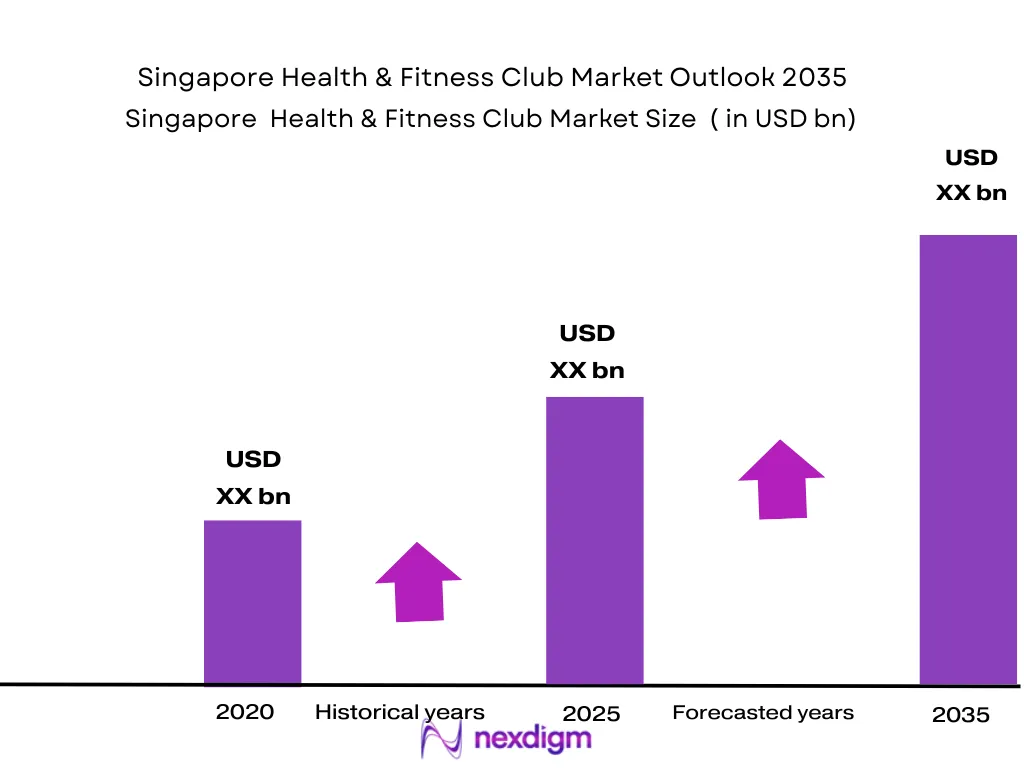
The Singapore health and fitness club market recorded revenue of USD ~ billion based on a recent historical assessment, with revenue defined as membership fees paid to gyms, health clubs and fitness clubs. Demand is driven by higher health awareness, lifestyle-disease concerns, personal training uptake, wellness programming and continued spending by younger consumers, including 1.5 million millennials and 1.2 million Gen Z residents.
Central Singapore, Orchard, Marina Bay, Raffles Place, Tanjong Pagar, Holland Village and other affluent mixed-use districts dominate club activity because they combine dense office employment, high-income residential clusters, expatriate demand and premium retail real estate. ActiveSG facilities strengthen public access across residential towns, while commercial chains concentrate in central business and transport-linked locations where footfall, corporate wellness demand and class utilization are strongest.
Market Segmentation
By Membership Model
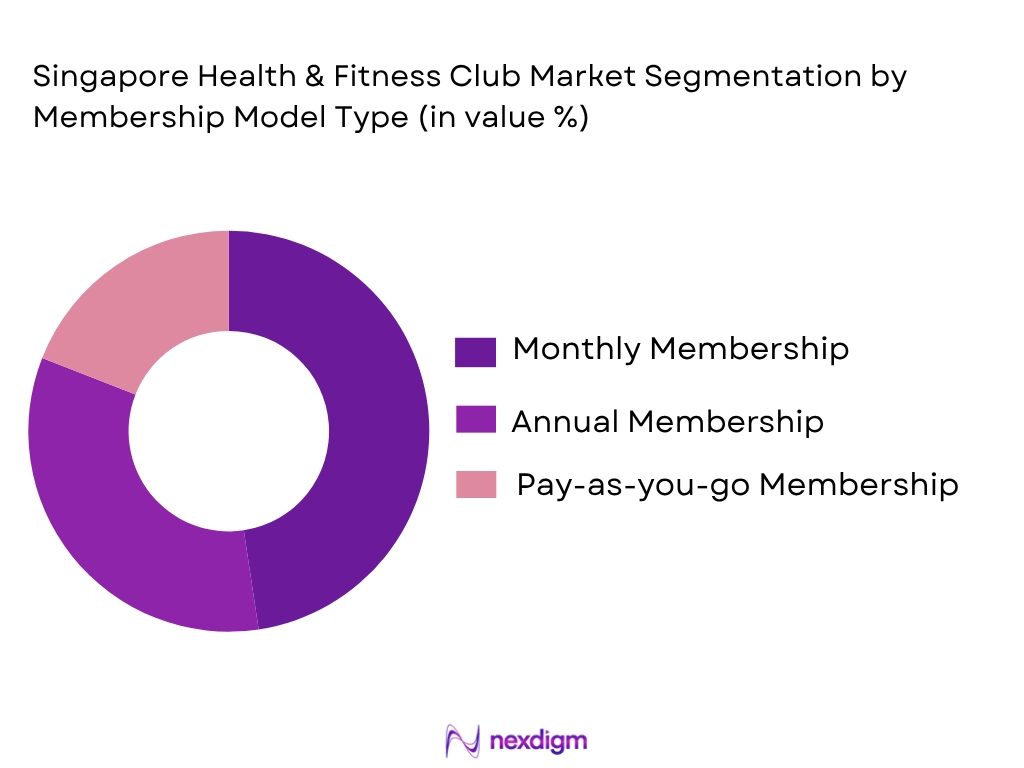
Singapore health and fitness club market is segmented by membership model into monthly membership, annual membership, and pay-as-you-go membership. Recently, monthly membership has a dominant market share due to factors such as recurring salary cycles, consumer preference for flexibility, high churn risk in urban fitness subscriptions, and the wide availability of app-based billing by commercial chains. Monthly plans suit Singapore’s compact geography because members can switch clubs when office, residence, or commuting patterns change, while operators use monthly billing to reduce entry barriers for younger professionals and expatriates. Annual memberships remain relevant for committed users seeking lower effective pricing, but they face friction from relocation, hybrid work, and preference for trial-based fitness formats. Pay-as-you-go models attract casual users, boutique class buyers, and travelers, but they do not provide the recurring revenue stability that club operators require
By Facility Type
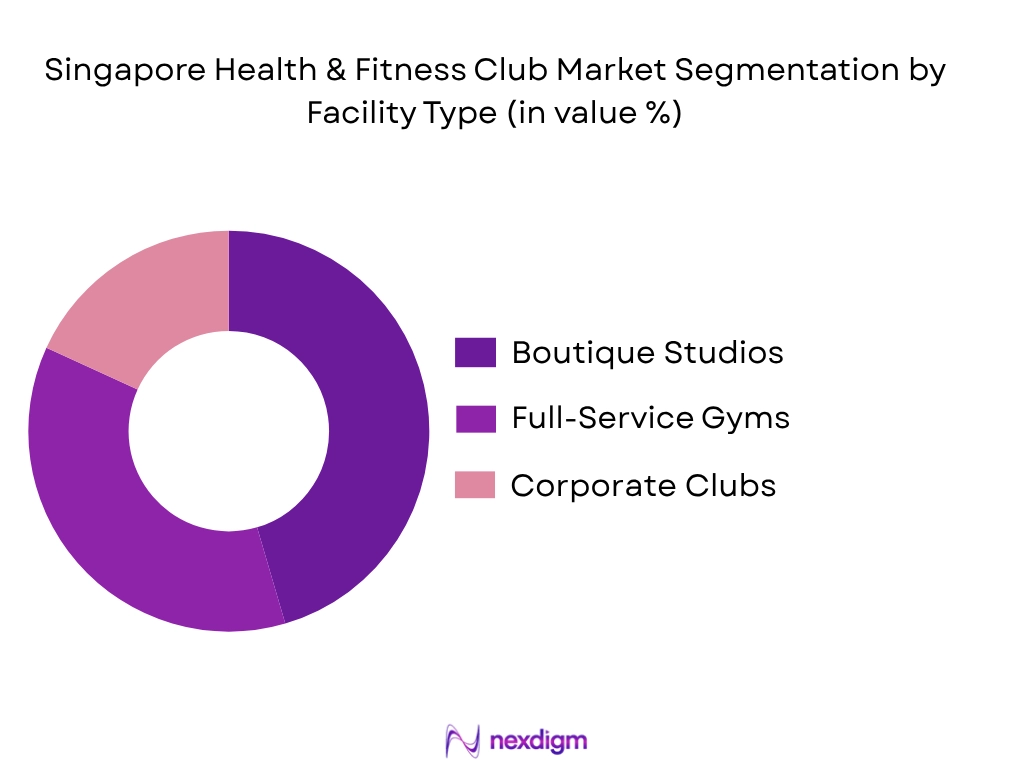
Singapore health and fitness club market is segmented by facility type into boutique studios, full-service gyms, and corporate clubs. Recently, boutique studios have a dominant market share due to factors such as class-based engagement, premium pricing, specialized formats, high instructor affinity, and consumer preference for curated fitness communities. Boutique studios perform strongly in Singapore because compact urban districts allow consumers to access Pilates, HIIT, boxing, yoga, spin, and strength classes near offices and residential clusters without needing large-floorplate facilities. Full-service gyms retain broad relevance because they offer equipment, personal training, recovery zones, and flexible opening hours, but high rent and space constraints can limit expansion. Corporate clubs benefit from employer wellness budgets and office-tower convenience, yet their reach depends heavily on corporate partnerships and workplace attendance pattern Premiumization and smaller-footprint formats therefore support boutique leadership.
Competitive Landscape
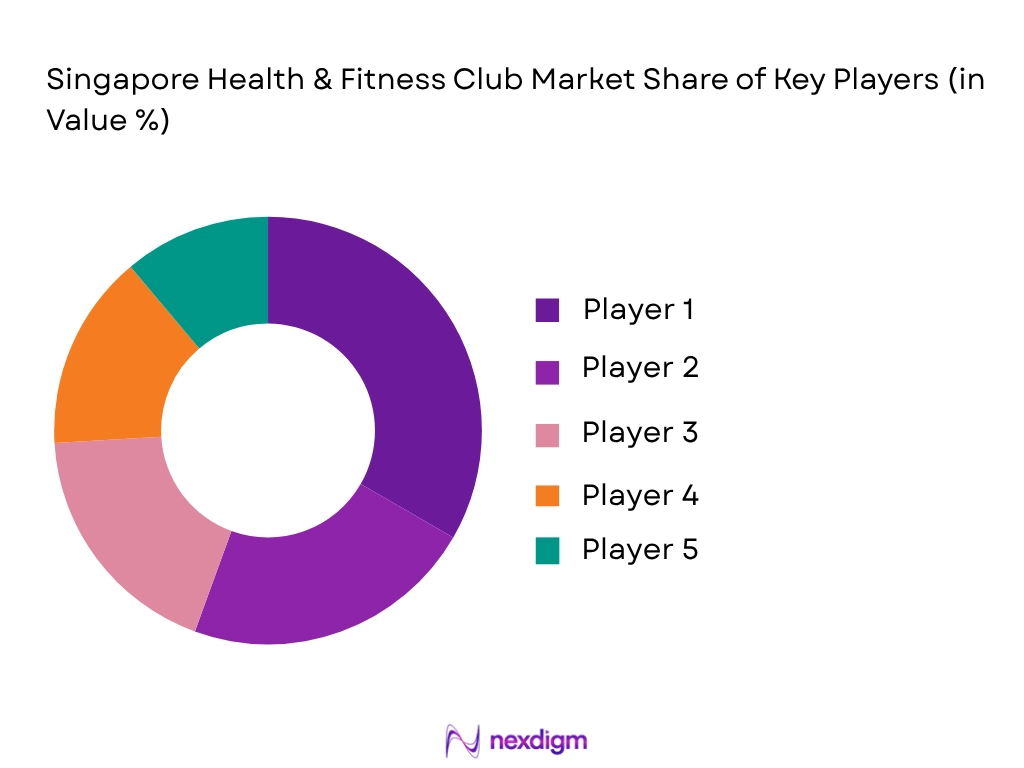
Singapore’s health and fitness club market is moderately fragmented, with strong influence from international franchise systems, premium wellness chains, local boutique operators and public-sector ActiveSG facilities. Consolidation pressure is visible through franchise expansion, high rental costs, brand exits and investment in premium club upgrades, while leading operators compete on convenience, trainer quality, class programming, recovery facilities, digital booking and corporate wellness partnerships. Virgin Active’s investment of nearly USD 5 million in Singapore clubs illustrates the premiumization trend.
| Company Name | Establishment Year | Headquarters | Technology Focus | Market Reach | Key Products | Revenue | Club Format Focus |
| Fitness First Singapore | 1995 in Singapore; brand founded 1993 | Singapore / regional ownership under Evolution Wellness | ~ | ~ | ~ | ~ | ~ |
| Anytime Fitness Singapore | Brand founded 2002 | Woodbury, Minnesota, USA / Singapore franchise network | ~ | ~ | ~ | ~ | ~ |
| Virgin Active Singapore | Brand founded 1999 | London, UK / Singapore operations | ~ | ~ | ~ | ~ | ~ |
| F45 Training Singapore | 2013 | Austin, Texas, USA / Australian-origin brand | ~ | ~ | ~ | ~ | ~ |
| Yoga Movement | 2012 | Singapore | ~ | ~ | ~ | ~ | ~ |
Singapore Health & Fitness Club Market Analysis
Growth Drivers
Increasing Corporate Wellness Programs
Increasing corporate wellness programs are strengthening demand for Singapore health and fitness clubs because the country has a large formal workforce concentrated in office-based, high-skill sectors where employers can integrate gym access, fitness classes, mobility programs and preventive wellness benefits into employee engagement packages. Singapore’s total employment grew by 44,500 workers in 2024, while resident employment increased by 8,800 workers, creating a larger addressable workplace base for club operators targeting corporate accounts. MOM also reported resident employment gains in Financial & Insurance Services by 5,300 workers, Health & Social Work by 5,200 workers, Professional Services by 5,000 workers, and Information & Communications by 4,200 workers, all of which are relevant demand pools for structured wellness memberships and lunchtime or after-work fitness formats. Singapore also had 202,100 Employment Pass holders and 178,200 S Pass holders in December 2024, adding a sizeable professional and managerial expatriate workforce that is typically reachable through employer-linked wellness benefits. On the macroeconomic side, World Bank data places Singapore’s GDP at USD 547.4 billion in 2024, supporting a corporate environment where employers can allocate resources to retention, productivity and preventive-health initiatives. HPB’s workplace health promotion framework further supports the use of workplaces as a setting for adult health interventions, which gives fitness clubs a practical route to sell group memberships, trainer-led sessions, challenge programs and hybrid wellness access to employers.
Government Support for Active Living and Healthy Ageing
Government support for active living and healthy ageing is a major growth driver because it normalizes exercise participation, expands public fitness access and creates long-term demand for safe, age-appropriate fitness formats that private clubs can also serve. Singapore’s total population stood at 6.04 million in June 2024, including 3.64 million citizens, 544,900 permanent residents and 1.86 million non-residents, giving fitness operators a dense and diverse consumer base across residential towns, central business districts and expatriate clusters. The citizen population continued to age, and Population in Brief 2024 reported that citizens aged 65 and above numbered 725,500, creating demand for strength, mobility, balance, fall-prevention and low-impact exercise programs. Sport Singapore reported that ActiveSG had a 2.5 million membership base in 2024, showing that state-backed fitness access has already brought a large part of the population into formal sport and recreation channels. MCCY also stated that 8 ActiveSG gyms had been equipped with machines for users of all abilities and that SportSG was on track to make all 27 ActiveSG gyms inclusive by 2026, which reinforces the national move toward accessible exercise infrastructure. The government’s Age Well SG program was supported by SGD 3.5 billion over the next decade, which strengthens community-based active ageing and indirectly supports commercial clubs offering senior fitness, recovery, physiotherapy-adjacent training and inclusive programming.
Challenges
Member Retention and Subscription Fatigue
Member retention and subscription fatigue remain a market-specific challenge because Singapore consumers have many public, private, digital and boutique alternatives within a compact urban environment, making it easier to pause, switch or downgrade memberships when routines change. World Bank data records Singapore’s urban population at 6,036,860 people in 2024, indicating that virtually the entire consumer base is concentrated in an urban service market where travel time between competing facilities is low. ActiveSG’s 2.5 million membership base gives consumers a large public-sector alternative to private fitness clubs, especially for basic gym access, swimming, courts and community sport facilities. Sport Singapore’s facility ecosystem also includes sport centres, gyms, swimming pools, sport halls and school facilities under the Dual-Use Scheme, increasing the number of non-commercial options available to residents. MOM’s labour-market data shows total employment expanded by 44,500 workers in 2024, but job vacancies eased from 81,200 in June 2024 to 63,400 in September 2024, showing that work routines and office attendance patterns can remain fluid for working adults. For fitness clubs, this creates retention pressure because membership usage can be disrupted by job switching, hybrid work, relocation within Singapore, changes in commute routes, or shifting employer wellness benefits. The challenge is especially important for monthly and app-linked subscriptions, where cancellation friction is lower and consumers can rotate between boutique classes, public gyms, outdoor exercise and home workouts.
Limited Space Availability for Large Fitness Clubs
Limited space availability for large fitness clubs is a structural challenge because Singapore’s land constraints make large-format gym expansion difficult, especially in central, transport-linked and high-footfall districts where commercial operators want to locate. SingStat’s environment data places Singapore’s total land area at approximately 744.3 square kilometres as at end-December 2025, while World Bank data shows the country’s urban population at 6,036,860 people in 2024, creating intense competition for land and built space across housing, offices, retail, transport, logistics and public amenities. World Bank data also reported Singapore’s land area at 718 square kilometres in 2023, while population density was reported at 8,242 people per square kilometre in 2023, illustrating the physical pressure under which large-footprint service formats operate. For health and fitness clubs, this means operators must fit cardio zones, strength floors, studios, changing rooms, showers, recovery areas and personal-training spaces into constrained premises, often favoring smaller boutique studios or compact gyms over full-service clubs. The Urban Redevelopment Authority’s Master Plan functions as the statutory land-use plan guiding permissible land use and development density over the medium term, so operators cannot freely convert space without planning and leasing constraints. This challenge affects expansion economics, member experience and location strategy because clubs need adequate floor area while still being close to offices, residential estates and transit nodes.
Opportunities
Corporate Wellness Partnerships
Corporate wellness partnerships are a future growth opportunity because Singapore’s employment base gives health and fitness clubs a scalable business-to-business route beyond individual memberships. MOM reported that total employment grew by 44,500 workers in 2024, with resident employment increasing by 8,800 workers, and this supports demand for employer-paid or employer-subsidized fitness access, group training and wellness programming. Higher-skilled sectors are especially relevant for this opportunity because MOM recorded resident employment increases of 5,300 in Financial & Insurance Services, 5,200 in Health & Social Work, 5,000 in Professional Services and 4,200 in Information & Communications. These sectors typically operate in office clusters where gyms, boutique studios and hybrid fitness providers can offer lunchtime classes, after-work memberships, annual wellness days and app-based employee challenges. Singapore also had 202,100 Employment Pass holders in December 2024, adding a professional expatriate base that is often served through corporate benefits and premium fitness networks. HPB’s workplace health promotion platform positions the workplace as a key health setting, which supports partnerships between employers and fitness service providers. For clubs, the opportunity is to move from simple discounted membership sales to integrated corporate packages covering fitness assessments, trainer-led sessions, recovery services, mental wellness tie-ins, active commuting challenges and hybrid access. This can improve utilization during off-peak hours and diversify revenue away from walk-in memberships.
Hybrid Fitness Membership Models
Hybrid fitness membership models represent a future growth opportunity because Singapore combines dense physical fitness infrastructure with strong digital connectivity, allowing operators to connect in-club workouts, remote coaching, class booking, wearable integration and app-based retention programs. World Bank data reports 9,960,700 mobile cellular subscriptions in Singapore in 2024, creating a large digital access base for fitness apps, virtual coaching, in-app scheduling and personalized training reminders. World Bank also records 6,036,860 urban residents in 2024, meaning hybrid fitness can work across a compact geography where members may train near home on some days, near the office on others, and online when schedules are constrained. ActiveSG’s 2.5 million membership base shows that digital facility booking and public sport participation have already introduced many consumers to structured fitness access, while commercial clubs can differentiate through premium content, personal training follow-ups, recovery sessions and member analytics. MOM’s labour data shows resident employment growth in Information & Communications by 4,200 workers in 2024, indicating a digitally literate professional customer base that is receptive to app-enabled services. For operators, hybrid memberships can reduce churn by keeping members engaged between physical visits and by allowing class credits, on-demand workouts and remote trainer check-ins to complement club access. The opportunity is strongest for chains and boutique studios that can connect physical locations with mobile-first membership management.
Future Outlook
The Singapore health and fitness club market is expected to remain growth-oriented over the next five years as preventive health, boutique fitness, premium wellness and corporate fitness benefits become more embedded in consumer lifestyles. Operators are likely to invest further in app-based booking, AI-assisted personalization, wearables, recovery technologies and hybrid memberships. Regulatory and public-health support for active living should continue to normalize gym participation. Demand will be strongest among urban professionals, ageing residents, expatriates, wellness-oriented women and companies seeking structured employee wellness offerings.
Major Players
- Fitness First Singapore
- Anytime Fitness Singapore
- Virgin Active Singapore
- F45 Training Singapore
- Yoga Movement
- Pure Fitness Singapore
- True Fitness Singapore
- ActiveSG Gym
- The Gym Pod
- BFT Singapore
- Ritual Gym
- Amore Fitness
- UFIT Singapore
- Gymmboxx
- Ground Zero Fitness
Key Target Audience
- Fitness club operators
- Boutique studio owners
- Franchise investors
- Real estate developers
- Corporate wellness buyers
- Health insurers
- Investments and venture capitalist firms
- Government and regulatory bodies
Research Methodology
Step 1: Identification of Key Variables
The research began by defining the Singapore health and fitness club market as revenue from gyms, fitness clubs, boutique studios and related membership-led fitness services. Key variables included membership model, facility type, pricing tier, location density, consumer demographics, corporate wellness demand, public gym access and technology adoption.
Step 2: Market Analysis and Construction
Market construction used public market-size references, operator information, government demographic data, health-survey indicators and company-level disclosures. Revenue, membership behavior and segment dominance were assessed through triangulation of published market reports, brand footprints, service formats and demand-side indicators.
Step 3: Hypothesis Validation and Expert Consultation
Segment hypotheses were checked against observable market behavior, including premium club investment, boutique expansion, franchise presence, public-sector facility usage and corporate wellness adoption. Where public segment-share disclosure was limited, directional validation was based on available disclosed segment values, operator positioning and channel evidence.
Step 4: Research Synthesis and Final Output
The final report synthesizes market size, segmentation, competitive structure, growth drivers, challenges, opportunities and future outlook into a decision-ready format. The output prioritizes cited public sources, separates disclosed data from directional interpretation, and aligns findings with investor, operator and policy-user needs.

- Executive Summary
- Research Methodology (Market Definitions and Assumptions, Abbreviations and Terminology, Data Sources and Validation Approach, Singapore Health & Fitness Club Market Sizing Methodology, Primary and Secondary Research Benchmarks, Market Reliability and Confidence Intervals)

- Industry Definition and Scope
- Market Genesis and Evolution in Singapore
- Consumer Adoption Patterns
- Market Value Chain and Distribution Architecture
- Import and Export Dynamic

- Growth Drivers
Increasing Corporate Wellness Programs
Rising Demand for Premium and Luxury Fitness Clubs
Digital Fitness and Hybrid Membership Adoption
Government Support for Active Living and Healthy Ageing - Challenges
Member Retention and Subscription Fatigue
Limited Space Availability for Large Fitness Clubs
Dependence on Imported Fitness Equipment and Technology
Shortage of Certified Trainers and Specialized Fitness Professionals - Opportunities
Corporate Wellness Partnerships
Hybrid Fitness Membership Models
Women-Centric Fitness and Wellness Services
Recovery, Mobility and Holistic Wellness Services
Fitness Services for Expatriates and High-Income Consumers - Trends
Hybrid Fitness Models
Personalized Coaching and AI-Led Training
Holistic Wellness, Recovery and Mental Health
Outdoor Fitness and Community-Based Fitness Events
Premiumization of Health Clubs - Government Regulations
Health and Safety Standards for Fitness Clubs
Licensing and Business Registration Requirements
Employment and Certification Standards for Fitness Professionals
Data Privacy Regulations for Digital Fitness Platforms
Regulations for Online Fitness and Virtual Training Services
Government Initiatives Promoting Active Living and Preventive Healthcare - SWOT Analysis
- Porter’s Five Forces Analysis

- By Market Value, 2020-2025
- By Number of Members / Subscribers, 2020-2025
- By Average Membership Fee, 2020-2025
- By Club Penetration Rate, 2020-2025
- By Service Category Revenue Contribution, 2020-2025

- By Facility Type (In value %)
Boutique Studios
Full-Service Gyms
Corporate Clubs
- By Membership Model (In value %)
Monthly Membership
Annual Membership
Pay-as-you-go Membership
- By Distribution Channel (In value %)
Physical Fitness Centers
Online Subscription Platforms
Hybrid Fitness Models
Corporate Wellness Partnerships - By Consumer Demographic (In value %)
Urban Professionals
Young Adults
Middle-Income Households
High-Income Consumers
Senior Fitness Segment
Corporate Employees
Women’s Fitness Segment
Expatriate Population - By Price Tier (In value %)
Budget / Entry-Level
Mid-Tier
Premium
Luxury / Exclusive Memberships
- By Region / Planning Area (In value %)
Central Region
East Region
West Region
North Region
North-East Region
Shortage of Certified Trainers and Specialized Fitness Professionals

- Market Share by Service Category
- Number of Members by Major Brands
- Competitive Positioning by Price Tier
- Cross Comparison Parameters(Company Overview, Service Portfolio Strength, Location Footprint, Digital and Technology Integration, Pricing Strategy, Brand Equity,Consumer Preference Score Annual Revenue, Growth Trajectory)
- Company Profiles
Fitness First Singapore
Virgin Active Singapore
Anytime Fitness Singapore
Pure Fitness
True Fitness
ActiveSG Gym
The Gym Pod
BFT Singapore
F45 Training Singapore
Ritual Gym
Amore Fitness
Yoga Movement
UFIT Singapore
Platinum Fitness
Gymmboxx

- Buying Decision Drivers
- Brand Loyalty and Membership Renewal Cycle
- Preferred Membership Duration
- Payment Preferences and Subscription Models
- Usage Frequency and Post-Membership Behavior
- Pain Points in Club Usage and Renewal
- Consumer Preference for Physical vs Digital Fitness Services

- By Market Value, 2026-2035
- By Number of Members / Subscribers, 2026-2035
- By Average Membership Fee, 2026-2035
- By Club Penetration Rate, 2026-2035
- By Service Category Revenue Contribution, 2026-2035


 Request a Sample
 Ask for Customization
 Get a Quote
 Enquire Now