
 Download PDF
Market Overview
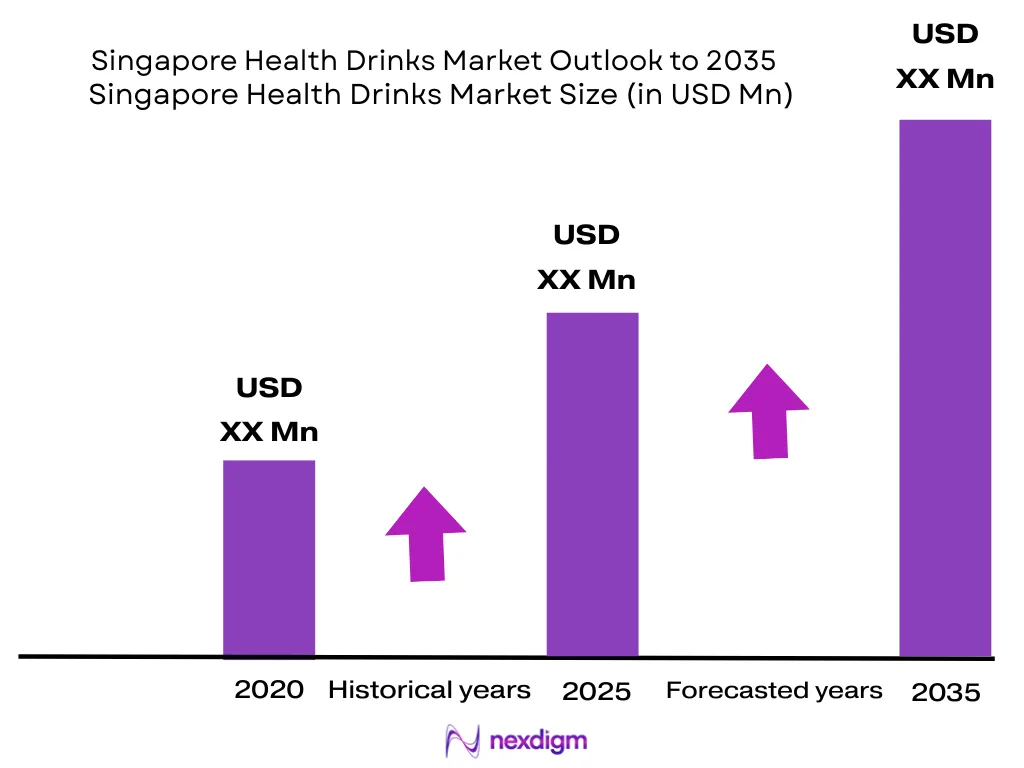
The Singapore Health Drinks Market is valued at USD ~ million, based on the Singapore functional drinks market revenue published by MarketLine through Research and Markets. The market is driven by RTD tea, probiotic drinks, sports hydration, functional water, energy drinks, fortified juices, plant-based beverages, protein RTDs and traditional Asian wellness drinks. Consumption volume reached 75.7 million liters, while Singapore’s GDP rose from USD 501.43 billion to USD 547.39 billion, supporting premium functional beverage demand. Central Business District, Orchard, Tampines, Jurong, Woodlands, Changi Airport and tourism-linked retail clusters dominate the Singapore Health Drinks Market because they concentrate offices, MRT nodes, convenience stores, gyms, hotels, pharmacies, vending machines and premium grocery outlets. Singapore’s population increased from 5.92 million to 6.04 million, while visitor arrivals increased from 13.6 million to 16.5 million, strengthening demand for on-the-go hydration, low-sugar RTD tea, probiotic multipacks and functional beverages.
Market Segmentation
By Product Type
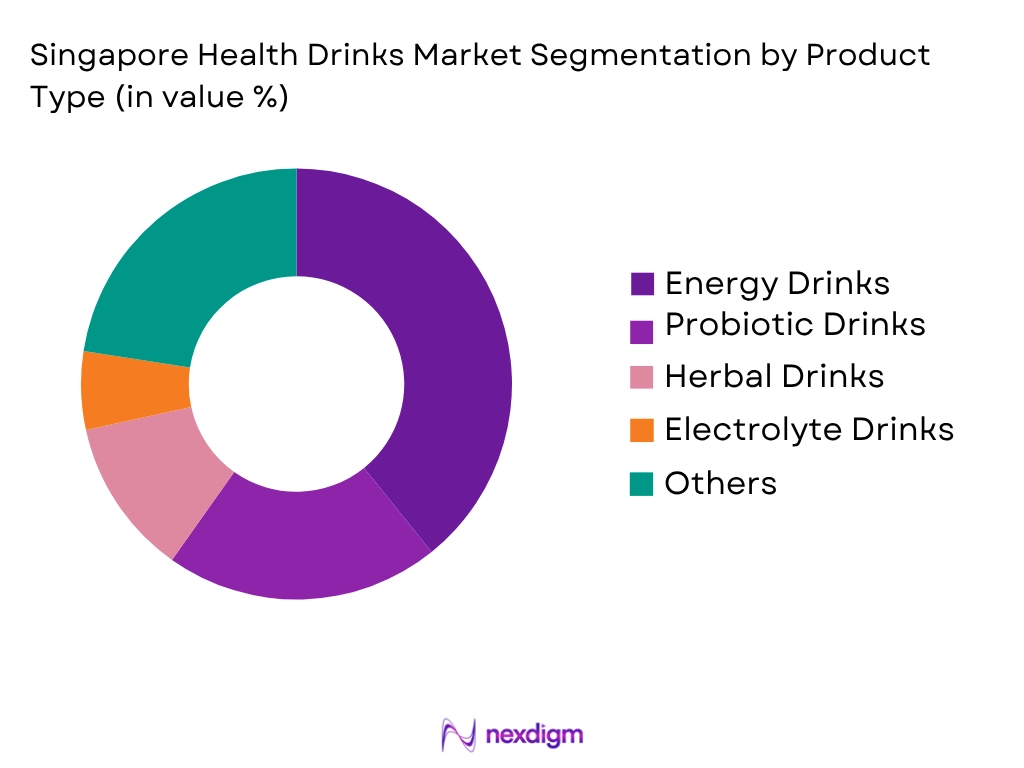
Singapore Health Drinks Market is segmented by product type into RTD tea and herbal drinks, probiotic drinks, sports and electrolyte drinks, functional water, energy drinks, fortified juices, plant-based functional beverages, protein RTD drinks, kombucha and traditional Asian wellness drinks. RTD tea and herbal drinks hold the dominant market share because tea-based beverages are embedded in Singapore’s daily consumption culture and fit well with the country’s low-sugar reformulation agenda. Brands such as Pokka, Yeo’s, F&N, Coca-Cola, Suntory and local Asian beverage players benefit from strong placement across FairPrice, Cold Storage, Sheng Siong, 7-Eleven, Cheers, vending machines, MRT corridors and foodservice outlets. Reduced-sugar green tea, oolong tea, chrysanthemum tea, barley drinks and herbal infusions appeal to office workers, students, commuters and families. Probiotic drinks and isotonic beverages are important, but RTD tea has broader frequency, affordability and channel reach.
By Distribution Channel
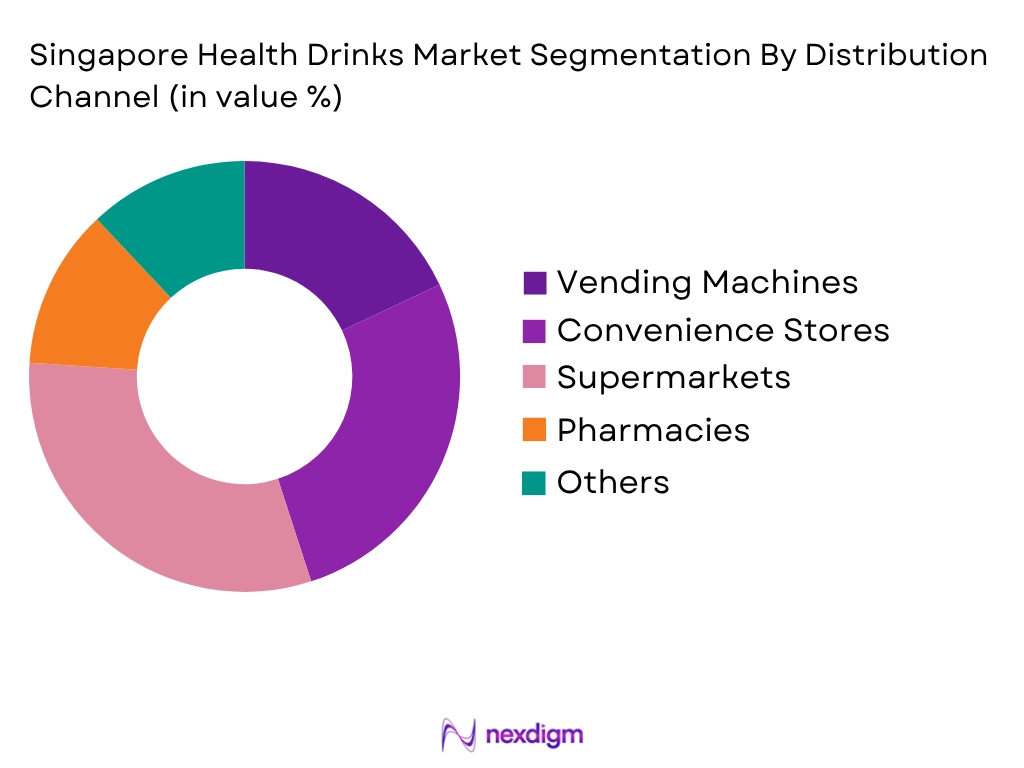
Singapore Health Drinks Market is segmented by distribution channel into supermarkets and hypermarkets, convenience stores, pharmacies and health stores, vending machines, online grocery and q-commerce, gyms and fitness studios, HORECA and specialty wellness retail. Supermarkets and hypermarkets dominate the market share under distribution channel segmentation because they support weekly household purchases, probiotic multipacks, low-sugar RTD tea, soy beverages, fortified juices, sports drinks, plant-based drinks and imported wellness products. FairPrice, Cold Storage, Giant, Sheng Siong and Don Don Donki provide strong shelf visibility, chilled aisles, multipack formats and promotional mechanics. Convenience stores and vending machines remain crucial for single-serve RTD tea, energy drinks, functional water and isotonic drinks, especially around MRT stations, schools, offices and hospitals. Online grocery is rising for premium wellness bundles, but supermarkets remain the core replenishment channel.
Competitive Landscape
The Singapore Health Drinks Market is led by regional beverage companies, probiotic specialists, isotonic drink leaders, multinational beverage companies and premium wellness brands. F&N Foods, Pokka Singapore, Yeo Hiap Seng, Yakult Singapore and The Coca-Cola Company have strong influence because they cover high-frequency categories such as isotonic drinks, RTD tea, soy beverages, probiotic drinks, functional water and enhanced beverages. Competition is shaped by Nutri-Grade positioning, low-sugar reformulation, Healthier Choice Symbol alignment, vending availability, convenience retail access, chilled distribution and imported premium wellness portfolios.
| Company | Establishment Year | Headquarters | Key Health Drinks Portfolio | Functional Positioning | Core Channel Strength | Nutri-Grade / Low-Sugar Strength | Packaging Strength | Singapore Competitive Advantage |
| F&N Foods Singapore | 1883 | Singapore | ~ | ~ | ~ | ~ | ~ | ~ |
| Pokka Singapore | 1977 | Singapore | ~ | ~ | ~ | ~ | ~ | ~ |
| Yeo Hiap Seng | 1900 | Singapore | ~ | ~ | ~ | ~ | ~ | ~ |
| Yakult Singapore | 1935 | Tokyo, Japan | ~ | ~ | ~ | ~ | ~ | ~ |
| The Coca-Cola Company Singapore | 1886 | Atlanta, USA | ~ | ~ | ~ | ~ | ~ | ~ |
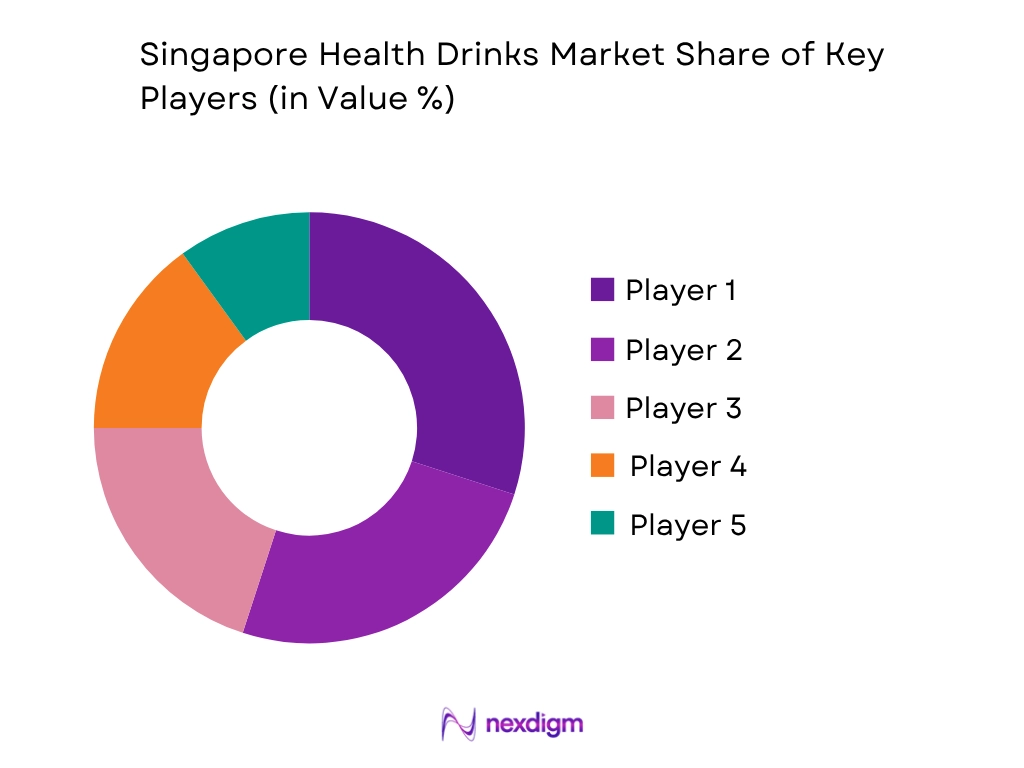
Singapore Health Drinks Market Analysis
Growth Drivers
High-Income Urban Consumer Base Supporting Premium Functional Beverage Adoption
Singapore Health Drinks Market is supported by a compact, high-income consumer base that enables frequent purchase of low-sugar RTD tea, probiotic drinks, functional water, sports hydration, plant-based drinks and collagen beverages through supermarkets, convenience stores, pharmacies, vending machines and online grocery. The World Bank records Singapore’s GDP at USD 547.39 billion and GDP per capita at USD 90,674.1, indicating strong consumer capacity for premium wellness and functional beverage formats. IMF also records Singapore’s population at 6.0 million and GDP per capita at USD 90,689, reinforcing the market’s high-spending urban base. For health drinks, this supports premium probiotic multipacks, imported Japanese and Korean wellness drinks, electrolyte beverages, Nutri-Grade A/B reformulated drinks and functional water sold through high-density retail nodes.
Tourism and Transit Consumption Expanding On-the-Go Health Drink Occasions
Singapore Health Drinks Market benefits from tourism, airport traffic, hotels, attractions, MRT corridors and convenience retail, which create repeated consumption occasions for isotonic drinks, RTD tea, functional water, energy drinks and probiotic beverages. Singapore Tourism Board reported 16.9 million international visitor arrivals, including 3.1 million from Mainland China, 2.4 million from Indonesia, 1.3 million from Malaysia, 1.3 million from Australia and 1.2 million from India. This visitor base supports beverage sales through Changi Airport, hotels, attractions, cafés, vending machines and convenience stores. SingStat also reports 1.33 million visitor arrivals in April 2026, showing continued travel-led beverage occasions. For market players, tourist and transit demand supports single-serve PET bottles, cans, low-sugar RTD teas, electrolyte drinks and premium Asian wellness beverages.
Market Challenges
Nutri-Grade Compliance Creating Reformulation and Labeling Pressure
Singapore Health Drinks Market faces a regulatory challenge because beverages are assessed under Nutri-Grade based on sugar and saturated fat, creating direct portfolio pressure for RTD tea, soy drinks, milk-based beverages, energy drinks, juices and freshly prepared beverages. Health Promotion Board states that Nutri-Grade uses 4 grades, from A to D, with healthier-choice drinks aligned to Nutri-Grade A or B. The Ministry of Health states that Nutri-Grade requirements for freshly prepared beverages apply across retail settings, digital platforms, hotels, workplaces, educational institutions, healthcare institutions and childcare facilities from 30 December 2023, making the rules operational across 2024 trading activity. For health drink companies, this raises reformulation, relabeling, menu disclosure and claim-substantiation costs, especially for higher-sugar RTD tea, juice drinks, flavored milk, protein beverages and café wellness drinks.
Small Domestic Population and Inflation Pressure Limiting Broad-Based Premiumization
Singapore Health Drinks Market has strong purchasing power but limited domestic scale, which creates challenges for brands relying on large-volume rollout of niche kombucha, collagen drinks, protein RTDs, functional waters and imported wellness beverages. IMF records Singapore’s population at 6.0 million, making the market smaller than regional peers and increasing dependence on high SKU productivity, fast retail rotation and strong distributor relationships. MAS reported CPI-All Items inflation averaged 2.4 and MAS Core Inflation averaged 2.7 in 2024, after 4.8 and 4.2 respectively in 2023. While inflation moderated, grocery and discretionary wellness purchases remain exposed to consumer trade-offs. Health drink brands therefore need tight channel selection, efficient pack architecture, Nutri-Grade positioning and reliable repeat-purchase drivers rather than depending only on premium novelty launches.
Market Opportunities
Low-Sugar and Nutri-Grade A/B Innovation Can Reshape Mainstream Health Drink Portfolios
Singapore Health Drinks Market has a strong opportunity in Nutri-Grade A/B reformulation because public-health regulation creates a clear commercial incentive for lower-sugar RTD tea, functional water, probiotic drinks, zero-sugar energy drinks, reduced-sugar soy beverages and electrolyte products. HealthHub states that lower-sugar and lower-saturated-fat drinks may carry Nutri-Grade labels, Healthier Choice identifiers, or both, while healthier-choice drinks are Nutri-Grade A or B. HPB also states that its Nutri-Grade measures and labeling requirements for beverages were updated on 13 May 2026, showing that beverage compliance remains a live operating issue for brands. With World Bank GDP per capita at USD 90,674.1, brands can target premium reformulated beverages rather than only low-cost drinks. This supports future growth through compliant functional claims, cleaner labels and better shelf acceptance.
Vending, Convenience and Digital Grocery Can Scale Single-Serve and Multipack Health Drinks
Singapore Health Drinks Market has an opportunity to scale through vending machines, convenience stores, online grocery and q-commerce because the country’s dense urban layout supports fast replenishment and frequent single-serve consumption. SingStat reports retail trade sales increased 5.4 and food & beverage services increased 0.4 in April 2026 compared with April 2025, showing ongoing activity across consumer retail and F&B channels. Singapore also recorded GDP of USD 547.39 billion, giving retailers and importers a strong economic base for higher-value beverage assortments. Health drinks are well suited to this channel mix because RTD tea, isotonic drinks, probiotic multipacks, functional water, energy drinks and protein RTDs can be sold through MRT-area stores, office vending, pharmacies, supermarkets and online bundles. The strongest opportunity lies in combining Nutri-Grade-compliant SKUs with availability at daily transit and workplace purchase points.
Future Outlook
The Singapore Health Drinks Market is forecasted to grow at a CAGR of around 6.4% during 2026-2035, aligned with the broader functional beverages outlook for the same period. Growth will be supported by low-sugar RTD tea, probiotic drinks, electrolyte hydration, functional water, plant-based beverages, protein RTDs, collagen drinks and Asian botanical wellness beverages. Over the next phase, Singapore will remain a regulation-led health drinks market. Nutri-Grade rules will continue pushing beverage companies toward lower sugar and lower saturated fat formulations. Drinks graded A and B will gain strategic importance in supermarkets, convenience stores, vending machines, cafés, schools, offices and online grocery platforms.
Premiumization will also continue, but within a small and highly competitive market. High-income consumers will support imported kombucha, collagen shots, Japanese wellness drinks, Korean vitamin drinks, plant-based beverages and protein RTDs. However, brands will still need clear functional claims, strong taste acceptance and competitive channel execution. Vending and convenience-led formats will remain important because Singapore’s dense transit network supports single-serve consumption. MRT stations, office towers, schools, hospitals, universities and residential towns will remain important placement points for RTD tea, isotonic beverages, functional water and energy drinks.
Major Players
- F&N Foods Singapore
- Pokka Singapore
- Yeo Hiap Seng
- Yakult Singapore
- The Coca-Cola Company Singapore
- PepsiCo Singapore
- Red Bull Singapore
- Monster Beverage Corporation
- Otsuka Pharmaceutical
- Suntory Beverage & Food
- Nestlé Singapore
- Danone / Alpro
- Health-Ade Kombucha
- Remedy Drinks
- Kinohimitsu
Key Target Audience
- Health drink manufacturers and brand owners
- Beverage importers and distributors
- Supermarket, hypermarket and convenience retail chains
- Vending machine operators and workplace pantry suppliers
- Online grocery and q-commerce platforms
- Pharmacies, health and beauty retailers, gyms and wellness stores
- Investments and venture capitalist firms
- Government and regulatory bodies (Singapore Food Agency, Health Promotion Board, Ministry of Health, Enterprise Singapore, Singapore Tourism Board)
Research Methodology
Step 1: Identification of Key Variables
The initial phase involves constructing an ecosystem map for the Singapore Health Drinks Market, covering brand owners, importers, distributors, retailers, vending operators, gyms, pharmacies, cafés, online grocery platforms and regulators. Key variables include product type, Nutri-Grade classification, sugar content, saturated fat content, packaging, route-to-market and consumer cohort.
Step 2: Market Analysis and Construction
In this phase, historical data is compiled across RTD tea, probiotic drinks, sports drinks, functional water, energy drinks, fortified juices, plant-based drinks, protein RTDs and Asian wellness beverages. Top-to-bottom analysis is supported by published functional-drinks revenue, while bottom-to-top validation uses SKU mapping, shelf checks, vending audits and online availability tracking.
Step 3: Hypothesis Validation and Expert Consultation
Market hypotheses are validated through computer-assisted telephone interviews with beverage distributors, supermarket category managers, vending operators, convenience store buyers, pharmacy buyers, gym operators and importers. These discussions help validate channel performance, Nutri-Grade reformulation, cold-chain needs, pricing architecture, product rotation and consumer response to functional claims.
Step 4: Research Synthesis and Final Output
The final phase integrates secondary research, regulatory review, SKU benchmarking, primary interviews and channel-level triangulation. Direct engagement with beverage manufacturers and retail buyers supports validation of product segmentation, competitive positioning and future growth assumptions. The final output provides market size, segmentation, competitive landscape, future outlook and strategic recommendations.

- Executive Summary
- Research Methodology (Market Definitions and Assumptions, Health Drinks Inclusion and Exclusion Criteria, Abbreviations, Top-to-Bottom Market Sizing, Bottom-to-Top SKU Build-Up, Nutri-Grade Classification Mapping, Healthier Choice Symbol Screening, Supermarket and Convenience Store Shelf Audit, Vending Channel Checks, E-Commerce Grocery Tracking, Distributor and Importer Interviews, Gym and Pharmacy Channel Validation, HORECA and Café Menu Review, Primary Research Approach, Limitations and Future Conclusions)

- Definition and Scope
- Overview Genesis
- Health Drinks Category Boundary
- Timeline of Major Players
- Business Cycle
- Supply Chain and Value Chain Analysis

- Growth Drivers (Health-Conscious Consumers, High Disposable Income, Nutri-Grade Awareness, Sports and Fitness Culture, Convenience Retail Density, E-Commerce Grocery, Premium Import Availability)
- Market Challenges (Small Domestic Population, High Retail Rental, Import Dependency, Nutri-Grade Advertising Restrictions, Premium Price Sensitivity, Cold-Chain Cost)
- Opportunities (Nutri-Grade A/B Innovation, Asian Botanical Wellness, Electrolyte Sachets, Protein RTD, Collagen Drinks, Probiotic Expansion, Vending Health Drinks, Senior Nutrition)
- Market Trends (Reduced Sugar RTD Tea, Zero Sugar Energy, Collagen Shots, Functional Waters, Kombucha, Probiotic Multipacks, Electrolyte Powders, Plant-Based Fortification)
- SWOT Analysis
- PESTLE Analysis
- Porter’s Five Forces Analysis

- By Value (2020-2026)
- By Volume (2020-2026)
- By Average Selling Price (2020-2026)

- By Product Type (In Value %)
RTD Tea and Herbal Drinks
Probiotic Drinks
Sports and Electrolyte Drinks
Functional Water
Energy Drinks - By Packaging Format (In Value %)
PET Bottles
Cans
Tetra Packs and Cartons
Glass Bottles
Small Probiotic Bottles
Sachets and Powder Sticks - By Distribution Channel (In Value %)
Supermarkets and Hypermarkets
Convenience Stores
Pharmacies and Health and Beauty Stores
Vending Machines
Online Grocery and Q-Commerce - By Region (In Value %)
Central Region
Eastern Region
Western Region
Southern Region

- Market Share of Major Players on the Basis of Value and Volume
- Cross Comparison Parameters (Nutri-Grade A/B SKU Penetration, Healthier Choice Symbol Alignment, Functional Product Portfolio Breadth, Low-Sugar Reformulation Capability, Convenience and Vending Presence, Cold-Chain Distribution Strength, E-Commerce Multipack Availability, Premium Imported Wellness Positioning)
- SWOT Analysis of Major Players
- Pricing Analysis Basis SKUs for Major Players
- Detailed Profiles of Major Companies
F&N Foods Singapore
Pokka Singapore
Yeo Hiap Seng
Yakult Singapore
The Coca-Cola Company Singapore
PepsiCo Singapore
Red Bull Singapore
Monster Beverage Corporation
Otsuka Pharmaceutical
Suntory Beverage & Food
Nestlé Singapore
Danone / Alpro
The Hain Celestial Group / Health-Ade Kombucha
Remedy Drinks
Kinohimitsu

- Office Professionals and Commuters
- Students and Young Adults
- Fitness Enthusiasts and Athletes
- Elderly and Preventive Health Consumers
- Families and Household Buyers
- Premium Wellness Consumers

- By Value (2026-2035)
- By Volume (2026-2035)
- By Average Selling Price (2026-2035)


 Request a Sample
 Ask for Customization
 Get a Quote
 Enquire Now