
 Download PDF
Market Overview
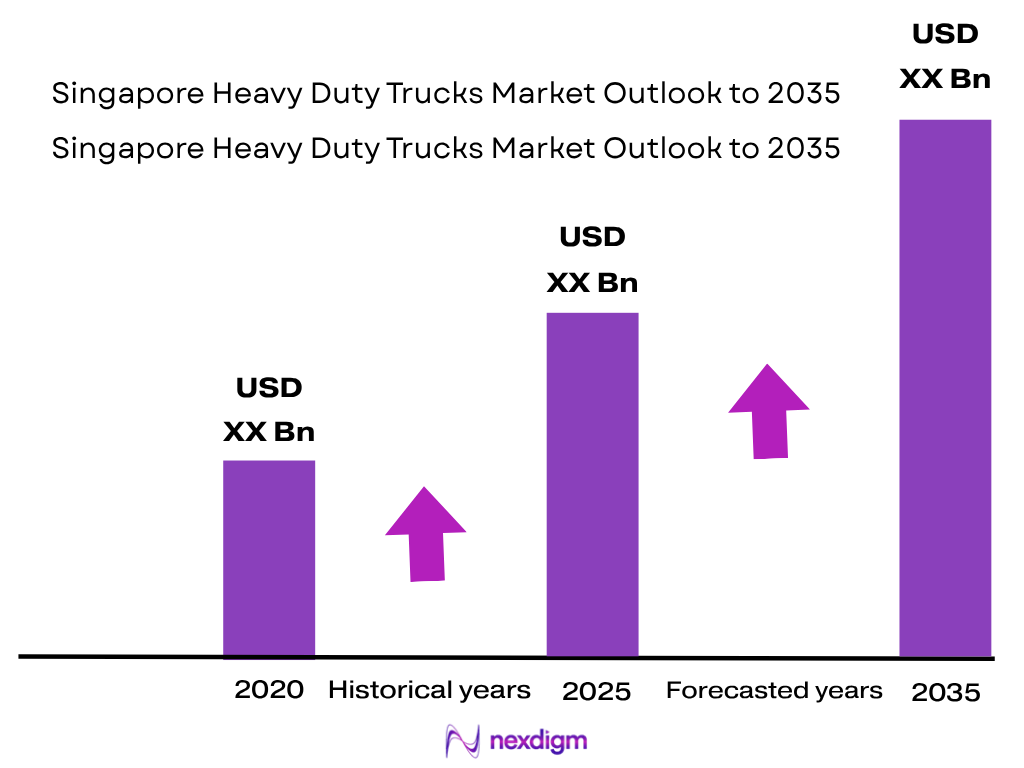
The Singapore Heavy Duty Trucks Market is valued at approximately USD ~XX billion, with the corresponding 2024 market size to be replaced with the validated commercial-vehicle revenue estimate. Official Land Transport Authority statistics provide the underlying vehicle-population and registration framework: Singapore had around 52,000 heavy vehicles in operation, while 0.9% of newly registered heavy goods vehicles were electric. The broader economy generated S$731.4 billion in nominal GDP, with transportation and storage contributing 9.1% of nominal value added.
Demand is concentrated around Tuas, Jurong, Jurong Island, Changi, Woodlands and the port-industrial belt, supported by Singapore’s position as a major transshipment, manufacturing and regional logistics hub. The Port of Singapore and cross-border connectivity with Malaysia generate continuous requirements for prime movers, container carriers and heavy freight vehicles, while construction and industrial activity adds demand for tippers, tankers and specialized trucks. Construction demand reached S$33.8 billion in the earlier historical observation and S$44.2 billion in the latest full-year preliminary observation, reinforcing the importance of construction and infrastructure activity to heavy-truck utilization.
Market Segmentation
By Truck Configuration
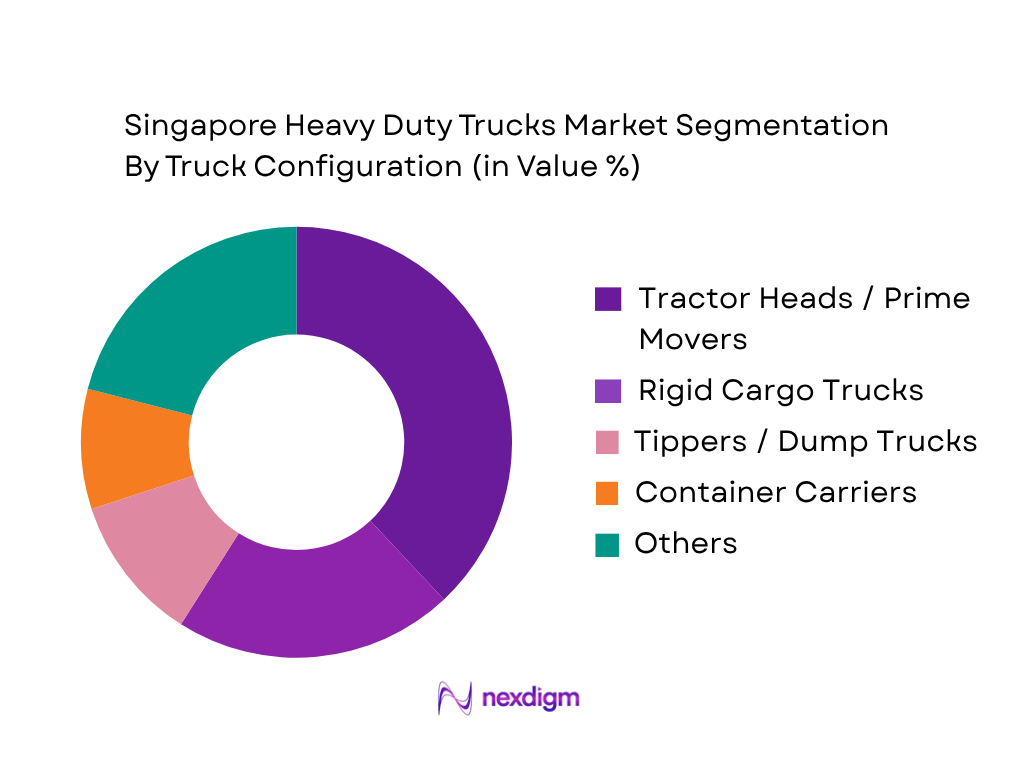
The Singapore Heavy Duty Trucks Market is segmented by truck configuration into tractor heads/prime movers, rigid cargo trucks, tippers and dump trucks, tankers, container carriers, concrete mixers, crane trucks, refrigerated trucks and specialized heavy vehicles. Tractor heads/prime movers are expected to represent the dominant configuration because Singapore’s logistics ecosystem is strongly connected to containerized freight, port operations and cross-border movement. LTA’s vehicle statistics separately track prime movers, lorries, tippers, tankers, cement mixers, cranes and refrigerated vehicles, allowing the market to be reconstructed according to actual vehicle configuration rather than broad commercial-vehicle categories. Prime movers are particularly relevant to Tuas and other port-linked logistics operations, where container movements require high-payload tractor-trailer combinations. Their importance is reinforced by Singapore’s extensive industrial and distribution infrastructure and its land connection with Malaysia. Construction-related rigid trucks and tippers remain important because BCA recorded S$44.2 billion of construction demand, while specialized vehicles serve petrochemical, industrial, municipal and cold-chain applications.
By End-Use Industry
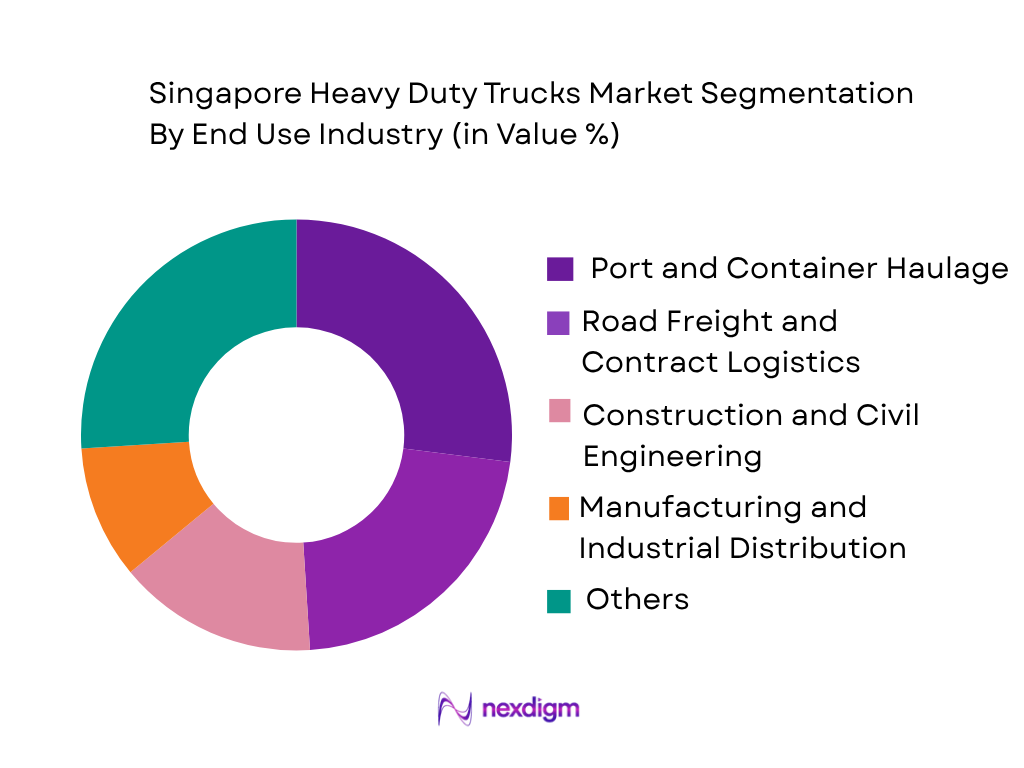
The Singapore Heavy Duty Trucks Market is segmented by end-use industry into port and container haulage, logistics and contract freight, construction and civil engineering, manufacturing and industrial distribution, petrochemicals and chemicals, food and cold-chain logistics, retail and e-commerce logistics, waste management, utilities and infrastructure, and marine and offshore services. Port and container haulage is expected to remain the dominant application because Singapore’s logistics economy requires continuous movement between terminals, container depots, warehouses and industrial facilities. Transportation and storage represented 9.1% of nominal GDP value added, while manufacturing represented 17.3%, creating substantial freight requirements across industrial supply chains. Construction is another major demand pool, with preliminary construction demand reaching S$44.2 billion. The combination of port operations, manufacturing, warehousing and construction creates high utilization rates for tractor heads, container trucks, rigid freight vehicles and specialized heavy vehicles.
Competitive Landscape
The Singapore Heavy Duty Trucks Market is characterized by a concentrated commercial-vehicle ecosystem involving global truck OEMs, authorized distributors and established fleet-service providers. Competition is shaped less by vehicle availability alone and more by payload capability, COE economics, fleet uptime, fuel efficiency, after-sales coverage, spare-parts availability, financing support and electrification readiness. The emergence of electric heavy vehicles is beginning to add another competitive dimension: LTA reported that 0.9% of newly registered heavy goods vehicles excluding buses were electric, while the government introduced the Heavy Vehicle Zero Emissions Scheme to accelerate adoption.
| Company | Establishment | Headquarters | Product Portfolio | Key Heavy-Truck Strength | Singapore Distribution / Service | Powertrain Positioning | Fleet Technology |
| Scania | 1891 | Södertälje, Sweden | ~ | ~ | ~ | ~ | ~ |
| Volvo Trucks | 1927 | Gothenburg, Sweden | ~ | ~ | ~ | ~ | ~ |
| Hino Motors | 1942 | Tokyo, Japan | ~ | ~ | ~ | ~ | ~ |
| Isuzu Motors | 1916 | Tokyo, Japan | ~ | ~ | ~ | ~ | ~ |
| Daimler Truck / Mercedes-Benz Trucks | 1926 | Leinfelden-Echterdingen, Germany | ~ | ~ | ~ | ~ | ~ |
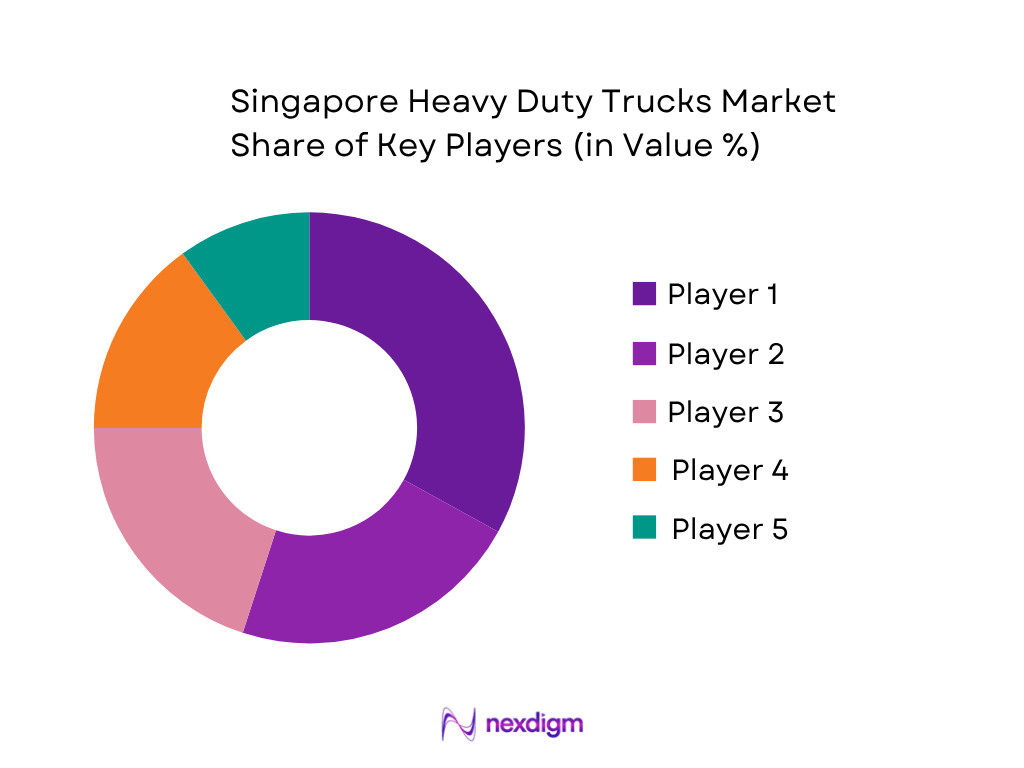
Singapore Heavy Duty Trucks Market Analysis
Growth Drivers
Port and Container Throughput, Cross-Border Freight with Malaysia, and E-Commerce Fulfilment
Singapore’s heavy-duty truck demand is closely linked to its role as a regional maritime and transshipment hub. The Port of Singapore handled 41.12 million TEUs of container throughput and 622.67 million tonnes of cargo in 2024, compared with 39.0 million TEUs and 592.01 million tonnes in 2023. Container activity is particularly relevant to tractor heads, prime movers, container chassis and specialized port-haulage vehicles because around 90% of Singapore’s container throughput is transshipment cargo. Port performance strengthened further in 2025, when throughput reached 44.66 million TEUs and vessel arrivals reached 3.22 billion gross tonnes, creating a larger operating base for heavy-haulage fleets. Cross-border freight with Malaysia adds another demand layer because Malaysia was Singapore’s second-largest trading partner in 2024, while Singapore’s total merchandise trade reached S$1.286 trillion, including S$674.5 billion of exports and S$611.4 billion of imports. Singapore’s GDP reached US$547.5 billion in 2024, reflecting the scale of economic activity that supports freight-intensive sectors. E-commerce also reinforces urban logistics requirements: IMDA’s nationwide Pick Network had around 1,000 parcel-locker stations, enabling consolidated delivery flows and requiring efficient movement between distribution centres, fulfilment facilities and last-mile nodes. Together, high container throughput, Malaysia-linked trade, international merchandise flows and dense urban fulfilment requirements sustain demand for high-utilisation heavy trucks, particularly prime movers and rigid trucks operating between ports, logistics parks, warehouses and industrial estates.
Industrial Manufacturing Activity, Construction and Infrastructure Development, and Jurong Island Logistics
Singapore’s industrial and infrastructure investment base creates recurring requirements for heavy-duty trucks used in equipment movement, bulk-material transport, project logistics, construction haulage and industrial distribution. Singapore’s merchandise trade reached S$1.286 trillion in 2024, while machinery and transport equipment alone represented S$363.2 billion of exports and S$322.1 billion of imports, demonstrating the scale of manufacturing-linked and industrial supply-chain activity. Singapore’s nominal GDP was US$547.5 billion in 2024, while the IMF reported gross capital formation of 10.1% growth during the year, indicating a stronger investment environment following the weaker investment conditions of 2023. Construction provides another direct demand channel. Singapore recorded preliminary construction demand of S$44.2 billion in 2024, with major public and private housing, institutional, infrastructure and industrial projects supporting requirements for tippers, concrete mixers, crane trucks, equipment carriers and other heavy vehicles. The 2025 construction pipeline was projected at S$47 billion–S$53 billion, including Changi Airport Terminal 5, public housing, MRT works, the Woodlands Checkpoint extension and Tuas Port infrastructure. Industrial logistics around Jurong Island further supports heavy-duty applications because petrochemical and energy operations require movement of chemicals, machinery, equipment and industrial materials through a highly concentrated industrial zone. Electricity consumption provides an additional indication of industrial activity: Singapore consumed 58 TWh of electricity in 2024, with the industrial sector accounting for approximately 23 TWh. These conditions favour heavy trucks with high payload capacity, strong uptime, specialized bodies and configurations suited to construction, industrial distribution, hazardous-material logistics and project cargo.
Market Challenges
Vehicle Quota and COE Constraints, Limited Land Availability, and High Operating Density
Singapore’s vehicle ownership framework creates a structural constraint on heavy-duty truck fleet expansion. Goods vehicles and buses fall under Category C of the Certificate of Entitlement system, while the total vehicle population is managed through quota mechanisms rather than unrestricted fleet growth. The Category C vehicle population stood at 153,419 vehicles at the end of 2023, while the May–July 2024 quota provided only 1,232 Category C COEs. The LTA’s quota methodology also included only 0.25% annual growth for Category C based on the vehicle population, illustrating how limited the structural expansion allowance can be relative to commercial fleet requirements. Singapore’s overall vehicle population reached 1,007,094 at the end of 2024, but goods and other vehicles numbered 143,209, of which 31,492 were heavy goods vehicles and 16,723 were very heavy goods vehicles. This regulated environment makes replacement cycles and fleet-utilisation decisions particularly important: operators cannot simply expand vehicle numbers whenever freight demand rises. Limited land availability adds another operational challenge because truck operators must coordinate vehicle storage, maintenance and loading activities within a highly constrained urban environment. Heavy vehicles above 5,000 kg require designated parking arrangements through a Vehicle Parking Certificate, while oversized vehicles face additional movement-permit and escort requirements. Commercial vehicles are also subject to restrictions on specified roads, and some vehicles cannot use particular expressways or tunnels. These constraints increase the importance of route planning, asset utilisation, depot productivity and fleet scheduling. For heavy-duty truck manufacturers and fleet operators, the result is a market where vehicle productivity, payload utilisation, reliability and compliance can be as important as absolute fleet additions.
Heavy-Vehicle Road Restrictions, Cross-Border Operating Dependencies, Skilled Driver Availability, and Zero-Emission Transition Challenges
Singapore’s heavy-duty truck market also faces operational constraints created by road regulation, cross-border dependencies, workforce requirements and the transition toward zero-emission vehicles. LTA regulations distinguish between heavy goods vehicles of 3,501–16,000 kg and very heavy goods vehicles above 16,000 kg, with additional controls applying to oversized vehicles. For oversized movements, permits can be required when vehicle width exceeds 3 metres, while auxiliary police escort requirements apply at widths above 3.4 metres, heights above 4.5 metres or weights of 80,000 kg or more. Such rules can limit route flexibility for specialized heavy-haul operations and increase planning requirements for construction and industrial logistics. Cross-border operations add dependency on the Woodlands and Tuas land checkpoints, where cargo movements require appropriate customs and joint-customs permits and oversized vehicles face specified dimensional limits; the Tuas checkpoint allows cargo vehicles up to 22 metres in length, 3.5 metres in width and 5 metres in height. Workforce constraints are also relevant because heavy trucks require licensed drivers with the appropriate operating competencies, while safety requirements apply to heavy and very heavy lorries. At the same time, electrification introduces new fleet-planning requirements. Only 0.9% of newly registered heavy goods vehicles, excluding buses, were electric in 2024, showing that electric heavy trucks remained at an early adoption stage. Singapore’s total electricity consumption reached 58 TWh in 2024, but heavy-vehicle electrification requires dedicated high-power charging infrastructure, suitable depot capacity and operational planning around charging cycles. These factors create technical and operational barriers for fleets transitioning away from conventional diesel heavy trucks.
Market Opportunities
Electric Heavy Trucks, Port Electrification, Zero-Emission Container Haulage, and Fleet Telematics
Singapore’s decarbonisation agenda creates a clear opportunity for electric heavy trucks, particularly in predictable-duty-cycle applications such as port drayage, depot-to-warehouse movements and short-haul container operations. The opportunity is supported by the existing scale of port activity: Singapore processed 41.12 million TEUs in 2024 and increased this to 44.66 million TEUs in 2025. At the same time, LTA reported that electric vehicles represented 0.9% of newly registered heavy goods vehicles in 2024, indicating that the heavy-truck electrification base remains relatively small and therefore has substantial room for fleet conversion. Singapore introduced the Heavy Vehicle Zero Emissions Scheme from 2026, providing an incentive of S$40,000 for qualifying zero-tailpipe-emission heavy goods vehicles and buses with maximum laden weight above 3,500 kg. The Electric Heavy Vehicle Charger Grant further supports deployment by co-funding up to 50% of eligible charger installation costs, subject to a cap of S$30,000 per charger, with support planned for up to 500 chargers. These policies directly address two major barriers to electric heavy-truck deployment: vehicle economics and charging infrastructure. Port automation provides an additional technology pathway. Tuas Port is designed around automated guided vehicles, electrified automated yard cranes and digitally managed operations, while subsequent phases are expected to expand next-generation autonomous horizontal transport systems. For conventional fleet operators, telematics can complement electrification by improving route optimisation, idle-time control, battery-state monitoring, driver behaviour management and predictive maintenance. The combination of large port flows, concentrated operating routes, government-supported charging infrastructure and increasingly automated logistics environments creates a strong commercial setting for electric prime movers, connected heavy trucks and digitally managed container-haulage fleets.
Autonomous Truck Operations, Smart Logistics, Predictive Maintenance, Cross-Border Fleet Modernization, and Specialized Heavy-Haul Vehicles
Singapore’s highly structured logistics environment provides opportunities for autonomous and connected heavy-duty trucks because many freight movements occur along repeatable routes between ports, logistics facilities, industrial estates and distribution centres. Tuas Port already operates the world’s largest fleet of automated guided vehicles in its port environment, while the Ministry of Transport indicates that subsequent Tuas phases will progressively deploy intelligent guided vehicles capable of perception-based navigation and mixed-traffic operation. This creates an established ecosystem for transferring automation principles into other controlled heavy-vehicle applications. The scale of Singapore’s logistics economy strengthens the opportunity: merchandise trade reached S$1.286 trillion in 2024, while machinery and transport equipment accounted for S$363.2 billion of exports and S$322.1 billion of imports. Cross-border modernization is also relevant because Malaysia was among Singapore’s leading trading partners, while the Woodlands and Tuas checkpoints provide important road links for regional cargo flows. Singapore’s 2024 construction demand reached S$44.2 billion, generating recurring requirements for specialized heavy-haul equipment, mobile cranes, low-bed transporters, concrete mixers and oversized-load carriers. Predictive maintenance and fleet-management platforms can improve utilization within the tightly regulated vehicle environment, where operators must extract more productivity from each registered truck rather than relying solely on fleet expansion. Smart logistics systems can combine GPS positioning, electronic dispatch, traffic information, vehicle-health diagnostics and driver-performance data to reduce empty running and improve asset scheduling. The opportunity therefore extends beyond autonomous trucks themselves: it includes connected prime movers, predictive-maintenance platforms, automated yard vehicles, specialized heavy-haul configurations and cross-border fleet systems capable of integrating Singaporean and Malaysian operating requirements.
Future Outlook
Over the coming period, the Singapore Heavy Duty Trucks Market is expected to undergo a structural transition rather than simply expand through additional vehicle volumes. Demand will remain anchored in port logistics, cross-border freight, construction, manufacturing and industrial distribution, while fleet operators increasingly evaluate vehicle efficiency and lifecycle economics. Electrification will become a more important competitive variable as commercially viable electric heavy vehicles become available. LTA has already introduced the S$40,000 Heavy Vehicle Zero Emissions Scheme incentive, while electric heavy-vehicle charging support is intended to reduce infrastructure barriers.
The market is therefore expected to move toward connected, energy-efficient and increasingly zero-emission heavy vehicles, particularly for predictable depot-to-port and short-haul routes. Long-haul and high-payload applications are likely to retain a stronger requirement for conventional heavy-duty platforms during the transition. Fleet operators will increasingly assess trucks through total cost of ownership, vehicle uptime, charging requirements, payload retention and regulatory compliance rather than acquisition price alone.
Major Players
- Scania
- Volvo Trucks
- Hino Motors
- Isuzu Motors
- Mercedes-Benz Trucks
- MAN Truck & Bus
- UD Trucks
- Mitsubishi Fuso
- DAF Trucks
- Iveco
- Hyundai Commercial Vehicles
- Tata Motors
- Ashok Leyland
- Sinotruk
- FAW Trucks
Key Target Audience
- Heavy-duty truck OEMs and commercial-vehicle manufacturers
- Authorized truck distributors, dealers and fleet-service operators
- Port operators, container-haulage companies and logistics fleet owners
- Construction, civil-engineering and infrastructure contractors
- Manufacturing, petrochemical and industrial fleet operators
- Investments and venture capitalist firms
- Government and regulatory bodies (Land Transport Authority, National Environment Agency, Ministry of Transport, Enterprise Singapore)
- Commercial-vehicle financing, leasing, insurance and fleet-management companies
Research Methodology
Step 1: Identification of Key Variables
The research begins by mapping Singapore’s heavy-duty truck ecosystem across OEMs, authorized distributors, fleet operators, ports, logistics companies, construction contractors, industrial users and regulators. LTA vehicle classifications, maximum laden weight categories, body types, fuel types and registration categories are established as core market variables.
Step 2: Market Analysis and Construction
Historical vehicle registrations, vehicle population, truck configuration and maximum laden-weight data are consolidated with end-use demand indicators. Construction activity, transportation and storage, manufacturing, port logistics and cross-border freight are used to establish the demand-side structure, while OEM and distributor information supports the supply-side assessment.
Step 3: Hypothesis Validation and Expert Consultation
Market hypotheses are validated through interviews with truck OEMs, distributors, fleet operators, logistics providers, port-linked transport companies, construction companies and fleet-management specialists. Discussions focus on procurement cycles, utilization, payload requirements, replacement behavior, powertrain selection, maintenance and total cost of ownership.
Step 4: Research Synthesis and Final Output
The final market model reconciles vehicle registrations, fleet population, configuration-level demand and end-use applications through bottom-up calculations. Top-down economic indicators are then used to validate the reconstructed market, with additional triangulation against OEM activity, distributor presence, fleet replacement patterns and Singapore’s commercial-vehicle regulatory framework.

- Executive Summary
- Research Methodology (Market Definition and Scope, Heavy Duty Truck Classification, GVW and Payload Thresholds, New and Used Vehicle Scope, Tractor-Head Inclusion Criteria, Market Sizing Framework, Top-Down Assessment, Bottom-Up Vehicle-Unit Reconstruction, New Registration Validation, Import Data Reconciliation, OEM and Distributor Interviews, Fleet Operator Interviews, Demand-Side Assessment, Supply-Side Assessment, Data Triangulation, Forecasting Model, Scenario Analysis, Assumptions and Limitations)

- Definition and Scope
- Heavy Duty Truck Industry Evolution in Singapore
- Singapore Commercial Vehicle Ecosystem Mapping
- Heavy Duty Truck Value Chain Analysis
- Heavy Duty Truck Supply Chain Analysis
- Singapore Heavy Vehicle Import and Registration Ecosystem

- Growth Drivers (Port and Container Throughput, Cross-Border Freight with Malaysia, Industrial Manufacturing Activity, E-Commerce Fulfilment, Construction and Infrastructure Development, Jurong Island Industrial Logistics, Fleet Replacement and Urban Freight Demand)
- Market Challenges (Vehicle Quota and COE Constraints, Limited Land Availability, High Operating Density, Heavy-Vehicle Road Restrictions, Cross-Border Operating Dependencies, Skilled Driver Availability, Fleet Acquisition Requirements and Zero-Emission Vehicle Transition Challenges)
- Market Opportunities (Electric Heavy Trucks, Port Electrification, Zero-Emission Container Haulage, Fleet Telematics, Autonomous Truck Operations, Smart Logistics, Predictive Maintenance, Cross-Border Fleet Modernization and Specialized Heavy-Haul Vehicles)
- Market Trends (Electrification of Commercial Fleets, Electric Port Vehicles, Connected Trucks, Fleet Telematics, Automated Driving Technologies, ADAS, Predictive Maintenance, Energy-Efficient Drivetrains and Low-Emission Logistics)
- Government and Regulatory Framework (Land Transport Authority Requirements, National Environment Agency Standards, Vehicle Registration, Certificate of Entitlement, Vehicular Emission Standards, Periodic Inspection, Road Tax, Vehicle Weight Regulations, Heavy Vehicle Licensing and Cross-Border Transport Requirements)
- Porter’s Five Forces Analysis
- PESTLE Analysis
- SWOT Analysis

- By Market Value (2020-2025)
- By Vehicle Units Sold (2020-2025)
- By Average Selling Price (2020-2025)
- By Truck Configuration (2020-2025)
- By Body Type (2020-2025)
- By End-Use Industry (2020-2025)
- By Fleet Ownership (2020-2025)

- By Gross Vehicle Weight / Payload Class (In Volume %)
Medium-Heavy Trucks
Heavy Trucks
Extra-Heavy Trucks
Tractor Heads
Multi-Axle Heavy Trucks
Heavy-Haul Trucks
Specialized Heavy Trucks - By Powertrain (In Volume %)
Diesel Heavy Duty Trucks
Battery Electric Heavy Trucks
Hybrid Heavy Trucks
CNG Heavy Trucks
LNG Heavy Trucks
Other Alternative-Fuel Heavy Trucks - By Truck Configuration (In Volume %)
4×2
6×2
6×4
8×4
8×6
Multi-Axle Configurations
Tractor-Head Configurations
Heavy-Haul Configurations - By Body Type / Vehicle Application (In Volume %)
Tractor Heads
Rigid Cargo Trucks
Tipper and Dump Trucks
Container Trucks
Flatbed Trucks
Tanker Trucks
Concrete Mixer Trucks
Crane Trucks
Waste Management Trucks
Specialized Heavy Vehicles - By End-Use Industry (In Volume %)
Port and Container Haulage
Road Freight and Logistics
Construction and Civil Engineering
Manufacturing and Industrial Distribution
Oil, Gas and Petrochemicals
Chemicals and Specialty Materials
Food and Beverage Logistics
Retail and E-Commerce Logistics
Waste Management
Utilities and Infrastructure
Marine and Offshore Services
Government and Municipal Operations - By Fleet Ownership (In Volume %)
Large Logistics Fleets
Port and Container Fleets
Construction Fleets
Industrial Manufacturing Fleets
Petrochemical Fleets
Government and Municipal Fleets
SME Fleet Operators
Contract Logistics Fleets
Rental and Leasing Fleets
Owner-Operators

- Market Share of Major Players (By Vehicle Units, Market Value, GVW Class, Tractor Heads, Body Type, Powertrain, End-Use Industry and Fleet Ownership)
- Cross Comparison Parameters (Heavy-Duty Product Portfolio Breadth, Maximum GVW, Payload and Axle Configuration Capability, Powertrain Efficiency and Emission Performance, Zero-Emission Heavy Truck Readiness)
- SWOT Analysis of Major Players
- Detailed Profiles of Major Companies
Cycle & Carriage Commercial Vehicles
Goldbell Group
Tan Chong Motor
Komoco Motors
Scania Singapore
Volvo Trucks Singapore
UD Trucks Singapore
Isuzu Commercial Truck
Hino Motors Singapore
FUSO Singapore
Mercedes-Benz Trucks
MAN Truck & Bus
Hyundai Commercial Vehicles
DAF Trucks
Iveco

- Port and Container Haulage Fleet Analysis
- Logistics and Contract Freight Fleet Analysis
- Construction and Civil Engineering Fleet Analysis
- Manufacturing and Industrial Fleet Analysis
- Petrochemical and Chemical Fleet Analysis

- By Market Value (2026-2035)
- By Vehicle Units Sold (2026-2035)
- By Average Selling Price (2026-2035)
- By Truck Configuration (2026-2035)
- By Body Type (2026-2035)
- By End-Use Industry (2026-2035)
- By Fleet Ownership (2026-2035)


 Request a Sample
 Ask for Customization
 Get a Quote
 Enquire Now