

 Download PDF
 Download PDF
Market Overview
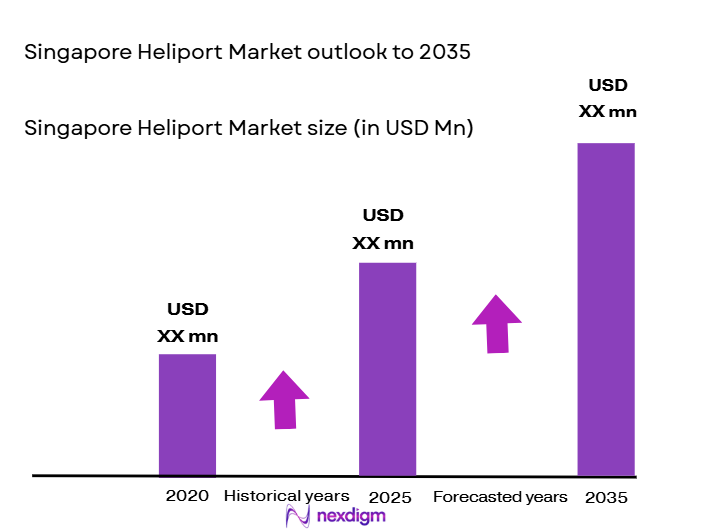
The Singapore Heliport market is projected to witness steady growth, driven by the country’s strategic location, advanced infrastructure, and the expanding demand for air transport services. In 2023, the market reached a value of USD ~ million, and in 2024, it is expected to rise to USD ~ million. This growth is primarily attributed to the increasing demand for urban air mobility, particularly in the commercial and tourism sectors. The government’s support in expanding heliport infrastructure to cater to emergency services, military operations, and offshore oil and gas operations further fuels market development. Additionally, technological advancements in heliport systems, including automation and sustainability, are bolstering growth.
Singapore stands as a dominant player in the heliport market, owing to its status as a global aviation hub and its well-developed infrastructure. The country’s strategic position in Southeast Asia makes it an ideal location for international air transport services, including helicopter operations. Cities like Singapore, with their dense urban landscapes and robust transport infrastructure, are driving the demand for heliports. Moreover, Singapore’s support for innovations in urban mobility and the establishment of sustainable and efficient air transport systems further enhances its position as a leader in the heliport market. This dominance is also due to significant investments in military and government-related heliport facilities, ensuring the nation’s safety and emergency response capabilities.
Market Segmentation
By System Type
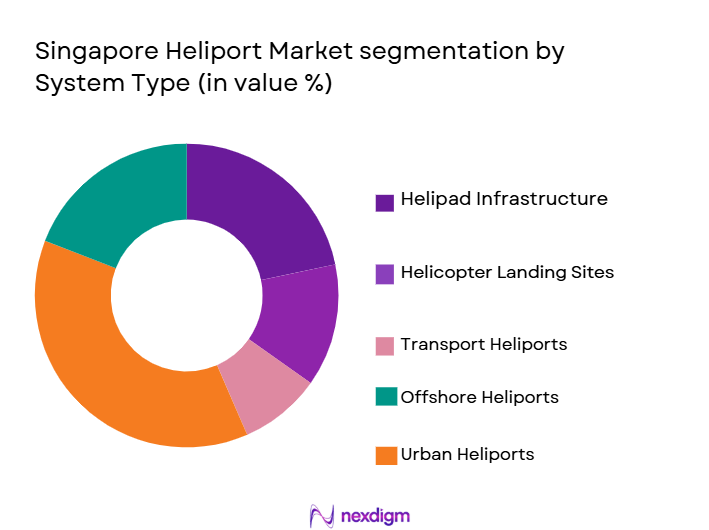
The Singapore Heliport market is segmented by system type into heliport lighting systems, helipad infrastructure, heliport navigation systems, heliport safety systems, and heliport communication systems. The helipad infrastructure segment dominates the market share in 2024. This segment is largely driven by the need for robust, reliable, and sustainable infrastructure that supports various types of helicopter operations, from tourism to military usage. The rapid expansion of both private and commercial heliports in urban and offshore regions of Singapore plays a critical role in the demand for such infrastructure. With increased investments in high-quality helipad designs and materials to ensure safety and operational efficiency, the helipad infrastructure segment is expected to continue leading the market.
By Platform Type
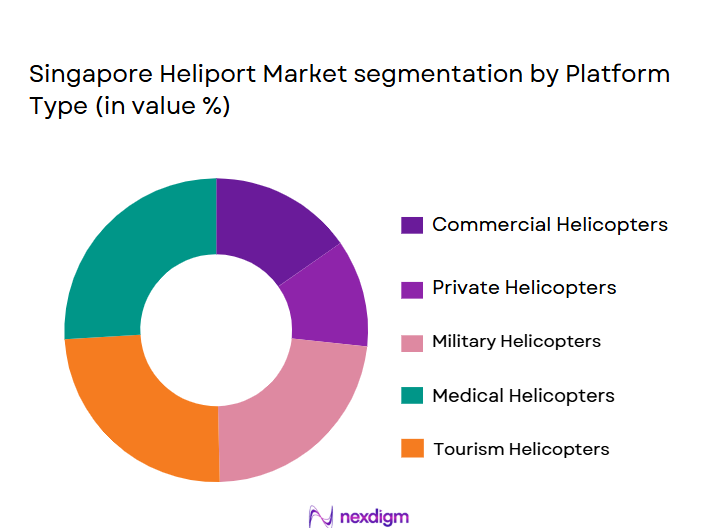
In the Singapore Heliport market, the platform type segment is divided into urban heliports, offshore heliports, military heliports, private heliports, and helicopter landing sites. The urban heliports segment holds the largest share in 2024. Singapore’s dense urban areas and the growing need for rapid transportation solutions drive the demand for heliports within the city. With major commercial hubs like Marina Bay and Sentosa experiencing increasing demand for quick aerial connectivity, urban heliports have become crucial. Additionally, the government’s push for developing urban air mobility solutions, including vertical takeoff and landing (VTOL) aircraft, is contributing to the rise of urban heliports in city centers. This growth is expected to accelerate as the country seeks to improve urban air transportation infrastructure.
Competitive Landscape
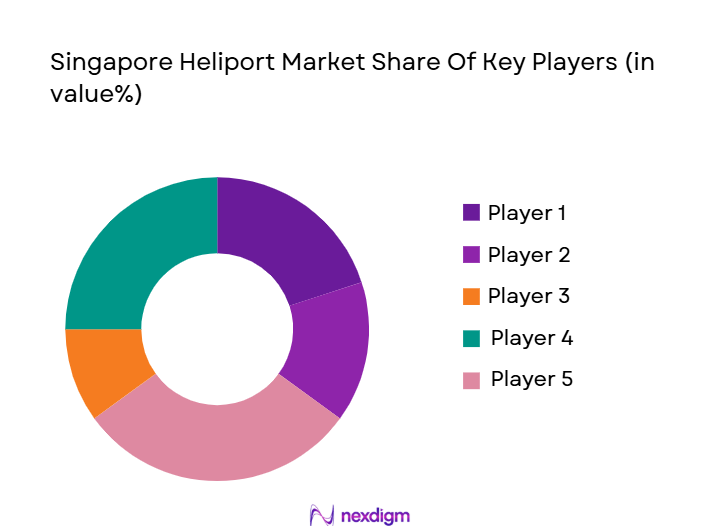
The Singapore Heliport market is dominated by a few key players, with both local and international companies having a significant presence. This consolidation highlights the strong influence of major companies that supply heliport infrastructure, services, and technologies to the market. Key players are involved in various aspects, such as the construction of heliport facilities, integration of advanced navigation and safety systems, and providing maintenance services for existing heliports.
| Company Name | Establishment Year | Headquarters | Product/Service Range | Market Presence | Technological Capabilities | Strategic Alliances | Regulatory Compliance |
| Singapore Helicopter Services | 2005 | Singapore | ~ | ~ | ~ | ~ | ~ |
| Heliport Solutions Singapore | 2010 | Singapore | ~ | ~ | ~ | ~ | ~ |
| SATS Ltd. | 1947 | Singapore | ~ | ~ | ~ | ~ | ~ |
| Singapore Civil Aviation Authority | 1956 | Singapore | ~ | ~ | ~ | ~ | ~ |
| Air Service International | 1998 | Singapore | ~ | ~ | ~ | ~ | ~ |
Singapore heliport Market Analysis
Growth Drivers
Rising Demand for Advanced Aircraft Safety Systems
The increasing focus on enhancing aircraft safety is a significant growth driver for the aircraft sensors market in Singapore. The growing demand for more reliable and sophisticated safety features, such as collision avoidance, weather detection, and navigation systems, is driving the adoption of advanced sensor technologies in aircraft. In 2024, global aircraft safety systems market expenditure is expected to exceed USD 9 billion, with a considerable portion allocated to sensor technologies. As Singapore continues to strengthen its position as a global aviation hub, the need for state-of-the-art safety systems is further accelerating the demand for aircraft sensors.
Technological Advancements in Aircraft Sensor Integration
The rapid advancements in sensor technologies, such as miniaturization and integration with flight control systems, are propelling the growth of the aircraft sensors market in Singapore. These advancements are enabling the development of more efficient, cost-effective, and reliable sensors for applications ranging from flight data monitoring to environmental sensing. In 2024, the market for smart sensors in aviation is expected to grow significantly due to increased demand for systems that improve operational efficiency and reduce maintenance costs. The introduction of integrated sensors that can monitor multiple parameters simultaneously is transforming how aircraft systems manage and process real-time data, creating vast opportunities for sensor adoption.
Market Challenges
Regulatory and Certification Hurdles
One of the primary challenges facing the aircraft sensors market in Singapore is the complex regulatory and certification processes involved in sensor adoption and integration. Aircraft sensors must meet rigorous standards set by organizations such as the International Civil Aviation Organization (ICAO) and the Civil Aviation Authority of Singapore (CAAS). The time and cost involved in obtaining the necessary certifications can delay product launches and limit the speed at which new sensor technologies are integrated into aircraft. In 2024, the regulatory landscape remains challenging for sensor manufacturers, as stringent safety and operational requirements continue to be a significant barrier to entry for new solutions in the market.
High Costs of Advanced Sensor Technologies
While technological advancements are driving the growth of the aircraft sensors market, the high costs associated with developing and implementing advanced sensor systems present a challenge. The demand for more sophisticated sensors, particularly those with integrated capabilities, often comes with significant research and development costs, as well as higher production expenses. Additionally, the maintenance and calibration of these advanced systems add to operational costs for airlines and operators. For example, the integration of radar and LiDAR systems for weather detection and collision avoidance can require significant capital investment, which may pose challenges for smaller operators in Singapore and other regional markets.
Opportunities
Emerging Market for Electric and Hybrid Aircraft
The growing interest in electric and hybrid aircraft presents significant opportunities for the aircraft sensors market in Singapore. With the aviation industry looking to reduce carbon emissions and improve fuel efficiency, electric and hybrid aircraft are becoming increasingly viable. These new aircraft platforms require advanced sensors to optimize flight operations, monitor battery systems, and ensure safe integration with existing aviation infrastructure. Singapore’s position as a leader in aerospace innovation and sustainability initiatives is expected to drive the adoption of sensor technologies tailored to the needs of electric and hybrid aircraft, opening up new growth avenues for market players.
Expanding Use of Aircraft Sensors in Drone Operations
The rapid growth of the unmanned aerial vehicle (UAV) market in Singapore offers a unique opportunity for the aircraft sensors market. Drones, used for both commercial and industrial applications, rely heavily on sensors for navigation, obstacle detection, and flight stability. As Singapore continues to develop its drone ecosystem, with a projected increase in drone usage for logistics, surveying, and aerial inspections, the demand for high-performance sensors will grow substantially. This expanding market for drones presents a new avenue for sensor manufacturers to develop specialized products designed for smaller, more agile aircraft platforms, further contributing to the overall growth of the aircraft sensors market in Singapore.
Future Outlook
Over the next ~ years, the Singapore Heliport market is expected to see continuous growth, driven by increased investments in urban air mobility infrastructure and the rise in helicopter operations for tourism, offshore services, and emergency medical services. The government’s efforts to promote the integration of innovative transport solutions into urban areas and its focus on sustainability will play a critical role in shaping the future of heliports in Singapore. Furthermore, as Singapore seeks to enhance its position as a global aviation hub, the demand for advanced heliport systems is anticipated to grow significantly.
Major Players in the Market
- Singapore Helicopter Services
- Heliport Solutions Singapore
- SATS Ltd.
- Singapore Civil Aviation Authority
- Air Service International
- United Helicopters
- Airbus Helicopters
- Boeing Helicopters
- Hensoldt
- Vero Systems
- Universal Helicopters
- Singapore Technologies Engineering
- Cochlear Limited
- Heli Services International
- AeroVironment
Key Target Audience
- Aviation and Helicopter Operators
- Government and Regulatory Bodies (Singapore Civil Aviation Authority)
- Investments and Venture Capitalist Firms
- Aviation Infrastructure Developers
- Offshore Oil and Gas Industry Stakeholders
- Emergency Medical Service Providers
- Private Enterprise Helicopter Operators
- Urban Transport Planning Authorities
Research Methodology
Step 1: Identification of Key Variables
The initial phase involves constructing an ecosystem map encompassing all major stakeholders within the Singapore Heliport Market. This step is underpinned by extensive desk research, utilizing a combination of secondary and proprietary databases to gather comprehensive industry-level information. The primary objective is to identify and define the critical variables that influence market dynamics.
Step 2: Market Analysis and Construction
In this phase, we will compile and analyze historical data pertaining to the Singapore Heliport Market. This includes assessing market penetration, the ratio of marketplaces to service providers, and the resultant revenue generation. Furthermore, an evaluation of service quality statistics will be conducted to ensure the reliability and accuracy of the revenue estimates.
Step 3: Hypothesis Validation and Expert Consultation
Market hypotheses will be developed and subsequently validated through computer-assisted telephone interviews (CATIS) with industry experts representing a diverse array of companies. These consultations will provide valuable operational and financial insights directly from industry practitioners, which will be instrumental in refining and corroborating the market data.
Step 4: Research Synthesis and Final Output
The final phase involves direct engagement with multiple heliport infrastructure developers and helicopter service providers to acquire detailed insights into product segments, sales performance, consumer preferences, and other pertinent factors. This interaction will serve to verify and complement the statistics derived from the bottom-up approach, ensuring a comprehensive, accurate, and validated analysis of the Singapore Heliport Market.

- Executive Summary
- Singapore Heliport Market Research Methodology
(Definitions, Scope, Industry Assumptions, Market Sizing Approach, Primary & Secondary Research Framework, Data Collection & Verification Protocol, Analytic Models & Forecast Methodology, Limitations & Research Validity Checks)

- Market Definition and Scope
- Value Chain & Stakeholder Ecosystem
- Regulatory / Certification Landscape
- Sector Dynamics Affecting Demand
- Strategic Initiatives & Infrastructure Growth

- Growth Drivers
Increasing demand for urban air mobility and heliports in densely populated areas
Expansion of tourism and helicopter services in Singapore
Government initiatives to develop heliports for emergency and military services - Market Challenges
High infrastructure costs and regulatory hurdles
Limited availability of suitable land for new heliports in urban areas
Concerns related to environmental impact and noise pollution - Market Opportunities
Expansion of offshore heliport infrastructure for the oil & gas sector
Investment in sustainable and eco-friendly heliport technology
Growing demand for medical emergency and air ambulance services - Trends
Technological advancements in heliport safety and navigation systems
Shift toward modular and portable heliport solutions
Increased focus on automation and remote operation of heliports
- Government Regulations & Defense Policy
FDI Rules
Offset Obligations
Export Licenses - SWOT Analysis (Capability Strengths, Cost Vulnerabilities, Competitive Pressures)
- Porter’s Five Forces (Procurement Power, Supplier Concentration, Substitutes, Barriers to Entry)

- By Market Value, 2020-2025
- By Installed Units, 2020-2025
- By Average System Price, 2020-2025
- By System Complexity Tier, 2020-2025

- By System Type (In Value%)
Heliport Lighting Systems
Helipad Infrastructure
Heliport Navigation Systems
Heliport Safety Systems
Heliport Communication Systems - By Platform Type (In Value%)
Urban Heliports
Offshore Heliports
Military Heliports
Private Heliports
Helicopter Landing Sites - By Fitment Type (In Value%)
New Installations
Upgrades & Modernizations
Maintenance & Repairs
Expansion of Existing Facilities
Refurbishment Projects - By EndUser Segment (In Value%)
Commercial Aviation Operators
Government & Military Agencies
Private Enterprises
Tourism & Helicopter Services
Oil & Gas Industry - By Procurement Channel (In Value%)
Direct Procurement from Manufacturers
Procurement through Distributors
Procurement through Contractors
Procurement via Online Platforms
Government Procurement Contracts

- Market Share Analysis
- Cross Comparison Parameters
(Market Share by Region, Technological Advancements, Market Penetration, Technology Integration, R&D Investment, Operational Efficiency, Customer Retention, Regulatory Compliance, Product Portfolio Diversity Service Quality, Investment Trends, Regulatory Compliance) - SWOT Analysis of Key Competitors
- Pricing & Procurement Analysis
- Key Players
Singapore Helicopter Services
Heliport Solutions Singapore
SATS Ltd.
Singapore Civil Aviation Authority
Singapore Technologies Engineering
United Helicopters
Airbus Helicopters
Boeing Helicopters
Cochlear Limited
Hensoldt
Universal Helicopters
Heli Services International
Singapore Airport Terminal Services (SATS)
Vero Systems
AeroVironment

- Government agencies driving infrastructure investment
- Commercial helicopter operators seeking reliable and efficient landing sites
- Private enterprises focusing on exclusive heliport access
- Tourism operators expanding services in Singapore

- Forecast Market Value, 2026-2035
- Forecast Installed Units, 2026-2035
- Price Forecast by System Tier, 2026-2035
- Future Demand by Platform, 2026-2035


 Request a Sample
 Ask for Customization
 Get a Quote
 Enquire Now