
 Download PDF
Market Overview
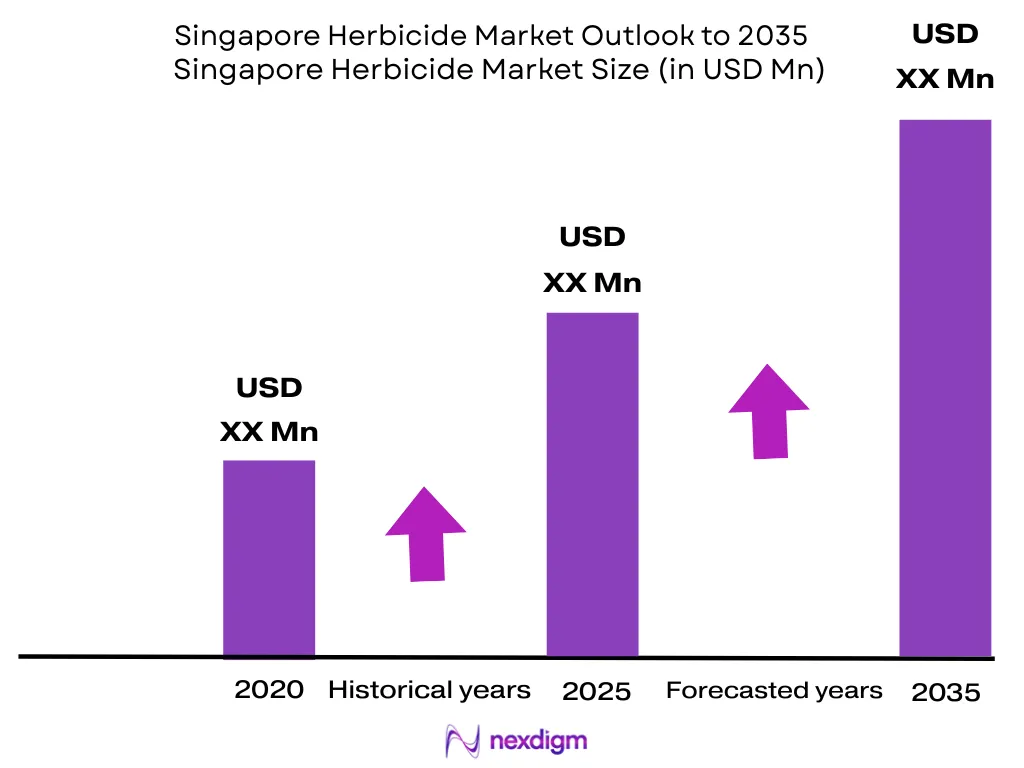
The Singapore Herbicide Market is assessed at USD ~ million, back-cast from the publicly reported USD ~ million benchmark and 7.8% growth rate for Singapore herbicides. Demand is driven less by broad-acre agriculture and more by public greenery, turf, industrial vegetation and protected farming. Singapore vegetable output moved from 16,915 tonnes to 16,391 tonnes, while vegetable-farm productivity improved from 227.2 tonnes per hectare to 231.4 tonnes per hectare, supporting controlled, professional weed-management demand. Singapore is a city-state, so demand is concentrated by functional zones rather than separate cities. The Central Region dominates institutional landscaping because it contains premium commercial landscapes, public parks and dense managed greenery; the West Region is important for Jurong industrial estates and utility corridors; the North Region supports agri-food and nursery demand. NParks completed the 18 km Eastern Corridor and established 391 km of park connectors by end-base year, expanding managed vegetation surfaces.
Market Segmentation
By Herbicide Type
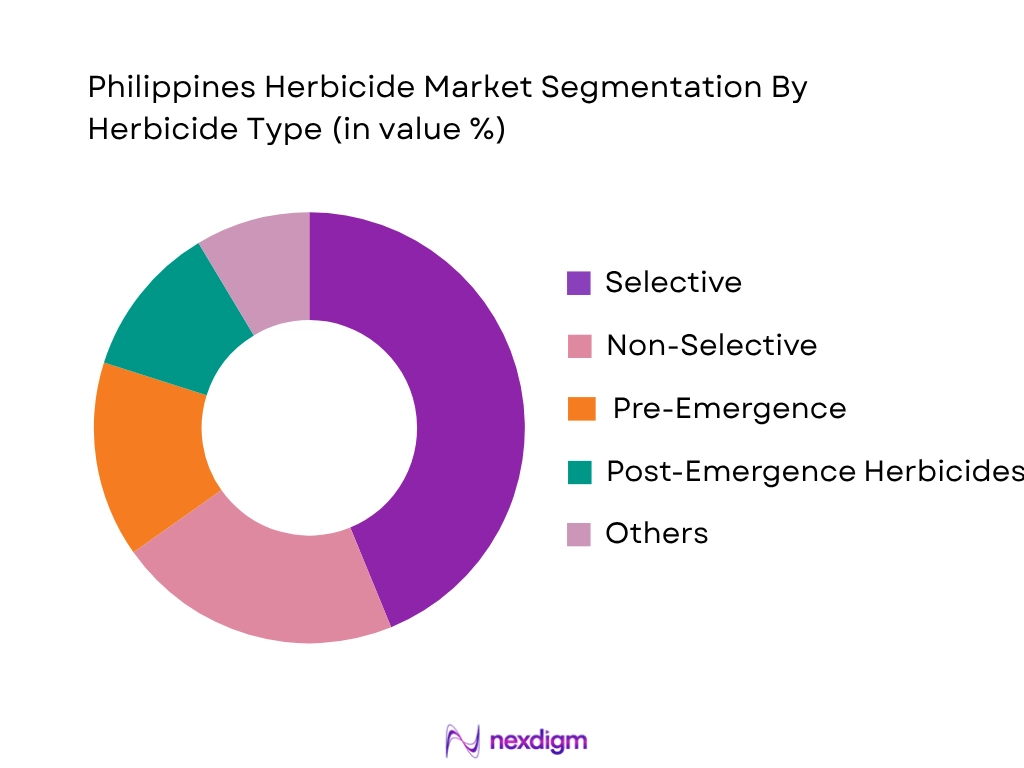
Singapore Herbicide Market is segmented by herbicide type into non-selective herbicides, selective herbicides, pre-emergence herbicides, post-emergence herbicides, residual herbicides and bio-based herbicides. Recently, non-selective herbicides have a dominant market share in Singapore under the segmentation herbicide type, mainly because the country’s largest use cases are non-crop vegetation control, hardscape weed control, industrial estates, roadside vegetation, utility corridors, drainage edges and public-landscape maintenance. Unlike larger agricultural economies, Singapore has limited broad-acre farms, so herbicide consumption is shaped by vegetation clearance, contractor-led spot spraying and maintenance of public infrastructure. Glyphosate and glufosinate-based formulations are preferred by professional applicators because they offer broad-spectrum weed control across mixed weed populations. Selective herbicides remain relevant in golf courses, sports turf and managed lawns, while bio-based products are emerging for residential gardens and eco-sensitive sites.
By Application Area
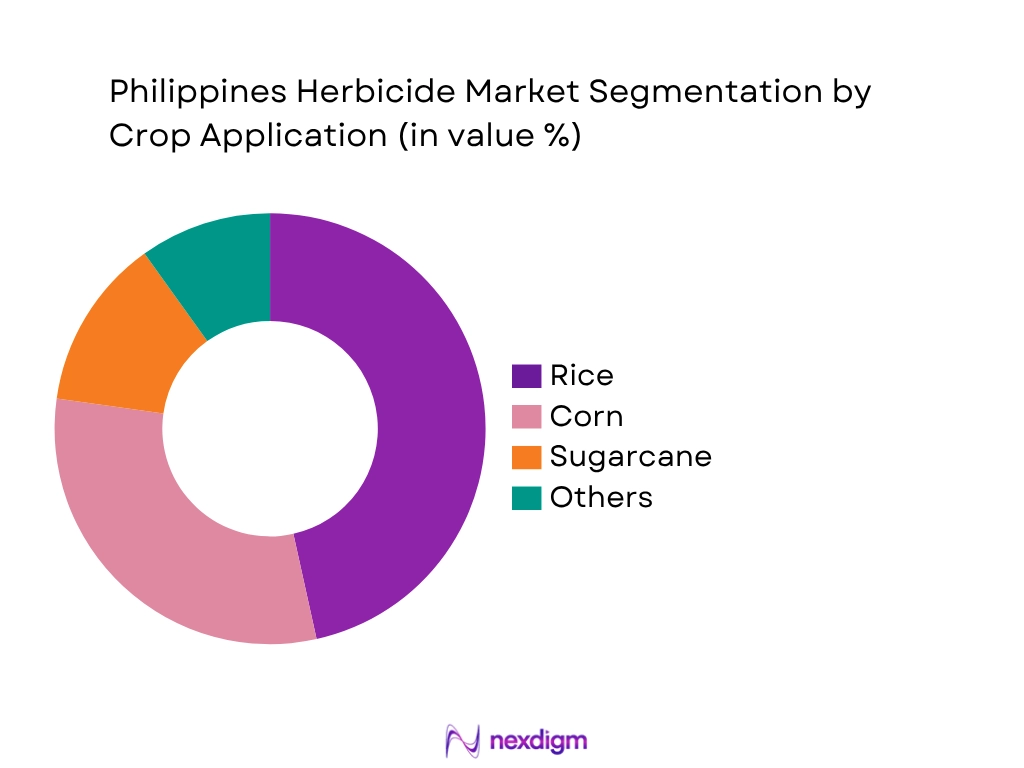
Singapore Herbicide Market is segmented by application area into urban landscaping, public parks and park connectors, industrial estates, agriculture and nurseries, turf and sports facilities, utilities, and residential gardens. Recently, urban landscaping has a dominant market share in Singapore under the segmentation application area because the country’s herbicide demand is closely tied to managed vegetation rather than open-field agriculture. Streetscapes, road verges, commercial landscapes, HDB estate greenery, town-council maintenance areas and building perimeters require frequent weed control to maintain accessibility, safety and visual standards. NParks’ City in Nature direction also expands managed green surfaces, increasing the need for integrated weed management. Agriculture and nurseries are smaller but technically important because products used in plant cultivation for sale require Singapore Food Agency registration. Turf, golf and sports fields support selective herbicide demand where grass quality and broadleaf weed control are critical.
Competitive Landscape
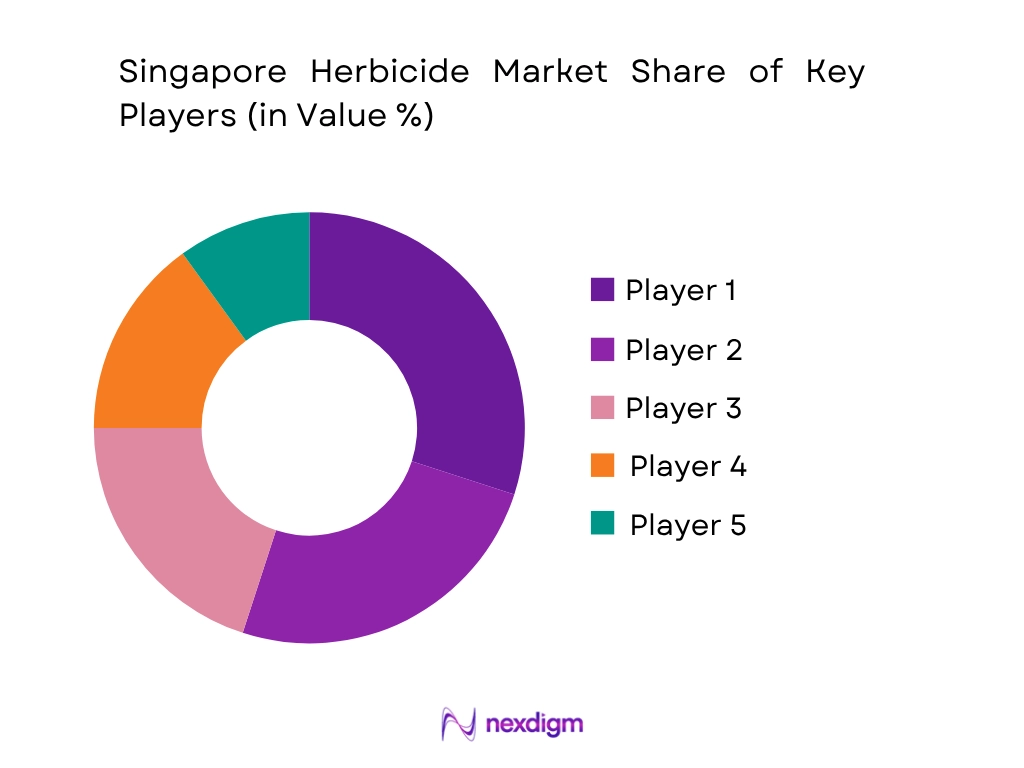
The Singapore Herbicide Market is moderately consolidated at the manufacturer level but fragmented at the distributor, applicator and contractor level. Global crop protection companies such as Bayer, Syngenta, BASF, Corteva and FMC compete through active ingredient portfolios, product stewardship, safety documentation and distributor relationships. Local market access depends heavily on registration compliance, importer capability, contractor networks, public-sector tender participation and technical support. SFA requires registration for agricultural pesticide products used in plant cultivation for sale, making regulatory clearance central to commercial participation.
| Company | Establishment Year | Headquarters | Key Herbicide Portfolio | Singapore Route to Market | Primary End Users | Regulatory / Stewardship Strength | Formulation Focus | Market-Specific Positioning |
| Bayer CropScience | 2002 | Leverkusen, Germany | ~ | ~ | ~ | ~ | ~ | ~ |
| Syngenta | 2000 | Basel, Switzerland | ~ | ~ | ~ | ~ | ~ | ~ |
| BASF Agricultural Solutions | 1865 | Ludwigshafen, Germany | ~ | ~ | ~ | ~ | ~ | ~ |
| Corteva Agriscience | 2019 | Indianapolis, United States | ~ | ~ | ~ | ~ | ~ | ~ |
| FMC Corporation | 1883 | Philadelphia, United States | ~ | ~ | ~ | ~ | ~ | ~ |
Singapore Herbicide Market Analysis
Growth Drivers
Urban Greenery and Public Landscape Maintenance Demand
Singapore Herbicide Market is supported by dense urban greenery, where weed control is required across parks, streetscapes, park connectors, road verges, turf areas and public landscapes. Singapore’s population reached 6,036,860 and GDP stood at USD 547.39 billion in 2024, indicating a dense, high-income city-state where public infrastructure and managed landscapes require regular upkeep. NParks’ latest annual reporting states that Singapore had 391 km of park connectors and completed the 18 km Eastern Corridor, expanding connected green surfaces that require vegetation management. Herbicides remain relevant for spot treatment, non-crop weed suppression and contractor-led maintenance in built-up environments.
Productive Controlled Farming and Nursery Weed Management
Singapore Herbicide Market is also supported by farm and nursery demand, although agriculture is compact and technology-led. SFA’s Singapore Food Statistics recorded vegetable farm productivity rising from 227.2 tonnes per hectare per year to 231.4 tonnes per hectare per year, while egg farm productivity increased from 14.8 million pieces per hectare per year to 16.7 million pieces per hectare per year. These figures show pressure on limited farm spaces to remain productive, which supports precise weed management around farm perimeters, nursery beds, access paths and cultivation zones. Singapore’s GDP per capita of USD 90,674.1 further supports high-standard farm inputs and professional compliance.
Market Challenges
Limited Agricultural Land Base Restricts Broad-Acre Herbicide Use
Singapore Herbicide Market faces a structural ceiling because the country does not have broad-acre agriculture. SFA states that Singapore dedicates less than 1 unit out of every 100 units of land to agricultural food production, making farm-use herbicide demand narrow compared with agriculture-led countries. World Bank data shows Singapore’s total population at 6,036,860 and GDP per capita at USD 90,674.1 in 2024, reflecting a dense urban economy where land allocation prioritizes housing, industry, transport and public infrastructure. This limits herbicide volumes from crop fields and shifts demand toward non-crop, landscaping, turf, industrial estate and public-space applications.
Food Import Dependence Reduces Local Crop-Based Herbicide Scale
Singapore Herbicide Market is constrained by the small scale of local crop cultivation because food security is still import-led. SFA reported that Singapore imports more than 90 units out of every 100 units of its food supply and maintained food sources from 187 countries and regions. Local vegetable production remained modest, with vegetable productivity at 231.4 tonnes per hectare per year and total vegetable output reported at 16,391 tonnes in 2024. At the macro level, Singapore’s GDP reached USD 547.39 billion, confirming a service-and-trade-heavy economy rather than a large farming economy. This keeps crop herbicide usage smaller than urban vegetation and facilities-management demand.
Market Opportunities
Low-Toxicity Herbicides for City-in-Nature Landscapes
Singapore Herbicide Market has an opportunity in low-odour, low-residue and targeted herbicide formulations because public greenery is expanding under dense urban conditions. NParks’ reporting highlights 391 km of park connectors and the completed 18 km Eastern Corridor, both of which increase managed interfaces between pedestrians, biodiversity areas, public paths and maintenance teams. With Singapore’s population at 6,036,860 and life expectancy at 83 years, vegetation management products must align with safety expectations in high-use public spaces. Suppliers can position bio-based, spot-spray and reduced-drift herbicide solutions for park connectors, landscaped estates, commercial gardens and nature-adjacent urban zone.
Compliance-Led B2B Supply for Contractors and Public-Sector Users
Singapore Herbicide Market has an opportunity in compliance-led distribution because registered products, safety data sheets, training and application discipline are central to institutional buyers. SFA requires registration for agricultural pesticide products used in plant cultivation for sale, making compliance support commercially important for farms, nurseries and distributors. Singapore’s macro base supports professionalized procurement GDP reached USD 547.39 billion, GDP per capita reached USD 90,674.1, and internet usage reached 94 out of every 100 people in 2024, enabling digital catalogues, documentation and repeat B2B ordering. Suppliers can differentiate through label support, applicator training, tender documentation and compliant pack formats for contractors.
Future Outlook
Over the next planning period, the Singapore Herbicide Market is expected to grow at around 7.8% CAGR during 2026-2035, using the cited Singapore herbicide growth benchmark as the planning rate. Demand will be supported by urban greenery maintenance, park connector expansion, industrial vegetation control, turf quality standards and professional contractor usage. Growth will not be broad-acre agriculture-led because Singapore’s agricultural land base is limited. Instead, the market will remain concentrated in non-crop weed control, landscaping, infrastructure corridors, nurseries, turf facilities and controlled farms. Public procurement, SFA registration, workplace safety and environmental sensitivity will influence product acceptance. Bio-based, low-odour and lower-residue herbicides will gain relevance in residential landscapes, premium public spaces and nature-adjacent areas. However, conventional non-selective herbicides will continue to serve large-volume needs where contractors require proven weed knockdown and cost-effective vegetation management. Distributor capability will become a differentiator. Companies with registered products, safety data sheets, applicator training, contractor relationships, technical guidance and reliable stock availability will be better placed than brands competing only on active ingredient price.
Major Players
- Bayer CropScience
- Syngenta
- BASF Agricultural Solutions
- Corteva Agriscience
- FMC Corporation
- UPL Limited
- Nufarm
- ADAMA Agricultural Solutions
- Sumitomo Chemical
- Albaugh
- Mitsui Chemicals Crop & Life Solutions
- Nissan Chemical Corporation
- Jiangsu Yangnong Chemical
- Rainbow Agro
- Zagro Singapore
Key Target Audience
- Herbicide manufacturers and crop protection companies
- Agrochemical importers and registered product holders
- Landscape maintenance contractors
- Turf, golf course and sports-field management companies
- Facility management and industrial estate operators
- Commercial farms, nurseries and controlled-environment agriculture operators
- Investments and venture capitalist firms
- Government and regulatory bodies
Research Methodology
Step 1: Identification of Key Variables
The initial phase involves constructing an ecosystem map for the Singapore Herbicide Market, including manufacturers, importers, distributors, landscape contractors, farms, turf managers, facility managers and government-linked buyers. The key variables include registered products, active ingredient mix, application area, treated surface, public greenery demand, farm usage and contractor procurement cycles.
Step 2: Market Analysis and Construction
In this phase, historical and current information is compiled from pesticide registration references, public greenery indicators, agricultural production data, company portfolios and distributor-level product audits. Market sizing is built through a combination of reported herbicide benchmarks, import-led supply assumptions, application-area mapping and professional usage validation.
Step 3: Hypothesis Validation and Expert Consultation
Market hypotheses are validated through structured interviews with agrochemical distributors, landscape contractors, turf managers, farm operators, public-tender vendors and facility-maintenance companies. These consultations help verify demand by active ingredient, formulation, pack size, application frequency, registration burden, safety compliance and substitution by manual or mechanical weed control.
Step 4: Research Synthesis and Final Output
The final phase integrates secondary research, expert consultation, SKU benchmarking and channel analysis into a validated market output. The findings are synthesized into market size, CAGR, segmentation, competitive landscape, future outlook and target-audience mapping for business professionals evaluating Singapore’s herbicide value chain.

- Executive Summary
- Research Methodology (Market Definitions and Assumptions, Herbicide Classification, Active Ingredient Mapping, Pesticide Registration Review, Import-Based Sizing, End-Use Validation, Applicator Interviews, Retail and Distributor Audit, Limitations and Forecast Assumptions)

- Definition and Scope
- Market Genesis and Evolution
- Timeline of Key Regulations and Major Suppliers
- Business Cycle
- Supply Chain and Value Chain Analysis

- Growth Drivers (City in Nature Strategy, Public Greenery Maintenance, Agri-Food Production, Turf Quality Standards, Industrial Vegetation Control, Contractor Outsourcing)
- Market Challenges (Regulatory Approval, Environmental Runoff Risk, Small Agricultural Base, Public Scrutiny, Labour Safety, Alternative Weed Control)
- Opportunities (Low-Toxicity Herbicides, Bio-Herbicides, Precision Spraying, Contractor Bundles, Turf-Specific Products, Digital Compliance)
- Trends (Glyphosate Stewardship, Bio-Based Herbicides, Reduced Drift Spraying, Contractor Digitization, Green Procurement, Urban Biodiversity Protection)
- SWOT Analysis
- Porter’s Five Forces Analysis
- PESTLE Analysis

- By Value (2020-2025)
- By Volume (2020-2025)
- By Average Selling Price (2020-2025)

- By Herbicide Type (In Value %)
Non-Selective Herbicides
Selective Herbicides
Pre-Emergence Herbicides
Post-Emergence Herbicides
Residual Herbicides
- By End User (In Value %)
Landscape Contractors
Government and Statutory Bodies
Commercial Farms and Nurseries
Golf Courses and Turf Managers
Facility Management Companies
Industrial Site Operators - By Distribution Channel (In Value %)
Agrochemical Distributors
Industrial Chemical and Safety Suppliers
Landscape and Horticulture Supply Stores
Direct Sales to Government-Linked Contractors
Online B2B and Maintenance Platforms - By Region (In Value %)
Central Region
North Region
West Region
East Region

- Market Share of Major Players by Value and Volume (Active Ingredient, Formulation, End Use, Channel, Application Area)
- Cross Comparison Parameters (Registered Herbicide Portfolio, Active Ingredient Breadth, SFA/NEA Compliance Support, Turf and Landscape Product Availability, Pack Size Range, Distributor and Contractor Reach, Safety Data Sheet and Label Support, Tender and Institutional Supply Capability)
- SWOT Analysis of Major Players
- Detailed Profiles of Major Companies
Bayer CropScience
Syngenta
BASF Agricultural Solutions
Corteva Agriscience
FMC Corporation
UPL Limited
Nufarm
ADAMA Agricultural Solutions
Sumitomo Chemical
Albaugh
Mitsui Chemicals Crop & Life Solutions
Nissan Chemical Corporation
Jiangsu Yangnong Chemical
Rainbow Agro
Zagro Singapore

- Market Demand and Utilization
- Purchasing Power and Budget Allocation
- Regulatory and Compliance Requirements
- Needs, Desires and Pain Point Analysis
- Decision-Making Process

- By Value (2026-2035)
- By Volume (2026-2035)
- By Average Selling Price (2026-2035)


 Request a Sample
 Ask for Customization
 Get a Quote
 Enquire Now