
 Download PDF
Market Overview
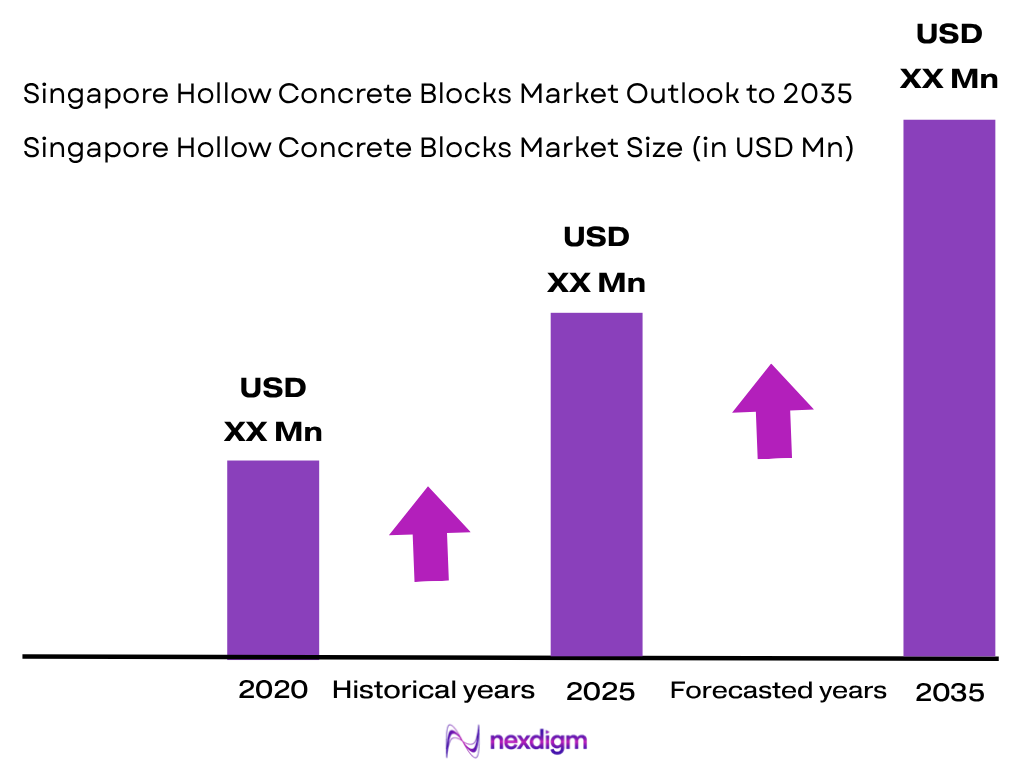
The Singapore Hollow Concrete Blocks Market is valued at approximately USD ~ million, based on historical market assessment, compared with approximately USD ~ million in the preceding period. Demand is supported by residential, industrial, institutional and redevelopment construction. Singapore’s total construction demand increased from approximately SGD 33.8 billion to SGD 44.2 billion, while public-sector construction demand reached approximately SGD 25.1 billion, supporting demand for concrete masonry used in partitions, service areas and ancillary structures.
Singapore’s Central, North-East, West and developing HDB towns form important demand clusters because construction is concentrated around public housing, commercial redevelopment, industrial estates and infrastructure. HDB launched 19,637 Build-To-Order flats across 23 projects during the latest annual period, compared with 22,780 flats across 23 projects in the preceding period. Jurong, Tengah, Woodlands, Punggol and mature urban areas generate masonry requirements through housing, industrial and mixed-use development.
Market Segmentation
By Product Type
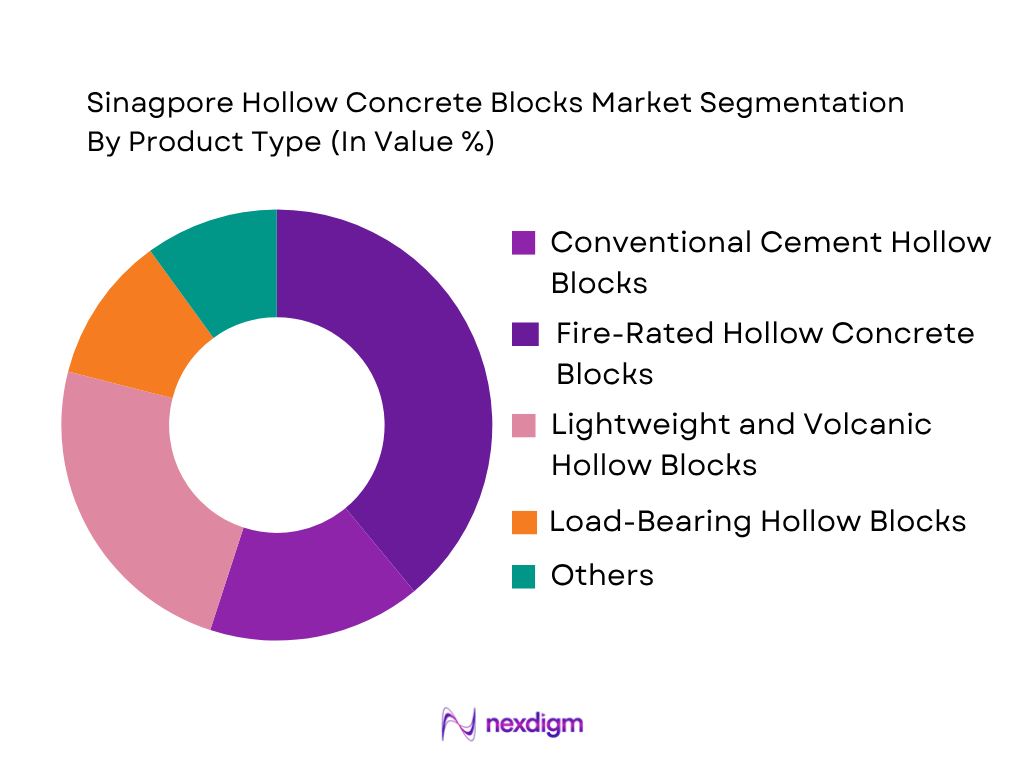
By Product Type, the Singapore Hollow Concrete Blocks Market is segmented into conventional hollow concrete blocks, lightweight hollow blocks, fire-rated hollow blocks, load-bearing blocks and specialty concrete masonry units. Conventional hollow concrete blocks hold a dominant position because they remain applicable across internal partitions, service rooms, plant areas, utility structures, boundary walls and selected infill applications. Singapore’s dense construction environment favors standardized masonry products with predictable dimensional tolerances and established contractor familiarity. Conventional hollow blocks also benefit from straightforward integration with reinforced-concrete construction and can be supplied in multiple thicknesses according to wall function. However, lightweight and fire-rated products are becoming increasingly important as contractors focus on installation productivity, structural dead-load reduction and compartmentation performance. Competition from drywall, AAC, precast walls and PPVC prevents conventional blocks from dominating every building application, making specialized performance increasingly important for concrete masonry suppliers serving Singapore’s sophisticated construction industry.
By Application
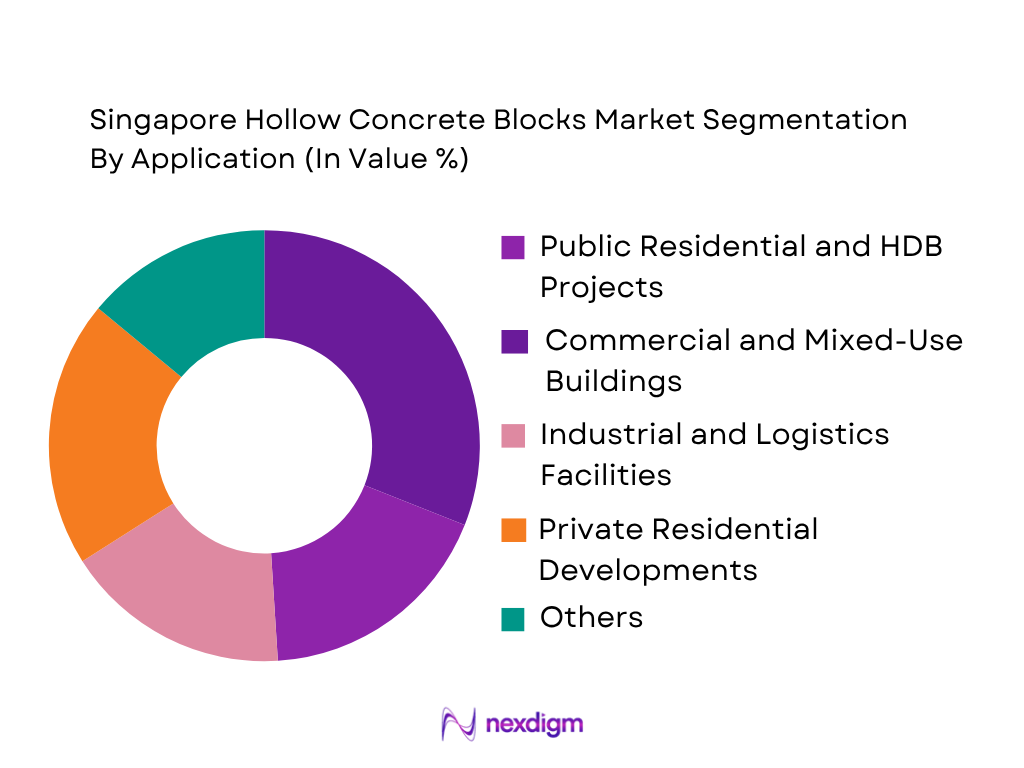
The Singapore Hollow Concrete Blocks Market is segmented into public residential and HDB projects, private residential developments, commercial and mixed-use buildings, industrial and logistics facilities, and institutional and infrastructure buildings. Public residential and HDB projects represent a major application segment because Singapore maintains a sustained pipeline of new public housing while simultaneously upgrading and redeveloping the existing housing stock. Concrete masonry can be used for selected internal partitions, service spaces, ancillary buildings, utility areas and other applications where durability and fire performance are important. HDB’s large project pipeline creates recurring construction-material demand, although Singapore’s extensive use of precast concrete and Prefabricated Prefinished Volumetric Construction limits blockwork penetration compared with markets dominated by conventional masonry. Industrial and logistics buildings provide another important application because blockwork remains relevant for plant rooms, service areas, fire compartments, workshops and utility spaces requiring robust wall construction.
Competitive Landscape
The Singapore Hollow Concrete Blocks Market operates within a broader concrete-products and masonry-material ecosystem comprising domestic manufacturers, building-material distributors and regional suppliers. Competition is shaped by product availability, block thickness range, compressive performance, fire resistance, lightweight capability, compliance documentation and reliable delivery to space-constrained construction sites. Local manufacturing and inventory availability provide logistical advantages, while regional suppliers can compete through broader masonry portfolios and specialized products. Alternative walling systems also make technical differentiation increasingly important.
| Company | Establishment Year | Headquarters | Hollow/Masonry Product Capability | Lightweight Capability | Fire/Technical Performance Focus | Manufacturing/Supply Model | Singapore Distribution Capability | Key Construction Exposure |
| Sunway Concrete Products | 1994* | Singapore | ~ | ~ | ~ | ~ | ~ | ~ |
| Pan-United Corporation | 1958 | Singapore | ~ | ~ | ~ | ~ | ~ | ~ |
| Island Concrete – Hong Leong Asia | 1970s* | Singapore | ~ | ~ | ~ | ~ | ~ | ~ |
| Samwoh Corporation | 1975 | Singapore | ~ | ~ | ~ | ~ | ~ | ~ |
| Buildmate (S) Pte Ltd | 1981* | Singapore | ~ | ~ | ~ | ~ | ~ | ~ |
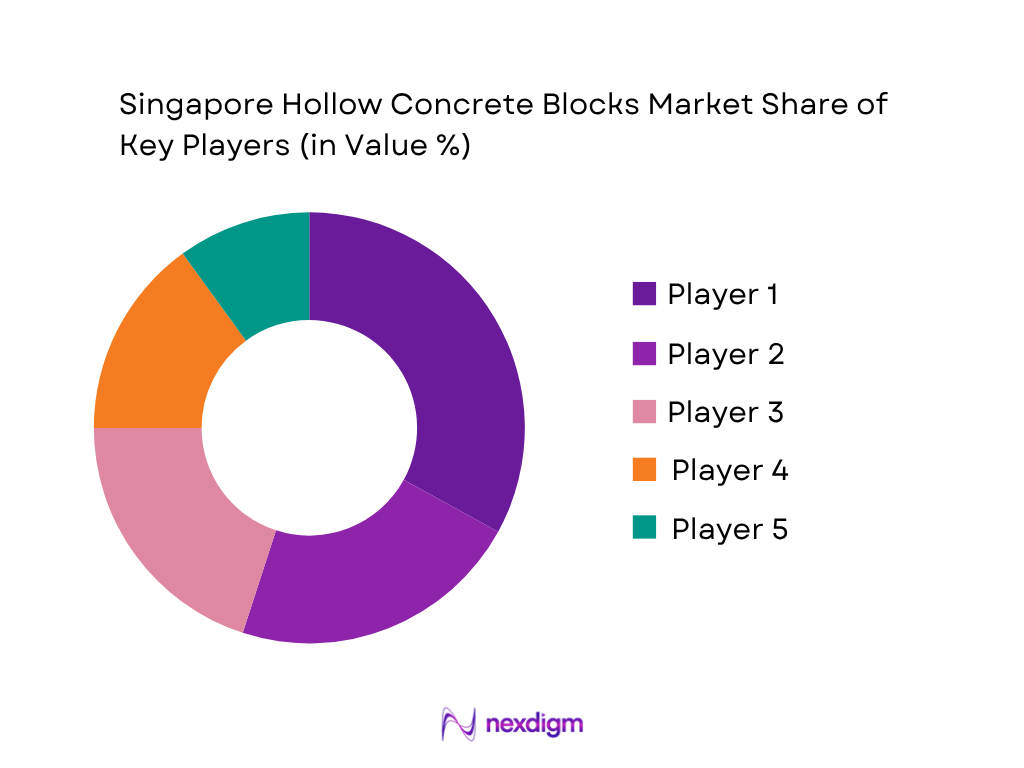
Singapore Hollow Concrete Blocks Market Analysis
Growth Drivers
HDB Housing Pipeline and Residential Construction Supporting Hollow Block Demand
Singapore’s sustained public and private housing pipeline supports demand for hollow concrete blocks used in service rooms, internal partitions, ancillary structures, fire-separated spaces and selected masonry infill applications. Total construction demand reached S$44.2 billion in 2024, including S$7.9 billion of public residential contracts and S$7.2 billion of private residential contracts. HDB launched 21,225 new flats in 2024, comprising 19,637 BTO flats and 1,588 Sale of Balance Flats, while construction commenced on approximately 23,600 flats during FY2024. The October 2024 BTO exercise alone offered 8,573 flats across 15 projects and 9 towns, demonstrating the geographic spread of residential construction. Singapore’s macroeconomic base also supports construction investment, with nominal GDP reaching US$547.5 billion in 2024 and GDP per capita reaching US$90,689. For hollow concrete block suppliers, sustained residential activity creates recurring requirements for standardized masonry units, particularly where contractors require durable walling, fire performance and dimensional consistency. Continued upgrading and redevelopment of existing HDB estates additionally supports masonry demand outside entirely new residential construction.
Industrial, Institutional and Infrastructure Construction Broadening Masonry Applications
Singapore’s diversified construction pipeline is expanding potential hollow concrete block applications beyond housing into industrial facilities, healthcare buildings, educational developments, transport infrastructure and other institutional projects. Construction demand reached S$44.2 billion in 2024, of which public institutional and other projects contributed S$10.6 billion, private industrial projects contributed S$4.4 billion, and public civil-engineering projects contributed S$6.8 billion. Actual construction output reached S$38.4 billion during the same period. The underlying economy generated US$547.5 billion in nominal GDP in 2024, while gross fixed investment remained an important component of domestic economic activity. Singapore is also expanding digital infrastructure: its Green Data Centre Roadmap provides for at least 300 MW of additional data-centre capacity, strengthening the pipeline for high-specification facilities requiring fire compartmentation, plant rooms, service areas and durable internal walls. Projects including Changi Airport Terminal 5, rail extensions and healthcare facilities further broaden building activity. These applications create opportunities for hollow concrete blocks with controlled dimensions, fire resistance, higher durability and specialized performance characteristics.
Market Challenges
PPVC and Industrialized Construction Reducing Conventional Blockwork Applications
Singapore’s strong emphasis on construction productivity creates a structural challenge for hollow concrete blocks because industrialized walling and volumetric construction can replace labor-intensive masonry in major building applications. Prefabricated Prefinished Volumetric Construction can deliver manpower and time productivity improvements of up to 40 units per 100 units of conventional resource requirement, depending on project complexity, while an established Singapore residential PPVC project achieved approximately 4 months of construction-time savings. This competitive pressure matters because residential construction represented S$15.1 billion of Singapore’s S$44.2 billion construction demand in 2024, combining S$7.9 billion of public and S$7.2 billion of private residential contracts. Singapore’s nominal GDP reached US$547.5 billion in 2024, with a population of approximately 6.0 million, supporting a highly urbanized construction environment where productivity and site efficiency are critical. Hollow-block suppliers consequently face substitution from PPVC, precast concrete walls, prefabricated bathroom units and other Design for Manufacturing and Assembly solutions. Suppliers must increasingly concentrate on applications where masonry retains advantages in fire compartmentation, plant rooms, alterations, utility spaces and project-specific partitions.
Limited Site Space and High Material-Handling Intensity Complicating Block Supply
Singapore’s dense urban construction environment creates logistical challenges for hollow concrete blocks because masonry units require pallet storage, repeated truck deliveries, unloading areas and protected on-site inventory. This becomes significant when construction activity is elevated: total construction demand reached S$44.2 billion in 2024, while certified construction output reached S$38.4 billion. Material movements are correspondingly substantial; monthly bulk cement demand reached 454.02 thousand tonnes in June 2025, while granite demand reached 1,765.60 thousand tonnes and ready-mixed concrete demand reached 1,205.30 thousand cubic metres during the same month. Singapore’s nominal GDP stood at US$547.5 billion in 2024, supporting intensive development within a compact urban economy of approximately 6.0 million residents. Hollow concrete blocks add another high-volume material stream requiring coordination with cranes, hoists, workers and other building materials. Restricted storage at high-rise and redevelopment sites can limit bulk deliveries, while damage during repeated handling can affect usable quantities. Manufacturers and distributors therefore need tightly scheduled deliveries, regional inventories and reliable palletized handling to remain competitive within Singapore’s productivity-focused construction system.
Market Opportunities
Lightweight and Low-Carbon Masonry Creating Higher-Performance Product Opportunities
Lightweight and lower-carbon hollow concrete blocks have an expanding opportunity as Singapore strengthens sustainable-building requirements while maintaining substantial construction activity. The country recorded S$44.2 billion in construction demand and S$38.4 billion in construction output during 2024, providing a broad installed pipeline for building-material suppliers. Singapore’s Green Mark ecosystem had expanded to 2,590 certified buildings by March 2025, while certified buildings collectively generated more than 4.2 billion kWh of annual energy savings. The macroeconomic environment remains supportive, with nominal GDP of US$547.5 billion in 2024 and GDP per capita of US$90,689. These conditions create future opportunities for masonry manufacturers to develop lightweight units incorporating recycled aggregates, lower-carbon cementitious binders and optimized hollow geometries. Reduced block weight can improve manual handling and installation productivity, while higher dimensional accuracy can reduce site cutting and material wastage. Suppliers able to document fire performance, density, compressive strength and environmental characteristics can position hollow blocks for institutional, industrial, refurbishment and selected residential applications where conventional masonry remains technically suitable despite increasing competition from prefabricated construction systems.
Data Centres and High-Specification Industrial Buildings Expanding Specialized Masonry Demand
Singapore’s digital and industrial infrastructure creates a future growth avenue for specialized hollow concrete blocks used in fire compartments, equipment rooms, utility spaces, service corridors and ancillary structures. The government’s Green Data Centre Roadmap provides for at least 300 MW of additional data-centre capacity, establishing a substantial current policy-backed platform for continued digital-infrastructure development. Industrial construction already represented S$4.7 billion of Singapore’s S$44.2 billion construction demand in 2024, comprising approximately S$4.4 billion of private and S$0.3 billion of public industrial contracts. Singapore’s nominal GDP reached US$547.5 billion in 2024, with GDP per capita at US$90,689, supporting continued investment in high-specification economic infrastructure. These facilities require wall systems capable of meeting demanding fire, durability and operational requirements. Hollow-block manufacturers can therefore develop higher-strength, fire-resistant and lightweight masonry systems specifically for plant rooms, electrical spaces, service enclosures and internal compartmentation. The opportunity is particularly relevant where flexible masonry installation is preferable to complete volumetric prefabrication, allowing suppliers to address specialized wall applications rather than competing solely in conventional residential blockwork.
Future Outlook
The Singapore Hollow Concrete Blocks Market is forecast to expand at approximately ~% CAGR during 2026–2035. Growth will be supported by continuing public housing construction, industrial development, institutional projects, redevelopment activity and specialized masonry requirements, although adoption will remain moderated by Singapore’s strong preference for industrialized construction methods. The product mix is expected to gradually shift toward lightweight, fire-resistant and lower-carbon masonry products. Concrete block suppliers will increasingly need to demonstrate construction productivity, dimensional consistency and compatibility with Singapore’s Green Mark and broader sustainable-building objectives.
Major Players
- Sunway Concrete Products (S) Pte Ltd
- Pan-United Corporation Ltd
- Island Concrete (Pte) Ltd – Hong Leong Asia
- Samwoh Corporation Pte Ltd
- Buildmate (S) Pte Ltd
- Lian Wang Trading Pte Ltd
- Choo Building Materials Co. Pte Ltd
- Yew Li Wire Mesh Contractor Pte Ltd
- Eastern Pretech (Pte) Ltd
- HL Building Materials Pte Ltd
- YTL Cement
- Hume Concrete Sdn Bhd
- Starken AAC Sdn Bhd
- Southern Concrete Industries Sdn Bhd
- Malayan Cement Berhad
Key Target Audience
- Hollow Concrete Block and Concrete Product Manufacturers
- Building Material Importers and Distributors
- HDB and Public Housing Contractors
- Private Real Estate Developers
- Main Building and Masonry Contractors
- Industrial, Logistics and Data Centre Developers
- Investments and Venture Capitalist Firms
- Government and Regulatory Bodies (Building and Construction Authority, Housing & Development Board, Urban Redevelopment Authority, Singapore Green Building Council)
Research Methodology
Step 1: Identification of Key Variables
The initial phase involves constructing an ecosystem map of the Singapore Hollow Concrete Blocks Market covering concrete-product manufacturers, regional suppliers, cement and aggregate suppliers, importers, distributors, contractors, developers and public-sector construction authorities. Critical variables include consumption volume, domestic supply, imported supply, block dimensions, technical performance, construction applications and competing wall systems.
Step 2: Market Analysis and Construction
Historical market information is assessed through top-down and bottom-up methodologies. Construction demand is mapped across HDB housing, private residential developments, commercial buildings, industrial facilities and institutional projects. Supplier-level analysis evaluates domestic manufacturing, imports, product availability and distribution while accounting for substitution from precast walls, drywall, AAC and PPVC construction.
Step 3: Hypothesis Validation and Expert Consultation
Market hypotheses are validated through computer-assisted telephone interviews with concrete-product suppliers, building-material distributors, main contractors, masonry contractors, developers and construction professionals. Discussions examine product specifications, preferred block thicknesses, supply arrangements, fire-performance requirements, project procurement, installation productivity and competitive substitution from alternative walling technologies.
Step 4: Research Synthesis and Final Output
The final phase triangulates primary interviews, supplier information, public construction indicators and project-level demand assessment. Bottom-up product consumption is reconciled with construction activity and application-level masonry requirements. The resulting framework establishes market structure, segmentation, competitive positioning, growth drivers, challenges and the long-term outlook of the Singapore Hollow Concrete Blocks Market.

- Executive Summary
- Research Methodology (Market Definitions and Assumptions, Concrete Masonry Unit Classification, Hollow Block Product Mapping, Load-Bearing and Non-Load-Bearing Block Mapping, Lightweight Concrete Block Mapping, Thermal and Fire-Rated Block Assessment, Block Dimension Mapping, Local Manufacturing Assessment, Imported Masonry Product Assessment, Cement and Aggregate Input Assessment, Production Capacity Assessment, Construction Demand Mapping, HDB Project Pipeline Assessment, Private Residential Construction Assessment, Industrial Building Assessment, Top-Down Market Sizing, Bottom-Up Supplier Assessment, Demand-Side Assessment, Supply-Side Assessment, Contractor and Distributor Interviews, Data Triangulation, Forecasting Framework)

- Definition and Scope
- Singapore Hollow Concrete Blocks Industry Evolution and Development of Conventional Hollow Concrete Blocks, Non-Load-Bearing Masonry Units, Load-Bearing Concrete Masonry Units, Lightweight Blocks, Insulated Masonry Units, Fire-Rated Blocks and Specialized Concrete Masonry Systems
- Hollow Concrete Block Industry Value Chain Analysis
- Hollow Concrete Block Supply Chain Analysis
- Local Production versus Imported Hollow Concrete Block Supply Structure

- Growth Drivers (HDB Housing Construction Pipeline, Private Residential Development, Industrial Building Construction, Data Centre Development, Institutional Construction, Building Replacement and Redevelopment, Fire-Rated Masonry Requirements, Urban Infrastructure Development)
- Market Challenges (Limited Domestic Manufacturing Land, Imported Cement and Aggregate Exposure, High Logistics Intensity, Restricted Site Storage, Urban Delivery Constraints, Construction Labor Productivity Requirements, Competition from Drywall Systems, Competition from Precast Walls, PPVC Adoption, Prefabricated Bathroom Unit Adoption)
- Market Opportunities (Lightweight Hollow Blocks, High Fire-Resistance Masonry, Low-Carbon Concrete Masonry Units, Recycled Aggregate Blocks, Green Mark-Compatible Walling Solutions, Data Centre Masonry Applications, Industrial and Logistics Buildings, Renovation and Redevelopment Projects, Automated Block Production, Productivity-Optimized Masonry Systems)
- Market Trends (Lightweight Masonry Adoption, Reduced Unit Weight, Higher Fire Performance, Recycled Aggregate Incorporation, Low-Carbon Cementitious Materials, Automated Manufacturing, Mechanized Block Handling, Thin-Joint Masonry, Higher Dimensional Accuracy, Productivity-Focused Wall Systems)
- Government Regulations and Standards (Building Control Act Requirements, BCA Approved Document Requirements, Singapore Building Control Regulations, BCA Buildability Requirements, BCA Constructability Requirements, Green Mark Requirements, SS EN Masonry Unit Standards, Fire Code Requirements, Structural Masonry Requirements, Material Testing and Product Conformity Requirements)
- SWOT Analysis
- Porter’s Five Forces Analysis
- PESTLE Analysis
- Stakeholder Ecosystem

- By Market Value (2020-2025)
- By Hollow Concrete Block Consumption Volume (2020-2025)
- By Domestic Production Volume (2020-2025)
- By Import Volume (2020-2025)
- By Number of Concrete Masonry Units Consumed (2020-2025)
- By Conventional Hollow Block Consumption (2020-2025)

- By Product Type (In Value %)
Conventional Hollow Concrete Blocks
Lightweight Hollow Concrete Blocks
Non-Load-Bearing Hollow Blocks
Load-Bearing Hollow Blocks
Fire-Rated Hollow Concrete Blocks
Thermal and Insulated Concrete Blocks
Specialty Concrete Masonry Units - By Block Dimension and Thickness (In Value %)
75–100 mm Blocks
125–150 mm Blocks
175–200 mm Blocks
Above 200 mm Blocks
Project-Specific and Custom Dimensions - By Masonry Function (In Value %)
Internal Partition Walls
External Infill Walls
Fire Compartment Walls
Service and Utility Walls
Load-Bearing Masonry
Boundary and Perimeter Walls
Plant Room and Ancillary Walls - By Application (In Value %)
Public Residential and HDB Projects
Private Residential Developments
Commercial and Mixed-Use Buildings
Industrial and Manufacturing Facilities
Warehouses and Logistics Facilities
Institutional and Healthcare Buildings
Transport and Infrastructure Buildings
Data Centres and High-Specification Facilities - By Customer Type (In Value %)
HDB and Public-Sector Contractors
Private Residential Developers
Main Building Contractors
Masonry and Specialist Contractors
Industrial and Logistics Developers
Institutional Project Contractors
Infrastructure Contractors
Building Material Distributors - By Sales and Procurement Channel (In Value %)
Direct Manufacturer-to-Contractor
Distributor and Building Material Merchant
Project-Specific Procurement
Main Contractor Procurement
Specialist Masonry Contractor Procurement
Regional Importer and Distributor

- Market Share of Major Players (By Sales Value, Consumption Volume Supplied, Hollow Block Product Range, Lightweight Masonry Portfolio, Project Coverage, Distribution Reach, Public-Sector Project Exposure, Industrial Project Exposure)
- Cross Comparison Parameters (Concrete Masonry Product Portfolio Breadth, Hollow Block Dimension and Thickness Range, Compressive Strength and Density Range, Fire-Rated and Lightweight Masonry Capability, Local Manufacturing versus Imported Supply Capability, Green Building and Recycled Material Product Capability, Contractor Distribution and Urban Delivery Network, HDB-Commercial-Industrial Project Supply Portfolio)
- SWOT Analysis of Major Players
- Detailed Profiles of Major Companies
Sunway Concrete Products (S) Pte Ltd
Pan-United Corporation Ltd
Island Concrete (Pte) Ltd – Hong Leong Asia
Samwoh Corporation Pte Ltd
Buildmate (S) Pte Ltd
Lian Wang Trading Pte Ltd
Choo Building Materials Co. Pte Ltd
Yew Li Wire Mesh Contractor Pte Ltd
Eastern Pretech (Pte) Ltd
HL Building Materials Pte Ltd
YTL Cement
Hume Concrete Sdn Bhd
Starken AAC Sdn Bhd
Southern Concrete Industries Sdn Bhd
Lafarge Concrete Malaysia / Malayan Cement

- HDB and Public Housing Contractor Requirement Assessment
- Private Developer Requirement Assessment
- Main Contractor Procurement Assessment
- Industrial and Logistics Developer Assessment
- Data Centre Developer Requirement Assessment
- Masonry Contractor Requirement Assessment

- By Market Value (2026-2035)
- By Hollow Concrete Block Consumption Volume (2026-2035)
- By Domestic Production Volume (2026-2035)
- By Import Volume (2026-2035)
- By Number of Concrete Masonry Units Consumed (2026-2035)
- By Conventional Hollow Block Consumption (2026-2035)


 Request a Sample
 Ask for Customization
 Get a Quote
 Enquire Now
