
 Download PDF
Market Overview
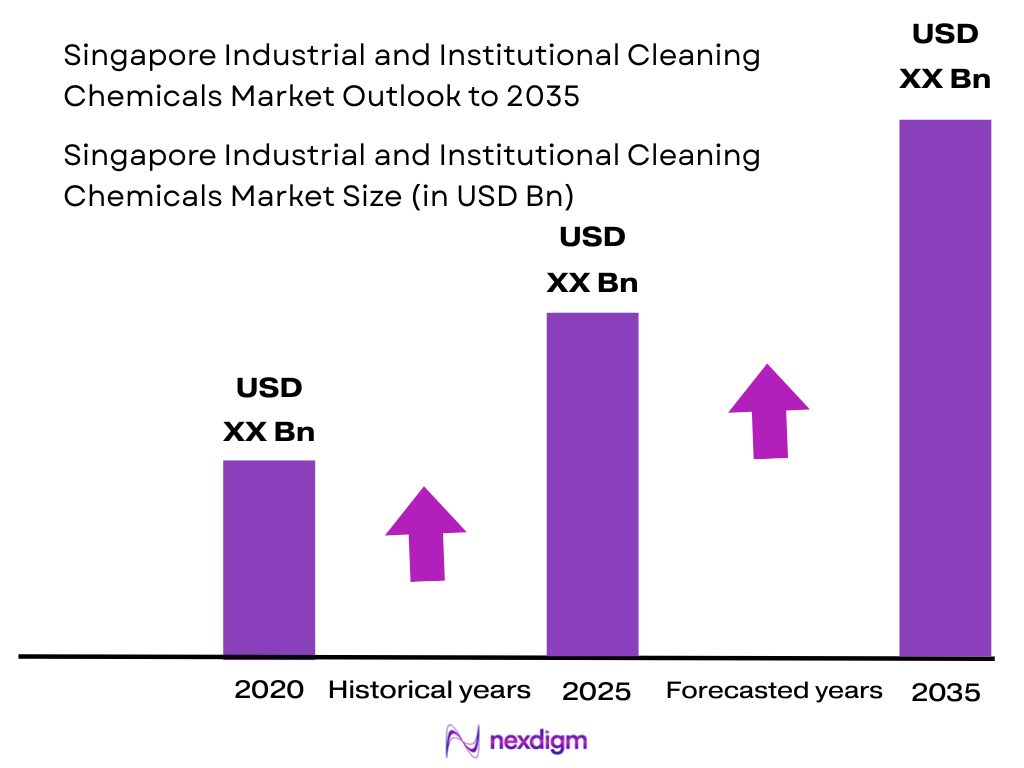
The Singapore Industrial and Institutional Cleaning Chemicals Market is valued at ~USD XX million, with demand supported by the scale and sophistication of Singapore’s industrial and commercial economy. Singapore’s GDP at current market prices reached S$765.50 billion in 2024, compared with S$686.40 billion in 2023, while goods-producing industries increased from S$152.16 billion to S$164.40 billion over the same period. This economic base supports recurring chemical-cleaning requirements across manufacturing, healthcare, food processing, hospitality, commercial buildings and specialized production environments.
Singapore’s demand is concentrated around the Central Region, Jurong, Tuas, Changi, Woodlands and one-north because these areas combine commercial buildings, manufacturing facilities, logistics infrastructure, healthcare facilities, hotels, technology operations and specialized industrial sites. The population reached 6,036,860 in 2024, compared with 5,917,648 in 2023, creating a dense residential, commercial and institutional environment requiring professional hygiene services. Tourism also strengthened the hospitality cleaning base, with international visitor arrivals reaching 16.5 million in 2024, compared with 13.6 million in 2023.
Market Segmentation
By Product Type
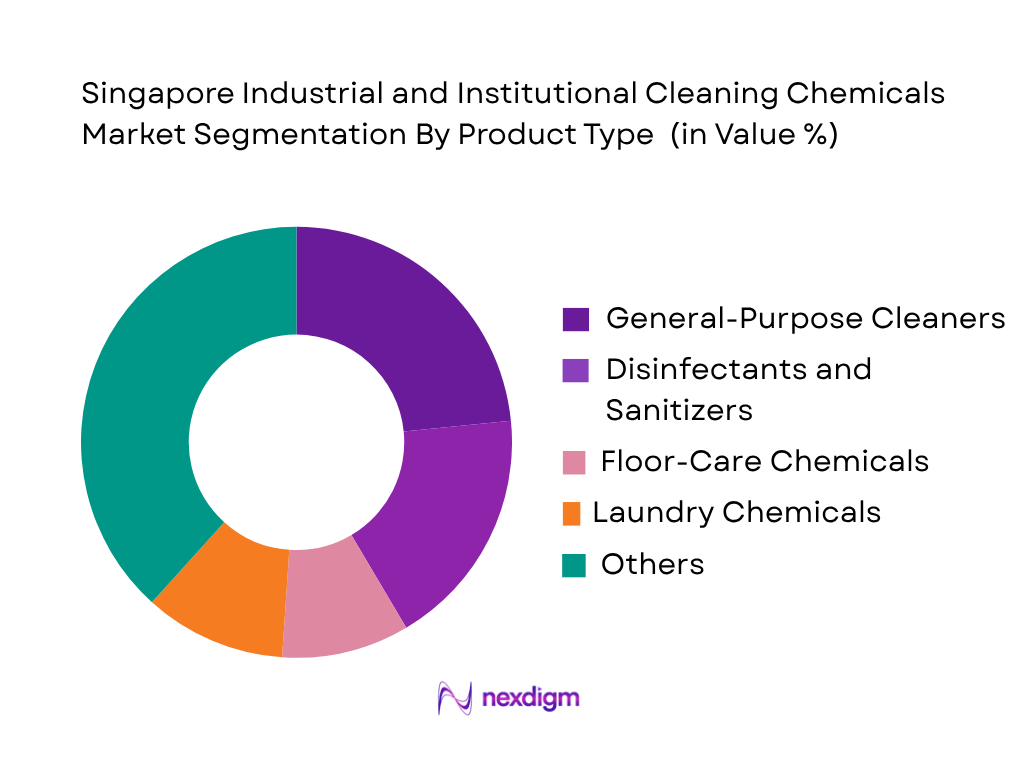
The Singapore Industrial and Institutional Cleaning Chemicals Market is segmented into general-purpose cleaners, disinfectants and sanitizers, floor-care chemicals, laundry chemicals, warewashing chemicals, industrial degreasers, kitchen cleaners, glass and surface cleaners, restroom chemicals and specialty industrial cleaners. General-purpose cleaners are expected to represent the dominant sub-segment because they serve the broadest range of professional facilities, including offices, hotels, healthcare premises, retail complexes, educational institutions, transport facilities and industrial sites. Their application across floors, walls, hard surfaces, equipment exteriors and frequently touched areas supports recurring consumption rather than project-based demand. The extensive facility-management ecosystem further increases utilization because cleaning contractors commonly require standardized formulations that can be deployed across multiple customer locations. Demand is also supported by Singapore’s dense commercial environment and stringent workplace and hygiene expectations. In specialized industries, however, general-purpose products increasingly coexist with application-specific chemistry for cleanrooms, food-processing areas, pharmaceutical facilities and precision manufacturing.
By End-Use Industry
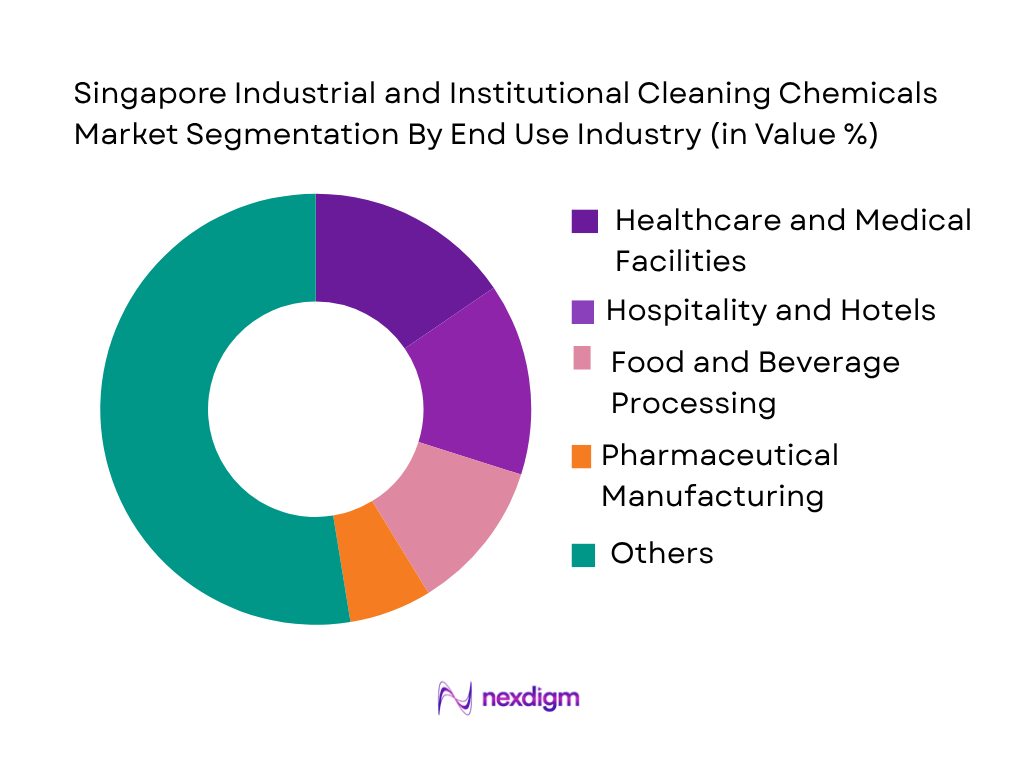
The Singapore Industrial and Institutional Cleaning Chemicals Market is segmented across healthcare, hospitality, food and beverage processing, pharmaceutical manufacturing, semiconductor and electronics manufacturing, commercial offices, industrial plants, marine facilities, aviation, data centres, retail, education and government facilities. Healthcare and hospitals constitute a strategically important high-intensity application because cleaning and disinfection are integrated into infection-control procedures, patient-area sanitation, operating-room maintenance, equipment cleaning and healthcare laundry. At the same time, Singapore’s advanced manufacturing base generates demand for specialized cleaning chemistry. The Ministry of Manpower recorded 5,511 chemical monitoring results in 2024, including 1,389 from petroleum and chemical-product manufacturing, 865 from computer, electronic and optical-product manufacturing, 324 from food, beverage and tobacco manufacturing, and 116 from pharmaceutical and biological-product manufacturing. These industrial environments require differentiated formulations according to contamination, surface compatibility, residue and worker-exposure requirements.
Competitive Landscape
The Singapore Industrial and Institutional Cleaning Chemicals Market is characterized by international chemical and hygiene companies serving multinational industrial customers, healthcare facilities, hospitality operators, food processors and professional cleaning contractors. Competition is shaped by product breadth, specialty chemistry, technical service, regulatory documentation, distribution coverage, sustainability credentials and the ability to support automated dosing and facility-management contracts. The market also benefits from Singapore’s position as a regional business and logistics hub, allowing international suppliers to serve both domestic customers and wider Southeast Asian operations.
| Company | Establishment Year | Headquarters | Key Product Coverage | Primary I&I Strength | Specialty Capability | Singapore Market Position |
| Ecolab Inc. | 1923 | St. Paul, Minnesota, USA | ~ | ~ | ~ | ~ |
| Diversey Holdings | 1923 | Fort Mill, South Carolina, USA | ~ | ~ | ~ | ~ |
| BASF SE | 1865 | Ludwigshafen, Germany | ~ | ~ | ~ | ~ |
| Henkel AG & Co. KGaA | 1876 | Düsseldorf, Germany | ~ | ~ | ~ | ~ |
| 3M Company | 1902 | St. Paul, Minnesota, USA | ~ | ~ | ~ | ~ |
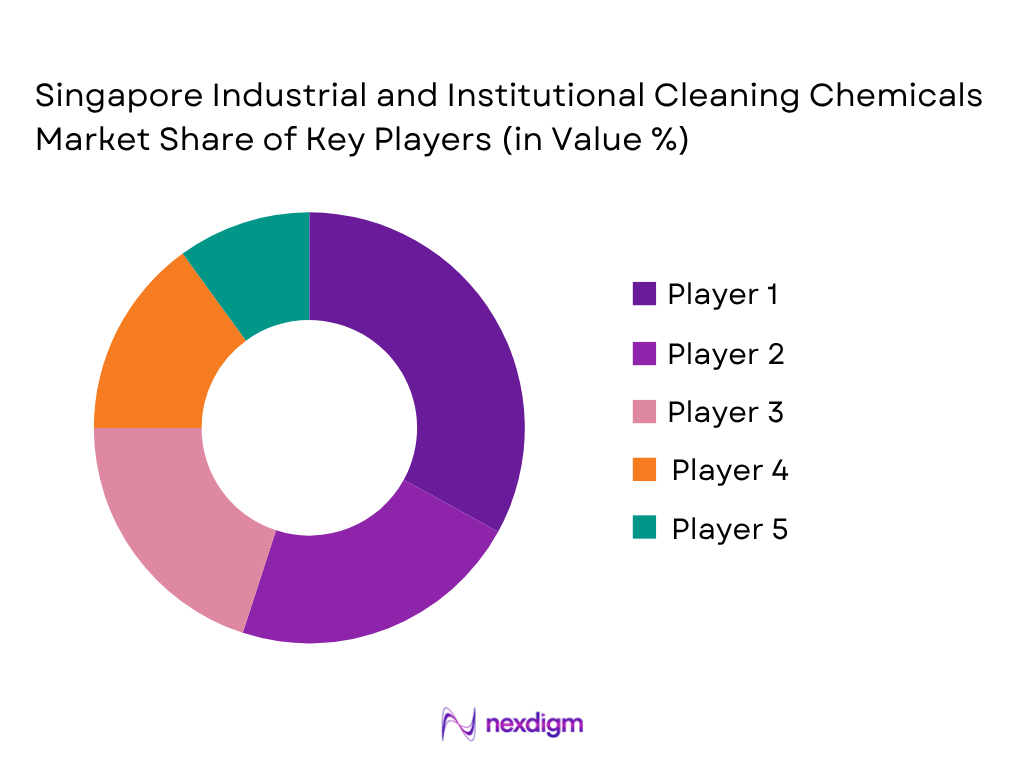
Singapore Industrial and Institutional Cleaning Chemicals Market Analysis
Growth Drivers
Healthcare Infrastructure
Singapore’s expanding healthcare infrastructure is a direct demand driver for industrial and institutional cleaning chemicals because hospitals, community facilities and long-term-care establishments require continuous cleaning, disinfection and sanitation. The Ministry of Health recorded 20 acute hospitals, 10 community hospitals and 88 nursing homes in 2024, compared with 19, 10 and 85 respectively in 2023. The country also had 12,620 acute-hospital beds and 2,553 community-hospital beds in 2024, compared with 12,025 and 2,303 in 2023. These facilities require hospital-grade disinfectants, detergent-disinfectants, floor cleaners, surface cleaners and restroom chemicals across patient rooms, operating areas and common spaces. Singapore’s wider economic capacity further supports institutional demand, with World Bank data recording USD 547.39 billion GDP and USD 90,674 GDP per capita in 2024. The healthcare pipeline reinforces the requirement for recurring cleaning consumption: MOH has stated that Singapore plans to add approximately 4,000 hospital beds by 2030. The combination of more healthcare facilities, greater bed capacity and higher institutional service intensity creates a structurally recurring requirement for professional cleaning chemistry, particularly formulations designed for infection control, material compatibility and frequent-use environments.
Hospitality and Tourism Activity
Singapore’s hospitality ecosystem creates substantial recurring requirements for surface cleaners, disinfectants, floor-care chemicals, glass cleaners, restroom formulations, kitchen degreasers and dishwashing chemicals across hotels, restaurants, food courts and related facilities. Singapore Tourism Board data shows that international visitor arrivals reached 16.5 million in 2024, compared with approximately 13.6 million in 2023, while tourism receipts reached S$29.8 billion in 2024. Hotel operating activity also strengthened: average occupancy reached 81.8 in 2024 compared with 80.5 in 2023, while 1,421 new hotel rooms were added during the year. Accommodation revenue indicators also increased, with average room rate reaching S$276 and revenue per available room reaching S$226. These figures translate into greater cleaning frequency across guestrooms, kitchens, public areas, washrooms and high-touch surfaces. Foodservice activity adds another layer of chemical consumption because grease removal, sanitization and floor hygiene are required repeatedly throughout operating cycles. Singapore’s Environmental Sanitation Regime further institutionalizes cleaning requirements for designated higher-risk premises. Consequently, sustained visitor flows, hotel capacity and foodservice activity support recurring professional consumption rather than one-time demand.
Market Challenges
Import Dependency and Specialty Raw Material Dependency
Singapore’s position as a globally integrated chemical and manufacturing hub also exposes cleaning-chemical suppliers to international raw-material and finished-product supply chains. Singapore’s 2024 merchandise trade data recorded S$611.36 billion of total imports, including S$42.8 billion of chemicals and chemical products, while chemical and chemical-product exports reached S$69.5 billion. The scale of cross-border chemical flows indicates the importance of imported feedstocks, intermediates and formulated products to the broader chemical ecosystem. At the same time, domestic chemical manufacturing is concentrated in specialized industrial clusters rather than being dedicated to every downstream formulation category. Singapore’s manufacturing sector generated S$429.58 billion of total output in 2024, with the chemicals cluster accounting for S$95.16 billion, demonstrating a substantial domestic chemical base but also highlighting the highly specialized structure of production. For industrial and institutional cleaning suppliers, dependence on imported surfactants, solvents, enzymes, specialty additives and functional ingredients can create exposure to international logistics disruptions, supplier concentration and formulation lead times. This challenge is particularly relevant for low-VOC, enzyme-based, cleanroom and other specialty chemistries requiring narrowly specified inputs.
Environmental Compliance, Chemical Handling and Limited Industrial Space
Singapore’s compact industrial geography and stringent workplace-safety framework create operational challenges for cleaning-chemical manufacturers, distributors and professional users. JTC explicitly identifies land scarcity as a continuing challenge for Singapore’s manufacturing sector, while industrial premises can impose restrictions on activities such as hazardous-chemical storage. This limits the flexibility available for facilities handling large inventories of concentrated detergents, solvents and other regulated chemical products. Workplace requirements add another layer: the Ministry of Manpower recorded 5,511 chemical-monitoring results in 2024, with 52 of results originating from petroleum and chemical products, computer/electronics and paper/rubber/plastics-related industries. Workplaces exceeding permissible exposure levels must implement additional engineering controls. Environmental management also affects chemical consumption and disposal: NEA reported 3,090 litres of chemical waste generated by its laboratory during FY2024, alongside 35,520 litres of biohazardous waste, with hazardous materials managed through controlled storage and licensed disposal channels. These requirements increase the technical complexity of handling concentrated cleaning chemistry and create additional compliance obligations for manufacturers, distributors and end users.
Market Opportunities
Concentrated, Low-Water and Sustainable Cleaning Chemistry
Singapore’s resource-efficient operating environment creates an opportunity for concentrated cleaning chemicals, low-water formulations and sustainable surfactant systems that can deliver cleaning performance while reducing product volume and operational resource requirements. The opportunity is supported by the scale of Singapore’s professional cleaning and industrial ecosystem: manufacturing generated S$429.58 billion of output in 2024, while the chemicals cluster alone generated S$95.16 billion. The country also recorded S$13.5 billion in fixed-asset investment commitments in 2024, including S$11.1 billion in manufacturing, with EDB identifying specialty chemicals and sustainable materials among investment areas. These industrial investments create potential customers requiring specialized cleaning, maintenance and process-hygiene chemistry. Concentrated formulations can be particularly relevant to large facilities where chemicals are dispensed repeatedly through controlled dilution systems. Low-water cleaning systems can support applications in sensitive industrial environments, while enzyme-based cleaners and lower-VOC formulations can address demand for more targeted chemistry. The opportunity extends across healthcare, hospitality, food processing, semiconductor manufacturing, pharmaceutical production and facility management, where suppliers can differentiate through dilution ratios, residue performance, worker-safety characteristics, packaging efficiency and compatibility with automated dosing equipment.
Automated Dosing, Cleanroom Chemistry and Data-Centre Cleaning
Singapore’s concentration of high-specification manufacturing and digital infrastructure creates an opportunity for specialized cleaning systems combining chemicals, dispensing technology and application controls. EDB reports that Singapore’s semiconductor industry supports more than 35,000 employees and that 9 of the world’s 15 largest semiconductor companies have established operations in the country. Biomedical manufacturing also remains substantial, with biopharmaceutical facilities producing S$12.1 billion of products in 2024 and employing more than 9,000 skilled workers. Digital infrastructure provides another specialized application base: IMDA’s 2024 Green Data Centre Roadmap targeted at least 300 MW of additional data-centre capacity in the near term. These facilities require cleaning approaches that minimize residue, moisture, contamination and chemical exposure around sensitive equipment and controlled production environments. Automated dosing can improve consistency in hospitality, healthcare and foodservice applications while reducing operator variability. Cleanroom-compatible detergents and disinfectants can serve pharmaceutical and semiconductor facilities, whereas low-moisture and sensitive-surface formulations can address data-centre environments. Suppliers capable of combining specialized formulations with smart dispensing, dosing controls, technical documentation and facility-specific protocols can therefore access higher-value professional cleaning applications.
Future Outlook
Over the next decade, the Singapore Industrial and Institutional Cleaning Chemicals Market is expected to become increasingly specialized as professional hygiene requirements intersect with advanced manufacturing, healthcare, hospitality, food processing and high-value technology facilities. Demand will increasingly shift toward concentrated formulations, low-residue chemistry, automated dosing, water-efficient cleaning and sustainable ingredients. Singapore’s continued development as a manufacturing, logistics, tourism and technology hub should sustain demand for professional cleaning chemistry across multiple high-specification environments. The market is also positioned for greater adoption of application-specific formulations for cleanrooms, semiconductor facilities, pharmaceutical manufacturing and data centres.
Major Players
- Ecolab Inc.
- Diversey Holdings
- BASF SE
- Henkel AG & Co. KGaA
- 3M Company
- Reckitt Benckiser Group plc
- Unilever PLC
- The Procter & Gamble Company
- SC Johnson Professional
- The Clorox Company
- Zep Inc.
- Spartan Chemical Company
- Christeyns NV
- Kärcher
- Kimberly-Clark Professional
Key Target Audience
- Industrial and Institutional Cleaning Chemical Manufacturers
- Facility Management and Contract Cleaning Companies
- Healthcare and Hospital Procurement Organizations
- Food Processing and Foodservice Operators
- Pharmaceutical and Biotechnology Manufacturers
- Semiconductor, Electronics and Precision-Manufacturing Companies
- Investments and Venture Capitalist Firms (Private Equity Funds, Venture Capital Funds, Strategic Investors)
- Government and Regulatory Bodies (National Environment Agency, Ministry of Manpower, Singapore Food Agency, Ministry of Health)
Research Methodology
Step 1: Identification of Key Variables
The initial stage involves mapping the Singapore Industrial and Institutional Cleaning Chemicals ecosystem, covering manufacturers, importers, distributors, facility-management companies and major end users. Product categories, chemistry types, applications, facility types and procurement channels are established as the principal market variables.
Step 2: Market Analysis and Construction
Historical market information is structured through product-level and end-use-level analysis. The assessment considers chemical consumption intensity, facility requirements, industrial activity, professional cleaning demand, distribution structures and the relationship between concentrated formulations and final-use consumption.
Step 3: Hypothesis Validation and Expert Consultation
Market hypotheses are validated through consultations with chemical suppliers, distributors, facility-management operators, industrial procurement professionals and end-user organizations. Discussions focus on product specifications, application requirements, purchasing criteria, formulation preferences and changing hygiene protocols.
Step 4: Research Synthesis and Final Output
The final research model integrates supply-side information with demand-side analysis and secondary-source validation. Market estimates are reconciled across product categories, end-use industries, applications and distribution channels to produce a consistent Singapore market framework and forward-looking assessment.

- Executive Summary
- Research Methodology (Market Definition and Scope, Product Inclusion and Exclusion Criteria, I&I Cleaning Chemical Taxonomy, Top-Down Market Sizing, Bottom-Up Market Sizing, Volume-to-Value Validation, Supply-Side Mapping, Demand-Side Mapping, Import-Dependency Assessment, Distributor and Channel Mapping, End-User Interviews, Facility-Level Consumption Assessment, Primary Expert Interviews, Secondary Data Validation, Data Triangulation, Forecasting Framework, Scenario Analysis, Market Assumptions, Data Limitations)

- Definition and Scope
- Market Ecosystem and Industry Structure
- Evolution of Professional Cleaning Chemistry in Singapore
- Singapore I&I Cleaning Chemicals Value Chain
- Raw Material-to-Formulation Value Chain
- Domestic Blending and Formulation Landscape
- Import and Regional Supply Network

- Growth Drivers (Healthcare Infrastructure, Hospitality and Tourism Activity, Food Processing Expansion, Semiconductor Manufacturing, Pharmaceutical Production, Data-Centre Development, Facility Management Outsourcing, Industrial Hygiene Standards)
- Market Challenges (Import Dependency, Limited Land for Chemical Manufacturing, Chemical Storage Constraints, Environmental Compliance, Wastewater Discharge Requirements, Hazardous Chemical Handling, Specialty Raw Material Dependency, Skilled Workforce Requirements)
- Market Opportunities (Concentrated Cleaning Chemistry, Low-Water Cleaning Systems, Sustainable Surfactants, Enzyme-Based Cleaners, Low-VOC Formulations, Automated Chemical Dosing, Smart Dispensing Systems, Cleanroom Chemistry, Data-Centre Cleaning, Local Formulation and Regional Distribution)
- Market Trends (Water-Efficient Cleaning, Concentrated Formulations, Green Cleaning Chemistry, Enzymatic Cleaning, Low-Residual Disinfection, Automated Dosing, Smart Chemical Dispensing, Robotics-Enabled Cleaning, Digital Facility Management, Sustainable Packaging)
- Regulatory and Compliance Framework (NEA Chemical Controls, Workplace Safety and Health Requirements, GHS Chemical Classification, Hazard Communication, Hazardous Substance Controls, Environmental Protection, Wastewater Discharge, Chemical Storage, Food Hygiene Requirements, Healthcare Infection Control, Workplace Exposure Controls)
- SWOT Analysis
- Porter’s Five Forces Analysis
- PESTLE Analysis

- By Market Value (2020-2025)
- By Volume Consumption (2020-2025)
- By Product Category (2020-2025)
- By Chemistry Type (2020-2025)
- By Formulation Type (2020-2025)

- By Product Type (In Value %)
General-Purpose Cleaners
Disinfectants and Sanitizers
Floor Care Chemicals
Laundry Chemicals
Warewashing Chemicals
Kitchen and Food-Service Cleaners
Industrial Degreasers
Glass and Surface Cleaners
Restroom and Washroom Cleaners
Carpet and Upholstery Cleaners
Vehicle and Transportation Cleaners
Specialty Industrial Cleaners
Cleanroom Cleaning Chemicals - By Chemistry Type (In Value %)
Alkaline Cleaners
Acidic Cleaners
Neutral Cleaners
Solvent-Based Cleaners
Surfactant-Based Cleaners
Enzyme-Based Cleaners
Biocide-Based Cleaners
Oxidizing Cleaners - By Formulation Type (In Value %)
Ready-to-Use Liquids
Concentrated Liquids
Powders
Gels
Foams
Tablets and Solid Doses
Pre-Moistened Wipes
Low-Foam Formulations
High-Foam Formulations
Dilutable Professional Formulations - By End-Use Industry (In Value %)
Healthcare and Hospitals
Hospitality and Hotels
Food and Beverage Processing
Pharmaceutical Manufacturing
Semiconductor and Electronics Manufacturing
Marine and Port Facilities
Aerospace and Precision Manufacturing
Oil and Gas and Petrochemical Facilities
Commercial Offices
Retail and Shopping Centres
Education and Institutional Facilities - By Cleaning Application (In Value %)
Hard-Surface Cleaning
Floor Cleaning and Maintenance
Equipment and Machinery Cleaning
Clean-in-Place Cleaning
Open-Plant Cleaning
Industrial Degreasing
Parts and Component Cleaning
Manual Warewashing
Automatic Warewashing
Laundry Cleaning
Restroom Sanitation
High-Touch Surface Disinfection
Cleanroom Cleaning
Precision and Specialty Cleaning - By Facility Type (In Value %)
Hospitals and Medical Centres
Hotels and Resorts
Restaurants and Commercial Kitchens
Food Processing Plants
Pharmaceutical Facilities
Industrial Manufacturing Plants
Ports and Marine Facilities
Airports and Aviation Facilities
Shopping Malls and Retail Complexes
Corporate Offices and Business Parks
Data Centres
Schools and Universities
Government Buildings

- Market Share Analysis of Major Players (By Value, Product Category, Chemistry Type, Formulation Type, End-Use Industry, Application, Customer Type, Distribution Channel)
- Cross Comparison Parameters (Product Portfolio Breadth, Professional Cleaning SKU Coverage, Domestic Formulation Footprint, Specialty Chemistry Capability, Sustainable Chemistry Portfolio, Automated Dosing Capability, Distribution Network Reach, End-User Industry Coverage)
- Major Player SWOT Analysis
- Detailed Profiles of Major Companies
Ecolab Inc.
Diversey Holdings
BASF SE
Henkel AG & Co. KGaA
Reckitt Benckiser Group plc
Unilever PLC
The Procter & Gamble Company
3M Company
SC Johnson Professional
The Clorox Company
Zep Inc.
Spartan Chemical Company
Christeyns NV
Kärcher
Kimberly-Clark Professional

- End-User Demand Structure
- Healthcare and Hospitals
- Hospitality and Foodservice
- Pharmaceutical and Biotechnology Manufacturing
- Semiconductor and Electronics Manufacturing
- Industrial Manufacturing and Engineering

- By Market Value (2026-2035)
- By Volume Consumption (2026-2035)
- By Product Category (2026-2035)
- By Chemistry Type (2026-2035)
- By Formulation Type (2026-2035)


 Request a Sample
 Ask for Customization
 Get a Quote
 Enquire Now