
 Download PDF
Market Overview
The Singapore insecticide market forms a niche but strategically important segment within the country’s crop protection and pest management industry. Singapore’s agricultural pesticides imports were valued at approximately USD ~ million, reflecting the country’s reliance on imported crop protection products due to limited domestic manufacturing capabilities. The market is driven by rising investments in food security initiatives, vertical farming systems, urban agriculture projects, and increasing demand for vector control solutions in densely populated urban environments. The Singapore Food Agency has targeted local food production expansion through controlled-environment agriculture, increasing demand for specialized insecticides and integrated pest management solutions. Singapore’s agricultural pesticides import trend and urban farming expansion continue to support insecticide demand.
Market Segmentation
By Product Category
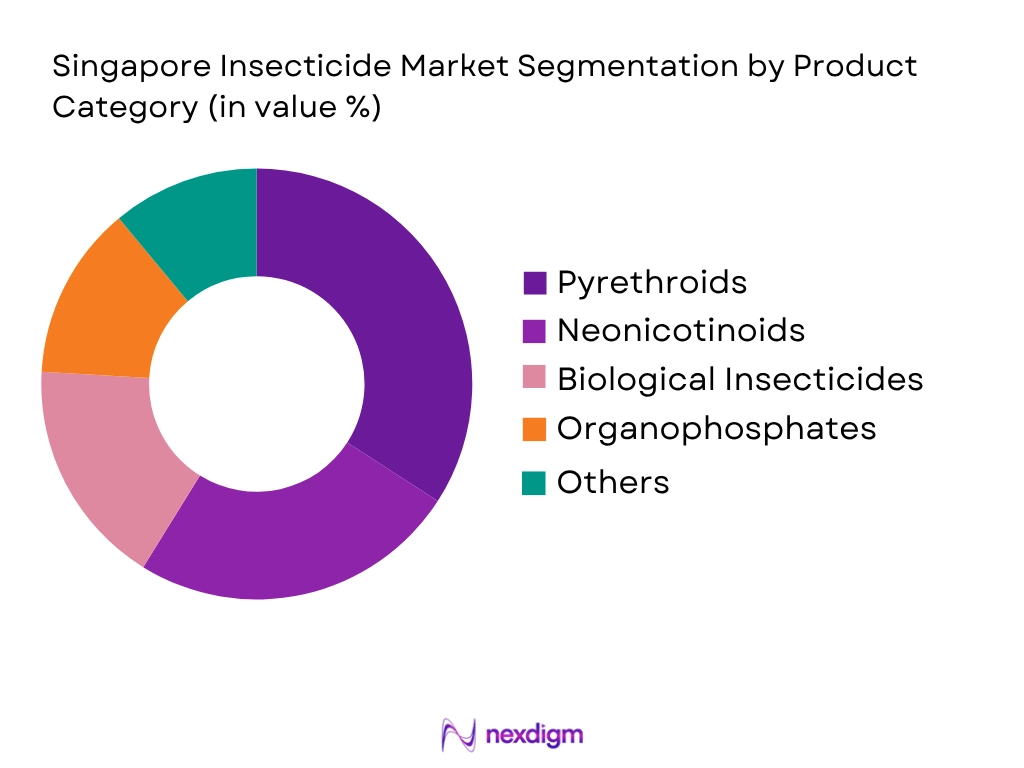
Singapore Insecticide Market is segmented by product type into Pyrethroids, Neonicotinoids, Biological Insecticides, Organophosphates, Carbamates, and Others. Recently, Pyrethroids have held the dominant market share due to their extensive usage in urban pest control, mosquito management programs, greenhouse farming, and public health applications. Singapore’s tropical climate creates favorable conditions for mosquito breeding, leading to continuous demand for pyrethroid-based products in vector control programs. Their effectiveness against a broad range of insects, lower application rates, and relatively favorable safety profile compared with older chemistries contribute to their dominance. Major pest management operators and government-led vector control initiatives frequently utilize pyrethroid formulations for residential, commercial, and industrial applications. Furthermore, increasing urban farming projects and protected cultivation facilities also favor pyrethroid products because of their quick knockdown effect and compatibility with integrated pest management programs.
By Application
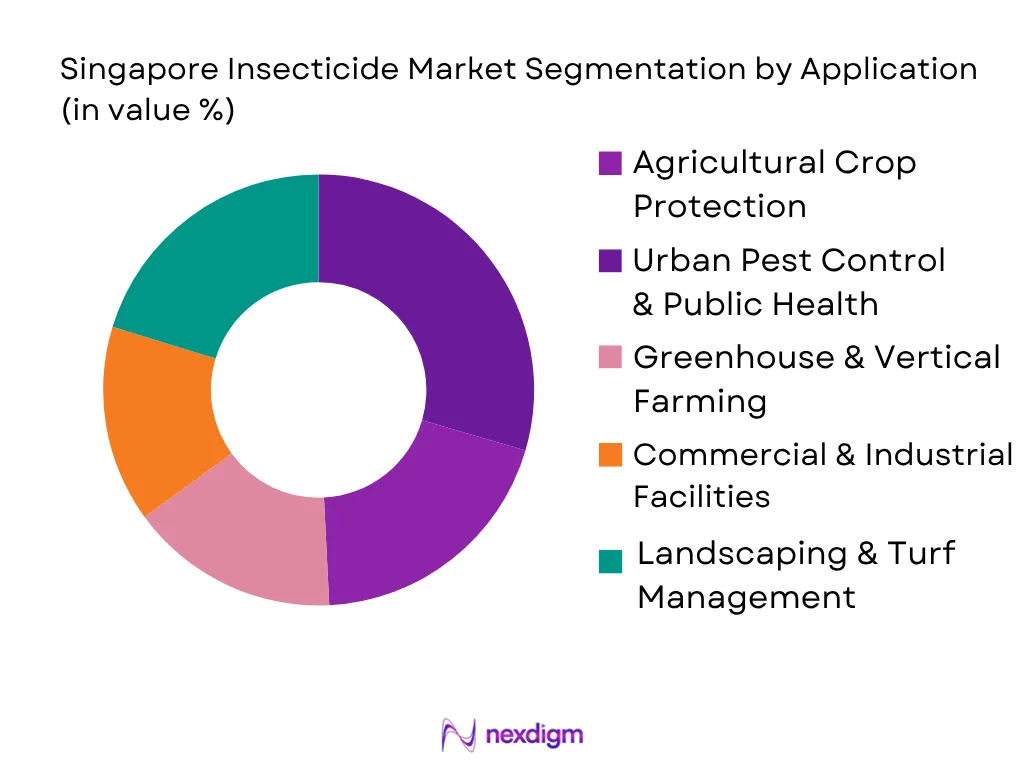
Singapore Insecticide Market is segmented by application into Urban Pest Control & Public Health, Agricultural Crop Protection, Greenhouse & Vertical Farming, Commercial & Industrial Facilities, and Landscaping & Turf Management. Urban Pest Control & Public Health represents the dominant segment due to Singapore’s dense population, tropical weather conditions, and extensive government-led mosquito management initiatives. The country experiences year-round challenges from mosquitoes, flies, cockroaches, termites, and other pests, driving substantial insecticide usage across residential, commercial, and municipal environments. The National Environment Agency maintains rigorous vector control programs to combat dengue and other mosquito-borne diseases. Additionally, Singapore’s extensive commercial infrastructure, including hotels, shopping centers, food processing facilities, and logistics hubs, requires continuous pest management services. The combination of public health priorities and strict hygiene standards supports sustained demand for insecticide products in non-agricultural applications.
Competitive Landscape
The Singapore insecticide market is characterized by the presence of multinational agrochemical manufacturers and specialized pest control solution providers. Competition is driven by product innovation, biological insecticide development, regulatory compliance capabilities, and partnerships with urban farming operators and pest management companies. Major global firms leverage Singapore as a regional headquarters and distribution hub for Southeast Asia operations.
| Company | Establishment Year | Headquarters | Product Portfolio | Biological Products | Key Active Ingredients | Regional Distribution Network | Urban Farming Solutions | Regulatory Strength |
| Bayer Crop Science | 1863 | ~ | ~ | ~ | ~ | ~ | ~ | ~ |
| Syngenta | 2000 | ~ | ~ | ~ | ~ | ~ | ~ | ~ |
| BASF | 1865 | ~ | ~ | ~ | ~ | ~ | ~ | ~ |
| FMC Corporation | 1883 | ~ | ~ | ~ | ~ | ~ | ~ | ~ |
| Corteva Agriscience | 2019 | ~ | ~ | ~ | ~ | ~ | ~ | ~ |
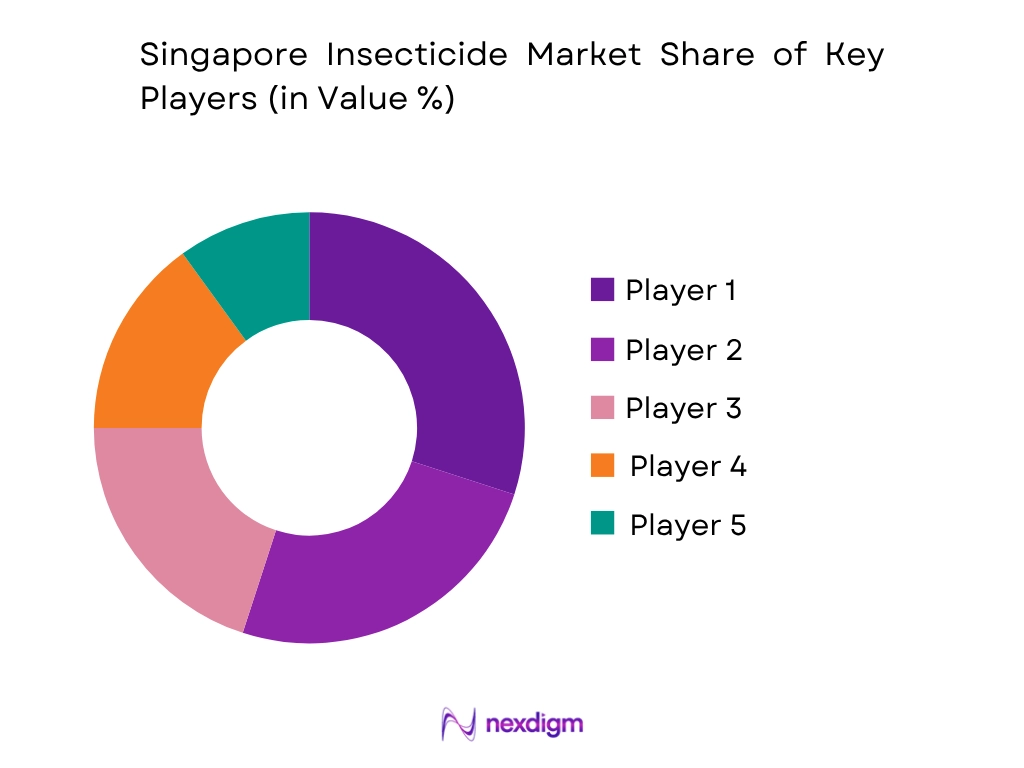
Singapore Insecticide Market Analysis
Growth Drivers
Expansion of Controlled Environment Agriculture and Urban Farming
Singapore’s insecticide market is increasingly supported by the expansion of controlled-environment agriculture, vertical farming, and food security initiatives. According to the Singapore Food Agency (SFA), Singapore operated 153 land-based farms and 72 sea-based farms, while the value of local food production reached SGD 231 million. Local egg production increased to 773 million eggs, while vegetable production reached 16,391 tonnes, highlighting ongoing agricultural activities requiring pest management solutions. Singapore continues to pursue food resilience strategies through advanced farming technologies, where insecticides remain essential for protecting high-value crops cultivated in enclosed environments. Additionally, Singapore imported agricultural products worth USD 16.6 billion, reflecting the strategic importance of safeguarding domestic and imported food supply chains from pest-related losses. The concentration of high-value vegetable, leafy green, and hydroponic cultivation systems creates demand for precision insecticide applications and integrated pest management programs. As controlled-environment farms operate under intensive production conditions, maintaining pest-free cultivation areas becomes critical for ensuring crop quality, productivity, and food safety standards.
Rising Demand for Public Health and Vector Control Programs
Public health pest management remains a significant growth driver for Singapore’s insecticide market. Singapore reported 13,655 dengue cases during the year, substantially exceeding the 9,949 cases recorded previously, demonstrating the persistent need for mosquito control programs. National Environment Agency (NEA) data also indicated weekly dengue case counts exceeding 300 cases during several periods, while active mosquito breeding sites increased across residential and commercial zones. Singapore’s tropical climate and population density create favorable conditions for Aedes mosquito proliferation throughout the year. In response, government agencies continue implementing extensive vector surveillance and control initiatives that rely heavily on insecticide applications, larvicides, and targeted pest management interventions. The country’s dense urban infrastructure, encompassing residential estates, industrial facilities, transport hubs, and commercial buildings, further increases demand for insecticide products. Growing concerns regarding mosquito-borne diseases, public hygiene, and environmental health continue to reinforce the strategic importance of insecticide deployment across both public and private sectors.
Market Challenges
Dependence on Imported Agrochemicals and Supply Chain Vulnerability
Singapore’s insecticide market faces structural challenges due to its dependence on imported agrochemicals and limited domestic production capabilities. Approximately 90% of Singapore’s food supply originates from imports, while agricultural pesticide and insecticide products are largely sourced from international manufacturers. Singapore maintains import relationships with 187 countries and regions, reflecting the complexity of its supply network. Any disruption in global logistics, geopolitical tensions, shipping bottlenecks, or regulatory changes can affect insecticide availability. Furthermore, import data indicate insecticide import volumes of 2.8 million kilograms previously, declining to 2.54 million kilograms subsequently, highlighting fluctuations in supply and demand dynamics. Since Singapore lacks large-scale active ingredient manufacturing facilities, distributors remain exposed to international sourcing risks. The high reliance on imported formulations creates challenges for inventory management, regulatory compliance, and supply continuity, particularly for specialized products used in greenhouse farming, urban agriculture, and vector control operations.
Limited Agricultural Land and Shrinking Traditional Farming Activity
The restricted size of Singapore’s agricultural sector limits large-scale insecticide consumption growth compared with neighboring agricultural economies. Government statistics show vegetable production declined from 24,296 tonnes to 16,391 tonnes, while seafood production fell from 5,335 tonnes to 3,533 tonnes. Singapore’s total land area dedicated to agriculture remains small, restricting expansion opportunities for broad-acre crop protection products. Several indoor farming operations have also experienced operational challenges, including closures and restructuring of certain large-scale vertical farming projects. High energy costs, land constraints, and labor expenses create barriers for agricultural expansion, reducing the overall cultivation area available for insecticide applications. While advanced farming technologies continue to emerge, the limited agricultural footprint restricts demand for conventional agricultural insecticides. Consequently, suppliers increasingly focus on specialty products, biological formulations, and urban pest management applications rather than traditional large-scale agricultural insecticide volumes.
Market Opportunities
Growth of Biological and Sustainable Insecticide Solutions
Singapore’s emphasis on food safety, environmental sustainability, and residue management creates substantial opportunities for biological insecticides and low-toxicity pest control products. The Singapore Food Agency maintains strict oversight of pesticide residues in food products, encouraging adoption of safer crop protection technologies. Controlled-environment farms producing vegetables, leafy greens, herbs, and specialty crops increasingly require pest management solutions compatible with sustainability objectives. The government has allocated significant resources to food innovation programs, including the SGD 60 million Agri-Food Cluster Transformation Fund, SGD 30 million 30×30 Express Grant, and SGD 144 million Singapore Food Story R&D Program. These initiatives support technology adoption and advanced farming systems where biological insecticides, microbial products, and integrated pest management approaches are gaining traction. As consumer demand for sustainably produced food increases, opportunities continue to emerge for manufacturers offering environmentally friendly insecticide solutions tailored to urban agriculture and greenhouse cultivation
Expansion of Smart Farming and Precision Pest Management Technologies
Singapore’s leadership in smart city development and agricultural technology creates favorable conditions for precision insecticide applications. The country continues investing heavily in automated farming systems, AI-powered crop monitoring, robotics, and sensor-driven cultivation platforms. More than 153 land-based farms increasingly utilize controlled production environments where pest monitoring systems can optimize insecticide usage. Smart agriculture technologies enable targeted applications, reducing chemical use while improving pest control effectiveness. Singapore’s focus on innovation and digital transformation encourages adoption of drone-assisted inspections, IoT-based pest detection, and predictive analytics for crop protection. Additionally, government-backed agri-tech programs support commercialization of advanced agricultural solutions. These developments create opportunities for manufacturers offering digital pest management platforms, precision application equipment, and data-driven insecticide solutions specifically designed for urban and indoor farming environments where operational efficiency and sustainability are critical priorities.
Future Outlook
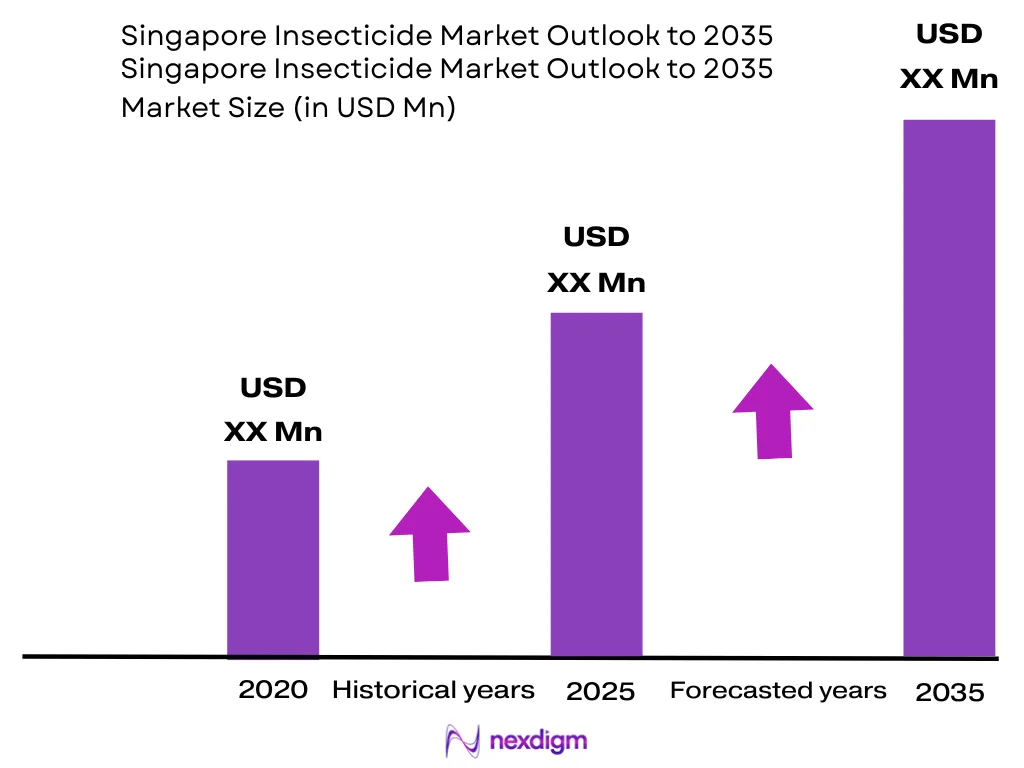
The Singapore insecticide market is expected to witness steady growth throughout the forecast period. Expansion of vertical farming, greenhouse cultivation, and controlled-environment agriculture will continue driving demand for specialized crop protection solutions. Increasing adoption of biological insecticides, precision agriculture technologies, and integrated pest management programs is expected to reshape purchasing patterns. Growing public health concerns regarding mosquito-borne diseases and stricter sustainability requirements will further encourage innovation in low-toxicity and environmentally friendly insecticide formulations. Market Size (2024): USD 15.5 Million (industry estimates derived from Singapore agricultural pesticide trade data and crop protection consumption patterns). Forecast CAGR (2026-2035): 5.5%
Major Players
- Syngenta Singapore
- Bayer Crop Science
- BASF Singapore
- FMC Corporation
- Corteva Agriscience
- UPL Limited
- Sumitomo Chemical
- Adama Agricultural Solutions
- Nufarm
- Nippon Soda
- Rentokil Initial Singapore
- Anticimex Singapore
- Ecolab Pest Elimination
- PelGar International
- Ensystex Singapore
Key Target Audience
- Agrochemical Manufacturers
- Biological Insecticide Producers
- Urban Farming Operators
- Greenhouse Farming Companies
- Pest Control Service Providers
- Food Processing and Storage Companies
- Investments and Venture Capitalist Firms
- Government and Regulatory Bodies
Research Methodology
Step 1: Identification of Key Variables
The initial stage involves mapping the entire Singapore insecticide ecosystem, including manufacturers, distributors, pest management firms, urban farming operators, and regulatory authorities. Secondary research is conducted through government databases, trade statistics, regulatory filings, and industry publications to identify key market variables affecting demand and supply.
Step 2: Market Analysis and Construction
Historical market data is compiled through trade statistics, pesticide import volumes, product registrations, and insecticide consumption patterns. Demand is assessed across agricultural, public health, industrial, and residential applications. Market sizing is developed using a combination of top-down and bottom-up analytical approaches.
Step 3: Hypothesis Validation and Expert Consultation
Preliminary market assumptions are validated through interviews with agrochemical distributors, pest control operators, greenhouse managers, regulatory experts, and industry participants. Discussions focus on market trends, product preferences, pricing dynamics, regulatory developments, and adoption of biological alternatives.
Step 4: Research Synthesis and Final Output
Final market estimates are generated by integrating primary and secondary findings. The resulting analysis evaluates market structure, competitive positioning, demand drivers, opportunities, challenges, and future growth prospects to provide a comprehensive view of the Singapore insecticide industry.

- Executive Summary
- Research Methodology (Market Definitions and Assumptions, Abbreviations, Market Sizing Framework, Bottom-Up Market Assessment, Top-Down Validation Approach, Primary Expert Interviews, Demand-Side Assessment, Supply-Side Assessment, Data Triangulation, Limitations and Future Conclusions)

- Definition and Scope
- Market Evolution and Industry Genesis
- Timeline of Major Industry Developments
- Agricultural Production Cycle and Pest Management Ecosystem
- Supply Chain Analysis

- Growth Drivers (Expansion of Urban Farming and Vertical Agriculture, Rising Mosquito and Vector Control Programs, Increasing Food Security and 30-by-30 Initiative, Growth in Commercial Pest Management Services, Rising Demand for High-Value Crop Protection Solutions)
- Market Challenges (Limited Agricultural Land Availability, Dependence on Imported Active Ingredients, Stringent Pesticide Registration and Compliance Requirements, High Operational Costs for Controlled Environment Agriculture, Pest Resistance and Environmental Concerns)
- Opportunities (Biological and Bio-Based Insecticides, Precision Agriculture and Smart Farming Technologies, Expansion of Greenhouse and Hydroponic Farming, Digital Pest Monitoring Solutions, Integrated Pest Management Programs)
- Market Trends (Transition Toward Sustainable Crop Protection Products, Increased Adoption of IoT-Based Pest Monitoring Systems, Growing Demand for Residue-Free Produce, Expansion of Drone and Automated Application Technologies, Rising Use of Combination and Target-Specific Insecticides)
- Government Regulation (National Environment Agency Pesticide Control Framework, Singapore Food Agency Food Safety Standards, Environmental Protection and Management Regulations, Hazardous Substances Control Requirements, Import and Distribution Licensing Procedures)
- SWOT Analysis
- Stakeholder Ecosystem
- Porter’s Five Forces
- Competition Ecosystem
- PESTLE Analysis

- By Value (2020-2025)
- By Volume (2020-2025)
- By Average Selling Price (2020-2025)

- By Product Category (In Value %)
Pyrethroids
Neonicotinoids
Organophosphates
Biological Insecticides
Others - By Crop Type (In Value %)
Maize Rice
Cassava
Cocoa
Vegetables & Fruits
Others - By Formulation Type (In Value %)
Liquid Concentrates
Wettable Powders
Granules
Suspension Concentrates
Emulsifiable Concentrates
Aerosols - By Application Area (In Value %)
Agricultural Crop Protection
Urban Pest Control
Public Health & Vector Control
Industrial & Commercial Facilities
Warehousing & Storage Pest Management
Landscaping & Turf Management - By End User (In Value %)
Commercial Farms
Vertical Farming Operators
Government Agencies
Pest Control Companies
Industrial Facilities
Residential Consumers

- Market Share of Major Players (Market Share by Value, Volume, Product Portfolio, Active Ingredient Portfolio, Pest Control Service Partnerships, Distribution Reach, Urban Farming Presence, Regulatory Registrations)
- Cross Comparison Parameters (Product Portfolio Strength, Registered Active Ingredients, Biological Insecticide Portfolio, Urban Farming Solutions, Distribution Network Reach, Pest Management Service Partnerships, Regulatory Compliance Portfolio, Innovation and Smart Pest Control Technologies)
- SWOT Analysis of Major Players
- Pricing Analysis Basis SKUs (Imidacloprid, Thiamethoxam, Lambda-Cyhalothrin, Deltamethrin, Bifenthrin, Abamectin, Spinosad, Emamectin Benzoate, Cypermethrin, Biological Insecticide Formulations)
- Detailed Profiles of Major Companies
Syngenta Singapore
Bayer Crop Science
BASF Singapore
FMC Corporation
Corteva Agriscience
UPL Limited
Sumitomo Chemical
Adama Agricultural Solutions
Nufarm
Nippon Soda
Rentokil Initial Singapore
Anticimex Singapore
Ecolab Pest Elimination
PelGar International
Ensystex Singapore

- Crop Protection Demand Assessment
- Pest Control Service Demand Analysis
- Purchasing Power and Agrochemical Spending Patterns
- Insecticide Utilization Rates
- Urban Farming and Vertical Farming Requirements
- Farmer and Commercial Operator Pain Points
- Decision-Making Framework for Product Selection
- Brand Awareness and Product Preference Assessment
- Insecticide Application Practices

- By Market Value (2026-2035)
- By Volume (2026-2035)
- By Average Selling Price (2026-2035)


 Request a Sample
 Ask for Customization
 Get a Quote
 Enquire Now