
 Download PDF
Market Overview
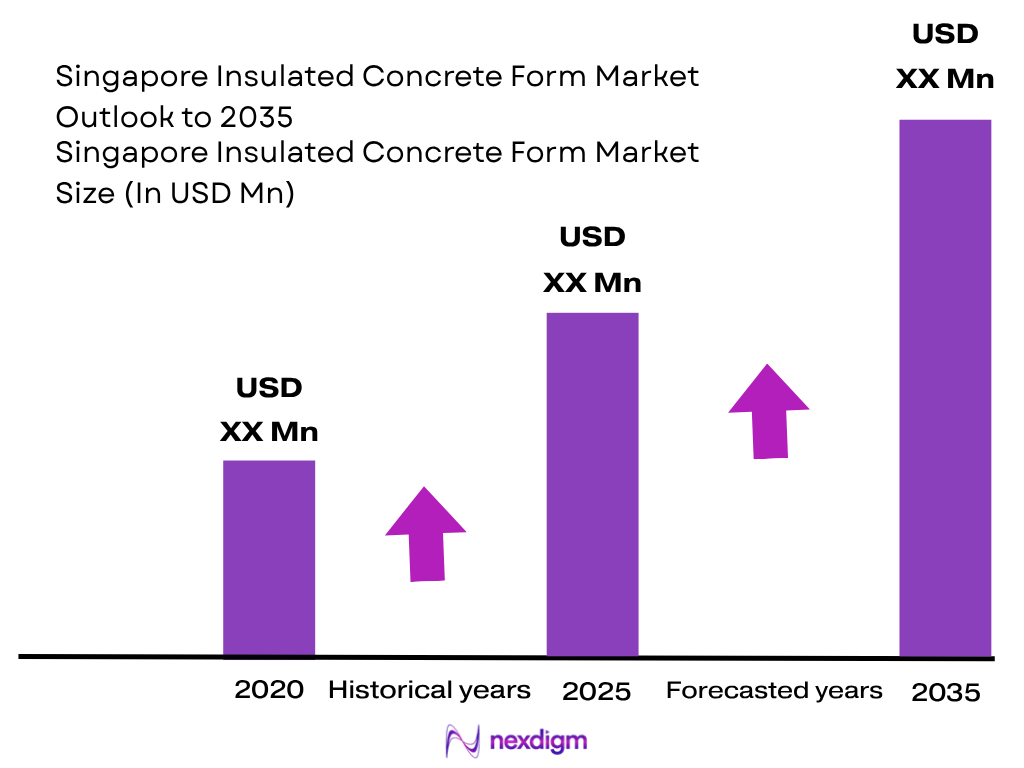
The Singapore Insulated Concrete Form Market is valued at approximately USD ~XX million, based on the report’s historical assessment. Demand is supported by the broader construction pipeline, building-envelope efficiency requirements and interest in productivity-enhancing construction systems. Singapore’s construction demand increased from S$33.8 billion to S$44.2 billion, while construction output reached S$38.4 billion. Private residential completions also reached approximately 10,600 units, creating an active addressable construction base for insulated reinforced-concrete wall systems.
Central Singapore, the Rest of Central Region and major suburban growth corridors dominate addressable demand because they concentrate private residential redevelopment, institutional construction and new housing supply. The Government Land Sales programme introduced 11,110 private residential units, including 5,450 units on the first-half Confirmed List and 5,050 units on the second-half Confirmed List. Locations such as Tengah, Bayshore and Dairy Farm support future building activity, while central districts remain important for redevelopment and premium residential construction.
Market Segmentation
By ICF System Type
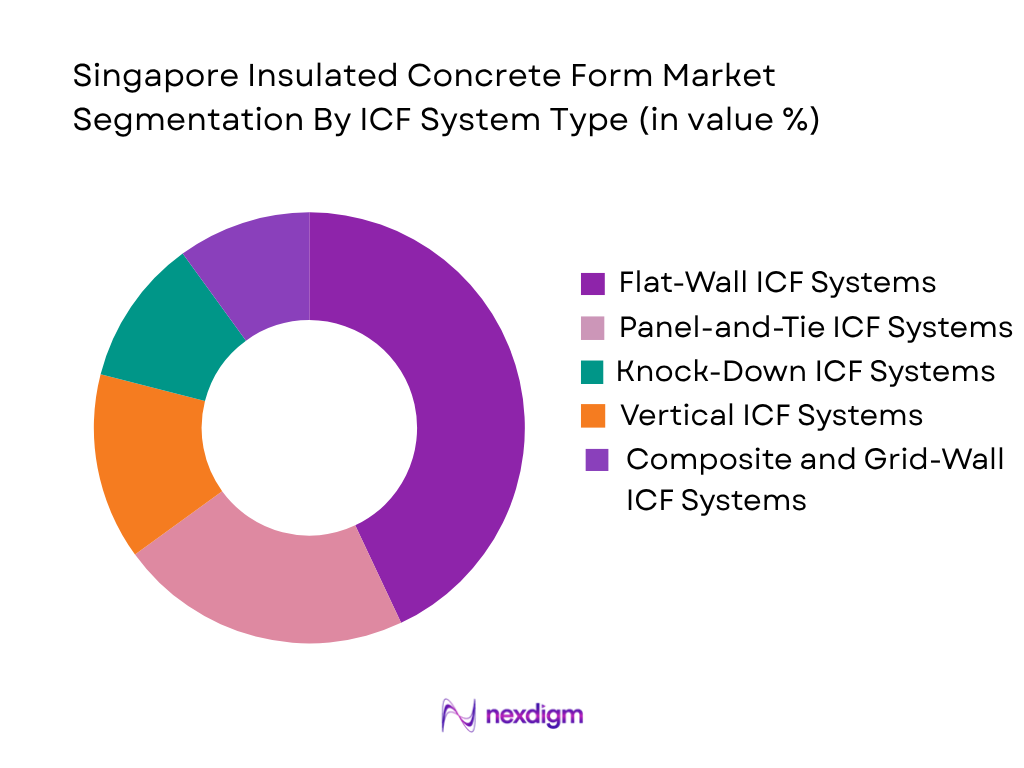
The Singapore Insulated Concrete Form Market is segmented into flat-wall ICF systems, panel-and-tie systems, knock-down systems, vertical ICF systems and composite or grid-wall systems. Flat-wall ICF is considered the dominant sub-segment in the report model because Singapore’s construction industry is strongly oriented toward reinforced-concrete structural systems, making monolithic concrete walls enclosed by permanent insulation comparatively straightforward to integrate from an engineering perspective. Flat-wall systems also provide continuous insulation, defined concrete core dimensions and relatively simple reinforcement layouts. These attributes are useful in landed housing, basements, institutional buildings and selected low- to medium-rise applications. Singapore’s construction demand reached S$44.2 billion, including S$7.9 billion of public residential and S$7.2 billion of private residential construction demand, providing an extensive potential application base. However, ICF competes with PPVC, advanced precast concrete systems and conventional cast-in-place formwork, so its strongest positioning is likely in projects where envelope performance, structural continuity and specialized wall geometries matter more than high-volume modular repetition.
By End-Use Construction
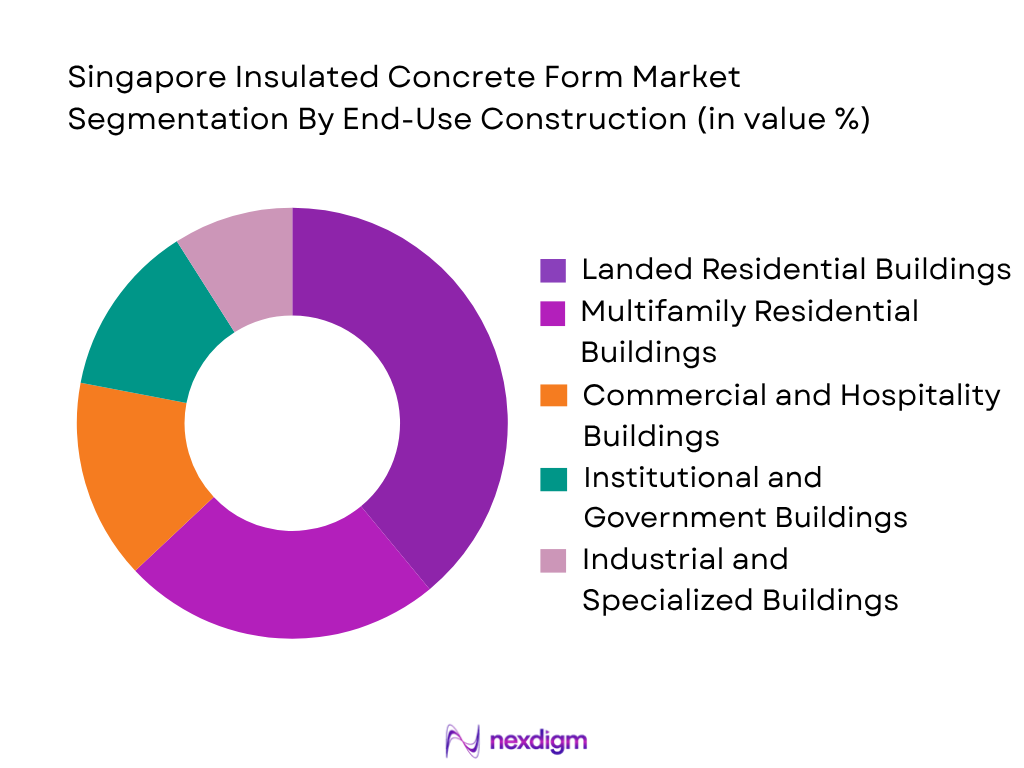
The Singapore Insulated Concrete Form Market is segmented into landed residential, multifamily residential, commercial and hospitality, institutional and government, and industrial or specialized building applications. Landed residential construction is considered the leading ICF sub-segment in the report model because detached, semi-detached and terrace properties offer greater flexibility for adopting alternative wall systems than standardized high-rise developments dominated by precast and PPVC construction. ICF can combine structural reinforced concrete and permanent insulation within one wall assembly, making it relevant for rebuilding projects, premium houses, basement walls and thermally efficient low-rise properties. Singapore’s private residential market completed approximately 10,600 units, while developers launched 6,647 uncompleted private residential units and sold 6,469 units. The Government Land Sales programme also provided 11,110 potential private residential units, the highest annual supply since 2013. This active residential pipeline supports opportunities for differentiated construction systems, although adoption remains narrower than conventional reinforced-concrete and precast methods.
Competitive Landscape
The Singapore Insulated Concrete Form Market is structurally import-led and technology-driven rather than characterized by a large domestic base of dedicated ICF manufacturers. International ICF brands therefore form the primary product and technology benchmark, while local construction companies, EPS processors, ready-mix concrete suppliers and specialist contractors influence specification and execution. Nudura, Fox Blocks, BuildBlock, SuperForm and TF Forming Systems represent major international ICF technology references offering different combinations of EPS forms, reinforced-concrete cores, installation support, BIM resources and contractor training. Nudura has operated since 2001, Fox Blocks has manufactured ICF products since 2005, BuildBlock was formed in 2004, SuperForm was established in 1998, and TF Forming Systems traces its operations to 1994.
| Major Player | Establishment Year | Headquarters | ICF Architecture | Concrete Core Capability | Insulation Configuration | Manufacturing Footprint | Technical Support | Key Application Coverage |
| Nudura | 2001 | Beachwood, Ohio, USA | ~ | ~ | ~ | ~ | ~ | ~ |
| Fox Blocks | 2005 | Omaha, Nebraska, USA | ~ | ~ | ~ | ~ | ~ | ~ |
| BuildBlock Building Systems | 2004 | Oklahoma City, Oklahoma, USA | ~ | ~ | ~ | ~ | ~ | ~ |
| SuperForm Products | 1998 | Pincher Creek, Alberta, Canada | ~ | ~ | ~ | ~ | ~ | ~ |
| TF Forming Systems | 1994 | Oneida/Green Bay, Wisconsin, USA | ~ | ~ | ~ | ~ | ~ | ~ |
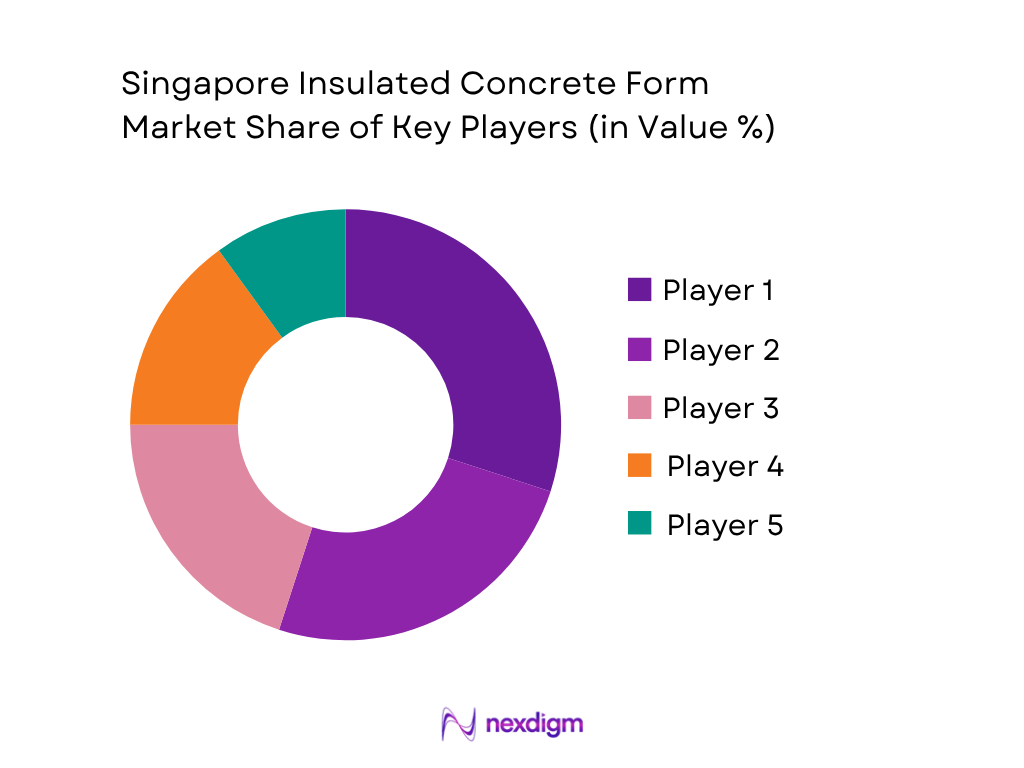
Singapore Insulated Concrete Form Market Analysis
Growth Drivers
Expanding Residential and Institutional Construction Pipeline Supports ICF Addressable Demand
Singapore’s continuing residential and institutional construction pipeline provides a strong demand foundation for insulated concrete form systems, particularly for landed housing, basements, specialized buildings and reinforced-concrete structures requiring permanent insulation. Building and Construction Authority data show that total construction demand reached S$44.2 billion in 2024, compared with S$33.8 billion in 2023, with the increase supported by public institutional developments and public and private housing projects. Housing and Development Board activity further illustrates the construction pipeline, with 21,225 new flats launched in 2024, comprising 19,637 Build-To-Order flats and 1,588 Sale of Balance Flats. Private-sector activity remained substantial, as the Urban Redevelopment Authority recorded 10,617 completed private residential units, 6,647 newly launched units, and 6,469 developer sales during 2024. This construction base creates application opportunities for ICF systems combining reinforced-concrete structural walls with permanent EPS insulation, particularly in projects emphasizing durability and envelope performance. At the macroeconomic level, World Bank data place Singapore’s 2024 GDP at USD 547.39 billion and GDP per capita at USD 90,674.1, indicating substantial economic capacity to support advanced building technologies and higher-performance construction specifications.
Building Productivity and High-Performance Construction Requirements Strengthen ICF Relevance
Singapore’s emphasis on construction productivity, industrialized building methods and high-performance structures creates a market-specific driver for ICF technologies capable of integrating permanent formwork, reinforced concrete and insulation within a single wall assembly. The Building and Construction Authority recorded S$44.2 billion of construction demand in 2024, significantly above the S$33.8 billion recorded in 2023, demonstrating a large project base within which contractors are continuously evaluating construction methods that improve execution efficiency. The government’s Productivity Gateway Framework was enhanced in 2024 to strengthen early productivity planning, standardization, automation and efficient construction technology adoption across public-sector projects. Residential construction also remained active: HDB launched 19,637 BTO flats during 2024, while URA recorded 10,617 private residential completions. For ICF suppliers, these conditions create opportunities to position stay-in-place forms as an integrated wall solution that eliminates repeated conventional wall-form stripping while embedding insulation directly around structural concrete. The approach is particularly applicable to landed residences, basements, retaining walls and specialized institutional structures where full volumetric prefabrication may be less practical. World Bank data show Singapore generated USD 547.39 billion in GDP during 2024, reinforcing the economic capacity for investment in advanced, engineered construction systems.
Market Challenges
Strong PPVC and Advanced Precast Ecosystem Restricts Mainstream ICF Penetration
A major challenge for the Singapore Insulated Concrete Form Market is the entrenched position of Prefabricated Prefinished Volumetric Construction, Advanced Precast Concrete Systems and other Design for Manufacturing and Assembly technologies within mainstream development. The Building and Construction Authority formally promotes PPVC, APCS, structural steel and prefabricated MEP solutions as productivity-enhancing construction methods, while the Productivity Gateway Framework was further enhanced in 2024 to encourage standardization and advanced construction technologies across government projects. This policy environment matters because Singapore recorded S$44.2 billion in construction demand during 2024, with public institutional and housing projects being major contributors, meaning a substantial proportion of addressable building activity already operates within procurement structures oriented toward established DfMA technologies. HDB also launched 19,637 BTO flats across the year, a segment where industrialized precast solutions possess mature engineering, fabrication and contractor ecosystems. ICF must therefore demonstrate a distinct technical fit rather than competing directly with volumetric systems on every project. Its strongest prospects remain landed housing, foundations, basements and irregular structural walls. Singapore’s 2024 GDP of USD 547.39 billion and GDP per capita of USD 90,674.1 support sophisticated construction, but also enable continued investment in competing automation-intensive construction technologies.
Limited Local ICF Supply and Specialized Installation Ecosystem Creates Adoption Barriers
The Singapore Insulated Concrete Form Market faces a structural challenge from the comparatively limited domestic ecosystem dedicated specifically to ICF block manufacturing, engineering and specialist installation. Singapore’s construction sector is highly developed, but its industrialization strategy has largely concentrated on precast, PPVC, prefabricated reinforcement and other DfMA technologies rather than a broad locally manufactured ICF platform. This creates additional requirements for imported systems, Singapore-specific engineering documentation, fire compliance, reinforcement detailing, installer training and integration with locally supplied concrete. The scale of competing conventional activity is considerable: BCA recorded S$44.2 billion in construction demand during 2024, while URA reported 10,617 private residential units completed, 6,647 units launched by developers, and 14,053 private residential resale transactions. HDB separately launched 21,225 new flats, illustrating how large-scale housing construction is already served through established contractor and prefabrication networks. Consequently, ICF suppliers need sufficient local installation expertise to capture even specialized portions of this pipeline. World Bank indicators show Singapore’s GDP reached USD 547.39 billion and GDP per capita reached USD 90,674.1 in 2024, highlighting a sophisticated high-value economy where new building technologies must meet demanding productivity, quality and compliance expectations before widespread specification.
Market Opportunities
Landed Housing and Private Residential Redevelopment Offer Targeted ICF Expansion Potential
Landed housing and specialized private residential redevelopment represent an important future expansion opportunity for the Singapore Insulated Concrete Form Market because such developments provide greater construction-system flexibility than repetitive high-rise projects designed around PPVC or precast modules. Urban Redevelopment Authority data show 10,617 private residential units were completed in 2024, while developers launched 6,647 units and sold 6,469 units during the same period. Singapore also recorded 14,053 private residential resale transactions, up from 11,329 transactions in 2023, indicating substantial movement within the existing residential stock and supporting longer-term redevelopment and rebuilding activity. Separately, the Government Land Sales programme introduced sites capable of supplying 11,110 private residential units during 2024, including 5,450 units through the first-half Confirmed List and 5,050 units through the second-half Confirmed List. For ICF suppliers, customized landed residences, basement extensions and rebuilding projects provide suitable applications for monolithic reinforced-concrete walls with integrated permanent insulation and flexible geometry. Singapore’s strong macroeconomic position further supports premium construction investment, with World Bank data reporting 2024 GDP of USD 547.39 billion and GDP per capita of USD 90,674.1. These current indicators establish a sizeable construction base for targeted future ICF penetration.
Localized ICF Engineering and Hybrid Construction Solutions Create Future Market White Space
Localization of ICF engineering, installation and integration with Singapore’s existing prefabrication ecosystem creates a significant opportunity for future market development. Rather than positioning ICF as a replacement for all established construction technologies, suppliers can develop hybrid approaches combining insulated concrete walls with prefabricated floors, reinforcement, façade systems and low-carbon ready-mix concrete. This strategy aligns with Singapore’s construction environment, where the Building and Construction Authority enhanced the Productivity Gateway Framework in 2024 to encourage efficient construction technologies, standardized components, robotics and improved project planning. The addressable construction base is substantial: Singapore recorded S$44.2 billion in construction demand during 2024, while HDB launched 21,225 new flats, and the private market completed 10,617 residential units. Government Land Sales sites introduced capacity for another 11,110 private residential units during the year, distributed across multiple locations, creating opportunities for suppliers capable of providing locally compliant building systems. ICF providers can therefore build future demand through Singapore-specific structural details, BIM libraries, installer certification and partnerships with concrete and EPS processors. World Bank data show the economy generated USD 547.39 billion in GDP in 2024, with GDP per capita of USD 90,674.1, supporting investment in technically differentiated building solutions with strong productivity and lifecycle-performance credentials.
Future Outlook
The Singapore Insulated Concrete Form Market is expected to expand at approximately ~XX.X% CAGR during 2026-2035, supported by continued building activity, stricter sustainability requirements, high-performance envelope design and pressure to improve construction productivity. Growth is expected to remain selective rather than broad-based because Singapore has already developed a sophisticated ecosystem around PPVC, advanced precast concrete systems, system formwork and prefabricated reinforcement.
The strongest opportunities are likely to emerge in landed residential rebuilding, specialized institutional structures, basements, retaining walls and projects where continuous insulation and structural concrete need to be integrated into one assembly. Singapore’s construction demand reached S$44.2 billion, while BCA expects average annual construction demand of S$39 billion to S$46 billion between 2026 and 2029. This provides a substantial future project pipeline into which alternative wall technologies can be introduced.
Major Players
- Nudura
- Amvic Building System
- Fox Blocks
- BuildBlock Building Systems
- Quad-Lock Building Systems
- SuperForm Products
- LiteForm Technologies
- IntegraSpec
- RASTRA
- Faswall
- Polycrete International
- TF Forming Systems
- Stronghold ICF
- Element ICF / Logix Brands
- EGDC Advanced Building Systems
Key Target Audience
- Insulated Concrete Form Manufacturers and System Suppliers
- EPS and Building Insulation Manufacturers
- Real Estate Developers and Landed Residential Developers
- Main Contractors and Specialist Concrete Contractors
- Ready-Mix Concrete and Reinforcement Suppliers
- Investments and Venture Capitalist Firms
- Government and Regulatory Bodies (Building and Construction Authority, Urban Redevelopment Authority, Housing & Development Board, Singapore Civil Defence Force)
- Architects, Structural Engineering Firms and Building-Envelope Design Companies
Research Methodology
Step 1: Identification of Key Variables
The initial phase involves constructing an ecosystem map of the Singapore Insulated Concrete Form Market covering international ICF manufacturers, importers, EPS suppliers, ready-mix concrete producers, contractors, developers, architects and regulatory bodies. Secondary and proprietary sources are assessed to identify critical variables including installed wall area, ICF consumption, construction demand, imported-system dependency, end-use applications, building-envelope requirements and technology substitution from PPVC and precast systems.
Step 2: Market Analysis and Construction
Historical market analysis combines Singapore construction demand, residential development activity, building completions, land supply and material consumption with company-level product and distribution information. A top-down construction-sector assessment is reconciled with bottom-up supplier and project analysis. Particular attention is given to landed housing, institutional buildings, commercial structures, basements and other applications where ICF systems have a realistic technical fit.
Step 3: Hypothesis Validation and Expert Consultation
Market hypotheses are validated through computer-assisted telephone interviews with ICF technology suppliers, concrete producers, EPS processors, main contractors, structural engineers, developers and building-envelope specialists. Discussions focus on system specification, concrete core dimensions, installation productivity, product availability, regulatory acceptance and competing construction systems. Expert inputs are used to refine estimated adoption rates, application segmentation and competitive positioning.
Step 4: Research Synthesis and Final Output
The final stage integrates supplier-side, project-side and regulatory findings into a consolidated Singapore Insulated Concrete Form Market model. Bottom-up company assessments are reconciled with construction-sector indicators and building pipeline data to reduce double counting. The resulting framework supports market sizing, segmentation, competitive benchmarking and forecasting while identifying realistic opportunities for ICF adoption within Singapore’s highly industrialized construction environment.

- Executive Summary
- Research Methodology (Market Definition and Scope, Singapore Insulated Concrete Form Market Classification, EPS and Composite ICF Demand Assessment, Insulated Concrete Form Consumption Mapping, Domestic Manufacturing Capacity Assessment, Import Dependency Analysis, EPS Resin and Form Feedstock Assessment, ICF Moulding and Assembly Technology Mapping, Application-Level Demand Assessment, End-Use Construction Demand Mapping, Primary Industry Interviews, Top-Down Market Sizing, Bottom-Up Company Revenue and Installation Volume Assessment, Trade Flow Analysis, Data Triangulation, Pricing Assessment, Forecasting Framework)

- Definition and Scope
- Singapore Insulated Concrete Form Industry Evolution and Development of EPS Stay-in-Place Formwork, Reinforced Concrete Wall Systems and High-Performance Building Envelope Ecosystem
- ICF Block, Panel, EPS Moulding, Reinforcement, Ready-Mix Concrete, Bracing and Installation Industry Structure
- Singapore Insulated Concrete Form Value Chain Analysis
- Singapore Insulated Concrete Form Supply Chain Analysis
- EPS Raw Material Supplier, ICF System Manufacturer, Importer, Distributor, Ready-Mix Concrete Producer, Reinforcement Supplier, Specialist Installer, Main Contractor, Developer and End-User Ecosystem Analysis
- ICF Construction Integration Across Landed Residential, Multifamily Residential, Commercial, Institutional, Basement, Retaining Wall and High-Performance Building Applications

- Growth Drivers (Green Mark Building Adoption, Building Envelope Thermal Performance Requirements, Growing Need for Cooling Load Reduction, Construction Productivity Improvement, Landed Residential Redevelopment, High-Performance Building Demand, Sustainable Construction Requirements, Reinforced Concrete Construction Familiarity, Demand for Integrated Structure and Insulation Systems)
- Market Challenges (Dependence on Imported ICF Systems, Limited Domestic ICF Manufacturing Capacity, Small Landed Residential Addressable Base, Strong PPVC and APCS Adoption, Limited Specialized ICF Installer Network, Product Qualification Requirements, Fire Performance Compliance, Structural Design Adaptation, Contractor Familiarity with Precast Systems, High-Rise Construction Preference)
- Market Opportunities (High-Performance Landed Housing, Green Mark Residential Projects, Institutional Building Applications, Basement Construction, Commercial High-Performance Buildings, ICF-Prefabrication Hybrid Systems, Local EPS Form Moulding, Installer Certification, Building Innovation Panel Technology Evaluation, Low-Carbon Concrete Integration, Regional Southeast Asia Distribution)
- Market Trends (Continuous EPS Insulation, Reversible ICF Forms, Knock-Down ICF Systems, Higher Thermal Resistance Forms, Integrated Rebar Holders, BIM-Based ICF Design, Low-Carbon Concrete Compatibility, Stay-in-Place Formwork, Monolithic Reinforced Concrete Walls, Digital Quantity Take-Off, Prefabricated Reinforcement Integration)
- Regulatory and Standards Landscape (Building Control Act, Building Control Regulations, BCA Buildability Framework, Code of Practice on Buildability, Green Mark Requirements, Environmental Sustainability Regulations, Residential Envelope Transmittance Value Requirements, Envelope Thermal Transfer Value Requirements, Fire Code Requirements, Structural Concrete Standards, Product Acceptance and Building Innovation Panel Requirements)
- SWOT Analysis
- Porter’s Five Forces Analysis
- PESTLE Analysis
- Stakeholder Ecosystem
- Competition Ecosystem

- By Market Value (2020-2025)
- By ICF Form Consumption Volume (2020-2025)
- By Installed ICF Wall Area (2020-2025)
- By Domestic ICF Form Production Volume (2020-2025)
- By Imported ICF Form Value (2020-2025)
- By Imported ICF Form Volume (2020-2025)
- By EPS Consumption in ICF Applications (2020-2025)
- By Average Selling Price (2020-2025)

- By ICF System Type (In Value %)
Flat-Wall ICF Systems
Panel-and-Tie ICF Systems
Knock-Down ICF Systems
Post-and-Beam ICF Systems
Grid-Wall ICF Systems
Screen-Grid ICF Systems
Vertical ICF Systems
Composite ICF Systems - By Insulating Form Material (In Value %)
Expanded Polystyrene ICF
Graphite-Enhanced Expanded Polystyrene ICF
Polyurethane-Based ICF
Cement-Bonded EPS Composite ICF
Cement-Bonded Fibre ICF
Recycled EPS Composite ICF
Hybrid Insulated Concrete Forms
Other Stay-in-Place Insulated Form Systems - By Application Type (In Value %)
External Load-Bearing Walls
External Non-Load-Bearing Walls
Internal Structural Walls
Basement Walls
Foundation Walls
Retaining Walls
Lift and Service Structures
Swimming Pools and Water Features
Insulated Concrete Floor and Roof Systems
Specialized High-Performance Structures - By End-Use Construction (In Value %)
Landed Residential Buildings
Terrace and Semi-Detached Housing
Private Multifamily Residential Buildings
Commercial and Office Buildings
Hotels and Hospitality Developments
Healthcare Facilities
Schools and Educational Buildings
Government and Institutional Buildings
Industrial and Specialized Buildings
Data Centre Ancillary Structures - By Building Performance Requirement (In Value %)
High Thermal-Performance Buildings
Cooling-Energy-Efficient Buildings
Low-Air-Infiltration Building Envelopes
High Acoustic-Insulation Buildings
Fire-Resistant Buildings
High Structural-Strength Buildings
Moisture-Resistant Structures
Green Mark-Oriented Buildings
Low-Embodied-Carbon Building Applications

- Market Share of Major Players (By Singapore Revenue, ICF Form Sales Volume, Installed ICF Wall Area, ICF System Portfolio, End-Use Application, Product Technology, Singapore Import and Distribution Footprint, Technical Support Capability)
- Cross Comparison Parameters (Singapore ICF Revenue, ICF Block and Panel System Portfolio Breadth, Available Concrete Core Thickness Range, EPS Thermal Resistance and RETV-ETTV Compatibility, Singapore Import-Distribution and Product Availability Footprint, Landed Residential-Commercial-Institutional Application Coverage, Installer and Contractor Technical Support Capability, Structural Design-BIM and Training Capability)
- SWOT Analysis of Major Players
- Competitive Positioning Matrix
- ICF System Architecture and Product Portfolio Benchmarking
- Pricing and ICF Product Category Benchmarking
- Concrete Core, Reinforcement and Thermal Performance Assessment
- Manufacturing, EPS Moulding and ICF Installation Technology Assessment
- End-Use Construction and Customer Application Exposure Assessment
- Imported ICF System Versus Local Manufacturing Positioning
- Detailed Profiles of Major Companies
Nudura
Amvic Building System
Fox Blocks
BuildBlock Building Systems
Quad-Lock Building Systems
SuperForm Products
LiteForm Technologies
IntegraSpec
RASTRA
Faswall
Polycrete International
TF Forming Systems
Stronghold ICF
Element ICF / Logix Brands
EGDC Advanced Building Systems

- Landed Residential Developer ICF Adoption Assessment
- Private Homeowner High-Performance Wall Requirement Analysis
- Multifamily Residential Developer Construction Method Assessment
- Commercial Developer Building Envelope Requirement Analysis
- Institutional Developer ICF Requirement Assessment
- Main Contractor ICF Construction Capability Assessment
- Architect ICF Specification Assessment
- Structural Engineer Concrete Core Design Assessment
- Building Envelope Specialist Thermal Performance Assessment
- Specialist ICF Contractor Installation Capability Assessment

- By Market Value (2026-2035)
- By ICF Form Consumption Volume (2026-2035)
- By Installed ICF Wall Area (2026-2035)
- By Domestic ICF Form Production Volume (2026-2035)
- By Imported ICF Form Value (2026-2035)
- By Imported ICF Form Volume (2026-2035)
- By EPS Consumption in ICF Applications (2026-2035)
- By Average Selling Price (2026-2035)


 Request a Sample
 Ask for Customization
 Get a Quote
 Enquire Now