

 Download PDF
Market Overview
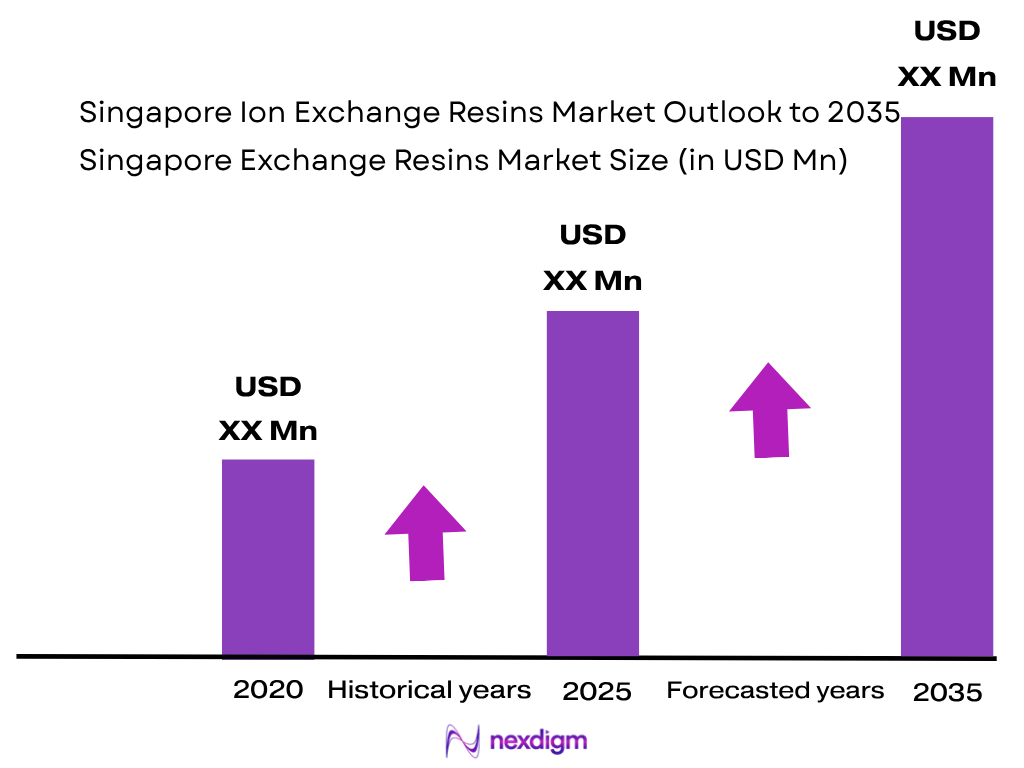
The Singapore Ion Exchange Resins Market is valued at approximately USD ~XX million, compared with USD ~XX million in the preceding period, based on the historical market assessment. Demand is supported by semiconductor fabrication, electronics manufacturing, pharmaceutical production, petrochemicals, industrial water recycling and ultrapure-water systems. Singapore manufactures roughly 1 in 10 chips globally, while its semiconductor sector employs more than 35,000 people, creating a concentrated requirement for high-purity cation, anion and mixed-bed resins.
Jurong Island, Tuas, Pasir Ris-Tampines and Woodlands constitute Singapore’s principal demand centres for ion exchange resins because they concentrate petrochemical processing, biomedical manufacturing, semiconductor fabrication and advanced industrial operations. Singapore operates 4 wafer fabrication parks housing 14 global semiconductor companies, while NEWater is supplied to more than 850 non-domestic customers, including wafer fabrication plants, petrochemical refineries and power stations. These industrial clusters therefore generate recurring demand for demineralization, ultrapure-water polishing, condensate treatment and resin replacement.
Market Segmentation
By Resin Type
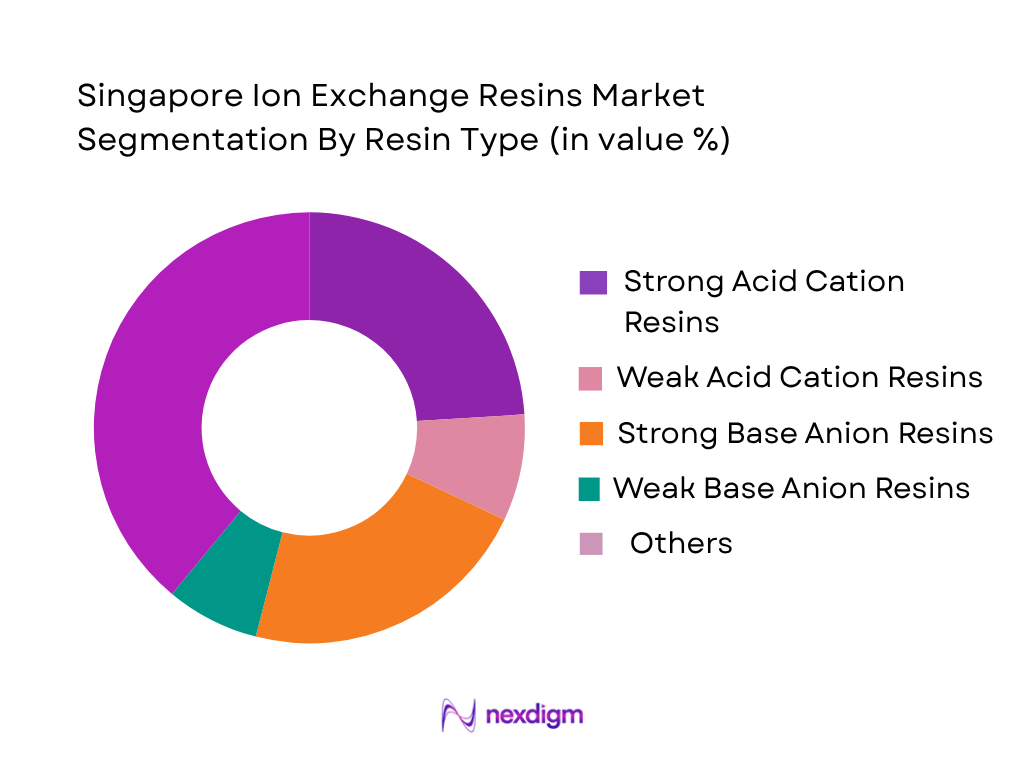
The Singapore Ion Exchange Resins Market is segmented by resin type into Strong Acid Cation Resins, Weak Acid Cation Resins, Strong Base Anion Resins, Weak Base Anion Resins, Mixed Bed Resins, Chelating Resins and Specialty/Selective Resins. Recently, mixed-bed and high-purity ion exchange resins have emerged as a dominant value-generating category because Singapore has an unusually high concentration of semiconductor wafer fabrication and advanced electronics manufacturing facilities. Semiconductor production requires ultrapure water with extremely low ionic and organic contamination, making final polishing systems critical. Purolite specifies ultrapure-water mixed-bed systems capable of achieving resistivity exceeding 18.2 MΩ·cm, while specialized grades are designed to maintain very low total organic carbon. Singapore’s extensive use of NEWater by wafer fabrication plants further supports downstream polishing requirements. Consequently, semiconductor-qualified mixed-bed resin demand attracts higher value realization than conventional commodity water-softening grades.
By Application
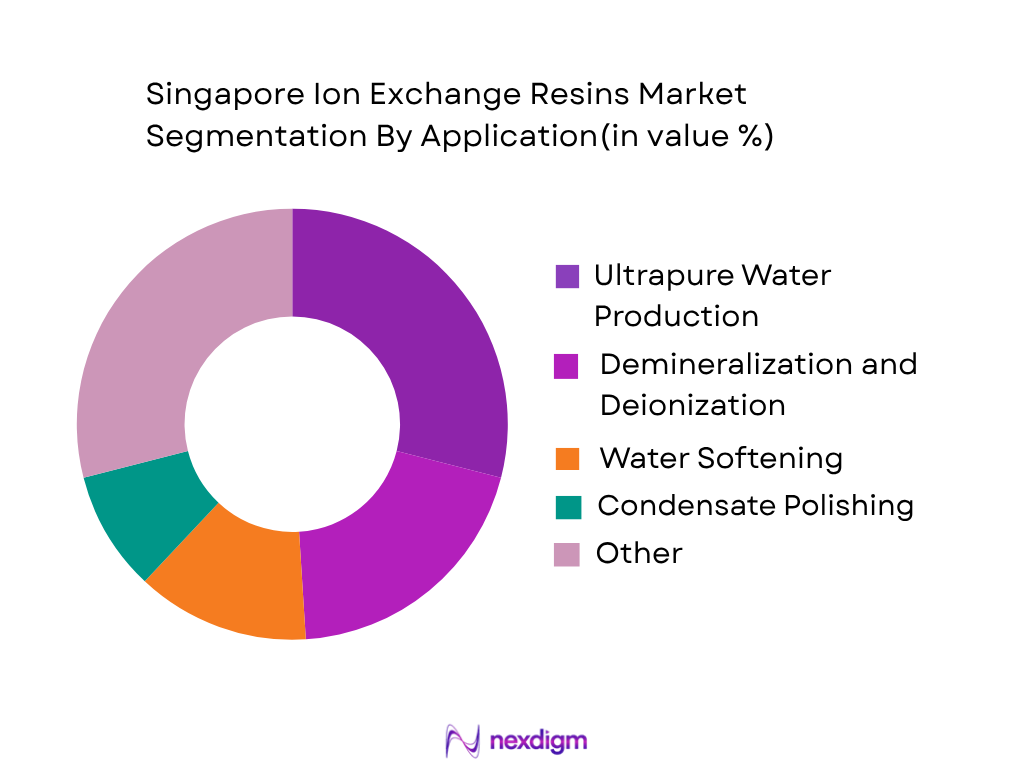
The Singapore Ion Exchange Resins Market is segmented by application into Ultrapure Water Production, Demineralization and Deionization, Water Softening, Condensate Polishing, Process Water Purification, Wastewater Treatment and Water Reuse, and Specialty Separation Applications. Ultrapure water production holds the dominant market position because Singapore’s semiconductor ecosystem has stringent water-quality requirements throughout wafer cleaning, rinsing and process operations. PUB identifies wafer fabrication plants as the largest users of NEWater because their required water quality is more stringent than drinking-water standards. Singapore also produces approximately one-tenth of global semiconductor chips, amplifying resin consumption in polishing and deionization systems. Ion exchange typically operates alongside reverse osmosis in semiconductor water systems, where mixed-bed polishing removes trace ions, boron, silica and residual contaminants. Pharmaceutical and biopharmaceutical manufacturing adds a second high-value source of demand for purified and high-purity process water.
Competitive Landscape
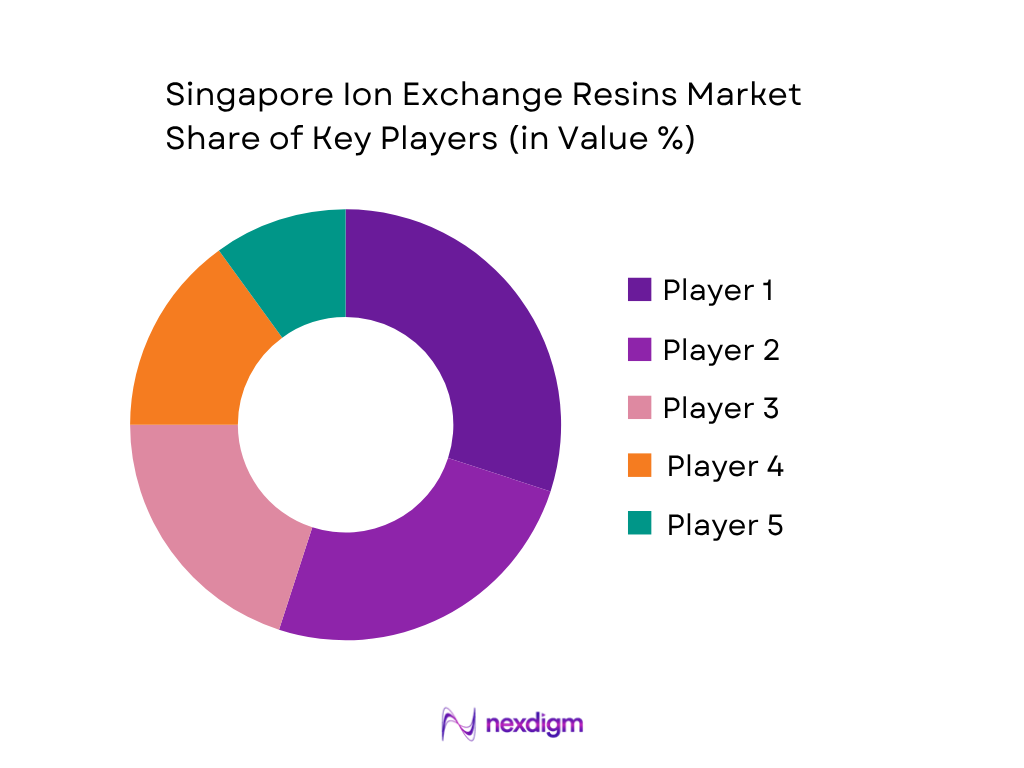
The Singapore Ion Exchange Resins Market is characterized by the presence of established global resin manufacturers supported by distributors, water-treatment engineering companies and application specialists. Major competitors such as DuPont, Ecolab/Purolite, LANXESS, Mitsubishi Chemical and Samyang Corporation compete across cation, anion, mixed-bed and specialty resin categories. Competition is particularly technology-intensive in semiconductor and ultrapure-water applications, where low TOC release, rapid rinse characteristics, uniform bead size, ionic purity, reliability and technical qualification can outweigh conventional resin pricing considerations.
| Major Player | Establishment Year | Headquarters | Major Resin Brand | Key Resin Categories | Ultrapure Water Capability | Semiconductor Applications | Specialty Resin Capability | Competitive Positioning |
| DuPont de Nemours, Inc. | 1802 | Wilmington, USA | ~ | ~ | ~ | ~ | ~ | ~ |
| Ecolab Inc. / Purolite | 1981 | Pennsylvania, USA / King of Prussia operations | ~ | ~ | ~ | ~ | ~ | ~ |
| LANXESS AG | 2004 | Cologne, Germany | ~ | ~ | ~ | ~ | ~ | ~ |
| Mitsubishi Chemical Group Corporation | 1933 | Tokyo, Japan | ~ | ~ | ~ | ~ | ~ | ~ |
| Samyang Corporation | 1924 | Seoul, South Korea | ~ | ~ | ~ | ~ |
Singapore Ion Exchange Resins Market Analysis
Growth Drivers
Semiconductor and Ultrapure-Water Manufacturing Expansion
Singapore’s semiconductor manufacturing base is a core demand driver for ion exchange resins because wafer fabrication requires continuous deionization, trace-ion removal and ultrapure-water polishing. Ministry of Trade and Industry data show that Singapore’s semiconductor manufacturing output reached S$135.26 billion in 2024, supported by 34,343 semiconductor employees and S$35.71 billion of value added. The Singapore Economic Development Board also records 4 dedicated wafer fabrication parks covering 391 hectares and accommodating 14 global semiconductor companies, demonstrating the concentration of water-intensive fabrication infrastructure. Semiconductor facilities use strong-acid cation, strong-base anion and high-purity mixed-bed resins downstream of membrane systems to remove residual ionic contaminants that can compromise wafer yields. The broader economic environment reinforces this industrial demand: World Bank data place Singapore’s 2024 GDP at US$547.39 billion and GDP per capita at US$90,674.1, indicating the scale and capital intensity of its advanced-manufacturing economy. Singapore further secured S$11.1 billion of manufacturing fixed-asset investment commitments in 2024, with semiconductors among the major investment categories, strengthening the installed base of facilities requiring sophisticated process-water treatment.
Industrial Water Recycling and High-Purity Process-Water Requirements
Singapore’s industrial water-management framework is another direct driver of ion exchange resin consumption because increasingly water-intensive industries must recycle process streams while maintaining demanding purity specifications. PUB reports that Singapore currently consumes around 440 million gallons of water each day, creating a large treatment requirement across industrial and municipal systems. From January 2024, new or expanded wafer fabrication, electronics and biomedical projects using at least 60,000 cubic metres of water annually became subject to additional recycling requirements, directly increasing the relevance of polishing, demineralization and selective-removal technologies. Ion exchange resins are particularly applicable after reverse osmosis when users must remove trace hardness, silica, boron, metals or residual ions before water is returned to sensitive processes. Singapore’s macroeconomic capacity supports continued investment in such systems: World Bank records a 2024 population of 6,036,860 alongside GDP of US$547.39 billion. PUB’s infrastructure reinforces this treatment ecosystem; Changi Water Reclamation Plant already accommodates 2 NEWater factories with capacities of 50 million gallons per day each. These operating conditions create recurring resin requirements through initial system loading, periodic replacement, mixed-bed polishing and application-specific contaminant removal.
Market Challenges
Import Dependence and Supply-Chain Exposure for Specialized Resin Grades
Singapore’s limited domestic ion exchange resin manufacturing base makes high-performance applications dependent on imported cation, anion, mixed-bed, chelating and semiconductor-grade products, exposing users to overseas manufacturing schedules, shipping constraints and qualification-related supply risks. This vulnerability matters because Singapore’s semiconductor output alone reached S$135.26 billion in 2024, while electronics manufacturing generated S$177.49 billion of total output, meaning disruptions to high-purity consumables can affect a substantial advanced-manufacturing ecosystem. Singapore’s trade-intensive economic structure further increases sensitivity to international supply conditions. The IMF reports nominal GDP of US$547.5 billion in 2024, while machinery and transport equipment represented the largest component of the country’s non-oil goods exports. For ion exchange resin buyers, the challenge is intensified by the technical specificity of semiconductor and pharmaceutical applications: approved resin grades cannot always be replaced immediately by chemically similar alternatives because qualification depends on ionic leakage, organic extractables, bead integrity, rinse performance and application history. Singapore also supports 14 global semiconductor companies across 4 wafer fabrication parks, creating concentrated demand for qualified materials. Consequently, distributors must maintain adequate local inventories and multiple supply routes to protect end users from resin shortages or extended overseas replenishment cycles.
Competition from Membrane and Electrodeionization Technologies
Ion exchange resin suppliers in Singapore face increasing technological competition as industrial users combine reverse osmosis, membrane bioreactors and electrodeionization to reduce chemical regeneration requirements and improve water recovery. PUB’s NEWater system illustrates the country’s strong membrane orientation: the production process incorporates microfiltration or ultrafiltration, while membrane bioreactor technology integrates 3 treatment functions into 1 stage where applicable. At Changi Water Reclamation Plant, 2 NEWater factories each operate at 50 million gallons per day, demonstrating the scale at which membrane-based purification is already embedded in Singapore’s water infrastructure. This does not eliminate ion exchange demand, but shifts resins toward final polishing, specialty removal and high-purity applications rather than conventional bulk demineralization. The challenge is commercially relevant within an economy where World Bank data record US$90,674.1 GDP per capita in 2024, supporting sophisticated capital-intensive treatment technologies. PUB also applies mandatory water-efficiency obligations to specified industrial consumers using at least 60,000 cubic metres annually, encouraging companies to optimize entire treatment trains. Resin suppliers therefore must demonstrate value through low ionic leakage, reduced organic release, longer operating cycles, selective contaminant removal and compatibility with RO-EDI configurations rather than relying on traditional stand-alone ion exchange installations.
Market Opportunities
High-Purity Resin Opportunity from Semiconductor Capacity Deepening
Singapore presents a significant future opportunity for high-purity and semiconductor-grade ion exchange resins as its existing fabrication ecosystem deepens into advanced memory, wafer processing and semiconductor equipment manufacturing. The opportunity is supported by current operating scale rather than speculative future capacity: Ministry of Trade and Industry data place semiconductor output at S$135.26 billion in 2024, with the industry generating S$35.71 billion in value added. Singapore’s Economic Development Board records 4 wafer fabrication parks spanning 391 hectares, while the semiconductor workforce exceeds 35,000 people. Investment activity further strengthens the addressable installed base: EDB recorded S$13.5 billion in fixed-asset investment commitments during 2024, including major semiconductor and biomedical manufacturing projects. World Bank data show Singapore’s economy at US$547.39 billion in GDP during 2024, providing the macroeconomic foundation for capital-intensive manufacturing expansion. These conditions create opportunities for low-TOC mixed beds, uniform-particle-size resins, boron-selective materials, high-capacity cation and anion products, and resin monitoring services. Suppliers that can provide semiconductor-qualified products, local inventory, rapid technical troubleshooting and documented performance under ultrapure-water conditions are positioned to capture both new-system loading and recurring replacement demand.
Biopharmaceutical, Chemical and Water-Reuse Applications
Singapore’s combination of biomedical manufacturing, chemicals production and regulated industrial water recycling creates an opportunity for ion exchange resins beyond semiconductor applications. Tuas Biomedical Park currently hosts 19 biomedical and nutraceutical multinational companies and more than 8,000 employees, providing a concentrated base of facilities requiring purified utility water, high-purity process streams and contaminant-control systems. In 2024, Novartis commenced a US$256 million expansion of its Singapore biopharmaceutical manufacturing facility, with the project associated with 100 high-skilled employment opportunities, demonstrating continuing investment in water-quality-sensitive production. Jurong Island provides another major demand pool: Singapore’s energy and chemicals sector employed more than 27,000 workers in 2024, while the Ministry of Trade and Industry reported that national chemicals output increased during the year, supported by petroleum, petrochemicals and other chemical activities. Singapore’s World Bank-recorded GDP of US$547.39 billion in 2024 further demonstrates the industrial economy supporting these applications. Ion exchange suppliers can therefore target pharmaceutical water polishing, condensate treatment, catalyst-process purification, heavy-metal capture, selective separation and wastewater-reuse systems, particularly where membrane treatment requires downstream removal of trace ionic contaminants before water recirculation or process reuse.
Future Outlook
The Singapore Ion Exchange Resins Market is projected to expand at a CAGR of approximately ~X.X% during the forecast period, supported primarily by semiconductor capacity additions, advanced manufacturing, biopharmaceutical investments and increasingly sophisticated industrial water-reuse systems. The growth trajectory is likely to favor high-purity mixed-bed, uniform-particle-size and selective ion exchange resins rather than commodity softening products. Singapore’s position in the semiconductor supply chain provides a particularly strong structural demand base. The country has attracted more than S$30 billion in semiconductor investment over a recent four-year investment cycle, and the government continues to expand infrastructure supporting wafer fabrication.
Water availability and recycling will remain another critical demand catalyst. PUB expects Singapore’s overall water demand to nearly double over the longer term and is expanding NEWater capacity, including the upcoming Tuas NEWater Factory with capacity of 75 million gallons per day. Increased industrial water recycling creates opportunities for ion exchange resins in polishing, demineralization, contaminant removal and hybrid RO-ion exchange treatment trains. Biopharmaceutical manufacturing will broaden high-purity resin applications beyond semiconductors. Singapore hosts manufacturing or R&D operations from 8 of the world’s top 10 biopharmaceutical companies, while manufacturers continue investing in additional production capacity. For example, Novartis announced a US$256 million expansion of its Singapore biopharmaceutical manufacturing site, strengthening prospective demand for high-purity utility water and purification systems.
Major Players
- DuPont de Nemours, Inc. – AmberLite™
- Ecolab Inc. / Purolite – Purolite™
- LANXESS AG – Lewatit™
- Mitsubishi Chemical Group Corporation – DIAION™
- Samyang Corporation – TRILITE™
- Thermax Limited – Tulsion™
- Ion Exchange (India) Limited – INDION™
- Sunresin New Materials Co., Ltd.
- ResinTech, Inc.
- Jacobi Carbons Group / Jacobi Resins
- Jiangsu Suqing Water Treatment Engineering Group
- Anhui Sanxing Resin Technology Co., Ltd.
- Pure Resin Co., Ltd.
- Zhejiang Zhengguang Industrial Co., Ltd.
- Hebi Higer Chemical Co., Ltd.
Key Target Audience
- Ion Exchange Resin Manufacturers and Specialty Resin Producers
- Water Treatment EPC Companies and System Integrators
- Semiconductor, Electronics and Wafer Fabrication Companies
- Pharmaceutical, Biopharmaceutical and Specialty Chemical Manufacturers
- Ion Exchange Resin Importers, Distributors and Industrial Chemical Suppliers
- Industrial Water Treatment and Water-Recycling Solution Providers
- Investments and Venture Capitalist Firms
- Government and Regulatory Bodies (PUB – Singapore’s National Water Agency, National Environment Agency, Singapore Economic Development Board, JTC Corporation, Ministry of Trade and Industry)
Research Methodology
Step 1: Identification of Key Variables
The initial phase involves constructing an ecosystem map covering resin manufacturers, international suppliers, Singapore importers, distributors, EPC contractors, water-treatment system integrators and major industrial end users. Secondary research is used to identify variables including resin type, application, installed resin-bed volume, replacement frequency, import dependency, average selling prices and end-user water-treatment requirements.
Step 2: Market Analysis and Construction
Historical market demand is reconstructed through a combination of import flows, distributor sales, application-level resin consumption and installed ion exchange system assessments. Bottom-up analysis evaluates resin loading across semiconductor, pharmaceutical, petrochemical, power, food processing and general industrial facilities, while top-down analysis benchmarks Singapore’s demand against industrial output, water consumption and regional ion exchange resin trends.
Step 3: Hypothesis Validation and Expert Consultation
Market hypotheses are validated through interviews with ion exchange resin suppliers, distributors, industrial water-treatment companies, EPC contractors and procurement personnel from major end-user industries. Computer-assisted telephone interviews and structured expert discussions are used to verify resin replacement cycles, application preferences, price bands, supplier positioning, qualification requirements and adoption of high-purity resin technologies.
Step 4: Research Synthesis and Final Output
The final stage triangulates primary findings with trade statistics, company information, industrial investment data, water-treatment infrastructure information and application-specific demand indicators. Top-down and bottom-up outputs are reconciled to establish the final market model, segmentation structure and competitive landscape. Forecast assumptions incorporate semiconductor investment, biopharmaceutical expansion, industrial water reuse, technology substitution and replacement demand to generate the long-term Singapore market outlook.

- Executive Summary
- Research Methodology (Market Definition and Scope, Ion Exchange Resin Classification, Market Boundary Assessment, Abbreviations, Market Sizing Methodology, Top-Down Market Estimation, Bottom-Up Market Validation, Demand-Side Assessment, Supply-Side Assessment, Import-Based Market Reconstruction, Distributor Sales Assessment, Installed Resin Bed Assessment, Resin Replacement Cycle Analysis, End-User Consumption Assessment, Industrial Water Treatment Project Mapping, Primary Interviews with Resin Manufacturers, Importers)

- Definition and Scope
- Evolution of Singapore Ion Exchange Resins Industry
- Ion Exchange Resin Industry Genesis and Market Development
- Singapore Ion Exchange Resins Industry Ecosystem Analysis
- Installed Ion Exchange System Base Assessment
- Resin Regeneration and Replacement Ecosystem
- High-Purity and Ultrapure Water Treatment Ecosystem

- Market Growth Drivers (Expansion of Semiconductor and Wafer Fabrication Manufacturing, Increasing Ultrapure Water Requirements, Growth of Advanced Manufacturing Facilities, Rising Industrial Water Treatment Investment, Increasing NEWater Utilization by Industrial Users, Expansion of Pharmaceutical and Biopharmaceutical Manufacturing)
- Market Challenges (High Dependence on Imported Resins, Foreign Exchange Exposure, Resin Price Volatility, Competition from Reverse Osmosis and Electrodeionization, Resin Fouling from Organic and Metal Contaminants, Regeneration Chemical Cost, Disposal of Spent Regenerants, Technical Skill Requirements)
- Market Opportunities (Ultrapure Water Resins for Semiconductor Manufacturing, Semiconductor Grade Mixed Bed Resins, Industrial Wastewater Recycling, Heavy Metal and Boron Selective Resins, High-Purity Pharmaceutical Resins, Biopharmaceutical Process Water Resins, Condensate Polishing Resins, Resin Replacement Services)
- Market Trends (Shift from Commodity to High-Performance Resins, Adoption of Uniform Particle Size Resins, RO–Ion Exchange Hybridization, Growth of Mixed Bed Polishing, Increasing Demand for Low-Leachable and Low-TOC Resins, Semiconductor Grade Resin Qualification, Longer Resin Life Optimization)
- Regeneration Economics Analysis
- SWOT Analysis of Major Players
- Resins Porter’s Five Forces Analysis
- PESTLE Analysis

- By Market Value (2020-2025)
- By Consumption Volume (2020-2025)
- By Average Selling Price (2020-2025)
- By Import Value (2020-2025)
- By Import Volume (2020-2025)
- By Installed Resin Bed Volume (2020-2025)
- By Fresh Resin Consumption versus Replacement Resin Demand (2020-2025)

- By Resin Type
Strong Acid Cation Resins
Weak Acid Cation Resins
Strong Base Anion Resins – Type I
Strong Base Anion Resins – Type II
Weak Base Anion Resins
Mixed Bed Resins
Chelating Resins
Selective Ion Exchange Resins
Adsorbent and Specialty Separation Resins
Ultrapure Water Grade Resins
Food and Pharmaceutical Grade Resins
Condensate Polishing Resins - By Polymer Matrix
Styrene-Divinylbenzene Resins
Acrylic Resins
Polystyrenic Resins
Macroporous Resins
Gel-Type Resins
Specialty Polymeric Matrices - By Application
Water Softening
Demineralization and Deionization
Condensate Polishing
Ultrapure Water Production
Boiler Feedwater Treatment
Process Water Purification
Drinking and Municipal Water Treatment
Wastewater Treatment and Water Reuse
Heavy Metal Removal
Boron and Selective Contaminant Removal
Food and Beverage Purification
Pharmaceutical Purification and Separation
Biopharmaceutical Process Water Treatment
Chemical Processing and Catalysis
Metal Recovery and Hydrometallurgy - By Supply Source
China
South Korea
Japan
India
Germany
United States
Other European Markets
Other Asia-Pacific Markets
Domestic and Locally Repacked Supply - By Geography
Western Singapore
Jurong Island Petrochemical and Energy Cluster
Jurong–Tuas Industrial Corridor
Tuas Biomedical and Advanced Manufacturing Cluster
Northern Singapore
Woodlands Industrial Cluster
Eastern Singapore
Tampines–Pasir Ris Semiconductor and Electronics Cluster
Central Singapore
Other Industrial Estates and Manufacturing Clusters

- Market Share Analysis of Major Players
- Cross Comparison Parameters (Product Portfolio Breadth, Ion Exchange Capacity and Resin Performance Range, Ultrapure Water and Semiconductor Grade Capability, Singapore Distributor and Inventory Coverage, Industrial and Biopharmaceutical Application Coverage, Resin Qualification and Technical Support Capability, Price Positioning and Total Cost of Ownership, Regeneration Efficiency and Expected Resin Service Life)
- Competitive Benchmarking Analysis (Product Innovation Capability, Pricing Strategy, Singapore Market Presence, Supply Chain Efficiency, Customer Base Strength, Product Grade Coverage, Application-Specific Resin Capability, Distribution and Technical Service Strength)
- SWOT Analysis of Major Players
- Pricing Analysis
- Major Companies
DuPont de Nemours, Inc. – AmberLite™
Ecolab Inc. / Purolite – Purolite™
LANXESS AG – Lewatit™
Mitsubishi Chemical Group Corporation – DIAION™
Samyang Corporation – TRILITE™
Thermax Limited – Tulsion™
Ion Exchange (India) Limited – INDION™
Sunresin New Materials Co., Ltd.
ResinTech, Inc.
Jacobi Carbons Group / Jacobi Resins
Jiangsu Suqing Water Treatment Engineering Group
Anhui Sanxing Resin Technology Co., Ltd.
Pure Resin Co., Ltd.
Zhejiang Zhengguang Industrial Co., Ltd.
Hebi Higer Chemical Co., Ltd.

- Procurement Behavior Analysis
- Buyer Preference Assessment
- Import Dependency and Sourcing Analysis
- Pricing Sensitivity Analysis
- Singapore Ion Exchange Resins Supply-Demand Analysis
- Domestic Resin Availability and Distribution Assessment
- Import Dependency Analysis
- Domestic Consumption Assessment

- By Market Value (2026-2035)
- By Consumption Volume (2026-2035)
- By Average Selling Price (2026-2035)
- By Import Value (2026-2035)
- By Import Volume (2026-2035)
- By Installed Resin Bed Volume (2026-2035)
- By Fresh Resin Consumption versus Replacement Resin Demand (2026-2035)


 Request a Sample
 Ask for Customization
 Get a Quote
 Enquire Now