

 Download PDF
Market Overview
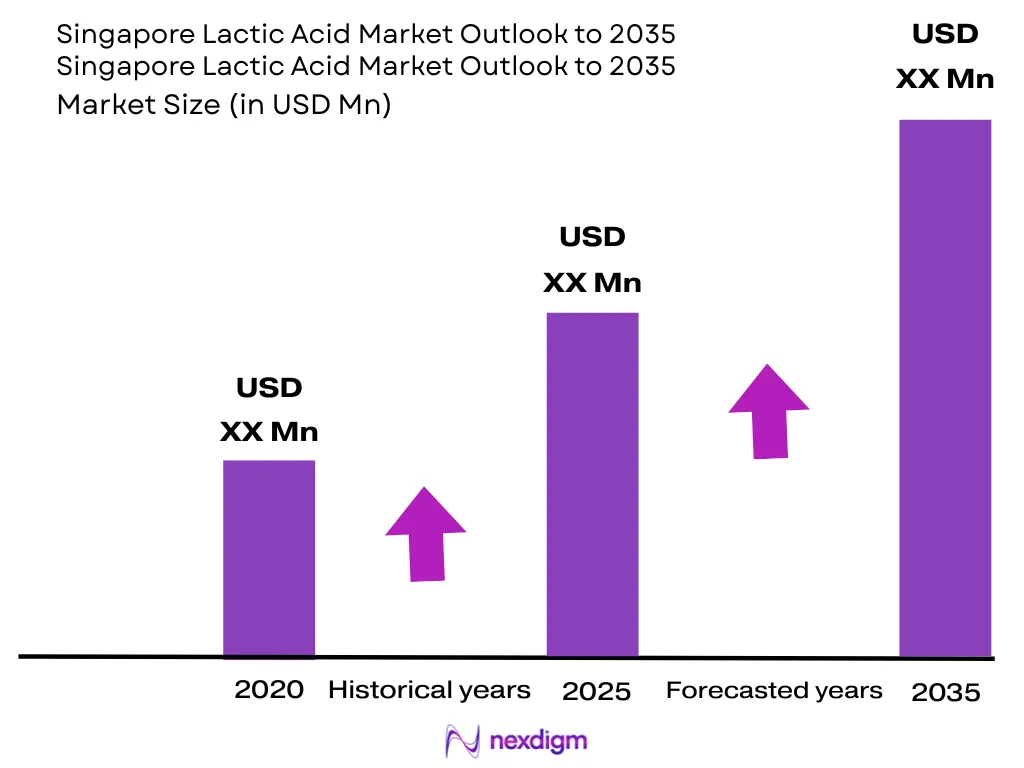
The Singapore Lactic Acid Market is valued at USD ~ Million in 2024 and is projected to grow at a CAGR of ~% during 2026–2035. Market growth is primarily supported by increasing demand for food-grade acidulants, pharmaceutical excipients, biodegradable plastics, and specialty chemicals. Singapore imported lactic acid, its salts, and esters worth approximately USD 6.68 million in 2024, compared to a strong import base in the preceding year, reflecting the country’s dependence on international suppliers to meet industrial demand. The expanding food processing, biomedical, and sustainable packaging industries continue to stimulate consumption across multiple applications.
Market Segmentation
By Raw Material
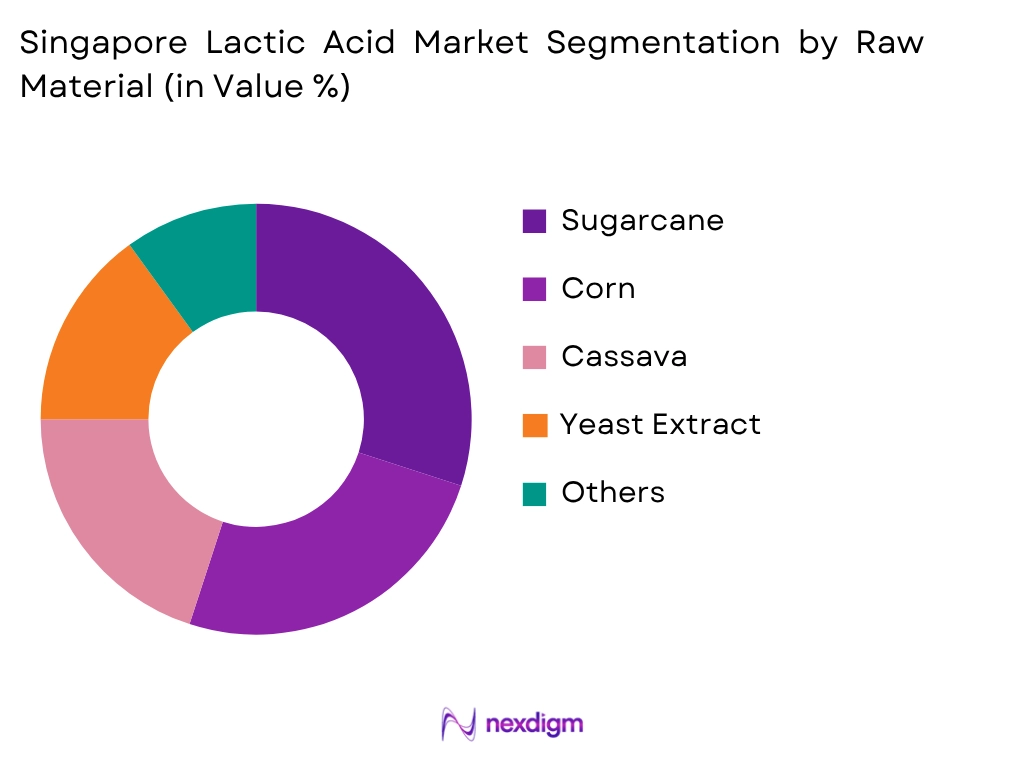
The Singapore Lactic Acid Market is segmented by raw material into Sugarcane, Corn, Cassava, Yeast Extract, and Other Crops. Sugarcane holds the dominant market share owing to its high fermentable sugar content, cost efficiency, and well-established supply chain across major producing countries such as Thailand, India, and Brazil, which serve as important suppliers to Singapore. Sugarcane-based feedstock offers higher fermentation efficiency, lower production costs, and improved sustainability compared to several alternative substrates, making it the preferred raw material for manufacturing food-grade lactic acid and polylactic acid (PLA). Growing demand for biodegradable plastics, clean-label food ingredients, and bio-based chemicals has further accelerated the adoption of sugarcane-derived lactic acid. Moreover, Singapore’s dependence on imported renewable feedstocks and its focus on sustainable manufacturing encourage manufacturers and importers to source sugarcane-based lactic acid, reinforcing the segment’s leadership in the domestic market.
By Application
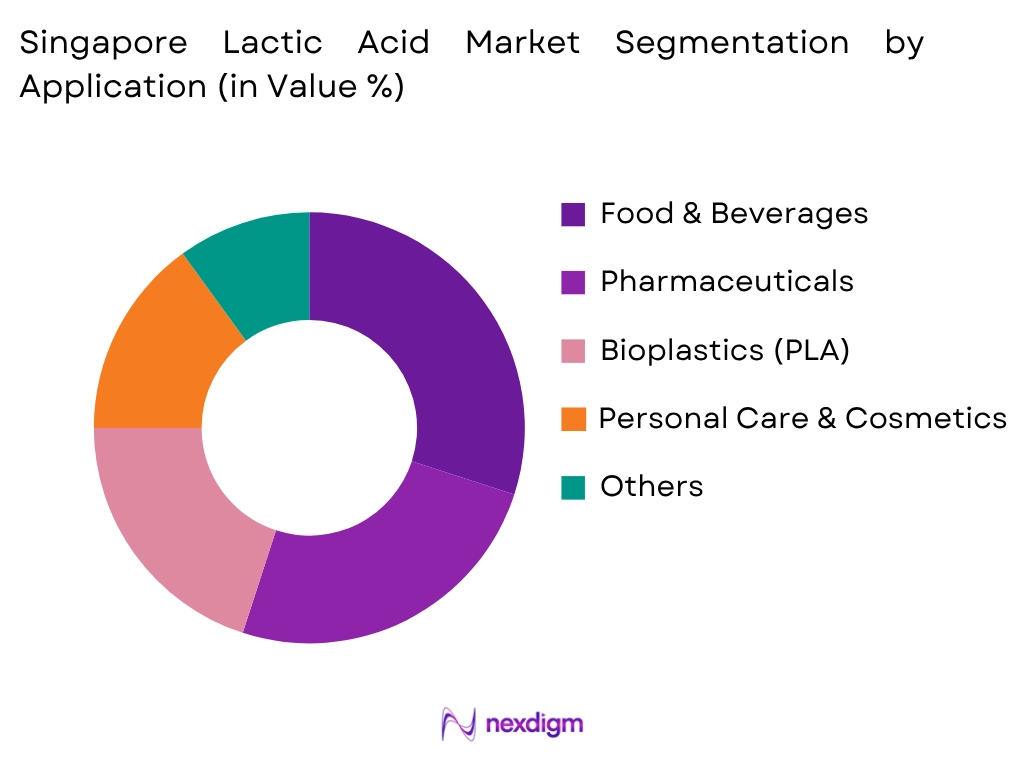
The Singapore Lactic Acid Market is segmented by application into Food & Beverage, Pharmaceuticals, Bioplastics (PLA), Personal Care & Cosmetics, Industrial Chemicals, and Home & Institutional Cleaning. Recently, the Food & Beverage segment has held the dominant market share due to the widespread use of lactic acid as an acidulant, preservative, pH regulator, and flavor enhancer across processed foods, dairy products, beverages, confectionery, and ready-to-eat meals. Singapore’s highly developed food manufacturing ecosystem, coupled with rising demand for clean-label ingredients and functional food formulations, has strengthened consumption of food-grade lactic acid. Furthermore, stringent food safety regulations encourage manufacturers to adopt naturally derived food additives over synthetic alternatives. Growing imports of premium food ingredients and expansion of regional food exports continue to reinforce the leadership of this application segment, while demand from pharmaceutical and biodegradable polymer manufacturers is steadily increasing.
Competitive Landscape
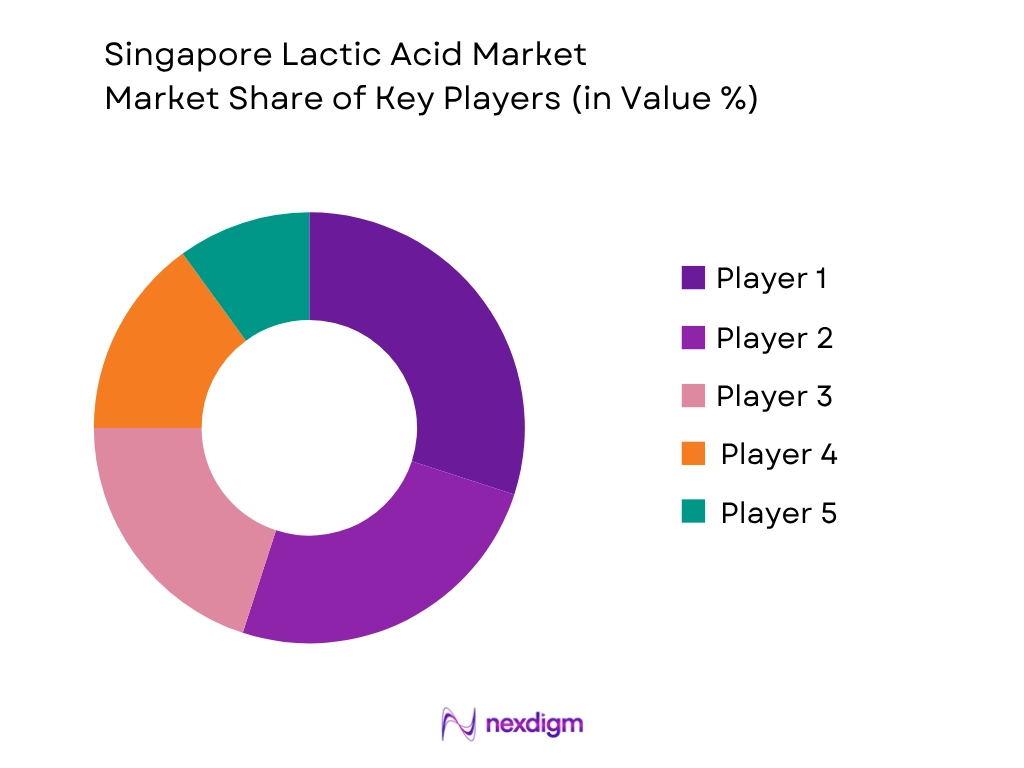
The Singapore Lactic Acid Market is moderately consolidated, with competition led by multinational manufacturers and specialty chemical companies supplying high-purity lactic acid for food, pharmaceutical, industrial, and bioplastic applications. Since Singapore relies primarily on imports, global producers maintain a strong presence through regional distribution partners and local chemical suppliers. Companies compete based on product purity, regulatory compliance, production capacity, sustainability initiatives, innovation in fermentation technologies, and supply reliability. Growing demand for biodegradable materials and food-grade ingredients has further intensified competition among established global manufacturers.
| Company | Establishment Year | Headquarters | Primary Product Portfolio | Lactic Acid Portfolio
|
Manufacturing Presence | Major End-Use Industries | Key Strategic Focus | Certifications & Compliance |
| Corbion | 1919 | ~ | ~ | ~ | ~ | ~ | ~ | ~ |
| Jungbunzlauer | 1867 | ~ | ~ | ~ | ~ | ~ | ~ | ~ |
| Cargill | 1865 | ~ | ~ | ~ | ~ | ~ | ~ | ~ |
| Galactic | 1994 | ~ | ~ | ~ | ~ | ~ | ~ | ~ |
| Henan Jindan Lactic Acid Technology | 1984 | ~ | ~ | ~ | ~ | ~ | ~ | ~ |
Singapore Lactic Acid Market Analysis
Growth Drivers
Expansion of Food Processing and Specialty Ingredients Industry
Singapore’s advanced food manufacturing sector continues to drive demand for lactic acid as a natural acidulant, preservative, pH regulator, and fermentation ingredient. According to the Singapore Department of Statistics, the country’s nominal GDP reached approximately SGD 779 billion in 2024, while the manufacturing sector remained one of the largest contributors to the economy, creating sustained demand for specialty food ingredients. The Singapore Food Agency (SFA) continues to strengthen domestic food production through its food resilience initiatives, encouraging greater investment in processed and value-added food manufacturing. In international trade, Singapore imported USD 6.68 million worth of lactic acid, its salts, and esters during 2024, with the Netherlands supplying USD 2.81 million, China USD 1.14 million, and Thailand USD 0.85 million, demonstrating robust industrial consumption of fermentation-based ingredients. Singapore’s position as ASEAN’s regional food distribution hub further increases demand for food-grade lactic acid across beverage, dairy, bakery, meat processing, and nutraceutical manufacturing. Continuous investments in premium food processing facilities, coupled with increasing exports of processed food products throughout Southeast Asia, continue to support stable demand for high-purity lactic acid across commercial manufacturing applications.
Growing Biomedical and Sustainable Chemicals Ecosystem
Singapore has established itself as one of Asia’s leading biomedical and specialty chemical manufacturing hubs, creating strong downstream demand for pharmaceutical- and industrial-grade lactic acid. According to Singapore’s Economic Development Board (EDB), biomedical manufacturing remains one of the country’s priority industries, supported by continued investments in pharmaceutical production, biotechnology, and advanced materials. The World Bank reports Singapore’s GDP per capita remained above USD 90,000 in 2024, reflecting the country’s capacity to support high-value manufacturing and specialty chemicals. Singapore also exported approximately USD 1.96 million worth of lactic acid and related products in 2024, supplying regional markets including Malaysia (USD 668 thousand), Indonesia (USD 592 thousand) and Vietnam (USD 208 thousand), highlighting its growing role as a regional redistribution hub. Rising investments in biodegradable materials, bioplastics, pharmaceutical excipients, and sustainable industrial chemicals continue to strengthen consumption of fermentation-derived lactic acid throughout Singapore’s advanced manufacturing ecosystem.
Market Challenges
Dependence on Imported Raw Materials and Finished Products
Singapore has limited agricultural resources and virtually no commercial-scale feedstock cultivation for fermentation-based lactic acid production, making the country highly dependent on imported raw materials and finished products. According to the World Bank’s WITS database, Singapore imported approximately 863,577 kg of lactic acid from the Netherlands, 719,999 kg from China, and 634,073 kg from Thailand during 2024. This heavy reliance on overseas suppliers exposes manufacturers and distributors to supply chain disruptions, freight bottlenecks, currency fluctuations, and geopolitical uncertainties. Since food-grade and pharmaceutical-grade lactic acid require consistent quality standards and uninterrupted supply, procurement risks remain a significant operational challenge for downstream industries. Furthermore, Singapore’s limited land availability restricts the establishment of large-scale fermentation facilities, increasing dependence on international production networks to meet domestic industrial demand. These structural constraints continue to challenge the long-term resilience of the Singapore lactic acid supply chain.
Limited Domestic Manufacturing Base for Fermentation Chemicals
Although Singapore possesses a highly developed petrochemical and specialty chemicals industry, domestic production of fermentation-derived organic acids such as lactic acid remains relatively limited compared with larger manufacturing economies. According to Singapore’s 2024 trade statistics, imports of lactic acid totaled USD 6.68 million, while exports amounted to only USD 1.96 million, indicating that domestic demand substantially exceeds local production capacity. Advanced fermentation facilities require specialized biotechnology expertise, continuous raw material availability, and large-scale bioprocessing infrastructure, all of which are constrained by Singapore’s limited industrial land and dependence on imported agricultural feedstocks. While institutions located within Biopolis and Tuas Biomedical Park continue to strengthen biotechnology capabilities, scaling commercial fermentation production remains challenging. Consequently, industries relying on food-grade, pharmaceutical-grade, and polymer-grade lactic acid continue to depend heavily on international manufacturers for secure and cost-effective supply.
Market Opportunities
Increasing Adoption of Sustainable Packaging and Bioplastics
Singapore’s sustainability agenda continues to create significant opportunities for lactic acid consumption through growing adoption of biodegradable materials, particularly polylactic acid (PLA). Under the Singapore Green Plan 2030, government agencies are promoting resource efficiency, waste reduction, and circular economy initiatives that encourage industries to adopt environmentally sustainable materials. Lactic acid serves as the primary feedstock for PLA production, making these initiatives directly supportive of future market demand. Singapore’s manufacturing ecosystem, combined with its regional logistics capabilities, enables suppliers to distribute sustainable materials across Southeast Asia. The country’s continued imports of more than USD 6.68 million worth of lactic acid during 2024 demonstrate the availability of supply required to support expanding downstream applications. As packaging manufacturers, food producers, and consumer goods companies increasingly transition toward recyclable and biodegradable materials, demand for fermentation-derived lactic acid is expected to strengthen across industrial applications while supporting Singapore’s broader environmental objectives.
Regional Trade Hub Supporting High-Value Chemical Distribution
Singapore’s strategic geographical location and world-class logistics infrastructure provide substantial opportunities for expanding regional trade in lactic acid and related specialty chemicals. During 2024, Singapore exported approximately 273,201 kg of lactic acid and its derivatives to multiple regional markets, including Malaysia, Indonesia, Vietnam, China, and India. Malaysia alone imported products worth USD 668 thousand, while Indonesia imported USD 592 thousand, highlighting Singapore’s growing importance as a redistribution center within ASEAN. The country’s highly efficient ports, free trade agreements, advanced warehousing infrastructure, and strong customs facilitation continue to attract multinational specialty chemical companies seeking regional distribution bases. As Southeast Asian demand for food ingredients, pharmaceuticals, biodegradable polymers, and industrial biotechnology products continues to expand, Singapore is well positioned to increase value-added trade, strengthen regional supply chains, and attract further investments in specialty chemical distribution and formulation activities.
Future Outlook
The Singapore Lactic Acid Market is expected to witness steady expansion over the forecast period, supported by increasing adoption of bio-based chemicals, rising investments in sustainable packaging, and continued growth of the country’s food processing and pharmaceutical industries. Demand for biodegradable polymers such as polylactic acid (PLA) is anticipated to accelerate as governments and manufacturers strengthen their sustainability commitments. Furthermore, Singapore’s strategic position as a regional chemical trading and logistics hub will continue to support imports and distribution of high-purity lactic acid across Southeast Asia.
Major Players
- Corbion
- Jungbunzlauer Suisse AG
- Galactic
- Henan Jindan Lactic Acid Technology Co., Ltd.
- Cargill Incorporated
- Futerro
- NatureWorks LLC
- Musashino Chemical Laboratory Co., Ltd.
- BASF SE
- Foodchem International Corporation
- Merck KGaA
- Thermo Fisher Scientific
- Cellulac plc
- Vaishnavi Bio Tech International Limited
- Kemia Pte Ltd.
Key Target Audience
- Food & Beverage Manufacturers
- Pharmaceutical Manufacturers
- Personal Care & Cosmetic Product Manufacturers
- Bioplastics & Sustainable Packaging Manufacturers
- Chemical Distributors and Specialty Ingredient Suppliers
- Investment and Venture Capital Firms
- Government and Regulatory Bodies (Singapore Food Agency (SFA), National Environment Agency (NEA), Economic Development Board (EDB), Enterprise Singapore, Health Sciences Authority (HSA))
- Biotechnology and Industrial Fermentation Companies
Research Methodology
Step 1: Identification of Key Variables
The initial phase involves constructing an ecosystem map encompassing all major stakeholders within the Singapore Lactic Acid Market. This step is supported by extensive desk research using government publications, trade statistics, company annual reports, industry associations, and proprietary databases. The objective is to identify critical variables such as production, imports, end-use industries, pricing trends, regulatory framework, and demand drivers that influence market performance.
Step 2: Market Analysis and Construction
In this phase, historical market data is compiled and analyzed to evaluate market size, consumption patterns, trade flows, pricing trends, and application-wise demand. Both demand-side and supply-side analyses are conducted to estimate market revenues and volume consumption. Segmentation analysis is further performed to understand the contribution of different raw materials, grades, and applications within the Singapore Lactic Acid Market.
Step 3: Hypothesis Validation and Expert Consultation
Market hypotheses developed through secondary research are validated through Computer-Assisted Telephone Interviews (CATIs) and structured discussions with manufacturers, distributors, importers, food ingredient suppliers, chemical companies, and industry experts. These consultations provide valuable operational insights regarding procurement trends, customer preferences, pricing dynamics, production technologies, and future business opportunities, ensuring the accuracy of market estimates.
Step 4: Research Synthesis and Final Output
The final stage integrates insights obtained from both primary and secondary research to produce a comprehensive assessment of the Singapore Lactic Acid Market. Data triangulation techniques are employed to validate market estimates, competitive positioning, and future growth prospects. The report is further reviewed to ensure consistency across market sizing, segmentation, competitive landscape, and forecast assumptions, resulting in a reliable and actionable market intelligence study.

- Executive Summary
- Research Methodology (Market Definitions and Assumptions, Abbreviations, Market Sizing Approach, Top-Down Analysis, Bottom-Up Analysis, Demand-Side Assessment, Supply-Side Assessment, Primary Industry Interviews, Secondary Research Validation, Data Triangulation, Forecasting Framework, Limitations and Future Conclusions)

- Definition and Scope
- Market Evolution and Industry Genesis
- Timeline of Major Industry Developments
- Lactic Acid Industry Value Chain Analysis
- Supply Chain Analysis

- Growth Drivers (Growing Demand for Bio-Based Chemicals, Expansion of Food Processing Industry, Rising PLA Adoption, Increasing Pharmaceutical Manufacturing, Singapore’s Position as ASEAN Chemical Trade Hub)
- Market Challenges (Dependence on Imported Feedstocks, High Manufacturing Costs, Raw Material Price Volatility, Competition from Alternative Acidulants, Limited Domestic Production Capacity)
- Market Opportunities (Growth in Sustainable Packaging, Functional Food Ingredients, Pharmaceutical Grade Expansion, Green Chemistry Initiatives, ASEAN Export Opportunities)
- Market Trends (Clean Label Ingredients, Advanced Fermentation Technologies, Circular Bioeconomy, Carbon-Neutral Manufacturing, High-Purity Lactic Acid Demand)
- Government Regulations (Food Safety Regulations, Chemical Import Regulations, Environmental Sustainability Standards, Pharmaceutical Ingredient Compliance, Workplace Chemical Safety Regulations)
- SWOT Analysis
- Porter’s Five Forces Analysis
- PESTLE Analysis
- Stakeholder Ecosystem
- Competition Ecosystem

- By Market Value (2020-2025)
- By Volume Consumption (2020-2025)
- By Average Selling Price (2020-2025)

- By Raw Material (In Value %)
Corn
Sugarcane
Cassava
Sugar Beet
Molasses
Other Fermentable Feedstocks - By Grade (In Value %)
Food Grade
Industrial Grade
Pharmaceutical Grade
Personal Care & Cosmetic Grade
Polymer Grade - By Application (In Value %)
Food & Beverage
Bioplastics (PLA)
Pharmaceuticals
Personal Care & Cosmetics
Industrial Chemicals
Home & Institutional Cleaning
Animal Feed - By End User Industry (In Value %)
Food Processing
Chemical Manufacturing
Pharmaceutical Manufacturing
Packaging Industry
Cosmetics & Personal Care
Biotechnology Industry - By Distribution Channel (In Value %)
Direct Sales
Chemical Distributors
Food Ingredient Suppliers
Pharmaceutical Ingredient Suppliers
Specialty Chemical Dealers
Online B2B Platforms

- Market Share of Major Players (By Value, Volume, Application, Grade)
- Cross Comparison Parameters (Product Purity Range, Fermentation Technology, Production Capacity, PLA Feedstock Capability, Food & Pharma Certifications, Distribution Network Strength, Sustainability Initiatives, ASEAN Market Presence)
- SWOT Analysis of Major Players
- Pricing Analysis by Grade and Bulk Purchase Volume
- Detailed Profiles of Major Companies
Corbion
Jungbunzlauer Suisse AG
Galactic
Henan Jindan Lactic Acid Technology Co., Ltd.
Cargill Incorporated
Futerro
NatureWorks LLC
Musashino Chemical Laboratory Co., Ltd.
Foodchem International Corporation
BASF SE
Merck KGaA
Thermo Fisher Scientific
Kemia Pte Ltd.
Cellulac plc
Vaishnavi Bio Tech International Limited

- Consumption Pattern Assessment (Purchase Frequency, Volume Utilization, Grade Preference, Import Dependence, Application Mix)
- Purchasing Power Analysis
- Procurement Strategy Assessment
- Needs, Preferences and Pain Point Analysis
- Quality & Certification Preference Analysis
- Purchase Decision-Making Process
- Online vs Offline Procurement Analysis

- By Market Value (2026-2035)
- By Volume Consumption (2026-2035)
- By Average Selling Price (2026-2035)


 Request a Sample
 Ask for Customization
 Get a Quote
 Enquire Now