

 Download PDF
Market Overview
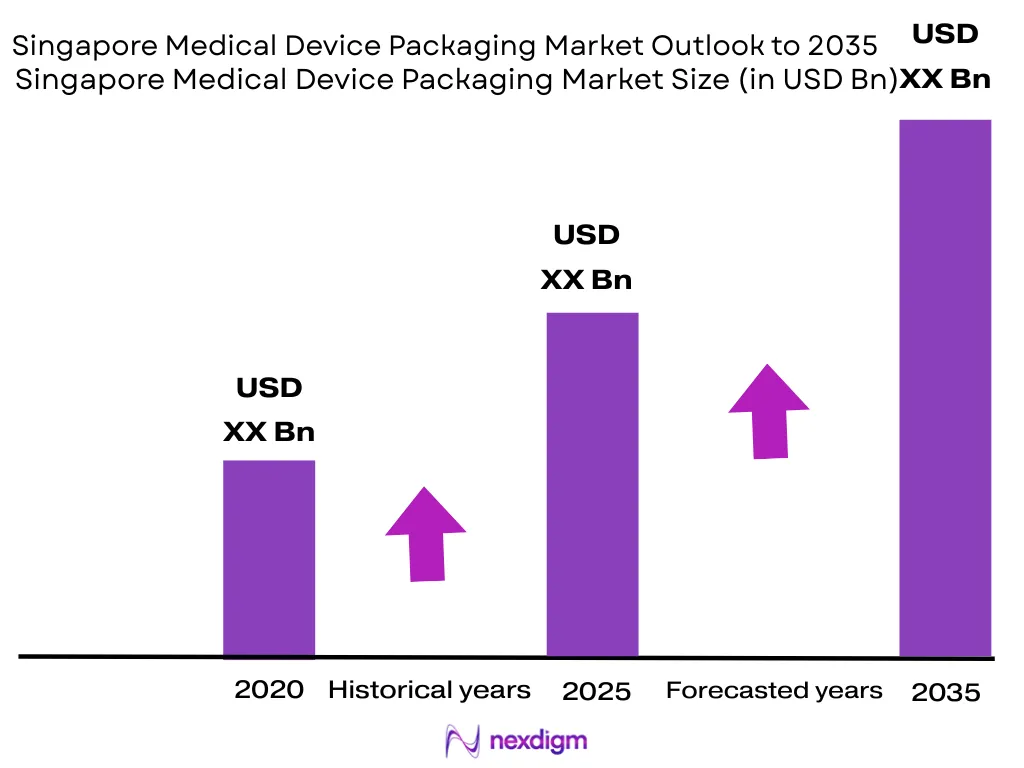
The Singapore Medical Device Packaging Market is valued at approximately USD ~ billion, compared with USD ~ billion in the preceding annual period. The figures remain placeholders because no official source reports medical-device-packaging revenue separately. Demand is supported by Singapore’s medical-technology manufacturing output of S$19.4 billion, more than 400 enterprises, approximately 17,000 employees, and over 35 global MedTech manufacturing plants, all requiring validated sterile barriers, trays, labels and export packaging. Tuas, Jurong, Woodlands, One-North and the Changi logistics corridor dominate Singapore’s medical device packaging activity. Tuas and Jurong provide advanced manufacturing, cleanroom and logistics infrastructure; Woodlands supports precision engineering and MedTech production; One-North concentrates biomedical research and product development; and Changi enables high-value air-freight distribution. These clusters serve manufacturers of diagnostics, life-science tools, ophthalmic products, minimally invasive devices and electronic monitoring equipment requiring export-grade packaging and regional customization.
Market Segmentation
By Packaging Format
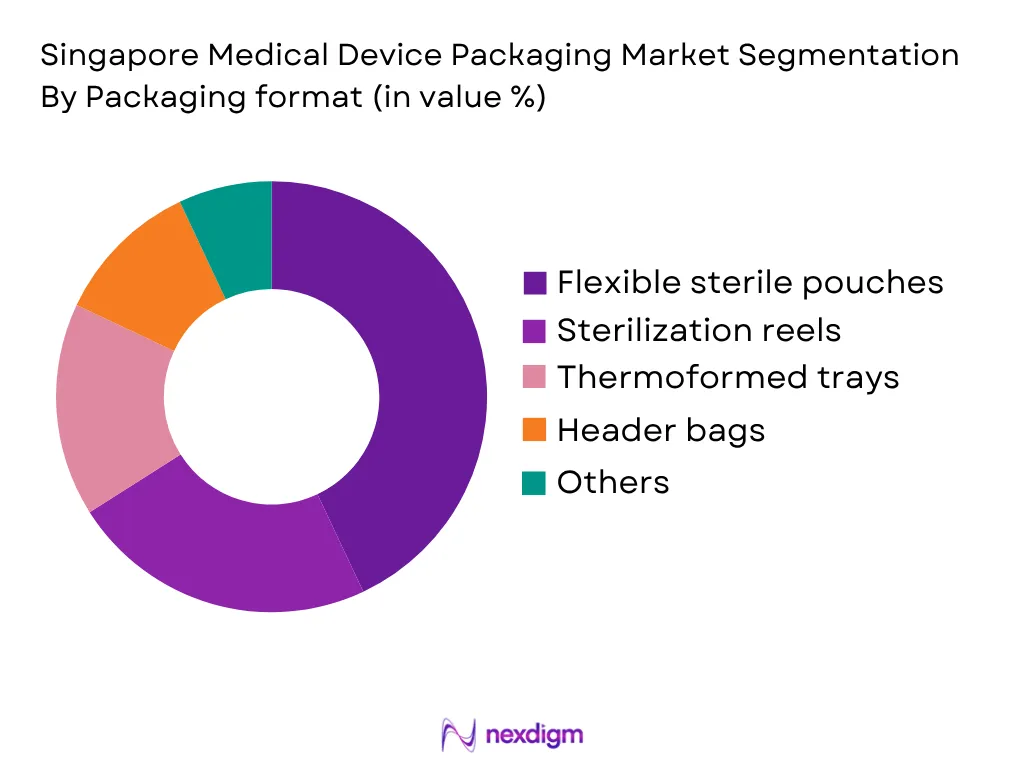
The Singapore Medical Device Packaging Market is segmented into flexible sterile pouches, sterilization reels, thermoformed trays, form-fill-seal packs, header bags, blister packs, rigid containers and protective transit packaging. Flexible sterile pouches hold the dominant position because Singapore’s MedTech manufacturing base produces high volumes of diagnostic consumables, surgical accessories, ophthalmic products and precision components requiring lightweight sterile barriers. Paper–film and Tyvek–film pouches provide microbial protection, product visibility, controlled peeling and compatibility with multiple sterilization methods. They also support automated sealing and rapid product changeovers, which are important in Singapore’s high-cost manufacturing environment. Thermoformed trays remain essential for fragile optical components, implants, surgical tools and electronic devices requiring dimensional protection. Sterilization reels serve hospitals and manufacturers processing varied device sizes. Export-oriented production further favours formats that minimize weight while retaining seal strength and distribution performance across air and sea routes.
By Packaging Material
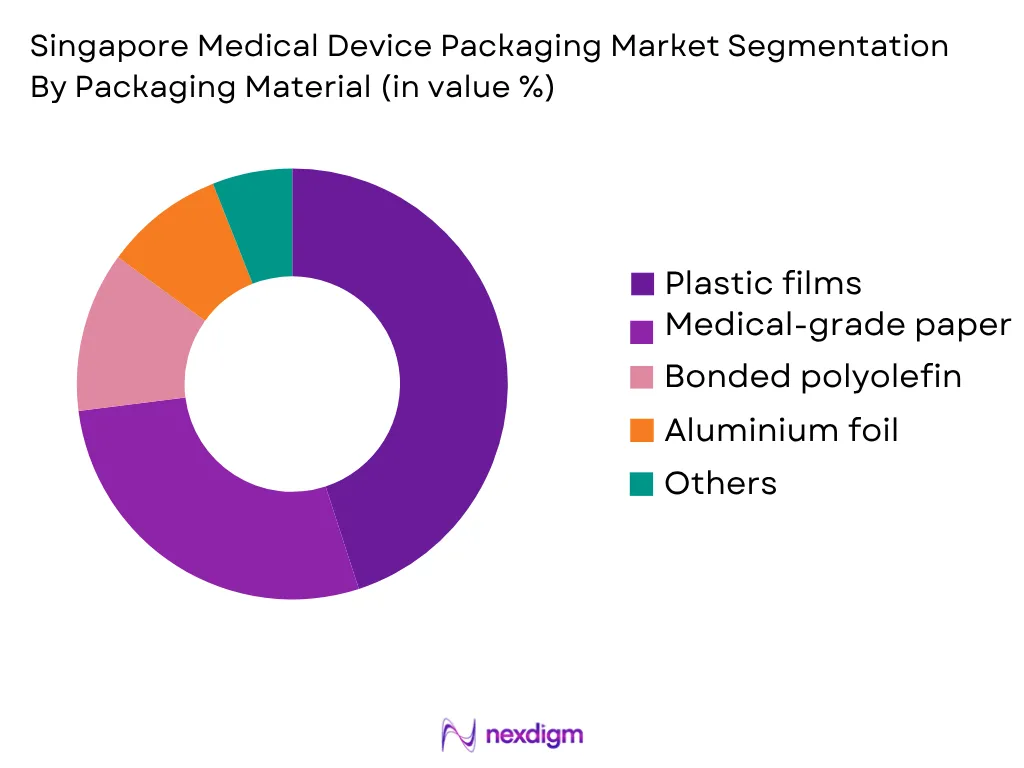
The Singapore Medical Device Packaging Market is segmented into plastic films and thermoforming sheets, spun-bonded polyolefin, medical-grade paper, paperboard, aluminium laminates and specialty barrier materials. Plastic films and thermoforming sheets represent the dominant segment because PETG, APET, polyethylene, polypropylene and multilayer structures offer transparency, sealability, dimensional stability and puncture resistance. These properties are important for ophthalmic devices, diagnostic cartridges, life-science tools and electronic medical components manufactured in Singapore. Spun-bonded polyolefin is widely used where low particulate generation, microbial-barrier strength and multiple sterilization options are required. Medical-grade paper remains important for breathable pouch and reel applications. Singapore imports many specialist substrates, giving an advantage to suppliers with regional inventories, approved dual sources and formal material-change controls. HSA’s recognition of ISO-based medical-device standards and quality systems also increases demand for traceable, validated materials rather than general-purpose packaging films.
Competitive Landscape
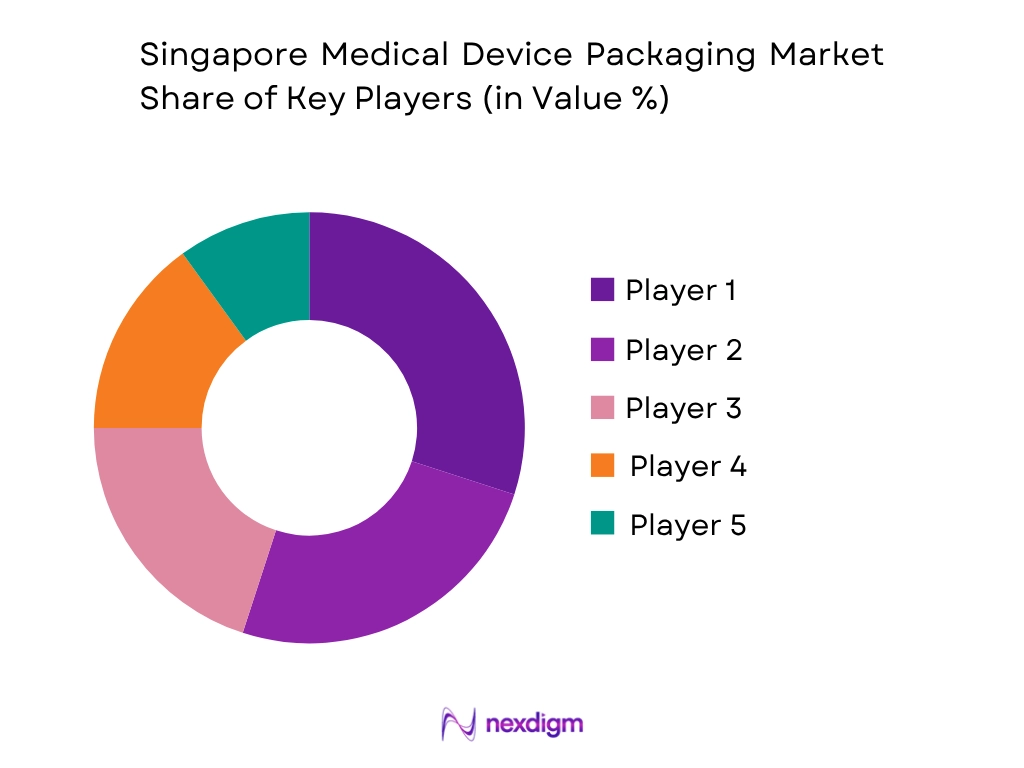
The Singapore Medical Device Packaging Market is characterized by global healthcare-packaging specialists, regional material suppliers and advanced contract manufacturers. International firms dominate primary sterile barriers because they possess validated materials, global quality systems and established relationships with multinational MedTech manufacturers. Competition is based on cleanroom capability, sterilization compatibility, rapid prototyping, package-integrity testing, automation and regional supply reliability. Local and regional suppliers compete through proximity to MedTech plants, shorter engineering cycles and integration with Singapore’s precision-engineering ecosystem, which includes more than 2,700 firms and electronics manufacturing service providers.
| Company | Establishment year | Headquarters | Core medical packaging | Material expertise | Sterilization compatibility | Validation support | Singapore relevance | Sustainability capability |
| Amcor | 1860 | Zurich, Switzerland | ~ | ~ | ~ | ~ | ~ | ~ |
| DuPont | 1802 | Wilmington, United States | ~ | ~ | ~ | ~ | ~ | ~ |
| TekniPlex Healthcare | 1967 | Wayne, United States | ~ | ~ | ~ | ~ | ~ | ~ |
| Oliver Healthcare Packaging | 1890 | Grand Rapids, United States | ~ | ~ | ~ | ~ | ~ | ~ |
| Nelipak Healthcare Packaging | 1953 | Phoenix, United States | ~ | ~ | ~ | ~ | ~ | ~ |
Singapore Medical Device Packaging Market Analysis
Growth Drivers
Advanced MedTech Manufacturing Base
Singapore’s established medical-technology manufacturing ecosystem is a central driver of demand for sterile pouches, thermoformed trays, medical-grade lidding, protective inserts and export-ready secondary packaging. The country hosts more than 400 global and regional MedTech enterprises, supported by approximately 16,000 workers and an extensive precision-engineering network. Medical-technology manufacturing output reached S$19.4 billion, compared with S$19.0 billion in the preceding reported period. Production covers ophthalmic products, diagnostic instruments, life-science tools, minimally invasive devices and electronic monitoring equipment. Each category requires packaging engineered around device geometry, sterilization method, particulate control, shelf life and destination-market regulation. Singapore’s economy expanded by 4.4 units for every 100 units in 2024, compared with 1.8 units in 2023, reflecting recovery in manufacturing and global technology demand. GDP per capita reached approximately US$94,900, providing the capital and technical base needed for automated cleanroom packaging, precision tray tooling and package-integrity laboratories. The concentration of multinational device plants also increases demand for globally standardized packaging platforms supported by documented material traceability and validated sealing processes. Packaging suppliers capable of serving export manufacturing rather than only domestic hospital consumption therefore benefit from Singapore’s high-value industrial structure.
Regional Export and Healthcare Supply-Chain Hub
Singapore’s role as an Asia-Pacific manufacturing, logistics and regional-headquarters hub supports demand for medical-device packaging that can withstand international air freight, sea transport, automated warehousing and country-specific labelling. The national MedTech ecosystem includes more than 35 global manufacturing plants, with output serving markets across Southeast Asia, China, Japan, Europe and North America. Changi’s air-cargo infrastructure is particularly relevant for high-value diagnostic, ophthalmic and electronic devices requiring lightweight but secure packaging. Maritime distribution creates additional requirements for moisture resistance, compression strength and long-duration transit protection. Singapore had a population of approximately 6.0 million in 2024, but its packaging demand is not limited to domestic consumption because the country functions as a regional production and redistribution centre. The IMF reported nominal GDP of roughly US$547.5 billion in 2024, while the World Bank classified Singapore as a highly connected, high-income economy. Global device companies can use Singapore for late-stage labelling, procedure-kit configuration, regional inventory and destination-specific packaging changes without disrupting core manufacturing lines. This model increases demand for digitally printed labels, modular secondary cartons, tamper-evident closures and validated transport systems. Suppliers with regional regulatory knowledge and short engineering cycles are therefore positioned to capture demand generated by Singapore’s export-oriented MedTech operations.
Market Challenges
High Cleanroom, Labour and Validation Requirements
Singapore’s high-value operating environment creates substantial entry requirements for companies seeking to manufacture primary sterile-barrier packaging. Suppliers need classified cleanrooms, calibrated sealing systems, environmental monitoring, precision thermoforming tools, electronic documentation and package-integrity equipment. A single device package may require installation qualification, operational qualification and performance qualification, followed by sterilization compatibility, distribution simulation and aging studies. These activities require packaging engineers, quality-system specialists and trained cleanroom operators who compete with semiconductor, pharmaceutical and precision-engineering employers for technical talent. Singapore’s GDP per capita reached approximately US$94,900 in 2024, while the economy supported more than 400 MedTech companies and around 16,000 sector employees. This concentration demonstrates strong capability but also creates intense competition for specialized personnel. HSA requires manufacturers to maintain ISO 13485-aligned quality systems, while importers and wholesalers must comply with applicable medical-device quality or distribution requirements. Packaging suppliers serving these companies must maintain controlled specifications, audit-ready records and formal change-notification procedures. The challenge is especially significant for smaller converters because expensive cleanrooms and testing assets may remain underutilized during customer qualification. Long approval cycles also mean equipment and tooling can be installed before commercial volumes begin, increasing financial exposure and limiting the number of new entrants capable of serving sterile applications.
Imported Medical-Grade Materials and Requalification Complexity
Singapore depends on imported medical-grade paper, spun-bonded polyolefin, PETG sheets, specialty coatings, sealants and multilayer barrier films. These substrates cannot be substituted as easily as ordinary packaging materials because each change can affect seal strength, peel behaviour, particulate generation, microbial protection and sterilization resistance. A replacement material may require new engineering trials, accelerated aging, transport simulation and regulatory assessment before use. This creates supply-chain exposure even though Singapore has advanced manufacturing and logistics infrastructure. The biomedical sector experienced considerable output volatility during 2024: production declined by 22.4 units for every 100 units between January and August compared with the corresponding prior period, before increasing by 62 units in September. Such fluctuations make inventory planning difficult because suppliers must maintain enough qualified substrate to protect customers while avoiding excessive stock during slower production periods. Singapore’s economy grew by 4.4 units for every 100 units in 2024, but externally oriented manufacturing remained sensitive to changes in global demand and trade conditions. Import dependence also exposes converters to shipping disruptions and supplier consolidation outside Singapore. Packaging companies therefore need dual sourcing, regional inventories and formal material-change agreements. However, qualifying two or more substrates adds technical work and may require customers to repeat parts of their packaging validation programme, reducing the speed at which suppliers can respond to shortages.
Market Opportunities
Automated Package Inspection and Digital Traceability
Singapore’s advanced manufacturing environment creates a strong opportunity for automated medical-device packaging and electronic quality records. Connected heat sealers can capture temperature, pressure, dwell time and line speed for every batch. Machine-vision systems can detect channels, folds, seal contamination, incorrect labels and missing kit components before packages leave the line. Vacuum-decay, pressure-decay and high-voltage leak-detection systems can improve package-integrity assessment while reducing dependence on destructive inspection. These capabilities align with Singapore’s high-value manufacturing model, where labour productivity and repeatability are more important than low-cost manual processing. The economy expanded by 4.4 units for every 100 units in 2024, and the MedTech ecosystem includes more than 400 enterprises supported by over 2,700 precision-engineering firms and electronics manufacturing service providers. This supplier base can support robotics, tooling, sensors, software integration and predictive maintenance for cleanroom packaging operations. Electronic batch records can connect device serial numbers, packaging-material lots, sealing parameters, sterilization cycles and inspection outcomes. During a complaint or recall, companies can identify affected units without withdrawing broader production. Smart labels and RFID can also support high-value inventory movement through Changi and regional distribution centres. Packaging suppliers offering integrated automation, testing and data systems can therefore expand from material conversion into regulated manufacturing services with higher technical and customer-retention value.
Regional Contract Packaging and Late-Stage Customization
Singapore can expand as a regional contract-packaging hub for global MedTech companies and emerging Asian device manufacturers. Shared cleanroom facilities can provide pouch sealing, tray lidding, device assembly, procedure-kit configuration, labelling, accelerated aging, package testing and sterilization coordination without requiring every manufacturer to establish separate infrastructure. The opportunity is supported by more than 35 global MedTech plants, over 400 enterprises and manufacturing output of S$19.4 billion. Singapore also had foreign direct investment stock of S$3,130 billion at the end of 2024, indicating its continuing importance as a location for multinational operations and regional decision-making. Late-stage customization can help companies maintain standard global device packs while adding destination-specific labels, instructions, importer information and regulatory symbols closer to the end market. This reduces obsolete inventory when labelling regulations change and enables smaller production batches for individual Asian countries. Contract providers can also manage protective packaging for air and maritime distribution, including moisture control, electrostatic protection and temperature monitoring. Future demand can be supported by Singapore’s position between device manufacturers, logistics providers, regulators and regional headquarters rather than by domestic patient volume alone. Suppliers that combine cleanroom conversion, digital printing, validation support and Asia-Pacific regulatory knowledge can become strategic partners for product launches and regional supply-chain resilience.
Future Outlook
The Singapore Medical Device Packaging Market is forecast to expand at approximately % CAGR during the 2026–2035 period. The rate is a placeholder because no authoritative source publishes a Singapore-specific medical-device-packaging forecast. Growth will be driven by expansion of MedTech manufacturing, regional contract packaging, advanced diagnostics, digital health, export-oriented production and increasing demand for validated sterile packaging. Singapore’s MedTech manufacturing output reached S$19.4 billion, with more than 35 plants operated by global companies and over 400 enterprises across manufacturing, precision engineering, diagnostics and life-science tools. This creates a stable base for high-value packaging engineering rather than only commodity conversion. The market will remain strongly export-oriented. Singapore manufactures devices for Asian, European and North American markets, requiring packaging capable of meeting multiple regulatory and labelling regimes. Suppliers offering regional late-stage customization, multilingual labels and destination-specific instructions can reduce obsolete inventory for multinational customers. Flexible pouches will continue serving high-volume diagnostic and surgical products. Thermoformed trays will gain relevance in ophthalmic, minimally invasive, cardiovascular and electronic devices where precision cavities, device retention and protection against vibration are essential. HSA regulation will continue raising the technical threshold for suppliers. Manufacturers must maintain quality systems conforming to ISO 13485, while importers and wholesalers may use ISO 13485 or Good Distribution Practice for Medical Devices. Class B, C and D devices require product registration unless approved under specific routes, making packaging documentation and change control important components of product lifecycle management.
Major Players
- Amcor
- DuPont
- TekniPlex Healthcare
- Oliver Healthcare Packaging
- Nelipak Healthcare Packaging
- Berry Global
- Wipak Group
- STERIMED
- Constantia Flexibles
- Huhtamaki
- Sonoco
- ProAmpac
- Klöckner Pentaplast
- Sealed Air
- Avery Dennison
Key Target Audience
- Medical device packaging manufacturers and sterile-barrier converters
- Global and Singapore-based medical device manufacturers
- In-vitro diagnostic and life-science tool manufacturers
- Contract development and manufacturing organizations
- Medical-grade polymer, paper and barrier-material suppliers
- Regional healthcare logistics and distribution companies
- Investments and venture capitalist firms
- Government and regulatory bodies (Health Sciences Authority, Singapore Economic Development Board, Enterprise Singapore, Ministry of Health, Singapore Accreditation Council and Agency for Science, Technology and Research)
Research Methodology
Step 1: Identification of Key Variables
The initial phase constructs an ecosystem map covering MedTech manufacturers, packaging converters, substrate suppliers, sterilization providers, contract manufacturers, logistics operators and regulators. Critical variables include device output, packaging units per device, packaging format, substrate consumption, cleanroom capacity, sterilization method, export destination and average packaging realization.
Step 2: Market Analysis and Construction
Historical demand is assessed through MedTech manufacturing output, device exports, packaging-supplier revenues, material consumption and installed conversion capacity. The top-down model converts device-category output into packaging-unit demand. The bottom-up model aggregates pouch, tray, reel, lidding, labelling and contract-packaging revenues before reconciliation through material-yield and unit-value checks.
Step 3: Hypothesis Validation and Expert Consultation
Market assumptions are validated through computer-assisted telephone interviews with packaging engineers, global MedTech plants, local contract manufacturers, material suppliers and validation laboratories. Discussions examine packaging-format penetration, qualification timelines, cleanroom capability, sterilization access, export compliance, material sourcing and package-failure experience.
Step 4: Research Synthesis and Final Output
The final phase integrates HSA regulation, EDB manufacturing data, company disclosures and primary interviews. Market size is triangulated across packaging revenue, device output, unit shipments and substrate demand. Forecast assumptions incorporate MedTech investment, regional contract packaging, automation, sustainability, export demand and regulatory change.

- Executive Summary
- Research Methodology (Market Definitions and Assumptions, Medical Device Packaging Taxonomy, Abbreviations, Market Sizing Approach, Top-Down MedTech Output Analysis, Bottom-Up Packaging Supplier Aggregation, Packaging Units per Device Assessment, Demand-Side Evaluation, Supply-Side Capacity Mapping, Import–Export Reconciliation, Primary Industry Interviews, Data Triangulation, Forecasting Framework, Scenario Analysis, Limitations and Future Conclusions)

- Definition and Scope
- Medical Device Packaging Market Evolution and Industry Genesis
- Timeline of Major Regulatory, Manufacturing and Packaging Developments
- Medical Device Packaging Business Cycle
- Packaging Demand Linkage with Singapore MedTech Manufacturing
- Medical Device Classification and Packaging Requirement Mapping
- Sterile and Non-Sterile Medical Packaging Ecosystem

- Growth Drivers (Expansion of MedTech Manufacturing Output, Global MedTech Plant Investments, Ophthalmic and Diagnostic Device Production, Advanced Manufacturing Capabilities, Regional Export Demand, Healthcare Innovation, Precision Engineering Ecosystem and Strong Regulatory Infrastructure)
- Market Challenges (Limited Domestic Raw Material Base, High Cleanroom and Labour Costs, Imported Medical-Grade Substrate Dependence, Long Packaging Qualification Cycles, Small Domestic Demand Base, Sterilization Capacity Constraints, Skilled Validation Workforce Competition and Sustainability–Sterility Trade-Offs)
- Market Opportunities (Advanced Sterile Barrier Conversion, High-Precision Thermoformed Packaging, Contract Packaging for Regional MedTech Companies, Smart Packaging and Serialization, Sustainable Healthcare Packaging, Life-Science Tool Packaging, Automated Package Integrity Testing and Asia-Pacific Export Platforms)
- Market Trends (Tyvek-Based Sterile Barriers, High-Barrier Thermoformed Trays, Double Sterile Barrier Systems, Digital Package Prototyping, Automated Vision Inspection, Cleanroom Packaging Outsourcing, Procedure-Kit Consolidation, Smart Labels and Regional Late-Stage Customization)
- SWOT Analysis
- Porter’s Five Forces Analysis
- PESTLE Analysis

- By Market Value (2020-2025)
- By Packaging Units (2020-2025)
- By Medical-Grade Material Consumption (2020-2025)

- By Packaging Format (In Value %)
Flexible Sterile Pouches
Medical Paper–Film Pouches
Tyvek–Film Pouches
Sterilization Reels
Thermoformed Medical Trays
Header Bags - By Packaging Material (In Value %)
Medical-Grade Paper
Spun-Bonded Polyolefin and Tyvek
Polyethylene Films
Polypropylene Films
Polyethylene Terephthalate Films and Sheets
PETG Thermoforming Sheets - By End-User Organization (In Value %)
Global MedTech Manufacturers
Singapore-Based Medical Device Manufacturers
In-Vitro Diagnostic Manufacturers
Life-Science Tools Manufacturers
Contract Development and Manufacturing Organizations
Original Equipment Manufacturers
Medical Device Importers and Wholesalers - By Geographic (In Value %)
Western Manufacturing Corridor
Tuas Biomedical and Advanced Manufacturing Cluster
Jurong Industrial and Logistics Cluster
Woodlands Medical Technology Cluster
One-North Biomedical Research Cluster
Science Park Life-Sciences Cluster
Changi Air Logistics Cluster

- Market Share of Major Players
- Cross Comparison Parameters (Sterile Barrier Product Portfolio, Medical-Grade Material Expertise, Singapore Cleanroom Manufacturing Footprint, Sterilization Compatibility Coverage, Packaging Validation and Testing Capability, Global MedTech Customer Coverage, Custom Tooling and Prototyping Capability, Sustainable Healthcare Packaging Portfolio)
- SWOT Analysis of Major Players
- Detailed Profiles of Major Companies
Amcor
DuPont
TekniPlex Healthcare
Oliver Healthcare Packaging
Nelipak Healthcare Packaging
Berry Global
Wipak Group
STERIMED
Constantia Flexibles
Huhtamaki
Sonoco
ProAmpac
Klöckner Pentaplast
Sealed Air
Avery Dennison

- Packaging Demand and Utilization Assessment
- Global MedTech Manufacturer Procurement Criteria
- Packaging Supplier Qualification Process
- Packaging Engineer Decision-Making Process
- Regulatory and Quality Team Requirements
- Ophthalmic Device Manufacturer Analysis

- By Market Value (2026-2035)
- By Packaging Units (2026-2035)
- By Medical-Grade Material Consumption (2026-2035)


 Request a Sample
 Ask for Customization
 Get a Quote
 Enquire Now