

 Download PDF
Market Overview
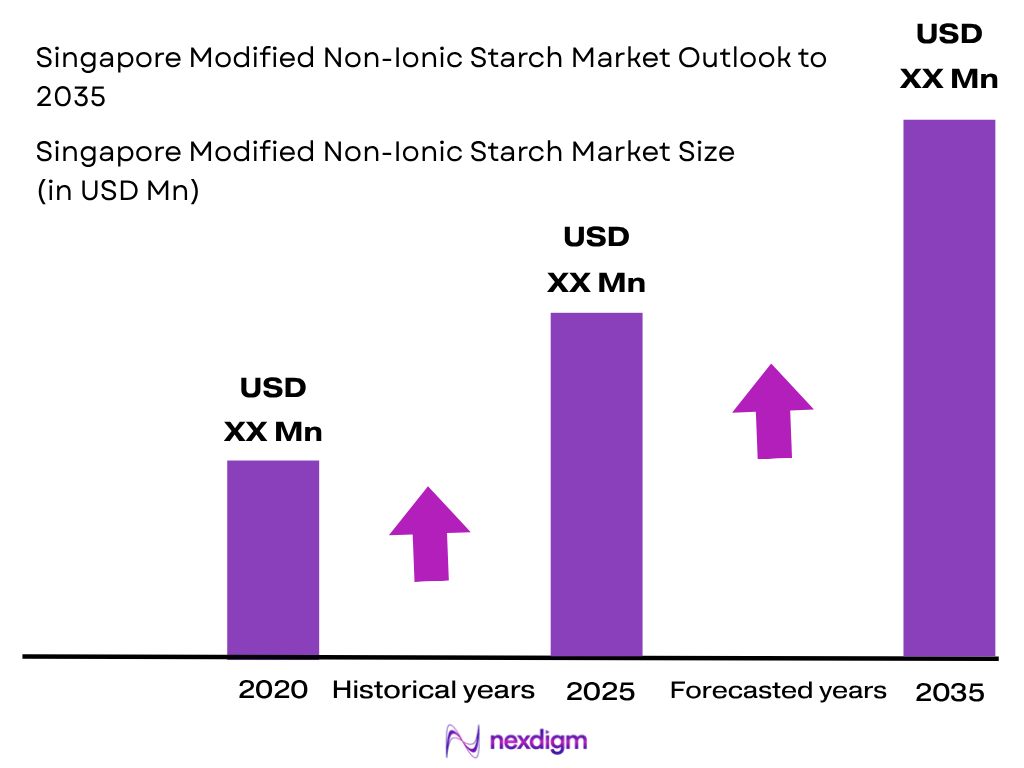
The Singapore Modified Non-Ionic Starch Market is valued at approximately USD ~ million in 2024, supported by demand from food processing, pharmaceutical formulation, and specialty industrial applications. The market growth is driven by Singapore’s position as a regional food manufacturing and ingredient trading hub, where modified starches are used for texture enhancement, viscosity control, stability improvement, and shelf-life extension. Singapore’s modified starch supply chain is primarily import-oriented, with major sourcing links from Thailand, Indonesia, and Malaysia due to limited domestic agricultural production.
The Singapore Modified Non-Ionic Starch Market is dominated by regional supply partners including Thailand, Malaysia, and Indonesia due to their strong cassava, corn, and tapioca starch production ecosystems. Singapore functions as a high-value processing, distribution, and formulation center because of its advanced food manufacturing infrastructure, pharmaceutical industry presence, and strategic logistics network. Major demand concentration exists around Singapore’s food processing clusters, specialty ingredient distributors, and multinational manufacturers operating in processed foods, beverages, and healthcare applications.
Market Segmentation
By Source Type
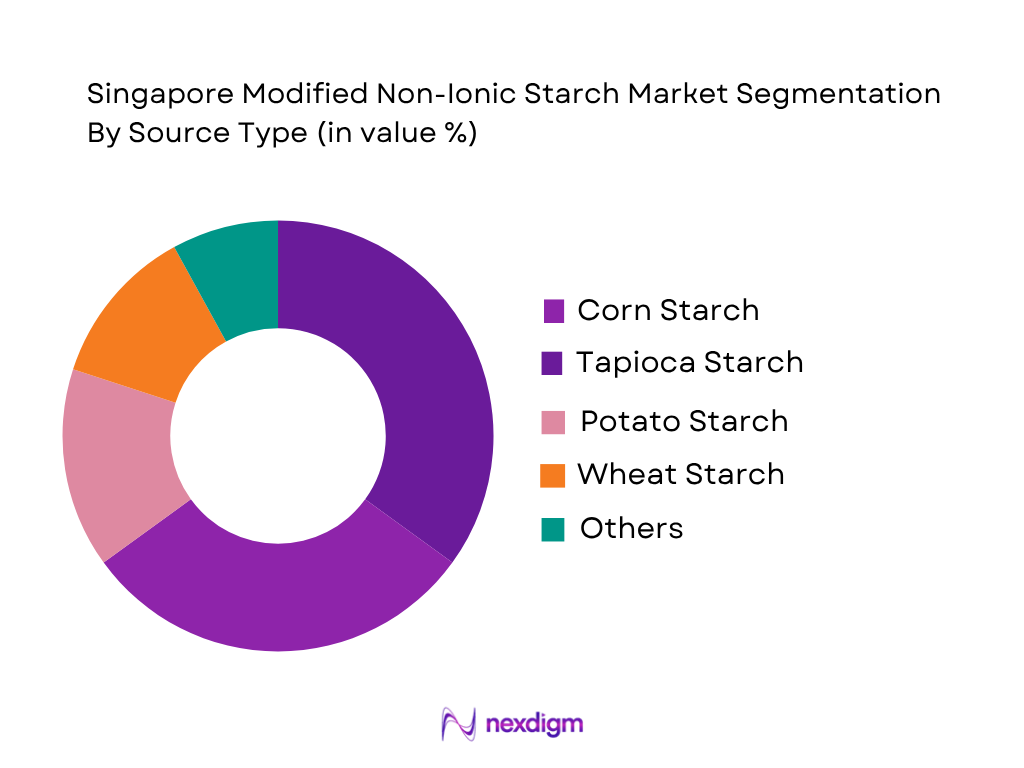
Singapore Modified Non-Ionic Starch Market is segmented by source type into corn starch, tapioca starch, potato starch, wheat starch, and other starch sources. Corn starch dominates the Singapore Modified Non-Ionic Starch Market due to its extensive global availability, established processing infrastructure, and broad compatibility across food and industrial applications. Corn-based modified starch is widely utilized in sauces, beverages, bakery products, processed foods, and pharmaceutical formulations because of its consistent functional characteristics. Tapioca starch represents another significant segment due to Southeast Asia’s strong cassava supply chain and preference for clean texture properties in food applications. Singapore’s import-dependent market structure enables manufacturers to source multiple starch varieties based on functionality, application requirements, and supply availability.
By Application
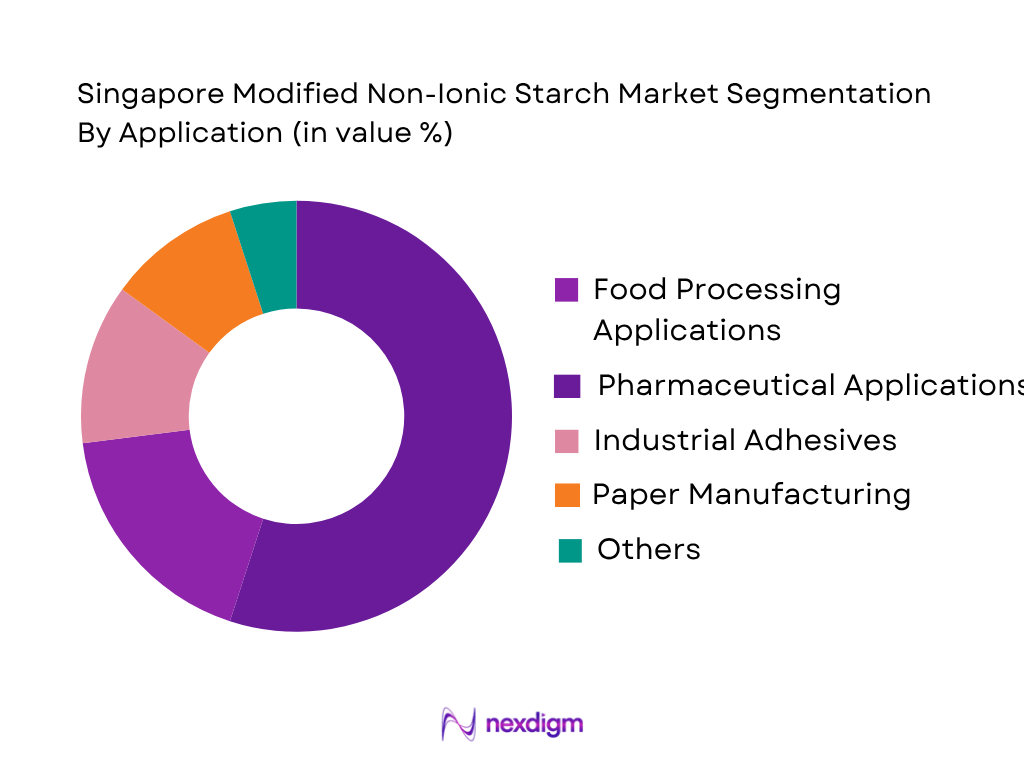
Singapore Modified Non-Ionic Starch Market is segmented by application into food and beverages, pharmaceuticals, industrial adhesives, paper and packaging, and other industrial applications. Food and beverages represent the dominant application segment in the Singapore Modified Non-Ionic Starch Market due to increasing utilization of functional ingredients for improving texture, stability, and processing performance. Modified starch is widely incorporated into convenience foods, frozen products, sauces, bakery fillings, and processed meals where manufacturers require freeze-thaw stability and consistent viscosity. Pharmaceutical applications also contribute significantly due to the use of starch derivatives as excipients and binding agents. Singapore’s developed food manufacturing ecosystem and strong pharmaceutical production capabilities support continuous demand for specialized starch ingredients.
Competitive Landscape
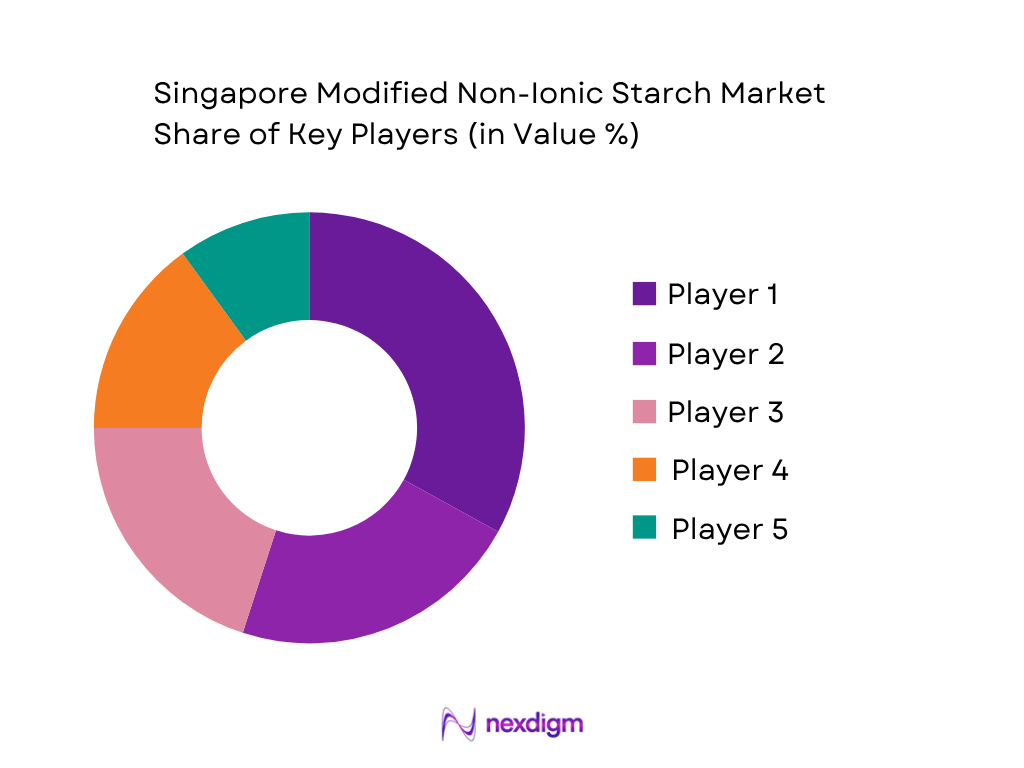
The Singapore Modified Non-Ionic Starch Market operates within an import-driven ingredient ecosystem, with competition shaped by global starch manufacturers, regional suppliers, and specialty ingredient distributors. Major companies compete through product functionality, application support, supply reliability, regulatory compliance, and customized starch solutions for food, pharmaceutical, and industrial users. Singapore’s limited agricultural base makes international sourcing capabilities and regional distribution networks critical competitive factors.
| Company | Establishment Year | Headquarters | Product Portfolio & Modified Starch Capabilities | Major Raw Material Focus | Key Application Areas | Regional Presence | Innovation & R&D Capability |
| Ingredion Incorporated | 1906 | Westchester, Illinois, USA | ~ | ~ | ~ | ~ | ~ |
| Cargill Incorporated | 1865 | Minneapolis, Minnesota, USA | ~ | ~ | ~ | ~ | ~ |
| Archer Daniels Midland Company (ADM) | 1902 | Chicago, Illinois, USA | ~ | ~ | ~ | ~ | ~ |
| Tate & Lyle PLC | 1921 | London, United Kingdom | ~ | ~ | ~ | ~ | ~ |
| Roquette | 1933 | Lestrem, France | ~ | ~ | ~ | ~ | ~ |
Singapore Modified Non-Ionic Starch Market Analysis
Growth Drivers
Expansion of Food Processing Industry
The Singapore Modified Non-Ionic Starch Market is supported by the expansion of the country’s advanced food processing ecosystem, where modified starch is used for improving viscosity, stability, texture, and shelf life in processed foods. Singapore’s food manufacturing sector benefits from its role as a regional production hub, with the country recording a GDP of approximately USD 501 billion at current prices in 2024, reflecting strong industrial and consumption activity. The Singapore Food Agency has identified food manufacturing as a strategic sector, supported by more than 1,000 food manufacturing establishments operating across the country. The increasing production of sauces, frozen foods, bakery products, beverages, and ready-to-eat meals is creating demand for functional starch ingredients. Singapore’s food import dependency, with more than 90% of food supplied through imports according to national food security data, further increases the requirement for specialized ingredient solutions that improve processing efficiency and product stability. Modified non-ionic starches support manufacturers in maintaining consistent quality despite changing raw material conditions and diverse international supply chains.
Growth of Functional Food Manufacturing
The Singapore Modified Non-Ionic Starch Market is benefiting from rising functional food manufacturing activities as producers increasingly require ingredients that provide improved texture, stability, and nutritional functionality. Singapore’s healthcare-oriented consumer environment and strong food innovation ecosystem support the adoption of specialty ingredients in functional beverages, dietary products, and health-focused foods. According to the World Bank, Singapore’s population reached approximately 5.9 million people in 2024, supporting continued demand for convenient and value-added food products. The country also recorded a services-dominated economy with manufacturing contributing a significant industrial base, creating opportunities for advanced ingredient applications. Functional food manufacturers use modified starches in products requiring controlled viscosity, improved mouthfeel, and enhanced processing performance. The growth of plant-based and wellness-oriented products further supports demand, as manufacturers require stabilizers and texture enhancers to replicate sensory properties traditionally achieved through animal-based ingredients. The increasing development of specialty food formulations in Singapore supports long-term adoption of modified non-ionic starch solutions.
Market Challenges
High Dependence on Imported Modified Starch Products
The Singapore Modified Non-Ionic Starch Market faces challenges due to limited domestic agricultural production and reliance on international suppliers for starch-based ingredients. Singapore has limited farmland availability, with agricultural land accounting for only a small portion of total territory, resulting in dependence on imports for food ingredients and industrial raw materials. According to government food security data, Singapore imports over 90% of its food supply, making ingredient availability closely connected with international trade networks. Modified starch production requires agricultural feedstocks such as corn, tapioca, potato, and wheat starch, which are primarily sourced from countries including Thailand, Indonesia, China, and the United States. This dependence exposes manufacturers to logistics disruptions, global commodity fluctuations, and international supply constraints. The absence of large-scale domestic starch modification facilities increases reliance on multinational ingredient producers. Food and pharmaceutical manufacturers operating in Singapore therefore need stable supplier relationships and diversified sourcing strategies to ensure consistent availability of specialized modified starch products.
Import Supply Chain Complexity and Regulatory Compliance Requirements
The Singapore Modified Non-Ionic Starch Market experiences supply chain complexity because most specialty starch ingredients enter through international trade channels before reaching domestic food, pharmaceutical, and industrial users. Singapore handled approximately 590 million tonnes of maritime cargo throughput in 2024, highlighting its position as a major global logistics hub; however, dependence on international shipping networks creates exposure to freight disruptions and geopolitical uncertainties. Modified starch products used in food and pharmaceutical applications must comply with strict safety and quality requirements established by regulatory authorities, increasing product approval and documentation requirements. The Singapore Food Agency regulates food ingredient safety, while pharmaceutical applications require compliance with healthcare manufacturing standards. Companies supplying modified starch solutions must maintain traceability, quality certifications, and technical documentation. These requirements can increase operational complexity for smaller manufacturers and distributors that lack specialized regulatory capabilities. The need for continuous compliance management remains a key challenge for market participants.
Market Opportunities
Clean Label Modified Starch Development
The Singapore Modified Non-Ionic Starch Market has opportunities through the development of clean-label modified starch solutions as food manufacturers increasingly seek recognizable and sustainable ingredients. Singapore’s strong food innovation ecosystem and focus on alternative protein and sustainable food technologies create demand for functional ingredients that improve product performance while meeting consumer preferences. The Singapore Economic Development Board continues to promote food technology investments, with the country hosting numerous multinational food companies and innovation facilities. The country’s food manufacturing sector is supported by advanced processing infrastructure and high consumer demand for convenient and healthier food products. Clean-label modified starches can support applications in sauces, bakery products, beverages, and plant-based foods by improving texture and stability without compromising formulation goals. Growing interest in plant-based foods also creates opportunities because alternative protein products require stabilizers and texture modifiers to achieve desirable sensory characteristics. Manufacturers developing specialty starch solutions can address these evolving formulation requirements.
Pharmaceutical Excipient Expansion
The Singapore Modified Non-Ionic Starch Market presents opportunities through pharmaceutical excipient applications due to the country’s established biomedical manufacturing sector and increasing demand for advanced healthcare production. Singapore is a major pharmaceutical manufacturing hub in Asia, with more than 60 biomedical manufacturing facilities operating across pharmaceutical, biotechnology, and medical technology segments. Modified starches are used as pharmaceutical excipients for binding, disintegration, and controlled-release applications in tablet and capsule formulations. The country’s pharmaceutical industry benefits from advanced manufacturing standards, strong regulatory infrastructure, and significant foreign investment. According to the World Bank, Singapore maintained high-income economy status with GDP per capita exceeding USD 80,000 in 2024, supporting healthcare infrastructure development and pharmaceutical innovation. Increasing demand for specialized drug formulations creates opportunities for pharmaceutical-grade starch suppliers that can provide consistent quality and regulatory compliance. Expansion of healthcare manufacturing activities strengthens demand for technically advanced modified starch solutions beyond traditional food applications.
Future Outlook
Over the next decade, the Singapore Modified Non-Ionic Starch Market is expected to witness steady expansion due to increasing demand from processed food manufacturers, pharmaceutical companies, and specialty ingredient users. Growth will be supported by rising preference for functional ingredients, clean-label reformulation, convenience food production, and advanced food processing technologies. Singapore’s role as a Southeast Asian distribution and manufacturing hub will continue strengthening demand for imported specialty starch products.
The future market direction will be influenced by the development of customized starch formulations, sustainable ingredient solutions, and improved functionality for temperature stability, viscosity control, and texture enhancement. Pharmaceutical and industrial applications are expected to provide additional opportunities alongside traditional food applications.
Major Players
- Ingredion Incorporated
- Cargill
- Archer Daniels Midland Company
- Tate & Lyle
- Roquette
- Kerry Group
- Beneo
- Avebe
- Asia Fructose Co., Ltd.
- Thai Wah Public Company Limited
- Tereos
- Japan Corn Starch Co., Ltd.
- Samyang Corporation
- Emsland Group
- AGRANA Beteiligungs-AG
Key Target Audience
- Food processing companies
- Beverage manufacturing companies
- Bakery and confectionery manufacturers
- Pharmaceutical manufacturers and excipient buyers
- Industrial adhesive manufacturers
- Packaging and paper manufacturing companies
- Investments and venture capitalist firms (Food technology investment funds, ingredient innovation investors)
- Government and regulatory bodies (Singapore Food Agency, Enterprise Singapore, Economic Development Board Singapore)
Research Methodology
Step 1: Identification of Key Variables
The initial phase involves defining the Singapore Modified Non-Ionic Starch Market ecosystem by identifying manufacturers, importers, distributors, end-user industries, and regulatory stakeholders. Secondary research is conducted to understand supply chains, application areas, product categories, and market influencing factors.
Step 2: Market Analysis and Construction
Historical market information is analyzed through demand-side and supply-side assessment approaches. The analysis evaluates starch consumption patterns, application penetration, import dependency, end-user requirements, and industry-level adoption trends across food, pharmaceutical, and industrial sectors.
Step 3: Hypothesis Validation and Expert Consultation
Market assumptions are validated through discussions with industry participants including ingredient suppliers, food manufacturers, pharmaceutical companies, and distributors. These consultations provide operational insights regarding product preferences, application challenges, and future demand patterns.
Step 4: Research Synthesis and Final Output
The final stage integrates collected information through data triangulation and validation processes. Insights from manufacturers, supply chain participants, and application industries are combined to develop a comprehensive assessment of the Singapore Modified Non-Ionic Starch Market.

- Executive Summary
- Research Methodology (Market Definitions and Assumptions, Modified Non-Ionic Starch Market Classification, Starch Chemistry Assessment, Starch Modification Technology Mapping, Hydroxypropyl Starch Analysis, Acetylated Starch Assessment, Cross-Linked Starch Evaluation, Pregelatinized Starch Assessment, Specialty Modified Starch Mapping, Feedstock Source Analysis, Corn-Based Starch Assessment, Tapioca-Based Starch Assessment, Potato-Based Starch Assessment, Application-Level Demand Analysis, Food Ingredient Assessment, Pharmaceutical Excipient Analysis, Industrial Application Evaluation, Import and Export Trade Analysis, Raw Material Supply Assessment, Demand-Side Assessment, Supply-Side Assessment, Top-Down Market Sizing, Bottom-Up Market Sizing, Primary Industry Interviews, Data Triangulation, Forecasting Framework, Market Share Validation, Limitations and Future Conclusions)

- Definition and Scope
- Market Evolution and Development of Functional Starch Ingredients
- Modified Non-Ionic Starch Value Chain Analysis
- Modified Non-Ionic Starch Supply Chain Analysis
- Modified Non-Ionic Starch Integration Across Food

- Growth Drivers (Expansion of Food Processing Industry, Growth of Functional Food Manufacturing, Increasing Demand for Clean Label Ingredients, Rising Bakery and Confectionery Production, Expansion of Ready-to-Eat Food Sector, Growth of Pharmaceutical Manufacturing, Increasing Demand for Texture Enhancement Solutions, Growth of Plant-Based Food Products, Expansion of Specialty Ingredient Applications)
- Market Challenges (High Dependence on Imported Modified Starch Products, Limited Domestic Starch Production Capacity, Dependence on International Feedstock Suppliers, Import Supply Chain Complexity, Regulatory Compliance Requirements, Competition from Hydrocolloids and Alternative Ingredients, Limited Local Modification Facilities, High Dependence on Global Ingredient Technology)
- Market Opportunities (Clean Label Modified Starch Development, Plant-Based Food Ingredient Innovation, Pharmaceutical Excipient Expansion, Gluten-Free Food Applications, Sustainable Starch Processing Technologies, Specialty Bakery Ingredient Demand, Functional Beverage Applications, Regional Export Supply Opportunities, Advanced Industrial Adhesive Applications)
- Market Trends (Clean Label Functional Ingredients, Halal and Quality Certified Ingredient Demand, Plant-Based Food Formulation Growth, Premium Bakery Product Innovation, Pharmaceutical Grade Starch Adoption, Sustainable Ingredient Processing, Specialty Food Ingredient Imports, Application-Specific Modified Starch Development)
- Government Regulations (Singapore Food Agency Food Additive Regulations, Singapore Standards and Food Safety Requirements, Imported Food Ingredient Compliance Standards, Halal Certification Requirements, Pharmaceutical Excipient Quality Standards, Chemical Import Regulations, Food Labeling Requirements)
- SWOT Analysis
- Porter’s Five Forces Analysis
- PESTLE Analysis
- Stakeholder Ecosystem
- Competition Ecosystem

- By Market Value (2020-2025)
- By Market Volume Consumption (2020-2025)
- By Modified Starch Import Volume (2020-2025)
- By Non-Ionic Starch Consumption Volume (2020-2025)
- By Food Grade Modified Starch Consumption (2020-2025)
- By Pharmaceutical Grade Modified Starch Consumption (2020-2025)

- By Modification Type (In Value %)
Hydroxypropyl Starch
Cross-Linked Starch
Acetylated Starch
Hydroxypropyl Distarch Phosphate
Acetylated Distarch Adipate
Pregelatinized Modified Starch
Oxidized Starch
Specialty Non-Ionic Modified Starch - By Raw Material Source (In Value %)
Corn-Based Modified Starch
Tapioca-Based Modified Starch
Potato-Based Modified Starch
Wheat-Based Modified Starch
Rice-Based Modified Starch
Other Specialty Feedstock-Based Modified Starch - By Application (In Value %)
Food and Beverage Processing
Bakery and Confectionery Products
Dairy and Frozen Food Applications
Processed Foods and Ready Meals
Sauces, Dressings and Condiments
Pharmaceutical Excipients
Nutraceutical Applications
Industrial Adhesives
Paper and Textile Processing - By End-Use Industry (In Value %)
Bakery Industry
Dairy Processing Industry
Pharmaceutical Manufacturing Industry
Nutraceutical Industry
Industrial Adhesive Manufacturing
Chemical Processing Industry - By Distribution Channel (In Value %)
Direct Import and Bulk Procurement
Specialty Ingredient Distributors
Food Ingredient Traders
Industrial Chemical Distributors
Online B2B Ingredient Platforms - By Region (In Value %)
Central Region
East Region
West Region
North Region
North-East Region

- Market Share of Major Players (By Revenue, Modified Starch Sales Volume, Modification Technology Portfolio, Food Application Coverage, Pharmaceutical Application Coverage, Industrial Application Coverage, Import Distribution Network, Regional Presence, Customer Base)
- Cross Comparison Parameters (Modified Starch Portfolio Breadth, Non-Ionic Modification Technology Capability, Hydroxypropyl Starch Expertise, Food Grade Certification Coverage, Pharmaceutical Grade Product Capability, Southeast Asia Distribution Network Reach, Technical Application Support Capability, Sustainable Starch Solution Portfolio)
- SWOT Analysis of Major Players
- Detailed Profiles of Major Companies
Ingredion Incorporated
Cargill Incorporated
Archer Daniels Midland Company (ADM)
Roquette Frères
Tate & Lyle PLC
Beneo GmbH
Avebe U.A.
Tereos Group
Emsland Group
AGRANA Beteiligungs-AG
KMC Ingredients
Thai Wah Public Company Limited
Asia Fructose Co., Ltd.
Universal Starch-Chem Allied Limited
Galam Group

- Food Manufacturer Modified Starch Procurement Assessment
- Bakery Manufacturer Functional Ingredient Requirement Analysis
- Dairy Processor Stabilizer and Texture Modifier Assessment
- Processed Food Manufacturer Formulation Analysis
- Pharmaceutical Manufacturer Excipient Procurement Assessment
- Nutraceutical Manufacturer Ingredient Requirement Analysis
- Plant-Based Food Producer Ingredient Assessment

- By Market Value (2026-2035)
- By Market Volume Consumption (2026-2035)
- By Modified Starch Import Volume (2026-2035)
- By Non-Ionic Starch Consumption Volume (2026-2035)
- By Food Grade Modified Starch Consumption (2026-2035)
- By Pharmaceutical Grade Modified Starch Consumption (2026-2035)


 Request a Sample
 Ask for Customization
 Get a Quote
 Enquire Now