
 Download PDF
Market Overview
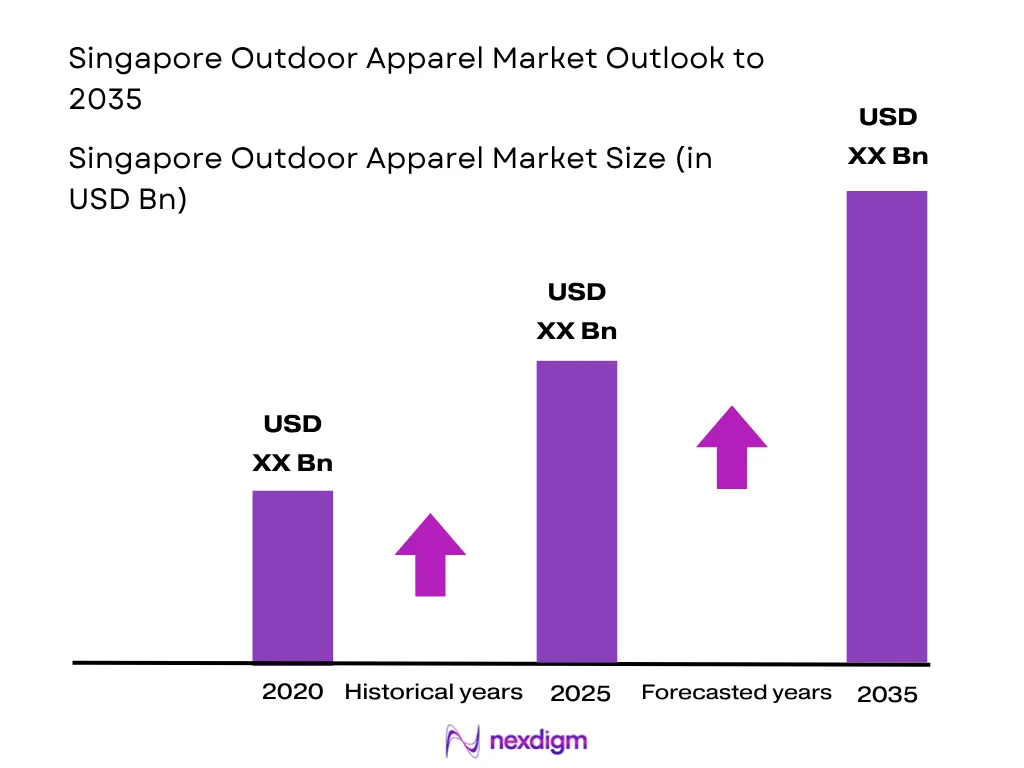
The Singapore outdoor apparel market is valued at USD ~ billion in 2025, based on Nexdigm’s estimates for the broader sports apparel segment that includes outdoor clothing and performance‑oriented gear. This figure reflects robust demand for technical outdoor wear driven by rising consumer participation in outdoor fitness activities and increasing disposable incomes that enable purchases of performance‑oriented apparel and accessories. Consumer preference for functional apparel that supports outdoor lifestyles underpins the ongoing expansion of market value.
The market’s expansion is also influenced by regional participation rates in outdoor sports and leisure activities, with Singapore serving as a hub for outdoor fitness events, trail running, and urban adventure activities. Dominant cities such as Singapore, supported by high urban affluence and widespread availability of outdoor retail formats, attract both global and regional outdoor brands. International players prioritize Singapore due to its high consumer purchasing power, well‑established retail infrastructure, and strategic location that facilitates distribution across Southeast Asia.
Market Segmentation
By Product Type
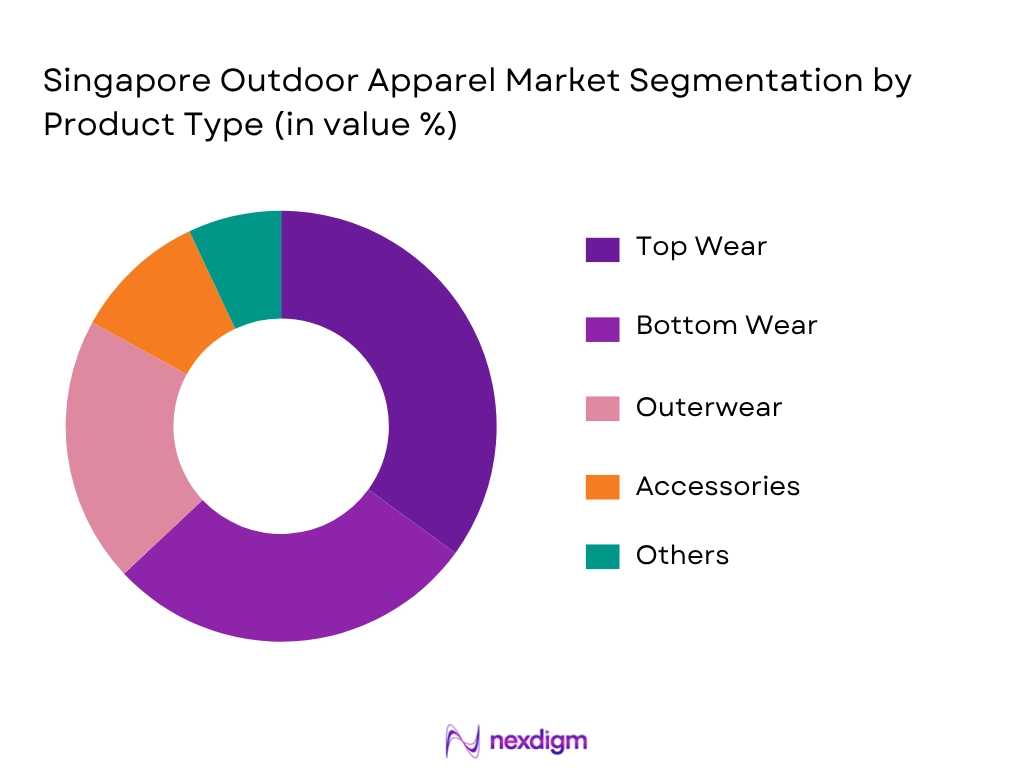
By product type, Top Wear dominates the Singapore outdoor apparel market share, capturing roughly 35 % of consumer spend. This dominance stems from the widespread preference for versatile upper body apparel that suits both urban and outdoor environments technical tops with moisture‑wicking, UV protection, and breathable fabrics meet the needs of trail runners, hikers, and fitness‑oriented outdoor participants alike. Global brands continue to expand their top wear offerings with technology‑integrated fabrics and fashion‑forward designs, which further supports consumer adoption in Singapore’s affluent market.
By Distribution Channel
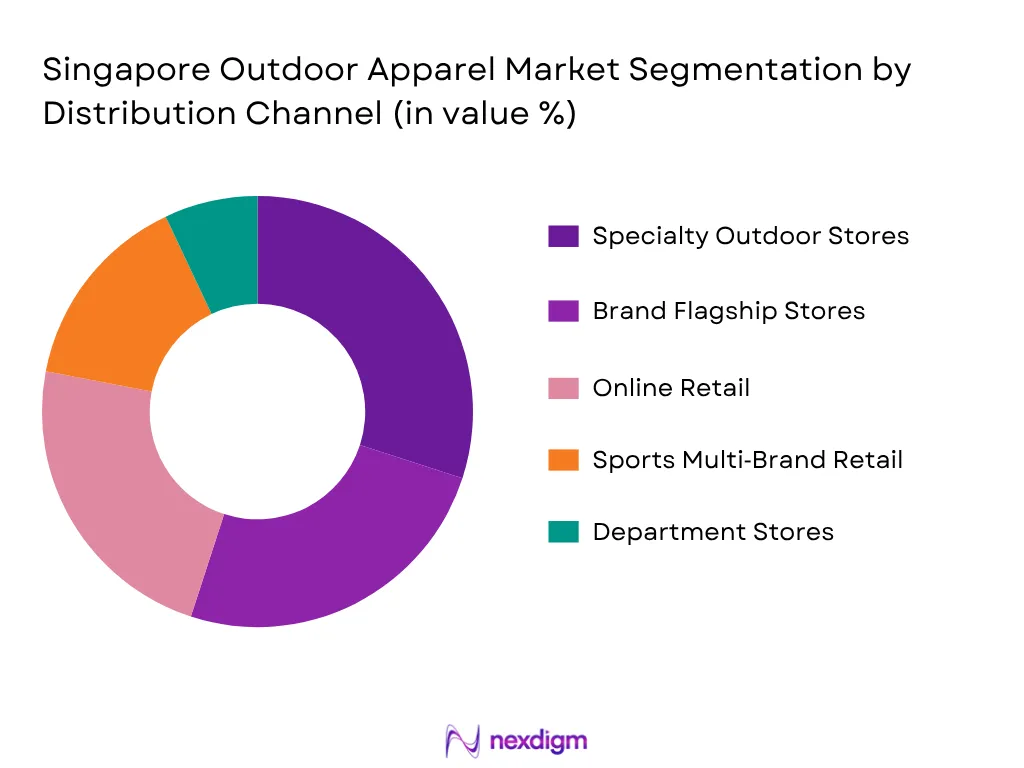
The Specialty Outdoor Stores segment holds the largest share among distribution channels, benefiting from curated selections of performance‑oriented outdoor apparel that attract enthusiasts seeking expert guidance and technical expertise. These stores often stock a wide range of products from major global brands and technical gear lines, which enhances their appeal to Singaporean consumers who prioritize product performance and durability. Flagship stores of outdoor brands also contribute significantly by offering exclusive lines and first‑access to new product releases, reinforcing channel preference within the market.
Competitive Landscape
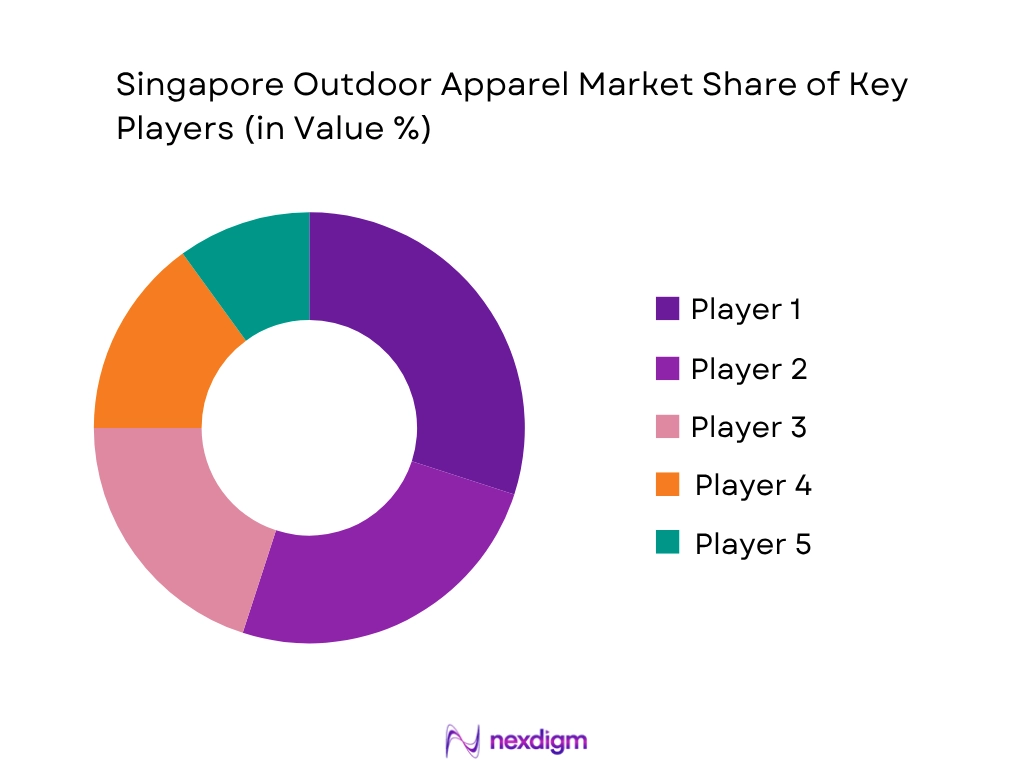
The Singapore outdoor apparel market exhibits a competitive yet consolidated environment where international brands lead visibility and retail presence. Major players compete across performance, sustainability, design aesthetics, and channel strategy. The market is influenced by a mix of global labels with strong technical apparel portfolios and regional retailers that cater to local preferences. Consolidation trends reflect strategic alliances, expanded retail footprints, and digital commerce acceleration.
| Company | Est. Year | Headquarters | Retail Footprint Cities | Technical Fabric Integration | Sustainable Product Range Presence | E‑Commerce Penetration | Brand Recognition Index |
| The North Face | 1966 | USA | ~ | ~ | ~ | ~ | ~ |
| Columbia Sportswear | 1938 | USA | ~ | ~ | ~ | ~ | ~ |
| Patagonia | 1973 | USA | ~ | ~ | ~ | ~ | ~ |
| Arc’teryx | 1989 | Canada | ~ | ~ | ~ | ~ | ~ |
| Salomon | 1947 | France | ~ | ~ | ~ | ~ | ~ |
Singapore Outdoor Apparel Market Analysis
Growth Drivers
Performance & Technology Innovation
Singapore’s outdoor apparel market is benefiting from the country’s strong economic fundamentals and high consumer purchasing power, which support demand for technologically advanced outdoor clothing. According to the IMF, Singapore’s GDP reached USD 659.57 billion in 2024, while GDP per capita stood at USD 107,760. The World Bank reported GDP per capita at approximately USD 90,674 in 2024, placing Singapore among the highest-income economies globally. High disposable incomes enable consumers to spend on premium outdoor apparel featuring moisture-wicking fabrics, UV protection, waterproof membranes, lightweight insulation, and smart textile technologies. Singapore also ranks among the world’s leading innovation-driven economies, supported by strong digital infrastructure and advanced manufacturing capabilities. These factors encourage the adoption of performance-oriented apparel products rather than basic clothing. The country’s role as a major regional trade and logistics hub further facilitates access to global outdoor apparel brands and technical textile innovations. As consumers increasingly prioritize functionality, comfort, and durability, performance-driven outdoor apparel continues to gain traction across Singapore’s retail landscape.
Outdoor Participation
The outdoor apparel market in Singapore is supported by growing participation in recreational and outdoor activities, facilitated by the country’s high standard of living and extensive urban recreation infrastructure. Singapore’s population exceeded 6.1 million in 2025, creating a substantial consumer base for outdoor clothing and accessories. The government continues to invest in parks, nature reserves, cycling networks, waterfront recreation spaces, and wellness initiatives that encourage outdoor engagement. Strong labor market conditions further support spending on leisure activities, with unemployment estimated at 1.8% in 2024. High-income households increasingly participate in activities such as hiking, cycling, trail running, camping during overseas travel, and water sports, all of which require specialized apparel. Singapore’s position as a major aviation hub also supports outbound tourism, enabling residents to engage in outdoor activities across neighboring countries and driving demand for weather-resistant and performance-oriented apparel. The combination of economic stability, low unemployment, and access to recreational infrastructure continues to create favorable conditions for sustained demand within the outdoor apparel segment.
Market Challenge
Raw Material Volatility
Raw material volatility remains a significant challenge for Singapore’s outdoor apparel market because the country relies heavily on imported textile inputs and finished apparel products. According to the WTO Global Value Chains Sectoral Profile, foreign value-added content accounted for approximately 50% of Singapore’s textile and clothing exports, highlighting substantial dependence on external suppliers and imported materials. Outdoor apparel production often relies on synthetic fibers such as polyester, nylon, and technical fabrics derived from petrochemical inputs, making manufacturers vulnerable to fluctuations in global commodity prices and supply conditions. The WTO also notes that agriculture contributed 10.9% of the value-added in global textile and apparel exports, while chemicals contributed 5.6%, illustrating the sector’s reliance on multiple upstream industries that are exposed to price shocks. Singapore’s highly open economy and dependence on global trade networks mean that fluctuations in raw material costs can affect sourcing decisions, inventory planning, and product development strategies for outdoor apparel companies operating in the market.
Supply Chain Issues
Supply chain disruptions continue to affect Singapore’s outdoor apparel market despite the country’s strong logistics infrastructure. The Asian Development Bank’s Asia-Pacific Trade Facilitation Report 2024 highlights that geopolitical tensions, trade disruptions, and elevated global trade costs continue to create uncertainty across international supply chains. Outdoor apparel manufacturers depend on globally dispersed sourcing networks for fabrics, technical materials, trims, and finished garments, making the sector particularly vulnerable to transportation delays and supply bottlenecks. Singapore functions as one of the world’s busiest transshipment hubs, handling more than 30 million twenty-foot equivalent units (TEUs) annually, according to the World Bank. While this provides significant logistical advantages, it also means that the local apparel industry remains closely linked to international shipping conditions. Delays in the movement of textiles, synthetic fibers, and finished products can impact inventory availability and seasonal product launches. The continued dependence on international suppliers and complex global value chains creates operational challenges for outdoor apparel brands serving Singapore’s market.
Market Opportunity
Sustainable and Circular Product Lines
Sustainability presents a significant opportunity for Singapore’s outdoor apparel market as consumers increasingly focus on environmentally responsible consumption. Singapore’s government has prioritized sustainability through national environmental initiatives and circular economy development. The outdoor apparel industry is particularly well-positioned to benefit because technical apparel products often have longer usage cycles and are suitable for repair, recycling, and resale programs. According to the WTO, services contributed 34.7% of the value-added in global textile and apparel exports in 2022, reflecting the growing importance of activities such as logistics, product lifecycle management, recycling systems, and circular business services. Singapore’s strong innovation ecosystem, advanced waste management capabilities, and high-income consumer base support the adoption of sustainable outdoor apparel offerings. The country’s GDP per capita exceeded USD 90,000 in 2024 according to World Bank data, providing consumers with the purchasing power needed to support premium sustainable products. Brands that introduce recycled materials, repair services, take-back programs, and circular business models can capitalize on evolving consumer preferences and sustainability-focused policy frameworks.
Direct-to-Consumer (DTC) Expansion
Direct-to-consumer channels represent a major growth opportunity for Singapore’s outdoor apparel market due to the country’s advanced digital infrastructure and affluent consumer base. Singapore ranks among the world’s most digitally connected economies and maintains a highly favorable business environment. The World Bank’s Business Ready 2024 assessment identifies Singapore as one of the leading global locations for business operations and investment. High-income consumers increasingly prefer online purchasing channels that provide access to specialized outdoor apparel products, exclusive collections, and personalized shopping experiences. Singapore’s GDP reached approximately USD 659.57 billion in 2024 according to the IMF, while GDP per capita exceeded USD 90,000 according to World Bank data. These economic conditions support higher discretionary spending and digital commerce adoption. Direct-to-consumer models allow outdoor apparel brands to improve customer engagement, collect consumer insights, and reduce reliance on traditional retail intermediaries. Singapore’s efficient logistics network, international connectivity, and digitally mature population create a strong foundation for further expansion of online and brand-owned sales channels in the outdoor apparel sector.
Future Outlook
Over the next decade, the Singapore outdoor apparel market is expected to maintain steady growth supported by sustained consumer interest in active lifestyles, outdoor wellness pursuits, and environmental awareness. The integration of performance‑enhancing technologies with sustainable materials will be a key driver, as brands respond to demand for eco‑friendly and functional apparel. Expansion of digital retail channels, personalized fit technologies, and experiential retail concepts will further influence purchasing behavior and enhance market penetration across consumer cohorts.
Major Players
- The North Face
- Columbia Sportswear
- Patagonia
- Arc’teryx
- Salomon
- Marmot
- Merrell
- Black Diamond
- Nike ACG
- Adidas Terrex
- Helly Hansen
- Uniqlo (Outdoor & Hybrid Lines)
- REI Co‑op (Regional Partnerships)
- Under Armour (Outdoor Lines)
- Outdoor Research
Key Target Audience
- Retail & Outdoor Chain Buyers
- Brand Licensing & Distribution Partners
- International Outdoor Apparel Brand Investors
- Investment & Venture Capitalist Firms (Outdoor & Active Lifestyle Equity Funds)
- Singapore Tourism Board – Active Lifestyle & Retail Promotion Agencies
- Ministry of Trade & Industry, Singapore – Apparel & Retail Policy Division
- Retail Real Estate Developers (Mall & Experience‑Led Retail Planning)
- E‑Commerce Marketplace Category Directors (Performance Apparel)
Research Methodology
Step 1: Market Scope Identification
The initial phase defines the Singapore outdoor apparel market boundaries, including product types, distribution channels, and end users. This involves extensive desk research across government statistics, retail trade data, and industry reports to establish scope and key variables.
Step 2: Data Collection & Market Synthesis
Historical revenue and unit shipment data are collated from secondary sources, including industry publications and proprietary databases. Complementary analysis of consumer behavior and retail channel penetration enhances accuracy of market sizing.
Step 3: Expert Consultation & Validation
Hypotheses and preliminary estimates are tested through interviews with industry stakeholders, including brand managers, retail executives, and supply chain professionals. These consultations refine data points and ensure alignment with operational insights.
Step 4: Forecast Modelling & Final Output
A combination of quantitative forecasting models and qualitative trend analysis is used to project future market size and growth. Outputs are cross‑verified with available industry forecasts and adjusted for Singapore’s macroeconomic and consumer spending patterns.

- Executive Summary
- Research Methodology (Market Scope Definition, Outdoor Apparel Specific Definitions, Abbreviations, Market Sizing Model, Retail Channel Data Sources, Consumer Survey Methodology, Import‑Export Data Sources and Assumptions, Competitive Benchmarking Approach, Price & Volume Estimation Methodology, Limitations)

- Market Definition & Scope
- Industry Genesis & Adoption Pattern
- Outdoor Apparel Value Chain Analysis
- Singapore Outdoor Apparel Market Structure
- Market Maturity and Lifecycle Assessment

- Growth Drivers (Performance & Tech Innovation, Outdoor Participation, Brand Loyalty, Omni-Channel Expansion, Eco Fabrics, Climate/Season Demand, Health & Fitness, Urban Adventure)
- Market Challenges (Raw Material Volatility, Supply Chain Issues, Channel Cannibalization, Counterfeit Products, Price Sensitivity, Inventory/Seasonal Stock, High Rent, Fast Fashion Competition)
- Opportunities (Sustainable/Circular Lines, Direct-to-Consumer, Rental/Resale, Customization, Wearable Tech, Private Labels, E-Commerce, Event Collaborations)
- Emerging Trends (Smart Fabrics, Influencer Marketing, Seasonal Capsules, Sustainable Packaging, Hybrid Urban-Outdoor, Personalized Apparel, Limited Editions, Eco Textiles)
- Regulatory Environment (Consumer Protection, Textile Safety, Tariffs & Trade, Environmental & Labor, OEKO-TEX/Bluesign, Advertising Rules, Packaging, Import/Labeling)
- Porter’s Five Forces (New Entrants, Supplier Power, Buyer Power, Substitutes, Rivalry)
- SWOT Analysis (Strengths: Brand Equity, Tech Performance; Weaknesses: Price Sensitivity, Inventory Risk; Opportunities: Sustainability, Direct-to-Consumer; Threats: Supply Disruption, Seasonal Demand)
- Value & Supply Chain Materials (Domestic vs Imports, Production & Capacity, Logistics & Distribution, Retail & Wholesale, Quality & Returns)
- Consumer Behavior & Retail Analytics (Purchase Frequency, Basket Affinity, Brand Loyalty, Online vs In-Store, Social Media Influence, Seasonal/Weather Buying, Willingness-to-Pay, Activity-Based Apparel)

- By Market Revenue (2020-2025)
- By Unit Volume Shipments (2020-2025)
- By Average Selling Price (2020-2025)
- By Import vs. Local Sourcing Value (2020-2025)

- By Product Type (In Value%)
Performance Tops
Outdoor Pants & Shorts
Waterproof / Rainwear
Insulated / Layering Apparel
Multifuntional / Hybrid Outdoor Lifestyle Apparel - By Material Composition (In Value%)
Synthetic High‑Performance
Natural Fibres
Recycled / Eco‑Certified Materials
Hybrid / Composite Textile Solutions - By End Use / Activity Segment (In Value%)
Hiking & Trekking
Trail Running & Outdoor Fitness
Camping & Backpacking
Water‑Based Outdoor Sports
Urban Adventure Lifestyle - By Distribution Channel (In Value%)
Speciality Outdoor Stores
Sports/Activewear Multi‑Brand Stores
Brand Flagship Stores
E‑Commerce
Department & Lifestyle Channels - By Consumer Cohort (In Value%)
Adventure Enthusiasts
Professional/Technical Users
Recreational Buyers
Youth / Lifestyle Segment
Premium & Luxury Outdoor Apparel Segment

- Market Share & Positioning (Revenue Share, Unit Volume Share, Price Tier Positioning, Brand Equity, Technical Apparel Focus, Activity-Specific Focus, Channel Strength, Geographic Coverage)
- Cross‑Comparison Parameters (Company Overview, Product Portfolio Breadth, Distribution Footprint Metrics, Retail Channel Penetration, Brand Penetration Index, Price Tier Matrix, Innovation & Tech Adoption Score, Sustainability Credentials)
- Pricing Analysis (SKU Price Bands, ASP Comparison, Premium vs Mid-Tier vs Value Segments, Discount & Promotion Strategies)
- SWOT Analysis of Key Players (Strengths: Brand Reputation, Technical Innovation; Weaknesses: Price Sensitivity, Limited Local Penetration; Opportunities: D2C & E-Commerce Growth, Sustainability Initiatives; Threats: Competition, Counterfeit Products, Supply Chain Risks)
- Strategic Initiatives & Developments (New Product Launches, Market Expansion, Partnerships & Collaborations, Omnichannel Strategy, Sustainability Projects, Digital Marketing Campaigns, Retail & E-Commerce Expansion)

- Purchase Drivers (Performance & Comfort, Brand Reputation, Sustainability, Price vs Value, Seasonal/Weather Suitability, Fashion & Lifestyle Appeal, Urban & Outdoor Versatility)
- Buying Challenges (High Prices, Limited Technical Options in Local Stores, Size/Fit Issues, Stock Seasonality, Counterfeit Products, Limited Awareness of Eco Options)
Consumer Segments (Adventure Enthusiasts, Recreational Users, Fitness-Focused, Urban Lifestyle Buyers, Premium & Luxury Outdoor Consumers) - Buying Channels (Specialty Outdoor Stores, Brand Flagships, Multi-Brand Retail, Online Retail, Department Stores)
- Influences on Decisions (Social Media & Influencers, Peer Recommendations, Retail Experience, Product Reviews, Sustainability Messaging, Product Innovation)
- Purchase Frequency & Patterns (Frequent Top Wear Purchases, Seasonal Outerwear, Accessories & Gear Bundling, Online Impulse vs Planned In-Store Buying)
- Willingness-to-Pay Factors (Technical Features, Eco-Certifications, Brand Trust, Limited Editions, Product Longevity)
- Consumer Trends (Preference for Hybrid Urban + Outdoor Apparel, Activity-Specific Apparel, Personalization & Customization, Digital & Omni-Channel Engagement)

- By Market Revenue (2026-2035)
- By Unit Volume Shipments (2026-2035)
- By Average Selling Price (2026-2035)
- By Import vs. Local Sourcing Value (2026-2035)


 Request a Sample
 Ask for Customization
 Get a Quote
 Enquire Now