

 Download PDF
Market Overview
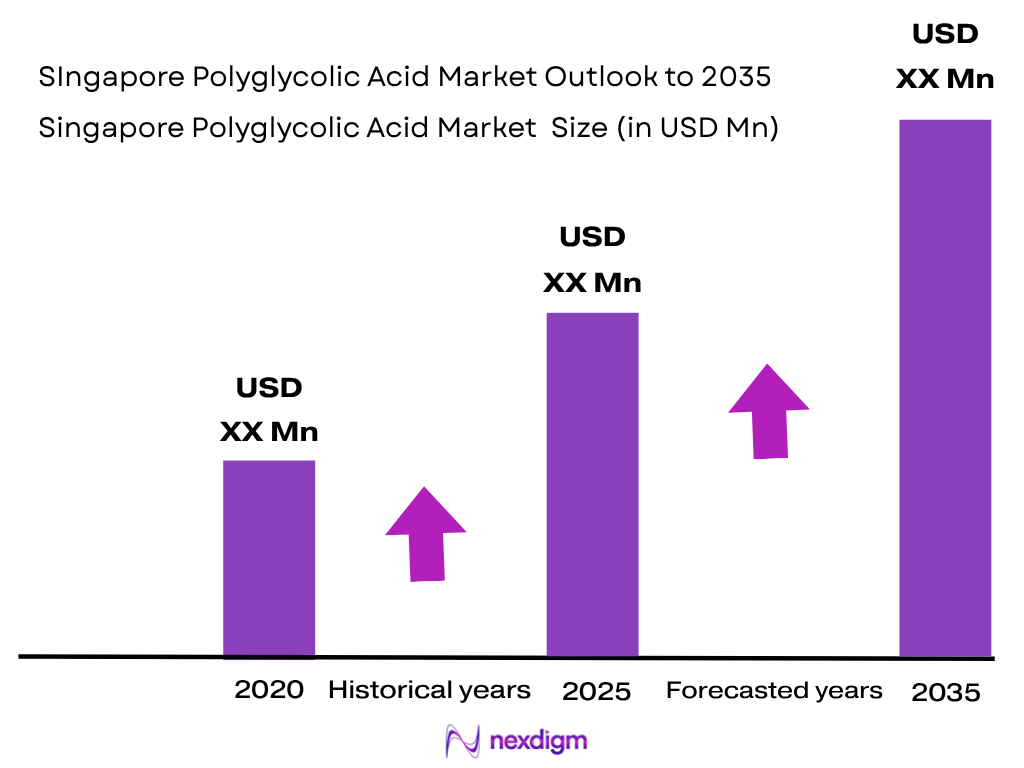
The Singapore Polyglycolic Acid Market is estimated at ~USD XX million in 2024, compared with ~USD XX million in 2023, with demand primarily connected to Singapore’s highly developed medical technology, biomedical manufacturing, specialty chemicals and advanced manufacturing ecosystems. Singapore’s MedTech manufacturing output reached S$19.4 billion in 2023, while the broader biomedical sciences industry produced more than S$32 billion of products in 2024. These industrial capabilities provide a strong downstream environment for high-performance, bioabsorbable and specialty polymers such as PGA.
Singapore and the wider Asia-Pacific region represent the principal demand context for PGA-based applications, with Singapore functioning primarily as a high-value manufacturing, medical-device, R&D and regional distribution hub rather than a large-volume commodity polymer production centre. Singapore’s ecosystem includes more than 400 global and local MedTech enterprises, approximately 17,000 MedTech workers, and more than 2,700 precision-engineering and electronic-manufacturing suppliers. The country’s ability to combine advanced manufacturing, regulatory infrastructure and regional market access supports adoption of specialty PGA materials in medical devices, biomedical research and selected industrial applications.
Market Segmentation
By Product Form
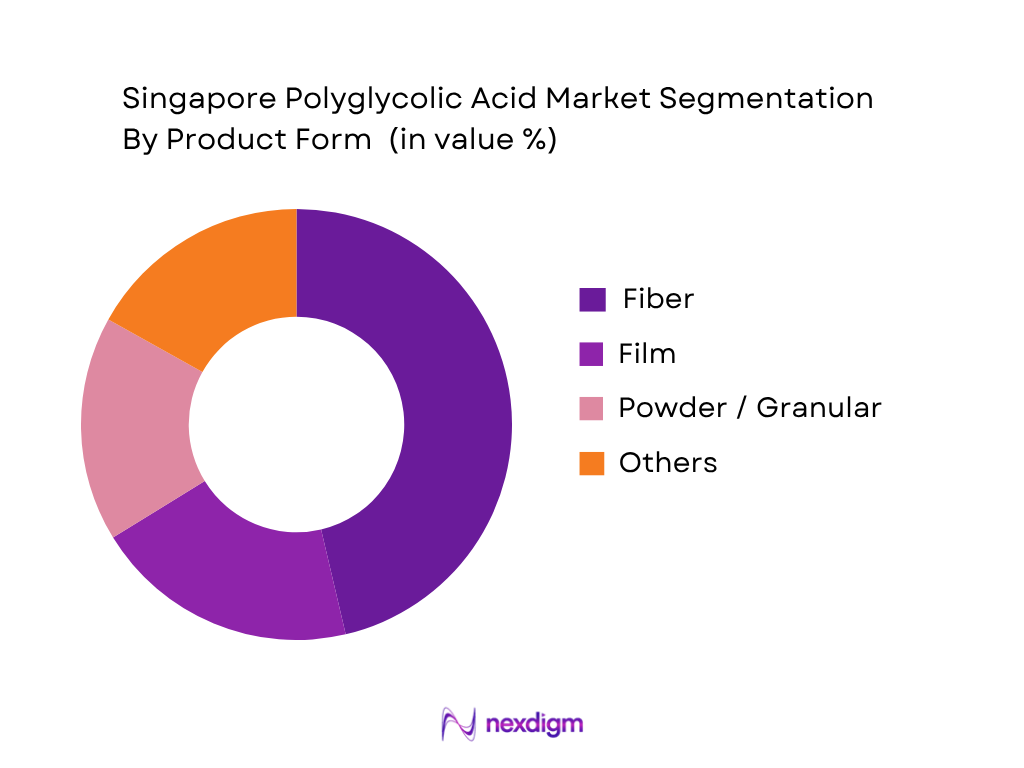
The Singapore Polyglycolic Acid Market is segmented by product form into PGA resin, PGA fiber, PGA film, PGA sheet, PGA rod, PGA composite and PGA-based medical components. PGA resin and fiber-based materials are expected to represent the leading segment because PGA’s principal commercial characteristics—high mechanical strength, biodegradability, hydrolyzability and high gas-barrier performance—support both medical and advanced industrial applications. Kureha’s Kuredux, for example, is commercially positioned as a PGA resin with high strength, biodegradability, abrasion resistance, toughness and solvent resistance. Its documented applications include industrial components and downhole tools, illustrating the ability of PGA to serve applications beyond traditional surgical materials. Singapore’s advanced precision-engineering base is particularly relevant because the country has more than 2,700 precision-engineering and EMS providers, creating potential conversion and component-manufacturing capabilities around imported specialty polymers.
By End-Use Industry
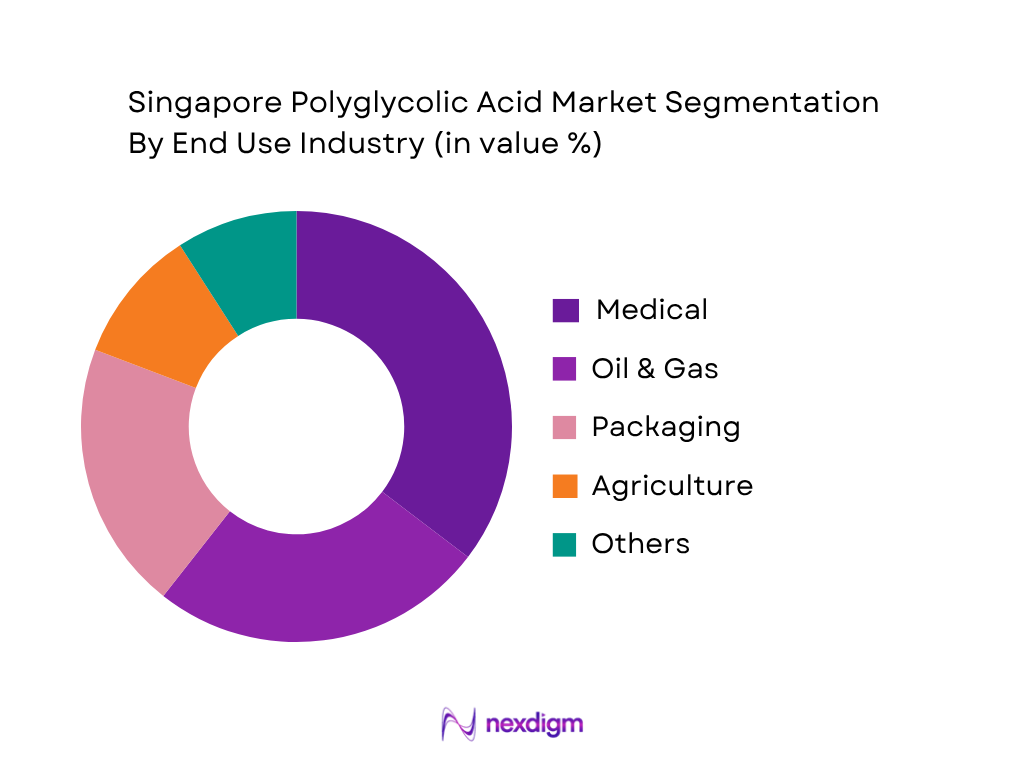
The Singapore Polyglycolic Acid Market is segmented by end-use industry into medical and healthcare, biomedical research and development, packaging, filtration, industrial manufacturing, energy applications, agriculture and specialty applications. Medical and healthcare applications are expected to dominate because Singapore has developed an unusually concentrated medical-device manufacturing and biomedical ecosystem, creating demand for materials capable of meeting stringent performance, quality and biocompatibility requirements. Singapore hosts more than 400 global and regional MedTech companies, while its MedTech manufacturing output reached S$19.4 billion in 2023. PGA’s established use in absorbable sutures provides an important application base, while its degradation characteristics create opportunities in bioabsorbable implants, tissue engineering and drug-delivery technologies. The regulatory environment further reinforces the importance of medical-grade material qualification because HSA regulates the import, manufacture, export and supply of medical devices in Singapore.
Competitive Landscape
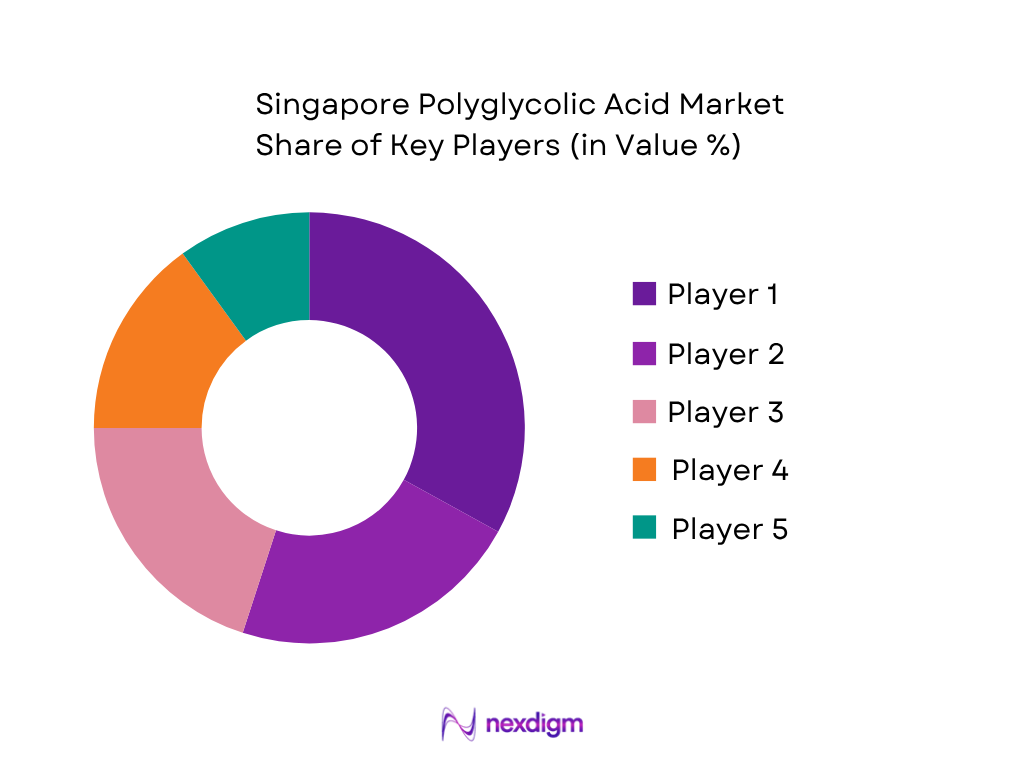
The Singapore Polyglycolic Acid Market is characterized by a combination of specialized PGA material producers and downstream medical-device manufacturers. Competition is therefore shaped not only by direct PGA resin availability but also by medical-grade processing, regulatory qualification, suture manufacturing, biomedical R&D and access to Singapore’s MedTech ecosystem. Kureha has a particularly differentiated position in PGA resin, having established an industrial PGA manufacturing process and commercialized Kuredux. Downstream competition includes medical-device companies that use absorbable polymer technologies and maintain manufacturing or commercial operations in Singapore. Singapore’s presence of all top 30 multinational MedTech companies further increases the potential customer base for specialty polymer suppliers.
| Company | Establishment | Headquarters | PGA Relevance | Core Application Exposure | Product/Material Capability | Singapore Relevance | Competitive Strength |
| Kureha Corporation | 1944 | Tokyo, Japan | ~ | ~ | ~ | ~ | ~ |
| Corbion | 1933 | Amsterdam, Netherlands | ~ | ~ | ~ | ~ | ~ |
| Teleflex | 1943 | Wayne, Pennsylvania, USA | ~ | ~ | ~ | ~ | ~ |
| B. Braun | 1839 | Melsungen, Germany | ~ | ~ | ~ | ~ | ~ |
| Advanced Medical Solutions | 1991 | Winsford, UK | ~ | ~ | ~ | ~ | ~ |
Singapore Polyglycolic Acid Market Analysis
Growth Drivers
Biomedical Manufacturing Expansion
Singapore’s biomedical manufacturing ecosystem provides a strong industrial base for specialized polymers such as polyglycolic acid (PGA), particularly where controlled processing, high-purity materials, and medical-grade manufacturing are required. The Singapore Economic Development Board (EDB) reported S$2.216 billion in fixed-asset investment commitments for biomedical manufacturing, alongside S$4.135 billion in expected annual value-added and 798 expected jobs from those commitments. Singapore’s broader biomedical sciences industry produced more than S$32 billion of products, covering biopharmaceutical and medical-technology activities. The country also operates more than 60 biomedical manufacturing plants and more than 30 R&D centres, creating a concentrated ecosystem for polymer development, medical-device manufacturing, formulation and downstream processing. This environment supports PGA demand because bioabsorbable polymers require close integration between material suppliers, medical-device producers, process engineers and regulatory functions. EDB also identifies more than 17,000 employees across more than 400 MedTech enterprises, providing a substantial specialized manufacturing base. These industrial capabilities support applications including absorbable sutures, temporary implants, tissue-engineering structures and controlled-release systems. The combination of biomedical investment, manufacturing infrastructure, specialized employment and R&D capability therefore creates a direct demand foundation for higher-value PGA materials and processing technologies.
Medical Device Production
Singapore’s medical-device manufacturing base is a direct structural driver for PGA because the polymer is particularly relevant to absorbable surgical materials and temporary biomedical components. EDB reports more than 400 global and local MedTech enterprises operating in Singapore and approximately 17,000 employees in the sector. The ecosystem produces high-value products including cardiac implantable devices, life-science tools and contact lenses, demonstrating established capabilities in tightly controlled medical manufacturing. Biomedical manufacturing also received S$2.216 billion of fixed-asset investment commitments, with S$4.135 billion in expected annual value-added and 798 expected jobs, according to EDB’s investment data. In addition, Singapore’s biomedical sciences sector generated more than S$32 billion in products, combining medical technology and biopharmaceutical production. These figures indicate a deep downstream customer base for specialty polymers rather than a purely research-oriented market. PGA can enter this ecosystem through medical-device components, absorbable sutures, temporary scaffolds and other products requiring predictable degradation and biocompatibility. Singapore’s established manufacturing infrastructure also lowers the technological barrier for qualification, process validation and commercialization of specialty polymer products. The concentration of medical-device manufacturers, skilled personnel and advanced production facilities therefore strengthens the addressable industrial environment for PGA-based medical applications and supports continued adoption of bioabsorbable polymer technologies.
Market Challenges
Limited Domestic PGA Production
Singapore’s advanced biomedical sector does not automatically translate into a large domestic PGA production base, creating a structural challenge around local material availability and supply-chain dependence. EDB reports more than 400 MedTech enterprises and approximately 17,000 sector employees, while Singapore’s biomedical sciences industry includes more than 60 manufacturing plants and more than 30 R&D centres. However, the country’s documented industrial strength is concentrated in medical devices, biopharmaceuticals and advanced manufacturing rather than dedicated large-scale PGA polymerization. The chemicals cluster recorded S$366 million in fixed-asset investment commitments, compared with S$2.216 billion for biomedical manufacturing, highlighting the comparatively smaller investment pipeline for chemicals-related capacity. Singapore also attracted S$13.451 billion in total fixed-asset investment commitments across industries, showing that specialty polymer production competes with substantial investment opportunities in electronics, biomedical manufacturing and other advanced sectors. PGA manufacturing requires controlled polymerization, high-purity glycolide feedstock, moisture management and specialized downstream processing, making localized production more technically demanding than conventional plastics conversion. For Singaporean PGA users, this can reinforce dependence on imported resin or semi-finished materials and increase exposure to international logistics and supply availability. The challenge is therefore not a lack of technical capability, but the relatively narrow domestic production infrastructure specifically dedicated to PGA.
Imported Specialty Material Dependence
Dependence on imported specialty polymers represents a significant challenge for Singapore’s PGA market because domestic demand is concentrated in high-value, technically qualified applications while local production capacity for specialized PGA grades remains limited. Singapore’s manufacturing economy is highly advanced, with World Bank data recording GDP of US$547.39 billion and GDP per capita of US$90,674.1. Its industrial ecosystem therefore supports sophisticated medical and precision-manufacturing applications, but PGA users may still require internationally sourced resin, glycolide-related intermediates, medical-grade compounds or specialized processing inputs. EDB reported S$13.451 billion in total fixed-asset investment commitments, including S$2.216 billion for biomedical manufacturing and S$366 million for chemicals. This investment structure demonstrates that Singapore possesses strong downstream manufacturing capabilities, while dedicated specialty-polymer capacity represents a narrower industrial opportunity. The country’s MedTech ecosystem contains more than 400 enterprises and approximately 17,000 employees, creating technically demanding customers that require consistent material specifications, traceability and regulatory documentation. Imported PGA therefore creates exposure to international supply-chain disruptions, lead-time variation and qualification requirements when suppliers change. For medical applications, replacing an approved polymer grade can require substantial validation work. The resulting dependence can constrain rapid scaling of PGA applications even when Singapore has strong downstream manufacturing capabilities.
Market Opportunities
Bioabsorbable Medical Devices
Singapore’s established medical-technology ecosystem creates a commercially relevant opportunity for PGA-based bioabsorbable devices because the country combines advanced manufacturing, medical-device production and biomedical R&D within a compact industrial environment. EDB reports more than 400 global and local MedTech enterprises and approximately 17,000 employees, while Singapore’s biomedical sciences sector produced more than S$32 billion of products. The country also has more than 60 biomedical manufacturing plants and more than 30 R&D centres, providing infrastructure relevant to medical-device development, prototyping, process validation and commercialization. EDB recorded S$2.216 billion in biomedical-manufacturing fixed-asset investment commitments, associated with S$4.135 billion in expected annual value-added. These conditions create an established customer environment for PGA applications where temporary mechanical support followed by controlled polymer degradation is valuable. Potential applications include absorbable fixation components, surgical sutures, temporary scaffolds and other resorbable medical structures. The opportunity is strengthened by Singapore’s concentration of multinational MedTech manufacturers and specialized suppliers, which can facilitate technology transfer and regional commercialization. Rather than relying on broad commodity-plastic demand, PGA suppliers can target higher-value medical applications requiring controlled molecular weight, degradation profiles and biocompatibility. Singapore’s existing medical-device manufacturing infrastructure therefore provides a practical platform for expanding PGA from specialty material supply into qualified bioabsorbable device applications and related contract-manufacturing activities.
Advanced Surgical Sutures
Advanced surgical sutures represent a focused opportunity for PGA because the polymer’s established relevance to absorbable medical materials aligns with Singapore’s specialized medical-device manufacturing ecosystem. EDB identifies more than 400 global and local MedTech enterprises and around 17,000 employees, indicating substantial downstream technical capability for designing, producing and validating medical products. Singapore also has more than 60 biomedical manufacturing plants and more than 30 R&D centres, creating an environment in which polymer-based surgical products can move from material development to device engineering and manufacturing. Biomedical manufacturing attracted S$2.216 billion in fixed-asset investment commitments, with 798 expected jobs associated with those commitments. Singapore’s wider biomedical sciences industry produced more than S$32 billion of products, demonstrating the scale of the surrounding life-sciences production ecosystem. For PGA suppliers, this supports opportunities to develop controlled-degradation fiber grades and medical-grade materials for absorbable sutures, particularly where manufacturers require predictable tensile retention, sterilization compatibility and controlled resorption. The opportunity extends beyond supplying basic resin because Singapore’s manufacturing ecosystem can support higher-value processing, coating, fiber formation and device assembly. Strong medical-device capabilities also create potential for regional exports from Singapore, allowing locally qualified PGA-based surgical products to serve healthcare markets across Asia.
Future Outlook
The Singapore Polyglycolic Acid Market is expected to develop primarily around high-value medical, biomedical and specialty-material applications rather than high-volume commodity polymer consumption. Growth will be supported by Singapore’s established MedTech manufacturing base, advanced precision engineering infrastructure and concentration of multinational healthcare companies. The country’s biomedical manufacturing cluster remains strategically significant, with S$32.457 billion of output recorded in 2024, while EDB has identified continued investment in biomedical manufacturing and specialty chemicals.
Future commercial opportunities are likely to center on PGA-based absorbable sutures, bioabsorbable medical components, tissue-engineering materials, drug-delivery systems and specialty polymer research. Industrial applications such as high-barrier materials and specialty components can provide additional diversification because PGA combines biodegradability with high mechanical and barrier performance. The projected CAGR for the Singapore Polyglycolic Acid Market during 2026–2035 is ~XX%, with the forecast dependent on downstream medical-device adoption, polymer qualification, local conversion capability, R&D commercialization and regional demand.
Major Players
- Kureha Corporation
- Corbion
- Teleflex Incorporated
- B. Braun Melsungen AG
- Advanced Medical Solutions Group
- Medtronic
- Johnson & Johnson / Ethicon
- Smith+Nephew
- Stryker
- Peters Surgical
- Meta Biomed
- Samyang Biopharm
- Cook Medical
- Poly-Med, Inc.
- Evonik Industries
Key Target Audience
- Medical device manufacturers and surgical-product manufacturers
- Biomedical material developers and bioabsorbable implant manufacturers
- Pharmaceutical and drug-delivery companies
- Healthcare procurement organizations and hospital groups
- Specialty polymer processors and precision-manufacturing companies
- Investments and venture capitalist firms (healthcare, MedTech and advanced-material investors)
- Government and regulatory bodies (Health Sciences Authority, Economic Development Board, Enterprise Singapore)
- Packaging, filtration and specialty-material application companies
Research Methodology
Step 1: Identification of Key Variables
The initial phase establishes the Singapore PGA market ecosystem by mapping polymer producers, importers, medical-device manufacturers, healthcare organizations, biomedical R&D organizations, processors and regulatory stakeholders. Secondary research is used to identify PGA applications, material specifications, production pathways, downstream demand factors and regulatory requirements.
Step 2: Market Analysis and Construction
Historical market information is compiled through supply-side and demand-side assessment. The analysis separates direct PGA resin consumption from PGA-containing finished medical products to prevent double counting and evaluates product form, grade, application, end-use industry and downstream conversion requirements.
Step 3: Hypothesis Validation and Expert Consultation
Market hypotheses are validated through discussions with PGA suppliers, medical-device manufacturers, polymer processors, healthcare procurement professionals and technical specialists. The consultations focus on material qualification, purchasing criteria, processing requirements, regulatory barriers, application adoption and substitution dynamics.
Step 4: Research Synthesis and Final Output
The final analysis integrates primary findings with secondary evidence from Singapore government agencies, regulatory authorities, company disclosures and industry datasets. Bottom-up estimates are reconciled against top-down industry indicators to develop market segmentation, competitive positioning, future-growth assessment and strategic recommendations.

- Executive Summary
- Research Methodology (Market Definition and Scope, PGA Product Boundary, Market Sizing Framework, Top-Down Market Estimation, Bottom-Up Market Reconstruction, Demand-Side Analysis, Supply-Side Analysis, Import-Export Reconciliation, Primary Industry Interviews, Expert Validation, Data Triangulation, Forecasting Framework, Scenario Analysis, Assumptions and Limitations)

- Definition and Scope
- Polyglycolic Acid Chemistry and Material Characteristics
- PGA Industry Evolution and Commercial Development
- Singapore PGA Industry Ecosystem Mapping
- Domestic Production Versus Import Dependence
- Singapore PGA Processing and Conversion Infrastructure

- Growth Drivers (Biomedical Manufacturing Expansion, Medical Device Production, Healthcare Technology Development, Demand for Bioabsorbable Surgical Materials, Advanced Polymer Research, Specialty Manufacturing Capabilities)
- Market Challenges (Limited Domestic PGA Production, Imported Specialty Material Dependence, Polymerization Complexity, Glycolide Feedstock Dependence, Moisture Sensitivity, Medical Qualification Requirements, Specialist Processing Requirements, Small Domestic End-User Base)
- Market Opportunities (Bioabsorbable Medical Devices, Advanced Surgical Sutures, Biomedical R&D Applications, Domestic PGA Processing, Tissue Engineering, Drug Delivery Systems, High-Barrier Packaging, Specialty Filtration)
- Market Trends (Medical Device Localization, Bioabsorbable Material Development, PGA Copolymer Innovation, Controlled Degradation, Surgical Material Innovation, High-Barrier Polymer Applications, Specialty Polymer Substitution)
- Government and Regulatory Framework (Health Sciences Authority, Medical Device Registration, Product Classification, Import Licensing, Manufacturing Licensing, Quality Management, Biocompatibility Testing, Sterilization Standards, Post-Market Surveillance)
- SWOT Analysis
- Porter’s Five Forces Analysis
- PESTLE Analysis

- By Market Value (2020-2025)
- By Volume Consumption (2020-2025)
- By PGA Resin Consumption (2020-2025)
- By PGA Fiber Consumption (2020-2025)
- By PGA Film Consumption (2020-2025)
- By PGA Composite Consumption (2020-2025)
- By Medical-Grade PGA Consumption (2020-2025)

- By Product Form (In Value %)
PGA Resin
PGA Fiber
PGA Film
PGA Sheet
PGA Rod
PGA Composite
PGA-Based Medical Components
Other PGA Forms - By End-Use Industry (In Value %)
Medical and Healthcare
Biomedical Research and Development
Packaging
Filtration
Industrial Manufacturing
Oil & Gas and Energy Applications
Agriculture
Other Specialty Applications - By Medical Application (In Value %)
Absorbable Surgical Sutures
General Surgical Closure and Ligatures
Dental Sutures
Ophthalmic Sutures
Orthopaedic Applications
Bioabsorbable Implants
Tissue Engineering Scaffolds
Drug Delivery Systems
Other Medical Applications - By Processing Technology (In Value %)
Ring-Opening Polymerization
Melt Polymerization
Solid-State Polymerization
Extrusion
Fiber Spinning
Film Extrusion
Injection Molding
Compression Molding
Composite Processing - By Grade (In Value %)
Medical Grade
Suture Grade
Biomedical Research Grade
Packaging Grade
Industrial Grade
High-Performance Grade
Biodegradable Grade

- Market Share of Major Players (By Value, Volume, Product Form, Grade, Medical Application, Industrial Application)
- Cross Comparison Parameters (PGA Product Portfolio Breadth, Medical-Grade Manufacturing Capability, Suture Portfolio Breadth, Biomedical R&D Capability, PGA Processing Technology, Application Portfolio Coverage, Regulatory and Certification Capability, R&D and Product Innovation Capability)
- SWOT Analysis of Major Players
- Detailed Profiles of Major Companies
Kureha Corporation
Corbion
BMG Incorporated
Teleflex Incorporated
Ethicon
Medtronic
B. Braun Melsungen
Smith+Nephew
Peters Surgical
Advanced Medical Solutions Group
Meta Biomed
Samyang Biopharm
Huizhou Foryou Medical Devices
Shenzhen Polymtek Biomaterial
Polysciences

- Healthcare and Medical Device End-User Assessment
- Biomedical Manufacturing Assessment
- Hospital Procurement Behaviour
- Quality Management Requirements
- Research and Development Requirements
- End-User Switching Analysis

- By Market Value (2026-2035)
- By Volume Consumption (2026-2035)
- By PGA Resin Consumption (2026-2035)
- By PGA Fiber Consumption (2026-2035)
- By PGA Film Consumption (2026-2035)
- By PGA Composite Consumption (2026-2035)
- By Medical-Grade PGA Consumption (2026-2035)


 Request a Sample
 Ask for Customization
 Get a Quote
 Enquire Now