
 Download PDF
Market Overview
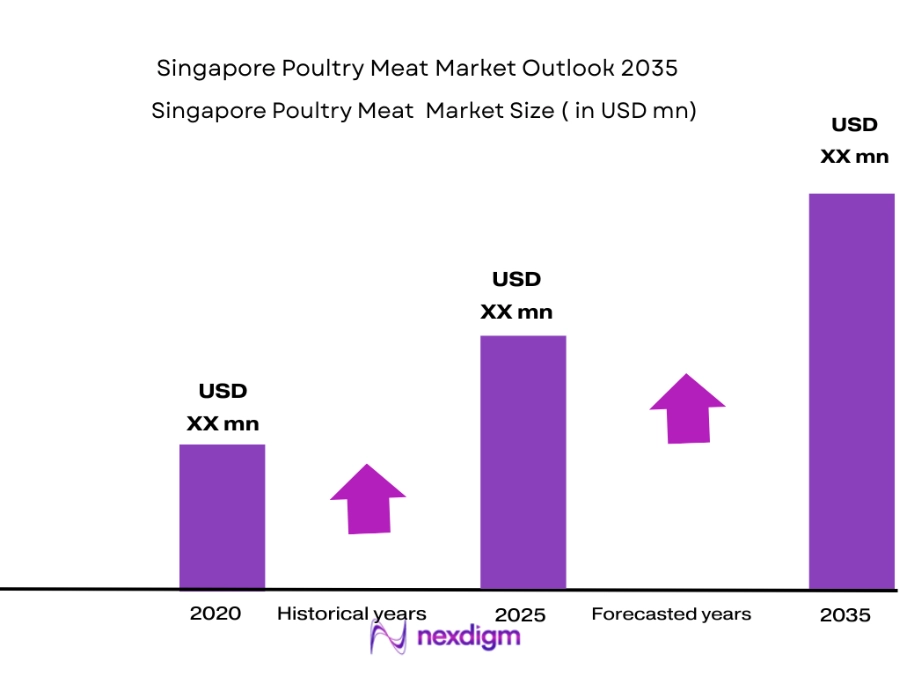
The Singapore Poultry Meat Market is valued at USD ~ million, based on a five-year historical analysis of chicken meat consumption, trade, and import pricing. The market is supported by Singapore’s dependence on imported poultry, steady household protein consumption, and foodservice demand from restaurants, hawker centres, hotels, caterers, and quick-service chains. Poultry remains preferred because it is versatile, relatively affordable, and widely accepted across ethnic and religious consumer groups.
Singapore’s poultry meat demand is concentrated in Central Region, East Region, West Region, and North-East Region, driven by dense residential clusters, supermarkets, wet markets, food courts, and HoReCa consumption. On the supply side, Brazil, Thailand, the United States, China, and Malaysia remain important supplier countries because Singapore has limited domestic poultry production capacity and relies on accredited import sources to maintain food availability, pricing stability, and food safety compliance.
Market Segmentation
By Product Type
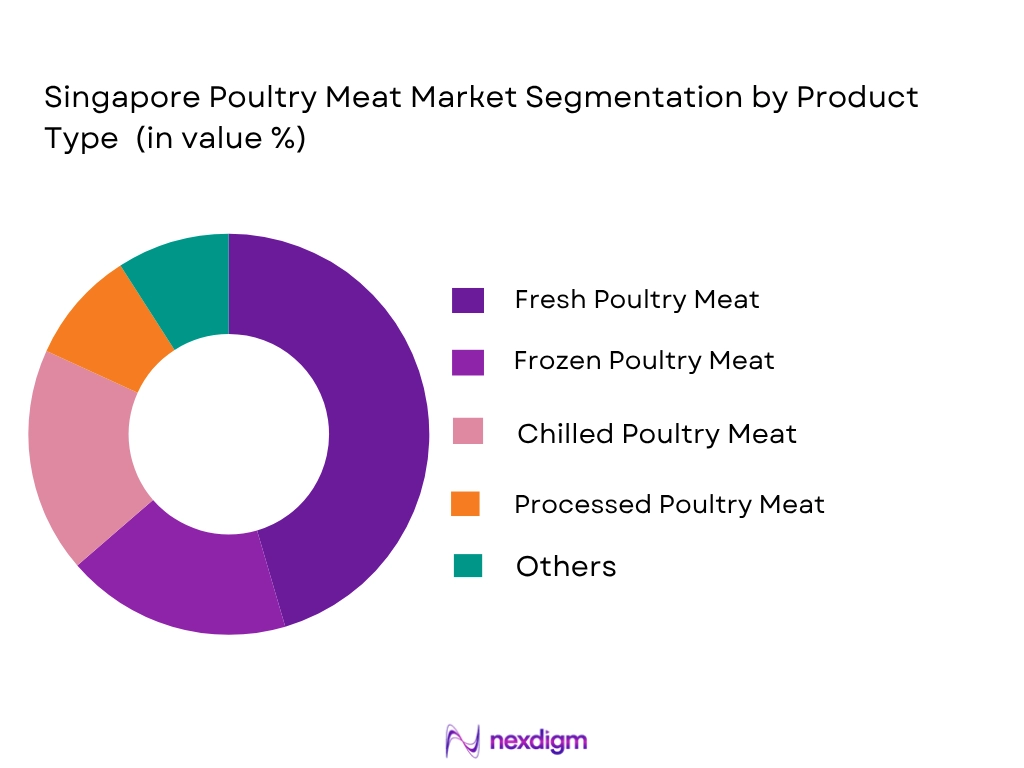
Singapore Poultry Meat Market is segmented by product type into fresh and chilled poultry meat, frozen poultry meat, processed poultry meat, and ready-to-eat poultry products. Recently, fresh and chilled poultry meat has held a dominant position under this segmentation because Singaporean consumers continue to associate chilled poultry with freshness, cooking flexibility, and suitability for daily home meals. Wet markets, supermarkets, and butcher counters remain important for consumers buying whole chickens, drumsticks, wings, breast meat, and minced poultry. The segment is also supported by foodservice buyers that require consistent cut specifications for Asian cuisines, hawker dishes, restaurants, and institutional kitchens. Frozen poultry is highly relevant due to import dependence and storage efficiency, but fresh and chilled formats retain stronger consumer preference in retail because they are perceived as better suited for soups, stir-fries, roasts, and family cooking.
By Poultry Type
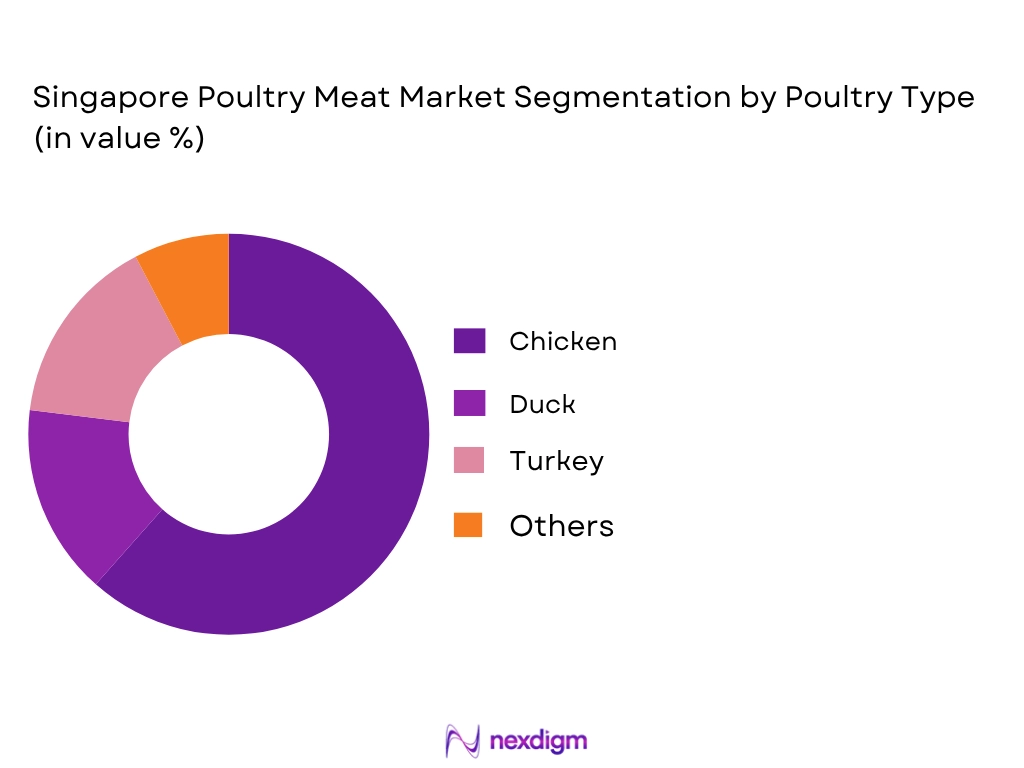
Singapore Poultry Meat Market is segmented by poultry type into chicken, duck, turkey, and other poultry. Recently, chicken has dominated this segmentation because it is the most affordable, versatile, and frequently consumed poultry meat across Singapore’s residential, foodservice, and institutional channels. Chicken is used extensively in local dishes such as chicken rice, curry chicken, fried chicken, grilled chicken, noodles, soups, and prepared meals. It also benefits from halal suitability, broad availability across wet markets and supermarkets, and strong procurement by quick-service restaurants and catering operators. Duck has stable demand in Chinese restaurants and roasted meat stalls, while turkey is seasonal and niche, largely tied to festive consumption and expatriate demand. Chicken’s dominance is reinforced by supplier diversity, established import flows, and wide product availability in fresh, frozen, marinated, and processed formats.
Competitive Landscape
The Singapore Poultry Meat Market is moderately consolidated across importers, processors, distributors, and branded food suppliers. Local companies such as Leong Hup Singapore, Kee Song Group, and Tiong Lian Food serve retail, wet market, foodservice, and institutional buyers, while multinational suppliers such as Cargill and CP Foods support imported frozen and processed poultry supply. Competition is shaped by price stability, import approvals, halal certification, cold-chain reliability, cut customization, and access to supermarket and HoReCa procurement channels.
| Company | Establishment Year | Headquarters | Product Focus | Core Channel Strength | Certification Positioning | Supply Role | Cold Chain / Processing Capability | Strategic Positioning |
| Leong Hup Singapore | 1979 | Singapore | ~ | ~ | ~ | ~ | ~ | ~ |
| Kee Song Group | 1987 | Singapore | ~ | ~ | ~ | ~ | ~ | ~ |
| Tiong Lian Food Pte Ltd | 1974 | Singapore | ~ | ~ | ~ | ~ | ~ | ~ |
| Cargill Singapore | 1981 | Singapore regional office | ~ | ~ | ~ | ~ | ~ | ~ |
| CP Foods Singapore | 1970s regional presence | Thailand / Singapore operations | ~ | ~ | ~ | ~ | ~ | ~ |
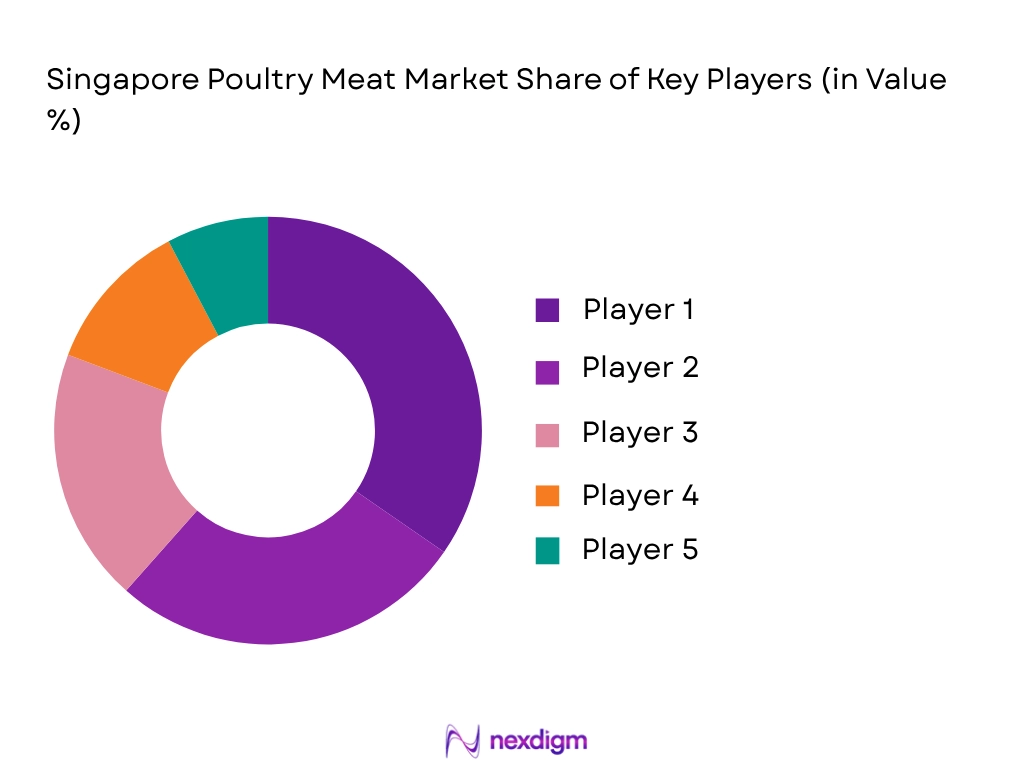
Singapore Poultry Meat Market Analysis
Growth Drivers
Rising Poultry Meat Consumption
Poultry meat consumption in Singapore is supported by its wide acceptance, affordability, and versatility across different cuisines. Chicken is commonly used in local dishes, household meals, hawker centers, restaurants, catering services, and quick-service food chains. It is generally preferred by many consumers because it is easy to cook, widely available, and suitable for both traditional and modern meal formats. Singapore’s multicultural food culture also supports steady demand for poultry across Chinese, Malay, Indian, Western, and fusion cuisines. As consumers continue to seek convenient and familiar protein options, poultry remains a core part of daily diets. This consistent consumption pattern supports stable demand for fresh, frozen, and processed poultry meat products.
Increasing Demand for Frozen and Processed Poultry Products
Demand for frozen and processed poultry products is growing in Singapore due to busy lifestyles, smaller households, and preference for convenient meal preparation. Products such as frozen chicken cuts, nuggets, sausages, patties, marinated chicken, and ready-to-cook poultry items are widely used by households, supermarkets, convenience stores, and foodservice operators. These products offer longer shelf life, easier storage, portion control, and faster cooking. Foodservice businesses also prefer processed poultry because it helps maintain consistency, reduce preparation time, and control costs. With strong cold chain infrastructure and modern retail channels, frozen and processed poultry products are easily accessible across Singapore. This trend supports higher value-added sales within the poultry meat market.
Market Challenges
High Dependence on Poultry Meat Imports
Singapore’s poultry meat market is highly dependent on imports because domestic agricultural production is limited by land constraints. Most poultry meat consumed in the country is sourced from overseas suppliers, making the market exposed to external supply conditions. Any disruption in exporting countries, including disease outbreaks, export restrictions, logistics delays, or production shortages, can affect product availability and pricing in Singapore. Import dependence also requires strong supplier diversification and strict monitoring of food safety standards. Although Singapore has a well-developed food supply system, reliance on external sources remains a structural risk. This makes supply resilience, diversified sourcing, and effective import management critical challenges for the poultry meat market.
Price Volatility and Supply Chain Disruptions
Price volatility and supply chain disruptions are key challenges for Singapore’s poultry meat market. Since the country relies heavily on imports, changes in global poultry prices, freight costs, exchange rates, energy prices, and feed costs in supplier countries can influence local retail and foodservice prices. Disruptions such as export bans, disease outbreaks, shipping delays, and geopolitical issues may also create short-term supply pressure. Foodservice operators and retailers may find it difficult to manage margins when procurement costs rise quickly. Consumers can also shift to lower-cost protein options when prices increase. Therefore, maintaining stable supply partnerships, diversified import sources, and efficient logistics is essential for market stability.
Opportunities
Growth in Ready-to-Cook and Ready-to-Eat Poultry Products
Ready-to-cook and ready-to-eat poultry products present a strong growth opportunity in Singapore. Consumers are increasingly looking for convenient meal solutions that fit busy work schedules, smaller households, and limited cooking time. Products such as marinated chicken cuts, frozen chicken meals, grilled chicken packs, chicken rice meal kits, skewers, nuggets, and microwave-ready poultry dishes can appeal to households and working professionals. Foodservice operators, convenience stores, and online grocery platforms can also expand these offerings to meet demand for quick, high-quality meals. These value-added products allow brands to differentiate through taste, packaging, portion size, and healthier formulations. As convenience remains important, this segment can support higher-margin market growth.
Expansion of Online Retail and Direct-to-Consumer Channels
Online retail and direct-to-consumer channels offer significant opportunities for Singapore’s poultry meat market. Consumers are increasingly using grocery apps, e-commerce platforms, and meat delivery services to purchase fresh, frozen, and processed poultry products. These channels provide convenience, product variety, scheduled delivery, and access to premium or specialty poultry options. For poultry suppliers and retailers, online platforms allow better consumer engagement, targeted promotions, subscription models, and direct feedback. They also help brands highlight product origin, certification, freshness, and traceability. With Singapore’s strong digital infrastructure and high consumer acceptance of online shopping, direct-to-consumer poultry sales can expand further and support brand differentiation in a competitive market.
Future Outlook
Over the next five years, the Singapore Poultry Meat Market is expected to remain stable, supported by consistent household consumption, foodservice recovery, and demand for affordable protein. Growth will be stronger in value-added poultry, including marinated cuts, frozen convenience packs, ready-to-cook chicken, and processed formats. Import diversification will remain a policy and business priority due to disease risks, export restrictions, and supply shocks. Companies with strong cold-chain systems, halal compliance, traceability, and retail-foodservice coverage will be better positioned.
Major Players
- Leong Hup Singapore
- Kee Song Group
- Tiong Lian Food Pte Ltd
- Cargill Singapore
- CP Foods Singapore
- Tyson Foods Singapore
- BRF Singapore
- Sadia Singapore
- Seara Singapore
- Sinmah Poultry Processing Singapore
- Japfa Ltd
- Ben Foods Singapore
- Angliss Singapore
- QB Food Singapore
- Far Ocean Singapore
Key Target Audience
- Poultry meat importers and exporters
- Poultry processors and slaughterhouses
- Frozen food distributors and cold-chain logistics providers
- Supermarkets, hypermarkets, and grocery retail chains
- HoReCa operators and institutional catering companies
- Quick-service restaurant chains and cloud kitchen operators
- Investments and venture capitalist firms
- Government and regulatory bodies
Research Methodology
Step 1: Identification of Key Variables
The initial phase involves constructing an ecosystem map covering poultry importers, processors, distributors, retailers, foodservice buyers, regulatory authorities, and cold-chain operators within the Singapore Poultry Meat Market. This step is supported by desk research and proprietary databases to identify variables such as import dependency, consumption patterns, pricing, product formats, and channel structure.
Step 2: Market Analysis and Construction
In this phase, historical market data is compiled and analyzed across value, volume, import flows, retail availability, and foodservice procurement. The analysis includes assessment of fresh, chilled, frozen, processed, and ready-to-cook poultry categories. Revenue construction is developed through bottom-up evaluation of product pricing, channel sales, and supplier participation.
Step 3: Hypothesis Validation and Expert Consultation
Market hypotheses are validated through computer-assisted telephone interviews with poultry importers, wholesalers, supermarket category managers, foodservice distributors, and processing companies. These discussions provide operational and commercial insights on sourcing, pricing, demand cycles, product preferences, and regulatory compliance.
Step 4: Research Synthesis and Final Output
The final phase involves synthesizing secondary research, primary interviews, company-level information, and market modeling outputs. Direct engagement with suppliers and distributors helps verify assumptions related to product segmentation, sales performance, distribution intensity, and end-user demand. The result is a validated assessment of the Singapore Poultry Meat Market.

- Executive Summary
- Research Methodology (Market Definitions and Assumptions, Abbreviations, Market Sizing Approach, Consolidated Research Approach, Understanding Market Potential Through In-Depth Industry Interviews, Primary Research Approach, Limitations and Future Conclusions)

- Definition and Scope
- Market Dynamics Overview
- Market Genesis
- Major Players and Market Timeline
- Business Cycle and Trends
- Supply Chain and Value Chain Analysis

- Growth Drivers
Rising Poultry Meat Consumption
Growing Demand for Affordable Protein Sources
Expansion of Foodservice and Quick-Service Restaurants
Increasing Demand for Frozen and Processed Poultry Products
Growth of Online Grocery and Meat Delivery Platforms - Market Challenges
High Dependence on Poultry Meat Imports
Price Volatility and Supply Chain Disruptions
Strict Food Safety and Import Regulations
Competition from Alternative Protein Products
Consumer Concerns About Meat Quality and Traceability - Opportunities
Rising Demand for Premium and Organic Poultry Meat
Growth in Ready-to-Cook and Ready-to-Eat Poultry Products
Expansion of Online Retail and Direct-to-Consumer Channels
Increasing Demand from Foodservice and Cloud Kitchens
Innovation in Packaging, Cold Chain, and Traceability Solutions - Key Trends
Shift Toward Frozen and Chilled Poultry Products
Growing Preference for Halal-Certified Poultry Meat
Rising Popularity of Convenience-Based Poultry Products
Emphasis on Food Safety, Traceability, and Quality Assurance
Increasing Adoption of Sustainable and Alternative Protein Options - Government Regulations
- SWOT Analysis
- Porter’s Five Forces

- By Value, 2020–2025
- By Volume, 2020–2025
- By Average Price, 2020–2025

- By Product Type (In Value %)
Fresh Poultry Meat
Frozen Poultry Meat
Processed Poultry Meat
Chilled Poultry Meat
Others - By Poultry Type (In Value %)
Chicken
Duck
Turkey
Others - By Processing Type (In Value %)
Raw Poultry Meat
Marinated Poultry Meat
Ready-to-Cook Poultry Meat
Ready-to-Eat Poultry Meat - By Application (In Value %)
Household Consumption
Foodservice and HoReCa
Processed Food Industry
Institutional Consumption - By Distribution Channel (In Value %)
Direct Sales
Wet Markets
Supermarkets and Hypermarkets
Online Channels
Convenience Stores
Specialty Meat Stores - By Region (In Value %)
Central Region
East Region
North Region
North-East Region
West Region
Rest of Singapore

- Market Share of Major Players by Value/Volume
- Market Share of Major Players by Product Type
- Cross Comparison Parameters (Company Overview, Business Strategies, Recent Developments, Strength, Weakness, Organizational Structure, Revenues, Revenues by Product Type, Number of Touchpoints Distribution Channels, Number of Dealers and Distributors, Margins, Production Plant, Capacity, Unique Value Offering and Others)
- SWOT Analysis of Major Players
- Pricing Analysis Based on Product Categories for Major Players
- Detailed Profiles of Major Companies
Leong Hup Singapore
Kee Song Group
Tiong Lian Food Pte Ltd
Chun Cheng Fishery Enterprise Pte Ltd
Sinmah Poultry Processing Singapore
Cargill Singapore
Tyson Foods Singapore
CP Foods Singapore
BRF Singapore
Sadia Singapore
Ayam Brand Singapore
Japfa Ltd
Olam Food Ingredients
Deli Hub Catering and Food Manufacturing

- Market Demand and Utilization
- Purchasing Power and Budget Allocations
- Regulatory and Compliance Requirements
- Needs, Desires, and Pain Point Analysis
- Decision-Making Process

- By Value, 2026–2035
- By Volume, 2026–2035
- By Average Price, 2026–2035


 Request a Sample
 Ask for Customization
 Get a Quote
 Enquire Now