

 Download PDF
Market Overview
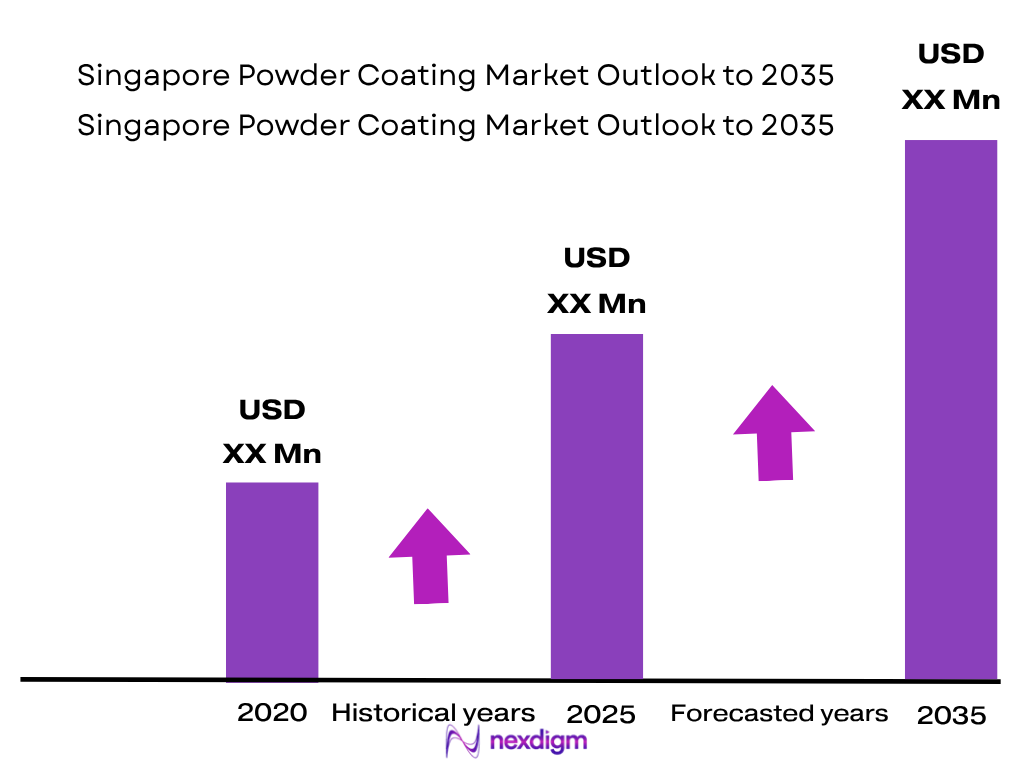
The Singapore Powder Coating Market is valued at approximately USD ~ million, supported by electronics, precision engineering, aerospace, architectural aluminum and industrial fabrication. Manufacturing output increased from S$411.2 billion to S$423.6 billion, while manufacturing value added reached S$114.5 billion. Singapore’s broader GDP increased from S$686.4 billion to S$765.5 billion, providing a high-value industrial base for polyester, epoxy, hybrid, architectural and functional powder-coating applications.
Jurong–Tuas, Changi–Seletar, Woodlands, Ang Mo Kio and Pasir Ris dominate Singapore’s powder-coating activity because they combine advanced manufacturing, aerospace, semiconductor equipment, precision engineering and metal fabrication. Construction demand increased from S$33.8 billion to S$44.2 billion, while aerospace output exceeded S$18 billion. Seletar and Changi anchor aerospace activity, Jurong–Tuas supports heavy industry, and Pasir Ris and northern clusters concentrate electronics and precision-manufacturing facilities requiring high-specification metal finishing.
Market Segmentation
By Resin Chemistry
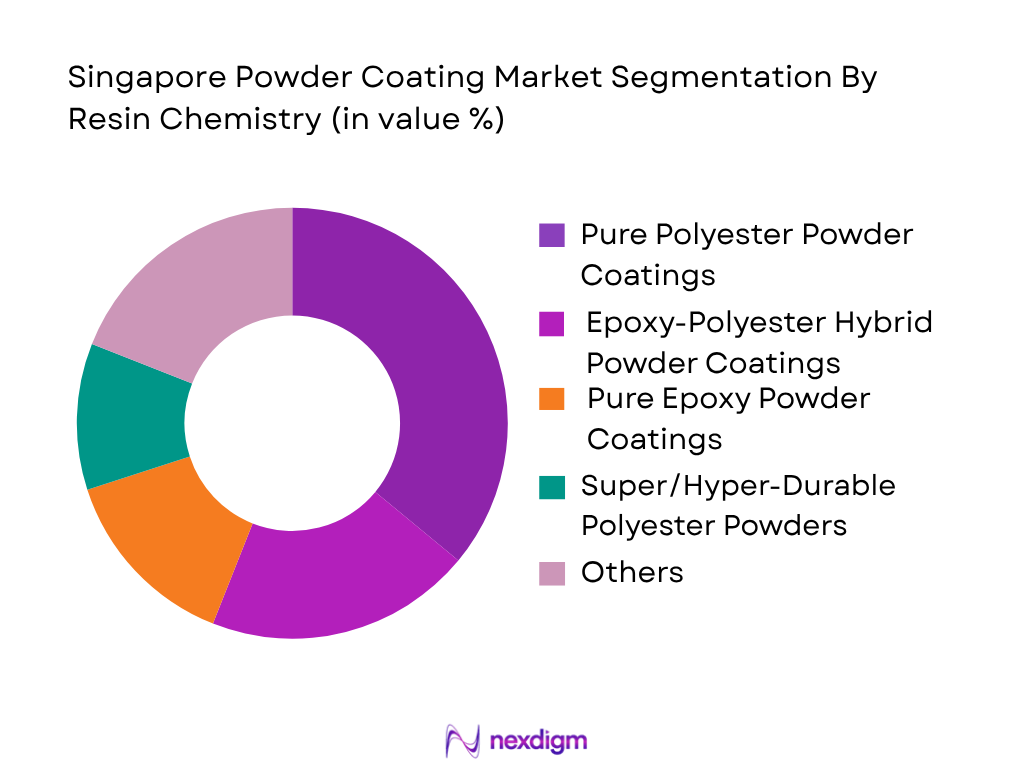
The Singapore Powder Coating Market is segmented into pure polyester, epoxy-polyester hybrid, pure epoxy, super-durable polyester, polyurethane, fluoropolymer, acrylic and thermoplastic powder coatings. Pure polyester powder coatings hold the dominant market share because Singapore combines tropical outdoor exposure with substantial architectural, HVAC, electrical-equipment and general-industrial applications. Polyester formulations offer UV resistance and color retention that epoxy-rich systems cannot provide in prolonged exterior exposure. Super-durable polyester products are increasingly important for façades, aluminum extrusions, railings and exterior equipment exposed to humidity and coastal conditions. Epoxy-polyester hybrids remain significant in indoor industrial applications because they provide balanced appearance, adhesion and mechanical performance. Pure epoxies serve electrical, corrosion-protection and functional applications, while fluoropolymers are used selectively where premium architectural durability is required. Specialty thermoplastic and functional powders remain smaller in volume but are relevant to demanding electronics, electrical and industrial uses where conventional decorative performance is insufficient.
By End-Use Industry
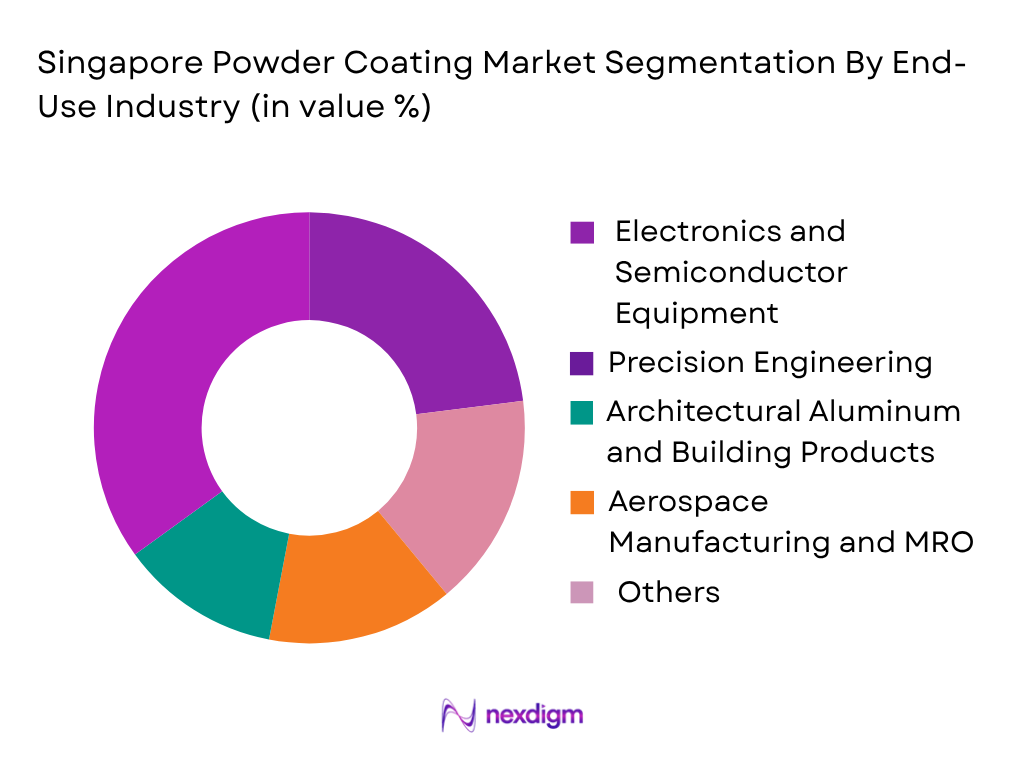
The Singapore Powder Coating Market is segmented into electronics and semiconductor equipment, precision engineering, aerospace, marine and offshore engineering, architectural aluminum, electrical equipment, data-center infrastructure, MedTech, HVAC and general industrial manufacturing. Electronics and semiconductor equipment represent the dominant end-use segment because Singapore’s manufacturing structure is strongly concentrated in electronics and high-value production machinery. Electronics accounted for the largest share of manufacturing output, while precision engineering represented another important production cluster. Total manufacturing output reached S$423.6 billion, with electronics representing 41.9% of that total and precision engineering contributing 8.0%. Powder coatings are used on semiconductor-equipment frames, automation housings, cleanroom fixtures, cabinets, server racks and electrical components. Aerospace is another premium application because Singapore hosts more than 130 aerospace companies and aerospace output exceeded S$18 billion, supporting demand for qualified protective finishes on MRO equipment and precision components.
Competitive Landscape
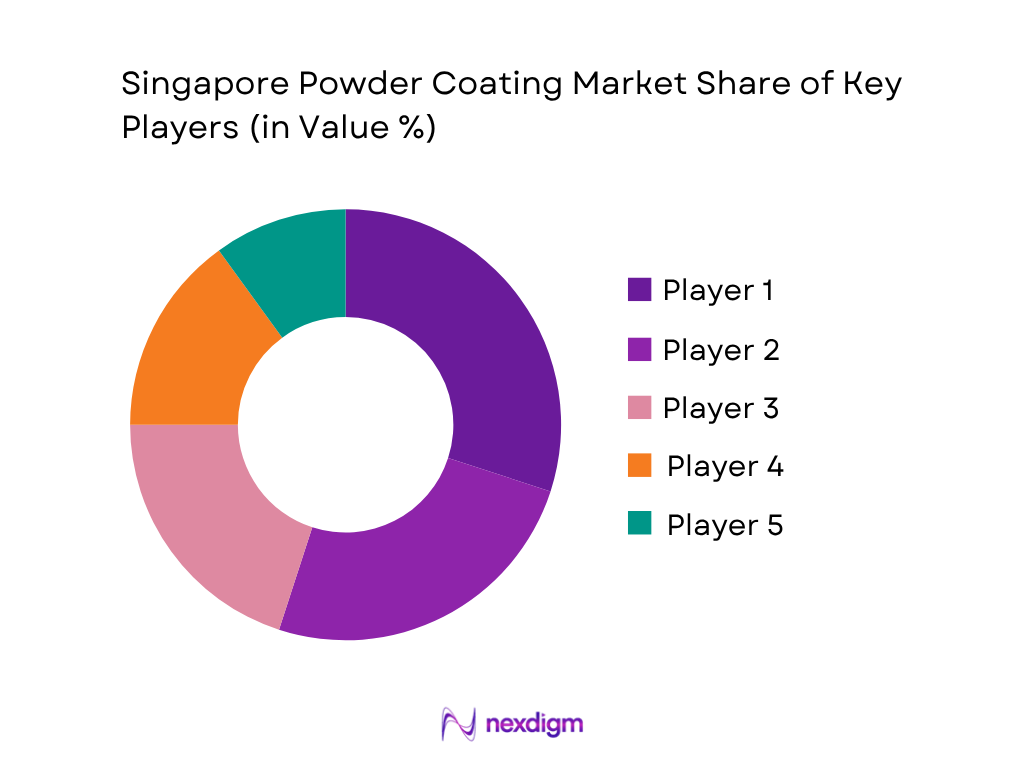
The Singapore Powder Coating Market is dominated by multinational coating companies supported by regional Southeast Asian manufacturing plants, Singapore commercial offices and local distributors. AkzoNobel Interpon, Jotun, Axalta, PPG and Nippon Paint compete through architectural durability, industrial powder technology, technical support, regional inventory and custom formulation. Axalta operates its Asia-Pacific headquarters in Singapore and supplies powder products through regional production assets, while Singapore also functions as an important technical and distribution center for multinational coatings companies.
| Company | Establishment Year | Headquarters | Resin Chemistry Breadth | Key Applications | Singapore/ASEAN Footprint | Functional Powder Capability | Architectural Capability | Technical Support |
| AkzoNobel – Interpon | 1994 | Amsterdam, Netherlands | ~ | ~ | ~ | ~ | ~ | ~ |
| Jotun | 1926 | Sandefjord, Norway | ~ | ~ | ~ | ~ | ~ | ~ |
| Axalta Coating Systems | 2013 | Glen Mills, Pennsylvania, US | ~ | ~ | ~ | ~ | ~ | ~ |
| PPG Industries | 1883 | Pittsburgh, Pennsylvania, US | ~ | ~ | ~ | ~ | ~ | ~ |
| Nippon Paint | 1881 | Tokyo, Japan | ~ | ~ | ~ | ~ | ~ |
Singapore Powder Coating Market Analysis
Growth Drivers
Advanced Manufacturing, Electronics and Precision Engineering Expansion
Singapore’s advanced manufacturing base is a major growth driver for powder coatings used on semiconductor equipment frames, automation systems, precision-machined assemblies, electrical cabinets, cleanroom fixtures and industrial machinery. Manufacturing output reached S$429.584 billion in 2024, compared with S$410.871 billion in 2023, while manufacturing value added increased from S$108.606 billion to S$116.595 billion. Electronics generated S$181.166 billion of output and S$46.813 billion of value added, while precision engineering produced S$51.983 billion of output and S$17.750 billion of value added. These production levels create a substantial installed base of metal substrates requiring polyester, epoxy, hybrid, dielectric and corrosion-resistant powder systems. Singapore’s macroeconomic scale further supports higher-value finishing requirements, with World Bank data placing GDP at USD 547.39 billion in 2024 and GDP per capita at USD 90,674.1. Semiconductor, electronics and precision-engineering customers typically require tight film-thickness control, repeatable appearance, chemical resistance and low contamination, encouraging demand for technically differentiated powder formulations rather than commodity decorative finishes. Continued investments in advanced manufacturing therefore support recurring powder consumption and higher technical-service intensity across Singapore’s industrial finishing ecosystem.
Construction and Architectural Metal Finishing Activity
Singapore’s construction pipeline is another significant driver for powder coatings used on aluminum extrusions, curtain walls, windows, doors, railings, façade panels, HVAC housings and electrical infrastructure. Construction demand reached S$44.2 billion in 2024, compared with S$33.8 billion in 2023, while certified construction output reached S$38.4 billion. Public-sector construction contracts accounted for S$25.9 billion, private-sector projects generated S$18.3 billion, and industrial construction contributed S$4.7 billion. These current activity levels support recurring demand for polyester, super-durable polyester and fluoropolymer powder systems that can withstand Singapore’s tropical humidity, salt exposure and outdoor weathering. The wider economic foundation remains substantial, with World Bank data recording GDP of USD 547.39 billion in 2024 and GDP per capita of USD 90,674.1. Architectural powder coatings are particularly relevant because aluminum façade systems require long-term adhesion, corrosion resistance, color retention and consistent appearance across large building envelopes. Construction involving public housing, transportation infrastructure, healthcare facilities, commercial redevelopment and high-specification industrial buildings therefore expands the addressable substrate base for qualified architectural powder applicators and coating suppliers.
Market Challenges
High Dependence on Imported Powders and Specialty Raw Materials
Singapore’s powder-coating ecosystem is structurally exposed to imported polyester resins, epoxy resins, crosslinkers, pigments, additives and finished specialty powders because domestic manufacturing is concentrated on high-value downstream activities rather than large-scale upstream coating raw-material production. Total merchandise imports reached S$611.359 billion in 2024, up from S$567.319 billion in 2023, while imports increased further to S$658.265 billion in 2025. Machinery and transport equipment alone accounted for S$322.1 billion of non-oil merchandise imports in 2024, and chemical products contributed another S$42.8 billion. These flows demonstrate Singapore’s deep integration with international supply chains, which also shapes powder-coating sourcing. Specialized fluoropolymer powders, dielectric systems, metallic effects, low-temperature formulations and performance additives often need to be sourced from regional manufacturing facilities. World Bank data place Singapore’s GDP at USD 547.39 billion in 2024, highlighting the high-value economy that these imported industrial inputs support. Supply disruptions can therefore create longer replenishment periods, greater inventory requirements and qualification risks, particularly for electronics, aerospace and architectural customers where changing resin chemistry or approved powder systems can require additional validation before production use.
Energy-Intensive Curing and High Process-Control Requirements
Powder coating requires pretreatment, compressed-air delivery, electrostatic application and thermal curing, making energy efficiency and line control important challenges in Singapore’s space- and resource-constrained manufacturing environment. National electricity consumption reached 58 TWh in 2024, with the industrial sector consuming approximately 23 TWh. Singapore generated about 60 TWh of electricity during the same period. Powder-coating lines contribute to industrial energy consumption through curing ovens, dry-off ovens, ventilation, spray booths, compressors and material-handling systems, particularly when thick metal components require extended heating to achieve specified substrate temperatures. The challenge is particularly relevant to precision manufacturing where production must also maintain controlled film thickness, grounding quality, cure consistency and contamination limits. Singapore’s manufacturing output reached S$429.584 billion in 2024, including S$181.166 billion from electronics and S$51.983 billion from precision engineering, demonstrating the scale of production where finishing reliability matters. World Bank data place national GDP at USD 547.39 billion and GDP per capita at USD 90,674.1. These conditions increase demand for low-bake powders, efficient infrared curing, automated application and tighter process monitoring to reduce thermal load while maintaining qualified coating performance.
Market Opportunities
Data Center and Electrical Infrastructure Functional Powders
Singapore’s expanding digital infrastructure creates a future growth opportunity for powder coatings used on server racks, electrical cabinets, busbars, power-distribution enclosures, cooling equipment and associated data-center hardware. The Infocomm Media Development Authority’s Green Data Centre Roadmap identified at least 300 MW of additional data-center capacity for near-term development, creating a substantial pipeline of electrical and mechanical infrastructure. This opportunity is supported by Singapore’s existing electronics manufacturing base, which produced S$181.166 billion of output in 2024 and generated S$46.813 billion of value added. Precision engineering contributed another S$51.983 billion of manufacturing output, providing local capabilities in metal fabrication, machining and equipment integration that can support data-center supply chains. Singapore’s GDP reached USD 547.39 billion in 2024, while GDP per capita stood at USD 90,674.1, reflecting the economy’s concentration in high-value technology and infrastructure. Current digital capacity expansion creates future opportunities for dielectric powders, heat-resistant coatings, ESD-compatible systems, corrosion-resistant finishes and thin-film formulations. Suppliers capable of meeting electrical insulation, fire-performance, thermal and dimensional requirements can move beyond conventional decorative powder applications into higher-value functional coating programs linked to Singapore’s digital infrastructure expansion.
Aerospace and High-Specification Industrial Coating Expansion
Singapore’s aerospace ecosystem creates a strong future opportunity for corrosion-resistant, chemical-resistant and precision powder coatings used on ground-support equipment, tooling, fixtures, avionics housings, maintenance systems and selected aircraft-related components. Aerospace output exceeded S$18 billion in 2024, supported by more than 130 aerospace companies and approximately 22,000 workers across manufacturing and maintenance activities. The sector’s scale is reinforced by transport-engineering manufacturing output of S$37.849 billion and value added of S$11.175 billion in 2024. These existing operations provide a strong customer base for high-specification powder systems where salt resistance, chemical durability, precise film thickness and repeatable batch quality matter. Singapore’s overall manufacturing value added reached S$116.595 billion, while World Bank data place national GDP at USD 547.39 billion in 2024. Aerospace expansion also complements Singapore’s marine, precision-engineering and advanced-manufacturing ecosystems, allowing coating suppliers to develop formulations applicable across several high-performance industries. Future growth opportunities include low-bake powders for precision components, high-temperature formulations, anti-corrosion primers, thin-film systems and specialty finishes designed for equipment operating under demanding chemical, humidity and coastal exposure conditions.
Future Outlook
The Singapore Powder Coating Market is forecast to expand at approximately ~X.X% CAGR during 2026–2035, with the final rate retained as a placeholder for the proprietary market model. Growth will increasingly come from functional and technically differentiated powders rather than high-volume commodity applications. Electronics, semiconductor equipment, aerospace, data centers and precision engineering are expected to increase demand for thin-film, dielectric, low-outgassing, chemical-resistant and thermally functional powder systems. Architectural demand will remain important as Singapore continues investment in public housing, transport infrastructure, industrial buildings and large developments.
Construction demand reached S$44.2 billion, compared with S$33.8 billion in the preceding period, while construction output reached S$38.4 billion. These activity levels support powder-coated aluminum, railings, façades, HVAC equipment and electrical systems. Manufacturing remains an equally strong foundation. Total manufacturing output reached S$423.6 billion, and electronics alone represented the largest manufacturing cluster. Singapore’s aerospace sector generated more than S$18 billion of output and supports over 130 companies, reinforcing high-performance coating opportunities.
Major Players
- AkzoNobel Paints Asia Pacific Pte. Ltd. – Interpon
- Jotun Singapore Pte. Ltd.
- Axalta Coating Systems Singapore Holding Pte. Ltd.
- PPG Industries Singapore
- The Sherwin-Williams Company
- TIGER Coatings / TIGER Drylac
- Nippon Paint Singapore
- Kansai Paint
- Protech Group / Oxyplast
- Teknos Group
- IGP Pulvertechnik
- Pulver Kimya
- Prismatic Powders
- Seng Fong Paints Pte. Ltd.
- Tech Coating
Key Target Audience
- Powder Coating Manufacturers
- Powder Resin, Pigment and Functional Additive Suppliers
- Electronics, Semiconductor and Precision Engineering OEMs
- Aerospace MRO, Marine and Industrial Equipment Companies
- Architectural Aluminum Extruders and Powder Applicators
- Powder Application Equipment and Finishing-System Manufacturers
- Investments and Venture Capitalist Firms
- Government and Regulatory Bodies (Singapore Economic Development Board, National Environment Agency, Ministry of Trade and Industry, Building and Construction Authority, Enterprise Singapore, Ministry of Manpower)
Research Methodology
Step 1: Identification of Key Variables
The initial phase constructs an ecosystem map covering powder manufacturers, ASEAN supply facilities, local distributors, job coaters, electronics OEMs, aerospace companies, architectural applicators and precision-engineering manufacturers. Secondary research identifies resin chemistry, powder consumption, coated surface area, film thickness, curing conditions, import dependency, application requirements and regional supply relationships as critical variables affecting the Singapore Powder Coating Market.
Step 2: Market Analysis and Construction
Historical demand is developed using top-down and bottom-up approaches. Top-down analysis evaluates electronics manufacturing, precision engineering, aerospace output, construction activity and industrial investment. Bottom-up analysis assesses distributor revenues, powder imports, applicator consumption, OEM coating lines and powder usage per coated surface area. Architectural, industrial and functional powder categories are analyzed separately to reflect different performance requirements and consumption patterns.
Step 3: Hypothesis Validation and Expert Consultation
Market hypotheses are validated through CATI and structured engagement with powder suppliers, industrial distributors, coating applicators, precision-engineering firms, electronics manufacturers and equipment suppliers. Interviews assess resin preferences, stock requirements, color-change frequency, cure parameters, coating qualification, customer specifications and supplier-switching constraints. The resulting operational information is used to refine preliminary supply-side and demand-side allocations.
Step 4: Research Synthesis and Final Output
The final phase triangulates Singapore manufacturing data, construction indicators, trade flows, supplier information and end-user application benchmarks. Powder consumption is cross-checked against coated surface area, average film thickness, transfer efficiency and reclaim assumptions. Forecast scenarios incorporate semiconductor investment, aerospace activity, architectural construction, functional coating adoption, low-temperature curing and Singapore’s role as an ASEAN technical and distribution hub.

- Executive Summary
- Research Methodology (Market Definition and Scope, Singapore Powder Coating Taxonomy, Thermoset and Thermoplastic Powder Classification, Resin Chemistry Mapping, Decorative and Functional Powder Classification, Substrate Mapping, Surface Pretreatment Assessment, Electrostatic Application Technology Assessment, Cure Technology Assessment, Film Thickness Assessment, Powder Recovery and Reclaim Assessment, Market Sizing Framework)

- Definition and Scope
- Singapore Powder Coating Industry Evolution and Technology Development
- Powder Coating Manufacturing and Formulation Process
- Powder Coating Value Chain Analysis
- Singapore Powder Coating Supply Chain Analysis
- Resin, Pigment, Additive and Filler Ecosystem Analysis
- Singapore Powder Coating Import Dependency and Regional Supply Hub Assessment
- OEM Powder Coating Application Architecture and Job-Coater Solution Framework

- Growth Drivers (Advanced Manufacturing Expansion, Semiconductor Equipment Manufacturing, Precision Engineering Demand, Aerospace MRO and Component Manufacturing, Architectural Aluminum Finishing, Data Center and Electrical Equipment Growth, Liquid-to-Powder Conversion, High Powder Recovery and Material Utilization)
- Market Challenges (High Imported Raw Material Dependence, Limited Domestic Powder Manufacturing Scale, High Industrial Electricity and Space Requirements, Stringent Coating Qualification, Combustible Dust Safety Compliance, Frequent Small-Batch Color Changes, Regional Supplier Competition, Skilled Applicator Constraints)
- Market Opportunities (Low-Temperature Cure Powders, Electronics and Dielectric Functional Powders, Aerospace-Grade Powder Coatings, Marine Corrosion-Protection Powders, Super-Durable Architectural Systems, Powder Coating for Heat-Sensitive Substrates, Automated Powder Application Systems, Singapore-Based ASEAN Technical and Distribution Hub)
- Market Trends (Low-Bake Fast-Cure Systems, Super-Durable Architectural Powders, Functional Powder Coatings, Precision Thin-Film Applications, Robotic Powder Application, Dense-Phase Powder Delivery, Regional Stocking and Rapid Supply, Sustainable Solvent-Free Finishing)
- Regulatory and Standards Landscape (Environmental Protection and Management Act Requirements, National Environment Agency Industrial Pollution Control Requirements, Workplace Safety and Health Act Requirements, Combustible Dust Notification Requirements, SS 667 Combustible Dust Code of Practice, Building and Construction Authority Material Specifications, QUALICOAT Architectural Performance Requirements, ASTM and ISO Powder Coating Test Standards)
- SWOT Analysis
- Porter’s Five Forces Analysis
- PESTLE Analysis
- Stakeholder Ecosystem
- Competition Ecosystem

- By Market Value (2020-2025)
- By Powder Coating Consumption Volume (2020-2025)
- By Coated Surface Area (2020-2025)
- By Domestic Application Volume (2020-2025)
- By Import Volume (2020-2025)
- By Re-Export Volume (2020-2025)
- By Average Selling Price (2020-2025)
- By Thermoset Powder Consumption (2020-2025)
- By Thermoplastic Powder Consumption (2020-2025)

- By Resin Chemistry (In Value %)
Pure Polyester Powder Coatings
TGIC Polyester Powder Coatings
TGIC-Free Polyester Powder Coatings
Super-Durable Polyester Powder Coatings
Hyper-Durable Polyester Powder Coatings
Epoxy Powder Coatings
Epoxy-Polyester Hybrid Powder Coatings
Polyurethane Powder Coatings
Acrylic Powder Coatings
Fluoropolymer Powder Coatings
Silicone Polyester Powder Coatings
Nylon Powder Coatings
Polyethylene Powder Coatings - By Coating Technology (In Value %)
Thermosetting Powder Coatings
Thermoplastic Powder Coatings
Low-Temperature Cure Powder Coatings
Low-Bake Fast-Cure Powder Coatings
Ultra-Low-Bake Powder Coatings
UV-Curable Powder Coatings
Thin-Film Powder Coatings
High-Temperature Resistant Powder Coatings - By Functional Performance (In Value %)
Decorative Powder Coatings
Corrosion-Resistant Powder Coatings
Super-Durable Architectural Powders
Hyper-Durable Architectural Powders
High-Temperature Powder Coatings
Electrical Insulation and Dielectric Powders
Thermally Conductive Powder Coatings
Antimicrobial Powder Coatings
Anti-Graffiti Powder Coatings
Scratch-Resistant Powder Coatings
Chemical-Resistant Powder Coatings
Marine Corrosion-Protection Powders
Fire-Retardant Powder Coatings
Electrostatic Dissipative Powder Coatings
Zinc-Rich and Zinc-Free Powder Primers - By End-Use Industry (In Value %)
Electronics and Semiconductor Equipment
Precision Engineering
Aerospace Manufacturing and MRO
Marine and Offshore Engineering
Architectural Aluminum and Building Products
General Industrial Manufacturing
Electrical Equipment and Control Panels
Data Center Equipment and Infrastructure
Medical Technology Equipment
Automotive and Transportation Components
HVAC and Refrigeration Equipment
Furniture and Commercial Fixtures
Material Handling and Warehousing Equipment
Oil, Gas and Energy Equipment
Renewable Energy Equipment
Telecommunications Equipment - By Distribution Channel (In Value %)
Direct Powder Manufacturer-to-OEM Sales
Direct Manufacturer-to-Applicator Sales
Authorized Powder Coating Distributors
Industrial Coatings Distributors
Regional ASEAN Supply Hubs
Local Stocking Warehouses
Dealer and Reseller Networks
Equipment and Powder Bundled Distribution
Project-Specific Supply Contracts
Custom Color and Small-Batch Channels - By Region (In Value %)
Jurong and Jurong Island
Tuas Industrial Cluster
Changi and Changi North
Seletar Aerospace Park
Woodlands and Marsiling Industrial Cluster
Kallang and MacPherson Industrial Area
Paya Lebar Industrial Cluster
Ang Mo Kio Industrial Area
Ubi Industrial Estate
Loyang Industrial Estate
Pasir Ris Wafer Fab Park
One-North and Advanced Technology Cluster

- Market Share of Major Players (By Revenue, Volume, Resin Chemistry, Powder Technology, End-Use Industry, Application Type, Market Type, Distribution Channel)
- Cross Comparison Parameters (Resin Chemistry and Powder Technology Breadth, Singapore and ASEAN Manufacturing and Supply Footprint, Low-Temperature and Fast-Cure Technology Capability, Super-Durable Architectural Powder Portfolio Strength, Electronics and Dielectric Functional Powder Capability, Marine and High-Corrosion Protection Capability, Custom Color Matching and Technical Application Support, Sustainable and TGIC-Free Low-Energy Powder Portfolio)
- SWOT Analysis of Major Players
- Competitive Positioning Matrix
- Product and Technology Portfolio Benchmarking
- Pricing and Distribution Network Benchmarking
- Market Entry Strategy Assessment
- Detailed Profiles of Major Companies
AkzoNobel Paints Asia Pacific Pte. Ltd. – Interpon
Jotun Singapore Pte. Ltd.
Axalta Coating Systems Singapore Holding Pte. Ltd.
PPG Industries Singapore
The Sherwin-Williams Company
TIGER Coatings / TIGER Drylac
Nippon Paint Singapore
Kansai Paint
Protech Group / Oxyplast
Teknos Group
IGP Pulvertechnik
Pulver Kimya
Prismatic Powders
Seng Fong Paints Pte. Ltd.
Tech Coating

- Buyer Segmentation
- OEM Procurement Behaviour
- Supplier Selection Criteria
- Buyer Pain Points
- Technology Adoption Assessment
- Replacement and Repurchase Behaviour

- By Market Value (2026-2035)
- By Powder Coating Consumption Volume (2026-2035)
- By Coated Surface Area (2026-2035)
- By Domestic Application Volume (2026-2035)
- By Import Volume (2026-2035)
- By Re-Export Volume (2026-2035)
- By Average Selling Price (2026-2035)
- By Thermoset Powder Consumption (2026-2035)
- By Thermoplastic Powder Consumption (2026-2035)


 Request a Sample
 Ask for Customization
 Get a Quote
 Enquire Now