
 Download PDF
Market Overview
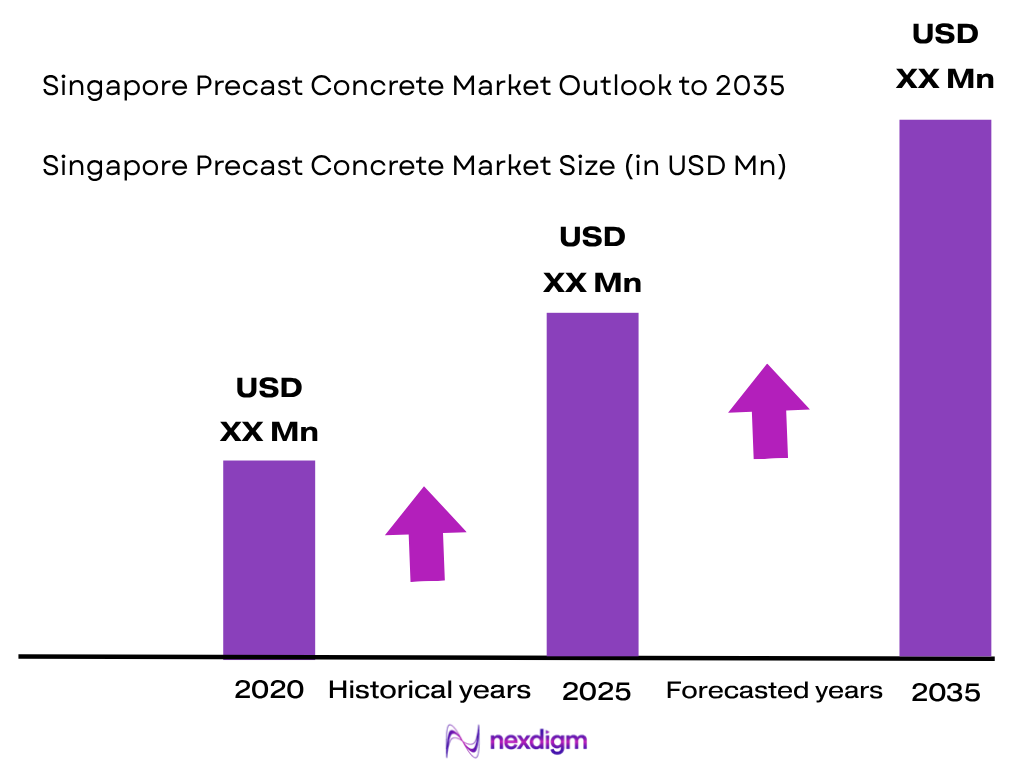
The Singapore Precast Concrete Market is estimated at ~USD XX million in 2024, with the market forecast to expand at a ~XX% CAGR during 2026–2035. The physical demand base is well established: precast concrete consumption reached approximately 1.6 million m³, compared with 1.5 million m³ in the preceding year. Total construction demand reached S$44.2 billion, while construction output reached S$38.4 billion, providing a substantial project pipeline for structural and infrastructure precast products. BCAA
Singapore’s precast concrete demand is concentrated around major public-housing, infrastructure, institutional and industrial development corridors rather than being differentiated by separate national markets. HDB remains a major demand generator, with 19,637 BTO flats and 1,588 SBF units launched during the latest full-year period, while the October exercise alone involved 8,573 flats across 15 projects. Major infrastructure programmes involving MRT expansion, Changi Airport Terminal 5, Tuas Port and public housing reinforce demand for factory-produced structural components.
Market Segmentation
By Product Type
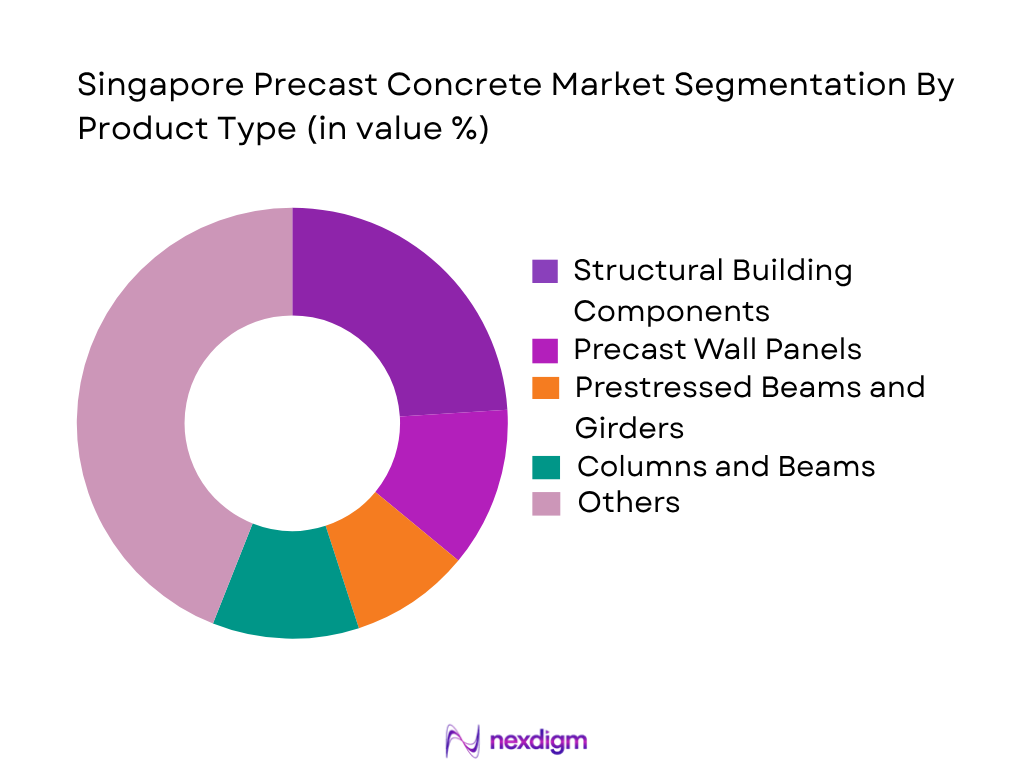
The Singapore Precast Concrete Market is segmented by product type into structural building components, precast wall panels, prestressed beams and girders, columns and beams, hollow-core slabs, precast floor and roof systems, precast staircases and landings, architectural precast components, precast concrete pipes, drainage structures, manholes and utility chambers, bridge components, road barriers and dividers, precast foundations and piles, and precast utility structures. Structural building components represent the leading sub-segment because Singapore’s construction model emphasizes factory-controlled production, standardized structural elements and accelerated site assembly. These products are particularly suited to residential towers, institutional buildings, industrial facilities and large infrastructure projects where repeated components can be manufactured in controlled environments. Precast wall panels, columns, beams and slabs also integrate effectively with Design for Manufacture and Assembly requirements. Singapore’s construction ecosystem has increasingly incorporated advanced precast solutions as part of productivity improvement initiatives, while approximately 1.6 million m³ of precast concrete was consumed in the latest full-year period.
By Application
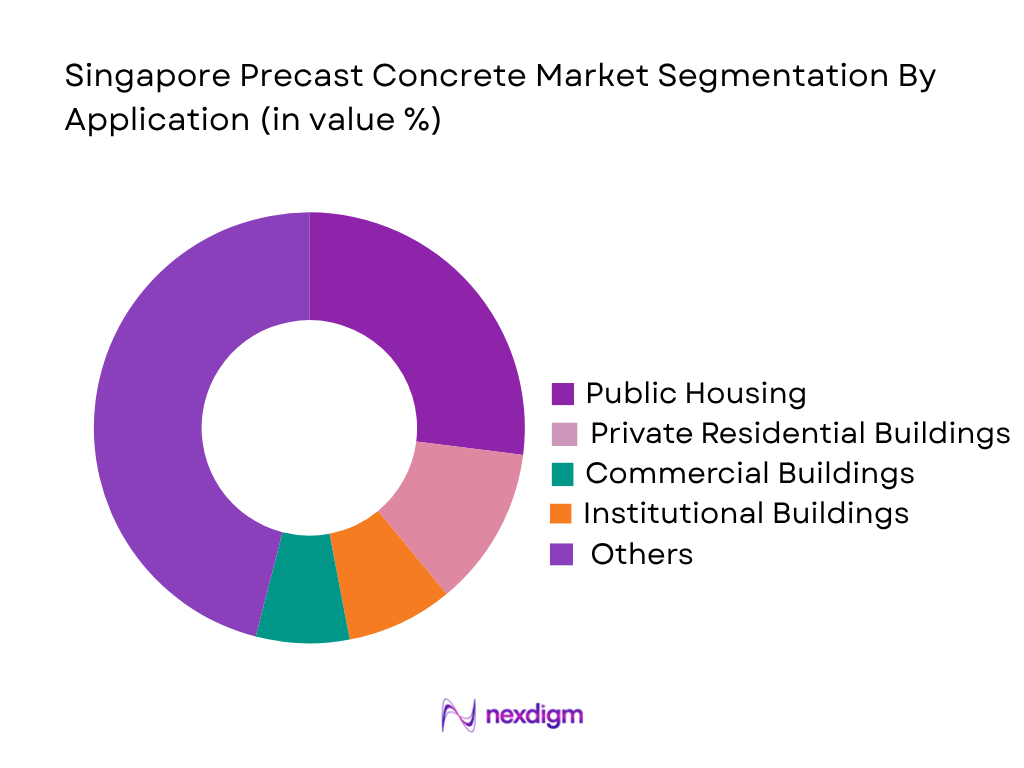
The Singapore Precast Concrete Market is segmented by application into public housing, private residential buildings, commercial buildings, institutional buildings, industrial and warehouse buildings, data centres, manufacturing facilities, bridges and transportation infrastructure, rail and MRT infrastructure, water and wastewater infrastructure, utility infrastructure, marine and port infrastructure, healthcare facilities, educational buildings, and government and defence facilities. Public housing represents the leading application because HDB programmes create a recurring pipeline for standardized residential structures where productivity, quality consistency and shortened construction schedules are critical. HDB launched 19,637 BTO flats and 1,588 SBF units, creating direct demand for structural precast components. Infrastructure is another significant demand pool, supported by MRT expansion, airport development, port expansion and public-sector civil-engineering works. BCA reported S$44.2 billion of construction demand, while public-sector construction remained a major contributor to overall activity.
Competitive Landscape
The Singapore Precast Concrete Market is characterized by a concentrated ecosystem of established precast manufacturers, construction groups and building-material suppliers serving HDB, private residential, commercial, institutional and infrastructure projects. Competition is increasingly determined by manufacturing capacity, DfMA capability, PPVC integration, engineering support, plant automation, logistics and the ability to coordinate factory production with constrained urban construction sites. Companies with established production facilities and relationships across the public-housing and infrastructure ecosystem have an advantage in securing recurring project volumes.
| Company | Establishment Year | Headquarters | Production / Capacity Indicator | Core Product Capability | DfMA / PPVC Capability | Infrastructure Capability | Geographic / Project Coverage | Engineering / Installation |
| Eastern Pretech Pte Ltd | 1982 | Singapore | ~ | ~ | ~ | ~ | ~ | ~ |
| Prefab Technology Pte Ltd | 2003 | Singapore | ~ | ~ | ~ | ~ | ~ | ~ |
| Greyform Pte Ltd | 1996 | Singapore | ~ | ~ | ~ | ~ | ~ | ~ |
| CES-Precast Pte Ltd | 1997 | Singapore | ~ | ~ | ~ | ~ | ~ | ~ |
| HL Building Materials Pte Ltd | 1961 | Singapore | ~ | ~ | ~ | ~ | ~ | ~ |
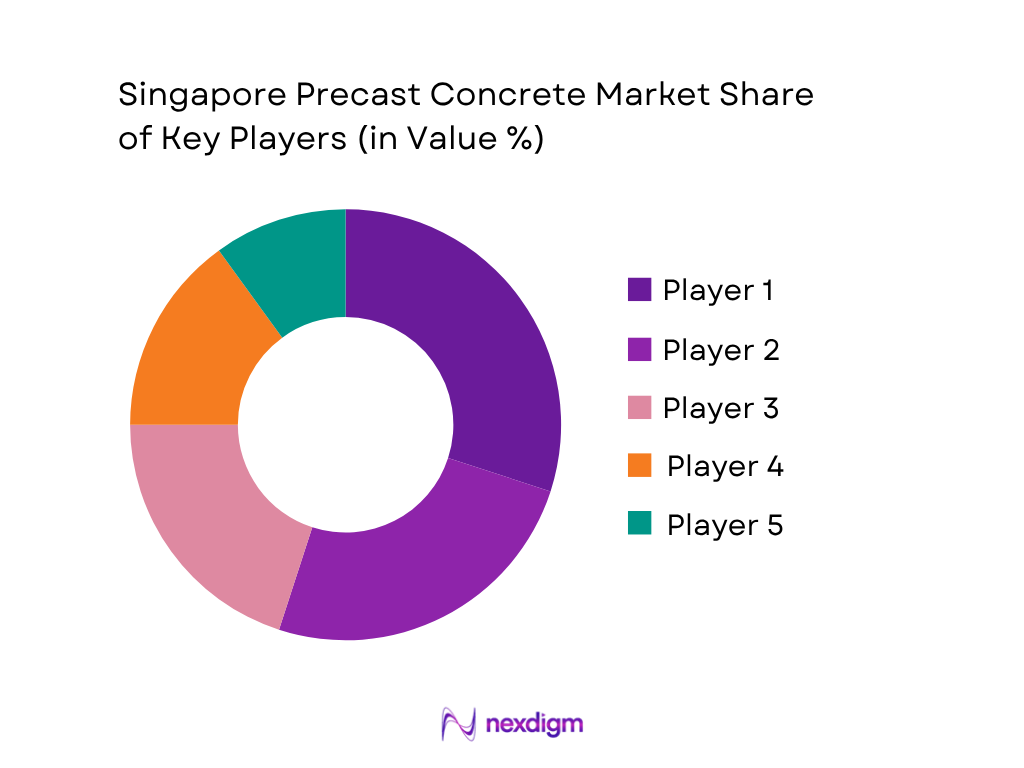
Singapore Precast Concrete Market Analysis
Growth Drivers
Expansion of Construction Activity
The Singapore Precast Concrete Market is supported by sustained construction activity across public housing, infrastructure, institutional facilities and private developments. Singapore’s construction demand reached S$44.2 billion in 2024, while construction output reached S$38.4 billion, providing a substantial project pipeline for structural precast, wall panels, beams, slabs, columns, drainage structures and infrastructure components. Public-sector projects remain particularly important because Singapore continues to invest in housing, transportation and essential infrastructure. HDB launched 21,225 new flats in 2024, comprising 19,637 BTO flats and 1,588 SBF flats, creating recurring requirements for standardized structural components. Singapore’s GDP also reached approximately US$547.39 billion in 2024, while GDP growth was 4.4, indicating a resilient economic environment supporting construction investment. The market benefits because precast concrete enables repetitive components to be manufactured under controlled factory conditions and assembled rapidly on constrained urban sites. Infrastructure programmes involving MRT expansion, Changi Airport Terminal 5, Tuas Port and other public works further broaden demand. BCA expects construction demand to remain between S$39 billion and S$46 billion annually during 2026–2029, indicating a sustained pipeline for precast applications across residential, commercial and infrastructure projects.
Industrialised Construction and Productivity Requirements
The Singapore Precast Concrete Market is increasingly supported by the country’s emphasis on Design for Manufacture and Assembly, prefabrication and construction productivity. Singapore’s construction model is suited to precast because land availability is constrained and construction activities must be coordinated within dense urban environments. HDB launched 19,600 BTO flats through three sales exercises in 2024, while approximately 21,400 flats were completed across 23 projects in 2023, demonstrating the scale and repetitive nature of residential construction activity. The government also continued strengthening industrialised construction methods to shorten project timelines and improve resource efficiency. Singapore’s GDP growth of 4.4 in 2024 and GDP per capita of approximately US$90,674 indicate strong underlying economic activity that supports investment in advanced construction systems. Precast manufacturers can benefit from repetitive component requirements involving columns, beams, slabs, staircases, façade panels and utility structures. The need to reduce site-based work also increases the relevance of factory-controlled production, automated reinforcement, standardized molds and digitally coordinated manufacturing. HDB’s FY2024 activity included construction commencement for approximately 23,600 flats, further supporting demand for industrialized structural systems. These conditions create a favourable environment for manufacturers capable of integrating engineering, production, logistics and installation into coordinated precast delivery models.
Market Challenges
Limited Space and Heavy-Component Logistics Constraints
The Singapore Precast Concrete Market faces logistical constraints because precast products are heavy, bulky and often require carefully sequenced transportation and lifting operations. Singapore’s highly urbanized construction environment means manufacturing plants, storage yards and project sites must operate within a geographically compact and infrastructure-intensive setting. Components such as prestressed beams, hollow-core slabs, wall panels and bridge elements require specialized vehicles, lifting equipment and coordinated delivery schedules. Delays can occur when site access, road restrictions, crane availability or installation sequencing do not align with factory production. The challenge becomes more important as construction activity remains elevated, with total construction demand reaching S$44.2 billion and construction output reaching S$38.4 billion in 2024. Large infrastructure projects also increase the complexity of delivery planning because precast components may need to reach constrained rail, road, port or institutional sites according to tightly controlled installation windows. Singapore handled about 61 million passengers at Changi Airport between January and November 2024, illustrating the intensity of activity across major transport infrastructure corridors. Tuas Port also had 9 berths operating by July 2024, with 2 additional berths scheduled to commence operations by year-end, creating additional infrastructure activity and logistics requirements.
High Coordination and Manufacturing Complexity
The Singapore Precast Concrete Market faces challenges arising from the coordination required between designers, engineers, developers, precast manufacturers, transport operators and installation contractors. Precast production depends on accurate design information because molds, reinforcement cages, embedded components and connection systems are prepared before products reach the construction site. Late design changes can therefore result in manufacturing disruption, additional fabrication requirements and scheduling difficulties. The challenge is particularly relevant in Singapore, where projects frequently involve high-rise residential buildings, institutional facilities, infrastructure and technically complex developments. Construction demand reached S$44.2 billion in 2024, while BCA expects annual construction demand of S$39–46 billion during 2026–2029, indicating a substantial pipeline requiring coordinated supply. HDB also commenced construction of approximately 23,600 flats during FY2024, creating large volumes of repetitive components that must be synchronized with project schedules. Digital coordination initiatives such as CORENET X are intended to improve regulatory submissions and coordination across the built environment. At the same time, manufacturers must maintain production flexibility while controlling quality across structural components, façade elements and infrastructure products. The need for precise engineering, mold management, reinforcement placement, quality inspection and just-in-time delivery can increase operational complexity for smaller or less technologically equipped manufacturers.
Market Opportunities
Expansion of Public Housing and Infrastructure Precast Applications
The Singapore Precast Concrete Market has an opportunity to expand through continued public housing and infrastructure development, particularly where standardized components can accelerate construction. HDB launched 21,225 new flats in 2024, including 19,637 BTO flats and 1,588 SBF flats, creating a recurring requirement for structural precast components such as columns, beams, slabs, staircases and wall panels. HDB also remained on track with its broader programme of launching approximately 100,000 flats during the five-year period from 2021 to 2025. Infrastructure provides another important opportunity, with projects involving MRT expansion, Changi Airport Terminal 5, Tuas Port, utilities and public facilities requiring durable structural and civil-engineering components. Changi Airport handled approximately 61 million passengers from January to November 2024, while its existing terminals have annual capacity of 90 million passengers, reinforcing the strategic importance of airport infrastructure. Tuas Port is planned around a future handling capacity of 65 million TEUs, creating a long-term infrastructure ecosystem requiring concrete structures, utility systems and marine-related components. Manufacturers can capture these opportunities through higher-value engineered precast, rapid-installation systems, infrastructure-specific components and integrated design-to-installation services.
Low-Carbon, Automated and Advanced Precast Solutions
The Singapore Precast Concrete Market has an opportunity to move beyond conventional structural products toward automated, digitally coordinated and lower-carbon precast solutions. Singapore’s construction transformation agenda increasingly emphasizes productivity, digital coordination and more efficient resource utilization. Construction demand reached S$44.2 billion in 2024, while BCA expects annual demand of S$39–46 billion during 2026–2029, creating a sizeable project pipeline in which productivity-enhancing construction technologies can gain adoption. Manufacturers can develop opportunities through automated reinforcement placement, robotic mold production, self-compacting concrete, optimized concrete mixes, digital quality control, BIM-to-fabrication workflows and lower-carbon cementitious materials. Singapore’s economic environment also supports investment in advanced construction technologies, with GDP reaching approximately US$547.39 billion and GDP per capita reaching approximately US$90,674 in 2024. The government’s digital built-environment initiatives, including CORENET X, further support better coordination among project stakeholders. Advanced precast can be particularly relevant for high-rise housing, data centres, institutional buildings, transportation infrastructure and industrial facilities where repeatability and quality control are important. Companies that combine manufacturing automation with engineering, logistics and installation capabilities can therefore strengthen their position in increasingly technology-driven construction projects. Building and Construction Authority
Future Outlook
Over the next decade, the Singapore Precast Concrete Market is expected to benefit from continued public-housing development, infrastructure expansion and increasing adoption of industrialized construction. DfMA and PPVC will remain central to productivity improvements, while automation and digitally coordinated manufacturing are expected to increase the sophistication of local precast production. Demand will also be supported by transportation infrastructure, institutional developments, industrial facilities and large-scale urban redevelopment. BCA’s medium-term construction pipeline indicates continued demand, with construction demand expected at S$39–46 billion annually during the medium-term forecast period. Building and Construction Authority
Major Players
- Eastern Pretech Pte Ltd
- Prefab Technology Pte Ltd
- Greyform Pte Ltd
- CES-Precast Pte Ltd
- HL Building Materials Pte Ltd
- Excel Precast Pte Ltd
- Sunway Concrete Products (S) Pte Ltd
- Integrated Precast Solutions Pte Ltd
- G & W Precast Pte Ltd
- Precast Concrete Pte Ltd
- Jin Cheng Pte Ltd
- Jin Sheng Pte Ltd
- JSTAR Precast Pte Ltd
- Kwan Yong Construction Pte Ltd
- Chip Eng Seng Contractors (1988) Pte Ltd
Key Target Audience
- Real Estate Developers and Property Development Companies
- Public Housing and Infrastructure Developers
- Precast Concrete Manufacturers and Building-Material Producers
- Main Contractors and Specialist Precast Installation Contractors
- Investments and Venture Capitalist Firms (Infrastructure Funds, Private Equity Funds, Construction Technology Investors)
- Government and Regulatory Bodies (Building and Construction Authority, Housing & Development Board, Land Transport Authority, JTC Corporation, Public Utilities Board)
- Cement, Aggregates, Steel Reinforcement and Construction-Material Suppliers
- Engineering, Architecture and Construction-Technology Product Companies
Research Methodology
Step 1: Identification of Key Variables
The initial phase involves constructing a Singapore-specific precast concrete ecosystem covering manufacturers, raw-material suppliers, contractors, developers, public agencies and infrastructure owners. The assessment identifies variables including production capacity, installed precast volume, product mix, DfMA adoption, PPVC integration, project pipeline, plant utilization and application-level demand. Public housing, infrastructure and industrial construction are separately mapped to establish the principal demand pools.
Step 2: Market Analysis and Construction
Historical market information is compiled using construction contracts, precast consumption volumes, construction output, public-housing activity and infrastructure project pipelines. The analysis separates structural, architectural and infrastructure precast applications and evaluates demand by product and construction system. The latest available industry evidence indicates approximately 1.6 million m³ of precast concrete consumption, providing a key volume benchmark for market construction. BCAA
Step 3: Hypothesis Validation and Expert Consultation
Market hypotheses are validated through discussions with precast manufacturers, contractors, structural engineers, developers, procurement specialists and construction-material suppliers. Interviews focus on plant utilization, product demand, manufacturing constraints, project award cycles, DfMA adoption, PPVC integration, transportation requirements and competitive positioning. These insights are used to challenge assumptions generated through secondary research and identify differences between installed capacity and actual market consumption.
Step 4: Research Synthesis and Final Output
The final stage triangulates demand-side construction activity with supply-side manufacturing capability and project-level requirements. HDB housing programmes, MRT infrastructure, institutional developments, industrial projects and major civil-engineering programmes are mapped against relevant precast products. The resulting framework provides a validated assessment of market size, segmentation, competitive positioning, technology adoption and future demand, while separating observable industry data from analytical assumptions.

- Executive Summary
- Research Methodology (Market Definitions and Assumptions, Singapore Precast Concrete Market Classification, Precast and Prestressed Concrete Scope, Product Mapping, Structural Component Mapping, Infrastructure Product Mapping, Architectural Precast Assessment, Structural Precast Assessment, Prestressed Concrete Assessment, Precast Pipe Assessment, Utility Structure Assessment, Bridge Component Assessment, Hollow-Core Slab Assessment, Precast Wall Panel Assessment, Production Capacity Assessment, Plant Utilization Assessment, BCA-Certified Contractor Mapping, DfMA Ecosystem Assessment, PPVC Ecosystem Assessment, Supply-Side Assessment, Demand-Side Assessment, Top-Down Market Sizing, Bottom-Up Market Sizing, Primary Industry Interviews, Construction and Infrastructure Project Pipeline Assessment, Data Triangulation, Forecasting Framework)

- Definition and Scope
- Singapore Precast Concrete Industry Evolution and Development of Structural Precast Systems, Prestressed Concrete Systems, Architectural Precast, Advanced Precast Concrete Systems, Total Precast Buildings, Precast Wall Panels, Hollow-Core Slabs, Precast Beams and Columns, Precast Staircases, Precast Concrete Pipes, Drainage Structures, Utility Chambers, Bridge Components, Modular Precast Systems, PPVC-Integrated Systems, DfMA-Based Construction, High-Performance Concrete, Automated Precast
- Technologies, Low-Carbon Precast Concrete
- Precast Concrete Value Chain Analysis
- Precast Concrete Supply Chain Analysis
Cement Suppliers, Aggregate Producers, Supplementary Cementitious Material Suppliers, Reinforcing Steel Suppliers, Prestressing Strand Suppliers, Admixture Suppliers, Formwork and Mold Providers, Precast Manufacturing Plants, Prestressing Facilities, Advanced Precast Manufacturing Facilities, Engineering and Design Companies, BIM and Digital Fabrication Providers, Heavy-Haul Transportation Providers, Crane and Erection Contractors, General Contractors, HDB, URA, JTC, LTA, PUB, Real Estate Developers, Architects, Structural Engineers, Certification and Testing Organizations

- Growth Drivers (HDB Public Housing Development, DfMA Adoption, PPVC Integration, Advanced Precast Concrete System Adoption, Construction Productivity Requirements, Labour Productivity Requirements, MRT Expansion, Transportation Infrastructure Development, Data Centre Construction, Industrial Development, Port Infrastructure Development, Faster Construction Requirements)
- Market Challenges (Limited Manufacturing Land Availability, Heavy Component Transportation Constraints, Crane and Erection Requirements, Skilled Precast Installation Requirements, Manufacturing Plant Capital Requirements, Factory Capacity Utilization Risk, Project-Specific Mold Requirements, Design Coordination Complexity, Site Access Constraints, Precast Storage Requirements, Tight Construction Scheduling, Material Supply Constraints)
- Market Opportunities (Advanced Precast Concrete Systems, PPVC-Integrated Construction, DfMA-Based Precast Construction, Automated Precast Manufacturing, High-Rise Public Housing, Data Centre Precast Systems, Industrial and Logistics Facilities, MRT and Rail Components, Bridge and Transportation Components, Water Infrastructure Precast, Modular Construction, Low-Carbon Precast Concrete)
- Market Trends (Advanced Precast Concrete Systems, DfMA Integration, PPVC Adoption, Automated Precast Production, BIM-to-Fabrication Integration, Digital Production Planning, Robotics in Precast Manufacturing, Modular Construction, High-Performance Concrete, Self-Consolidating Concrete, Low-Carbon Concrete Mixes, Prefabricated MEP Integration)
- Government Regulations and Standards (Building Control Act, Building Control Regulations, BCA DfMA Requirements, Advanced Precast Concrete System Requirements, PPVC Accreditation Requirements, Prefabricated Bathroom Unit Requirements, BCA Contractor Registration Requirements, Singapore Standards for Concrete Structures)
- SWOT Analysis
- Porter’s Five Forces Analysis
- PESTLE Analysis
- Stakeholder Ecosystem
- Precast Concrete Production and Construction Ecosystem

- By Market Value (2020-2025)
- By Precast Concrete Production Volume (2020-2025)
- By Precast and Prestressed Concrete Shipment Volume (2020-2025)
- By Structural Precast Production Volume (2020-2025)
- By Architectural Precast Production Volume (2020-2025)
- By Infrastructure Precast Production Volume (2020-2025)
- By Precast Concrete Pipe Production Volume (2020-2025)
- By Precast Wall Panel Production Volume (2020-2025)
- By Hollow-Core Slab Production Volume (2020-2025)
- By Precast Beam and Column Production Volume (2020-2025)
- By Precast Staircase Production Volume (2020-2025)

- By Product Type (In Value %)
Structural Building Components
Precast Wall Panels
Prestressed Beams and Girders
Columns and Beams
Hollow-Core Slabs
Precast Floor and Roof Systems
Precast Staircases and Landings
Architectural Precast Components
Precast Concrete Pipes
Drainage Structures
Manholes and Utility Chambers
Bridge Components
Road Barriers and Dividers
Precast Foundations and Piles
Precast Utility Structures - By Construction System (In Value %)
Structural Precast Systems
Prestressed Concrete Systems
Total Precast Building Systems
Architectural Precast Systems
Advanced Precast Concrete Systems
Precast Envelope Systems
Hybrid Precast-Steel Systems
Hybrid Precast-Cast-in-Place Systems
PPVC-Integrated Precast Systems
DfMA-Based Precast Systems - By Application (In Value %)
Public Housing
Private Residential Buildings
Commercial Buildings
Institutional Buildings
Industrial and Warehouse Buildings
Data Centers
Manufacturing Facilities
Bridges and Transportation Infrastructure
Rail and MRT Infrastructure
Water and Wastewater Infrastructure
Utility Infrastructure
Marine and Port Infrastructure
Healthcare Facilities
Educational Buildings
Government and Defense Facilities - By Manufacturing Technology (In Value %)
Conventional Wet-Cast Precast
Prestressed Precast
Self-Consolidating Concrete Precast
High-Performance Concrete Precast
Advanced Precast Concrete Production
Automated Precast Production
Robotic Precast Manufacturing
Digital Precast Manufacturing
Modular and Volumetric Precast
Low-Carbon Precast Concrete - By Region (In Value %)
Central Region
East Region
North Region
North-East Region
West Region

- Market Share of Major Players (By Singapore Revenue, Precast Production Capacity, Number of Manufacturing Plants, Structural Precast Capacity, Prestressed Concrete Capacity, Architectural Precast Capability, Infrastructure Product Portfolio, Advanced Precast Capability, PPVC Integration Capability, DfMA Capability, Geographic Coverage, Engineering and Design-Assist Capability, Heavy-Haul Capability, Erection Capability, Major Project Portfolio)
- Cross Comparison Parameters (Annual Precast Production Capacity, Manufacturing Plant Network, Structural and Prestressed Product Breadth, Advanced Precast System Capability, PPVC and DfMA Integration Capability, Automated Production Capability, Engineering and Design-Assist Capability, Transportation and Erection Capability)
- SWOT Analysis of Major Players
- Competitive Positioning Matrix
- Major Companies
Prefab Technology Pte Ltd
Eastern Pretech Pte Ltd
Greyform Pte Ltd
Excel Precast Pte Ltd
CES-Precast Pte Ltd
HL Building Materials Pte Ltd
Sunway Concrete Products (S) Pte Ltd
Integrated Precast Solutions Pte Ltd
G & W Precast Pte Ltd
Precast Concrete Pte Ltd
Jin Cheng Pte Ltd
Jin Sheng Pte Ltd
JSTAR Precast Pte Ltd
Kwan Yong Construction Pte Ltd
Chip Eng Seng Contractors (1988) Pte Ltd

- HDB Precast Concrete Requirement Assessment
- Real Estate Developer Precast Requirement Assessment
- Main Contractor Procurement Assessment
- Precast Erection Contractor Requirement Analysis
- Structural Engineer Specification Assessment
- Commercial Building Precast Requirement Assessment
- Residential High-Rise Precast Requirement Assessment
- Industrial and Warehouse Precast Requirement Assessment
- Data Center Precast Requirement Assessment
- Bridge and Transportation Precast Assessment

- By Market Value (2026-2035)
- By Precast Concrete Production Volume (2026-2035)
- By Structural Precast Production Volume (2026-2035)
- By Prestressed Concrete Production Volume (2026-2035)
- By Architectural Precast Production Volume (2026-2035)
- By Infrastructure Precast Production Volume (2026-2035)
- By Precast Concrete Pipe Production Volume (2026-2035)
- By Bridge Component Production Volume (2026-2035)
- By Water and Wastewater Precast Demand (2026-2035)
- By Data Center Precast Demand (2026-2035)
- By Public Housing Precast Demand (2026-2035)


 Request a Sample
 Ask for Customization
 Get a Quote
 Enquire Now
