

 Download PDF
Market Overview
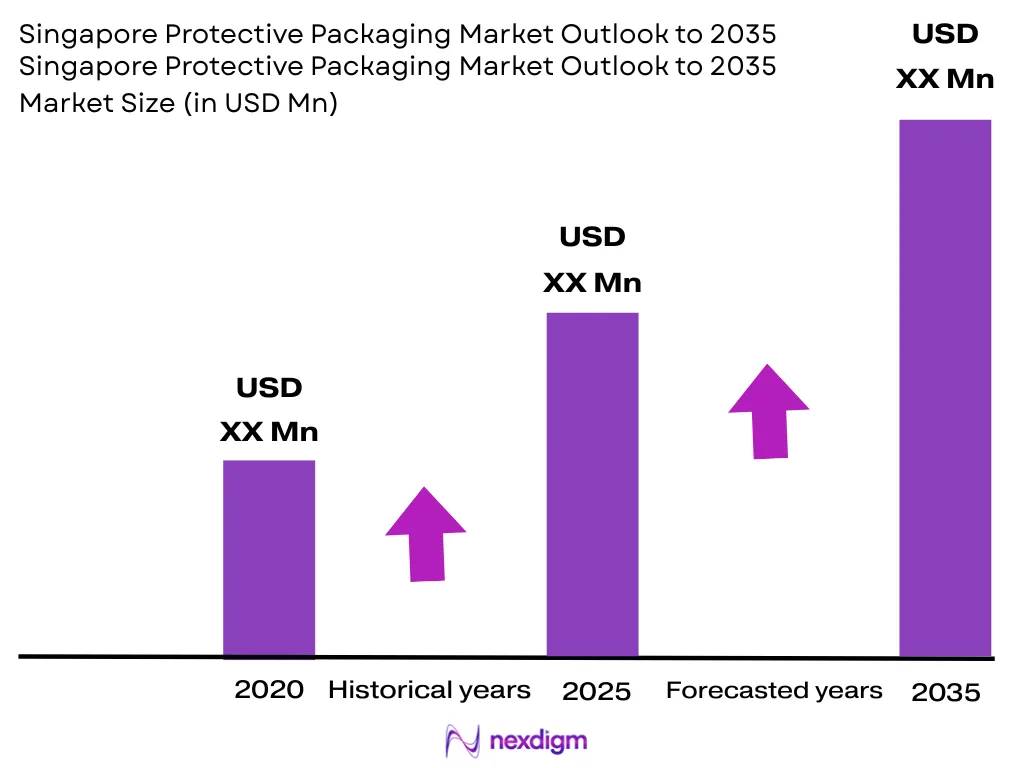
The Singapore Protective Packaging Market was valued at USD ~ Million in 2024 and is anticipated to expand at a CAGR of ~% during 2026-2035. The market is primarily driven by Singapore’s position as a global semiconductor and electronics manufacturing hub, rapid e-commerce growth, and substantial investment in regional logistics infrastructure. The broader Asia Pacific protective packaging market dominated the global industry with the largest revenue share of approximately 43.0% in 2024, with Asia Pacific also representing the fastest-growing region globally at a CAGR of approximately 7.8-7.9% through 2033, driven by rapid industrialization, expanding e-commerce, and rising export activity. Within Singapore specifically, single-wall corrugated cartons accounted for approximately 53.85% of shipments in 2025, while triple-wall board is projected to grow at approximately 6.81% annually through 2031, driven by semiconductor equipment, precision machinery, and photovoltaic modules requiring extra crush resistance across multiple transshipment points, reflecting the country’s specialized role in high-value electronics and precision goods logistics.
Market Segmentation
By Type
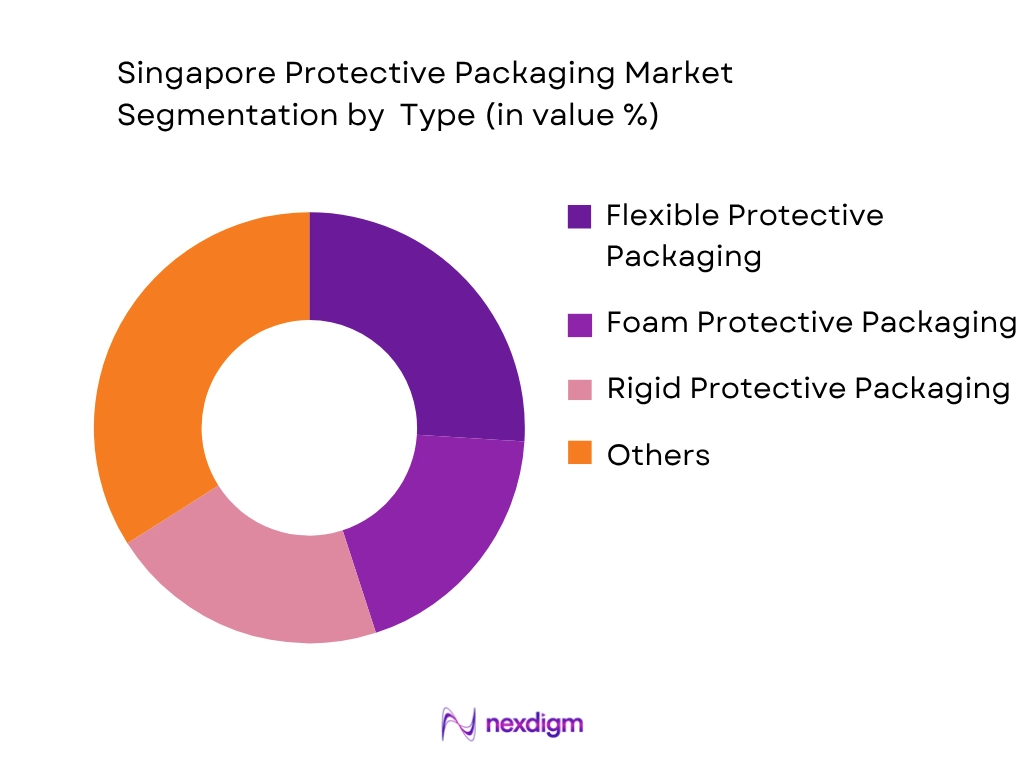
Among these, Rigid Protective Packaging, particularly corrugated board formats, holds the largest share of the Singapore Protective Packaging Market, with single-wall cartons accounting for approximately 53.85% of shipments in 2025 as they satisfy the protective needs of most parcel networks at the lowest material weight. Triple-wall board is emerging as the fastest-growing format, projected to grow approximately 6.81% annually through 2031, as semiconductor equipment, precision machinery, and photovoltaic modules demand extra crush resistance across multiple transshipment points, with enhanced rigidity mitigating vibration damage during airfreight legs and temperature cycling in unconditioned containers protecting cargoes worth millions of dollars. Die-cut custom boxes are projected to record a CAGR of approximately 6.45% as e-commerce brands differentiate through memorable unboxing experiences that cultivate social-media buzz and repeat purchases. Automation upgrades inside regional converter plants continue to shorten setup times, making lower-volume triple-wall production economically viable and extending its reach from niche to mainstream high-value exports.
By Application
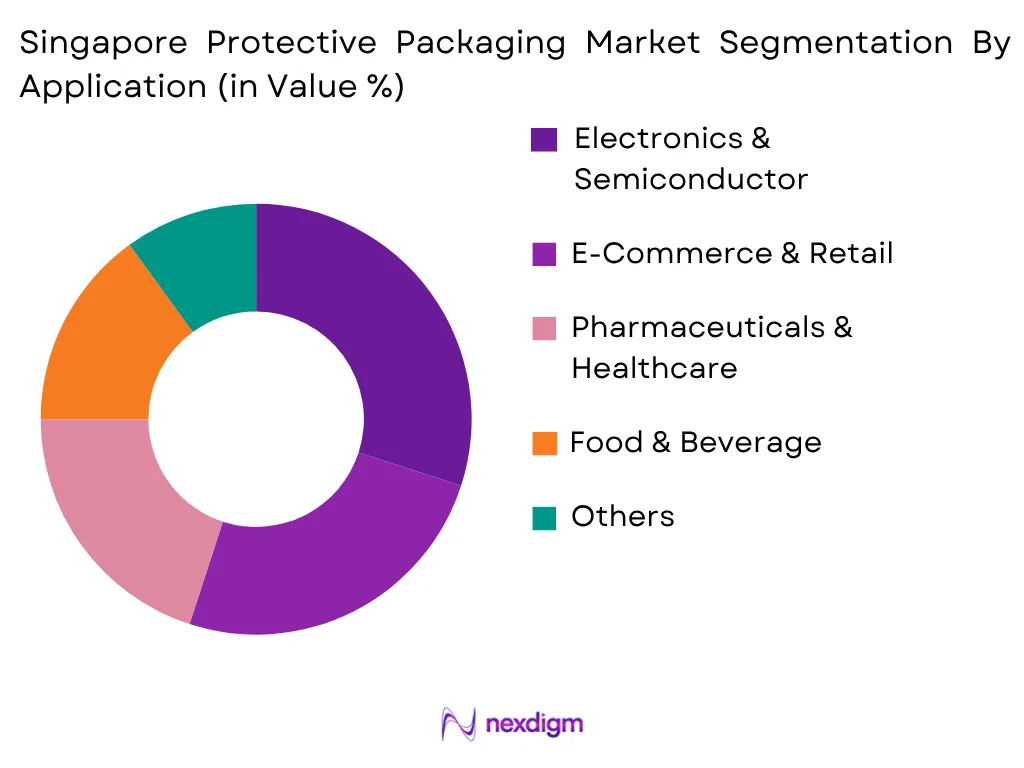
The Electronics & Semiconductor segment holds a significant and distinctive share of the Singapore Protective Packaging Market given the country’s position as a global hub for semiconductor manufacturing, precision machinery, and high-value electronics exports requiring specialized anti-static films, foam inserts, and triple-wall crush-resistant packaging. E-Commerce & Retail continues to expand rapidly, supported by substantial infrastructure investment such as SingPost’s SGD 182 million (USD 135 million) regional e-commerce logistics hub inaugurated at Tampines Logistics Park in March 2026, reinforcing Singapore’s role as a regional e-commerce fulfillment and distribution center. Pharmaceuticals & Healthcare and Food & Beverage applications continue to generate steady demand for protective packaging, supported by Singapore’s advanced logistics infrastructure and cold chain capabilities. Industrial & Precision Machinery applications remain a critical demand driver given Singapore’s role as a transshipment hub for high-value cargo requiring specialized protective formats capable of withstanding multiple handling points across international supply chains.
Competitive Landscape
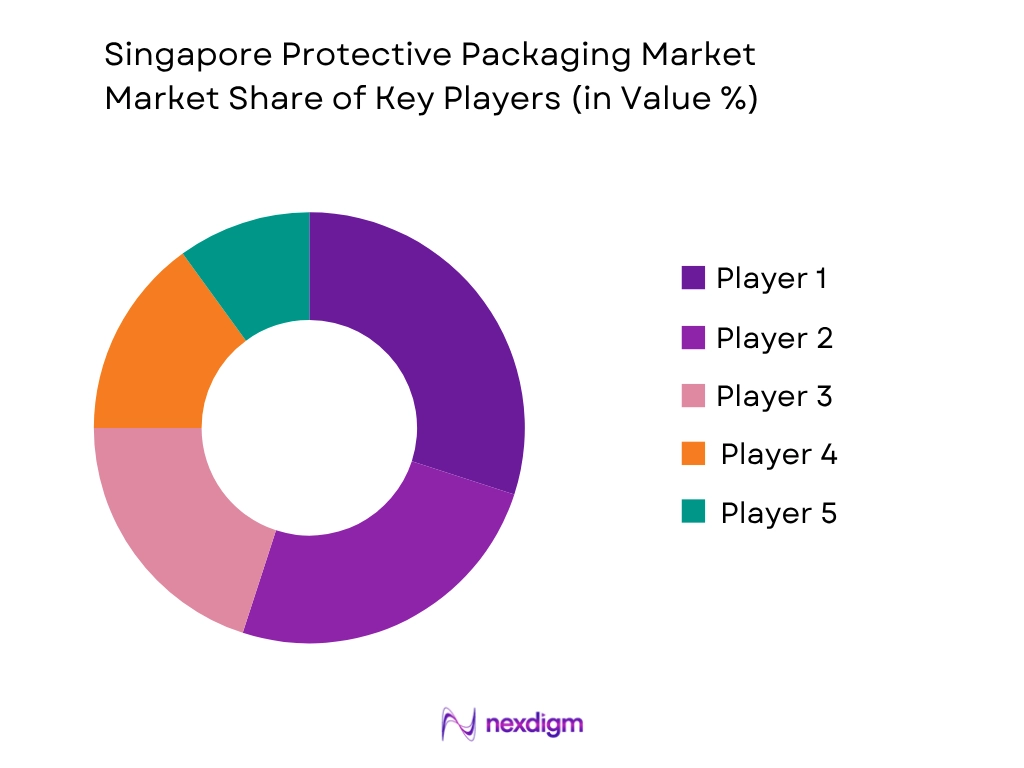
The Singapore Protective Packaging Market is moderately consolidated, comprising specialized regional distributors alongside multinational packaging manufacturers with strong distribution networks serving the country’s role as a regional logistics and manufacturing hub. Competition is primarily based on crush-resistance performance, automation capability, regulatory compliance, application-specific technical support for semiconductor and electronics applications, and sustainability credentials. Regional distributors such as Syspex Packaging, a leading distributor of packaging solutions across Southeast Asia, offer environmentally friendly protective solutions including Storopack’s PAPERbubble product line, reflecting the market’s growing emphasis on sustainable alternatives to conventional plastic protective materials. Global players including Sealed Air, Storopack, Sonoco, and Smurfit WestRock, which reported FY 2025 results with a USD 7 billion EBITDA ambition for 2030 in February 2026, continue to expand their regional presence and product innovation to serve Singapore’s high-value electronics, pharmaceutical, and e-commerce sectors. Companies operating within Singapore continue to invest in automation upgrades within converter plants to shorten setup times and make specialized triple-wall and high-barrier protective packaging formats economically viable for the country’s demanding export and logistics requirements.
| Company | Established | Headquarters | Primary Product Portfolio | Sustainable/Recyclable Portfolio | Manufacturing Presence | Major End-Use Industries | Key Strategic Focus | Certifications & Compliance |
| Syspex Packaging (S) Pte Ltd. | 1990 | ~ | ~ | ~ | ~ | ~ | ~ | ~ |
| Sealed Air Corporation | 1960 | ~ | ~ | ~ | ~ | ~ | ~ | ~ |
| Storopack Hans Reichenecker GmbH | 1874 | ~ | ~ | ~ | ~ | ~ | ~ | ~ |
| Sonoco Products Company | 1899 | ~ | ~ | ~ | ~ | ~ | ~ | ~ |
| Smurfit WestRock plc | 2024 | ~ | ~ | ~ | ~ | ~ | ~ | ~ |
Singapore Protective Packaging Market Analysis
Growth Drivers
Singapore’s Position as a Global Semiconductor and Electronics Logistics Hub
The Singapore Protective Packaging Market is experiencing sustained growth driven by the country’s established position as a global semiconductor manufacturing and electronics logistics hub. Triple-wall corrugated board is projected to grow at approximately 6.81% annually through 2031, driven by semiconductor equipment, precision machinery, and photovoltaic modules that demand extra crush resistance across multiple transshipment points inherent to Singapore’s role as a major international trading and logistics center. Enhanced rigidity in these protective formats mitigates vibration damage during airfreight legs and temperature cycling in unconditioned containers, protecting cargoes worth millions of dollars as they transit through Singapore’s ports and airports. Retail automation facilities also prefer triple-wall protective formats for their durability, while automation upgrades inside regional converter plants continue to shorten setup times, making lower-volume triple-wall production economically viable and extending its reach from niche applications to mainstream high-value electronics exports.
Rapid E-Commerce Growth and Regional Logistics Hub Investment
Singapore’s continued investment in regional e-commerce and logistics infrastructure remains a critical driver of protective packaging demand. In March 2026, SingPost inaugurated a SGD 182 million (USD 135 million) regional e-commerce logistics hub at Tampines Logistics Park, directly strengthening Singapore’s position as a fulfillment and distribution center for the wider Southeast Asian region. Die-cut custom boxes are projected to record a CAGR of approximately 6.45% as e-commerce brands increasingly differentiate through memorable unboxing experiences that cultivate social media engagement and repeat purchases. The broader Asia Pacific protective packaging market, of which Singapore forms a strategically important logistics node, dominated the global protective packaging industry with approximately 43.0% revenue share in 2024 and continues to represent the fastest-growing global region, driven by rapid industrialization, expanding e-commerce, and rising export activity across the wider Southeast Asian trading bloc that Singapore serves as a key transshipment and distribution hub.
Market Challenges
High Operating Costs and Land Constraints Limiting Domestic Manufacturing Capacity
Singapore’s limited land area and high operating costs present significant challenges for protective packaging manufacturers seeking to establish or expand domestic production capacity. Unlike larger regional markets, Singapore’s packaging converters face substantially higher labour, rental, and utility costs, requiring companies to prioritize automation and high-value specialized production, such as triple-wall board and semiconductor-grade protective packaging, over commodity-scale manufacturing. This cost structure has encouraged many companies to position Singapore primarily as a regional distribution, innovation, and quality-control hub rather than a high-volume manufacturing base, with bulk production increasingly located in lower-cost neighboring markets. Domestic converters must therefore compete on technical sophistication, automation capability, and proximity to Singapore’s world-class port and airport infrastructure rather than on raw production cost, creating a persistent structural challenge for companies seeking to scale commodity protective packaging production domestically.
Import Dependency for Raw Materials and Regulatory Compliance Under EPR
Singapore’s protective packaging market remains heavily dependent on imported raw materials, including virgin and specialty polymers, kraft paper, and high-performance foams, given the country’s lack of domestic petrochemical feedstock and pulp production at scale. This import dependency exposes converters to global commodity price volatility and freight cost fluctuations that directly affect input costs and pricing competitiveness. Compounding this challenge, Singapore’s Resource Sustainability Act and Mandatory Packaging Reporting framework require companies to comply with Extended Producer Responsibility obligations for packaging waste, mandating detailed reporting on packaging materials placed on the market and driving investment in recyclable and reduced-material packaging design. Companies must navigate these compliance requirements alongside import cost pressures, requiring sophisticated supply chain management and material substitution strategies to balance regulatory obligations against the country’s high operating cost environment.
Market Opportunities
Growth in High-Barrier and Triple-Wall Protective Packaging for Semiconductor Exports
Singapore’s specialized role in global semiconductor and precision electronics manufacturing presents substantial opportunities for companies investing in high-barrier and triple-wall protective packaging innovation. Triple-wall board is projected to grow at approximately 6.81% annually through 2031, and automation upgrades inside regional converter plants continue to shorten setup times, making lower-volume triple-wall production economically viable and extending its reach from niche to mainstream high-value exports. Companies developing anti-static films, moisture-barrier packaging, and vibration-dampening cushioning materials specifically engineered for semiconductor equipment, precision machinery, and photovoltaic modules are well positioned to capture growing demand as Singapore continues to strengthen its position within global electronics supply chains. This specialization creates opportunities for premium-positioned converters capable of delivering technically sophisticated protective solutions that justify Singapore’s higher operating cost structure through superior product performance and reliability.
Expansion of Regional Distribution Hub Investment and Sustainable Packaging Innovation
Continued investment in Singapore’s logistics infrastructure, exemplified by SingPost’s SGD 182 million regional e-commerce logistics hub at Tampines Logistics Park, presents significant opportunities for protective packaging companies to strengthen distribution capabilities across the wider Southeast Asian region. Growing regulatory emphasis under the Resource Sustainability Act and Singapore Green Plan 2030 continues to drive demand for recyclable and sustainable protective packaging alternatives, exemplified by regional distributors such as Syspex offering environmentally friendly solutions including Storopack’s PAPERbubble product line. Companies developing recycled-content corrugated packaging, paper-based cushioning materials, and mono-material recyclable films are well positioned to capture growing demand from both domestic brand owners and regional customers seeking sustainability-compliant packaging solutions sourced through Singapore’s efficient logistics and distribution networks, reinforcing the country’s role as a premium sustainability-focused packaging hub for the broader region.
Future Outlook
The Singapore Protective Packaging Market is expected to witness steady expansion over the forecast period, supported by continued growth in semiconductor and electronics exports, sustained e-commerce and regional logistics hub investment, and rising demand for high-barrier and sustainable packaging solutions. Continued investment in automation, triple-wall and specialized protective formats, and recyclable materials is expected to further strengthen the market’s competitive positioning within the broader Asia Pacific region. Growing regulatory emphasis on packaging waste reduction under the Resource Sustainability Act will continue to accelerate the shift toward recyclable and reduced-material protective packaging formats through 2035.
Major Players
- Syspex Packaging (S) Pte Ltd.
- Sealed Air Corporation
- Storopack Hans Reichenecker GmbH
- Sonoco Products Company
- Smurfit WestRock plc
- DS Smith plc (International Paper)
- Pregis LLC
- Ranpak Holdings Corp.
- Huhtamaki Oyj
- Intertape Polymer Group Inc.
- Crown Holdings, Inc.
- Amcor plc
- Mondi Group plc
- Cascades Inc.
- Pro-Pac Packaging Ltd.
Key Target Audience
- Protective Packaging Manufacturers and Distributors
- Semiconductor and Electronics Manufacturers
- E-Commerce and Retail Companies
- Pharmaceutical and Healthcare Companies
- Third-Party Logistics (3PL) and Freight Forwarding Providers
- Investment and Venture Capitalist Firms
- Government and Regulatory Bodies (National Environment Agency (NEA), Enterprise Singapore, Maritime and Port Authority of Singapore (MPA))
- Port and Free Trade Zone Infrastructure Providers
Research Methodology
Step 1: Identification of Key Variables
The research process begins with identifying the complete ecosystem of the Singapore Protective Packaging Market, including raw material suppliers, packaging manufacturers, distributors, e-commerce and logistics companies, and regulatory authorities. Extensive secondary research is conducted using company annual reports, government publications, trade associations, customs statistics, industry journals, and proprietary databases to determine the variables influencing market demand, pricing, production, consumption, and technological developments.
Step 2: Market Analysis and Construction
Historical market information is collected and analyzed to estimate market size, import-export activity, application-wise demand, and pricing trends. A combination of top-down and bottom-up approaches is used to estimate market revenues and validate segment-level performance. Consumption patterns across electronics, e-commerce, pharmaceuticals, food and beverage, and industrial applications are evaluated to establish an accurate representation of the industry.
Step 3: Hypothesis Validation and Expert Consultation
The preliminary findings are validated through Computer-Assisted Telephone Interviews (CATIs) and structured discussions with packaging manufacturers, procurement managers, e-commerce and logistics executives, regulatory experts, and senior executives operating within Singapore’s protective packaging industry. These interviews help verify market assumptions, competitive developments, technology adoption trends, pricing dynamics, and future investment opportunities while refining the overall market estimates.
Step 4: Research Synthesis and Final Output
The final stage integrates insights obtained from primary interviews with quantitative information collected through secondary sources. Data triangulation techniques are applied to reconcile differences between supply-side and demand-side estimates, ensuring robust market forecasting. The report is then reviewed through multiple quality assurance checkpoints to deliver a comprehensive analysis covering market size, segmentation, competitive landscape, future outlook, and strategic recommendations for industry stakeholders.

- Executive Summary
- Research Methodology (Market Definitions and Assumptions, Protective Packaging Taxonomy, Abbreviations, Market Sizing Approach, Top-Down Personal Care Product Consumption Analysis, Bottom-Up Packaging Supplier Aggregation, Packaging Units per Finished Product, Demand-Side Assessment, Supply-Side Capacity Mapping, Import–Export Reconciliation, Retail Channel Analysis, Primary Industry Interviews, Data Triangulation, Forecasting Framework, Scenario Analysis, Limitations and Future Conclusions)

- Definition and Scope
- Market Evolution and Industry Genesis
- Timeline of Major Industry Developments
- Protective Packaging Industry Value Chain Analysis
- Supply Chain Analysis

- Growth Drivers (Singapore’s Position as a Global Semiconductor and Electronics Hub, Rapid E-Commerce Growth, Regional Logistics Hub Investment, Growth in Precision Machinery Exports, Expansion of Pharmaceutical Manufacturing, Rising Demand for Damage-Free Transit Solutions)
- Market Challenges (High Operating Costs and Land Constraints, Import Dependency for Raw Materials, Regulatory Compliance Under Extended Producer Responsibility, Limited Domestic Recycling Infrastructure, Skilled Labour Shortages, Freight and Currency Cost Volatility)
- Market Opportunities (Growth in High-Barrier and Triple-Wall Protective Packaging, Expansion of Regional Distribution Hub Investment, Sustainable Packaging Innovation, Automation-Driven Packaging Systems, Cold Chain and Pharmaceutical Packaging Growth, Semiconductor Export Packaging Demand)
- Market Trends (Growth in Triple-Wall Corrugated Cartons, Rise of Die-Cut Custom Boxes for Unboxing Experience, Adoption of Recyclable Paper-Based Cushioning, Automation Upgrades in Converter Plants, Smart and Trackable Packaging Solutions, Lightweighting and Dimensional Optimization)
- Government Regulations (Resource Sustainability Act 2019, Mandatory Packaging Reporting (MPR) Framework, Extended Producer Responsibility (EPR) Scheme for Packaging Waste, National Environment Agency (NEA) Requirements, Singapore Green Plan 2030 Sustainability Targets, Enterprise Singapore Standards)
- Import and Export Analysis (Trade Volume, Major Import Sources, Export Destinations, HS Code Analysis, Trade Balance)
- Raw Material Availability Analysis (Virgin and Recycled Polymers, Kraft Paper and Corrugated Board, Molded Pulp Feedstocks, Specialty Films and Foams, Anti-Static Materials)
- Technology Landscape (Automated Air Cushioning Systems, Triple-Wall Board Manufacturing, Foam-in-Bag Technologies, Anti-Static Film Technologies, Dimensional Optimization Software)
- Sustainability Assessment (Recycled Content Utilization, Biodegradable and Compostable Material Development, Carbon Footprint Reduction, Circular Economy Integration, Right-Sizing and Material Reduction)
- PESTLE Analysis
- SWOT Analysis
- Porter’s Five Forces Analysis
- Stakeholder Ecosystem
- Competition Ecosystem

- By Market Value (2020-2025)
- By Volume Consumption (2020-2025)
- By Average Selling Price (2020-2025)

- By Material (In Value %)
Plastic
Paper & Paperboard
Molded Pulp
Corrugated Board
Others - By Type (In Value %)
Flexible Protective Packaging (Bubble Wrap, Foam Wrap, Air Pillows)
Rigid Protective Packaging (Corrugated Boxes, Triple-Wall Cartons)
Void Fill (Paper Fill, Foam Peanuts)
Insulated Packaging - By Application (In Value %)
E-Commerce & Retail
Electronics & Semiconductor
Pharmaceuticals & Healthcare
Food & Beverage
Industrial & Precision Machinery - By Distribution Channel (In Value %)
Direct Sales to Manufacturers
Packaging Distributors
Online B2B Platforms - By Region (In Value %)
Jurong Island & Western Industrial Zone
Tuas Port & Logistics Corridor
Tampines & Eastern Logistics Hub
Central Business District & Other Areas

- Market Share of Major Players (By Value, Volume, Material Type, Application Industry, Product Type)
- Cross Comparison Parameters (Recyclable Portfolio Breadth, Automation Capability, Manufacturing Capacity, Application Technical Support Capability, Regulatory Compliance & Certifications, Semiconductor and E-Commerce Customer Base, Innovation & New Product Launch Frequency, Regional Distribution Network)
- SWOT Analysis of Major Players
- Pricing Analysis by Material Category and Format
- Production Capacity Analysis
- Manufacturing Footprint Analysis
- Distribution Network Analysis
- Innovation Benchmarking
- Detailed Profiles of Major Companies
Syspex Packaging (S) Pte Ltd.
Sealed Air Corporation
Storopack Hans Reichenecker GmbH
Sonoco Products Company
Smurfit WestRock plc
DS Smith plc (International Paper)
Pregis LLC
Ranpak Holdings Corp.
Huhtamaki Oyj
Intertape Polymer Group Inc.
Crown Holdings, Inc.
Amcor plc
Mondi Group plc
Cascades Inc.
Pro-Pac Packaging Ltd.

- Consumption Pattern Analysis (Order Volume, Fulfillment Center Throughput, Product Category Penetration, Seasonal Demand, Return Rate Impact)
- Purchasing Criteria (Damage Protection Performance, Cost Efficiency, Regulatory Compliance, Sustainability Credentials, Supply Reliability, Automation Compatibility)
- Procurement and Supplier Selection Analysis
- Sustainable Packaging Adoption Assessment
- Premium vs Conventional Packaging Demand
- Product Attribute Preference Analysis (Recycled Content Percentage, Cushioning Performance, Crush Resistance, Weight Efficiency, Material Origin, Recyclability Compliance)
- Consumer Damage-Free Delivery Expectations
- Pain Point Analysis
- Decision-Making Process

- By Market Value (2026-2035)
- By Volume Consumption (2026-2035)
- By Average Selling Price (2026-2035)


 Request a Sample
 Ask for Customization
 Get a Quote
 Enquire Now