
 Download PDF
Market Overview
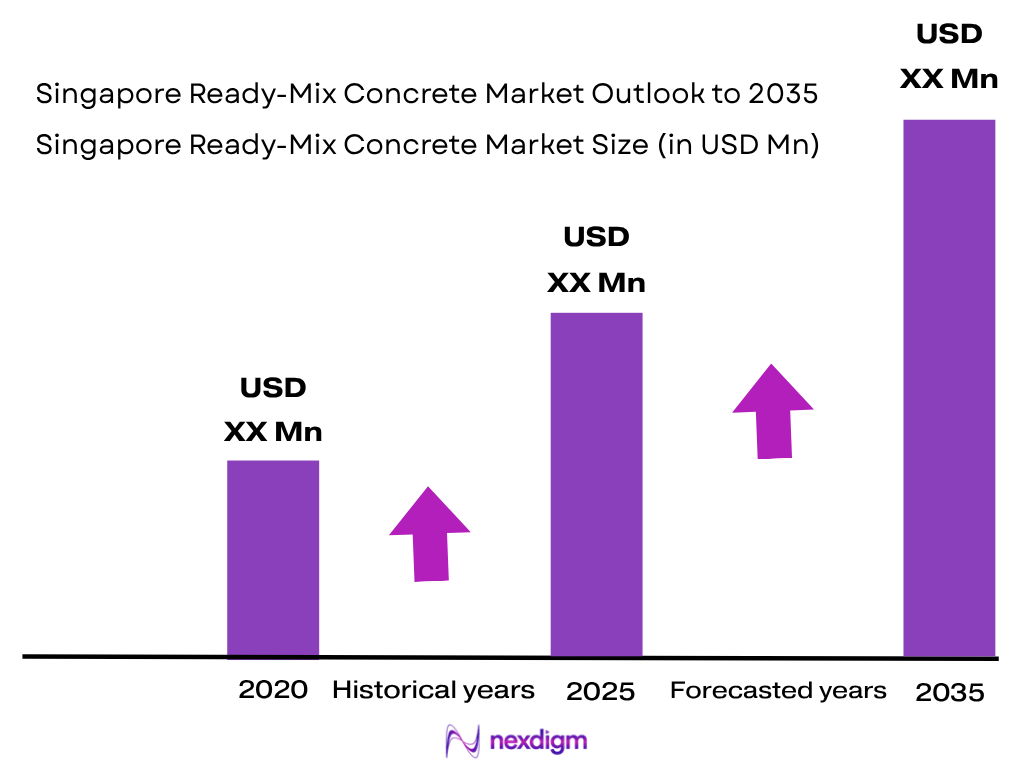
The Singapore ready-mix concrete market is valued at ~USD XX billion in 2024, supported by continuous construction activity across public housing, transport infrastructure, commercial developments, and industrial facilities. Ready-mix concrete demand is closely linked with national construction output, where Singapore’s construction sector recorded strong activity supported by public sector projects and private developments. Ready-mix concrete demand reached approximately 13.3 million cubic metres in FY2024, reflecting increased consumption from major construction projects and infrastructure requirements. SGX Links The market is driven by centralized concrete production, strict quality requirements, and growing adoption of sustainable concrete solutions.
Singapore’s ready-mix concrete demand is concentrated around major urban development zones including Central Region, Jurong Innovation District, Changi, Tuas, and Punggol, where large-scale infrastructure, industrial, residential, and commercial projects are located. The Central Region benefits from redevelopment projects, commercial buildings, and transport infrastructure, while Jurong and Tuas are supported by industrial expansion. Changi continues to generate demand through aviation-related construction, including long-term airport expansion projects. Singapore’s limited land availability encourages high-density construction, creating consistent demand for engineered concrete solutions.
Market Segmentation
By Concrete Type
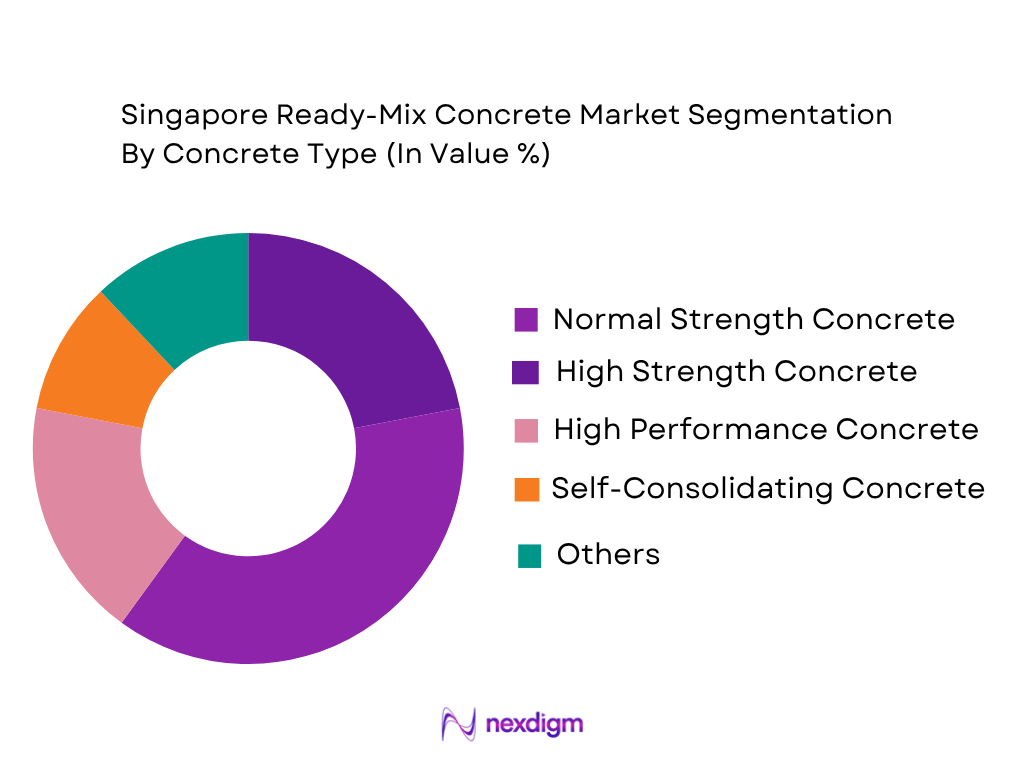
Singapore Ready-Mix Concrete Market is segmented by concrete type into normal strength concrete, high strength concrete, high-performance concrete, self-compacting concrete, lightweight concrete, and sustainable concrete. High-strength concrete represents the dominant segment due to its extensive usage in high-rise residential buildings, commercial towers, and infrastructure projects requiring enhanced structural performance. Singapore’s dense urban environment requires buildings with higher vertical construction capability, increasing the requirement for concrete grades with superior compressive strength and durability. High-performance mixes are increasingly used in projects requiring longer service life, reduced maintenance, and improved environmental performance. The adoption of advanced concrete mixes is also supported by government sustainability initiatives encouraging greener construction practices. Ready-mix producers are expanding specialized concrete offerings to meet requirements from major contractors, developers, and infrastructure agencies.
By Application
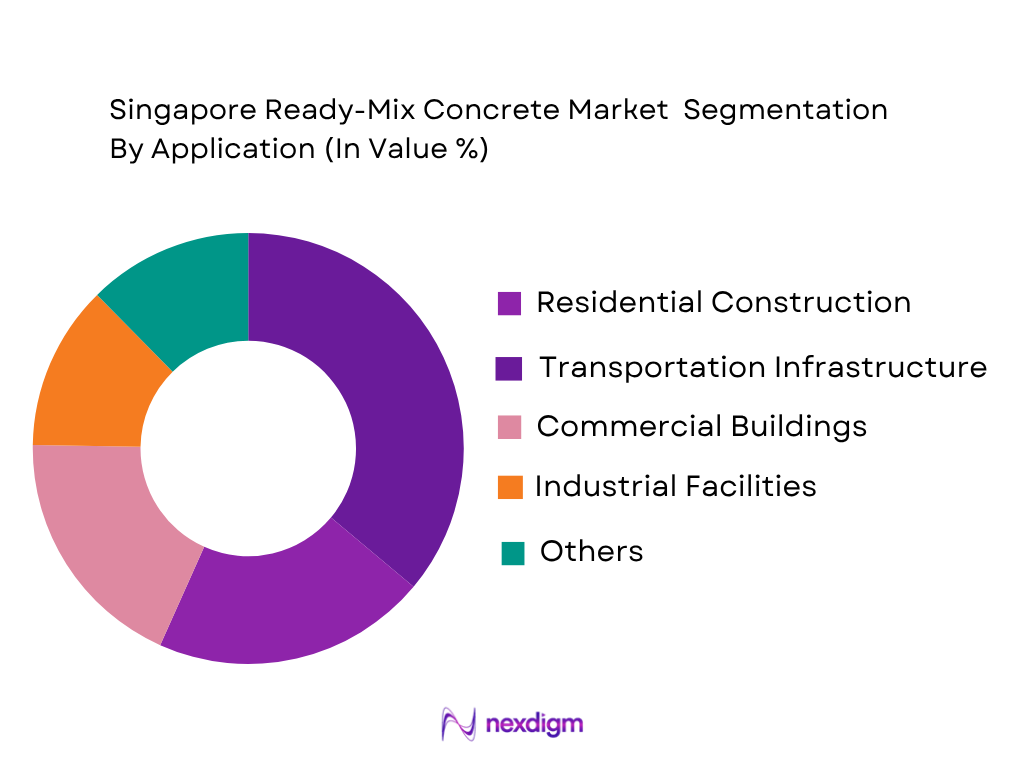
Singapore Ready-Mix Concrete Market is segmented by application into residential construction, commercial buildings, industrial facilities, transportation infrastructure, marine infrastructure, and public infrastructure projects. Residential construction dominates the application segment due to continuous demand from public housing development and private residential projects. The country’s urban planning model relies heavily on high-density housing, requiring large volumes of ready-mix concrete for building foundations, structural frames, and precast components. Public housing projects developed by government agencies contribute significantly to concrete consumption due to their scale and repetitive construction requirements. Commercial and infrastructure projects such as transport facilities, industrial parks, and aviation developments also support demand for specialized concrete solutions. The preference for ready-mix concrete over site-mixed alternatives is increasing due to better quality control, faster construction cycles, and reduced material wastage.
Competitive Landscape
The Singapore ready-mix concrete market consists of established producers with integrated batching facilities, delivery fleets, and experience supplying large-scale construction projects. The market structure is characterized by companies focusing on production reliability, technical concrete solutions, sustainability capabilities, and long-term relationships with contractors and developers. The Building and Construction Authority directory lists multiple approved ready-mixed concrete suppliers operating in Singapore, including Pan-United Concrete, Island Concrete, Samwoh Ready Mix, Alliance Concrete Singapore, and other suppliers.
| Company | Establishment Year | Headquarters | Batching Plant Network | Key Products | Sustainability Capability | Mixer Truck Fleet | Major Project Capability |
| Pan-United Corporation | 1997 | Singapore | ~ | ~ | ~ | ~ | ~ |
| Island Concrete | 1970 | Singapore | ~ | ~ | ~ | ~ | ~ |
| Samwoh Ready Mix | 2004 | Singapore | ~ | ~ | ~ | ~ | ~ |
| Alliance Concrete Singapore | 2005 | Singapore | ~ | ~ | ~ | ~ | ~ |
| YTL Concrete (S) | 2007 | Singapore | ~ | ~ | ~ | ~ | ~ |
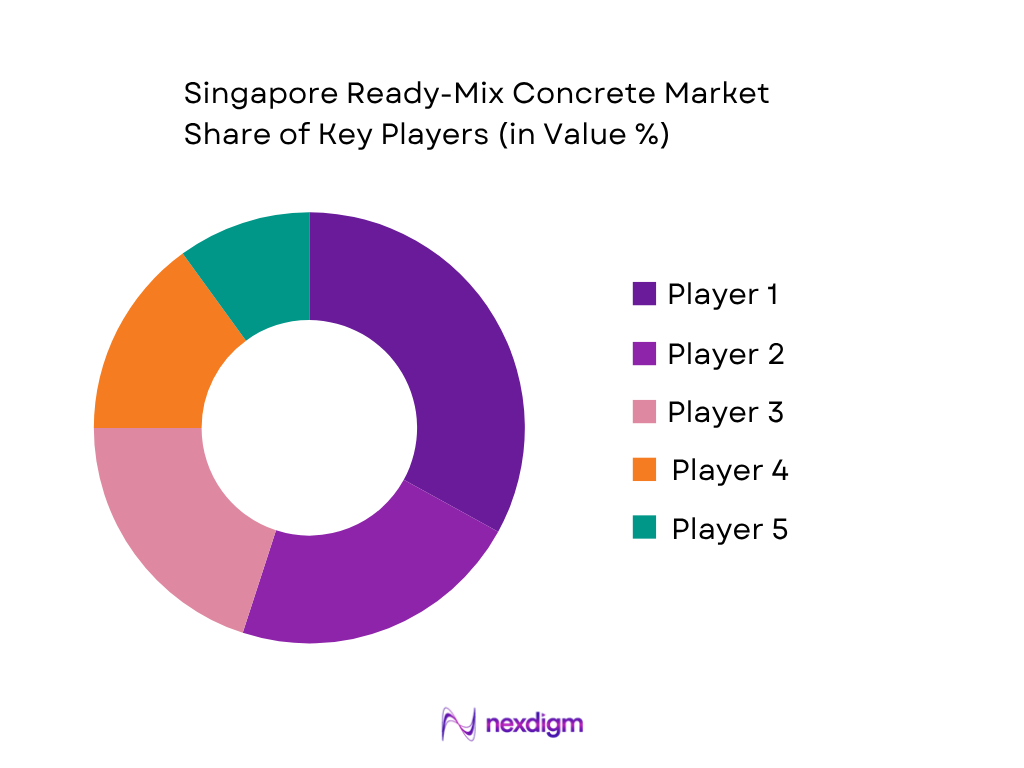
Singapore Ready-Mix Concrete Market Analysis
Growth Drivers
Public Housing Expansion
Public housing expansion remains a major demand driver for Singapore’s ready-mix concrete market because large-scale residential developments require continuous supply of standardized concrete mixes for foundations, structural frames, precast components, and high-rise construction. The Housing & Development Board (HDB) reported that Singapore had approximately 1.04 million HDB flats completed as of 2024, supporting sustained demand for construction materials. The government’s housing pipeline includes thousands of new Build-To-Order (BTO) units released annually, requiring reliable ready-mix concrete supply. Singapore’s population reached approximately 6.04 million in 2024, according to official population statistics, increasing pressure for efficient urban housing development. The high-density residential model requires concrete with consistent quality, durability, and faster delivery cycles, which supports adoption of centralized batching plants. Public housing projects also increasingly incorporate sustainable construction requirements, encouraging suppliers to develop lower-carbon concrete solutions. Ready-mix producers benefit from long-term construction activity because residential projects involve repeated concrete requirements across multiple construction stages, including piling, structural works, and finishing activities.
MRT Infrastructure Development
Expansion of Singapore’s Mass Rapid Transit (MRT) network continues to support ready-mix concrete demand through underground structures, stations, tunnels, viaducts, and supporting infrastructure. The Land Transport Authority operates an extensive rail network exceeding 260 km of MRT and LRT lines, creating continuous requirements for concrete-intensive infrastructure development and maintenance. Major rail projects require specialized concrete formulations with high durability, low permeability, and resistance to environmental exposure. Singapore’s infrastructure investment approach is supported by strong economic fundamentals, with the World Bank reporting Singapore’s GDP at approximately USD 501 billion in 2023, reflecting the country’s capacity for large infrastructure programs. MRT construction requires significant volumes of ready-mix concrete due to complex engineering requirements, including diaphragm walls, tunnel segments, station structures, and elevated guideways. Future rail connectivity improvements, including network expansion and capacity upgrades, are expected to maintain demand for technically advanced concrete products. Ready-mix suppliers with experience in infrastructure-grade concrete remain important partners for large transportation projects.
Market Challenges
Limited Land Availability
Limited land availability creates operational and construction challenges for Singapore’s ready-mix concrete market because urban density restricts plant locations, storage capacity, and logistics flexibility. Singapore has a total land area of approximately 735 square kilometers, according to national geographic statistics, requiring highly optimized land use planning across residential, commercial, industrial, and infrastructure requirements. The scarcity of industrial land available for batching facilities increases the importance of efficient plant utilization and strategic distribution networks. Ready-mix concrete suppliers must maintain delivery reliability despite limited space for production facilities and high construction activity concentrated within urban areas. The dense built environment also creates challenges related to mixer truck movement, construction-site accessibility, and delivery scheduling. Singapore’s construction sector operates under strict urban planning regulations, requiring suppliers to balance operational requirements with environmental and land-use restrictions. Limited domestic raw material availability further increases dependence on imported cement and aggregates, requiring effective supply-chain coordination. These constraints encourage companies to invest in automated batching systems, digital logistics platforms, and optimized fleet management solutions to improve operational efficiency.
Raw Material Import Dependency
Singapore’s ready-mix concrete industry faces challenges due to dependence on imported construction materials, including aggregates, sand, and cement-related inputs. The country has limited domestic mineral resources, requiring external sourcing networks to support construction activity. Singapore imported approximately 59 million tonnes of construction materials in 2023, including essential aggregates and related materials, according to trade statistics, highlighting the importance of international supply chains for the construction sector. Import dependency exposes ready-mix producers to risks related to transportation availability, global commodity movements, and geopolitical disruptions. Concrete production requires consistent raw material quality because variations in aggregate properties can affect strength, durability, and performance characteristics. Suppliers must maintain strict quality-control procedures to comply with Singapore construction standards. In addition, increasing sustainability requirements are pushing companies to reduce embodied carbon associated with imported materials and transportation. This challenge is encouraging greater adoption of supplementary cementitious materials, recycled aggregates, and lower-emission concrete formulations. Efficient procurement strategies and diversified sourcing networks have become critical for maintaining reliable ready-mix concrete production.
Market Opportunities
Low-Carbon Concrete Adoption
Low-carbon concrete adoption presents a significant opportunity for Singapore’s ready-mix concrete market as the construction industry moves toward sustainable building practices. Singapore’s Green Building Masterplan aims to strengthen environmental performance across the built environment, increasing demand for materials with reduced embodied carbon. The Building and Construction Authority reported that Singapore had more than 2,500 Green Mark-certified buildings by 2024, creating opportunities for suppliers offering environmentally optimized concrete solutions. Low-carbon concrete products using supplementary cementitious materials, recycled content, and alternative binders can support green building requirements while maintaining structural performance. Government-led sustainability initiatives encourage developers and contractors to consider carbon reduction throughout construction supply chains. Ready-mix producers are developing specialized concrete formulations that reduce emissions while meeting strength and durability requirements for high-rise buildings, infrastructure projects, and industrial facilities. As Singapore continues urban redevelopment, demand is expected to increase for concrete solutions aligned with environmental certification standards. Suppliers capable of providing verified sustainability data, carbon measurement capabilities, and green concrete technologies can participate in premium construction segments.
Data Center Construction Demand
Data center construction is creating new opportunities for Singapore’s ready-mix concrete market because facilities require specialized structural solutions, high durability, and reliable construction materials. Singapore remains a major digital infrastructure hub in Southeast Asia, supported by advanced telecommunications infrastructure and strong business connectivity. The country’s data center industry operates under controlled development policies, with new capacity approvals focused on energy efficiency and sustainability. The Infocomm Media Development Authority reported that Singapore maintained strong digital infrastructure capabilities, with nationwide connectivity supporting enterprise technology growth. Data center projects require large quantities of concrete for foundations, equipment halls, security structures, and specialized facilities designed for continuous operations. These projects often require high-performance concrete mixes with enhanced durability and precision specifications. Growth in cloud computing, artificial intelligence applications, and enterprise digitalization is increasing demand for reliable data infrastructure. Ready-mix concrete suppliers with experience in technically demanding industrial projects can benefit from opportunities linked to data center development. The segment also supports innovation in sustainable concrete solutions because operators increasingly prioritize energy-efficient and environmentally responsible facilities.
Future Outlook
Over the coming decade, the Singapore ready-mix concrete market is expected to evolve toward sustainable, technology-enabled, and high-performance concrete solutions. Demand will be supported by urban redevelopment, infrastructure renewal, industrial expansion, and increasing requirements for environmentally responsible construction materials. The adoption of low-carbon concrete, recycled materials, automated batching systems, and digital delivery management platforms will influence supplier strategies. Future construction projects will increasingly require specialized concrete grades designed for durability, reduced emissions, and improved structural efficiency.
Major Players
- Pan-United Corporation Limited
- Island Concrete (Private) Limited
- Samwoh Ready Mix Pte Ltd
- Alliance Concrete Singapore Pte Ltd
- YTL Concrete (S) Pte Ltd
- Eminent Star Readymix Pte Ltd
- G & W Ready-Mix Pte Ltd
- Raffles Concrete Pte Ltd
- Sinmix Pte Ltd
- Premium Concrete Pte Ltd
- Top-Mix Concrete Pte Ltd
- Promix Concrete Pte Ltd
- RDC Concrete Pte Ltd
- Concrete Industries Pte Ltd
- Ecofast Concrete Pte Ltd BCA
Key Target Audience
- Ready-Mix Concrete Manufacturers and Suppliers
- Construction Companies and Main Contractors
- Real Estate Developers
- Infrastructure Development Companies
- Cement and Building Material Producers
- Investments and Venture Capitalist Firms
- Government and Regulatory Bodies (Building and Construction Authority, Housing & Development Board, Land Transport Authority)
- Industrial Facility Developers and Data Center Operators
Research Methodology
Step 1: Identification of Key Variables
The research begins with defining the Singapore ready-mix concrete ecosystem, including concrete producers, construction contractors, government infrastructure agencies, developers, cement suppliers, and logistics providers. Secondary research is conducted using industry databases, government construction statistics, regulatory publications, and company information to identify variables affecting market demand.
Step 2: Market Analysis and Construction
Historical construction activity, concrete consumption patterns, project pipelines, supplier capacity, and application demand are analyzed to establish market fundamentals. The assessment evaluates residential, commercial, industrial, and infrastructure construction segments to determine demand contribution and operational requirements.
Step 3: Hypothesis Validation and Expert Consultation
Market assumptions are validated through discussions with industry stakeholders including ready-mix suppliers, contractors, construction material specialists, and project developers. These interactions provide insights into procurement practices, concrete specifications, sustainability requirements, and future demand patterns.
Step 4: Research Synthesis and Final Output
The final analysis integrates supply-side and demand-side findings to create a comprehensive assessment of the Singapore ready-mix concrete market. Data validation is performed through triangulation of company information, construction indicators, regulatory developments, and industry observations.

- Executive Summary
- Research Methodology (Market Definitions and Scope, Market Boundary Identification, Ready-Mix Concrete Value Chain Mapping, Top-Down Market Assessment, Bottom-Up Demand Analysis, Supply-Side Capacity Evaluation, Construction Activity Analysis, Primary Interviews with Concrete Producers and Contractors, Project Pipeline Assessment, Data Triangulation, Forecasting Framework, Market Limitations)

- Definition and Scope of Singapore Ready-Mix Concrete Market
- Evolution of Ready-Mix Concrete Industry
- Singapore Construction Ecosystem Analysis
- Ready-Mix Concrete Industry Value Chain Analysis
- Ready-Mix Concrete Supply Chain Analysis
- Construction Project Pipeline Assessment

- Growth Drivers (Public Housing Expansion, MRT Infrastructure Development, Urban Redevelopment Programs, Industrial Facility Construction, Data Center Development, Sustainable Construction Requirements, High-Density Building Demand, Government Infrastructure Spending)
- Market Challenges (Limited Land Availability, Raw Material Import Dependency, High Logistics Complexity, Strict Construction Regulations, Carbon Reduction Requirements, Mixer Truck Fleet Management, Construction Schedule Pressure, Weather-Related Disruptions, Cost Volatility of Imported Materials)
- Market Opportunities (Low-Carbon Concrete Adoption, Sustainable Building Materials, Green Mark Certified Construction, Data Center Construction Demand, Infrastructure Modernization, Digital Concrete Ordering Platforms, Automated Dispatch Systems, High-Performance Concrete Applications, Carbon-Neutral Concrete Solutions)
- Market Trends (Green Concrete Adoption, Prefabricated Construction Integration, Digital Construction Management, Advanced Concrete Admixtures, Automated Batching Systems, High-Durability Concrete Development)
- Government Regulations and Standards (Building and Construction Authority Standards, Singapore Green Building Masterplan Requirements, Concrete Quality Standards, Environmental Sustainability Regulations, Construction Productivity Requirements)
- SWOT Analysis
- Porter’s Five Forces Analysis
- PESTLE Analysis
- Stakeholder Ecosystem Analysis
- Construction Supply Chain Ecosystem

- By Market Value (2020-2025)
- By Concrete Consumption Volume (2020-2025)
- By Ready-Mix Concrete Production Volume (2020-2025)
- By Average Concrete Delivery Volume (2020-2025)
- By Application Revenue Contribution (2020-2025)

- By Concrete Type (In Value %)
Normal Strength Concrete
High Strength Concrete
High Performance Concrete
Self-Compacting Concrete
Lightweight Concrete
Fiber Reinforced Concrete
Sustainable / Low-Carbon Concrete - By Application (In Value %)
Residential Construction
Commercial Buildings
Industrial Facilities
Transportation Infrastructure
Marine and Port Infrastructure
Public Infrastructure Projects
Utility and Civil Engineering Projects - By Construction Sector (In Value %)
Public Housing Development
Private Residential Development
Commercial Real Estate
Industrial Manufacturing Facilities
Data Centers
Infrastructure Projects - By Delivery Mode (In Value %)
Direct Ready-Mix Delivery
Large Project Bulk Supply
Contract-Based Concrete Supply
On-Demand Concrete Delivery - By End User (In Value %)
Government Agencies
Main Contractors
Real Estate Developers
Infrastructure Developers
Industrial Facility Owners

- Market Positioning of Major Players (Production Capacity, Batching Plant Network, Project Portfolio, Customer Segments)
- Cross Comparison Parameters (Production Capacity and Batching Plant Network, Concrete Product Portfolio Breadth, High-Performance Concrete Capability, Low-Carbon Concrete Product Development, Mixer Truck Fleet Size, Large Infrastructure Project Experience, Digital Ordering and Delivery Tracking Capability, Sustainability Certification and Green Building Compliance)
- SWOT Analysis of Major Players
- Pricing Analysis by Concrete Grade and Application
- Detailed Profiles of Major Companies
Pan-United Corporation Limited
Island Concrete (Private) Limited
Samwoh Ready Mix Pte Ltd
Alliance Concrete Singapore Pte Ltd
YTL Concrete (S) Pte Ltd
Eminent Star Readymix Pte Ltd
G & W Ready-Mix Pte Ltd
Raffles Concrete Pte Ltd
Sinmix Pte Ltd
Premium Concrete Pte Ltd
Top-Mix Concrete Pte Ltd
Promix Concrete Pte Ltd
RDC Concrete Pte Ltd
Concrete Industries Pte Ltd
Ecofast Concrete Pte Ltd BCA

- Construction Demand Assessment
- Project-Based Consumption Analysis
- Contractor Procurement Behaviour Analysis
- Concrete Supplier Selection Criteria
- Construction Technology Adoption Analysis
- Sustainable Construction Preference Analysis
- Digital Procurement Behaviour Analysis

- By Market Value (2026-2035)
- By Concrete Consumption Volume (2026-2035)
- By Ready-Mix Concrete Production Volume (2026-2035)
- By Average Concrete Delivery Volume (2026-2035)
- By Application Revenue Contribution (2026-2035)


 Request a Sample
 Ask for Customization
 Get a Quote
 Enquire Now