
 Download PDF
Market Overview
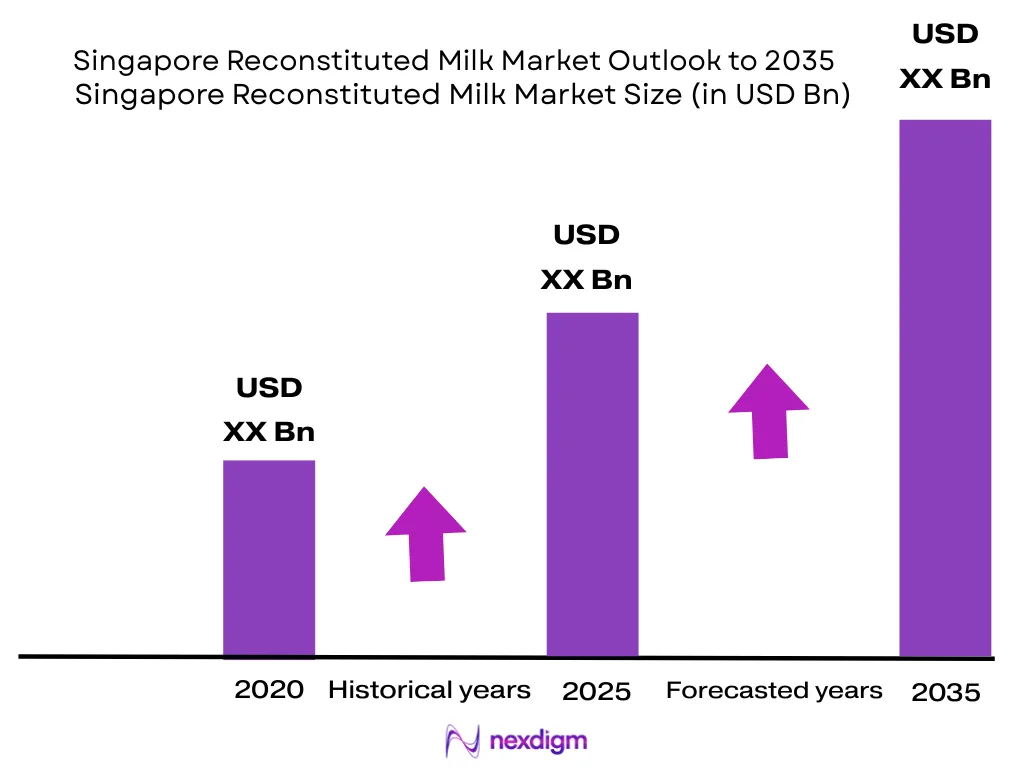
Singapore Reconstituted Milk Market is valued at USD ~ billion, based on dairy products net imports used as the closest formal proxy for reconstituted and recombined dairy demand. The previous base also recorded dairy products net imports of USD 1.1 billion, showing stable import-led dairy dependence. Demand is driven by UHT milk, milk powder, infant nutrition, foodservice dairy bases and imported dairy ingredients, while total agricultural and related product imports moved from USD 18.4 billion to USD 18.2 billion.
Singapore’s market is dominated by the Central Area, Orchard-CBD, Tampines, Jurong, Woodlands, Changi and Sentosa hospitality clusters, while New Zealand, Australia, Thailand and the United States dominate supply. Dairy products net imports are led by New Zealand at 28, Australia at 15, Thailand at 8 and the United States at 6 in the current base, compared with New Zealand 8, Australia 8, United States 6 and Thailand 6 in the previous base. Dense retail, hotels, cafés, airport catering and imported-dairy trust support dominance.
Market Segmentation
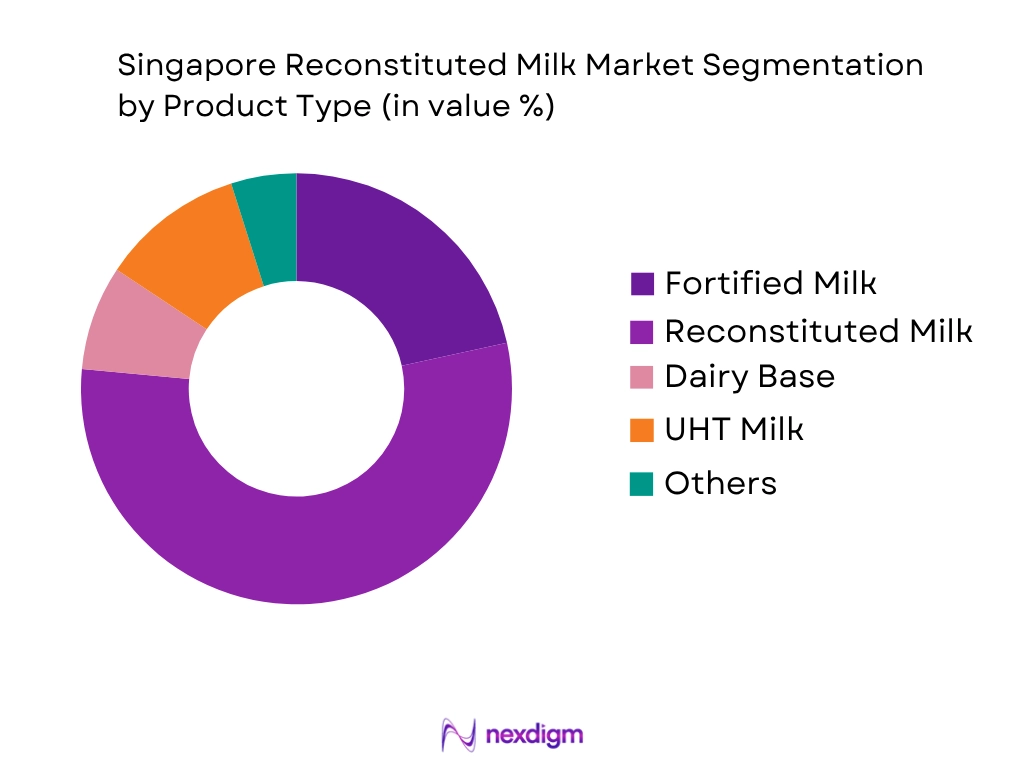
By Product Type
Singapore Reconstituted Milk Market is segmented by product type into UHT/long-life reconstituted milk, milk powder-based reconstituted milk, recombined dairy beverages, fortified reconstituted milk and foodservice dairy base. Recently, UHT/long-life reconstituted milk has a dominant market share in Singapore under product type segmentation because the country’s dairy system is structurally import-dependent and shelf-stable milk suits urban grocery behaviour, compact homes, convenience stores, e-grocery fulfilment and foodservice storage. Fresh milk remains preferred for taste in several consumer groups, but UHT milk has a strong functional role in a city-state that imports most food and relies on stable foreign supply. USDA FAS lists dairy products, including milk and cream, ice cream, infant food preparations, butter, yogurt and buttermilk, among best-prospect products, reinforcing the breadth of imported dairy demand.
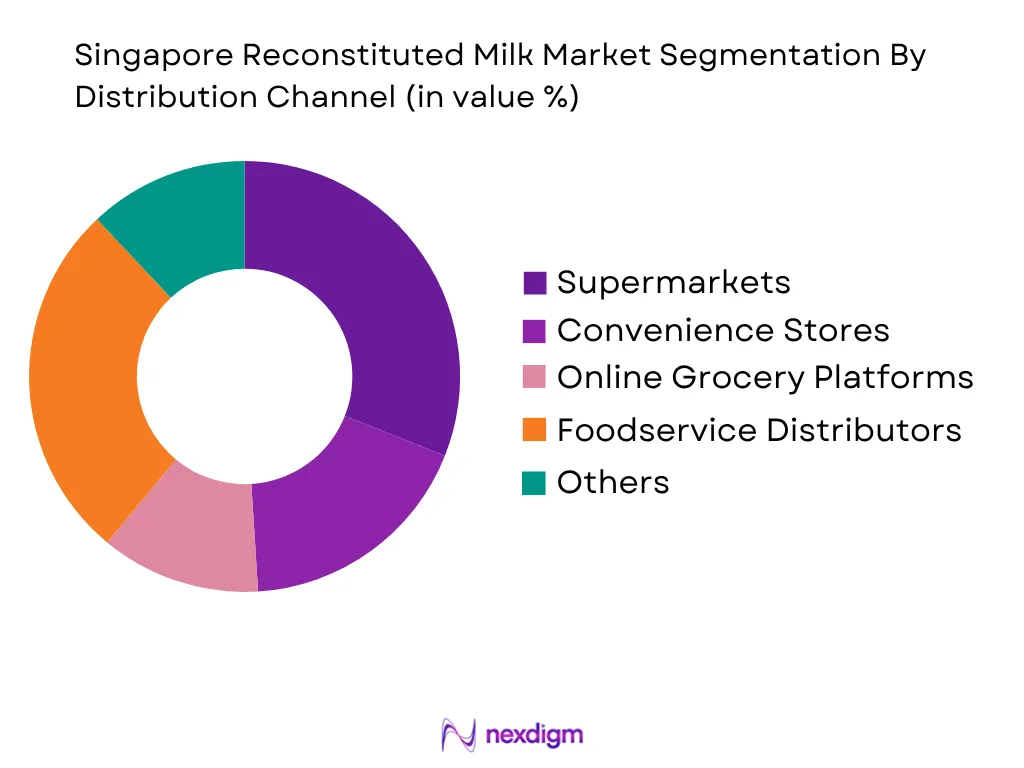
By Distribution Channel
Singapore Reconstituted Milk Market is segmented by distribution channel into supermarkets and hypermarkets, convenience stores, online grocery platforms, foodservice distributors and B2B ingredient distributors. Recently, supermarkets and hypermarkets have a dominant market share in Singapore under the distribution channel segmentation because the country has a highly developed and competitive food retail sector led by NTUC FairPrice, Macrovalue/Dairy Farm and Sheng Siong. These chains provide national shelf coverage, imported dairy assortments, private-label lines, multipack promotions and chilled plus ambient merchandising. USDA FAS reports Singapore’s retail foods sector is highly developed and competitive, with consumer-oriented imports of USD 11 billion in the current base. Foodservice remains important due to hotels, cafés, airports and institutional buyers, but household dairy purchases are concentrated through formal retail and e-grocery.
Competitive Landscape
Singapore Reconstituted Milk Market is dominated by imported dairy brands, regional processors, nutrition companies, retail private labels and foodservice ingredient suppliers. F&N/Magnolia, Malaysia Dairy Industries/Marigold, Meiji, FrieslandCampina and Nestlé are major competitors because they combine UHT milk, pasteurized milk, flavoured milk, milk powder, nutrition and strong retail access. Competition is shaped by import-origin credibility, SFA compliance, shelf-life performance, foodservice suitability, e-grocery visibility and ability to serve both household and B2B dairy applications.
| Company | Establishment Year | Headquarters | Reconstituted/UHT Milk Presence | Key Brands/Business Lines | Import/Ingredient Linkage | Retail & E-Grocery Reach | Foodservice/B2B Exposure | Market-Specific Position |
| F&N Foods Singapore / Magnolia | 1883 group roots | ~ | ~ | ~ | ~ | ~ | ~ | ~ |
| Malaysia Dairy Industries / Marigold | 1969 | Singapore | ~ | ~ | ~ | ~ | ~ | ~ |
| Meiji Seika Singapore | 1974 | Singapore | ~ | ~ | ~ | ~ | ~ | ~ |
| FrieslandCampina Singapore / Dutch Lady | 1871 group roots | Netherlands/Singapore operations | ~ | ~ | ~ | ~ | ~ | ~ |
| Nestlé Singapore | 1912 local presence | Singapore | ~ | ~ | ~ | ~ | ~ | ~ |
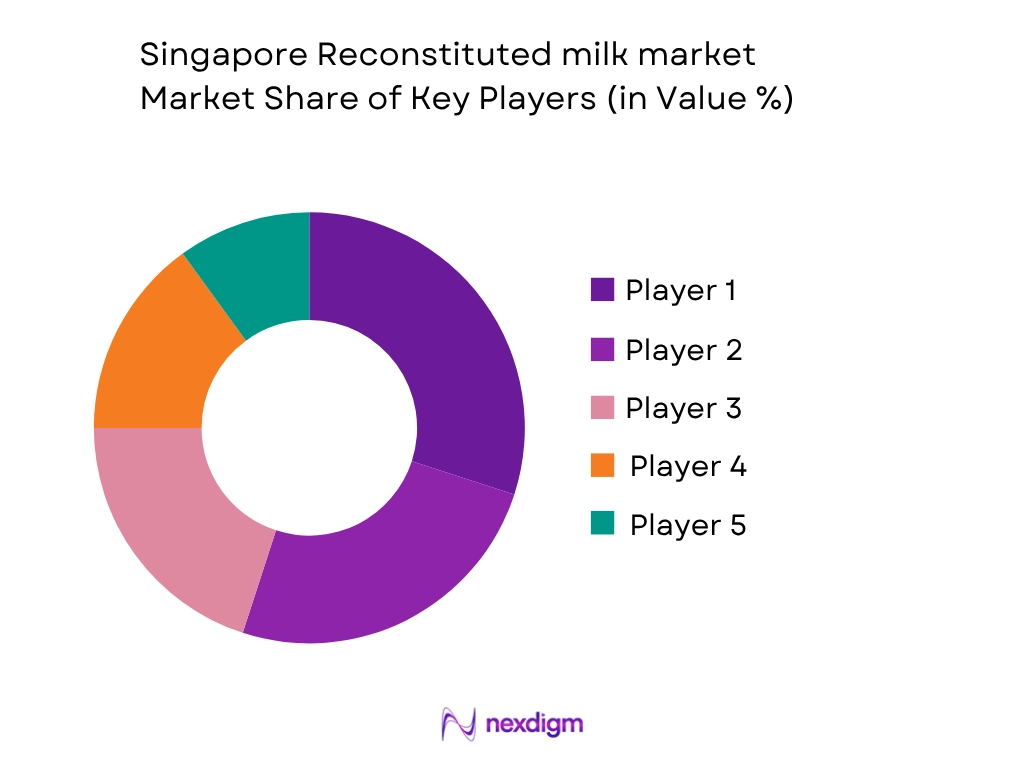
Singapore Reconstituted Milk Market Analysis
Growth Drivers
Import-Led Dairy Supply Supporting Reconstituted Milk Availability
Singapore Reconstituted Milk Market is supported by an import-led food system, making milk powder, UHT milk, whey, lactose and other dairy ingredients structurally important for reconstituted and recombined milk products. Singapore Food Agency states that Singapore sourced food from 187 countries and regions in 2024, compared with 140 countries and regions around two decades earlier. World Bank records Singapore’s GDP at USD 547.39 billion and GDP per capita at USD 90,674.1 in 2024, supporting formal grocery demand and premium imported dairy consumption. This import-diversified structure enables retailers, foodservice buyers and nutrition companies to maintain reconstituted milk availability despite limited domestic dairy production.
Foodservice and Tourism Recovery Strengthening Dairy Base Demand
Singapore Reconstituted Milk Market benefits from foodservice, cafés, hotels, airline catering and hospitality-linked consumption, where reconstituted milk and recombined dairy bases are used in coffee, tea, bakery, desserts and institutional catering. Singapore Tourism Board reported 16.5 million international visitor arrivals in 2024, while IMF states that Singapore’s growth increased to 4.4 in 2024 from 1.8 in 2023, supported by private consumption and the global technology cycle. World Bank records Singapore’s population at approximately 6 million in 2024, creating a dense urban consumption base. These indicators support higher dairy throughput across supermarkets, cafés, airport foodservice, hotels and convenience-led dairy channels.
Market Challenges
Complete Import Dependence Increases Supply-Chain Exposure
Singapore Reconstituted Milk Market faces supply-chain risk because the country has no meaningful local dairy farming base and depends on imported milk powder, UHT milk and dairy ingredients. Singapore Food Agency states that Singapore increased its food supply sources to 187 countries and regions in 2024, showing diversification but also confirming external dependency. USDA FAS states that Singapore is heavily reliant on imports for food and energy, while IMF notes that GDP contracted by 0.6 quarter-on-quarter in 2025Q1 due to weaker externally oriented sectors such as manufacturing and wholesale trade. This matters for reconstituted milk because ingredient sourcing, port logistics, documentation and retail replenishment remain tied to global supply conditions.
Strict Food Safety Compliance Raises Operating Complexity
Singapore Reconstituted Milk Market is challenged by strict import, labelling and food safety requirements, especially for dairy products made from milk powder, whey, lactose, UHT milk and recombined ingredients. Singapore Food Agency states that traders importing food and food-contact articles must comply with SFA import conditions and licensing requirements. SFA’s annual report states that between April 2024 and March 2025, it tested more than 6,000 food samples from retail outlets under the Market Monitoring Programme. World Bank records Singapore’s GDP per capita at USD 90,674.1 in 2024, reflecting a high-income market where consumers expect safety, traceability and product consistency. Compliance therefore becomes a major operational requirement for dairy importers and reconstituted milk brands.
Market Opportunities
Fortified and Functional Reconstituted Milk for High-Income Consumers
Singapore Reconstituted Milk Market has an opportunity in fortified and functional products because reconstituted milk can be standardized with calcium, protein, vitamin D, low-fat profiles and adult-nutrition positioning. World Bank records Singapore’s GDP at USD 547.39 billion and GDP per capita at USD 90,674.1 in 2024, supporting demand for premium nutrition and differentiated dairy formats. IMF states that headline inflation decreased to 1.5 at end-2024 and further to 0.9 in March 2025, improving the operating environment for packaged food and nutrition brands. This supports product development in fortified UHT milk, senior nutrition, children’s milk, barista milk and medical-nutrition-adjacent dairy formulations.
ASEAN Distribution and Re-Export Hub Potential
Singapore Reconstituted Milk Market has an opportunity to function as a regional dairy ingredient and shelf-stable milk distribution hub because the country combines import diversification, warehousing, food safety regulation and regional connectivity. Singapore Food Agency reports food supply sources from 187 countries and regions in 2024, while USDA FAS states that Singapore’s food processing industry is small and that almost all raw materials or ingredients used in processing are imported. Singapore Tourism Board also reported 16.5 million visitor arrivals in 2024, strengthening foodservice and hospitality demand that supports bulk dairy bases. These conditions allow importers and brand owners to serve domestic retail, cafés, hotels, airports and ASEAN-facing B2B dairy channels.
Future Outlook
Over the next decade, Singapore Reconstituted Milk Market is expected to grow steadily as imported dairy ingredients, UHT milk, infant nutrition, adult nutrition and foodservice dairy applications remain structurally important. The country’s limited agricultural land and high dependence on imported food mean reconstituted and recombined dairy will continue to function as a reliable supply solution. Growth will be supported by foodservice recovery, café culture, airport and hotel catering, e-grocery adoption, high-income consumers and premium nutrition positioning. Singapore’s HRI sector benefits from tourism recovery, with 16.5 million international visitor arrivals and tourism receipts reaching the upper bound of the official forecast, strengthening demand for milk bases used in coffee, bakery, desserts and institutional catering. The market will also benefit from Singapore’s role as an import, storage and redistribution hub. USDA FAS states that Singapore’s food processing industry is small but almost all raw materials or ingredients used in processing are imported, making milk powder, cream, whey, lactose and dairy preparations relevant for reconstitution, recombination and nutritional manufacturing. However, the market will face competition from fresh imported milk, lactose-free dairy, plant-based beverages and premium origin-led dairy products. Companies with strong import documentation, SFA compliance, traceability, product consistency, e-grocery partnerships and foodservice technical support will remain better positioned. The forecasted CAGR benchmark for 2026-2035 is 3.7%, based on the global reconstituted milk market outlook.
Major Players
- F&N Foods Singapore / Magnolia
- Malaysia Dairy Industries / Marigold HL Milk
- Meiji Seika Singapore
- FrieslandCampina Singapore / Dutch Lady
- Nestlé Singapore
- Abbott Nutrition Singapore
- Danone Singapore
- Arla Foods Ingredients Singapore
- Fonterra Singapore / Anchor
- Ben Foods Singapore / Cowhead
- Greenfields Dairy Singapore
- Lactalis Singapore / Lactel
- The a2 Milk Company Singapore
- FairPrice Private Label Dairy
- DFI Retail Group Private Label Dairy / Meadows
Key Target Audience
- Dairy importers and distributors
- UHT milk and recombined dairy brand owners
- Supermarket, hypermarket and convenience retail chains
- Foodservice, café, hotel and institutional procurement teams
- Infant, adult and medical nutrition companies
- Investments and venture capitalist firms
- Government and regulatory bodies (Singapore Food Agency; Ministry of Sustainability and the Environment; Enterprise Singapore; Singapore Customs; Health Promotion Board)
- Aseptic packaging, dairy ingredient and cold/ambient logistics companies
Research Methodology
Step 1: Identification of Key Variables
The initial phase involves constructing an ecosystem map covering dairy exporters, milk powder importers, UHT milk brands, food ingredient distributors, supermarket chains, convenience stores, e-grocery platforms, foodservice distributors and institutional buyers. The objective is to identify variables such as dairy import value, milk powder usage, UHT penetration, pack-size mix and foodservice demand.
Step 2: Market Analysis and Construction
In this phase, historical data is compiled across dairy product imports, consumer-oriented agricultural imports, retail channel activity, foodservice demand, import-origin contribution and company product portfolios. The market is constructed through a top-down import-led dairy proxy and a bottom-up assessment of SKUs, channel reach and end-use applications.
Step 3: Hypothesis Validation and Expert Consultation
Market hypotheses are validated through CATI interviews with dairy importers, supermarket category managers, foodservice distributors, nutrition companies, packaging suppliers and B2B ingredient traders. These consultations help verify assumptions around reconstituted milk usage, UHT demand, import-origin preference, product positioning and channel-level procurement.
Step 4: Research Synthesis and Final Output
The final phase integrates secondary data, company benchmarking, trade indicators and primary validation into a structured market model. The final output captures market size, forecast trajectory, segmentation, competitive positioning and strategic recommendations for stakeholders operating in Singapore’s reconstituted, recombined and import-led dairy ecosystem.

- Executive Summary
- Research Methodology (Market Definitions and Assumptions, Reconstituted Milk and Recombined Milk Scope, UHT and Sterilized Milk Inclusion Criteria, SMP/WMP Conversion Ratio, Milk Solids-Not-Fat Assumptions, Fat Standardization Approach, Retail SKU Mapping, Import-Export Triangulation, SFA Regulatory Mapping, Distributor and Foodservice Interviews, Bottom-Up Brand Assessment, Top-Down Dairy Import Analysis, Limitations and Forecast Sensitivities)

- Definition and Scope
- Market Genesis and Evolution
- Role of Reconstituted Milk in Singapore’s Dairy Consumption
- Timeline of Major Dairy Brands and Importers
- Business Cycle and Demand Seasonality

- Growth Drivers (Import-Led Dairy Availability, Urban Household Demand, Convenience Retail Density, Foodservice and Café Culture, Infant Nutrition Demand, Shelf-Stable Milk Adoption, E-Grocery Expansion, Premium Fortified Dairy Consumption)
- Market Challenges (Limited Domestic Milk Production, Imported Input Exposure, Strict Food Safety Compliance, Fresh Milk Competition, Plant-Based Dairy Alternatives, Label Transparency, Shelf Differentiation, Premium Pricing Sensitivity)
- Opportunities (Fortified Reconstituted Milk, Foodservice Bulk Milk Base, Private Label Long-Life Milk, Infant and Adult Nutrition, Premium Recombined Dairy Drinks, ASEAN Re-Export, Sustainable Packaging, Low-Lactose Formulations)
- Market Trends (Premium Imported Dairy, High-Protein Milk, Lactose-Free Milk, Plant-Based Substitution, Aseptic Packaging, Sustainability Claims, Private Label Growth, Digital Grocery Discovery)
- SWOT Analysis
- Porter’s Five Forces
- PESTLE Analysis

- By Value (2026-2035)
- By Volume (2026-2035)
- By Average Realization per Litre (2026-2035)

- By Product Type (In Value %)
Full Cream Reconstituted Milk
Low-Fat Reconstituted Milk
Skim/Fat-Free Reconstituted Milk
Recombined Milk - By Application (In Value %)
Household Drinking Milk
Tea and Coffee Whitening
Breakfast Cereal Consumption
Foodservice Beverage Base
Bakery and Confectionery - By Distribution Channel (In Value %)
Supermarkets and Hypermarkets
Convenience Stores
Online Grocery Platforms
Specialty Grocery Stores
Foodservice Distributors
Institutional Procurement - By Region (In Value %)
New Zealand-Origin Dairy Inputs
Australia-Origin Dairy Inputs
European Union-Origin Dairy Inputs
United States-Origin Dairy Inputs
Thailand-Origin Dairy Inputs
Malaysia-Origin Dairy Inputs

- Market Share of Major Players (Value Share, Volume Share, UHT Milk Share, Reconstituted Milk Share, Powder Milk Share, Retail Shelf Presence, Online Grocery Presence)
- Cross Comparison Parameters (Import-Origin and Dairy Ingredient Sourcing Network, UHT/Aseptic Milk Portfolio Strength, Reconstituted and Recombined Milk Capability, Retail and Online Grocery Distribution Reach, Foodservice and Barista Channel Exposure, Product Shelf-Life and Pack-Size Portfolio, SFA Compliance and Traceability Documentation, Private Label and B2B Manufacturing Capability)
- Pricing Analysis by SKU
- Detailed Profiles of Major Companies
F&N Foods Singapore / Magnolia
Malaysia Dairy Industries / Marigold HL Milk
Meiji Seika Singapore
FrieslandCampina Singapore / Dutch Lady
Nestlé Singapore
Abbott Nutrition Singapore
Danone Singapore
Arla Foods Ingredients Singapore
Fonterra Singapore / Anchor
Ben Foods Singapore / Cowhead
Greenfields Dairy Singapore
Lactalis Singapore / Lactel
The a2 Milk Company Singapore
FairPrice Private Label Dairy
DFI Retail Group Private Label Dairy / Meadows

- Household Consumers
- Foodservice Buyers
- Bakery and Dessert Manufacturers
- Infant and Adult Nutrition Companies
- 7Institutional Buyers

- By Value (In Value %)
- By Volume (In Value %)
- By Average Realization per Litre (In Value %)


 Request a Sample
 Ask for Customization
 Get a Quote
 Enquire Now