
 Download PDF
Market Overview
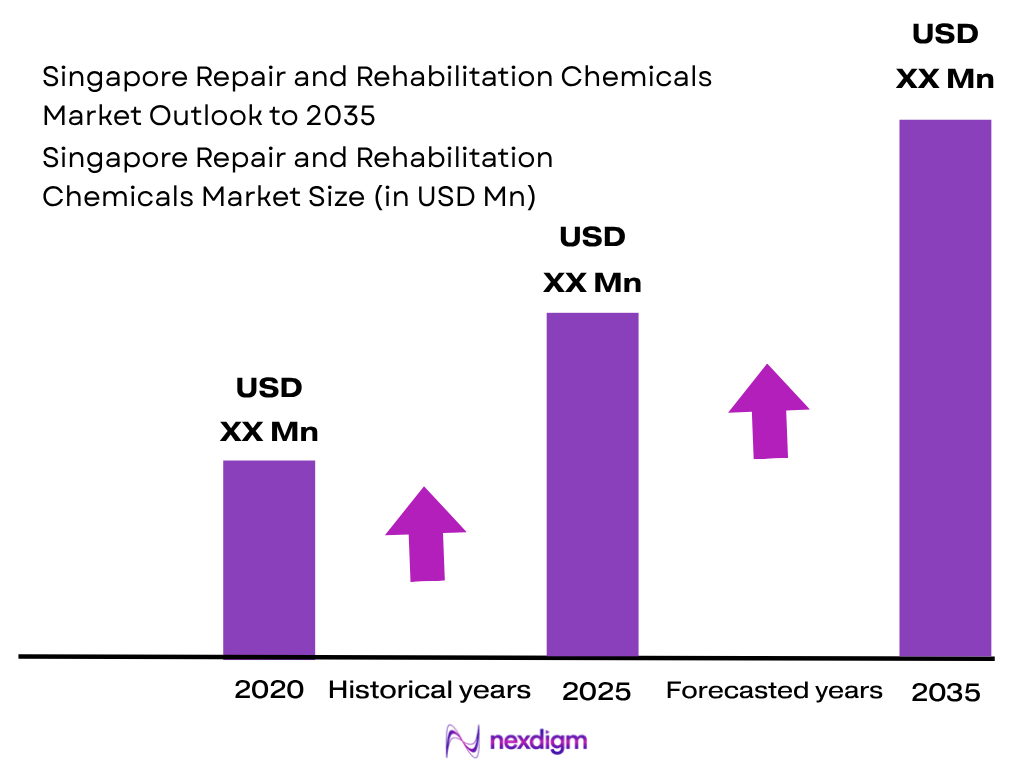
The Singapore Repair and Rehabilitation Chemicals Market is valued at approximately ~USD XX million, supported by ageing buildings, HDB upgrading, structural inspections and infrastructure maintenance. Total construction demand increased from S$33.8 billion in the preceding reporting period to S$44.2 billion in the latest period. HDB also upgraded 62,386 flats through its Home Improvement Programme in the preceding reporting cycle, sustaining demand for repair mortars, bonding agents and corrosion treatments.
Jurong West, Hougang, Woodlands, Pasir Ris, Toa Payoh, Queenstown and mature Central Region estates are important demand centres because Singapore’s rehabilitation market follows concentrations of ageing HDB blocks, commercial buildings and infrastructure. The preceding reporting period recorded 62,386 HIP-upgraded flats, while the latest programme selection added more than 53,000 flats and allocated over S$742 million for upgrading, including spalling-concrete and structural repair works.
Market Segmentation
By Product Type
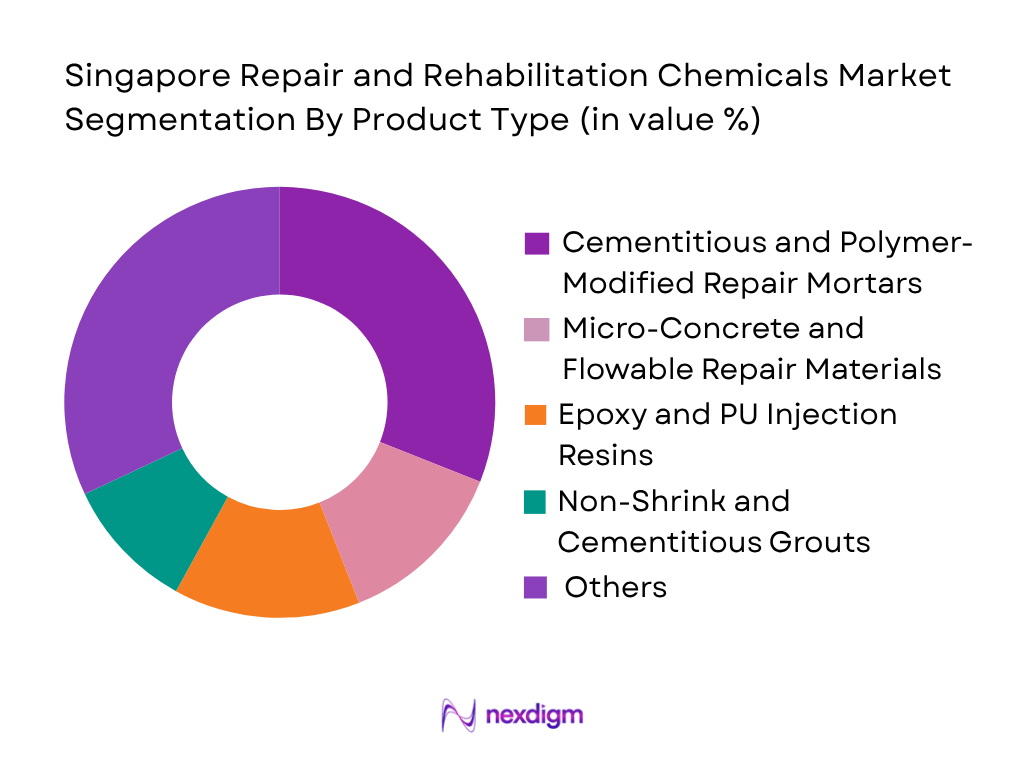
The Singapore Repair and Rehabilitation Chemicals Market is segmented into cementitious repair mortars, polymer-modified repair mortars, micro-concrete, epoxy injection resins, polyurethane injection resins, non-shrink grouts, corrosion-protection systems, protective coatings, structural strengthening systems and waterproofing rehabilitation chemicals. Cementitious and polymer-modified repair mortars hold the dominant position because Singapore’s built environment contains extensive reinforced-concrete residential, commercial and infrastructure assets requiring recurring treatment of spalling, delamination, honeycombing and reinforcement-corrosion damage. HDB specifically identifies spalling concrete as a recurring maintenance issue in older flats and specifies removal of deteriorated concrete, rebar treatment, bonding agents and polymer-modified cement mortar during remediation. Structural repair mortars also suit vertical and overhead applications common in beams, slabs, soffits and façades. Products such as fibre-reinforced and low-shrink mortars are increasingly relevant where contractors require stronger bond performance, controlled cracking and faster reinstatement within occupied buildings.
By Repair Application
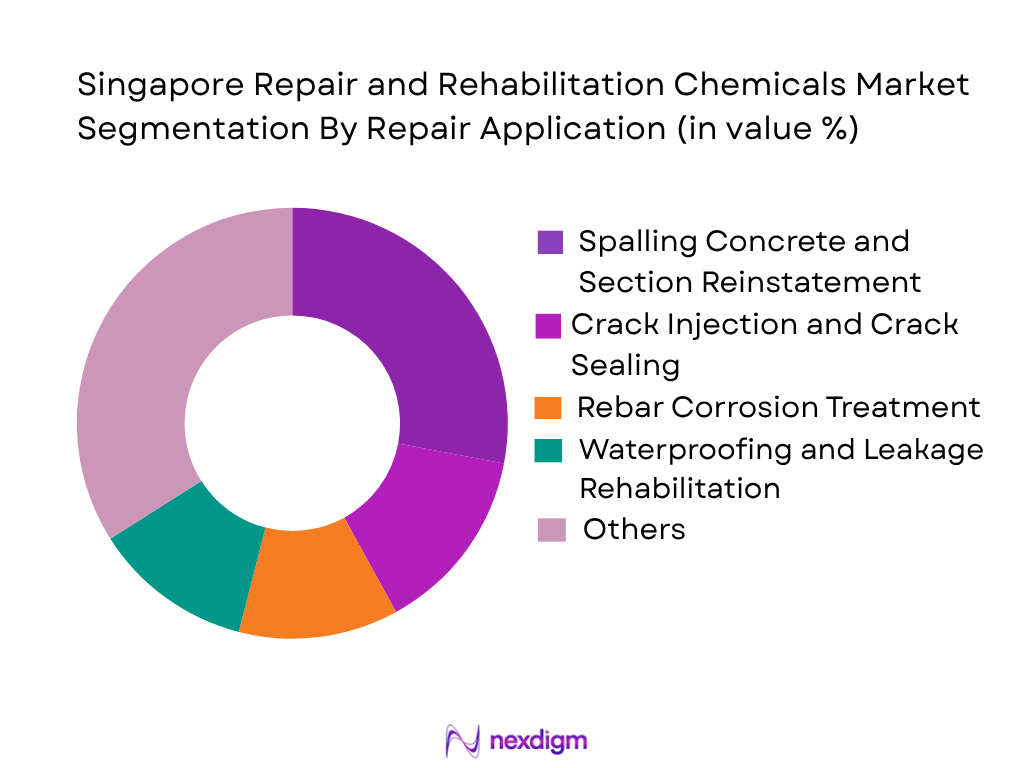
The Singapore Repair and Rehabilitation Chemicals Market is segmented into spalling concrete repair, crack injection, reinforcement-corrosion treatment, façade repair, waterproofing rehabilitation, structural strengthening, bridge and viaduct repair, tunnel leakage treatment, marine concrete rehabilitation and grouting. Spalling concrete and concrete section reinstatement represent the dominant application because Singapore has a large installed base of ageing reinforced-concrete buildings exposed to carbonation, moisture and corrosion. HDB’s HIP expressly includes repair of spalling concrete and structural cracks as essential upgrading works, while its enhanced Corrosion Resistant Repair method applies anti-corrosion protection to exposed reinforcement before reinstatement. The same repair logic extends to commercial buildings, car parks, façades and infrastructure where concrete cover deterioration must be removed and rebuilt. BCA’s Periodic Structural Inspection regime also requires recurring inspection and rectification, strengthening demand for defect diagnosis followed by repair mortar, injection, coating and strengthening systems rather than one-time construction consumption.
Competitive Landscape
The Singapore Repair and Rehabilitation Chemicals Market is characterized by multinational construction-chemical manufacturers and specialist engineering-material suppliers competing through complete system capability rather than standalone repair products. Market positioning depends on structural repair mortars, injection technologies, reinforcement corrosion protection, grouts, protective coatings, strengthening systems, specification support and contractor training. Sika, for example, markets structural repair mortars, corrosion-protection systems, micro-concrete and engineered refurbishment solutions from its Singapore operation, illustrating the importance of integrated repair platforms.
| Major Player | Establishment Year | Headquarters | Repair Mortars | Injection / Grouting | Corrosion Protection | Structural Strengthening | Protective Coatings | Singapore Technical Presence |
| Sika | 1910 | Baar, Switzerland | ~ | ~ | ~ | ~ | ~ | ~ |
| Fosroc | 1972 | Dubai, UAE | ~ | ~ | ~ | ~ | ~ | ~ |
| MAPEI | 1937 | Milan, Italy | ~ | ~ | ~ | ~ | ~ | ~ |
| ARDEX | 1949 | Witten, Germany | ~ | ~ | ~ | ~ | ~ | ~ |
| Hilti | 1941 | Schaan, Liechtenstein | ~ | ~ | ~ | ~ | ~ | ~ |
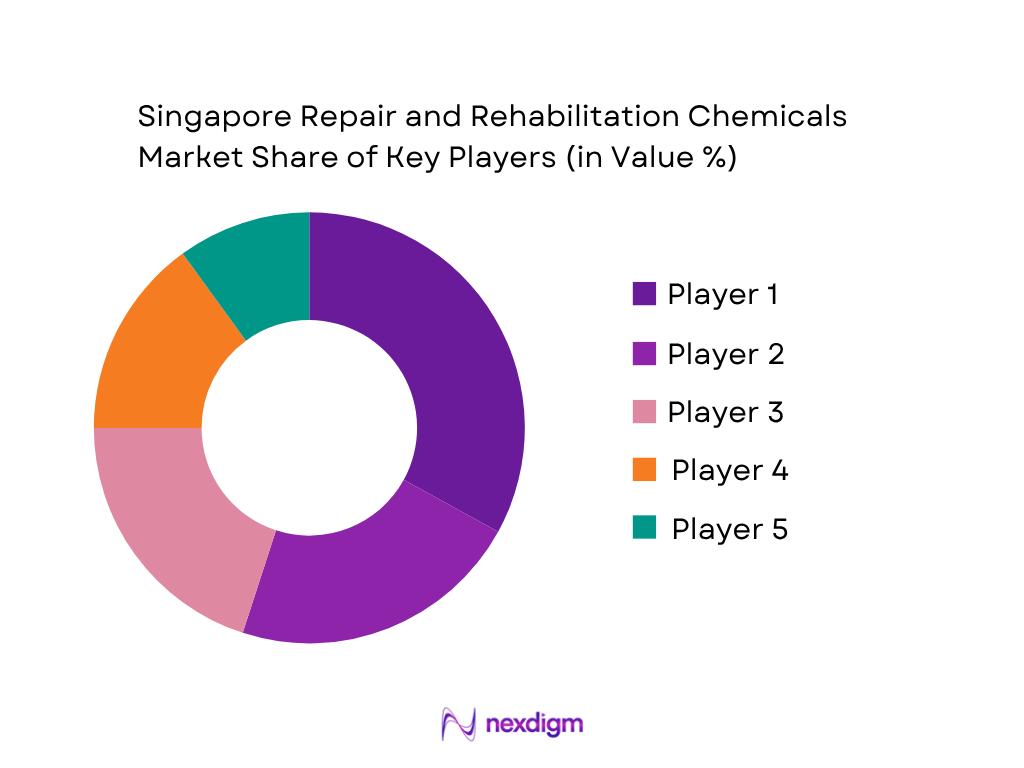
Singapore Repair and Rehabilitation Chemicals Market Analysis
Growth Drivers
HDB Upgrading and Spalling-Concrete Remediation Are Creating Recurring Repair-Chemical Demand
Singapore’s Repair and Rehabilitation Chemicals Market is strongly supported by the systematic renewal of ageing public housing, where concrete spalling, reinforcement corrosion, leakage and structural deterioration require recurring treatment rather than one-time construction materials. HDB’s Annual Report records 22,540 homes upgraded under the Home Improvement Programme in FY2024, while an additional 82,000 flats were selected for HIP across locations including Choa Chu Kang, Pasir Ris, Tampines and Jurong West. The programme incorporates an enhanced Corrosion Resistant Repair method for spalling concrete in toilets, directly supporting demand for reinforcement-protection coatings, bonding agents, polymer-modified repair mortars and reinstatement materials. A separate HDB programme announcement allocated more than S$742 million for upgrading over 53,000 flats, further strengthening the active rehabilitation pipeline. Singapore’s broader economic capacity supports this lifecycle-investment model: World Bank data record nominal GDP of USD547.39 billion in 2024 and GDP per capita of USD90,674.1. The combination of a large ageing HDB base, scheduled upgrading and corrosion-focused repair procedures provides recurring demand for repair mortars, injection materials, corrosion inhibitors and waterproofing rehabilitation systems.
Mandatory Structural and Façade Inspections Sustain Specification-Driven Rehabilitation
Singapore’s regulatory building-inspection framework creates a recurring source of demand for repair chemicals because identified structural and façade defects must be investigated and rectified rather than deferred indefinitely. The Building and Construction Authority requires Periodic Structural Inspections every 5 years for non-residential buildings and every 10 years for residential buildings, while buildings subject to the Periodic Façade Inspection regime and older than 20 years must undergo façade inspections every 7 years. These inspection cycles generate repeated requirements for crack injection, concrete patch repair, anti-carbonation coatings, corrosion treatment, façade reinstatement and structural strengthening when defects are detected. The demand base is reinforced by high overall activity in the built environment: BCA recorded preliminary construction demand of S$44.2 billion in 2024, with construction output reaching S$38.4 billion. This enlarges the installed asset stock that will progressively require inspection and maintenance. World Bank data record Singapore’s nominal GDP at USD547.39 billion in 2024 and GDP per capita at USD90,674.1. Regulatory inspection therefore converts building ageing into a recurring, specification-led rehabilitation pipeline for technically validated repair systems.
Market Challenges
Specialist Repair Work Requires a Skilled and Highly Controlled Application Workforce
Singapore’s Repair and Rehabilitation Chemicals Market faces execution challenges because structural repair, injection grouting, CFRP installation, reinforcement treatment and overhead mortar application depend heavily on trained workers and strict workmanship. Ministry of Manpower data show 456,800 Work Permit holders in construction, marine shipyard and process sectors at December 2024, within a total foreign workforce of 1,576,500. BCA simultaneously requires construction firms to maintain at least 10 workers out of every 100 Work Permit holders as Higher Skilled R1 workers, reflecting the sector’s need for competency upgrading. Repair work is particularly sensitive because incorrect substrate preparation, injection pressure, moisture assessment or curing can cause debonding and recurring corrosion even when technically suitable materials are used. HDB’s completion of 22,540 HIP homes in FY2024 demonstrates the scale of occupied-building repair that contractors must execute while maintaining quality and resident access. World Bank data place Singapore’s nominal GDP at USD547.39 billion in 2024 and GDP per capita at USD90,674.1. The requirement for trained manpower, controlled installation and specialist supervision therefore remains a significant constraint on scaling technically demanding rehabilitation projects.
Repairing Ageing Concrete While Buildings Remain Operational Increases Execution Complexity
Singapore’s rehabilitation market faces a distinctive operational challenge because a large proportion of repair activity occurs in occupied housing, commercial properties, transport facilities and public infrastructure that cannot simply be taken out of service for prolonged periods. HDB completed upgrades for 22,540 homes in FY2024 and selected another 82,000 flats for HIP, meaning large volumes of spalling-concrete, leakage and reinstatement work must be coordinated around residents. Transport assets present similar constraints: Singapore’s operating rail network extended to approximately 271.3 kilometres in 2024, including around 242.5 kilometres of MRT infrastructure, where tunnel injection, viaduct repair and station rehabilitation must be completed within tightly controlled engineering windows. BCA’s inspection regime additionally requires defects found during inspections to be rectified, increasing the need for rapid-setting mortars, low-viscosity injections and fast-return-to-service technologies. Singapore’s World Bank-recorded nominal GDP was USD547.39 billion in 2024, with GDP per capita of USD90,674.1. These conditions make productivity, curing time, access planning and compatibility with existing concrete as important as material strength, raising execution complexity for rehabilitation contractors.
Market Opportunities
Low-Carbon and Asset-Life-Extension Repair Systems Have Strong Future Potential
Singapore’s emphasis on extending the service life of existing buildings creates future opportunity for low-carbon repair mortars, corrosion-control systems, hydrophobic treatments and structural strengthening technologies that avoid premature demolition and reconstruction. Current rehabilitation activity provides a substantial base: HDB completed 22,540 HIP upgrades in FY2024 and selected 82,000 additional flats, while another programme allocation committed more than S$742 million to upgrading over 53,000 flats. BCA also recorded S$44.2 billion of construction demand and S$38.4 billion of construction output in 2024, expanding the asset base that will ultimately require maintenance. Products that enable localized concrete reinstatement, rebar passivation, crack injection and CFRP strengthening can extend structural service life while limiting replacement of intact building components. The opportunity is particularly relevant for occupied estates and commercial structures where full replacement creates disruption and waste. World Bank data show Singapore’s nominal GDP at USD547.39 billion in 2024 and GDP per capita at USD90,674.1. These current conditions support future demand for rehabilitation systems positioned around durability, lower material consumption and lifecycle asset management.
Marine, Port and Transport Assets Create Scope for Chloride-Resistant Rehabilitation Technologies
Singapore’s expanding transport and maritime infrastructure creates future opportunity for repair chemicals engineered for chloride exposure, water ingress, abrasion and high-service-load environments. Maritime and Port Authority data show Singapore handled 622.67 million tonnes of cargo in 2024 and a record 41.12 million TEUs, while 11 berths at Tuas Port were operational and Phase 2 reclamation works were approximately 75 parts out of 100 complete by year-end. These active marine assets require long-term protection of reinforced concrete exposed to saltwater, splash zones and aggressive chloride ingress, supporting demand for silane impregnation, corrosion inhibitors, high-performance repair mortars and protective coatings. Transport infrastructure adds another opportunity: Singapore’s rail network reached approximately 271.3 kilometres in 2024, creating a growing installed base of tunnels, stations, viaducts and structural concrete requiring future maintenance. World Bank data record Singapore’s nominal GDP at USD547.39 billion in 2024 and GDP per capita at USD90,674.1. Current port and rail infrastructure therefore provide a substantial foundation for future growth in marine repair, tunnel injection, corrosion protection and high-durability rehabilitation systems.
Future Outlook
The Singapore Repair and Rehabilitation Chemicals Market is expected to expand at approximately ~X.X% CAGR during 2026-2035, with lifecycle maintenance becoming more important as the national building and infrastructure stock matures. Growth will increasingly come from repair, protection and asset-life extension rather than only from new construction.
Regulatory inspection will remain a structural source of demand. BCA requires Periodic Structural Inspections once every 5 years for non-residential buildings and once every 10 years for residential buildings, while buildings more than 20 years old covered by the Periodic Façade Inspection regime require inspection every 7 years. Defects identified through these regimes must be rectified, supporting recurring demand for repair mortars, injections and protective coatings.
Major Players
- Sika Singapore Pte Ltd
- Fosroc Singapore
- Mapei Far East Pte Ltd
- Master Builders Solutions Singapore
- Saint-Gobain Weber Singapore
- ARDEX Singapore Pte Ltd
- MC-Bauchemie Singapore / Regional Solutions
- Normet Singapore
- Tremco CPG Singapore
- Hilti Singapore
- GCP Applied Technologies / Saint-Gobain
- Jotun Singapore
- Nippon Paint Singapore
- Penetron Singapore / Regional Solutions
- Kryton International / Singapore Distribution
Key Target Audience
- Concrete Repair and Construction Chemical Manufacturers
- Structural Repair and Injection Contractors
- Property Owners, MCSTs and Facility Management Companies
- Transport, Water and Marine Infrastructure Contractors
- Housing Upgrading and Building Rehabilitation Contractors
- Investments and Venture Capitalist Firms
- Government and Regulatory Bodies (Building and Construction Authority, Housing & Development Board, Land Transport Authority, PUB Singapore’s National Water Agency, Maritime and Port Authority of Singapore)
- Construction Chemical Distributors and Specialist Applicator Networks
Research Methodology
Step 1: Identification of Key Variables
The initial phase involves constructing an ecosystem map covering repair chemical manufacturers, resin and binder suppliers, distributors, structural engineers, repair contractors, HDB contractors, MCSTs and infrastructure agencies. Secondary and proprietary research is used to identify deterioration mechanisms, repair technologies, inspection cycles, building age and application-specific material demand. The primary variables include repaired area, defect type, repair depth, injection volume, structure type and specification intensity.
Step 2: Market Analysis and Construction
Historical demand is assessed using construction activity, HDB upgrading, regulatory inspection requirements and infrastructure asset data. The top-down approach evaluates the existing reinforced-concrete asset base and rehabilitation programmes, while the bottom-up method examines supplier sales, contractor consumption and material intensity across repair applications. Demand is reconciled across mortars, injections, grouts, protective coatings, corrosion systems and structural strengthening.
Step 3: Hypothesis Validation and Expert Consultation
Market hypotheses are validated through computer-assisted telephone interviews and structured discussions with repair contractors, structural engineers, product suppliers, waterproofing specialists and facility managers. These consultations assess typical repair depth, product-system selection, substrate preparation, corrosion recurrence, injection requirements and procurement practices. Findings are used to distinguish cosmetic maintenance from structural and durability-driven rehabilitation.
Step 4: Research Synthesis and Final Output
The final phase triangulates BCA regulations, HDB rehabilitation activity, transport infrastructure statistics, manufacturer disclosures and primary interviews. Market demand is validated across product type, application, asset category and customer group. Forecasting incorporates building ageing, HIP execution, inspection-triggered rectification, MRT maintenance, façade repair, water infrastructure rehabilitation, corrosion protection and adoption of low-carbon repair technologies.

- Executive Summary
- Research Methodology (Market Definitions and Assumptions, Singapore Repair and Rehabilitation Chemicals Market Classification, Cementitious Repair Mortar Assessment, Polymer-Modified Repair Mortar Assessment, Micro-Concrete Assessment, Epoxy Repair Assessment, Crack Injection Resin Assessment, Cementitious Injection Grout Assessment, Polyurethane Injection Assessment, Non-Shrink Grout Assessment, Reinforcement Corrosion Protection Assessment, Migrating Corrosion Inhibitor Assessment, Protective Coating Assessment, Carbonation Protection Assessment, Chloride Protection Assessment, Structural Strengthening Assessment, CFRP System Assessment, Epoxy Bonding Assessment, Waterproofing Rehabilitation Assessment, Spalling Concrete Repair Assessment, Concrete Delamination Assessment, Honeycombing Repair Assessment, Joint Rehabilitation Assessment, Façade Repair Assessment, HDB Upgrading Assessment, MRT and Transport Asset Rehabilitation Assessment, Marine Concrete Rehabilitation Assessment, BCA Periodic Structural Inspection Assessment, BCA Periodic Façade Inspection Assessment, EN 1504 Repair Principle Assessment, Adhesion Strength Assessment, Compressive Strength Assessment, Chloride Resistance Assessment, Carbonation Resistance Assessment, Crack-Bridging Assessment)

- Definition and Scope
- Singapore Repair and Rehabilitation Chemicals Industry Evolution and Development of Conventional Cementitious Patching, Polymer-Modified Repair Mortars, Flowable Micro-Concrete, Non-Shrink Grouts, Epoxy Injection Resins, Polyurethane Injection Resins, Cementitious Injection Grouts, Reinforcement Passivation Systems, Corrosion Inhibitors, Hydrophobic Impregnation, Anti-Carbonation Coatings, Crack-Bridging Protective Coatings, Structural Epoxy Bonding, CFRP Strengthening Systems, Waterproofing Rehabilitation, Façade Repair Systems, Marine Concrete Protection and Low-Carbon Repair Technologies
- Repair and Rehabilitation Chemicals Value Chain Analysis
- Repair and Rehabilitation Chemicals Supply Chain Analysis
- Cement and SCM Suppliers, Polymer Modifier Suppliers, Epoxy Resin Suppliers, Polyurethane Resin Suppliers, Corrosion Inhibitor Suppliers, Silane and Siloxane Suppliers, Carbon Fibre Suppliers, Mineral Filler Suppliers, Additive Suppliers, Repair Chemical Manufacturers, Local Blenders, Importers, Specialist Distributors, Structural Repair Contractors, Waterproofing Contractors, Injection Contractors, Façade Contractors, Structural Engineers, Building Owners, MCSTs, HDB Contractors, LTA Contractors, PUB Contractors and Marine Infrastructure Contractors

- Growth Drivers (HDB Home Improvement Programme, Periodic Structural Inspection, Periodic Façade Inspection, Aging Residential Stock, Spalling Concrete Remediation, Commercial Building Refurbishment, MRT Asset Renewal, Bridge and Tunnel Maintenance, Water Infrastructure Rehabilitation, Marine Chloride Exposure, Asset-Life Extension, Preventive Maintenance)
- Market Challenges (Occupied-Building Repair Constraints, Short Repair Windows, Skilled Applicator Availability, Hidden Concrete Delamination, Rebar Corrosion Recurrence, Chloride Contamination, Moisture Behind Repairs, Repair-Mortar Compatibility, Substrate Preparation Quality, Injection Access Constraints, Structural Engineer Approval, Project-Specific Performance Validation)
- Market Opportunities (Low-Carbon Repair Mortars, Rapid-Setting Repair Systems, CFRP Strengthening, Migrating Corrosion Inhibitors, Silane Impregnation, Crack-Bridging Protective Coatings, Tunnel Injection Systems, HDB Spalling Repair, Façade Rehabilitation, Marine Concrete Protection, Predictive Maintenance-Linked Repair, High-Durability Rehabilitation Systems)
- Market Trends (Polymer-Modified Repair Mortars, High-Flow Micro-Concrete, Low-Viscosity Epoxy Injection, Hydrophilic PU Injection, CFRP Strengthening, Silane Hydrophobic Treatment, Anti-Carbonation Coatings, Rapid-Cure Systems, Low-Carbon Repair Materials, System-Based EN 1504 Repair, Digital Condition Assessment, Drone-Assisted Façade Inspection)
- Government Regulations and Standards (Building Control Act, BCA Periodic Structural Inspection Requirements, BCA Periodic Façade Inspection Requirements, Building Control Regulations, Workplace Safety Requirements, PUB Infrastructure Requirements, LTA Asset Maintenance Requirements, EN 1504 Concrete Repair Principles, Fire Safety Requirements, Green Mark Material Considerations, Structural Engineer Supervision Requirements)
- SWOT Analysis
- Porter’s Five Forces Analysis
- PESTLE Analysis
- Stakeholder Ecosystem
- Repair and Rehabilitation Project Ecosystem

- By Market Value (2020-2025)
- By Repair Chemical Consumption Volume (2020-2025)
- By Cementitious Repair Mortar Consumption (2020-2025)
- By Micro-Concrete Consumption (2020-2025)
- By Crack Injection Resin Consumption (2020-2025)
- By Cementitious Injection Grout Consumption (2020-2025)
- By Polyurethane Injection Consumption (2020-2025)
- By Non-Shrink Grout Consumption (2020-2025)
- By Corrosion Protection Chemical Consumption (2020-2025)
- By Protective Coating Consumption (2020-2025)
- By Structural Strengthening Chemical Consumption (2020-2025)
- By Waterproofing Rehabilitation Chemical Consumption (2020-2025)
- By HDB and Residential Rehabilitation Demand (2020-2025)
- By Commercial and Institutional Building Rehabilitation Demand (2020-2025)
- By Transport Infrastructure Rehabilitation Demand (2020-2025)
- By Marine and Coastal Infrastructure Rehabilitation Demand (2020-2025)

- By Product Type (In Value %)
Cementitious Repair Mortars
Polymer-Modified Repair Mortars
Flowable Micro-Concrete
Epoxy Repair Mortars
Non-Shrink Grouts
Epoxy Injection Resins
Polyurethane Injection Resins
Cementitious Injection Grouts
Reinforcement Corrosion Protection Systems
Migrating Corrosion Inhibitors
Hydrophobic Impregnation Systems
Anti-Carbonation Coatings
Crack-Bridging Protective Coatings
Structural Epoxy Bonding Agents
CFRP Strengthening Systems
Waterproofing Rehabilitation Chemicals - By Repair Application (In Value %)
Spalling Concrete Repair
Delaminated Concrete Repair
Honeycombing Repair
Structural Crack Injection
Non-Structural Crack Sealing
Rebar Corrosion Repair
Concrete Section Reinstatement
Void Filling and Grouting
Baseplate and Machine Grouting
Façade Concrete Repair
Balcony and Podium Repair
Roof Slab Rehabilitation
Basement Leakage Repair
Tunnel Leakage Injection
Bridge and Viaduct Repair
Marine Concrete Repair - By Deterioration Mechanism (In Value %)
Reinforcement Corrosion
Carbonation-Induced Deterioration
Chloride-Induced Corrosion
Water Ingress
Concrete Cracking
Delamination
Spalling
Honeycombing
Chemical Attack
Sulfate Attack
Abrasion and Erosion
Thermal Movement
Joint Failure
Age-Related Deterioration
Construction Defects - By Performance Requirement (In Value %)
High Bond Strength
High Compressive Strength
Shrinkage Compensation
Rapid Strength Development
Low Permeability
Chloride Resistance
Carbonation Resistance
Chemical Resistance
Crack-Bridging Capability
Water-Tightness
Corrosion Protection
Structural Load Transfer
High Flowability
Overhead Application
Low-Carbon Repair Performance - By Location (In Value %)
Central Region
East Region
North-East Region
North Region
West Region
Jurong
Tampines
Bedok
Woodlands
Hougang
Ang Mo Kio
Toa Payoh
Queenstown
Bukit Merah
Pasir Ris

- Market Share of Major Players (By Singapore Revenue, Repair Mortar Volume, Injection Resin Portfolio, Grouting Portfolio, Corrosion Protection Portfolio, Protective Coating Portfolio, CFRP Strengthening Exposure, Waterproofing Rehabilitation Exposure, HDB Project Exposure, Commercial Rehabilitation Exposure, MRT and Infrastructure Exposure, Marine Repair Exposure, Local Warehousing, Approved Applicator Network, Technical Specification Support)
- Cross Comparison Parameters (Structural Repair Mortar and Micro-Concrete Portfolio Breadth, Epoxy PU and Cementitious Injection Technology Capability, Reinforcement Corrosion and Chloride Protection Capability, CFRP Structural Strengthening System Capability, HDB Spalling Concrete and Building Rehabilitation Reference Base, MRT Bridge Tunnel and Marine Infrastructure Rehabilitation Capability, Singapore Warehousing Approved Applicator and Contractor Network, Structural Engineer Specification Technical Testing and Site-Support Capability)
- SWOT Analysis of Major Players
- Competitive Positioning Matrix
- Major Companies
Sika Singapore Pte Ltd
Fosroc Singapore
Mapei Far East Pte Ltd
Master Builders Solutions Singapore
Saint-Gobain Weber Singapore
ARDEX Singapore Pte Ltd
MC-Bauchemie Singapore / Regional Solutions
Normet Singapore
Tremco CPG Singapore
Hilti Singapore
GCP Applied Technologies / Saint-Gobain
Jotun Singapore
Nippon Paint Singapore
Penetron Singapore / Regional Solutions
Kryton International / Singapore Distribution

- Structural Repair Contractor Requirement Assessment
- Injection Specialist Requirement Assessment
- Waterproofing Contractor Requirement Assessment
- Façade Repair Contractor Requirement Assessment
- Structural Engineer Specification Assessment
- HDB Contractor Requirement Assessment
- MCST Procurement Assessment
- Commercial Property Owner Requirement Assessment
- Industrial Facility Owner Requirement Assessment
- LTA Contractor Requirement Assessment
- PUB Contractor Requirement Assessment
- Marine Contractor Requirement Assessment
- Technical Training Requirement Assessment
- Site Support and Pull-Off Testing Requirement Assessment

- By Market Value (2026-2035)
- By Repair Chemical Consumption Volume (2026-2035)
- By Cementitious Repair Mortar Consumption (2026-2035)
- By Micro-Concrete Consumption (2026-2035)
- By Crack Injection Resin Consumption (2026-2035)
- By Cementitious Injection Grout Consumption (2026-2035)
- By Polyurethane Injection Consumption (2026-2035)
- By Non-Shrink Grout Consumption (2026-2035)
- By Corrosion Protection Chemical Consumption (2026-2035)
- By Protective Coating Consumption (2026-2035)
- By Structural Strengthening Chemical Consumption (2026-2035)


 Request a Sample
 Ask for Customization
 Get a Quote
 Enquire Now