
 Download PDF
Market Overview
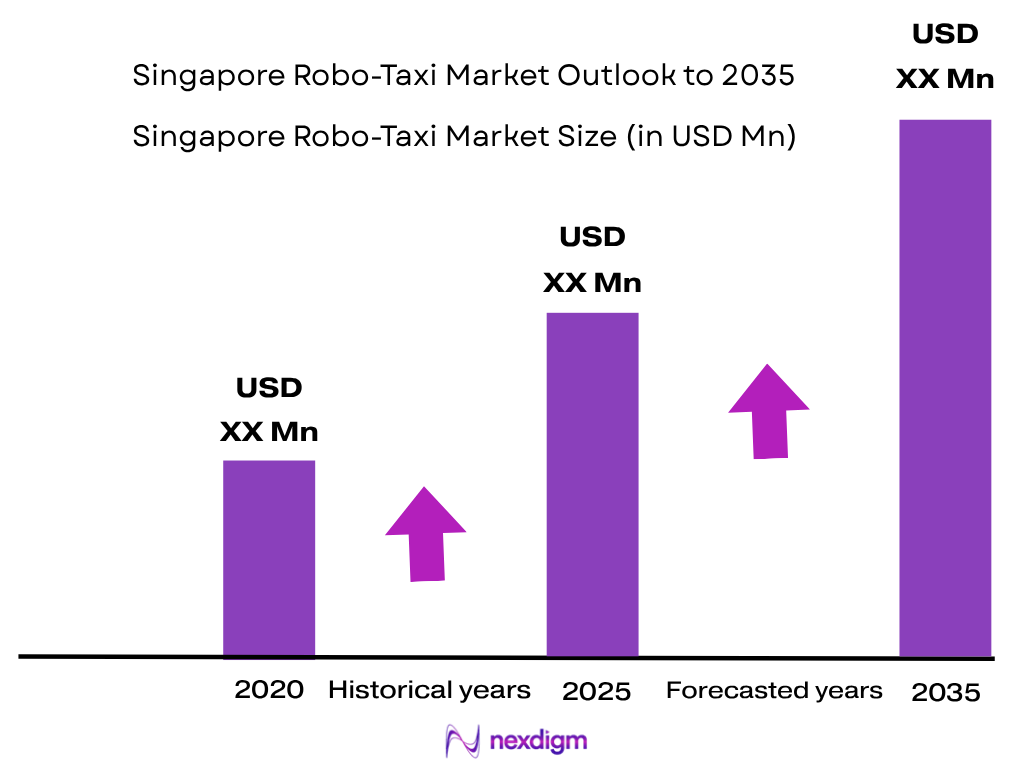
The Singapore robo-taxi market is an emerging autonomous mobility segment driven by government-led autonomous vehicle (AV) initiatives, urban mobility requirements, and the transition toward smart transportation ecosystems. The market is valued at ~USD XX million in 2024 and is expected to expand at a CAGR of ~XX% during 2026-2035. Growth is supported by Singapore’s long-term autonomous mobility roadmap, increasing investments in AI-based transportation systems, and the need to address manpower constraints in public transport operations. Singapore’s Ministry of Transport has highlighted AV deployment as a pathway to improve transport efficiency while creating technology-enabled mobility solutions.
Singapore represents a highly concentrated robo-taxi market due to its compact geography, advanced digital infrastructure, and controlled urban environment. Key deployment zones include one-north, Punggol, Marina Bay, Resorts World Sentosa, Gardens by the Bay, and Nanyang Technological University areas, where autonomous mobility trials have been conducted. Singapore began AV testing initiatives in 2014 and established one-north as an AV testing environment in 2016. (Land Transport Authority) The city-state’s dense road network, smart traffic management systems, and government-supported testing frameworks provide suitable conditions for autonomous taxi commercialization.
Market Segmentation
By Vehicle Type
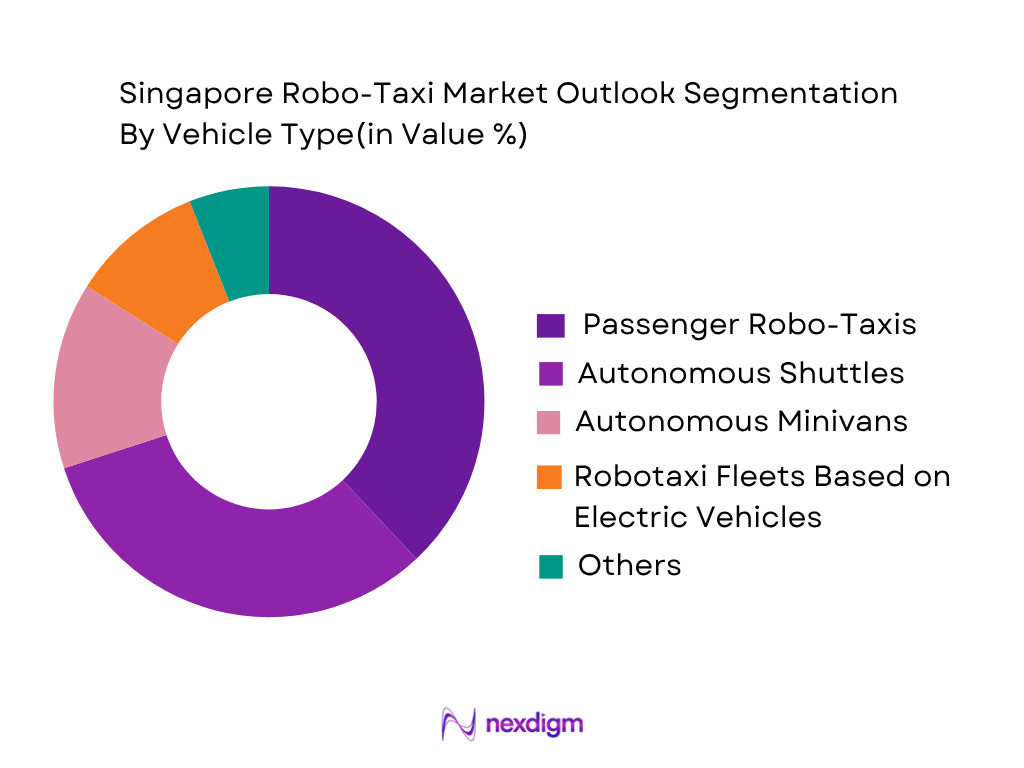
Singapore’s passenger robo-taxi segment represents the largest opportunity within the autonomous mobility ecosystem due to increasing interest from technology companies and mobility operators in point-to-point transportation services. Passenger robo-taxis benefit from their ability to provide flexible mobility compared with fixed-route autonomous shuttles. However, commercial deployment remains dependent on regulatory approvals, safety validation, and operational reliability. Singapore’s Ministry of Transport has indicated that robo-taxis require more complex operational capabilities compared with fixed-route autonomous vehicles because they must navigate diverse routes and traffic situations. (Ministry of Transport) The segment is expected to gain traction as AI perception systems, remote supervision capabilities, and autonomous driving reliability improve.
By Technology Level
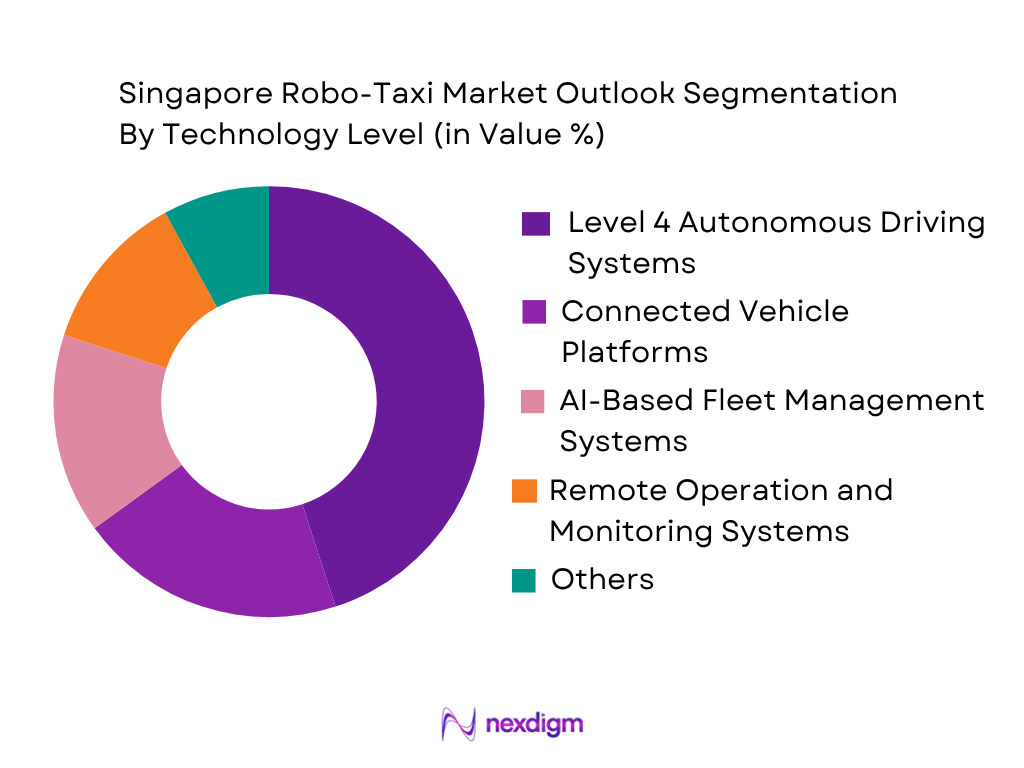
Level 4 autonomous driving technology dominates Singapore’s robo-taxi development landscape due to its capability to operate without continuous human intervention within defined operational design domains. Singapore’s regulatory framework requires autonomous vehicle operators to obtain approval before conducting trials or commercial usage on public roads. (AGC Singapore) Level 4 systems are preferred because they combine advanced sensor technology, AI decision-making, geofencing capabilities, and remote monitoring support. The development of CETRAN (Centre of Excellence for Testing & Research of Autonomous Vehicles) has strengthened Singapore’s testing ecosystem for autonomous mobility solutions. (Ministry of Transport)
Competitive Landscape
The Singapore robo-taxi market is characterized by collaboration between autonomous technology developers, mobility operators, automotive manufacturers, and government agencies. Unlike traditional taxi markets, competition is based on autonomous software capability, fleet management infrastructure, safety validation, and deployment partnerships. Singapore has issued multiple AV trial authorisations and continues to evaluate autonomous mobility applications.
| Company | Establishment Year | Headquarters | Autonomous Technology | Singapore Presence | Vehicle Platform | Key Capability | Business Model |
| Waymo | 2009 | Mountain View, USA | ~ | ~ | ~ | ~ | ~ |
| Cruise | 2013 | San Francisco, USA | ~ | ~ | ~ | ~ | ~ |
| WeRide | 2017 | Guangzhou, China | ~ | ~ | ~ | ~ | ~ |
| Grab | 2012 | Singapore | ~ | ~ | ~ | ~ | ~ |
| nuTonomy | 2013 | Singapore | ~ | ~ | ~ | ~ | ~ |
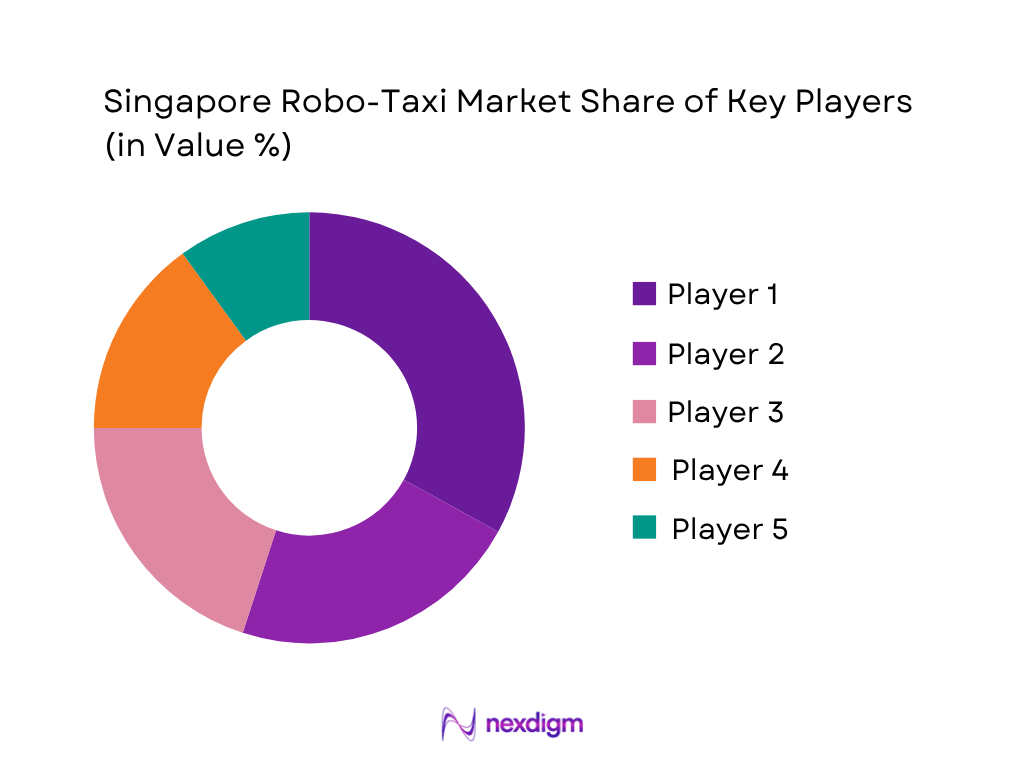
Singapore Robo-Taxi Market Analysis
Growth Drivers
Expansion of Autonomous Vehicle Trials
Singapore’s structured autonomous vehicle (AV) testing ecosystem is accelerating the development of robo-taxi services through controlled trials, regulatory sandboxes, and smart mobility initiatives. The country has designated multiple test areas, including one-north, Jurong Innovation District, and Sentosa, allowing AV operators to validate autonomous driving technologies in real-world environments. Singapore recorded a population of approximately 6.04 million people in 2024, creating a dense urban environment where autonomous shared mobility solutions can address transportation efficiency requirements. The Ministry of Transport and Land Transport Authority have supported AV trials involving autonomous shuttles and mobility services to improve urban transport accessibility. The country’s road network extends over 3,500 km, requiring efficient traffic management solutions in a geographically constrained environment. Singapore’s Smart Nation initiatives also emphasize artificial intelligence, connected infrastructure, and digital mobility systems, creating favorable conditions for robo-taxi deployment. The combination of compact geography, advanced digital infrastructure, and government-led AV testing frameworks is strengthening the commercialization pathway for autonomous taxi services. These factors are expected to support wider deployment of autonomous mobility solutions across business districts, residential communities, and transport hubs.
Smart Nation Program Development
Singapore’s Smart Nation strategy provides a strong foundation for robo-taxi adoption through advanced connectivity, artificial intelligence integration, and digital infrastructure development. The country has achieved extensive digital penetration, with household internet access reaching more than 99% according to national statistics, supporting connected vehicle communication and real-time mobility management systems. Singapore’s population density of more than 8,000 people per square kilometer creates significant demand for optimized transportation solutions that reduce congestion and improve mobility efficiency. The government continues investing in intelligent transport systems, including vehicle-to-infrastructure communication, autonomous driving research, and traffic analytics platforms. Singapore’s economy recorded a GDP of approximately USD 501 billion in 2024, reflecting strong financial capability for technology-driven infrastructure development. The nation also operates one of the most advanced public transportation networks globally, with rail and bus systems serving millions of daily commuters. Integration between autonomous vehicles and existing public transport infrastructure provides opportunities for robo-taxis to function as first-mile and last-mile mobility solutions. Smart Nation development, supported by advanced telecommunications networks and government technology programs, is therefore a key growth driver for Singapore’s autonomous mobility ecosystem.
Market Challenges
Regulatory Approval Requirement
The Singapore robo-taxi market faces regulatory complexity due to strict requirements related to autonomous vehicle safety validation, operational permits, cybersecurity compliance, and passenger protection standards. Autonomous vehicles must undergo extensive evaluation before commercial deployment under Singapore’s autonomous vehicle regulatory framework managed by the Land Transport Authority. The country’s transport system recorded more than 6 million residents in 2024, increasing the importance of maintaining high safety standards across urban mobility networks. Singapore has one of the highest vehicle densities in Southeast Asia, with more than 1 million registered vehicles, requiring autonomous systems to demonstrate reliable performance in mixed traffic conditions. Regulatory authorities require manufacturers and technology providers to address decision-making algorithms, sensor reliability, emergency response mechanisms, and operational limitations. Tropical weather conditions also require additional validation because frequent rainfall can affect cameras, LiDAR sensors, and perception systems. While Singapore provides a supportive environment for innovation, the approval process remains highly structured to ensure public safety. These regulatory requirements may extend commercialization timelines and increase development complexity for robo-taxi operators seeking large-scale deployment.
Passenger Safety Concerns
Passenger safety concerns remain a major challenge for robo-taxi adoption as users must develop confidence in fully autonomous transportation systems. Singapore’s highly regulated transport environment places strong emphasis on reliability, with public transport systems serving millions of passenger journeys annually. The country recorded approximately 5.9 million daily public transport journeys in 2024, demonstrating the importance of maintaining dependable mobility services. Autonomous taxi operators must ensure that artificial intelligence systems can safely manage complex urban conditions, including pedestrians, cyclists, motorcycles, road construction, and unpredictable traffic behavior. Singapore experiences tropical rainfall conditions, with annual precipitation exceeding 2,000 mm, creating additional challenges for autonomous sensors and vehicle perception systems. Public acceptance also depends on transparency regarding safety performance, emergency intervention procedures, and data security. Robo-taxi providers must demonstrate consistent operation across different environments before achieving widespread consumer adoption. Concerns regarding vehicle decision-making, passenger emergency handling, and cybersecurity vulnerabilities may slow adoption despite technological advancements. Building trust through successful pilot programs, safety validation, and operational transparency will remain essential for market expansion.
Market Opportunities
Autonomous Mobility-as-a-Service Integration
The integration of autonomous mobility-as-a-service (MaaS) platforms presents significant opportunities for Singapore’s robo-taxi ecosystem by connecting autonomous vehicles with existing public transport networks. Singapore’s compact urban structure, with a total land area of approximately 735 square kilometers, creates favorable conditions for shared autonomous mobility deployment. The country’s public transport infrastructure already supports high-volume commuter movement, with millions of daily passenger trips recorded across rail and bus networks. Integration of robo-taxis into MaaS platforms can improve connectivity between Mass Rapid Transit stations, residential zones, commercial areas, and business districts. Singapore’s digital economy infrastructure supports app-based mobility services, electronic payments, and real-time transport information systems. The government’s focus on intelligent transport solutions creates opportunities for autonomous fleets to complement traditional mobility options rather than replace them. Robo-taxi operators can utilize artificial intelligence-based fleet management, dynamic routing, and demand forecasting to improve operational efficiency. Growing urban mobility requirements, combined with limited land availability and increasing demand for flexible transportation solutions, create opportunities for autonomous MaaS models to become part of Singapore’s future mobility framework.
Airport and Tourism Mobility Applications
Airport and tourism mobility applications represent a major opportunity area for Singapore robo-taxi deployment due to the country’s position as a regional travel hub. Singapore Changi Airport handled approximately 67.7 million passenger movements in 2024, creating substantial demand for efficient passenger transportation solutions. Autonomous vehicles can support airport transfers, terminal connectivity, and tourist mobility services while reducing dependence on conventional transport options. Singapore welcomed millions of international visitors in 2024, supported by strong tourism infrastructure and global connectivity. Deployment of robo-taxis around airports, resorts, and attractions such as Sentosa can provide controlled operating environments suitable for autonomous mobility services. The country’s advanced road infrastructure, digital payment ecosystem, and smart city capabilities support integration of autonomous transport solutions in tourism applications. Robo-taxi fleets can also enhance accessibility for elderly passengers and travelers seeking convenient point-to-point transportation. By combining autonomous technology with tourism mobility demand, Singapore can establish specialized autonomous transport zones that demonstrate commercial viability before wider urban deployment. These applications provide an important pathway for scaling autonomous vehicle operations.
Future Outlook
The Singapore robo-taxi market is expected to experience gradual expansion as autonomous driving technologies mature, regulatory frameworks evolve, and mobility operators integrate autonomous fleets into urban transportation networks. Growth will be supported by smart city initiatives, AI development, electric vehicle adoption, and demand for manpower-efficient transportation solutions. Singapore is expected to follow a controlled deployment approach focusing initially on specific routes, geofenced areas, and public mobility applications before wider robo-taxi commercialization.
Major Players
- Waymo
- Cruise
- WeRide
- Grab
- nuTonomy
- Motional
- Baidu Apollo
- Pony.ai
- Zoox
- Mobileye
- NVIDIA
- Toyota
- Hyundai Motor Company
- Volvo Cars
- Mercedes-Benz
Key Target Audience
- Automotive OEMs and Autonomous Vehicle Technology Developers
- Ride-Hailing and Mobility Service Providers
- Fleet Operators and Transportation Companies
- Electric Vehicle Manufacturers and Charging Infrastructure Providers
- Artificial Intelligence and Software Solution Providers
- Investments and Venture Capitalist Firms (Mobility Technology Investors, Automotive Technology Funds, Smart Transportation Investors)
- Government and Regulatory Bodies (Land Transport Authority Singapore, Ministry of Transport Singapore, Urban Redevelopment Authority Singapore)
- Infrastructure Developers and Smart City Solution Providers
Research Methodology
Step 1: Identification of Key Variables
The initial research phase involves developing a comprehensive ecosystem map covering autonomous vehicle manufacturers, mobility operators, regulatory authorities, technology providers, infrastructure companies, and end users. Secondary research is conducted through government publications, transportation databases, regulatory frameworks, and industry documentation to identify key market variables influencing Singapore’s robo-taxi ecosystem.
Step 2: Market Analysis and Construction
Historical market information is analyzed through assessment of autonomous vehicle trials, deployment programs, technology adoption patterns, and mobility infrastructure development. Market construction includes evaluation of vehicle deployment models, operational routes, autonomous technology maturity, fleet management systems, and commercialization pathways.
Step 3: Hypothesis Validation and Expert Consultation
Market assumptions are validated through discussions with autonomous mobility specialists, automotive technology professionals, transportation operators, and ecosystem participants. Expert consultations evaluate operational challenges, regulatory requirements, technology readiness, and commercialization opportunities within Singapore’s autonomous transportation environment.
Step 4: Research Synthesis and Final Output
The final stage integrates primary and secondary findings to develop a validated market assessment. Insights from autonomous vehicle deployments, regulatory developments, technology partnerships, and mobility trends are synthesized to provide strategic intelligence for industry stakeholders.

- Executive Summary
- Research Methodology (Market Definition and Scope, Robo-Taxi Ecosystem Mapping, Autonomous Mobility Market Assessment Framework, Market Sizing Methodology, Top-Down Market Analysis, Bottom-Up Market Analysis, Primary Interviews with Autonomous Vehicle Developers and Mobility Operators, Demand-Side Assessment, Supply-Side Assessment, Regulatory Framework Analysis, Technology Adoption Assessment, Data Triangulation, Forecasting Model, Market Assumptions, Research Limitations)

- Definition and Scope
- Evolution of Autonomous Mobility and Robo-Taxi Industry Development
- Timeline of Key Autonomous Vehicle Initiatives and Smart Mobility Programs
- Singapore Autonomous Transportation Ecosystem Analysis
- Robo-Taxi Value Chain Analysis
- Supply Chain Analysis
- Singapore Smart Nation and Intelligent Transport System Integration

- Growth Drivers (Expansion of Autonomous Vehicle Trials, Smart Nation Program Development, Limited Land Availability Driving Mobility Efficiency, Electric Vehicle Infrastructure Expansion, Public Transport Connectivity Enhancement, Demand for First-Mile and Last-Mile Mobility)
- Market Challenges (Regulatory Approval Requirements, Passenger Safety Concerns, High Autonomous Technology Investment, Limited Operating Space, Cybersecurity Risks, Weather and Tropical Climate Adaptation Requirements)
- Market Opportunities (Autonomous Mobility-as-a-Service Integration, Airport and Tourism Mobility Applications, Electric Autonomous Fleet Expansion, AI-Based Traffic Optimization, Public Transport Network Integration)
- Market Trends (Connected Autonomous Mobility Development, AI-Based Navigation Systems, Shared Autonomous Transportation Models, Electric Robo-Taxi Fleets, Smart City Transportation Integration)
- Government Regulations and Policy Framework (Land Transport Authority Autonomous Vehicle Guidelines, Committee on Autonomous Road Transport Regulations, Smart Nation Mobility Policies, Road Safety Standards, Data Protection Requirements)
- SWOT Analysis
- Porter’s Five Forces Analysis
- PESTLE Analysis
- Stakeholder Ecosystem Analysis
- Competition Ecosystem Analysis

- By Market Value (2020-2025)
- By Fleet Deployment Volume (2020-2025)
- By Passenger Trip Volume (2020-2025)
- By Autonomous Vehicle Fleet Size (2020-2025)
- By Average Revenue Per Autonomous Vehicle (2020-2025)

- By Vehicle Type (In Value %)
Passenger Cars
Autonomous Shuttle Vans
Electric Minibuses
Autonomous Pods
Luxury Autonomous Mobility Vehicles - By Level of Automation (In Value %)
Level 4 Autonomous Vehicles
Level 3 Conditional Autonomous Vehicles
Level 2+ Advanced Driver Assistance Vehicles
Level 5 Fully Autonomous Vehicles - By Powertrain Type (In Value %)
Battery Electric Robo-Taxis
Hybrid Electric Robo-Taxis
Hydrogen Fuel Cell Autonomous Vehicles - By Application Area (In Value %)
Urban Mobility Services
Airport Transportation
Business District Transportation
Industrial Park Mobility
Tourism and Leisure Transportation - By Service Model (In Value %)
Autonomous Ride-Hailing Services
Autonomous Shuttle Services
Mobility-as-a-Service Platforms
Corporate Employee Transportation
Public Transport Integration - By Operating Environment (In Value %)
Public Road Deployment
Dedicated Autonomous Corridors
Private Campuses
Ports and Industrial Zones
Residential Communities

- Market Share Analysis of Major Players (By Fleet Deployment, Technology Partnership, Application Segment, Autonomous Capability, Operating Location)
- Cross Comparison Parameters (Autonomous Driving Technology Capability, Sensor and AI Platform Integration, Autonomous Fleet Deployment Experience, Regulatory Approval Progress, Electric Vehicle Platform Compatibility, Mobility Platform Integration, Testing Location Coverage, Fleet Management Technology Capability)
- SWOT Analysis of Major Players
- Detailed Profiles of Major Companies
Waymo
Motional
Baidu Apollo
Pony.ai
WeRide
Zoox
Tesla
Mobileye
NVIDIA
Toyota Motor Corporation
Hyundai Motor Company
Volvo Cars
Grab
ComfortDelGro
ST Engineering

- Passenger Adoption Assessment
- Demographic Mobility Behaviour Analysis
- Urban Transportation Usage Analysis
- Consumer Acceptance Drivers
- Consumer Concerns Analysis
- Passenger Experience Preference Analysis
- Purchase and Usage Decision Process

- By Market Value (2026-2035)
- By Fleet Deployment Volume (2026-2035)
- By Passenger Trip Volume (2026-2035)
- By Autonomous Vehicle Fleet Size (2026-2035)
- By Average Revenue Per Autonomous Vehicle (2026-2035)


 Request a Sample
 Ask for Customization
 Get a Quote
 Enquire Now