
 Download PDF
Market Overview
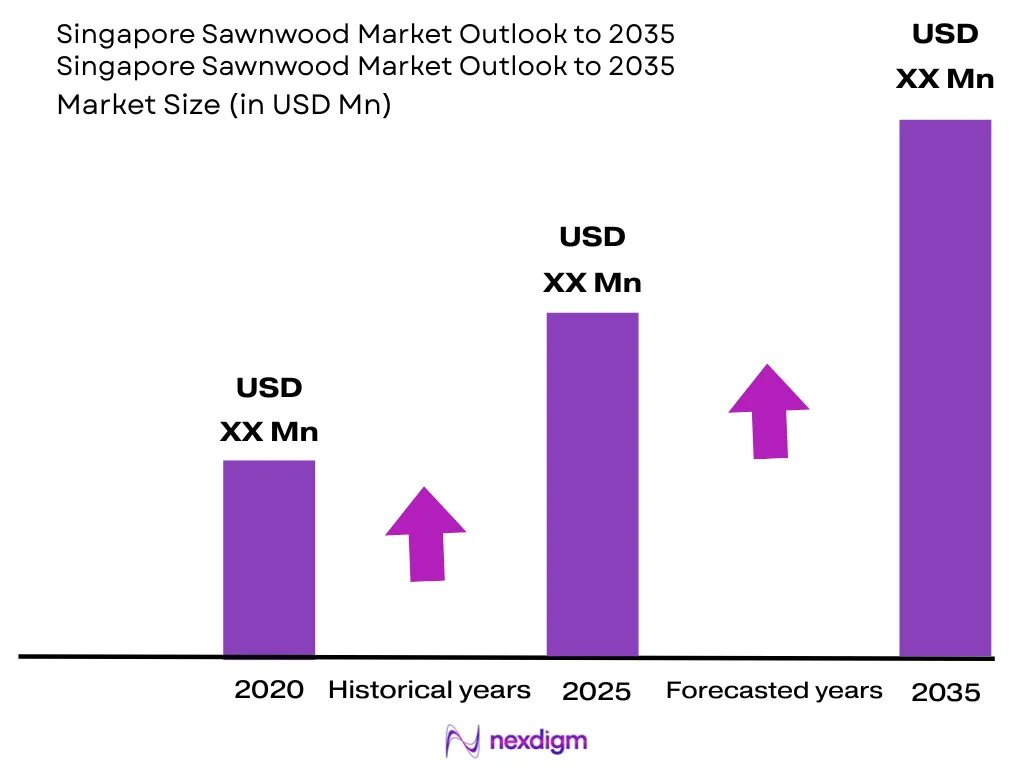
The Singapore Sawnwood Market was valued at approximately USD ~ Million in 2024, reflecting the city-state’s unique position as Southeast Asia’s most sophisticated timber-consuming economy and one of the region’s most strategically important timber trading and re-export hubs. According to data published by the Food and Agriculture Organization, Singapore Customs, and the Building and Construction Authority (BCA), Singapore is entirely import-dependent for sawnwood and all wood products, with the city-state’s 733 square kilometres of land area and dense urban development precluding any form of commercial timber production. Singapore’s sawnwood market is intrinsically shaped by the intersection of a highly active urban construction sector, one of Asia’s most internationally recognised interior design and fit-out industries, stringent government green building policies requiring certified and sustainable construction materials, and the city-state’s enduring role as Southeast Asia’s premier trade and logistics hub channelling wood products to regional markets across ASEAN, South Asia, and the Pacific. The Housing and Development Board (HDB)’s Build-To-Order programme, private residential condominium and landed property development, large-scale integrated resort and commercial mixed-use projects, and an internationally renowned hospitality and retail fit-out sector collectively generate concentrated and high-specification timber demand within one of the world’s most densely constructed urban environments. Singapore’s Green Building Masterplan, BCA Green Mark Certification Scheme, and the broader Singapore Green Plan 2030 framework are progressively elevating sustainability standards across the construction and building industry, creating growing demand for FSC-certified, legally verified, and sustainably documented sawnwood and engineered timber products across all construction and interior application categories.
Market Segmentation
By Wood Species Type
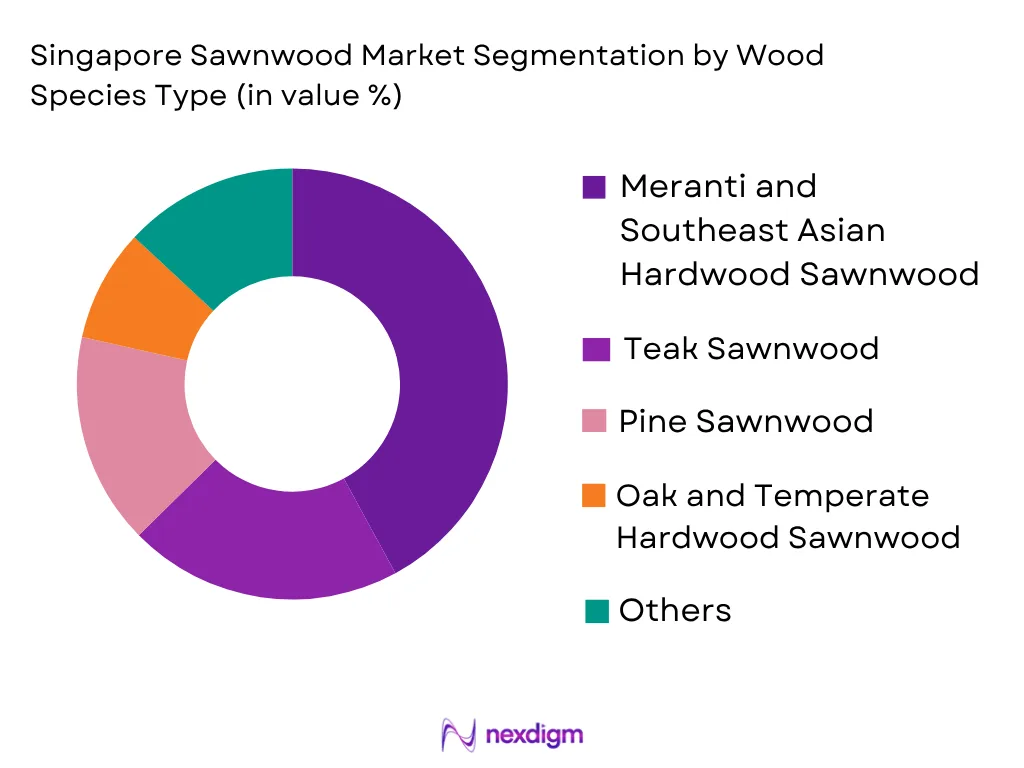
Singapore Sawnwood Market is segmented by wood species type into Meranti and Southeast Asian Hardwood Sawnwood, Teak Sawnwood, Pine Sawnwood, Oak and Temperate Hardwood Sawnwood, Engineered and Composite Timber Products, and Other Commercial Species. Meranti and Southeast Asian Hardwood Sawnwood historically held the dominant market position, reflecting Singapore’s geographic location within the heart of the Southeast Asian tropical hardwood producing region and the long-established trade relationships between Singapore timber merchants and forest concession operators across Malaysia, Indonesia, Papua New Guinea, and the Solomon Islands. Meranti, Keruing, Kapur, and related Dipterocarp family species have been extensively used in Singapore’s construction industry for structural framing, concrete formwork, door and window frames, and interior joinery applications, benefiting from their proximity, availability from regional suppliers, and familiarity among local contractors and specifiers. However, progressive tightening of tropical timber procurement standards under Singapore’s timber legality requirements, the BCA Green Mark scheme’s preference for certified timber, and growing corporate sustainability procurement policies among major developers, contractors, and government agencies have collectively shifted demand towards certified sources, reducing the share of uncertified Meranti and increasing the proportion of FSC-certified Southeast Asian hardwood and alternative species in specifications. Teak Sawnwood maintains a premium value share driven by sustained specification demand from high-end residential developments, luxury hotel and resort projects, marine applications at Singapore’s extensive marina and yacht club facilities, and bespoke interior joinery projects across the city-state’s internationally active interior design sector. Pine Sawnwood from New Zealand, Scandinavia, and South America represents a growing volume share, particularly for structural and construction-grade applications in BTO housing projects, commercial construction formwork, and pallet manufacturing serving Singapore’s dominant logistics and trade sector.
By End-Use Industry
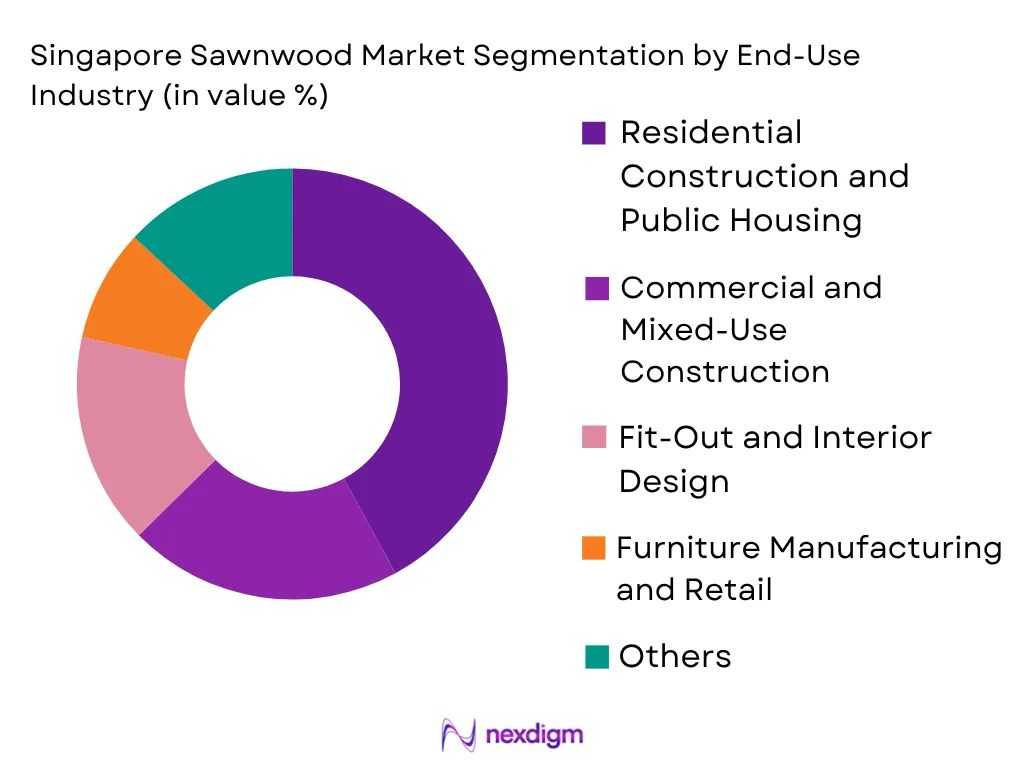
Singapore Sawnwood Market is segmented by end-use industry into Residential Construction and Public Housing (HDB), Commercial and Mixed-Use Construction, Fit-Out and Interior Design, Furniture Manufacturing and Retail, Landscaping, Outdoor Decking and Marine, and Packaging, Pallets and Logistics. Residential Construction and Public Housing represents the largest volume segment, driven by the Housing and Development Board’s Build-To-Order (BTO) programme that consistently delivers tens of thousands of new public housing units annually across Singapore’s five planning regions. HDB flats, which house approximately 80% of Singapore’s resident population, generate substantial and recurring demand for structural timber in formwork, door and window frames, interior carpentry, and renovation works associated with new flat completions and Minimum Occupation Period resale transactions. Private residential development across condominium projects in the Core Central Region, Rest of Central Region, and Outside Central Region contributes additional demand for higher-specification sawnwood in fit-out, flooring, bespoke joinery, and architectural feature applications. Fit-Out and Interior Design represents the highest-value segment per square metre of timber consumed, reflecting Singapore’s internationally recognised design and fit-out industry that serves commercial offices, luxury hotels and integrated resorts, retail malls, healthcare facilities, and high-end private residences across the city-state and supplies project delivery capabilities throughout the ASEAN region. The Packaging, Pallets and Logistics segment is uniquely significant within the Singapore market context, reflecting the city-state’s role as one of the world’s busiest ports by container throughput, generating sustained demand for timber packaging, wooden pallets, and crating materials associated with the enormous volume of international trade processed through the Port of Singapore Authority (PSA) terminals at Tanjong Pagar, Pasir Panjang, Brani, and Keppel.
Competitive Landscape
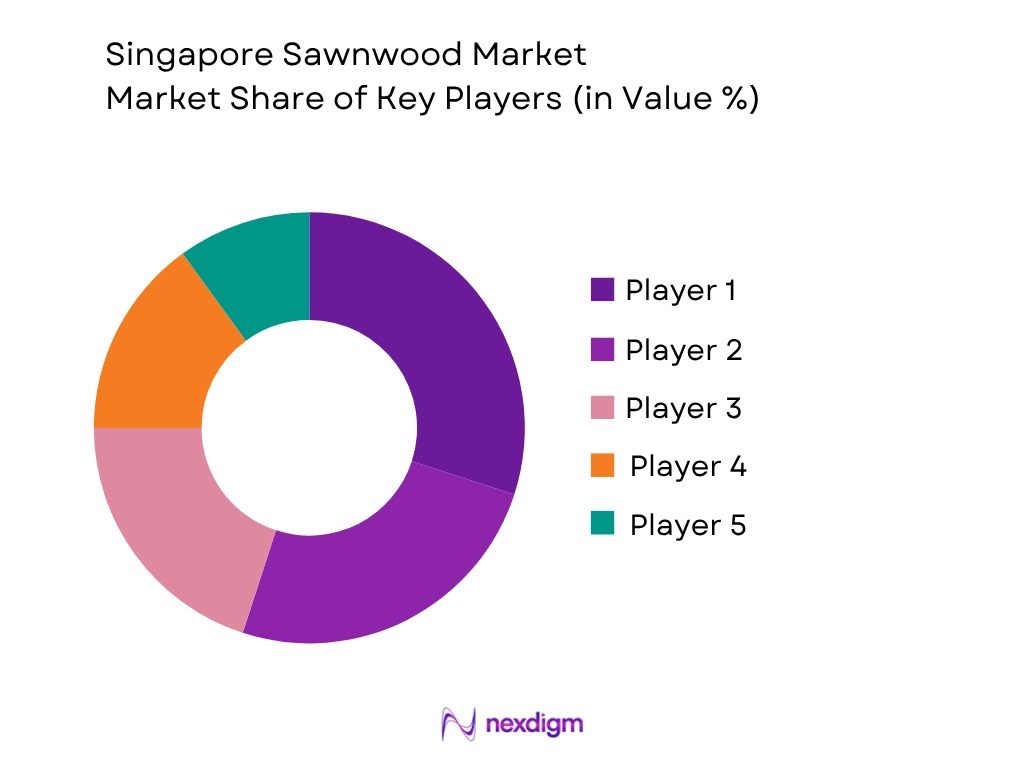
The Singapore Sawnwood Market is characterised by a fully import-dependent, trade-oriented competitive structure concentrated among specialist timber importers, regional hardwood trading companies, building material distributors, and fit-out supply specialists serving a small but highly sophisticated and premium-pricing domestic construction and interior design market. Singapore’s timber trade has historically been dominated by established family-owned trading companies, many originating from the post-war period of rapid construction growth, that have built deep supplier relationships across Malaysia, Indonesia, Papua New Guinea, New Zealand, and Scandinavia and developed extensive domestic distribution networks serving contractors, hardware retailers, and direct industrial customers. The market is notable for its very high regulatory compliance standards relative to most Asian markets, driven by Singapore Customs’ rigorous documentation requirements, BCA Green Mark certification incentives mandating certified timber specification in government-funded and premium private projects, and the corporate ESG procurement standards of major developers, contractors, and hospitality operators active in Singapore. Companies with established FSC chain-of-custody certification, documented CITES compliance procedures, and the ability to supply certified sawnwood with full traceability documentation hold significant competitive advantages in Singapore’s increasingly sustainability-driven procurement environment. Singapore’s role as a regional timber re-export and transit hub amplifies market volumes beyond purely domestic consumption, with established traders supplying ASEAN regional customers through Singapore-based logistics and financing operations at PSA and Jurong Port.
| Company | Establishment Year | Headquarters | Plantation Assets | Sawmill Capacity | FSC/PEFC Certification | Export Presence | Product Portfolio | End-Use Focus |
| Thong Guan Industries Bhd (SG Ops) | 1942 | ~ | ~ | ~ | ~ | ~ | ~ | ~ |
| Sin Heng Chan (Malaya) Pte Ltd. | 1948 | ~ | ~ | ~ | ~ | ~ | ~ | ~ |
| Kee Seng Timber Pte Ltd. | 1960 | ~ | ~ | ~ | ~ | ~ | ~ | ~ |
| Buildmate Group Pte Ltd. | 1980 | ~ | ~ | ~ | ~ | ~ | ~ | ~ |
| Times Timber Pte Ltd. | 1972 | ~ | ~ | ~ | ~ | ~ | ~ | ~ |
Singapore Sawnwood Market Analysis
Growth Drivers
HDB Build-To-Order Programme and Sustained Residential Construction Activity
Singapore’s sawnwood market benefits from one of the most structured and consistently funded public housing construction programmes in the world, with the Housing and Development Board’s Build-To-Order (BTO) scheme maintaining a sustained pipeline of new public housing unit completions that generates predictable and recurring timber demand across structural, formwork, carpentry, and renovation applications. The Singapore government’s commitment to ensuring affordable, high-quality public housing for its resident population has sustained HDB construction activity continuously for more than six decades, creating a stable baseline of sawnwood consumption that underpins market demand regardless of private sector construction cycle fluctuations. HDB’s progressive adoption of Design for Manufacturing and Assembly (DfMA) construction methods, including prefabricated prefinished volumetric construction (PPVC) and prefabricated bathroom units, has increased the specification of precision-dimensioned, kiln-dried, and certified timber components in factory-manufactured building modules, elevating timber quality requirements and supporting premium product positioning within the public housing construction supply chain. Private residential development activity, driven by Singapore’s persistent population of high-net-worth residents and families, its status as a global wealth management centre attracting ultra-high-net-worth domicile decisions, and sustained demand from permanent residents and eligible buyers, generates continuous demand for higher-specification sawnwood in luxury condominium fit-out, landed property renovation, and bespoke residential interior design. The Urban Redevelopment Authority’s (URA) Master Plan land use framework, which consistently allocates substantial residential development land across all five planning regions, ensures a sustained pipeline of new residential project approvals supporting long-term construction sector timber demand through the forecast period.
Green Building Masterplan and Certified Timber Specification Demand
Singapore’s internationally recognised green building policy framework, anchored by the Building and Construction Authority’s Green Mark Certification Scheme and the Singapore Green Building Masterplan, is a structurally distinctive and increasingly powerful driver of certified, sustainably documented sawnwood demand within the city-state’s construction and real estate sector. The BCA Green Mark scheme, revised and enhanced under the Green Mark 2021 framework, awards credits for the use of FSC or PEFC certified timber and wood products across new building and major renovation projects, creating direct procurement incentives for developers, main contractors, and fit-out specialists targeting Green Mark Platinum, Gold Plus, or Gold certification for their buildings. Singapore’s Green Building Masterplan targets having 80% of all buildings in Singapore Green Mark certified by 2030, a highly ambitious objective that is progressively increasing the proportion of construction projects specifying certified timber and sustainable building materials as standard procurement practice rather than an optional premium. The Singapore Green Plan 2030’s City in Nature pillar, which seeks to incorporate biophilic design principles and natural materials into Singapore’s urban environment, is stimulating growing architect and interior designer specification of timber in public realm projects, community facilities, parks infrastructure, and new residential developments seeking to integrate natural materials into the city-state’s dense urban fabric. Singapore’s National Parks Board (NParks) commitment to expanding the city’s tree canopy and green corridor infrastructure also generates demand for certified, sustainably sourced timber in outdoor decking, boardwalk construction, and park furniture applications. These converging green building and biophilic design policy drivers create a durable and expanding market for certified sawnwood across Singapore’s highly regulated construction sector through the forecast period.
Market Challenges
Complete Import Dependency and High Operating Cost Environment
Singapore’s sawnwood market faces the fundamental structural constraint of complete import dependency, compounded by the city-state’s characteristically high operating cost environment, which together create persistent margin management challenges for timber importers, distributors, and downstream processors operating in one of Asia’s most expensive business locations. Singapore possesses no harvestable forest or agricultural land suitable for commercial timber production, making every cubic metre of sawnwood consumed in the domestic market and handled for regional re-export entirely dependent on international supply chains. The city-state’s high land costs, warehouse rental rates, labour costs driven by tight employment market conditions, and mandatory Central Provident Fund employer contributions significantly elevate the operating cost base of timber trading and processing businesses relative to regional competitors in Malaysia, Indonesia, and Vietnam. Port handling fees, import duties on selected timber products, customs clearance costs, and inland logistics expenses in Singapore’s congested road network add further layers of cost to the timber supply chain that must ultimately be absorbed by market participants or passed through to buyers. International freight rate volatility, as demonstrated dramatically during the 2021-2022 container shipping crisis, directly impacts the landed cost of imported sawnwood and creates significant inventory valuation risk for traders carrying substantial stock positions. Singapore’s strategic dependence on the Strait of Malacca as the primary shipping corridor for timber imports from Southeast Asia and Australasia creates concentration risk in the event of maritime security incidents, extreme weather events, or other disruptions to this critical waterway. These structural cost and supply chain characteristics require Singapore timber market participants to maintain strong financial management, diversified supplier relationships, and efficient logistics operations to sustain commercially viable operations.
Stringent Timber Legality Requirements and Certification Compliance Costs
Singapore’s position as a responsible global trading centre and its alignment with international sustainability frameworks impose stringent timber legality and certification compliance requirements on sawnwood importers and traders that represent both a market access prerequisite and a significant ongoing operational cost burden, particularly for smaller trading companies with limited compliance infrastructure. Singapore Customs requires timber importers to comply with documentation and due diligence requirements aligned with the Convention on International Trade in Endangered Species of Wild Fauna and Flora (CITES), which restricts or regulates international trade in a number of commercially significant tropical hardwood species including certain Dalbergia rosewoods, Swietenia mahogany, and other listed species. The BCA Green Mark scheme’s requirements for certified timber in qualifying projects, corporate ESG procurement policies among major Singapore-listed developers and contractors, and growing specification requirements from international hotel brands and commercial tenants demanding certified material documentation collectively create a multi-layered compliance obligation for timber suppliers that requires investment in FSC chain-of-custody certification, supplier audit programmes, and documentation management systems. Obtaining and maintaining FSC chain-of-custody certification involves ongoing audit fees, certification body costs, documentation system investments, and staff training commitments that represent a meaningful fixed cost increment for smaller timber trading businesses. The progressive tightening of EU Deforestation Regulation requirements, UK Timber Regulation compliance, and similar frameworks in key destination markets that Singapore re-exports to further increases the documentation and traceability standards that Singapore-based timber traders must satisfy in their regional supply chain operations. These compliance cost requirements, while manageable for larger established operators, present barriers to entry and ongoing operational pressures for smaller market participants.
Market Opportunities
Singapore Green Plan 2030 and Mass Timber Construction Adoption
Singapore’s ambitious Singapore Green Plan 2030 and the Building and Construction Authority’s progressive regulatory framework for sustainable construction present significant and growing market opportunities for high-specification, certified, and sustainably sourced sawnwood and engineered timber products, particularly as mass timber construction methods gain traction in Singapore’s commercial, institutional, and mixed-use development pipeline. The BCA has been actively promoting Design for Manufacturing and Assembly (DfMA) approaches and the use of mass timber structural systems, including cross-laminated timber (CLT) and glulam structural members, as part of Singapore’s Construction Industry Transformation Map, which targets higher productivity, better buildability, and reduced environmental impact across the construction sector. Singapore’s first CLT building projects, including community facilities and educational institutions, have demonstrated the structural and sustainability credentials of mass timber construction in a tropical climate context and established a growing pipeline of design professionals, engineers, and developers with mass timber project experience. The integration of timber as a structural and aesthetic material in Singapore’s biophilic urban design agenda, supported by URA’s Long-Term Plan Review and NParks’ City in Nature vision, is expected to stimulate growing specification of certified, appearance-grade, and structural sawnwood in public buildings, parks infrastructure, and new mixed-use developments incorporating natural material design philosophies. The adoption of mass timber construction would create substantial new demand for high-quality, certified, kiln-dried lamstock sawnwood from sustainably managed plantation and forest sources, opening a premium and differentiated market segment that complements Singapore’s existing commodity timber consumption base and aligns strongly with the city-state’s internationally recognised sustainability leadership positioning.
ASEAN Regional Re-Export Hub Expansion and Digital Timber Trading
Singapore’s unrivalled position as Southeast Asia’s premier trade, finance, and logistics hub presents a substantial and strategically important opportunity to expand its role as a regional timber re-export, value-added processing, and digital trading platform centre serving the broader ASEAN, South Asian, and Pacific market. The Port of Singapore, consistently ranked among the world’s top two busiest ports by container throughput, provides world-class logistics infrastructure including deep-water berths at PSA’s Pasir Panjang Terminal, extensive bonded warehousing, efficient customs clearance systems, and mature international freight forwarding networks that enable cost-competitive import, processing, and re-export of sawnwood and wood products to regional destinations. ASEAN’s collective construction boom, driven by rapid urbanisation across Indonesia, Vietnam, the Philippines, Thailand, and Myanmar, is generating growing regional timber import demand that Singapore-based traders are well-positioned to serve through consolidation, quality grading, and redistribution operations that leverage Singapore’s superior logistics, financing, and trade documentation capabilities. The development of digital timber trading platforms, leveraging Singapore’s advanced fintech infrastructure, blockchain-based trade finance capabilities, and position as a leading global trade digitalisation centre, represents an emerging opportunity to establish Singapore as the regional hub for verified, certified, and traceable timber procurement across ASEAN supply chains. Singapore’s strong rule of law, transparent business environment, reliable contract enforcement, and well-developed commodity trade finance sector provide structural advantages for establishing timber supply chain platforms that can serve regional buyers demanding documented timber legality and certification compliance. Deepening ASEAN economic integration, the Regional Comprehensive Economic Partnership (RCEP) framework, and Singapore’s extensive bilateral free trade agreement network collectively support the development of Singapore’s timber re-export and regional distribution hub role through the forecast period.
Future Outlook
The Singapore Sawnwood Market is expected to witness steady and quality-driven growth over the forecast period, underpinned by sustained HDB and private residential construction activity, the progressive expansion of Singapore’s Green Building Masterplan driving certified timber specification across the construction sector, and the city-state’s growing adoption of mass timber and biophilic design principles in commercial and institutional architecture. The Singapore Green Plan 2030’s City in Nature vision, BCA Green Mark 2021 certification incentives, and corporate sustainability procurement standards among major Singapore developers and contractors are expected to progressively increase the specification of FSC-certified, sustainably documented, and premium-grade sawnwood and engineered timber products across all construction and interior application categories. Singapore’s role as a regional timber re-export and digital trading hub is expected to grow as ASEAN construction markets expand, certified timber supply chain requirements intensify across regional procurement frameworks, and Singapore’s digital trade infrastructure matures to support blockchain-enabled timber traceability and certification verification. The development of mass timber construction capabilities, supported by BCA’s DfMA promotion and Singapore’s construction industry transformation agenda, is anticipated to create new premium demand segments for certified structural sawnwood and lamstock inputs. Supply chain diversification across Southeast Asian, Australasian, Scandinavian, and North American origins, combined with strengthened FSC certification infrastructure and digital procurement platform investment, will enhance market resilience and competitiveness for Singapore timber industry participants through 2035.
Major Players
- Sin Heng Chan (Malaya) Pte Ltd.
- Kee Seng Timber Pte Ltd.
- Buildmate Group Pte Ltd.
- Times Timber Pte Ltd.
- Thong Guan Industries Bhd (Singapore Operations)
- Ban Lee Huat Timber Pte Ltd.
- Weng Fatt Timber Pte Ltd.
- Sin Soon Huat Timber Pte Ltd.
- Lim Kim Hai Electric Co. (S) Pte Ltd. (Timber Division)
- Pacific Hardwood Pte Ltd.
- Eng Hup Seng Timber Pte Ltd.
- Hwa Hong Corporation Ltd. (Timber Division)
- Nanyang Timber Pte Ltd.
- Eco Forest Pte Ltd.
- Chew’s Agriculture Pte Ltd. (Timber Division)
Key Target Audience
- Timber Importers, Distributors and Regional Re-Export Trading Companies
- Wood Processing and Treatment Enterprises
- Furniture Manufacturing and Interior Design Supply Companies
- Residential, Commercial and Hospitality Construction Companies
- Fit-Out Contractors and Interior Design Firms
- Investments and Venture Capitalist Firms
- Government and Regulatory Bodies (Building and Construction Authority (BCA), Singapore Customs, Urban Redevelopment Authority (URA), Housing and Development Board (HDB), National Parks Board (NParks), National Environment Agency (NEA))
- ASEAN Regional Timber Importers, Traders and International Wood Products Procurement Organisations
Research Methodology
Step 1: Identification of Key Variables
The initial phase involves constructing an ecosystem map covering timber importers, regional hardwood traders, building material distributors, fit-out supply companies, construction contractors, furniture retailers, logistics operators, and re-export trading companies operating within the Singapore Sawnwood Market. Extensive secondary research is conducted using industry associations, trade databases, government publications, and regulatory frameworks including data from Singapore Customs, the Building and Construction Authority (BCA), the Housing and Development Board (HDB), the Urban Redevelopment Authority (URA), Enterprise Singapore, and the Food and Agriculture Organization to identify the variables influencing market demand, import trade flows, green building policy requirements, and regional re-export market dynamics within Singapore’s fully import-dependent and highly regulated timber trading environment.
Step 2: Market Analysis and Construction
This phase focuses on gathering historical information relating to sawnwood import volumes and values by origin country and species, domestic consumption patterns across construction, fit-out, furniture, and logistics end uses, re-export flows to ASEAN and regional markets, pricing trends by species and certification status, and demand projections linked to BTO housing delivery pipelines, URA development approvals, and major commercial project completions. Market revenues are estimated using a combination of Singapore Customs trade data, BCA construction output statistics, average landed prices, distribution margins, and end-use consumption modelling calibrated against building permit approvals, HDB completion schedules, and commercial development pipeline assessments.
Step 3: Hypothesis Validation and Expert Consultation
Market assumptions are validated through structured interviews with timber import traders, building material distributors, fit-out contractors, HDB and private developer procurement teams, interior design firms, logistics operators, and BCA industry association representatives. These consultations provide operational insights regarding import sourcing strategies, certification compliance practices, Green Mark specification requirements, species demand evolution, re-export market dynamics, and the growing adoption of mass timber and engineered wood products in Singapore’s construction sector, ensuring greater accuracy of market estimates within Singapore’s unique and highly sophisticated timber trading and consuming market context.
Step 4: Research Synthesis and Final Output
The final stage integrates findings from primary and secondary research to develop market forecasts, segmentation analysis, competitive benchmarking, and strategic recommendations. Data triangulation techniques are applied across Singapore Customs trade statistics, BCA construction output data, HDB completion records, and primary market intelligence to validate market estimates and generate a comprehensive assessment of the Singapore Sawnwood Market ensuring consistency across all species segments, end-use industries, planning regions, and stakeholder perspectives within this small but strategically influential Southeast Asian timber trading economy.

- Executive Summary
- Research Methodology (Market Definitions and Assumptions, Abbreviations, Market Sizing Approach, Top-Down Analysis, Bottom-Up Analysis, Demand-Side Assessment, Supply-Side Assessment, Primary Industry Interviews, Forestry Sector Validation Framework, Trade Flow Assessment, Data Triangulation, Forecasting Framework, Limitations and Future Conclusions)

- Definition and Scope
- Market Evolution and Industry Genesis
- Timeline of Major Industry Developments
- Timber Trade and Wood Processing Industry Ecosystem
- Sawnwood Value Chain Analysis

- Growth Drivers (Construction Sector Activity and BTO/HDB Programme, High-Specification Commercial and Hospitality Development, Green Building Certification Demand, Regional Re-Export Hub Role, Luxury Interior Design Sector Growth)
- Market Challenges (Complete Import Dependency and Land Scarcity, High Operating Costs and Labour Constraints, Stringent Timber Legality and Sustainability Requirements, Competition from Engineered Wood and Composite Alternatives, Port Congestion and Freight Cost Exposure)
- Market Opportunities (Singapore Green Plan 2030 and Certified Timber Specification, Mass Timber and Cross-Laminated Timber Adoption, Regional ASEAN Re-Export Hub Expansion, Value-Added Processing and Digital Timber Procurement, Luxury Hospitality and Mixed-Use Development Timber Demand)
- Market Trends (FSC-Certified Timber Specification Growth, Engineered Wood and Mass Timber Adoption, Kiln-Dried and Treated Timber Preference, Biophilic Design and Timber in Architecture, Sustainable Construction Material Alignment)
- Government Regulations (Singapore Green Building Masterplan, BCA Green Mark Certification Scheme, Timber Legality Requirements under Singapore Customs, CITES Implementation, Building Control Act and Structural Timber Standards)
- SWOT Analysis
- Porter’s Five Forces Analysis
- PESTLE Analysis
- Stakeholder Ecosystem
- Competition Ecosystem

- By Market Value (2020-2025)
- By Volume (2020-2025)
- By Average Realized Price (2020-2025)

- By Wood Species Type (In Value %)
Meranti and Southeast Asian Hardwood Sawnwood
Teak Sawnwood
Pine Sawnwood
Oak and Temperate Hardwood Sawnwood
Engineered and Composite Timber Products
Other Commercial Wood Species - By Product Form (In Value %)
Rough Sawn Lumber
Planed Sawnwood
Kiln-Dried Sawnwood
Treated Sawnwood
Structural Sawn Timber
Appearance Grade Lumber - By End-Use Industry (In Value %)
Residential Construction and Public Housing (HDB)
Commercial and Mixed-Use Construction
Fit-Out and Interior Design
Furniture Manufacturing and Retail
Landscaping, Outdoor Decking and Marine
Packaging, Pallets and Logistics - By Distribution Channel (In Value %)
Direct Sales to Construction and Fit-Out Contractors
Timber Traders and Importers
Building Material Distributors and Hardware Retailers
Interior Design and Fit-Out Supply Companies
Re-Export and Regional Trading Companies - By Planning Region (In Value %)
Central Region
East Region
North Region
North-East Region
West Region

- Market Share of Major Players (By Value, Import Volume, Distribution Reach, Processing Capability)
- Cross Comparison Parameters (Annual Sawnwood Import Volume, Warehouse and Processing Capacity, Kiln Drying Capability, FSC/PEFC Certified Timber Share, Re-Export Revenue Share, Number of Distribution Facilities, Product Grade Portfolio, ASEAN Regional Network)
- SWOT Analysis of Major Players
- Benchmarking Analysis of Major Players
- Pricing Analysis (By Species, Grade, Moisture Content, Thickness, Import Origin and Re-Export vs Domestic Sales)
- Detailed Profiles of Major Companies
Sin Heng Chan (Malaya) Pte Ltd.
Kee Seng Timber Pte Ltd.
Buildmate Group Pte Ltd.
Times Timber Pte Ltd.
Thong Guan Industries Bhd (Singapore Operations)
Ban Lee Huat Timber Pte Ltd.
Weng Fatt Timber Pte Ltd.
Sin Soon Huat Timber Pte Ltd.
Lim Kim Hai Electric Co. (S) Pte Ltd. (Timber Division)
Chew’s Agriculture Pte Ltd. (Timber Division)
Pacific Hardwood Pte Ltd.
Eng Hup Seng Timber Pte Ltd.
Hwa Hong Corporation Ltd. (Timber Division)
Nanyang Timber Pte Ltd.
Eco Forest Pte Ltd.

- Consumption Pattern Assessment (Consumption Frequency, Product Mix, Industry Demand Share, Volume Utilisation, Seasonal Demand)
- Sawnwood Utilisation by Industry (Construction Sector Usage, Fit-Out and Interior Design Share, Furniture Consumption, Landscaping and Marine Applications, Packaging and Logistics Demand)
- Procurement and Sourcing Analysis (Contract Duration, Supplier Preference, Import Sourcing Origins, Procurement Volume, Lead Time Requirements)
- Buyer Preference Analysis (Species Preference, Grade Preference, Moisture Requirements, Certification Requirements, Delivery Expectations)
- Price Sensitivity Analysis (Price Elasticity, Grade-Based Pricing, Specification-Driven Premium Pricing, Volume Discounts, Contract Pricing Trends)

- By Market Value (2026-2035)
- By Volume (2026-2035)
- By Average Realized Price (2026-2035)


 Request a Sample
 Ask for Customization
 Get a Quote
 Enquire Now