
 Download PDF
Market Overview
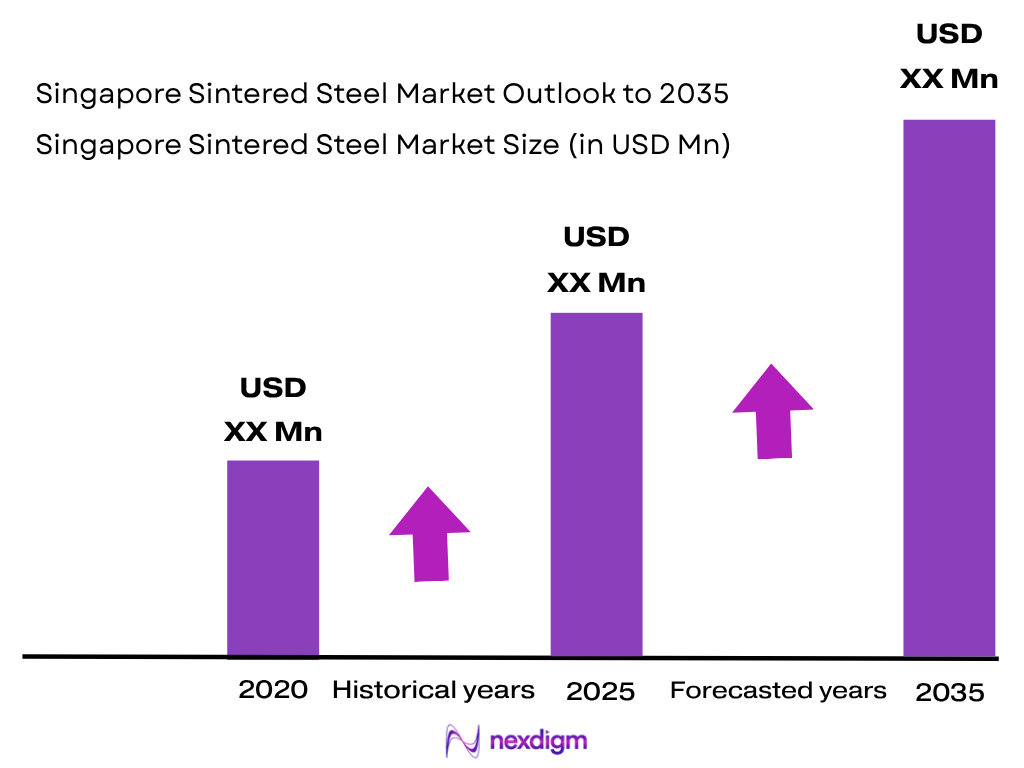
The Singapore Sintered Steel Market is supported by a substantial precision-manufacturing ecosystem. Singapore recorded S$429.584 billion in manufacturing output and S$116.595 billion in manufacturing value added, with 9,858 manufacturing establishments. Precision engineering generated S$51.983 billion in output and S$17.750 billion in value added, providing an important downstream base for powder-metal gears, bearings, structural parts and precision components. Electronics output reached S$181.166 billion, strengthening demand for miniature, repeatable and high-precision metal components used in advanced equipment and manufacturing systems.
Singapore’s demand is concentrated around its principal manufacturing and engineering clusters rather than multiple geographic cities. The country’s electronics, precision engineering, transport engineering and biomedical ecosystems create recurring requirements for specialized metal components. Singapore’s manufacturing sector recorded 4.3% annual growth, while precision engineering output increased 2.3% and transport engineering increased 9.4%. EDB also reported more than 2,700 precision-engineering and electronics manufacturing service providers, supporting a dense supplier environment for precision components, semiconductor equipment and industrial systems.
Market Segmentation
By Product Type
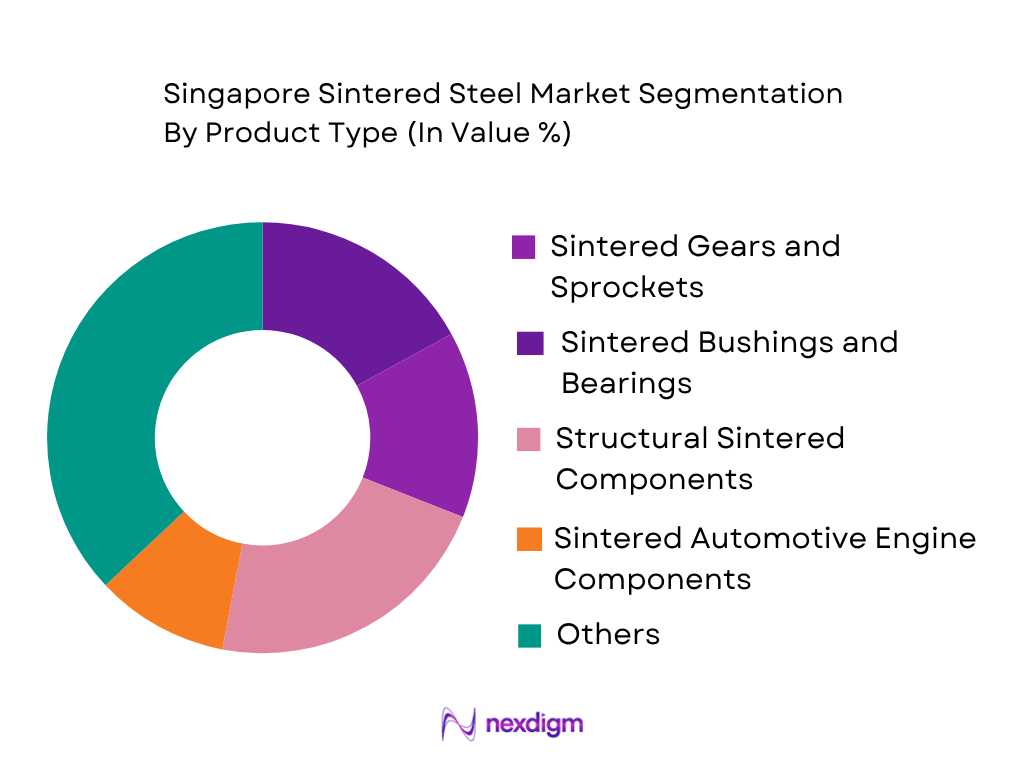
The Singapore Sintered Steel Market is segmented by product type into structural sintered steel components, sintered gears and sprockets, sintered bushings and bearings, sintered automotive components, transmission components, electrical and magnetic components, compressor components, pump components, power-tool components and other precision sintered components. Structural sintered steel components are expected to represent the leading category because Singapore’s precision-engineering and semiconductor-equipment industries require repeatable components capable of meeting tight dimensional and mechanical specifications. The country recorded S$51.983 billion in precision-engineering output, while its electronics cluster generated S$181.166 billion, creating a large downstream ecosystem for precision metal components. Sintered structural parts can reduce machining requirements while supporting complex geometries and high-volume repeatability. Bearings, gears and magnetic components remain important because automation equipment, motion-control systems and industrial machinery require compact mechanical assemblies. The presence of more than 2,700 precision engineering and EMS providers also creates a broad customer base for customized components and contract manufacturing.
By End-Use Industry
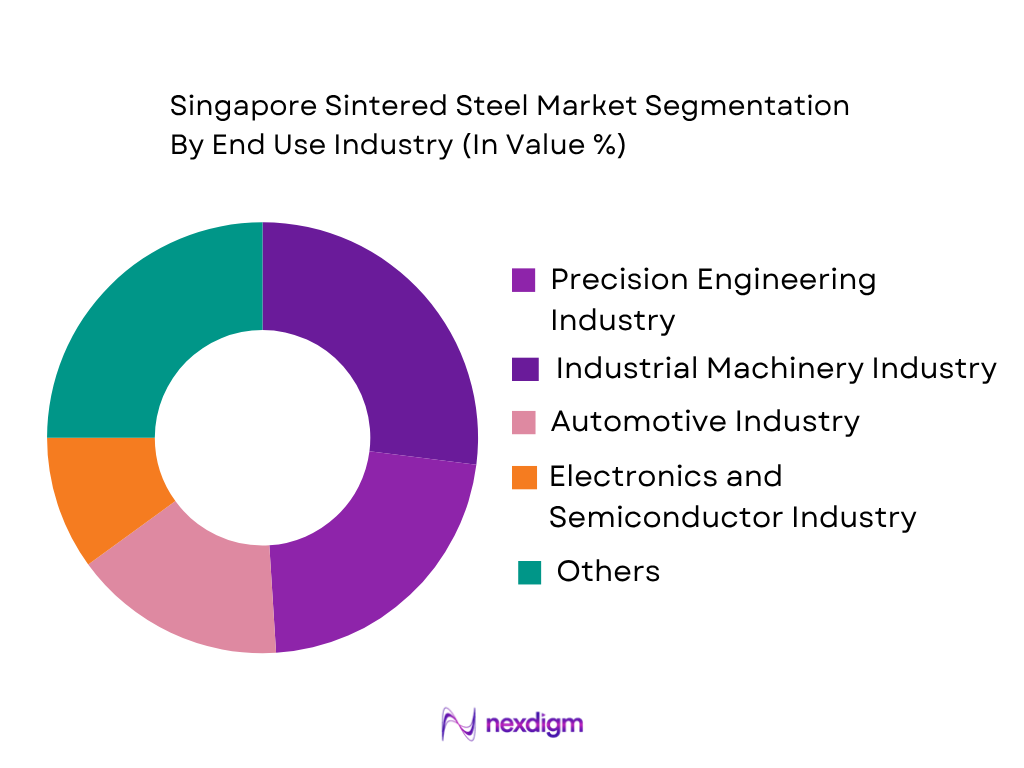
The Singapore Sintered Steel Market is segmented by end-use industry into electronics and semiconductor manufacturing, industrial machinery, automotive and mobility, aerospace, biomedical and medical technology, robotics and automation, home appliances, HVAC and refrigeration, precision engineering and other manufacturing applications. Electronics and semiconductor manufacturing represents a major demand category because Singapore has an extensive semiconductor ecosystem requiring precision equipment, mechanical assemblies and miniature metal components. Electronics manufacturing generated S$181.166 billion of output, while precision engineering generated S$51.983 billion. EDB also recorded S$7.665 billion of electronics fixed-asset investment commitments and S$555 million in precision-engineering commitments. These investments support demand for high-precision machinery, semiconductor production equipment, connectors, actuators, gears and other components that can incorporate powder-metallurgy manufacturing. Aerospace and biomedical manufacturing provide additional high-value applications where dimensional consistency, material performance and complex geometries are important procurement criteria.
Competitive Landscape
The Singapore Sintered Steel Market operates within a broader precision-engineering and advanced-manufacturing ecosystem comprising international powder-metallurgy manufacturers, regional component suppliers, metal-injection-molding specialists and precision-engineering companies. Competition is shaped by material expertise, component-design capability, manufacturing precision, quality certification and the ability to support customers from prototyping through volume production. Singapore’s advanced manufacturing environment is particularly relevant because EDB identifies more than 2,700 precision engineering and electronics manufacturing service providers, while 2024 manufacturing investment commitments included S$555 million for precision engineering.
| Company | Establishment Year | Headquarters | Product Portfolio | Powder Metallurgy Capability | Key Applications | Manufacturing Capability | Singapore/Regional Presence | Technology Focus |
| GKN Powder Metallurgy | 1930 | Germany | ~ | ~ | ~ | ~ | ~ | ~ |
| Höganäs AB | 1797 | Sweden | ~ | ~ | ~ | ~ | ~ | ~ |
| Sumitomo Electric Industries | 1897 | Japan | ~ | ~ | ~ | ~ | ~ | ~ |
| Miba AG | 1927 | Austria | ~ | ~ | ~ | ~ | ~ | ~ |
| AMES Group | 1951 | Spain | ~ | ~ | ~ | ~ | ~ | ~ |
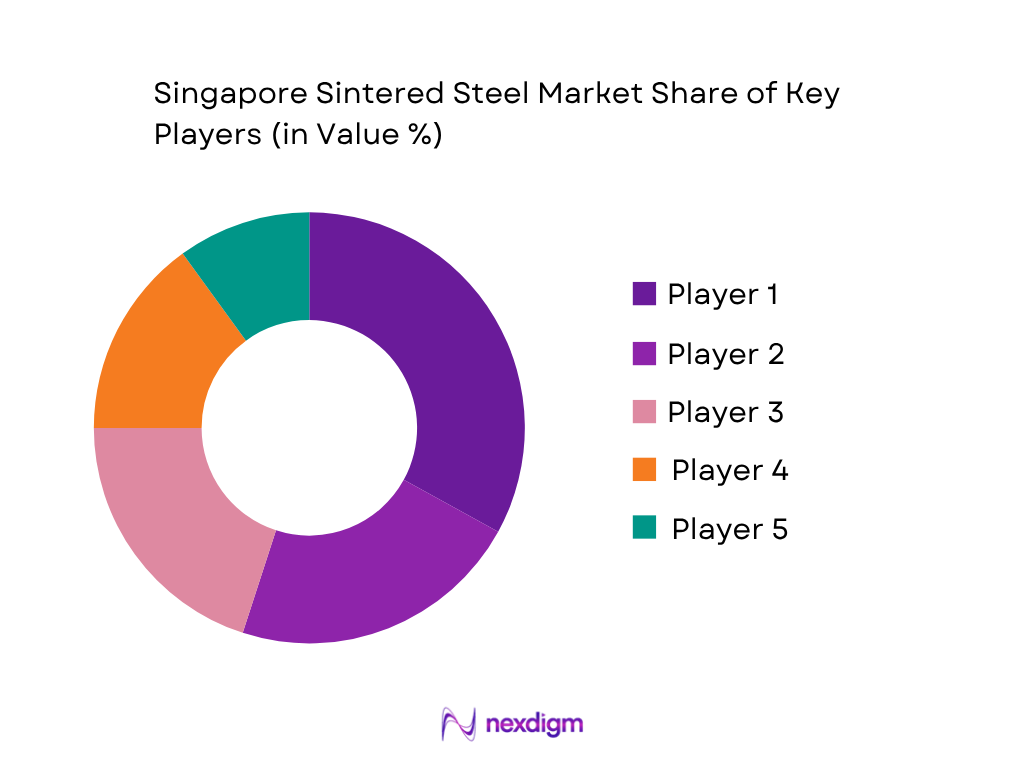
Singapore Sintered Steel Market Analysis
Growth Drivers
Expansion of Precision Engineering and Advanced Manufacturing
Expansion of Singapore’s precision-engineering and advanced-manufacturing base is a direct demand driver for sintered steel components because these industries require repeatable, dimensionally controlled and material-efficient metal parts for machinery, actuators, gears, bearings, tooling systems and semiconductor equipment. Singapore recorded S$429.584 billion in manufacturing output and S$116.595 billion in manufacturing value added, demonstrating the scale of the industrial base supporting downstream component demand. Within this ecosystem, precision engineering generated S$51.983 billion of output and S$17.750 billion of value added, while the sector recorded S$49.005 billion in business costs. The country also had 9,858 manufacturing establishments, creating a broad customer and supplier ecosystem for engineered metal components. Advanced manufacturing is particularly relevant because Singapore had 730 robots per 10,000 workers, indicating substantial automation intensity and demand for precision mechanical systems. Sintered steel technologies can support this environment through near-net-shape manufacturing, repeatability and reduced material wastage. Continued investment in semiconductor, machinery, aerospace and precision manufacturing therefore creates opportunities for gears, bushings, structural components, magnetic parts and other powder-metal products. Source: Singapore Economic Development Board (EDB), Singapore’s Manufacturing Performance 2024 and Advanced Manufacturing Industry data.
Electronics and Semiconductor Manufacturing Expansion
Singapore’s electronics and semiconductor manufacturing ecosystem provides a substantial downstream demand base for precision sintered components used in semiconductor production equipment, motion-control systems, actuators, miniature mechanisms, magnetic assemblies and specialized industrial machinery. Electronics manufacturing generated S$181.166 billion in output and S$46.813 billion in value added, making it the largest manufacturing cluster by output. Electronics business costs reached S$156.474 billion, including substantial expenditure on materials and subcontracting activities that support complex manufacturing supply chains. Singapore also attracted S$13.5 billion in fixed-asset investment commitments, with S$11.1 billion directed toward manufacturing; major commitments included semiconductor and biomedical projects. The semiconductor ecosystem is further reinforced by new fabrication investments, including the VisionPower Semiconductor Manufacturing facility, whose planned production capacity is 55,000 300mm wafers per month when fully operational. Applied Materials also announced plans to double its Singapore manufacturing capacity, headcount and research activities, strengthening the local semiconductor-equipment ecosystem. Such expansion increases requirements for highly precise mechanical components capable of operating within demanding production environments. Sintered steel can address applications where dimensional consistency, complex geometry, wear resistance and repeatable mass production are required. Source: Singapore Economic Development Board (EDB), Manufacturing Performance 2024, Year in Review and semiconductor investment announcements.
Market Challenges
Dependence on Imported Metal Powders and Specialized Inputs
Dependence on internationally sourced metal powders and specialized powder-metallurgy inputs remains a structural challenge for Singapore’s sintered steel industry because the country has a highly developed manufacturing ecosystem but limited upstream production of iron, alloy and specialized metal powders. Manufacturing businesses reported S$380.759 billion in total business costs, with materials consumed accounting for S$215.5 billion, demonstrating the importance of material availability within Singapore’s industrial cost structure. Precision engineering alone recorded S$49.005 billion in business costs, with materials consumed accounting for approximately S$24.9 billion. This exposure becomes particularly important for sintered-steel manufacturers requiring tightly controlled powder chemistry, particle-size distribution, apparent density and compressibility. Specialized applications can additionally require stainless-steel, nickel-alloy, copper-alloy or soft-magnetic powders, which may need qualification before being incorporated into safety-critical or high-precision components. Singapore’s reliance on international supply networks also means that shipping disruptions, export restrictions, geopolitical developments or supplier qualification changes can affect material availability and production planning. For small-volume specialized components, maintaining multiple qualified powder suppliers can be difficult because changing material sources may require renewed testing and customer approval. Source: Singapore Economic Development Board (EDB), Singapore’s Manufacturing Performance 2024.
High Tooling, Equipment and Technical Qualification Requirements
High tooling requirements, specialized sintering equipment and stringent component qualification procedures can constrain the adoption of sintered steel manufacturing, particularly for applications requiring complex geometries, tight tolerances or specialized material properties. Singapore’s manufacturing environment is highly capital- and technology-intensive, with S$116.595 billion in manufacturing value added and S$380.759 billion in business costs. Precision engineering recorded S$51.983 billion in output and S$49.005 billion in business costs, reflecting the scale of resources required to operate sophisticated manufacturing systems. Sintered steel production can require dedicated compaction presses, precision dies, controlled-atmosphere furnaces, sizing equipment, heat-treatment systems and automated inspection technologies. Tooling becomes especially challenging when component volumes are limited or designs change frequently because dedicated dies must be developed and qualified before production. Singapore’s manufacturing workforce also operates in a highly automated environment, with 730 robots per 10,000 workers, increasing the requirement for engineers capable of integrating powder-metallurgy equipment with automated production and inspection systems. Qualification requirements can further lengthen development cycles for aerospace, medical, semiconductor and other precision applications. Source: Singapore Economic Development Board (EDB), Manufacturing Performance 2024 and Advanced Manufacturing Industry data.
Market Opportunities
Semiconductor Equipment Components and Precision Mechanical Parts
The expansion of semiconductor manufacturing and semiconductor-equipment production creates a pathway for Singapore’s sintered steel industry to move toward higher-value precision components. Singapore’s electronics manufacturing output reached S$181.166 billion, while electronics value added reached S$46.813 billion, providing a substantial industrial base for suppliers of precision mechanical systems. The country also attracted S$11.1 billion of manufacturing fixed-asset investment commitments, with semiconductor projects representing a major component of investment activity. VisionPower Semiconductor Manufacturing began construction of a 300mm wafer facility with planned initial production in 2027 and expected output of 55,000 wafers per month in 2029. Applied Materials separately announced plans to double its Singapore manufacturing capacity, headcount and research activities, including work associated with advanced semiconductor packaging. These developments create potential applications for sintered gears, bushings, magnetic components, actuator parts, structural mechanisms and other precision components used in semiconductor equipment. The opportunity is particularly relevant where manufacturers require stable dimensions, high repeatability and complex geometries while minimizing material waste. Singapore’s existing ecosystem of 9,858 manufacturing establishments can also facilitate collaboration among component manufacturers, equipment producers and specialized engineering suppliers. Source: Singapore Economic Development Board (EDB), Manufacturing Performance 2024 and semiconductor investment announcements.
Aerospace, Biomedical and Robotics Component Applications
Expansion across aerospace, biomedical manufacturing and robotics creates opportunities for specialized sintered steel components where precision, repeatability, material efficiency and complex geometries are important. Singapore’s transport-engineering cluster generated S$37.849 billion in manufacturing output, while biomedical manufacturing generated S$32.457 billion. The country also has more than 400 global and regional MedTech companies and around 16,000 MedTech workers, supporting a substantial ecosystem for precision medical-device manufacturing. Singapore’s aerospace ecosystem is similarly supported by manufacturing and maintenance, repair and overhaul activities, while the country’s advanced manufacturing environment recorded 730 robots per 10,000 workers. These conditions create potential applications for compact gears, actuation mechanisms, structural components, magnetic parts, pump components and other precision metal parts. Biomedical applications can require miniature and highly controlled components, while aerospace and robotics applications can place greater emphasis on mechanical reliability, dimensional consistency and weight optimization. Powder metallurgy can address these requirements through near-net-shape production and controlled material properties. Further opportunities can emerge through metal injection molding, high-density compaction, soft-magnetic materials and hybrid powder-based manufacturing, particularly as Singapore continues attracting investments in advanced manufacturing, semiconductors, aerospace and biomedical activities. Source: Singapore Economic Development Board (EDB), Manufacturing Performance 2024, Year in Review and MedTech ecosystem data.
Future Outlook
The Singapore Sintered Steel Market is expected to develop alongside the country’s continued transition toward high-value and advanced manufacturing. Semiconductor equipment, precision engineering, aerospace, biomedical manufacturing, robotics and industrial automation are likely to remain important demand channels. Singapore attracted S$13.451 billion of fixed-asset investment commitments, including S$11.1 billion from manufacturing, while the commitments are expected to generate 18,737 jobs and S$23.523 billion in annual value added once realized. The technology direction is likely to emphasize tighter tolerances, high-density components, soft magnetic materials, automated inspection, digital manufacturing and hybrid production. Singapore’s advanced-manufacturing ecosystem already has 730 robots per 10,000 workers, demonstrating the relevance of automation-intensive production environments.
Major Players
- GKN Powder Metallurgy
- Höganäs AB
- Sumitomo Electric Industries Ltd.
- Miba AG
- AMES Group
- Hitachi Powdered Metals
- Fine Sinter Co., Ltd.
- Porite Corporation
- TPR Europe
- Keystone Powdered Metal Company
- SSI Sintered Specialties
- Advanced Materials Technologies Pte. Ltd.
- Resonac Powdered Metals
- Mitsubishi Materials Corporation
- Sandvik Powder Solutions
Key Target Audience
- Automotive and mobility component manufacturers
- Semiconductor equipment and electronics manufacturers
- Precision engineering and industrial machinery manufacturers
- Aerospace component manufacturers and MRO providers
- Biomedical and medical-device manufacturers
- Investments and venture capitalist firms
- Government and regulatory bodies (Singapore Economic Development Board, Enterprise Singapore, Ministry of Trade and Industry)
- Metal powder, tooling and powder-metallurgy equipment suppliers
Research Methodology
Step 1: Identification of Key Variables
The initial phase involves constructing a Singapore Sintered Steel Market ecosystem covering powder suppliers, tooling providers, component manufacturers, OEMs and end-use industries. Key variables include powder consumption, component production, manufacturing processes, application demand, import dependence, production capacity and qualification requirements.
Step 2: Market Analysis and Construction
Historical market information is compiled through bottom-up assessment of component applications and top-down analysis of Singapore’s manufacturing ecosystem. Manufacturing output, precision-engineering activity, electronics production, industrial investment and relevant trade flows are evaluated to establish demand relationships and market boundaries.
Step 3: Hypothesis Validation and Expert Consultation
Market hypotheses are validated through discussions with powder-metallurgy manufacturers, precision-engineering companies, equipment suppliers, component purchasers and end-use manufacturers. Technical discussions focus on material grades, component specifications, manufacturing processes, qualification requirements and application-specific procurement practices.
Step 4: Research Synthesis and Final Output
The final stage triangulates industry data, company information, government statistics and demand-side indicators. Component-level findings are reconciled with manufacturing activity and end-use requirements to develop the market structure, competitive assessment, segmentation framework and long-term outlook for the Singapore Sintered Steel Market.

- Executive Summary
- Research Methodology (Market Definitions and Assumptions, Sintered Steel Classification, Powder Metallurgy Process Mapping, Market Sizing Framework, Top-Down Market Reconstruction, Bottom-Up Component Demand Analysis, Production-Capacity Assessment, End-Use Demand Mapping, Import-Export Assessment, Primary Industry Interviews, Manufacturer Validation, Data Triangulation, Forecasting Framework, Sensitivity Analysis, Research Limitations)

- Definition and Scope
- Sintered Steel Manufacturing Ecosystem
- Singapore Sintered Steel Industry Evolution
- Sintered Steel Value Chain Analysis
- Sintered Steel Supply Chain Analysis
- Key Manufacturing Clusters Relevant to Sintered Steel

- Growth Drivers (Expansion of Precision Engineering, Electronics and Semiconductor Manufacturing, Advanced Manufacturing Investment, Aerospace Component Production, Industrial Automation, Machinery and Systems Manufacturing, Biomedical Manufacturing, High-Precision Component Demand)
- Market Challenges (Dependence on Imported Metal Powders, Limited Domestic Powder Production, High Tooling Requirements, Specialized Sintering Equipment, Material Qualification, Skilled Engineering Requirements, Production Yield Management, Competition from Machining and Forging)
- Market Opportunities (Semiconductor Equipment Components, Automotive and Mobility Components, Aerospace Powder-Metal Components, Biomedical Components, Robotics Components, Soft Magnetic Components, High-Density Sintered Parts, Advanced Sintering, Metal Injection Molding, Powder-Based Additive Manufacturing)
- Market Trends (Miniaturization, Near-Net-Shape Manufacturing, Lightweight Components, Soft Magnetic Materials, Electrification, Industry 4.0 Manufacturing, Automated Quality Inspection, Digital Process Monitoring, Material Efficiency, High-Density Powder Metallurgy)
- Regulatory and Standards Environment (Singapore Standards, Workplace Safety Requirements, Environmental Regulations, Chemical Handling, Imported Material Requirements, Product Quality Standards, Aerospace Qualification, Automotive Quality Requirements)
- SWOT Analysis
- Porter’s Five Forces Analysis
- PESTLE Analysis
- Stakeholder Ecosystem

- By Market Value (2020-2025)
- By Production Volume (2020-2025)
- By Component Volume (2020-2025)
- By Average Component Weight (2020-2025)
- By Manufacturing Output (2020-2025)
- By Domestic Production and Imported Components (2020-2025)

- By Product Type (in value %)
Structural Sintered Steel Components
Sintered Gears and Sprockets
Sintered Bushings and Bearings
Sintered Automotive Components
Sintered Transmission Components
Sintered Electrical and Magnetic Components
Sintered Compressor Components
Sintered Pump Components
Sintered Power-Tool Components
Other Precision Sintered Components - By Material Grade (in value %)
Iron-Based Powders
Iron-Carbon Alloys
Iron-Copper-Carbon Alloys
Nickel-Alloyed Steels
Stainless Steel Powders
High-Strength Low-Alloy Materials
Soft Magnetic Materials - By Manufacturing Process
Conventional Press-and-Sinter
High-Density Compaction
Sinter Hardening
Warm Compaction
Metal Injection Molding
Powder Forging
Binder Jetting
Secondary Machining and Finishing - By End-Use Industry
Automotive and Mobility
Electronics and Semiconductors
Industrial Machinery
Aerospace
Biomedical and Medical Technology
Home Appliances
HVAC and Refrigeration
Power Tools
Robotics and Automation
Precision Engineering - By Application
Gears
Bearings and Bushings
Rotors
Cams
Pulleys
Structural Components
Magnetic Cores
Pump Components
Compressor Components
Actuation Components
Precision Mechanical Components - By Customer Type
OEMs
Tier-1 Component Suppliers
Tier-2 Manufacturers
Contract Manufacturers
Precision Engineering Companies
Semiconductor Equipment Manufacturers
Industrial Equipment Producers

- Market Positioning of Major Players (Product Breadth, Application Coverage, Manufacturing Capabilities, Technology Portfolio, Customer Industries)
- Cross Comparison Parameters (Sintered Component Portfolio, Powder Metallurgy Process Range, Production Capacity, Tooling and Die Capability, Material Grade Breadth, Precision Tolerance Capability, End-Use Industry Coverage, Secondary Processing Capability)
- SWOT Analysis of Major Players
- Detailed Profiles of Major Companies
Resonac Powdered Metals Singapore Pte. Ltd.
Wisma Technology Pte Ltd
Sumitomo Electric Industries / Sumitomo Electric Sintered Components
GKN Sinter Metals
Höganäs AB
Miba AG
AMES Group
Hitachi Powdered Metals
Advanced Materials Technologies Pte Ltd
Sumitomo Electric Sintered Components (M)
Keystone Powdered Metal Company
Porite Corporation
SSI Sintered Specialties
Fine Sinter Co., Ltd.
TPR Sintered Technologies

- Automotive and Mobility Industry
- Electronics and Semiconductor Industry
- Industrial Machinery Industry
- Aerospace Industry
- Biomedical Manufacturing Industry
- Robotics and Automation Industry
- Singapore Sintered Steel Demand Analysis
- Component Demand Assessment
- OEM Procurement Analysis

- By Market Value (2026-2035)
- By Production Volume (2026-2035)
- By Component Volume (2026-2035)
- By Average Component Weight (2026-2035)
- By Manufacturing Output (2026-2035)
- By Domestic Production and Imported Components (2026-2035)


 Request a Sample
 Ask for Customization
 Get a Quote
 Enquire Now