

 Download PDF
Market Overview
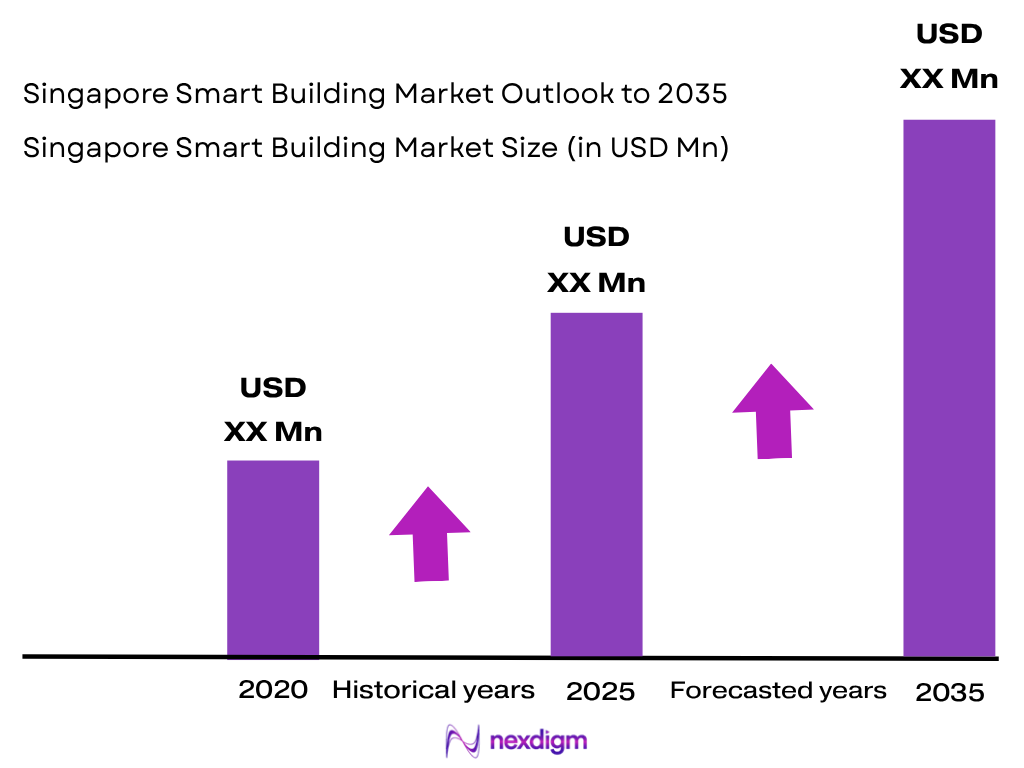
The Singapore Smart Building Market is valued at approximately USD ~XX billion in 2024, compared with USD ~XX billion in 2023, supported by Singapore’s high level of digital infrastructure, concentrated urban development, and strong emphasis on energy-efficient buildings. The market is driven by adoption of building management systems, smart HVAC controls, connected lighting, IoT sensors, energy-management platforms, access-control systems, and intelligent facility-management solutions. Singapore’s dense commercial building environment and ongoing building modernization create recurring demand for technologies that improve energy performance, operational visibility, occupant comfort, and asset management. Government-led green-building initiatives and digitalization programs further encourage building owners to integrate connected technologies into new developments and retrofit projects. The development of data centres, commercial offices, hotels, healthcare facilities, and mixed-use properties is also expanding the addressable base for smart-building technologies. Increasing integration of cloud platforms, AI analytics, digital twins, and predictive maintenance is shifting smart buildings from isolated automation systems toward connected building ecosystems. These factors collectively support continued investment in intelligent building infrastructure and create opportunities for technology vendors, system integrators, facility-management providers, and building owners.
Singapore is a city-state, so market concentration is closely associated with major commercial, financial, residential, industrial, and institutional districts rather than separate cities. The Central Region, particularly the Central Business District, Marina Bay, Orchard, and Downtown Core, represents an important concentration of smart-building demand because of its extensive portfolio of Grade-A offices, hotels, retail properties, financial institutions, and mixed-use developments. Areas such as Jurong East, one-north, Punggol, Changi, and the Jurong Innovation District also contribute to demand through business parks, technology facilities, industrial developments, research infrastructure, and data-centre-related activity. Singapore’s compact geography allows building-technology suppliers and system integrators to serve multiple high-density developments through established technical and maintenance networks. Smart-building adoption is supported by requirements for efficient cooling, centralized facility management, occupancy monitoring, security, energy optimization, and environmental performance. The concentration of technologically advanced commercial assets makes Singapore particularly suitable for integrated BMS, IoT, AI-based analytics, digital twins, smart lighting, HVAC optimization, and predictive-maintenance deployments.
Market Segmentation
By Component
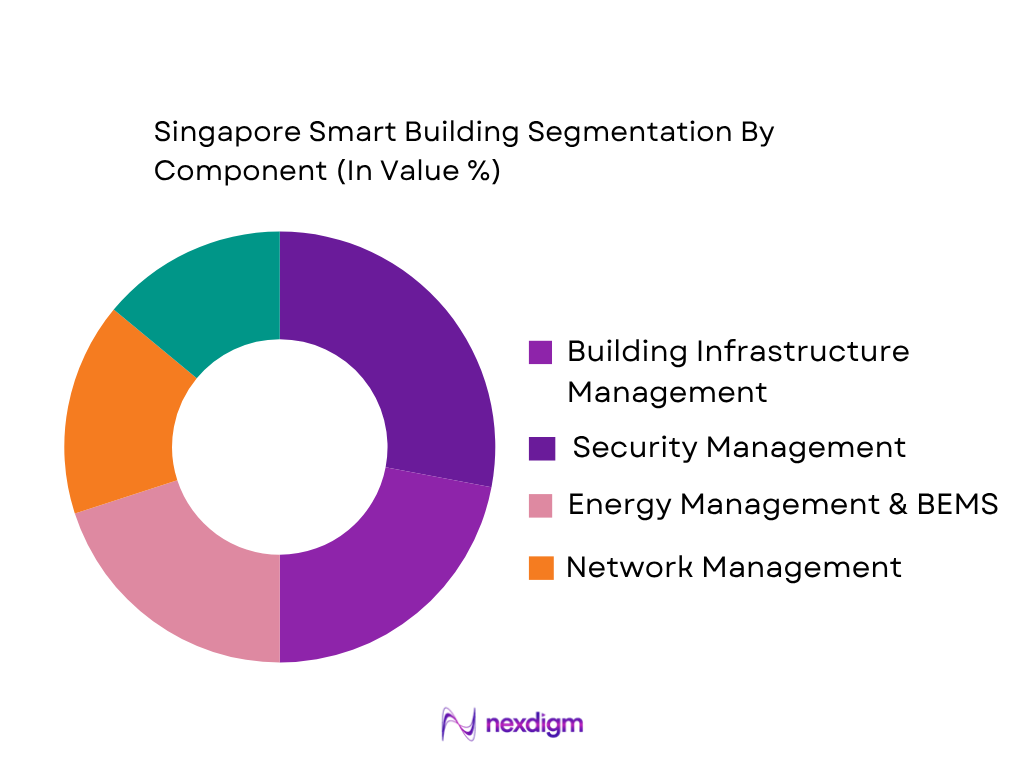
The Singapore Smart Building Market is segmented by component into hardware, software, and services. Hardware includes smart sensors, controllers, IoT gateways, HVAC control devices, smart meters, lighting controllers, security devices, and building automation equipment. Software includes building-management platforms, energy-management software, facility-management platforms, IoT platforms, digital-twin solutions, and AI-based analytics. Services include system integration, installation and commissioning, managed building services, energy optimization, maintenance, and technical support. Hardware is expected to represent the dominant component segment, with a market share of ~XX% in 2024, supported by the continued installation of sensors, controllers, meters, gateways, security equipment, HVAC controls, and connected lighting devices across new and existing buildings. Hardware forms the physical foundation for smart-building connectivity and provides the data required by software platforms and analytics applications. Singapore’s dense building environment and continuing modernization of commercial, hospitality, healthcare, industrial, and institutional properties support recurring demand for connected equipment. Retrofit projects also require additional sensors, controllers, communication gateways, and meters to connect previously isolated building systems. At the same time, software and services are gaining importance as building owners seek integrated analytics, automation, predictive maintenance, and energy optimization rather than standalone equipment.
By Building Technology
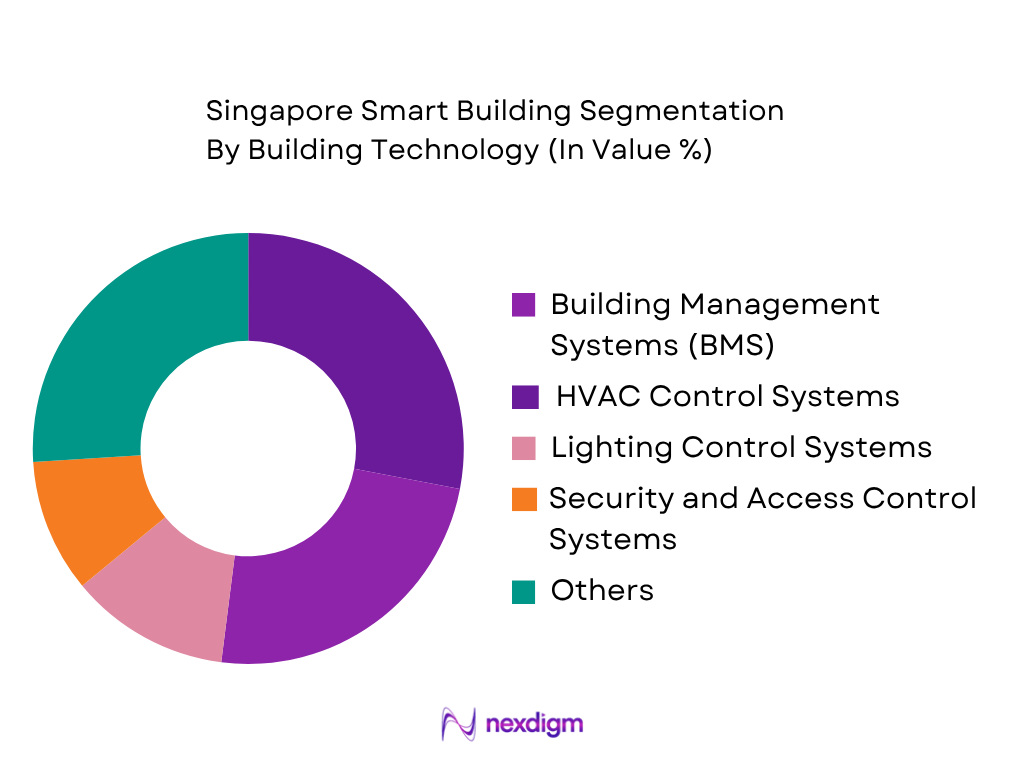
The Singapore Smart Building Market is segmented by building technology into Building Management Systems, HVAC Control Systems, Lighting Control Systems, Security and Access Control Systems, Energy Management Systems, Fire and Life Safety Systems, Indoor Air Quality Monitoring Systems, Smart Water Management Systems, Occupancy and Space Management Systems, and Integrated Facility Management Systems. Building Management Systems are expected to hold the dominant market share of ~XX% in 2024, reflecting their central role in connecting and controlling multiple building systems through a unified operational platform. BMS solutions can integrate HVAC, lighting, energy monitoring, alarms, equipment status, and other building functions, allowing facility teams to monitor performance from centralized interfaces. Singapore’s dense commercial and institutional building stock creates strong requirements for centralized operational visibility and automated control. HVAC integration is particularly important because cooling systems are critical to indoor comfort and building operations in Singapore’s tropical climate. The expansion of IoT connectivity is also enabling BMS platforms to incorporate data from smart sensors, meters, occupancy systems, and connected equipment. Software-based analytics can further support fault detection, energy optimization, predictive maintenance, and performance monitoring. The increasing shift toward integrated rather than isolated building systems therefore supports BMS adoption across new developments and modernization projects.
Competitive Landscape
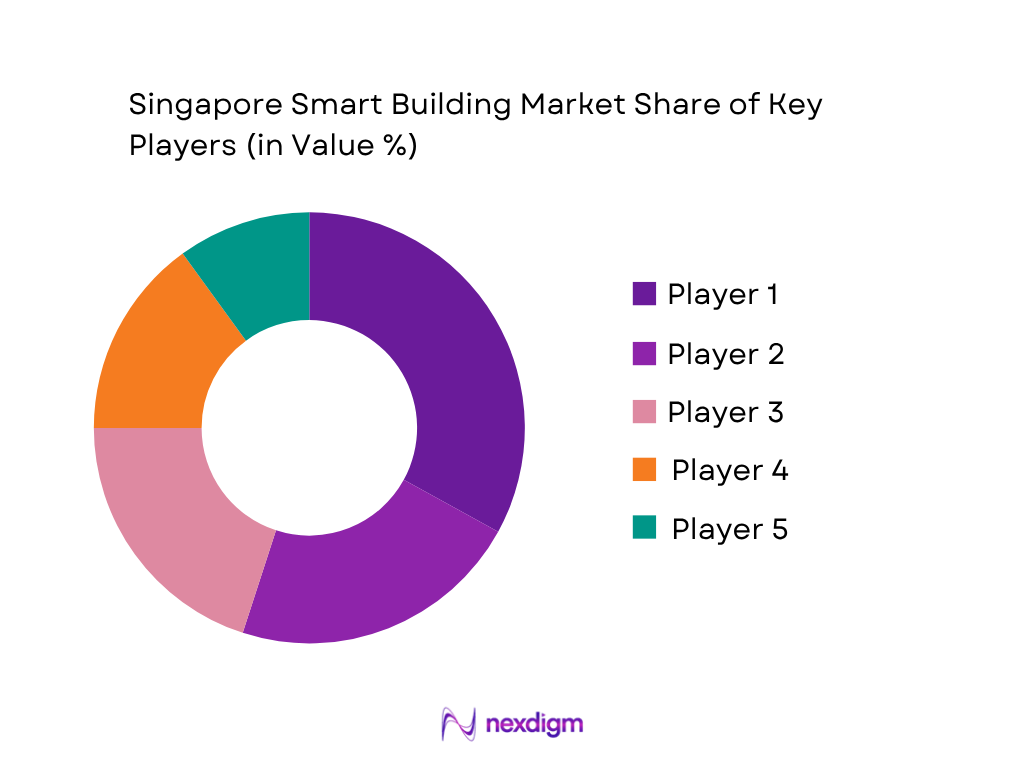
The Singapore Smart Building Market comprises global building-technology manufacturers, automation specialists, HVAC companies, security-system providers, energy-management companies, and local system integrators. Major participants compete through breadth of automation portfolios, BMS capabilities, HVAC optimization, IoT connectivity, energy-management solutions, software analytics, cybersecurity, integration expertise, and local technical-support networks. The competitive environment is shaped by demand for integrated solutions capable of connecting multiple building systems rather than isolated automation products.
| Company | Establishment Year | Headquarters | BMS Capability | HVAC Automation | Energy Management | IoT Integration | Security & Access Control | System Integration |
| Johnson Controls | 1885 | Cork, Ireland | ||||||
| Schneider Electric | 1836 | Rueil-Malmaison, France | ||||||
| Siemens | 1847 | Munich, Germany | ||||||
| Honeywell | 1906 | Charlotte, USA | ||||||
| ABB | 1988 | Zurich, Switzerland |
Singapore Smart Building Market Analysis
Growth Drivers
Singapore Green Building Masterplan and Mandatory Green Building Standards
Singapore’s building-efficiency policy framework is directly supporting demand for smart building technologies, particularly building management systems, energy monitoring, automated HVAC controls, smart lighting and connected building analytics. The Building and Construction Authority (BCA) reported that more than 500 buildings met environmental criteria in 2024, while more than 150 buildings had received Super Low Energy certification. BCA also reported a 72-unit improvement index relative to the 2005 energy-efficiency baseline for best-in-class buildings. The Singapore Green Building Masterplan targets 80% of buildings by gross floor area to be green by 2030, 80% of new developments to achieve Super Low Energy standards from 2030, and an 80-unit improvement in energy efficiency compared with 2005 levels for best-in-class buildings. These requirements create a continuing need for automated energy management, smart HVAC optimization, building analytics, occupancy controls and real-time performance monitoring. The BCA’s Green Buildings Innovation Cluster 2.0 also has S$45 million in enhanced funding for energy-efficient technologies, including data-driven smart-building solutions and next-generation ventilation. The source for these figures is the Building and Construction Authority (BCA), Singapore Annual Report and Green Building Masterplan.
High Construction Activity, Digital Transformation and Connected Building Infrastructure
Singapore’s construction pipeline is creating a substantial addressable base for smart-building deployment across commercial, institutional, industrial, residential and infrastructure projects. The Building and Construction Authority recorded S$44.2 billion of preliminary construction demand in 2024, compared with S$33.8 billion in 2023, while construction output reached S$38.4 billion in 2024. The 2024 pipeline included public housing, MRT infrastructure, Changi Airport Terminal 5, Tuas Port, healthcare facilities, commercial redevelopment and mixed-use developments, all of which can incorporate connected building-management and automation technologies. The digitalization environment is also expanding: the Infocomm Media Development Authority (IMDA) reported that Singapore’s Digital Economy generated S$128.1 billion of value added in 2024, while 95.1% of SMEs had adopted at least one digital technology area. Singapore’s technology workforce reached 214,000 in 2024, supporting implementation capacity for IoT, analytics, cybersecurity and building software. Electricity demand provides an additional operational rationale: the Energy Market Authority recorded 58 TWh of electricity consumption in 2024, with commerce and services accounting for 23 TWh and industry another 23 TWh. These figures demonstrate the scale of digitally addressable commercial and industrial energy consumption.
Market Challenges
High System Integration Complexity and Legacy Building-System Interoperability
Singapore’s smart-building market faces integration challenges because building owners must connect HVAC equipment, lighting controls, access systems, fire and life-safety systems, elevators, energy meters, occupancy sensors and facility-management platforms that can originate from different technology generations and vendors. The scale of the existing built environment makes retrofit integration particularly important. BCA’s Green Mark framework covers both new and existing buildings, while its public Green Mark dataset contains records extending from January 2005 to February 2026, demonstrating the long operating history of Singapore’s certified building stock. The public-sector estate also illustrates the operational complexity: the Ministry of Sustainability and the Environment reported 5,623 GWh of public-sector electricity use in FY2024 and an Energy Utilisation Index of 112.5 kWh/m². Retrofitting such assets requires integration with installed equipment rather than replacing complete systems, increasing engineering complexity and commissioning requirements. Singapore’s Built Environment Industry Digital Plan, refreshed in 2024, was developed with approximately 400 industry stakeholders and specifically addresses integrated digital delivery, advanced manufacturing and sustainable urban systems. This indicates that interoperability, digital coordination and technology integration remain central transformation requirements.
Cybersecurity, Specialized Engineering and Multi-Vendor Integration Requirements
Greater connectivity between building equipment and digital platforms increases the technical requirements for cybersecurity, data governance, network architecture and specialist engineering. Singapore’s digital economy reached S$128.1 billion in 2024, while the technology workforce reached 214,000, indicating the breadth of the digital infrastructure supporting connected operations. AI adoption also expanded substantially, with 14.5% of SMEs and 62.5% of non-SMEs adopting AI during 2024, according to IMDA. For smart buildings, this creates opportunities for AI-based fault detection, predictive maintenance and automated energy optimization but also increases the number of connected endpoints and software interfaces requiring governance. The challenge is particularly relevant to data centres and highly connected commercial facilities. Singapore’s Ministry of Digital Development and Information reported in February 2026 that the country had more than 70 data centres with total capacity exceeding 1.4 GW. These facilities require highly integrated cooling, power, monitoring, security and automation systems, making reliability and cyber resilience critical technical considerations. The Government’s Digital Enterprise Blueprint and subsequent digitalization programmes also emphasize digital resilience and cybersecurity.
Market Opportunities
Smart Building Retrofit Programs and AI-Based Energy Optimization
Singapore’s large installed building base creates an opportunity for retrofit-oriented smart-building solutions that can improve operational performance without requiring complete redevelopment. BCA’s Green Building Masterplan specifically extends sustainability requirements to existing buildings undergoing major retrofits, while its Green Mark framework increasingly emphasizes operational performance, maintainability and energy efficiency. The public sector provides a tangible example of the retrofit opportunity: government buildings consumed 5,623 GWh of electricity in FY2024, with an Energy Utilisation Index of 112.5 kWh/m². MSE reported that systematic retrofits, improved designs and smart-building technologies contributed to reductions in energy and water intensity. At the national level, Singapore consumed 58 TWh of electricity in 2024, with commerce and services using 23 TWh and industry using another 23 TWh. This creates a substantial operational base for AI-enabled HVAC optimization, automated demand management, occupancy analytics, energy monitoring and predictive maintenance. BCA has also allocated S$45 million to the GBIC 2.0 programme, including support for data-driven smart-building technologies and next-generation ventilation. These existing policy, building and energy conditions provide a foundation for future deployment of AI-enabled retrofit platforms, integrated BMS and energy-management systems.
Data Centre Automation, Digital Twins and Connected Infrastructure
Singapore’s expanding digital infrastructure creates a specialized opportunity for high-performance smart-building technologies capable of managing intensive cooling, electrical loads, environmental conditions and asset performance. MDDI reported in February 2026 that Singapore had more than 70 data centres with aggregate capacity exceeding 1.4 GW, while IMDA’s Green Data Centre Roadmap introduced a pathway for at least 300 MW of additional near-term data-centre capacity. Such facilities require continuous monitoring and automated control across cooling, power distribution, environmental conditions, physical security and equipment performance, creating applications for digital twins, AI-based cooling optimization, predictive maintenance and integrated energy-management platforms. The wider commercial environment reinforces this opportunity: Singapore’s commerce and services sector consumed 23 TWh of electricity in 2024, while national electricity consumption reached 58 TWh. Meanwhile, IMDA recorded 14.5% SME AI adoption and 62.5% non-SME AI adoption in 2024, indicating increasing organizational familiarity with AI-enabled systems. Singapore’s refreshed Built Environment Industry Digital Plan also focuses on Integrated Digital Delivery and Sustainable Urban Systems. Together, these developments support opportunities for connected facility platforms, digital twins, AI-based building analytics, automated cooling and cybersecurity solutions across data centres, commercial buildings, hotels and other digitally intensive facilities.
Future Outlook
Over the forecast period, the Singapore Smart Building Market is expected to develop through increasing integration of IoT, AI, cloud-based building management, digital twins, predictive maintenance, and automated energy optimization. Building owners are increasingly focused on connecting individual systems into unified operational platforms that can improve energy performance and facility visibility. Retrofit activity is expected to remain important alongside smart technologies incorporated into new commercial, hospitality, institutional, residential, and industrial developments. The expansion of data-driven facility management is also expected to support demand for advanced analytics and intelligent automation.
Major Players
- Johnson Controls
- Schneider Electric
- Siemens
- Honeywell
- ABB
- Azbil Corporation
- Delta Electronics
- Daikin Industries
- ST Engineering
- Emerson Electric
- Bosch Building Technologies
- Mitsubishi Electric
- Quantum Automation
- Flotech Controls
- Cyclect Engineering
Key Target Audience
- Commercial Property Developers and Building Owners
- Real Estate Investment Trusts and Asset Management Firms
- Facility Management and Building Operations Companies
- Investments and Venture Capitalist Firms
- Government and Regulatory Bodies (Building and Construction Authority, Energy Market Authority, Infocomm Media Development Authority)
- Data Centre Operators and Infrastructure Developers
- Hospitality and Commercial Real Estate Operators
- Smart Building Technology Manufacturers and System Integrators
Research Methodology
Step 1: Identification of Key Variables
The initial phase involves constructing an ecosystem map covering building owners, developers, technology manufacturers, system integrators, facility managers, HVAC providers, IoT vendors, and government stakeholders within the Singapore Smart Building Market. Desk research is used to identify the technologies, applications, building types, deployment models, and operational variables influencing market development.
Step 2: Market Analysis and Construction
This phase involves compiling historical information relating to smart-building deployments, building automation systems, connected devices, HVAC controls, energy-management platforms, BMS installations, and facility-management technologies. The analysis evaluates demand across commercial, residential, hospitality, institutional, industrial, healthcare, and data-centre buildings while separating new installations from retrofit activity.
Step 3: Hypothesis Validation and Expert Consultation
Market hypotheses are validated through structured consultations with smart-building technology providers, system integrators, facility-management companies, building owners, developers, and engineering stakeholders. Interviews focus on technology adoption, procurement practices, system integration requirements, deployment barriers, retrofit demand, and the relative importance of BMS, HVAC, IoT, energy management, and security technologies.
Step 4: Research Synthesis and Final Output
The final phase consolidates secondary research, market calculations, company-level information, industry interviews, and demand-side assessments. Findings are triangulated across technology, component, application, building type, deployment, and regional dimensions to develop the Singapore Smart Building Market outlook. The resulting analysis is structured to support strategic planning, investment assessment, technology positioning, and market-entry decisions.

- Executive Summary
- Research Methodology (Market Definition and Scope, Singapore Smart Building Market Classification, Smart Building Technology Mapping, Building Automation System Assessment, IoT Infrastructure Assessment, AI-Based Building Intelligence Assessment, Building Management System Evaluation, HVAC Automation Assessment, Smart Lighting Assessment, Security and Access Control Assessment, Energy Management System Assessment, Digital Twin Technology Assessment, Occupancy Analytics Assessment, Predictive Maintenance Assessment, Smart Water Management Assessment, Building Cybersecurity Assessment, Green Building Technology Assessment, New-Build Smart Building Assessment, Existing-Building Retrofit Assessment, Commercial Building Assessment, Residential Building Assessment, Institutional Building Assessment, Industrial Facility Assessment, Data Centre Smart Infrastructure Assessment, Supply-Side Assessment, Demand-Side Assessment, Top-Down Analysis, Bottom-Up Analysis, Primary Industry Interviews, Data Triangulation, Forecasting Framework)

- Definition and Scope
- Singapore Smart Building Industry Evolution and Development of Building Automation Systems, Integrated Building Management Systems, IoT-Enabled Building Controls, Smart HVAC Systems, Intelligent Lighting Networks, Connected Security Systems, Energy Management Platforms, Digital Twin Solutions, AI-Based Building Analytics, Occupancy Monitoring, Predictive Maintenance Platforms, Smart Water Management, Cloud-Based Facility Management, Edge Computing Infrastructure, Green Building Technologies and Net-Zero Building Management
- Smart Building Value Chain Analysis
- Smart Building Supply Chain Analysis

- Growth Drivers (Singapore Green Building Masterplan, Mandatory Green Building Standards, High Commercial Building Density, Building Energy Efficiency Requirements, Digital Transformation of Facility Operations, IoT and Connectivity Infrastructure Expansion, Data Centre Development, Smart City Infrastructure, Advanced HVAC Automation Demand, Government Building Digitization)
- Market Challenges (High System Integration Complexity, Legacy Building-System Interoperability, Cybersecurity Requirements, Fragmented Technology Protocols, Specialized Engineering Requirements, Retrofit Constraints, Multi-Vendor Integration Complexity, Data Governance Requirements, Long Building Asset Replacement Cycles, High Dependence on HVAC and Cooling Systems)
- Market Opportunities (Smart Building Retrofit Programs, AI-Based Energy Optimization, Digital Twin Deployment, Predictive Maintenance, Smart HVAC Optimization, Integrated Energy Management Platforms, Connected Hospitality Infrastructure, Data Centre Automation, Smart Building Cybersecurity, IoT-Based Occupancy Analytics, Intelligent Water Management, Smart Building-as-a-Service, Net-Zero Building Management)
- Market Trends (AI-Enabled Building Operations, Cloud-Based Building Management, Digital Twin Adoption, IoT Sensor Deployment, Integrated Building Platforms, Predictive HVAC Maintenance, Occupancy-Based Energy Optimization, Smart Indoor Air Quality Management, Connected Lighting Systems, Building Electrification, Data-Driven Facility Management, Automated Energy Reporting)
- Government Regulations and Standards (BCA Green Mark Certification Scheme, Green Mark 2021 Requirements, Green Mark Version 7, Singapore Green Building Masterplan, Building Control Act Requirements, Energy Efficiency Requirements, Building Environmental Sustainability Standards, Green Mark for Data Centres, Cybersecurity and Data Protection Requirements, Building Information Modelling Requirements)
- SWOT Analysis
- Porter’s Five Forces Analysis
- PESTLE Analysis
- Stakeholder Ecosystem
- Competition Ecosystem

- By Market Value (2020-2025)
- By Installed Smart Building Systems (2020-2025)
- By Connected Building Devices (2020-2025)
- By Smart Building Floor Area (2020-2025)
- By Building Automation System Installations (2020-2025)

- By Component (In Value %)
Hardware
Building Management Controllers
Smart Sensors
IoT Gateways
HVAC Controllers
Smart Lighting Controllers
Security and Access Control Hardware
Energy Meters and Monitoring Devices
Software
Building Management Software
Energy Management Software
Facility Management Platforms
IoT Building Platforms
Digital Twin Platforms
AI-Based Building Analytics Software
Services
System Integration Services
Installation and Commissioning Services
Managed Building Services
Energy Optimization Services
Maintenance and Support Services - By Building Technology (In Value %)
Building Management Systems
HVAC Control Systems
Lighting Control Systems
Security and Access Control Systems
Energy Management Systems
Fire and Life Safety Systems
Indoor Air Quality Monitoring Systems
Smart Water Management Systems
Occupancy and Space Management Systems
Integrated Facility Management Systems - By Application (In Value %)
Energy Management and Optimization
HVAC Automation
Lighting Automation
Security and Access Control
Fire and Life Safety
Indoor Air Quality Management
Occupancy and Space Utilization
Predictive Maintenance
Water Management
Integrated Facility Management - By Building Type (In Value %)
Commercial Offices
Retail and Shopping Centers
Hotels and Hospitality Buildings
Residential Buildings
Government and Institutional Buildings
Healthcare Facilities
Educational Buildings
Industrial Facilities
Data Centres
Transportation Infrastructure
Mixed-Use Developments - By Deployment Type (In Value %)
New Smart Building Deployment
Existing Building Retrofit
Building System Upgrade
Integrated Building Automation Deployment
Cloud-Based Smart Building Deployment
On-Premise Smart Building Deployment
Hybrid Smart Building Deployment - By Region (In Value %)
Central Region
East Region
North Region
North-East Region
West Region

- Market Share of Major Players (By Singapore Revenue, Smart Building Technology Portfolio, Building Automation Capability, BMS Portfolio, HVAC Control Capability, Smart Lighting Capability, Energy Management Solutions, Security and Access Control Portfolio, IoT Platform Capability, Digital Twin Capability, AI Analytics Capability, System Integration Capability, Retrofit Capability, Data Centre Building Solutions, Local Distribution and Technical Support)
- Cross Comparison Parameters (BMS and Integrated Building Platform Capability, HVAC Automation and Chiller Optimization Capability, IoT Sensor and Connectivity Portfolio, AI-Based Energy Analytics Capability, Digital Twin and Building Data Integration Capability, Cybersecurity and Data Governance Capability, Green Mark and Energy Optimization Experience, Singapore Project References and Local Technical Support)
- SWOT Analysis of Major Players
- Detailed Profiles of Major Companies
Johnson Controls Singapore Pte. Ltd.
Schneider Electric Singapore Pte. Ltd.
Siemens Pte. Ltd.
Honeywell Pte. Ltd.
ABB Pte. Ltd.
Azbil Singapore Pte. Ltd.
Delta Electronics Singapore Pte. Ltd.
Daikin Airconditioning (Singapore) Pte. Ltd.
ST Engineering Urban Solutions Ltd.
Emerson Asia Pacific Private Limited
Bosch Building Technologies
Mitsubishi Electric Asia Pte. Ltd.
Quantum Automation Pte. Ltd.
Flotech Controls Pte. Ltd.
Cyclect Engineering Pte. Ltd.

- Commercial Property Owner Assessment
- Office Building Energy Management Requirements
- Retail Building Automation Requirements
- Hospitality Building Connectivity Assessment
- Residential Smart Home and Building Automation Requirements
- Government and Institutional Building Digitization Assessment
- Data Centre Automation Requirements

- By Market Value (2026-2035)
- By Installed Smart Building Systems (2026-2035)
- By Connected Building Devices (2026-2035)
- By Smart Building Floor Area (2026-2035)
- By Building Automation System Installations (2026-2035)


 Request a Sample
 Ask for Customization
 Get a Quote
 Enquire Now
