
 Download PDF
Market Overview
The Singapore Sour Milk Drinks Market sits within yoghurt, sour milk products, probiotic dairy drinks, cultured milk drinks and drinking yoghurt. The most directly comparable global sour milk drinks category reached USD ~ billion in 2025, after USD ~ billion in 2024, driven by probiotic-rich formats such as kefir, yoghurt drinks and buttermilk. In Singapore, demand is supported by chilled retail access, gut-health positioning, sugar reformulation, and household multi-pack consumption.
Singapore is a city-state market, so demand is concentrated across Central Singapore, mature residential towns, neighbourhood malls, transport nodes and e-grocery catchments rather than multiple domestic cities. Singapore’s total population stood at 6.04 million in June 2024, while visitor arrivals reached 16.5 million in 2024 after 13.6 million in 2023. Central retail districts dominate premium and convenience consumption, while heartland towns dominate household replenishment because supermarkets, HDB catchments, schools and family grocery missions are concentrated there.
Market Segmentation
By Product Type
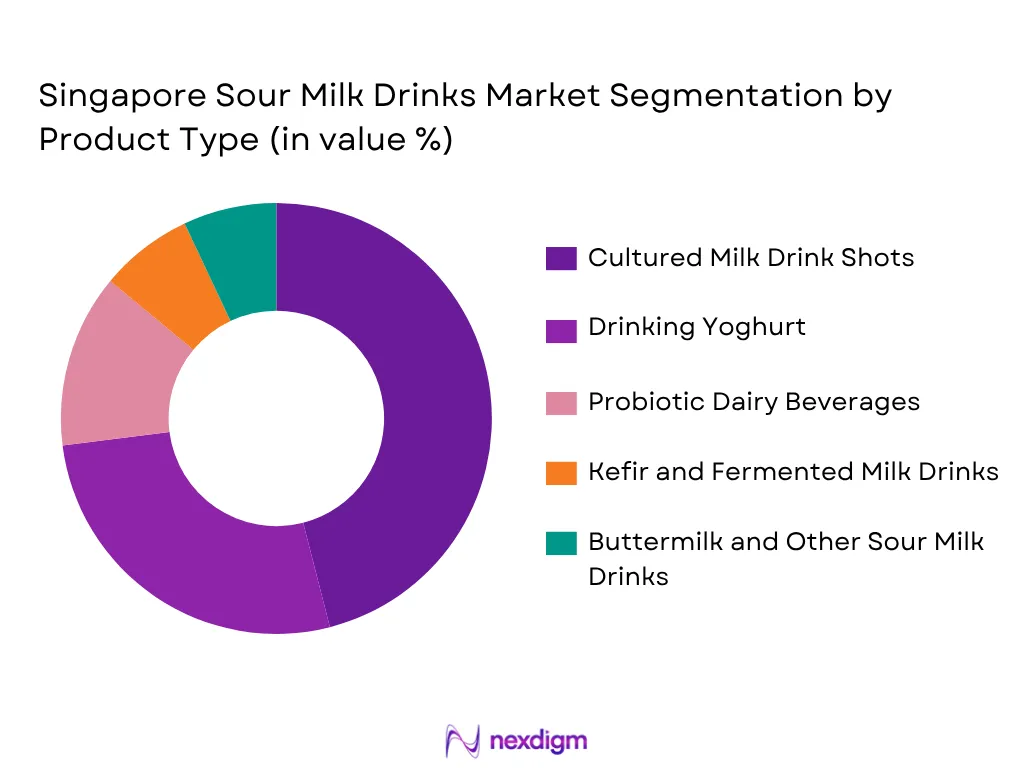
The Singapore Sour Milk Drinks Market is segmented by product type into cultured milk drink shots, drinking yoghurt, probiotic dairy beverages, kefir and fermented milk drinks, buttermilk and other sour milk drinks, and functional fortified sour milk drinks. Cultured milk drink shots dominate the market because Singapore has long-established consumer familiarity with small-format probiotic dairy drinks sold in multi-packs. These products fit local consumption habits better than large sour dairy formats: they are portion-controlled, affordable per purchase, easy to store in small refrigerators, and suitable for children, office workers and elderly consumers. Yakult and VITAGEN have also trained the market around daily digestive-health consumption, with strong cold-chain availability in supermarkets and direct home delivery. Drinking yoghurt remains important, but it competes more directly with breakfast drinks, flavoured milk, fresh milk, protein drinks and yoghurt cups.
By Distribution Channel
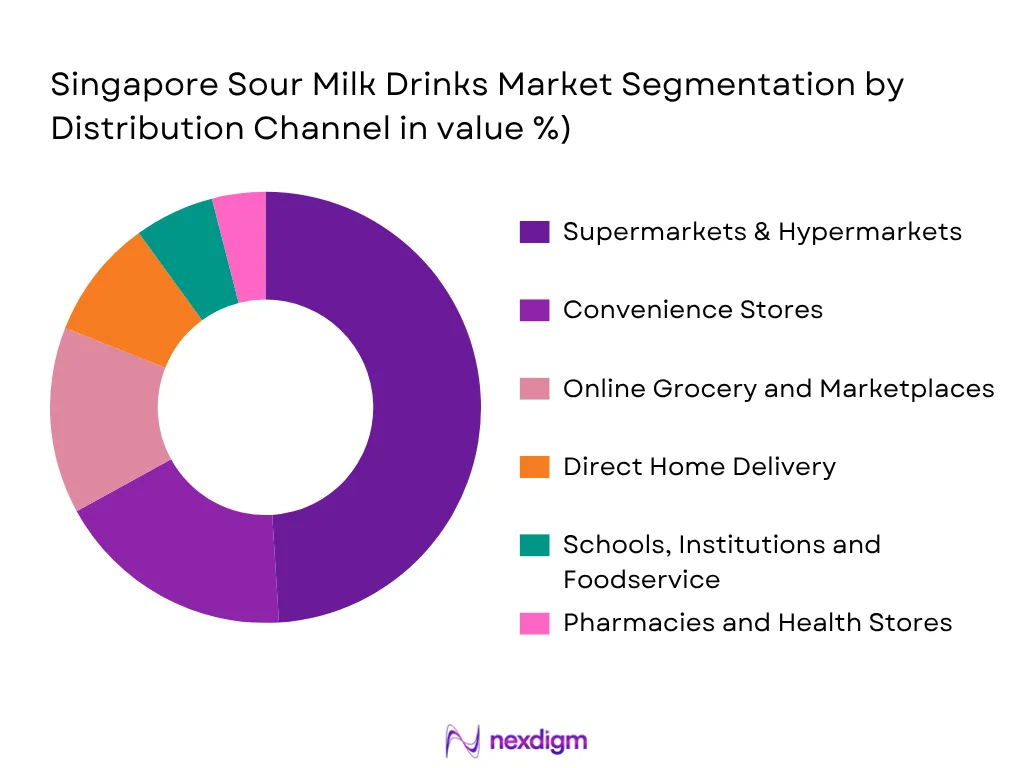
The Singapore Sour Milk Drinks Market is segmented by distribution channel into supermarkets and hypermarkets, convenience stores, online grocery and marketplaces, direct home delivery, schools, institutions and foodservice, and pharmacies and health stores. Supermarkets and hypermarkets dominate the market because sour milk drinks are chilled, replenishment-oriented products that depend on high-frequency grocery visits and visible chiller placement. Singaporean households typically purchase cultured milk drinks as weekly multi-packs, and supermarkets provide the strongest combination of SKU variety, promotional pricing, cold-chain reliability and basket attachment with dairy, bread, breakfast foods and children’s snacks. Convenience stores perform well for impulse single-serve consumption, but their higher price per ml and smaller chilled shelf space limit household stock-up. Online grocery is growing because chilled delivery and multi-pack bundling support repeat replenishment, especially among families.
Competitive Landscape
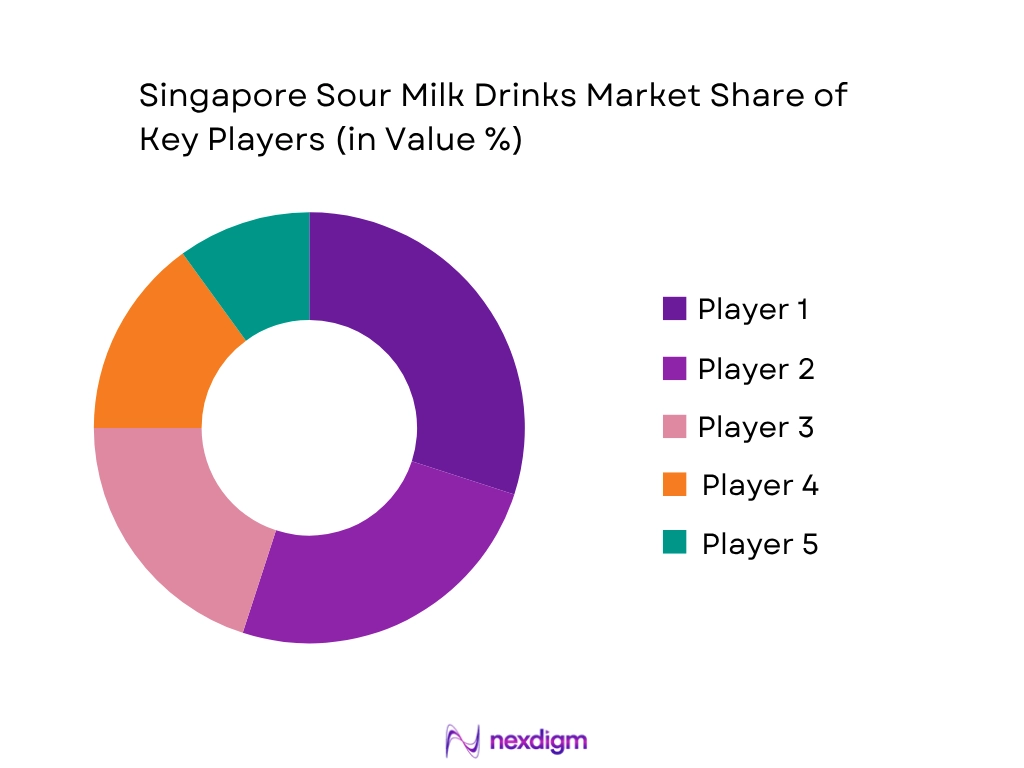
The Singapore Sour Milk Drinks Market is concentrated around a small set of cultured milk and dairy beverage specialists, led by Yakult Singapore and Malaysia Dairy Industries’ VITAGEN. Competition is shaped by probiotic credibility, chiller visibility, household penetration, sugar profile, direct delivery capability and availability across supermarkets, convenience chains and e-grocery platforms. Global dairy players such as Meiji, Danone, Nestlé and Fonterra influence the broader functional dairy and drinking yoghurt space, while local dairy brands retain trust through freshness, halal certification, price accessibility and mass retail distribution.
| Company | Establishment Year | Headquarters | Core Sour Milk/Probiotic Portfolio | Singapore Route-to-Market | Cold-Chain Strength | Sugar/Nutri-Grade Positioning | Target Consumer Base | Market-Specific Differentiator |
| Yakult Singapore | 1979 | Singapore | ~ | ~ | ~ | ~ | ~ | ~ |
| Malaysia Dairy Industries — VITAGEN | 1963 | Singapore | ~ | ~ | ~ | ~ | ~ | ~ |
| Meiji | 1917 | Tokyo, Japan | ~ | ~ | ~ | ~ | ~ | ~ |
| Danone | 1919 | Paris, France | ~ | ~ | ~ | ~ | ~ | ~ |
| Nestlé | 1866 | Vevey, Switzerland | ~ | ~ | ~ | ~ | ~ | ~ |
Singapore Sour Milk Drinks Market Analysis
Growth Drivers
Gut-health awareness
Singapore’s sour milk drinks market is supported by a large urban consumer base with sufficient income capacity for routine functional beverages. World Bank data shows Singapore’s GDP reached USD 547.39 billion and GDP per capita reached USD 90,674.1 in 2024, creating a premium-consumption base for probiotic cultured milk, drinking yoghurt and digestive-health dairy drinks. The demand case is reinforced by public-health indicators: Singapore’s National Population Health Survey 2024 reported diabetes among residents aged 18–74 at 9.1 cases per 100 residents, obesity at 12.7 cases per 100 residents, high-risk BMI at 22.8 cases per 100 residents, and abdominal obesity at 43.6 cases per 100 residents during 2023–2024. These indicators are market-specific because sour milk drinks are positioned around probiotics, gut balance, digestion and routine wellness rather than refreshment alone. Singapore’s total population also stood at 6.0369 million in June 2024, including 4.1809 million residents, giving brands a concentrated market where chilled retail, e-grocery, workplace pantries and household multi-packs can repeatedly target the same consumers.
Children’s nutrition
Children’s nutrition supports cultured milk shots and drinking yoghurt because the category is strongly linked to lunchbox use, school-going children, parental purchase and daily digestive-health routines. Ministry of Education data shows Singapore had 420,178 students enrolled across primary, secondary and pre-university levels in 2024, including 237,966 primary students, 157,082 secondary students, and 25,130 pre-university students. The primary segment alone had 37,785 Primary 1 students, 39,621 Primary 2 students, 40,360 Primary 3 students, 41,040 Primary 4 students, 38,089 Primary 5 students, and 41,071 Primary 6 students, giving sour milk drink companies a measurable school-age consumption base for small-bottle multi-packs, less-sugar variants and child-friendly flavours. Population in Brief 2025 also recorded 29,237 citizen births in 2024, higher than 28,877 citizen births in 2023, showing continuing household formation around young-child consumption despite a mature demographic structure. For sour milk drink brands, these figures justify child-specific pack architecture: mini bottles, 5-pack or 10-pack formats, original and fruit flavours, and nutrition-led messaging around probiotics, calcium, digestion and lower sugar.
Market Challenges
Sugar scrutiny
Sugar scrutiny is a direct market challenge because cultured milk and drinking yoghurt are covered by Singapore’s beverage nutrition-labelling regime when sold as ready-to-consume drinks. The Health Promotion Board states that Nutri-Grade beverages are graded through 4 colour-coded grades, from Grade A to Grade D, using a single threshold system for sugar and saturated fat; Grade C and Grade D drinks must display a front-of-pack Nutri-Grade mark, while the sugar level must be shown clearly on the label. This affects sour milk drinks because the category is often sweet-sour, flavoured and child-oriented. The pressure is supported by Singapore health data: NPHS 2024 reported 12.7 cases of obesity per 100 residents aged 18–74, 22.8 high-risk BMI cases per 100 residents, 43.6 abdominal-obesity cases per 100 residents, and 9.1 diabetes cases per 100 residents during 2023–2024. The category implication is clear: brands must reformulate regular cultured milk, drinking yoghurt and probiotic dairy beverages into lower-sugar formats without damaging taste, texture, live-culture positioning or children’s acceptance.
Chilled logistics cost
Chilled logistics cost is a structural challenge because sour milk drinks depend on refrigerated storage, short shelf-life handling, stock rotation and high-frequency delivery to supermarkets, convenience stores, schools and e-grocery fulfilment centres. Singapore Food Agency reported that Singapore imports more than 90 food units out of every 100 consumed, and its food supply sources reached 187 countries/regions in 2024, compared with 140 countries/regions around two decades earlier. For fermented dairy beverages, this import dependence increases operational exposure to overseas sourcing, customs compliance, cold-chain integrity and distributor coordination. SFA also recorded 22.8 foodborne illness cases per 100,000 population in 2024, showing why food safety, temperature control and regulatory compliance cannot be treated as optional cost items for chilled dairy. The challenge is amplified by Singapore’s compact but high-service retail environment: SingStat reported retail trade and food & beverage service indicators in 2026 with online retail and foodservice channels still active, meaning sour milk drink brands must serve both physical chillers and online chilled fulfilment without compromising product condition.
Opportunities
Low-sugar cultured milk
Low-sugar cultured milk is a near-term growth opportunity because Singapore’s regulatory and public-health environment rewards products that can retain probiotic positioning while reducing sugar burden. Health Promotion Board’s Nutri-Grade framework uses 4 beverage grades and requires Grade C and Grade D beverages to display a front-of-pack label, while drinks aligned with Healthier Choice Symbol and Healthier Dining Programme guidelines are Grade A or Grade B. For cultured milk brands, this creates a clear commercial route: develop less-sugar SKUs, smaller bottles, and child-friendly flavours that can be positioned more favourably to parents, schools, e-grocery shoppers and health-conscious adults. The opportunity is supported by the fact that Singapore’s total population reached 6.0369 million in June 2024, while residents numbered 4.1809 million, giving brands a dense addressable base for repeated household replenishment. The broader macroeconomic base is also supportive: World Bank reported Singapore GDP per capita at USD 90,674.1 in 2024, indicating strong capacity for premium daily-wellness beverages when the product meets nutrition and labelling expectations.
Adult gut-health formats
Adult gut-health formats present an opportunity because Singapore’s ageing and working-age population creates demand beyond children’s cultured milk shots. Population in Brief 2025 shows Singapore’s citizen median age increased from 43.4 years in June 2024 to 43.7 years in June 2025, while citizens aged 80 and above reached 145,000 in June 2025. The same source reported a resident base of 4.1809 million in June 2024 and 4.2045 million in June 2025, providing a stable adult-heavy market for digestive-health beverages, post-meal probiotic shots, drinking yoghurt, lower-sugar fermented dairy and senior-friendly packs. NPHS 2024 further strengthens the opportunity: diabetes was reported at 9.1 cases per 100 residents aged 18–74, obesity at 12.7 cases per 100 residents, and abdominal obesity at 43.6 cases per 100 residents during 2023–2024. These indicators support adult-oriented positioning around digestive comfort, daily wellness, portion control and reduced sugar, rather than child-only flavour-led communication.
Future Outlook
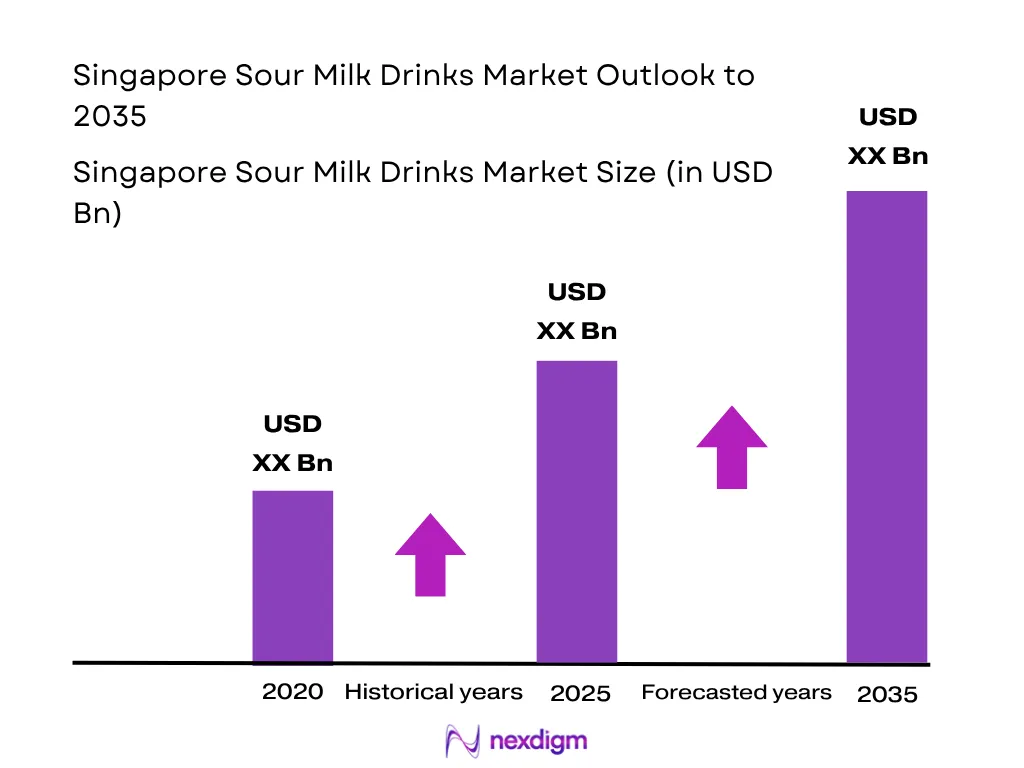
The Singapore Sour Milk Drinks Market is expected to grow steadily, supported by gut-health awareness, sugar reduction, ageing demographics, e-grocery replenishment and premium functional dairy launches. For the 2026–2035 outlook, the report applies a benchmark CAGR of around 5.4%, aligned with global sour milk drinks growth projections for the same long-range period. Growth will be strongest in low-sugar cultured milk shots, fortified probiotic dairy drinks, premium drinking yoghurt and subscription-led household replenishment.
Major Players
- Yakult Singapore
- Malaysia Dairy Industries – VITAGEN
- Meiji
- F&N Foods – Magnolia
- MARIGOLD
- Dutch Lady
- Farmhouse
- Greenfields
- Nestlé
- Danone
- Yoplait
- Pauls
- Cowhead
- Lactel
- Chobani
Key Target Audience
- Dairy beverage manufacturers and brand owners
- Probiotic drink manufacturers
- Drinking yoghurt and functional dairy companies
- Supermarket, hypermarket and convenience-store chains
- Online grocery platforms and chilled logistics operators
- Investments and venture capitalist firms
- Government and regulatory bodies (Singapore Food Agency, Health Promotion Board, Ministry of Health, Enterprise Singapore)
- Dairy ingredient suppliers and probiotic culture suppliers
Research Methodology
Step 1: Identification of Key Variables
The initial phase involves constructing an ecosystem map for the Singapore Sour Milk Drinks Market, covering cultured milk manufacturers, probiotic drink brands, dairy importers, supermarkets, convenience chains, online grocery platforms, distributors and regulators. Variables include product format, sugar profile, probiotic strain positioning, cold-chain availability, pack size, price per 100 ml and channel penetration.
Step 2: Market Analysis and Construction
This phase compiles historical and current data relating to yoghurt, sour milk products, drinking yoghurt, probiotic drinks and broader dairy beverages. The analysis evaluates category revenues, SKU pricing, retail chiller presence, product claims, online listings, home delivery availability and channel-level sales indicators to construct a bottom-up view of demand.
Step 3: Hypothesis Validation and Expert Consultation
Market hypotheses are validated through interviews with dairy manufacturers, distributors, modern trade buyers, e-grocery category managers, cold-chain logistics operators and nutrition-positioned beverage companies. These consultations are used to test assumptions on product dominance, consumer cohorts, sugar reformulation, promotional intensity and route-to-market profitability.
Step 4: Research Synthesis and Final Output
The final phase integrates secondary research, retail audits, expert validation and bottom-up SKU modelling. Company profiles, segment shares, growth drivers, competitive positioning and forecast assumptions are reconciled against market indicators such as population, tourism, retail distribution, Nutri-Grade regulation and category-level yoghurt and sour milk product trends.

- Executive Summary
- Research Methodology (Market definitions and assumptions, sour milk drinks taxonomy, cultured milk versus drinking yoghurt boundary, probiotic strain inclusion criteria, SKU-level price tracking, retail audit approach, e-grocery basket scraping, distributor interviews, store-check coverage, import flow triangulation, TAM/SAM/SOM approach, value-volume reconciliation, limitations and future conclusions)

- Definition and Scope
- Market Genesis
- Evolution of Cultured Milk and Probiotic Dairy Consumption
- Timeline of Major Players
- Business Cycle
- Supply Chain and Value Chain Analysis
- Route-to-Market Structure
- Retail Shelf Architecture and Chilled Cabinet Placement
- Consumer Need-State Mapping
- Import Dependency and Local Manufacturing Footprint

- Growth Drivers (Gut-health awareness, children’s nutrition, daily wellness routines, small-format affordability, supermarket penetration, convenience-store availability)
- Market Challenges (Sugar scrutiny, chilled logistics cost, shelf-space competition, limited local milk supply, small domestic market scale)
- Opportunities (Low-sugar cultured milk, adult gut-health formats, premium drinking yoghurt, children’s fortified packs, direct subscription models)
- Market Trends (Mini-shot probiotics, less-sugar flavour extensions, functional fortification, online grocery bundling, chilled shelf premiumization)
- Government Regulations (Nutri-Grade, Singapore Food Regulations, labelling, nutrition information panel, permitted claims, chilled storage, food safety)
- SWOT Analysis (Brand loyalty, chilled penetration, sugar pressure, premium probiotic opportunity)
- Stakeholder Ecosystem (Brand owners, importers, distributors, supermarkets, convenience chains, e-grocery platforms, schools, consumers, regulators)
- Porter’s Five Forces (Shelf power, buyer switching, threat from plant-based functional beverages, imported brand rivalry, supplier dependence)
- Competition Ecosystem (Global probiotic majors, local cultured milk manufacturers, dairy beverage importers, supermarket private labels, functional beverage challengers)
- Pricing and Promotion Architecture (Price per bottle, price per 100 ml, multi-pack discounts, loyalty promotions, bundle elasticity)
- Cold-Chain and Retail Execution Analysis (Temperature-controlled logistics, chiller facings, expiry rotation, stock-out risk)

- By Value (2020-2025)
- By Volume (2020-2025)
- By Average Selling Price (2020-2025)
- By Price per 100 ml (2020-2025)
- By Pack Sales Velocity (2020-2025)
- By Per Capita Consumption (2020-2025)

- By Product Format (In Value%)
Cultured Milk Drink Shots
Drinking Yoghurt
Fermented Milk Beverages
Probiotic Dairy Beverages
Flavoured Sour Milk Drinks - By Probiotic/Culture Positioning (In Value%)
Strain-Specific Probiotic Drinks
General Live-Culture Drinks
Digestive Wellness Drinks
Immunity-Support Drinks
Functional Fortified Variants - By Sugar and Nutri-Grade Profile (In Value%)
Regular Sweetened Cultured Milk Drinks
Less-Sugar Variants
Light/Low-Calorie Variants
No-Added-Sugar or Reduced-Sugar Drinking Yoghurt
Fortified Low-Sugar Functional Drinks - By Packaging and Pack Size (In Value%)
Mini Bottles
Multi-Packs
Single-Serve Bottles
Family Bottles
E-Grocery Bulk Bundles - By Flavour Profile (In Value%)
Original
Grape
Orange
Apple
Strawberry and Mixed Fruit - By Consumer Group (In Value%)
Children
Students and Young Adults
Working Adults
Elderly Consumers
Family Households - By Distribution Channel (In Value%)
Supermarkets and Hypermarkets
Convenience Stores
Online Grocery and Marketplaces
Direct Home Delivery
Schools, Institutions and Foodservice - By Price Tier (In Value%)
Value Tier
Mass Tier
Premium Tier
Functional Premium Tier
E-Commerce Promotional Tier - By Geography and Consumption Catchment (In Value%)
Central Singapore
North-East Singapore
East Singapore
West Singapore
North Singapore

- Market Share of Major Players (Based on Value and Volume, Product Format, Distribution Channel, Sugar Profile
- Cross Comparison Parameters (Probiotic strain portfolio, CFU/live-culture communication, Nutri-Grade and sugar profile, chilled-chain coverage, pack-size and multi-pack architecture, price per 100 ml, retail chiller visibility, direct home-delivery/institutional reach)
- SWOT Analysis of Major Players (Brand equity, SKU depth, distribution strength, sugar reformulation exposure, premium innovation capability)
- Pricing Analysis Basis SKUs for Major Players (Mini bottle packs, 5-pack cultured milk, family drinking yoghurt, less-sugar variants, e-commerce bundles)
- Promotional Benchmarking (Multi-buy offers, supermarket markdowns, e-grocery vouchers, loyalty-card discounts, chilled end-cap visibility)
- Product Claim and Label Benchmarking (Probiotic strain claim, live-culture count, sugar per 100 ml, fat content, calcium and vitamin fortification)
- Detailed Profiles of Major Companies
Yakult Singapore
Malaysia Dairy Industries – VITAGEN
Meiji
F&N Foods – Magnolia
MARIGOLD
Dutch Lady
Farmhouse
Greenfields
Nestlé
Danone
Yoplait
Pauls
Cowhead
Lactel
Chobani

- Market Demand and Utilization (Daily consumption frequency, breakfast use, post-meal use, lunchbox use, snack occasion)
- Purchasing Power and Basket Behaviour (Multi-pack spend, promotional sensitivity, premium willingness-to-pay, household replenishment)
- Regulatory and Health Awareness (Nutri-Grade recognition, sugar awareness, probiotic literacy, label reading)
- Needs, Desires and Pain Point Analysis (Digestive comfort, child acceptance, taste, sugar concern, chilled availability, price-value equation)
- Decision-Making Process (Parent-led purchase, child flavour preference, brand trust, supermarket visibility, e-grocery convenience)
- Consumption Occasion Mapping (Breakfast, after-school, office pantry, post-meal, late-night snack, elderly wellness routine)
- Brand Switching and Loyalty Triggers (Price promotions, flavour variety, sugar level, pack size, probiotic claim credibility)

- By Value (2026-2035)
- By Volume (2026-2035)
- By Average Selling Price (2026-2035)
- By Price per 100 ml (2026-2035)
- By Per Capita Consumption (2026-2035)


 Request a Sample
 Ask for Customization
 Get a Quote
 Enquire Now