
 Download PDF
 Download PDF
Market Overview
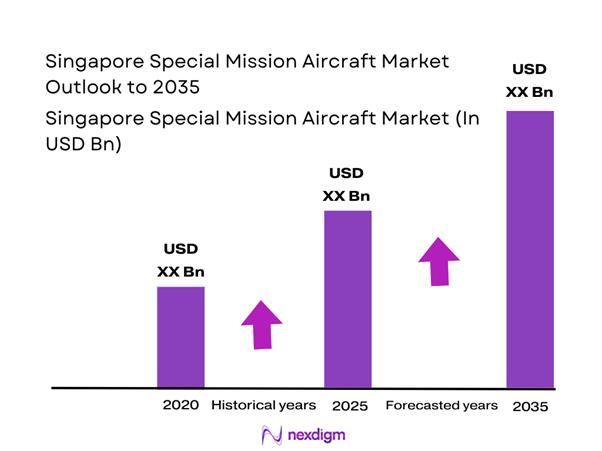
The Singapore Special Mission Aircraft market current size stands at around USD ~ million, supported by expanding airborne surveillance, defense readiness priorities, and modernization initiatives. Aircraft deliveries during 2024 and 2025 reflected steady fleet optimization, with increased deployment for maritime patrol, reconnaissance, and command missions. Platform utilization intensity rose alongside enhanced sensor integration and data fusion requirements. Procurement activity remained stable, supported by multi-year defense planning cycles and capability sustainment programs. Demand remained concentrated within government-led aviation programs emphasizing mission reliability and interoperability.
The market is geographically concentrated within Singapore due to centralized defense procurement and integrated airbase infrastructure. Strong aerospace engineering capabilities, advanced maintenance ecosystems, and government-backed technology adoption support sustained activity. Demand is further shaped by regional maritime security obligations and airspace monitoring requirements. Policy stability and long-term defense planning encourage consistent platform upgrades. The ecosystem benefits from close collaboration between defense agencies, integrators, and aerospace service providers operating within a highly regulated environment.
Market Segmentation
By Application
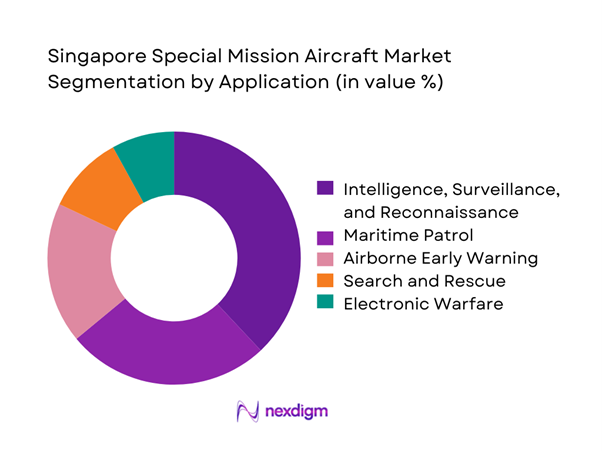
The application-based segmentation is dominated by intelligence, surveillance, and reconnaissance missions due to Singapore’s strategic maritime position and airspace monitoring priorities. ISR platforms are extensively utilized for border surveillance, maritime domain awareness, and threat detection, driving consistent demand for sensor-equipped aircraft. Maritime patrol and airborne early warning applications also hold significant shares, supported by regional security commitments and naval coordination requirements. Search and rescue and electronic warfare missions represent smaller but critical segments, benefiting from mission-specific upgrades and interoperability requirements across defense agencies.
By Fleet Type
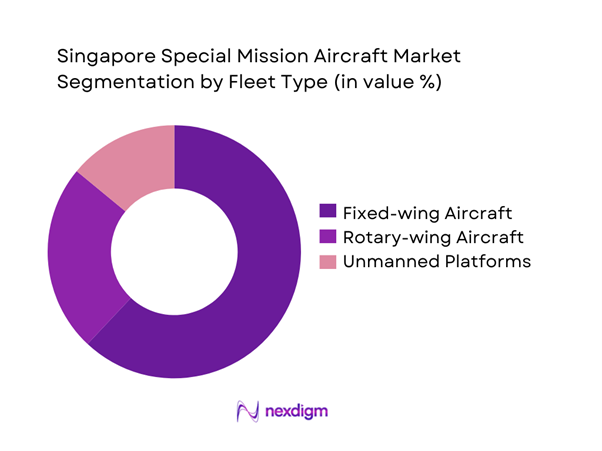
Fixed-wing aircraft dominate fleet composition due to their extended range, endurance, and payload flexibility for complex missions. These platforms support multi-role configurations, enabling cost-efficient mission deployment. Rotary-wing aircraft maintain relevance for tactical and rescue operations, especially in coastal and urban environments. Unmanned platforms are gaining gradual traction as supplementary assets, driven by advancements in autonomy and sensor miniaturization. Fleet diversification remains guided by operational flexibility, lifecycle efficiency, and mission adaptability.
Competitive Landscape
The competitive environment is characterized by established aerospace manufacturers with strong defense portfolios and long-term government relationships. Market participation is shaped by technological depth, integration capability, and compliance with stringent defense procurement standards. Competition emphasizes platform reliability, mission customization, and long-term support commitments rather than volume-based sales.
| Company Name | Establishment Year | Headquarters | Formulation Depth | Distribution Reach | Regulatory Readiness | Service Capability | Channel Strength | Pricing Flexibility |
| Airbus Defence and Space | 2000 | Netherlands | ~ | ~ | ~ | ~ | ~ | ~ |
| Boeing Defense | 2002 | United States | ~ | ~ | ~ | ~ | ~ | ~ |
| Lockheed Martin | 1995 | United States | ~ | ~ | ~ | ~ | ~ | ~ |
| Leonardo | 1948 | Italy | ~ | ~ | ~ | ~ | ~ | ~ |
| ST Engineering | 1967 | Singapore | ~ | ~ | ~ | ~ | ~ | ~ |
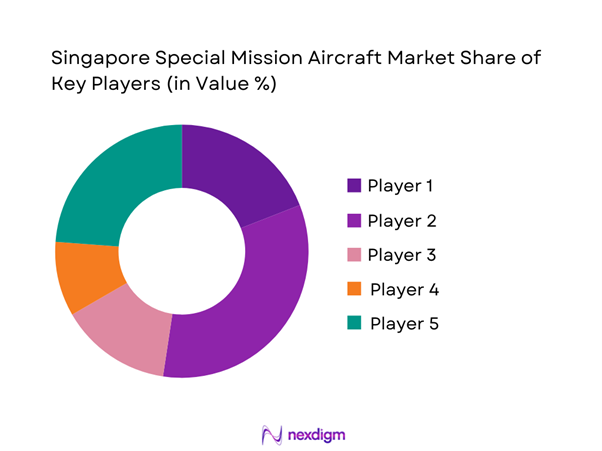
Singapore Special Mission Aircraft Market Analysis
Growth Drivers
Rising maritime surveillance and border security needs
Maritime surveillance requirements increased significantly due to expanding regional trade routes and heightened security monitoring expectations. Enhanced patrol coverage became necessary as vessel traffic density and maritime boundary complexity continued rising. Defense planners prioritized persistent airborne surveillance to strengthen situational awareness and threat detection capabilities. Multi-domain coordination requirements encouraged increased reliance on airborne intelligence platforms. Mission readiness standards required higher sortie availability and improved sensor integration. These operational demands stimulated investment in advanced mission aircraft platforms. Aircraft utilization rates increased steadily during 2024 and 2025. Surveillance missions accounted for a growing share of total flight hours. Enhanced interoperability between naval and air units further supported demand growth. Overall operational tempo reinforced long-term procurement planning.
Modernization of airborne ISR capabilities
Airborne ISR modernization remained central to defense capability enhancement strategies. Legacy platforms underwent upgrades to support advanced radar and sensor payloads. Digital communication integration improved real-time data sharing across command structures. Upgraded mission systems enabled faster threat identification and response coordination. Interoperability with allied forces strengthened through standardized communication architectures. Fleet modernization programs emphasized modular system compatibility and scalability. Maintenance efficiency improved through predictive diagnostics and digital monitoring tools. Modernization initiatives aligned with evolving regional security doctrines. Platform life extensions reduced operational risk while maintaining mission effectiveness. Continued modernization reinforced sustained investment momentum.
Challenges
High acquisition and lifecycle costs
Special mission aircraft acquisition involves substantial capital commitment due to specialized equipment integration. Lifecycle costs remain elevated because of complex maintenance and system upgrade requirements. Budget planning must accommodate long-term sustainment obligations. High operating costs constrain fleet expansion decisions. Maintenance downtime impacts operational availability and mission readiness. Specialized spare parts increase logistical complexity and expense. Training requirements further add to long-term cost structures. Cost pressures influence procurement pacing and platform selection strategies. Financial planning must balance capability enhancement with fiscal discipline. These factors collectively limit rapid fleet expansion.
Limited domestic manufacturing base
Singapore relies heavily on imported airframes and mission systems for fleet development. Domestic manufacturing capabilities focus primarily on integration and maintenance activities. Limited local production increases dependence on foreign suppliers. Supply chain disruptions can affect delivery timelines and upgrade schedules. Technology transfer constraints restrict indigenous system development. Customization flexibility remains linked to external vendor cooperation. Regulatory approvals add complexity to procurement cycles. Strategic autonomy considerations influence sourcing decisions. Localization efforts require sustained investment and policy support. These constraints shape long-term capability planning.
Opportunities
Fleet modernization programs by RSAF
Ongoing fleet modernization initiatives create sustained demand for advanced mission platforms. Replacement of aging aircraft supports improved operational efficiency and reliability. Modernization programs prioritize multi-role capability and mission adaptability. Enhanced avionics and sensor suites improve situational awareness. Integration of data-centric systems strengthens command effectiveness. Modern platforms support reduced maintenance cycles and higher availability. Long-term modernization roadmaps encourage stable procurement pipelines. Collaborative development opportunities emerge with technology partners. These programs reinforce market stability over the forecast period. Continued modernization aligns with evolving defense strategies.
Upgrades of legacy patrol and surveillance aircraft
Legacy aircraft upgrades present significant opportunities for capability enhancement without full fleet replacement. Sensor retrofitting improves detection and tracking performance. Communication system upgrades enable real-time data sharing. Structural enhancements extend aircraft service life efficiently. Software-defined systems allow mission reconfiguration flexibility. Upgrade programs reduce total ownership costs compared to new acquisitions. Operational downtime is minimized through phased implementation. Modernization improves interoperability with allied forces. Upgrade demand remains consistent across multiple platforms. This approach supports cost-effective capability enhancement.
Future Outlook
The market is expected to maintain steady growth through the forecast period, supported by sustained defense investment priorities. Technological upgrades and fleet renewal programs will remain central to procurement strategies. Increasing emphasis on maritime security and intelligence capabilities will continue shaping demand patterns. Long-term planning frameworks will support stable platform modernization and integration initiatives.
Major Players
- Airbus Defence and Space
- Boeing Defense
- Lockheed Martin
- Leonardo
- ST Engineering
- Northrop Grumman
- Saab
- Elbit Systems
- Thales Group
- Dassault Aviation
- General Atomics
- L3Harris Technologies
- RTX Corporation
- Embraer Defense
- Israel Aerospace Industries
Key Target Audience
- Singapore Ministry of Defence
- Republic of Singapore Air Force
- Defence Science and Technology Agency
- Homeland Security and Maritime Agencies
- Aerospace system integrators
- Maintenance, repair, and overhaul providers
- Defense-focused investment and venture capital firms
- Government procurement and regulatory authorities
Research Methodology
Step 1: Identification of Key Variables
Market scope, platform types, mission categories, and operational roles were defined based on defense aviation structures. Key demand indicators and capability requirements were mapped. Baseline assumptions were validated through defense procurement frameworks.
Step 2: Market Analysis and Construction
Segmentation was developed using platform type, application, and operational usage. Data was structured to reflect fleet composition and modernization trends. Qualitative and quantitative indicators were integrated.
Step 3: Hypothesis Validation and Expert Consultation
Industry inputs from aviation specialists and defense planners were incorporated. Assumptions were cross-verified through operational benchmarks. Scenario consistency checks ensured logical alignment.
Step 4: Research Synthesis and Final Output
Findings were consolidated into coherent market narratives. Analytical consistency was ensured across sections. Final outputs reflect validated insights aligned with industry realities.

- Executive Summary
- Research Methodology (Market Definitions and mission aircraft scope alignment, platform and mission-type segmentation logic for special mission fleets, bottom-up fleet and contract-based market sizing approach, revenue attribution across airframe modification and mission systems, primary validation with defense procurement and MRO stakeholders, triangulation using fleet inventories defense budgets and program disclosures)

- Definition and Scope
- Market evolution
- Usage and mission deployment landscape
- Ecosystem structure
- Supply chain and integration framework
- Regulatory and defense procurement environment

- Growth Drivers
Rising maritime surveillance and border security needs
Modernization of airborne ISR capabilities
Increasing regional security and geopolitical monitoring
Integration of advanced sensors and mission systems
Emphasis on multi-role and modular aircraft platforms - Challenges
High acquisition and lifecycle costs
Limited domestic manufacturing base
Long procurement and certification cycles
Integration complexity of mission systems
Dependence on foreign OEMs and technologies - Opportunities
Fleet modernization programs by RSAF
Upgrades of legacy patrol and surveillance aircraft
Adoption of ISR and electronic warfare payloads
Growing demand for maritime domain awareness
Expansion of MRO and system integration capabilities - Trends
Shift toward multi-mission configurable platforms
Increasing use of data fusion and AI-enabled analytics
Growing reliance on SATCOM and secure datalinks
Integration of unmanned and manned operations
Emphasis on lifecycle sustainment contracts - Government Regulations
- SWOT Analysis
- Stakeholder and Ecosystem Analysis
- Porter’s Five Forces Analysis
- Competition Intensity and Ecosystem Mapping

- By Value, 2020–2025
- By Volume, 2020–2025
- By Installed Base, 2020–2025
- By Average Selling Price, 2020–2025

- By Fleet Type (in Value %)
Fixed-wing special mission aircraft
Rotary-wing special mission aircraft
Unmanned special mission platforms - By Application (in Value %)
Intelligence Surveillance and Reconnaissance
Maritime Patrol and Anti-Submarine Warfare
Airborne Early Warning and Control
Search and Rescue
Electronic Warfare and Signal Intelligence
Command and Control - By Technology Architecture (in Value %)
Manned mission systems
Optionally piloted systems
Fully unmanned mission systems - By End-Use Industry (in Value %)
Defense and air force
Naval aviation command
Homeland security agencies
Maritime enforcement authorities - By Connectivity Type (in Value %)
SATCOM-based systems
Line-of-sight data links
Beyond line-of-sight networks
Multi-band integrated communication systems - By Region (in Value %)
Singapore domestic deployment
Regional operational collaboration

- Market structure and competitive positioning
Market share snapshot of major players - Cross Comparison Parameters (platform capability, mission system integration, fleet reliability, lifecycle cost, local support presence, technology maturity, delivery timelines, upgrade flexibility)
- SWOT Analysis of Key Players
- Pricing and Commercial Model Benchmarking
- Detailed Profiles of Major Companies
Airbus Defence and Space
Boeing Defense, Space & Security
Lockheed Martin
Northrop Grumman
Saab AB
Leonardo S.p.A.
Elbit Systems
Israel Aerospace Industries
L3Harris Technologies
Thales Group
Embraer Defense & Security
General Atomics Aeronautical Systems
Dassault Aviation
RTX Corporation
ST Engineering

- Demand and utilization drivers
- Procurement and tender dynamics
- Buying criteria and vendor selection
- Budget allocation and financing preferences
- Implementation barriers and risk factors
- Post-purchase service expectations

- By Value, 2026–2035
- By Volume, 2026–2035
- By Installed Base, 2026–2035
- By Average Selling Price, 2026–2035


 Request a Sample
 Ask for Customization
 Get a Quote
 Enquire Now