

 Download PDF
Market Overview
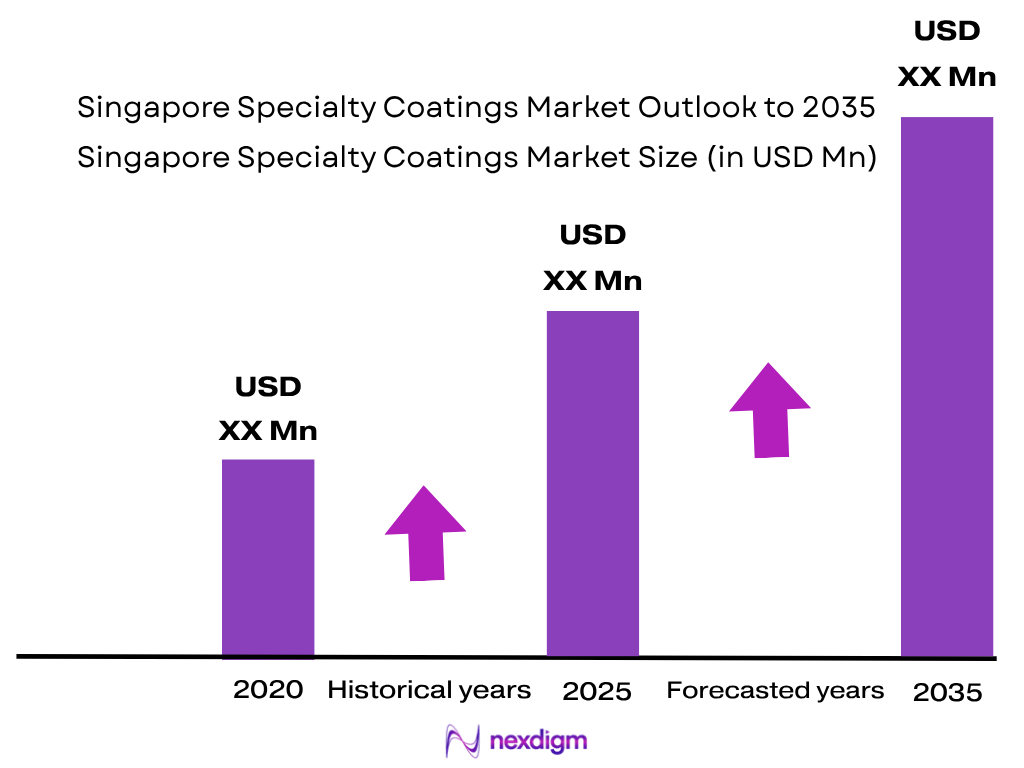
The Singapore Specialty Coatings Market is valued at approximately USD ~ million, compared with USD ~XX million in the preceding period, supported by demand from marine maintenance, offshore engineering, petrochemicals, infrastructure, electronics and high-performance construction applications. Singapore’s coating ecosystem benefits particularly from specialized anti-corrosion, antifouling, chemical-resistant and protective systems. Rising imports of specialized coatings also indicate demand for technologically advanced products, while local suppliers serve industrial, infrastructure, oil and gas, seaport and marine applications.
Jurong, Tuas and Singapore’s major port and shipyard clusters represent the most important specialty-coatings demand locations, supported by approximately ~XX million tonnes of industrial/maritime-linked activity in the latest period versus ~XX million tonnes in the preceding period across the relevant demand base. Jurong and Tuas concentrate petrochemical, industrial and engineering assets requiring corrosion protection and fireproofing, while port-linked areas generate marine coating demand. Local applicators maintain blasting, painting and intumescent-coating capabilities specifically for industrial and offshore projects.
Market Segmentation
By Coating Type
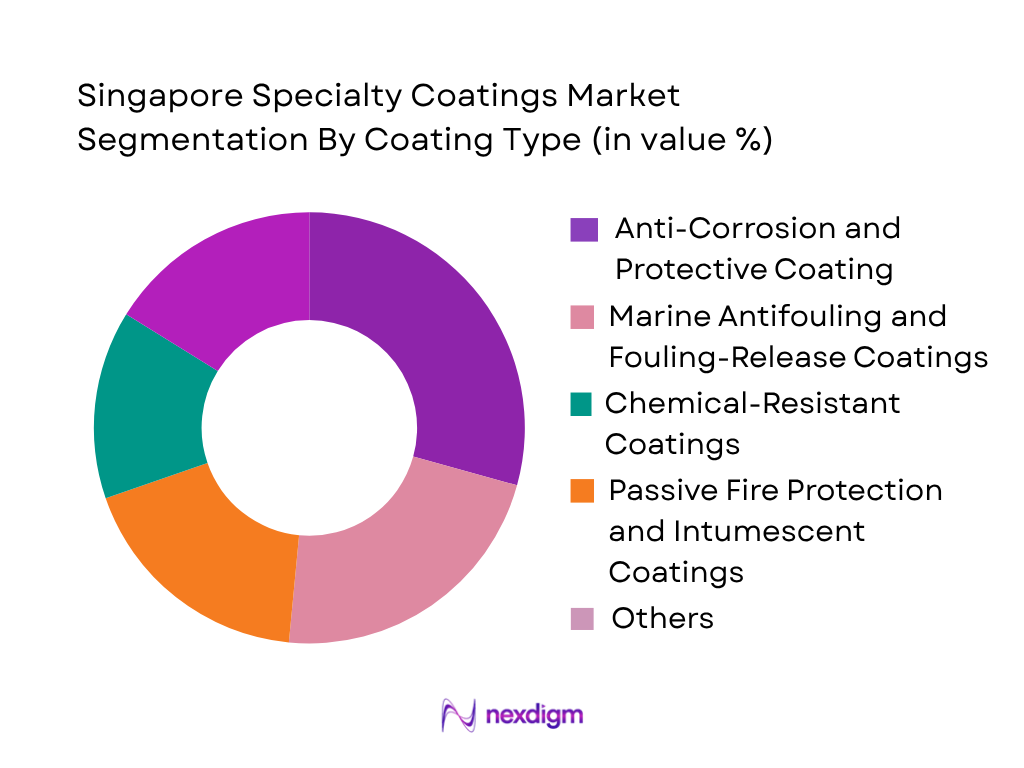
The Singapore Specialty Coatings Market is segmented by coating type into anti-corrosion and protective coatings, marine antifouling and fouling-release coatings, passive fire protection coatings, chemical-resistant coatings, heat-resistant coatings, flooring and concrete protection coatings, and other functional specialty coatings. Anti-corrosion and protective coatings hold the dominant market share. Singapore’s humid, saline environment and concentration of marine, offshore, petrochemical, industrial and infrastructure assets create continuous requirements for corrosion prevention and asset-life extension. Protective systems are applied to structural steel, pipelines, tanks, offshore equipment, ports and process facilities. Leading suppliers offer epoxy primers, high-build systems, specialty topcoats and chemical- and heat-resistant products for these applications. The segment also benefits from maintenance and recoating demand because asset owners evaluate coating systems on durability, downtime, surface preparation and lifecycle protection rather than solely on initial material cost. Nippon Paint’s Singapore protective portfolio, for example, specifically addresses infrastructure, oil and gas, petrochemical, power and seaport applications.
By End-Use Industry
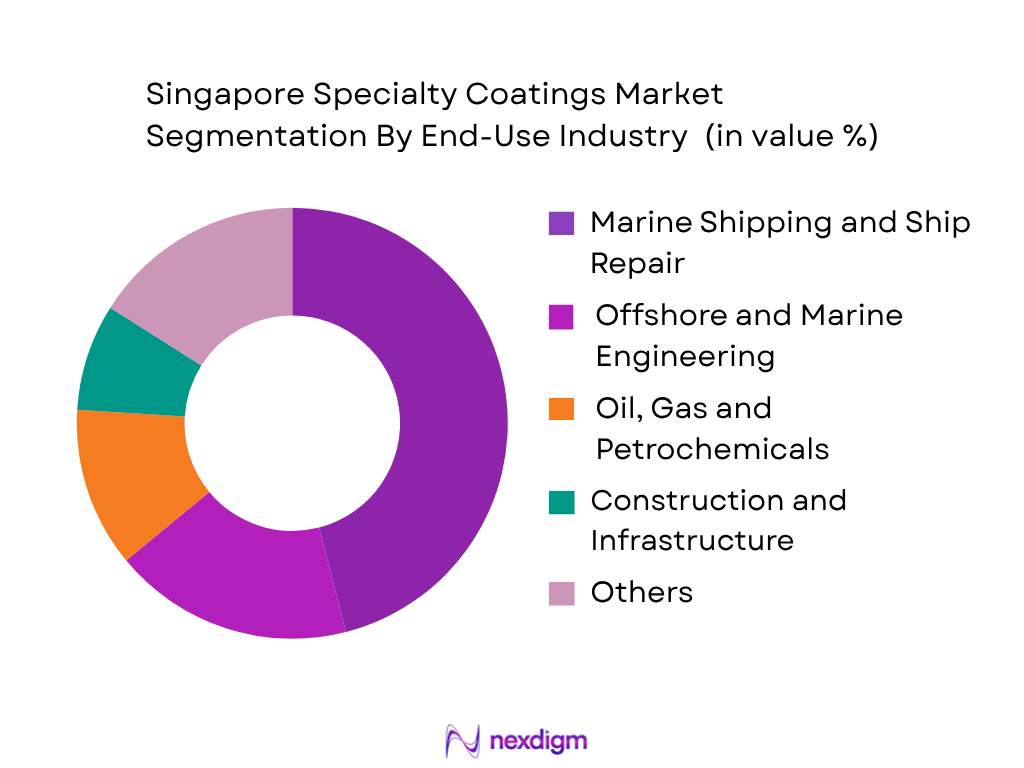
The Singapore Specialty Coatings Market is segmented by end-use industry into marine shipping and ship repair, offshore and marine engineering, oil and gas and petrochemicals, construction and infrastructure, semiconductor and electronics, aerospace and aviation MRO, and other industrial applications. Marine shipping and ship repair represent the dominant sub-segment because Singapore functions as a major maritime services and vessel-maintenance location where coatings are essential for hull protection, ballast tanks, decks, superstructures and other exposed surfaces. Marine suppliers in Singapore distribute products from major brands including Jotun, Hempel and International Paint, covering antifouling, epoxy and protective systems for commercial vessels, offshore assets and dry-docking requirements. Specialized coating demand is reinforced by the need to control corrosion and biofouling while extending vessel service intervals and maintaining hull performance. Jotun’s Singapore portfolio similarly includes dedicated shipping, fouling-protection and ballast-tank coating systems.
Competitive Landscape
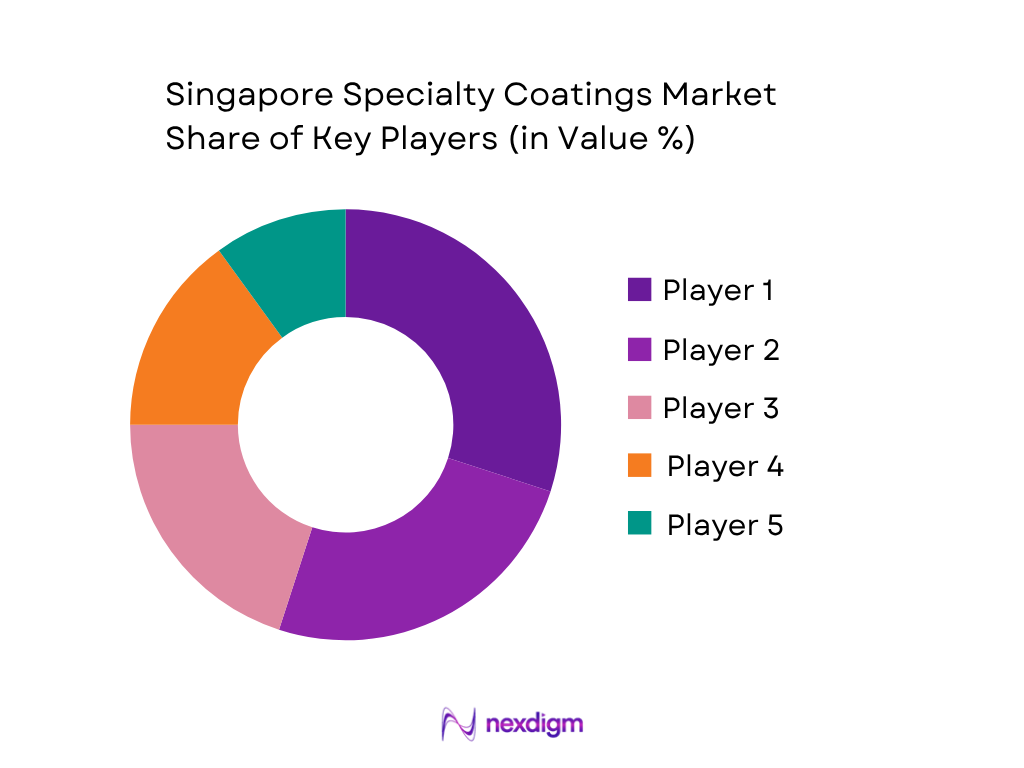
The Singapore Specialty Coatings Market has a strong presence of multinational and regional coating manufacturers, including Nippon Paint, AkzoNobel/International Paint, Jotun, PPG Industries and Hempel. Competition is shaped by marine and protective coating portfolios, specification approvals, application engineering, distributor availability and technical service. Singapore’s marine supply ecosystem visibly carries several of these brands, while companies such as Hempel use Singapore as a regional headquarters and Nippon Paint combines local manufacturing heritage with protective-coating capabilities.
| Company | Establishment Year | Headquarters | Key Specialty Coating Portfolio | Marine & Offshore Capability | Protective Coating Capability | Low-VOC / Sustainable Technology | Singapore Presence | Technical & Application Support |
| Nippon Paint | 1881 | Tokyo, Japan | ~ | ~ | ~ | ~ | ~ | ~ |
| AkzoNobel / International Paint | 1792 | Amsterdam, Netherlands | ~ | ~ | ~ | ~ | ~ | ~ |
| Jotun | 1926 | Sandefjord, Norway | ~ | ~ | ~ | ~ | ~ | ~ |
| PPG Industries | 1883 | Pittsburgh, United States | ~ | ~ | ~ | ~ | ~ | ~ |
| Hempel | 1915 | Lyngby, Denmark | ~ | ~ | ~ | ~ | ~ |
Singapore Specialty Coatings Market Analysis
Growth Drivers
Maritime, Ship-Repair and Offshore Asset Protection Demand
Singapore’s position as a global maritime hub creates a structurally large installed base of vessels, terminals, offshore equipment and marine infrastructure requiring anti-corrosion, antifouling, fouling-release, ballast-tank, deck and protective coating systems. The Maritime and Port Authority of Singapore reported 3.11 billion gross tons of vessel arrival tonnage in 2024, compared with 3.09 billion gross tons in 2023, demonstrating the scale of assets continuously entering an environment where hull protection, corrosion management and maintenance coatings are operational necessities. Singapore also handled a record 41.12 million TEUs of containers in 2024, while the port supplied 54.92 million tonnes of marine fuel, reinforcing its position as a major centre for vessel calls, bunkering, servicing and maintenance. More than 200 international shipping groups operate from Singapore, broadening the addressable customer base for technically qualified marine coatings. The demand implications extend beyond underwater hull systems: commercial ships, chemical tankers, offshore-support vessels, terminals, steel structures and port equipment require primers, epoxy intermediate coats, polyurethane topcoats, tank linings and chemically resistant systems. Singapore’s macroeconomic scale also supports this ecosystem. The World Bank recorded GDP of US$547.39 billion and GDP per capita of US$90,674.1 in 2024, while the Singapore Department of Statistics recorded S$1,285.9 billion of merchandise trade, comprising S$674.5 billion of exports and S$611.4 billion of imports.
Expansion of Construction, Manufacturing and High-Specification Industrial Assets
Singapore’s specialty coatings demand is also supported by the scale of construction and manufacturing activity requiring fire protection, corrosion resistance, industrial flooring, concrete protection, chemical resistance, waterproofing, ESD protection and high-performance surface finishes. The Building and Construction Authority recorded S$44.2 billion of construction demand in 2024, measured through contracts awarded, while construction output reached S$38.4 billion. The project pipeline includes public institutions, housing, high-specification industrial facilities, transportation infrastructure and developments associated with the Tuas Port, creating recurring demand for protective systems applied to structural steel, concrete surfaces, floors, roofs and service infrastructure. At the industrial level, the Singapore Economic Development Board reported S$423.6 billion of manufacturing output in 2024 and S$114.5 billion of manufacturing value added. Electronics generated S$44.0 billion of manufacturing value added, chemicals generated S$18.8 billion, transport engineering generated S$15.3 billion, biomedical manufacturing generated S$10.5 billion, and precision engineering generated S$8.3 billion. These industries collectively require substantially more specialized surface-performance characteristics than conventional decorative painting.
Market Challenges
Dependence on International Chemical and Raw-Material Supply Chains
Singapore’s specialty coatings industry operates within an exceptionally trade-intensive economy, leaving manufacturers, formulators and distributors exposed to international availability of resins, curing agents, specialty pigments, functional fillers, solvents and coating additives. Singapore Department of Statistics data show merchandise imports of S$611.4 billion in 2024, increasing further to S$658.3 billion in 2025. Total merchandise trade reached S$1,285.9 billion in 2024 and S$1,397.7 billion in 2025, illustrating the scale of Singapore’s dependence on cross-border supply networks. More specifically for the coatings value chain, Singapore imported S$42.8 billion of chemicals and chemical products in 2024, a category encompassing the broader chemical inputs from which coating formulations and related industrial materials are sourced. Manufacturing output of S$423.6 billion further demonstrates the large industrial base competing for chemicals, intermediates and specialized materials. Specialty coating formulations can be particularly sensitive to international supply conditions because protective epoxies, polyurethane systems, polysiloxanes, fluoropolymers, silicone technologies, zinc-rich products and fire-protection systems depend on tightly specified raw materials that cannot always be substituted without reformulation or requalification. This creates an operational challenge distinct from conventional paints: changing a curing agent, binder, pigment package or functional additive can alter adhesion, chemical resistance, drying behaviour, corrosion protection and certification performance. Singapore’s role as a trading hub partly mitigates availability risk, but its small domestic raw-material base means international shipping disruptions, geopolitical trade restrictions and changes in regional chemical production can affect replenishment schedules and inventory planning.
Increasing Product Compliance and Skilled Application Requirements
Specialty coating suppliers in Singapore face an increasingly demanding combination of formulation compliance, product testing, technical documentation and application-quality requirements. The National Environment Agency has established controls taking effect from 1 January 2026 under which interior paints containing formaldehyde at or above the equivalent of 0.1 gram per kilogram of product cannot be imported, manufactured or sold for local consumption. Paints intended for outdoor or industrial use at or above the same concentration require prescribed labelling, and manufacturers or importers can be required to submit test reports produced by appropriately accredited laboratories. Although many protective and marine systems fall within industrial applications rather than interior decorative paints, the measure demonstrates the direction of Singapore’s chemical-management framework and creates additional documentation responsibilities across product portfolios. The operational side is equally important. The Ministry of Manpower recorded 77,500 job vacancies in December 2024, while total employment increased by 44,500 workers during 2024, including 35,700 additional non-resident workers. Specialty coating application is particularly dependent on trained personnel because surface preparation, abrasive blasting, mixing ratios, pot-life management, environmental-condition monitoring, wet-film control and dry-film-thickness verification directly influence coating performance. Failures in these areas can lead to blistering, delamination, corrosion breakthrough, inadequate fire resistance or premature recoating.
Market Opportunities
Advanced Marine Hull, Fouling-Control and Asset-Efficiency Coatings
Singapore’s maritime decarbonisation activity creates a strong commercial opening for advanced antifouling, fouling-release, low-friction hull and longer-life protective coating technologies. The opportunity is supported by the current scale of Singapore’s shipping ecosystem rather than speculative future fleet numbers. The Maritime and Port Authority recorded 3.11 billion gross tons of vessel arrivals in 2024, while container throughput reached 41.12 million TEUs and total bunker sales reached 54.92 million tonnes. These operating volumes create a large population of vessel surfaces regularly exposed to seawater, biological fouling, abrasion and corrosive environments. The transition toward cleaner maritime operations is already visible in current fuel statistics: Singapore supplied approximately 1.35 million tonnes of alternative bunker fuels in 2024, including 883,000 tonnes of bio-blended fuels and 464,000 tonnes of liquefied natural gas. Methanol bunkering also entered commercial activity, while Singapore continued developing infrastructure and standards for new marine fuels. This shift matters directly to specialty coatings because shipowners pursuing improved vessel efficiency cannot focus solely on fuel type; underwater hull condition, surface roughness and fouling accumulation affect hydrodynamic performance throughout the operating cycle. High-performance fouling-control systems can therefore be positioned as part of broader vessel-efficiency and maintenance strategies. Singapore’s maritime ecosystem includes more than 200 international shipping groups, giving coating companies access to shipowners, managers, charterers, yards and technical decision-makers operating internationally.
Green Buildings, Advanced Manufacturing and Functional Coating Technologies
Singapore’s combination of green-building deployment and advanced manufacturing provides a widening opportunity for low-emission, solar-reflective, ESD, hygienic, chemical-resistant, fire-protection and other functional specialty coatings. The Building and Construction Authority recorded 2,590 Green Mark-certified buildings as of March 2025. The certified building stock was associated with annual energy savings valued at more than S$1.3 billion and approximately 1.7 million tonnes of carbon-dioxide-equivalent emissions avoided each year, highlighting the scale at which environmental performance is being integrated into the built environment. Specialty coatings can participate through low-emission interior systems, reflective roof and façade coatings, protective concrete systems, waterproofing, high-performance flooring and fire-protection solutions designed for high-specification buildings. This opportunity is supported by current construction activity: BCA recorded S$44.2 billion of construction demand and S$38.4 billion of construction output in 2024. The industrial opportunity is equally important. EDB reported S$423.6 billion of manufacturing output and S$114.5 billion of manufacturing value added in 2024.
Future Outlook
The Singapore Specialty Coatings Market is expected to expand at a forecast CAGR of approximately ~XX%, supported by continuing marine maintenance, petrochemical asset protection, infrastructure refurbishment and advanced manufacturing requirements. Demand is expected to progressively favor longer-life, high-solids, water-borne, low-VOC and multifunctional coating systems. Marine decarbonization and hull-efficiency requirements should further support advanced fouling-control technologies, while semiconductor facilities, data centres and high-specification industrial assets create opportunities for ESD, fire-protection, chemical-resistant and other functional coatings. The marine and offshore segment will remain strategically important as vessel owners focus on corrosion prevention, hull performance and maintenance-cycle optimization. Advanced antifouling and fouling-release technologies are expected to gain attention where reduced drag, longer service intervals and operational efficiency justify premium coating costs. Suppliers offering integrated primer, intermediate, topcoat and underwater-hull systems should therefore retain advantages in technically demanding marine projects.
Protective coatings should also benefit from Singapore’s large installed base of industrial infrastructure. Petrochemical facilities, storage tanks, pipelines, process equipment, structural steel and utilities require periodic inspection and recoating. High-build epoxy, zinc-rich primer, polyurethane, polysiloxane, chemical-resistant and high-temperature systems are consequently expected to remain central to the market.
Major Players
- Nippon Paint Singapore
- AkzoNobel / International Paint
- Jotun
- PPG Industries
- Hempel
- Chugoku Marine Paints
- The Sherwin-Williams Company
- Kansai Paint
- KCC Corporation
- Axalta Coating Systems
- Sika
- RPM International / Carboline
- Teknos
- Tnemec
- Berger Paints Singapore
Key Target Audience
- Specialty Coatings Manufacturers and Formulators
- Marine, Offshore and Protective Coating Suppliers
- Shipyards, Vessel Owners and Marine Engineering Companies
- Oil, Gas, Petrochemical and Industrial Asset Owners
- Construction, Infrastructure and Specialty Coating Applicators
- Semiconductor, Electronics and Advanced Manufacturing Companies
- Investments and Venture Capitalist Firms
- Government and Regulatory Bodies (National Environment Agency, Building and Construction Authority, Maritime and Port Authority of Singapore, Singapore Civil Defence Force, Enterprise Singapore)
Research Methodology
Step 1: Identification of Key Variables
The initial research phase involves developing an ecosystem map of the Singapore Specialty Coatings Market, covering manufacturers, importers, distributors, applicators, raw-material suppliers and end users. Extensive desk research is conducted using company disclosures, trade information, government publications and industry sources. Critical variables such as coating type, resin chemistry, application, end-use sector, import dependency, pricing and replacement cycles are identified.
Step 2: Market Analysis and Construction
Historical market information is compiled and analyzed through both top-down and bottom-up frameworks. The analysis considers specialty-coating consumption across marine, offshore, petrochemical, construction, infrastructure, electronics and other industrial applications. Supplier revenues, trade flows, application intensity, coated surface requirements, replacement demand and average realized prices are assessed to construct and cross-check the market model.
Step 3: Hypothesis Validation and Expert Consultation
Market hypotheses are validated through computer-assisted telephone interviews (CATIs) and discussions with coating manufacturers, distributors, applicators, procurement professionals and technical specialists. These consultations examine purchasing patterns, coating consumption, pricing, product qualification, replacement cycles and technology adoption. Primary insights are used to challenge assumptions developed from secondary research and improve the reliability of segment-level market estimates.
Step 4: Research Synthesis and Final Output
The final stage triangulates supply-side findings with demand-side indicators and primary research. Manufacturer and distributor inputs are reconciled with end-user coating requirements, trade flows, project activity and application-level consumption. Findings from the top-down and bottom-up approaches are compared and adjusted to produce the final market structure, competitive assessment, segmentation analysis and long-term outlook for the Singapore Specialty Coatings Market.

- Executive Summary
- Research Methodology (Market Definition and Scope, Singapore Specialty Coatings Taxonomy, Functional Coating Classification, Resin Chemistry Mapping, Coating Technology Classification, Market Sizing Framework, Top-Down Analysis, Bottom-Up Analysis, Domestic Manufacturing Assessment, Import Dependency Assessment, Demand-Side Assessment, Supply-Side Assessment, Marine and Protective Coatings Demand Mapping, Industrial Application Assessment, Construction Coatings Assessment, Primary Industry Interviews, Trade-Flow Validation, Distributor and Applicator Assessment, Data Triangulation, Forecasting Framework, Scenario Analysis, Assumptions and Limitations)

- Definition and Scope
- Singapore Specialty Coatings Industry Evolution and Technology Development
- Specialty Coatings Manufacturing, Formulation and Application Process
- Specialty Coatings Value Chain Analysis
- Singapore Specialty Coatings Supply Chain Analysis
- Domestic Manufacturing and Imported Specialty Coatings Ecosystem
- Singapore Specialty Coatings Raw Material and Formulation Ecosystem
- Singapore as a Regional Marine, Industrial Coatings and Distribution Hub

- Growth Drivers (Singapore Maritime and Ship-Repair Activity, Offshore Asset Maintenance, Petrochemical Asset Integrity Requirements, Tropical Corrosion Exposure, Expansion of Data Centres, Semiconductor and Electronics Manufacturing, Green Building Development, Infrastructure Maintenance, Aerospace MRO Activity, Demand for Longer Asset Life)
- Market Challenges (Imported Raw-Material Dependency, Resin and Pigment Price Volatility, High Specialty Coating Qualification Requirements, Skilled Applicator Availability, Surface-Preparation Costs, VOC Compliance Requirements, Project-Based Demand Volatility, High Application Labour Costs, Product Certification Costs, Competition from Established Multinational Brands)
- Market Opportunities (Biocide-Free Fouling-Release Coatings, High-Solids Protective Coatings, CUI Protection Systems, Passive Fire Protection Coatings, ESD Flooring, Semiconductor Conformal Coatings, Solar-Reflective Coatings, Low-VOC Coatings, Solvent-Free Tank Linings, Advanced Corrosion-Control Systems)
- Market Trends (Water-Borne Technology Adoption, High-Solids Coating Penetration, Fouling-Release Technology Adoption, Direct-to-Metal Systems, Fast-Cure Coatings, Polysiloxane Topcoats, Longer Maintenance Intervals, Smart and Functional Coatings, Digital Coating Inspection, Sustainable Raw-Material Adoption)
- Regulatory and Standards Landscape (National Environment Agency Requirements, Building and Construction Authority Green Mark, Singapore Green Labelling Scheme, Low-VOC Requirements, Formaldehyde Restrictions, Hazardous Substance Controls, SCDF Fire Safety Requirements, ISO 12944, IMO PSPC, Marine Antifouling Regulations)
- SWOT Analysis
- Porter’s Five Forces Analysis
- PESTLE Analysis

- By Market Value (2020-2025)
- By Specialty Coatings Consumption Volume (2020-2025)
- By Domestic Production Volume (2020-2025)
- By Import Volume (2020-2025)
- By Export and Re-export Volume (2020-2025)
- By Maintenance and Recoating Volume (2020-2025)
- By New-Project Coating Volume (2020-2025)
- By Average Realized Selling Price (2020-2025)
- By Application Revenue (2020-2025)

- By Coating Type (In Value %)
Anti-Corrosion and Protective Coatings
Marine Antifouling Coatings
Fouling-Release Coatings
Passive Fire Protection and Intumescent Coatings
Chemical-Resistant Coatings
Heat-Resistant and Thermal Barrier Coatings
Floor and Concrete Protection Coatings
Waterproofing and Elastomeric Coatings
Anti-Microbial and Hygienic Coatings
Anti-Static and ESD Coatings
Conformal and Dielectric Coatings
Solar-Reflective and Cool Coatings
Abrasion- and Wear-Resistant Coatings
Self-Cleaning and Functional Surface Coatings - By Resin Chemistry (In Value %)
Epoxy
Polyurethane
Acrylic
Polyester
Alkyd
Polysiloxane
Silicone
Fluoropolymer
Vinyl and Vinyl Ester
Phenolic and Novolac Epoxy
Polyurea
Hybrid Resin Systems - By Coating Technology (In Value %)
Water-Borne Coatings
Solvent-Borne Coatings
High-Solids Coatings
100% Solids and Solvent-Free Coatings
Powder Coatings
UV-Curable Coatings
Moisture-Cure Coatings
Thermal-Cure Coatings
Advanced Hybrid Coating Systems - By Application (In Value %)
Corrosion Protection
Marine Hull Protection
Antifouling and Fouling Control
Structural Steel Protection
Passive Fire Protection
Industrial Flooring
Tank and Vessel Lining
Concrete Protection
Roof and Façade Protection
Chemical and Process Equipment Protection
Electronic Component Protection
Thermal and High-Temperature Protection - By End-Use Industry (In Value %)
Marine Shipping and Ship Repair
Offshore and Marine Engineering
Oil, Gas and Petrochemicals
Construction and Built Environment
Infrastructure and Utilities
Semiconductor and Electronics
Aerospace and Aviation MRO
Industrial Manufacturing
Power and Energy
Food and Beverage Processing
Pharmaceutical and Healthcare Facilities
Water and Wastewater Treatment
Data Centres and Mission-Critical Facilities - By Substrate Type (In Value %)
Carbon Steel
Stainless Steel
Galvanized Steel
Aluminium
Concrete
Cementitious Surfaces
Non-Ferrous Metals
Plastics and Composites
Electronic Substrates and PCBs
Wood and Engineered Surfaces

- Market Share of Major Players (By Revenue, Volume, Coating Type, Resin Chemistry, Application, End-Use Industry, Technology, Distribution Channel)
- Cross Comparison Parameters (Marine and Protective Coatings Portfolio Breadth, High-Performance Resin and Functional Technology Coverage, Singapore Stocking and Distribution Reach, Marine and Offshore Specification Track Record, Low-VOC/High-Solids/Solvent-Free Portfolio, Passive Fire Protection and Extreme-Environment Capability, Technical Service and Qualified Applicator Ecosystem, Green and Regulatory Certification Portfolio)
- SWOT Analysis of Major Players
- Competitive Positioning Matrix
- Pricing and Product Benchmarking
- Distribution and Route-to-Market Benchmarking
- Detailed Profiles of Major Companies
Nippon Paint Singapore
AkzoNobel / International Paint
Jotun
PPG Industries
Hempel
Chugoku Marine Paints
The Sherwin-Williams Company
Kansai Paint
KCC Corporation
Axalta Coating Systems
Sika
RPM International / Carboline
Teknos
Tnemec
Berger Paints Singapore

- Buyer Segmentation
- Procurement Behaviour
- Supplier Selection Criteria
- Buyer Pain Points
- Technology Adoption Assessment
- Replacement and Repurchase Behaviour

- By Market Value (2026-2035)
- By Specialty Coatings Consumption Volume (2026-2035)
- By Domestic Production Volume (2026-2035)
- By Import Volume (2026-2035)
- By Export and Re-export Volume (2026-2035)
- By Maintenance and Recoating Volume (2026-2035)
- By New-Project Coating Volume (2026-2035)
- By Average Realized Selling Price (2026-2035)
- By Application Revenue (2026-2035)


 Request a Sample
 Ask for Customization
 Get a Quote
 Enquire Now