
 Download PDF
 Download PDF
Market Overview
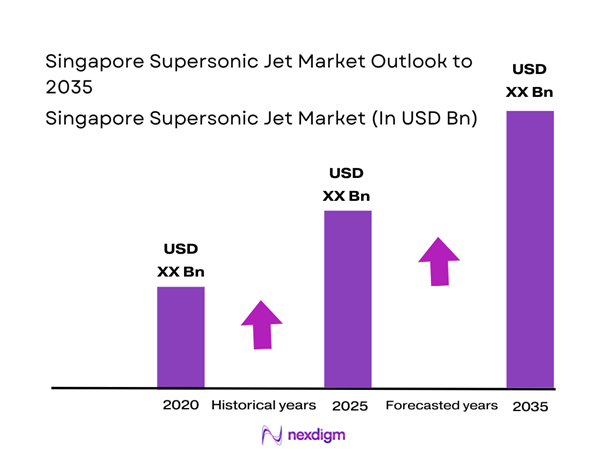
The Singapore Supersonic Jet market current size stands at around USD ~ million, reflecting early-stage commercial and defense-linked adoption activity. Demand is primarily driven by prototype development, testing programs, and preliminary procurement initiatives supported by aviation modernization strategies. During 2024 and 2025, platform evaluation programs expanded, supported by increased aerospace R&D spending and regional connectivity ambitions. The market remains limited in operational scale, yet demonstrates consistent growth signals driven by technological maturation and policy-backed aviation innovation initiatives.
Singapore’s dominance in the market is supported by its advanced aviation infrastructure, strong regulatory clarity, and established aerospace ecosystem. The presence of major maintenance, repair, and overhaul hubs strengthens readiness for supersonic operations. Demand concentration is centered around government-backed aviation programs, defense-linked testing initiatives, and premium commercial aviation stakeholders. The city-state’s strategic airspace management, innovation-friendly policies, and integration with regional aerospace supply chains further reinforce its leadership position within the Asia-Pacific supersonic aviation landscape.
Market Segmentation
By Fleet Type
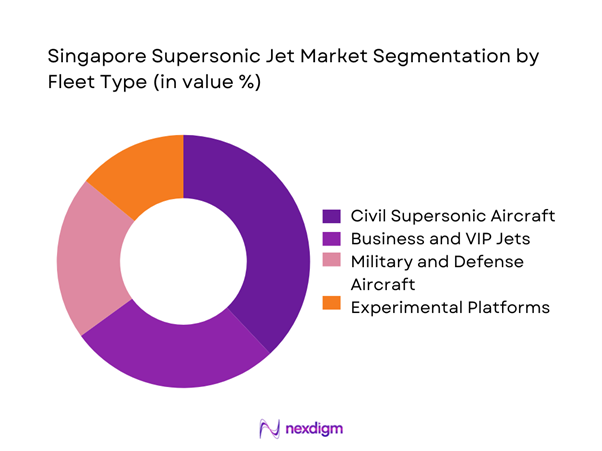
The market is primarily dominated by civil and experimental supersonic aircraft platforms due to ongoing testing programs and future commercial route planning. Business and VIP supersonic jets follow closely, supported by demand for time-sensitive executive travel and premium aviation services. Military and defense aircraft maintain steady relevance, particularly for surveillance, rapid response, and advanced testing roles. Experimental and prototype platforms account for a significant share, reflecting the market’s developmental stage and emphasis on performance validation, acoustic compliance, and sustainability testing within controlled airspace environments.
By Application
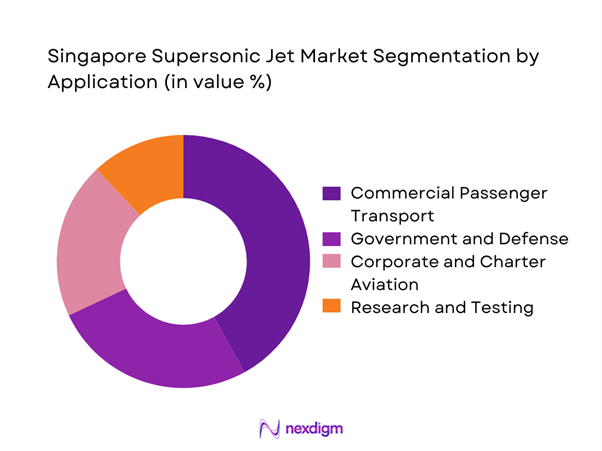
Commercial passenger transport represents the dominant application segment, driven by premium long-haul travel demand and reduced transit time objectives. Government and defense usage remains critical, focusing on reconnaissance, strategic mobility, and testing programs. Corporate and charter aviation follows as enterprises seek faster intercontinental connectivity. Research and experimental applications maintain relevance, supporting aerodynamic testing, propulsion optimization, and noise-reduction validation programs across controlled aviation corridors.
Competitive Landscape
The competitive landscape is moderately concentrated, characterized by aerospace manufacturers, propulsion system developers, and advanced aviation technology providers. Market participants focus on technological differentiation, regulatory alignment, and strategic collaborations with aviation authorities. Innovation intensity remains high, while commercialization timelines depend heavily on certification milestones and infrastructure readiness.
| Company Name | Establishment Year | Headquarters | Formulation Depth | Distribution Reach | Regulatory Readiness | Service Capability | Channel Strength | Pricing Flexibility |
| Boom Supersonic | 2014 | USA | ~ | ~ | ~ | ~ | ~ | ~ |
| Lockheed Martin | 1912 | USA | ~ | ~ | ~ | ~ | ~ | ~ |
| Northrop Grumman | 1939 | USA | ~ | ~ | ~ | ~ | ~ | ~ |
| Dassault Aviation | 1929 | France | ~ | ~ | ~ | ~ | ~ | ~ |
| Boeing | 1916 | USA | ~ | ~ | ~ | ~ | ~ | ~ |
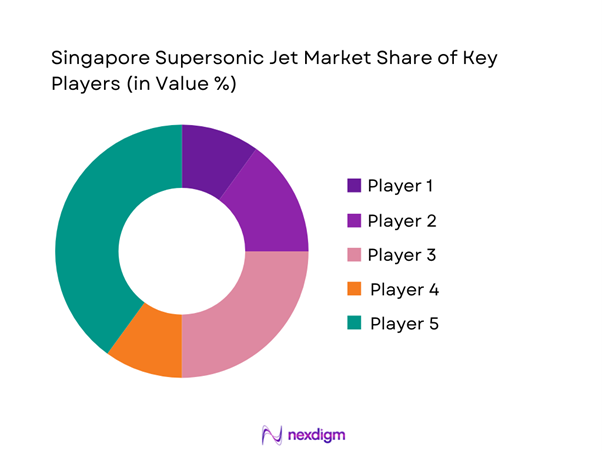
Singapore Supersonic Jet Market Analysis
Growth Drivers
Rising demand for ultra-fast intercontinental travel
The growing need for reduced long-haul travel time continues to support supersonic jet adoption across premium aviation segments. Business leaders increasingly value time efficiency, encouraging investment in faster air mobility solutions. In 2024, demand for rapid intercontinental connectivity strengthened across Asia-Pacific routes. Singapore’s geographic positioning enhances its role as a strategic transit hub. High-income passenger segments demonstrate willingness to adopt premium flight alternatives. Aviation stakeholders prioritize speed advantages for competitive differentiation. Infrastructure readiness supports testing and gradual operational integration. Airlines continue exploring high-yield routes suitable for supersonic deployment. Government-backed aviation programs reinforce industry confidence. These factors collectively strengthen market momentum.
Strategic positioning of Singapore as an aviation hub
Singapore’s established aviation ecosystem supports early adoption of advanced aerospace technologies. The presence of integrated MRO facilities enhances operational readiness for next-generation aircraft. Strong regulatory frameworks enable controlled experimentation and certification pathways. Investment in aerospace research facilities strengthens technological capabilities. Regional connectivity positions Singapore as a launch platform for supersonic services. Airport infrastructure supports high-performance aircraft requirements. Policy consistency encourages long-term industry participation. International collaborations strengthen technical knowledge transfer. Demand concentration supports pilot deployment programs. These elements collectively drive sustained market development.
Challenges
Strict sonic boom and noise regulations
Regulatory constraints on sonic boom emissions limit operational flexibility for supersonic aircraft. Urban density increases sensitivity to noise compliance requirements. Aviation authorities enforce stringent environmental impact assessments. Certification timelines extend due to evolving acoustic standards. Operational route planning remains restricted over populated regions. Compliance costs increase development complexity. Manufacturers must invest heavily in noise-mitigation technologies. Regulatory harmonization remains limited across jurisdictions. These constraints delay widespread commercial deployment. Market expansion depends on regulatory adaptation.
High development and certification costs
Supersonic aircraft development involves complex engineering and prolonged testing cycles. Certification requirements increase financial exposure for manufacturers. Advanced materials and propulsion systems elevate production expenses. Limited economies of scale constrain cost efficiency. Testing infrastructure demands significant capital commitment. Certification delays affect commercialization timelines. Smaller developers face entry barriers due to capital intensity. Risk profiles remain elevated for early-stage programs. Financial sustainability becomes critical for long-term participation. These factors collectively restrict rapid market expansion.
Opportunities
Next-generation low-emission supersonic aircraft
Development of low-emission propulsion systems creates opportunities for sustainable supersonic travel. Environmental compliance drives innovation in engine efficiency and fuel usage. Sustainable aviation fuel integration enhances regulatory acceptance. Aircraft manufacturers focus on reducing carbon intensity. Governments support cleaner aviation initiatives through policy frameworks. Demand for environmentally responsible travel continues rising. Technology advancements improve operational viability. Collaboration accelerates innovation timelines. Market acceptance improves with sustainability alignment. These developments create long-term growth potential.
Public-private partnerships in aerospace R&D
Collaborative research initiatives accelerate technological validation and certification readiness. Government funding reduces financial burden on manufacturers. Shared infrastructure enhances testing efficiency. Partnerships support knowledge exchange between academia and industry. National aerospace programs strengthen innovation ecosystems. Risk-sharing models improve investment confidence. Collaborative frameworks enable faster regulatory alignment. Public sector support enhances commercialization prospects. Regional cooperation expands research capabilities. These partnerships significantly enhance market development opportunities.
Future Outlook
The Singapore supersonic jet market is expected to progress steadily through the forecast period as regulatory clarity improves and technological validation advances. Continued investments in sustainable aviation, infrastructure readiness, and aerospace innovation will shape long-term growth. Strategic collaborations and phased commercialization are likely to define the market’s trajectory toward broader adoption.
Major Players
- Boom Supersonic
- Lockheed Martin
- Northrop Grumman
- Dassault Aviation
- Boeing
- Airbus
- GE Aerospace
- Rolls-Royce
- Honeywell Aerospace
- Safran
- RTX Corporation
- Mitsubishi Heavy Industries
- Singapore Technologies Aerospace
- Spike Aerospace
- Aerion Supersonic
Key Target Audience
- Commercial airline operators
- Business jet operators
- Defense and aerospace procurement agencies
- Civil aviation authorities of Singapore
- Ministry of Transport Singapore
- Aerospace manufacturing companies
- Airport infrastructure developers
- Investments and venture capital firms
Research Methodology
Step 1: Identification of Key Variables
Market boundaries, technology scope, application areas, and regulatory parameters were defined to establish analytical relevance and consistency.
Step 2: Market Analysis and Construction
Data was structured through evaluation of aircraft programs, infrastructure readiness, policy frameworks, and operational deployment trends.
Step 3: Hypothesis Validation and Expert Consultation
Insights were validated through engagement with aviation professionals, regulatory experts, and aerospace engineering specialists.
Step 4: Research Synthesis and Final Output
Findings were consolidated using triangulation methods to ensure accuracy, coherence, and strategic relevance.

- Executive Summary
- Research Methodology (Market Definitions and supersonic aviation scope framing, platform segmentation and aircraft classification logic, bottom-up fleet and order book based market sizing, revenue modeling by aircraft program and service lifecycle, primary interviews with OEMs airports and aviation regulators, triangulation using flight activity data certification pipelines and investment flows, assumptions on regulatory timelines and sonic boom compliance)

- Definition and Scope
- Market evolution
- Usage and operational deployment models
- Ecosystem structure
- Supply chain and MRO framework
- Regulatory and airspace governance environment

- Growth Drivers
Rising demand for ultra-fast intercontinental travel
Strategic positioning of Singapore as an aviation hub
Advancements in low-boom supersonic technologies
Increasing defense modernization spending
Growing interest from premium business travel segment
Supportive aerospace innovation ecosystem - Challenges
Strict sonic boom and noise regulations
High development and certification costs
Limited infrastructure readiness
Fuel efficiency and sustainability concerns
High acquisition and operating costs
Regulatory uncertainty for overland supersonic flight - Opportunities
Next-generation low-emission supersonic aircraft
Public-private partnerships in aerospace R&D
Expansion of premium point-to-point travel
Defense and surveillance aircraft modernization
Integration of sustainable aviation fuels
Regional leadership in supersonic testing corridors - Trends
Shift toward low-boom supersonic designs
Increased use of composite materials
Digital flight testing and simulation adoption
OEM collaborations with governments
Emphasis on sustainable propulsion technologies
Rising investment in supersonic business jets - Government Regulations
- SWOT Analysis
- Stakeholder and Ecosystem Analysis
- Porter’s Five Forces Analysis
- Competition Intensity and Ecosystem Mapping

- By Value, 2020–2025
- By Volume, 2020–2025
- By Installed Base, 2020–2025
- By Average Selling Price, 2020–2025

- By Fleet Type (in Value %)
Civil supersonic aircraft
Business and VIP supersonic jets
Military and defense supersonic platforms
Test and experimental aircraft - By Application (in Value %)
Commercial passenger transport
Government and defense operations
Corporate and charter aviation
Research and test flight operations - By Technology Architecture (in Value %)
Low-boom aerodynamic designs
Advanced composite airframes
Sustainable aviation fuel compatible engines
Hybrid propulsion and noise-mitigation systems - By End-Use Industry (in Value %)
Commercial aviation
Defense and homeland security
Private aviation and charter services
Aerospace research institutions - By Connectivity Type (in Value %)
Satellite-based connectivity
Air-to-ground communication systems
Hybrid connectivity architectures - By Region (in Value %)
Singapore domestic operations
Intra-Asia Pacific routes
Intercontinental long-haul routes

- Market structure and competitive positioning
Market share snapshot of major players - Cross Comparison Parameters (technology maturity, fleet size, certification progress, geographic presence, pricing strategy, partnerships, R&D intensity, aftersales capability)
- SWOT Analysis of Key Players
- Pricing and Commercial Model Benchmarking
- Detailed Profiles of Major Companies
Boom Supersonic
Lockheed Martin
Northrop Grumman
Spike Aerospace
Aerion Supersonic
Dassault Aviation
Boeing
Airbus
GE Aerospace
Rolls-Royce
Honeywell Aerospace
Safran
RTX Corporation
Singapore Technologies Aerospace
Mitsubishi Heavy Industries

- Demand and utilization drivers
- Procurement and tender dynamics
- Buying criteria and vendor selection
- Budget allocation and financing preferences
- Implementation barriers and risk factors
- Post-purchase service expectations

- By Value, 2026–2035
- By Volume, 2026–2035
- By Installed Base, 2026–2035
- By Average Selling Price, 2026–2035


 Request a Sample
 Ask for Customization
 Get a Quote
 Enquire Now