
 Download PDF
Market Overview
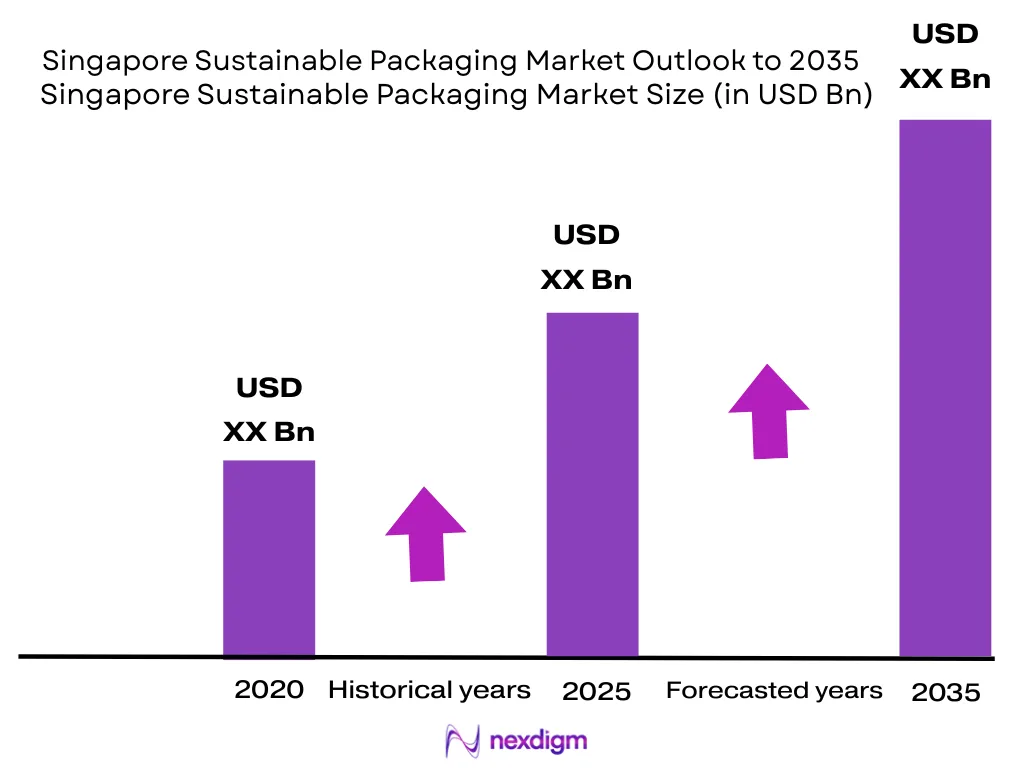
The Singapore Sustainable Packaging Market is valued at approximately USD ~ billion and is forecast to expand at a CAGR of % during 2026–2035. Demand is supported by food imports, advanced manufacturing, pharmaceuticals, electronics, aviation, hospitality, e-commerce, and regional distribution. Singapore’s total population increased from approximately 5.92 million to 6.04 million, while its high-value manufacturing and service economy creates demand for technically advanced, lightweight, traceable, recyclable, and reusable packaging. Jurong, Tuas, Pioneer, Woodlands, Senoko, Changi, Loyang, Pasir Panjang, and one-north dominate Singapore’s sustainable packaging ecosystem. Jurong and Tuas concentrate chemicals, food processing, logistics, waste treatment, and industrial conversion. Changi and Loyang support aviation, pharmaceuticals, electronics, and temperature-controlled logistics. Pasir Panjang provides port connectivity, while one-north and Science Park support material innovation, life-science packaging, digital traceability, and packaging research. Their dominance reflects customer proximity, infrastructure quality, skilled labour, and access to regional supply chains.
Market Segmentation
By Material Type
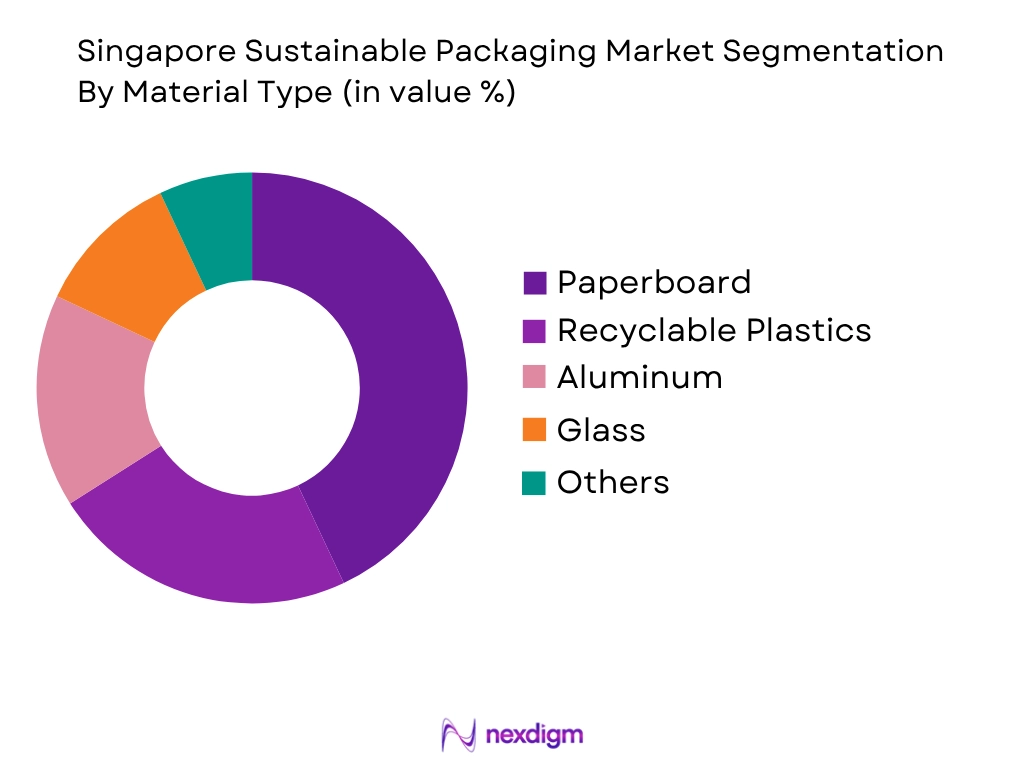
The Singapore Sustainable Packaging Market is segmented into paper and paperboard, recycled and recyclable plastics, aluminum and steel, glass, molded fiber, bio-based and compostable materials, wood, and sustainable composite structures. Paper and paperboard hold the dominant position because corrugated cases, folding cartons, paper mailers, bags, molded-fiber inserts, food boxes, cups, and protective packaging serve e-commerce, foodservice, electronics, pharmaceuticals, retail, and regional exports. Fiber packaging benefits from established commercial collection and its compatibility with right-sizing and lightweighting initiatives. Plastics remain indispensable where moisture protection, sterility, transparency, sealing, and low transport weight are required. Future plastic development will increasingly favour mono-material polyethylene or polypropylene formats, recycled PET, thinner films, compatible labels, and packaging designed for sorting and recycling. Metal beverage containers will gain additional relevance through Singapore’s beverage-return infrastructure, while reusable industrial packaging will remain important for electronics, healthcare, chemicals, and regional logistics.
By End-Use Industry
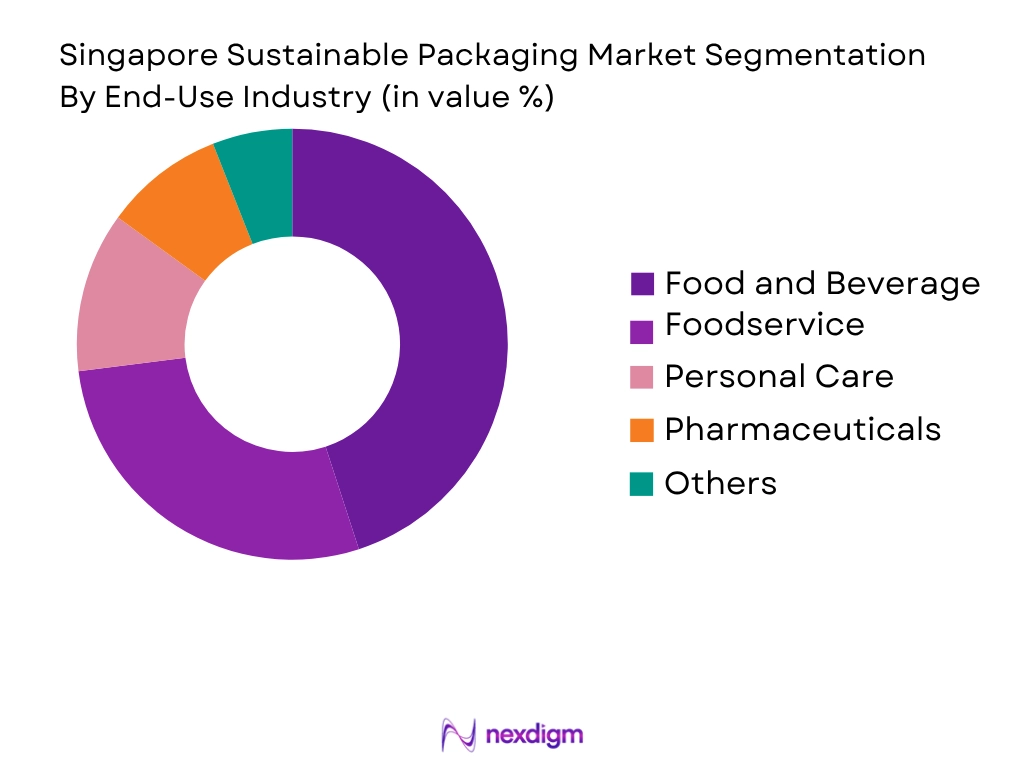
The Singapore Sustainable Packaging Market is segmented into food and beverage, foodservice and hospitality, healthcare and pharmaceuticals, electronics and semiconductors, e-commerce and retail, aviation catering, personal and household care, chemicals, and other industrial applications. Food and beverage hold the dominant position because Singapore imports and distributes substantial volumes of packaged food, beverages, ingredients, fresh products, dairy products, ready meals, snacks, bottled water, coffee, tea, and nutritional products. These categories require flexible films, cartons, bottles, cans, trays, closures, labels, and corrugated distribution cases. Foodservice demand is reinforced by hawker centres, restaurants, hotels, delivery platforms, institutions, and event venues. The Beverage Container Return Scheme increases the strategic importance of compatible PET bottles and metal cans. Healthcare and electronics require higher-value packaging with sterility, traceability, static protection, tamper evidence, barrier properties, and damage prevention, supporting specialized sustainable structures rather than simple material substitution.
Competitive Landscape
The Singapore Sustainable Packaging Market combines multinational packaging groups, regional converters, protective-packaging specialists, foodservice-packaging suppliers, carton-system providers, label companies, and local engineering businesses. Competition is based on material science, regional supply reliability, life-cycle performance, food-contact compliance, cleanroom capability, automation compatibility, lightweighting, recyclability, recycled content, packaging-reporting support, and technical design services. Multinational companies serve food, healthcare, and consumer-product customers, while local companies compete through rapid customization, industrial-packaging engineering, and proximity to electronics, medtech, logistics, and export customers.
| Company | Establishment Year | Headquarters | Core Sustainable Portfolio | Material Capability | Principal End Uses | Singapore Footprint | Circularity Capability | Strategic Differentiation |
| Amcor | 1860 | Zurich, Switzerland | ~ | ~ | ~ | ~ | ~ | ~ |
| Greenpac Singapore | 2002 | Singapore | ~ | ~ | ~ | ~ | ~ | ~ |
| Huhtamaki | 1920 | Espoo, Finland | ~ | ~ | ~ | ~ | ~ | ~ |
| Sealed Air | 1960 | Charlotte, United States | ~ | ~ | ~ | ~ | ~ | ~ |
| Tetra Pak | 1951 | Pully, Switzerland | ~ | ~ | ~ | ~ | ~ | ~ |
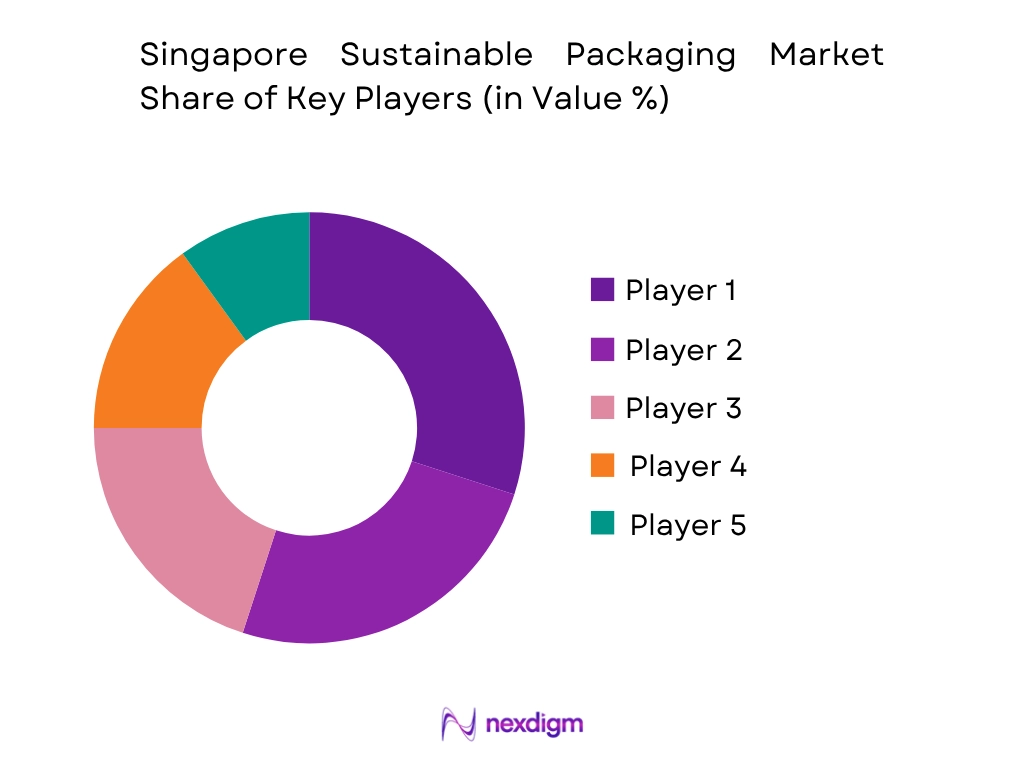
Singapore Sustainable Packaging Market Analysis
Growth Drivers
Mandatory Packaging Reporting and Producer Accountability
Singapore’s Mandatory Packaging Reporting framework is a direct growth driver for sustainable packaging because it requires larger producers to quantify packaging use and submit reduction, reuse or recycling plans. Companies with annual turnover above S$10 million in 2024 were required to report their 2025 packaging data and planned 3R initiatives between 1 January and 31 March 2026. This creates measurable demand for lightweight formats, recyclable mono-material structures, reusable transit systems and packaging-data management services. The policy is commercially important because packaging constitutes about one-third of Singapore’s domestic waste disposed of by weight. Producers can no longer treat packaging optimization solely as a voluntary corporate initiative; material composition, pack weight and reduction projects must be documented through an official reporting process. The requirement applies across food, beverages, consumer goods, electronics, e-commerce and other packaged-product categories, supporting demand for converters capable of redesigning packaging without affecting product protection. Singapore’s macroeconomic capacity reinforces implementation: the IMF recorded nominal GDP of US$547.5 billion, population of 6.0 million and GDP per capita of US$90,689 in 2024. These indicators reflect a high-value consumption and manufacturing economy in which multinational brand owners possess both the regulatory obligation and financial capacity to adopt advanced sustainable packaging systems.
Beverage Container Return Scheme and High-Volume Consumption Channels
The Beverage Container Return Scheme is accelerating redesign and recovery infrastructure for plastic beverage bottles and metal cans. The scheme commenced on 1 April 2026, and all regulated beverage products supplied from 1 October 2026 must display the official deposit mark and carry a refundable deposit of S$0.10. It covers pre-packaged beverages in plastic bottles and metal cans ranging from 150 millilitres to 3 litres. This framework creates demand for scannable labels, compatible adhesives, standardized barcodes, recyclable container designs and packaging capable of passing through reverse-vending systems. The opportunity is supported by Singapore’s large foodservice, retail and tourism ecosystem. Singapore Department of Statistics data placed December 2024 food-and-beverage service sales at approximately S$1.0 billion, with online transactions contributing nearly one-quarter of the month’s sales. Retail sales reached S$4.6 billion in the same month, including substantial activity in supermarkets, food retail and convenience channels. Singapore also had a population of approximately 6.0 million and nominal GDP of US$547.5 billion, according to the IMF. These consumption volumes create a continuous flow of beverage containers, takeaway packs and delivery packaging, making collection-compatible design and closed-loop material recovery increasingly relevant to beverage producers, retailers, foodservice operators and packaging suppliers.
Market Challenges
High Conversion and Compliance Investment
Transitioning to sustainable packaging can require substantial initial investment because companies must evaluate new materials, redesign packs, modify filling lines, update labels and document packaging quantities under the national reporting framework. Recyclable mono-material films may require different sealing temperatures, barrier coatings or production speeds from conventional multilayer laminates. Beverage companies must also prepare container labels, deposit marks and barcode systems for the return scheme, while retailers and collection operators need reverse-vending, sorting and storage infrastructure. These expenditures are difficult to recover immediately where existing packaging lines remain technically functional. The challenge is particularly relevant for smaller suppliers serving large multinational customers, because brand owners may require documented recyclability, carbon information and consistency across multiple markets. Singapore’s economy generated US$547.5 billion in nominal GDP and US$90,689 per person in 2024, but its limited land area and high-value operating environment place pressure on factory space, warehousing and waste-handling infrastructure. Companies reporting packaging data must also maintain internal systems capable of separating material types, packaging levels and product categories. The financial burden therefore extends beyond purchasing sustainable material. It includes testing, machine trials, artwork changes, staff training, reporting systems, supplier qualification and, in some cases, parallel inventory during the transition from legacy packaging to compliant formats.
Material Performance and Domestic Recycling Constraints
Technical performance remains a major challenge because sustainable packaging must meet Singapore’s requirements for moisture resistance, food safety, shelf life, transport durability and tropical-climate stability. Replacing multilayer barrier laminates with mono-material structures can affect oxygen protection, puncture resistance, print quality and sealing reliability. Fibre-based packaging may need coatings for grease or moisture resistance, but certain coatings can complicate recycling. Reusable packaging systems must also withstand repeated washing, handling and reverse-logistics cycles. The challenge is intensified by Singapore’s limited land and dependence on imported raw materials, recovered-material markets and regional recycling capacity. The National Environment Agency has stated that packaging accounts for around one-third of domestic waste disposed of and that about 60 units out of every 100 units of this packaging waste are plastic. Although the user requested numbers rather than percentages, the policy significance can be expressed as approximately 60 kilograms of plastic for every 100 kilograms of packaging waste. Singapore’s 2024 population of 6.0 million and GDP of US$547.5 billion generate high consumption density within a small geographic area. Companies must therefore design packaging not only for theoretical recyclability but also for actual collection, sorting and processing conditions. Limited local end-markets for certain recovered polymers or composite formats can weaken the economics of circular packaging even when technical redesign has been completed.
Market Opportunities
Smart Packaging, Data Systems and Design Optimization
Technological advancement creates an opportunity for Singapore to combine sustainable packaging with digital traceability, automated reporting and material optimization. Companies covered by Mandatory Packaging Reporting need accurate information on packaging weight, material type and planned reduction initiatives. Digital product records, enterprise resource-planning integration and packaging lifecycle databases can reduce manual reporting and allow companies to identify high-material-use stock-keeping units. Artificial-intelligence-assisted design and simulation can reduce packaging dimensions, improve pallet utilization and test whether thinner materials can retain compression or barrier performance. Smart labels and machine-readable identifiers will also support the Beverage Container Return Scheme, which applies a S$0.10 deposit to regulated containers from October 2026. The commercial base for these systems is substantial: Singapore recorded nominal GDP of US$547.5 billion, GDP per capita of US$90,689 and population of 6.0 million in 2024. The World Bank also reported that approximately 94 people out of every 100 people used the internet, indicating strong digital infrastructure for connected consumer and supply-chain applications. In foodservice, December 2024 online sales contributed approximately S$248 million of the month’s S$1.0 billion in total sales when the official online proportion is converted into an absolute value. This digital ordering volume supports future demand for right-sized delivery packaging, reusable systems, traceable containers and data-enabled packaging optimization.
Regional Collaboration and Circular Packaging Platforms
Singapore’s position as a regional headquarters, trading and logistics hub creates an opportunity to develop sustainable packaging platforms for Southeast Asia rather than only the domestic market. Multinational food, beverage, electronics, aviation and consumer-goods companies can test packaging formats in Singapore, establish regional specifications and then deploy qualified solutions across neighbouring markets. The country’s 2024 goods-export structure was concentrated in machinery, transport equipment, chemicals and manufactured articles, while nominal GDP reached US$547.5 billion. This supports demand for high-performance protective packaging, reusable industrial containers, export cartons and material-efficient transit systems. The opportunity also extends to collaboration among packaging converters, recyclers, retailers, logistics providers and brand owners. Shared standards can improve resin quality, labelling consistency and regional acceptance of recycled content. Singapore’s Beverage Container Return Scheme provides a current operating foundation through the collection of plastic bottles and metal cans from 150 millilitres to 3 litres, while the S$0.10 deposit creates a defined value for returning each eligible container. International partnerships can help process recovered materials, develop food-grade recycled resin and establish regional end markets where domestic scale is insufficient. Singapore’s population of 6.0 million limits local collection volume compared with larger countries, but its regulatory stability, high-value manufacturing and concentration of regional corporate decision-makers make it suitable for piloting circular packaging technology, financing infrastructure and coordinating cross-border recovery systems.
Future Outlook
The Singapore Sustainable Packaging Market is expected to advance through 2035 as regulation, corporate reporting, beverage-container deposits, e-commerce design standards, regional trade, and advanced manufacturing increase the value placed on packaging circularity. The market will move from broad sustainability commitments toward measurable packaging weight, recycled content, return eligibility, reuse cycles, carbon performance, and verified end-of-life routes. Mandatory Packaging Reporting will remain a central demand catalyst. Companies meeting the applicable turnover threshold must submit packaging data and plans to reduce, reuse, or recycle packaging. For the 2026 reporting cycle, companies with annual turnover exceeding S$10 million in 2024 must report their packaging data for calendar year 2025 and submit their 3R plans. This increases demand for material inventories, package-weight databases, supplier declarations, reduction roadmaps, internal controls, and reporting software.
Major Players
- Amcor Singapore
- Huhtamaki Singapore
- Sealed Air Singapore
- Tetra Pak South East Asia
- SIG Singapore
- Crown Asia Pacific Holdings
- Greenpac Singapore
- Tat Seng Packaging Group
- Teo Soon Seng
- New Toyo International Holdings
- Starlite Printers Singapore
- Fagerdala Singapore
- Thong Guan Industries Singapore
- BioPak Singapore
- Avery Dennison Singapore
Key Target Audience
- Packaging material manufacturers and converters
- Food, beverage, personal-care, and household-product companies
- Healthcare, pharmaceutical, medtech, and electronics manufacturers
- Retailers, e-commerce platforms, and logistics providers
- Hotels, airlines, foodservice operators, and institutional caterers
- Investments and venture capitalist firms
- Private-equity and strategic packaging investors
- Government and regulatory bodies
Research Methodology
Step 1: Identification of Key Variables
The initial phase maps packaging converters, importers, material suppliers, brand owners, retailers, foodservice operators, healthcare companies, electronics manufacturers, waste collectors, scheme operators, recyclers, and regulators. Key variables include package weight, material composition, recycled content, return eligibility, reporting exposure, food-contact status, reusability, and recovery pathway.
Step 2: Market Analysis and Construction
Historical data is compiled by material, format, end use, packaging level, customer category, and circularity strategy. Bottom-up analysis evaluates converter shipments, packaging-unit consumption, material tonnage, imports, customer procurement, and reusable-system activity. Top-down analysis reviews manufacturing, trade, foodservice, retail, aviation, pharmaceuticals, electronics, and waste flows.
Step 3: Hypothesis Validation and Expert Consultation
Market hypotheses are validated through computer-assisted telephone interviews with packaging engineers, procurement managers, beverage producers, retailers, food manufacturers, recyclers, deposit-scheme stakeholders, converters, and regulatory specialists. Consultations assess material switching, reporting processes, deposit readiness, food-contact testing, supply risks, collection access, and commercial adoption barriers.
Step 4: Research Synthesis and Final Output
Supply-side and demand-side findings are triangulated to reconcile domestic conversion, packaging imports, customer use, material recovery, and reusable-system activity. Segment shares and forecasts are tested against material weight, package units, industrial output, regulatory implementation, capacity additions, trade activity, company disclosures, and expert feedback.

- Executive Summary
- Research Methodology (Market Definitions and Assumptions, Sustainable Packaging Inclusion and Exclusion Criteria, Abbreviations, Market Sizing Approach, Top-Down Analysis, Bottom-Up Analysis, Packaging Material Flow Model, Packaging Unit Conversion Model, Demand-Side Assessment, Supply-Side Assessment, Converter Capacity Assessment, Import and Re-Export Analysis, Primary Industry Interviews, Data Triangulation, Regulatory Scenario Modelling, Forecasting Framework, Limitations and Future Conclusions)

- Definition and Scope
- Market Evolution and Industry Genesis
- Transition from Conventional Packaging to Circular Packaging Systems
- Evolution of Packaging Reduction and Lightweighting
- Development of Recycled-Content Packaging
- Expansion of Paper, Paperboard and Molded-Fiber Packaging

- Growth Drivers (Mandatory Packaging Reporting, Beverage Container Return Scheme, High-Value Manufacturing, Food and Beverage Trade, E-Commerce, Aviation and Tourism, Corporate Decarbonization and Regional Headquarters Demand)
- Market Challenges (Limited Domestic Recycling Land, Dependence on Imported Feedstock, Flexible Packaging Recovery Gaps, Food-Contact Constraints, Contamination in Mixed Recycling, High Product-Protection Requirements and Cross-Border Material Traceability)
- Market Opportunities (Deposit-Compatible Beverage Packaging, Food-Grade Recycled PET, Mono-Material Flexible Packaging, Reusable Foodservice Systems, Circular E-Commerce Packaging, Advanced Sorting, Chemical Recycling and Regional Sustainable Packaging Innovation)
- Market Trends (Packaging Lightweighting, Paperization, High-PCR Packaging, Refill Pouches, Recyclable Laminates, Reusable Hawker Containers, Digital Deposit Marks, Smart Reverse Vending, Product Passports and Packaging Carbon Disclosure)
- SWOT Analysis
- Porter’s Five Forces Analysis
- PESTLE Analysis

- By Market Value (2020-2025)
- By Packaging Volume (2020-2025)
- By Packaging Unit Shipments (2020-2025)

- By Material Type (In Value %)
Paper and Paperboard
Corrugated Board
Molded Fiber
Recycled Plastic
Bio-Based Plastic
Compostable Plastic - By End-Use Industry (In Value %)
Food and Beverage
Personal Care and Cosmetics
Household Care
Healthcare and Pharmaceuticals
Electronics and Semiconductors
E-Commerce - By Distribution Channel (In Value %)
Direct Sales to Brand Owners
Packaging Distributors
Contract Packaging Companies
Digital Packaging Platforms
Industrial Wholesalers
Retail Packaging Suppliers
E-Commerce Packaging Providers - By Industrial and Logistics Cluster (In Value %)
Jurong and Tuas Industrial Cluster
Pioneer Industrial Area
Woodlands Industrial Cluster
Senoko Industrial Estate
Changi Logistics and Aviation Cluster

- Market Share of Major Players
- Cross Comparison Parameters (Sustainable Material Portfolio Breadth, Post-Consumer Recycled and Circular Polymer Capability, Design-for-Recycling and Lightweighting Expertise, Singapore Manufacturing and Regional Supply Footprint, Mandatory Packaging Reporting and Deposit Scheme Support Capability, Food-Contact and Product-Traceability Capability, End-Use Industry Coverage, Packaging Innovation and Commercialization Speed)
- SWOT Analysis of Major Players (Portfolio Strength, Circularity Capability, Regional Reach, Feedstock Exposure and Growth Potential)
- Detailed Profiles of Major Companies
Amcor Singapore
Huhtamaki Singapore
Sealed Air Singapore
Tetra Pak South East Asia
SIG Singapore
Crown Asia Pacific Holdings
Greenpac Singapore
Tat Seng Packaging Group
Teo Soon Seng
New Toyo International Holdings
Starlite Printers Singapore
Fagerdala Singapore
Thong Guan Industries Singapore
BioPak Singapore
Avery Dennison Singapore

- Food and Beverage Brand Analysis
- Beverage Producer Analysis
- Grocery Retailer Analysis
- E-Commerce and Marketplace Analysis
- Foodservice and Hawker Operator Analysis
- Hotel and Tourism Analysis

- By Market Value (2026-2035)
- By Packaging Volume (2026-2035)
- By Packaging Unit Shipments (2026-2035)


 Request a Sample
 Ask for Customization
 Get a Quote
 Enquire Now