
 Download PDF
Market Overview
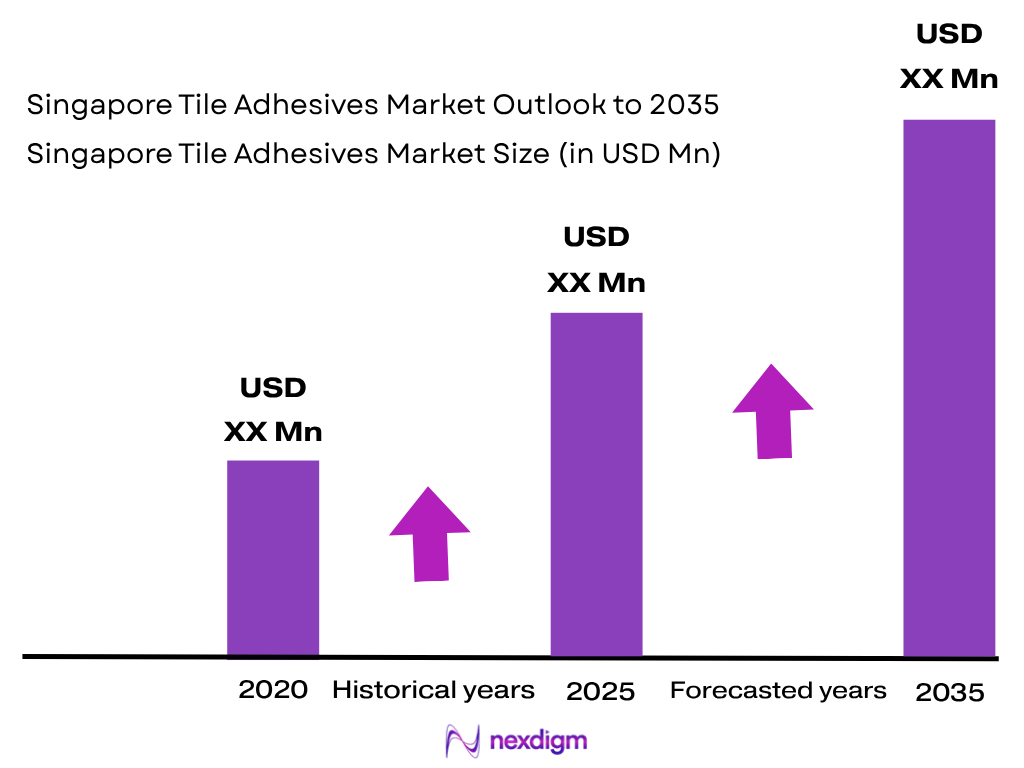
The Singapore Tile Adhesives Market is valued at approximately ~USD XX million, supported by public housing, private residential construction, institutional buildings and renovation. Construction demand increased from S$33.8 billion in the preceding observation to S$44.2 billion in the latest observation. Private residential completions moved from 21,284 units to 10,617 units, while HDB upgrading continued to support recurring bathroom, kitchen and replacement-tile applications requiring factory-mixed adhesive systems.
Central Singapore, established HDB towns and growth areas in the East, North-East and West dominate tile adhesive consumption because they combine condominium development, public-housing upgrading, commercial properties and transport infrastructure. Public construction demand reached S$19.5 billion in the preceding observation, while total construction demand subsequently reached S$44.2 billion. Separately, about 410,000 HDB flats had been selected for HIP and approximately 370,000 had already undergone upgrading, creating a substantial renovation-oriented installation base.
Market Segmentation
By Adhesive Technology
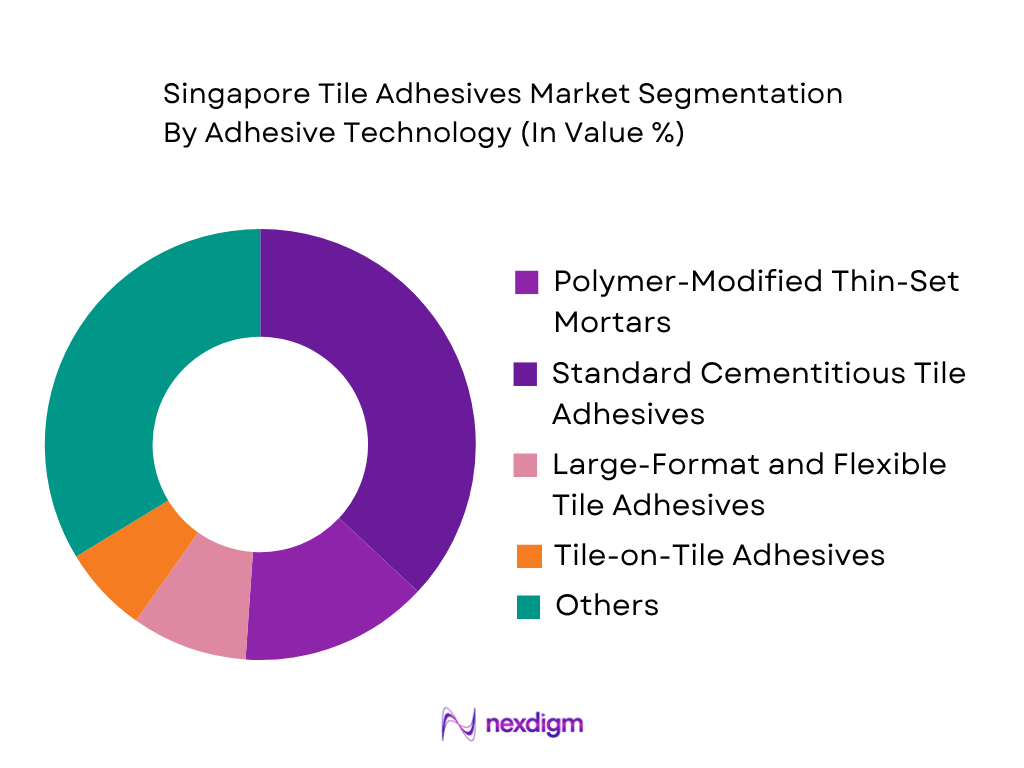
The Singapore Tile Adhesives Market is segmented into standard cementitious adhesives, polymer-modified cementitious adhesives, C2 high-performance products, C2TE systems, S1/S2 flexible adhesives, large-format products, rapid-setting adhesives, tile-on-tile systems and reaction-resin adhesives. Polymer-modified and C2-class cementitious adhesives hold the dominant modeled share because Singapore’s tile installation environment increasingly involves porcelain, homogeneous tiles, wet areas and large formats that require greater bond strength and moisture resistance than conventional cement-sand bedding. BCA guidance references EN 12004, EN 12002 and ISO 13007-1 for the classification and performance of tile adhesives. Singapore’s product market already includes C1, C2S1E and C2S2TE systems, indicating a mature performance ladder covering standard installation through highly deformable applications. SikaCeram-268 SAC 28, for example, is classified C2S1E and incorporates approved recycled material, while Sika’s local portfolio also includes a C2S2TE flexible adhesive.
By Tile and Stone Type
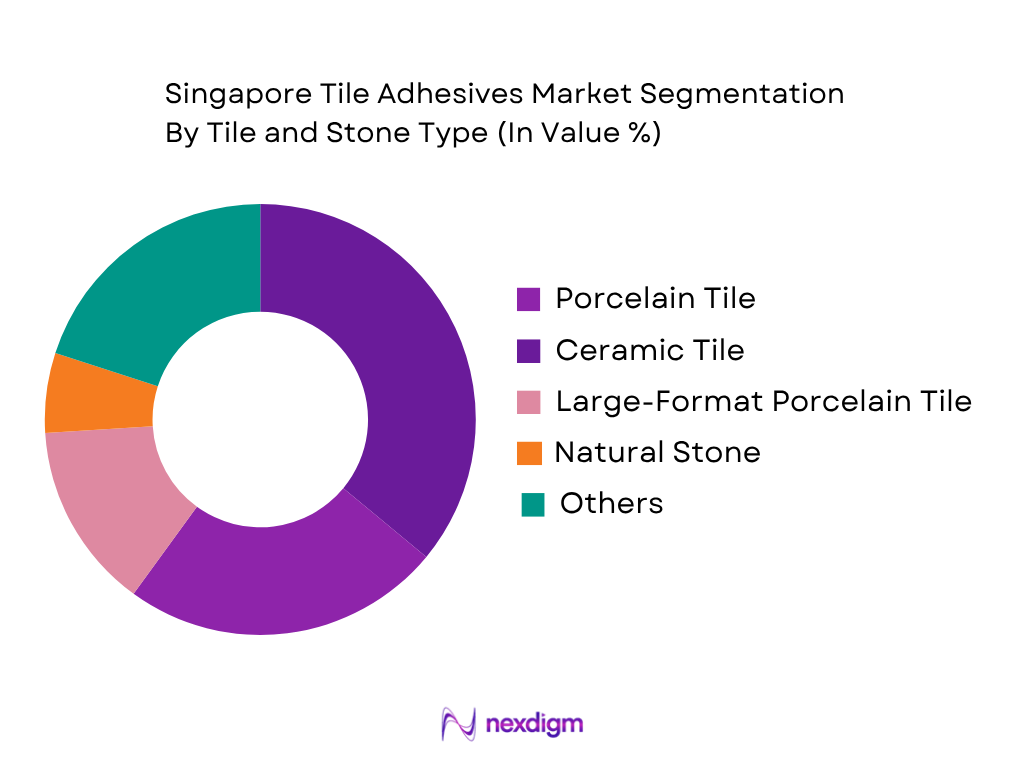
The Singapore Tile Adhesives Market is segmented into ceramic, homogeneous, porcelain, large-format porcelain, large ceramic panels, natural stone, marble, granite and mosaics. Porcelain and homogeneous tiles hold the dominant modeled share because they are widely suited to apartments, bathrooms, commercial interiors and institutional buildings, while their reduced porosity makes higher-bond adhesives more important. Large-format products are also increasing technical requirements. BCA defines conventional ceramic tile as having a surface area not exceeding 3,600 cm², while large-format ceramic tiles exceed 3,600 cm² and large ceramic panels exceed 1 m²; panels can reach approximately 3.6 m by 1.5 m. Such dimensions place greater emphasis on flat substrates, complete adhesive coverage and deformability. Local suppliers consequently offer C2S1E and C2S2TE systems designed for porcelain, vitrified, natural-stone and large-format applications, indicating increasing product specialization.
Competitive Landscape
The Singapore Tile Adhesives Market combines multinational construction-chemical companies with established local and regional dry-mix suppliers. Sika/Davco, Saint-Gobain Weber/E.MIX, MAPEI, LATICRETE and Bostik compete through EN 12004/ISO 13007 performance classes, flexible large-format systems, wet-area capability, green-product credentials and local technical support. Competition is increasingly based on system compatibility and specification strength rather than standard cementitious adhesive availability alone.
| Major Player | Establishment Year | Headquarters | C2 / Flexible Adhesive Capability | Large-Format Capability | Singapore Manufacturing / Supply | Wet-Area / Renovation Systems | Green Product Capability | Technical / Project Support |
| Sika / Davco | 1910 | Baar, Switzerland | ~ | ~ | ~ | ~ | ~ | ~ |
| Saint-Gobain Weber / E.MIX | 1984 Singapore operation | Singapore | ~ | ~ | ~ | ~ | ~ | ~ |
| MAPEI | 1937 | Milan, Italy | ~ | ~ | ~ | ~ | ~ | ~ |
| LATICRETE | 1956 | Bethany, Connecticut, USA | ~ | ~ | ~ | ~ | ~ | ~ |
| Bostik / Arkema | 1889 | Colombes, France | ~ | ~ | ~ | ~ | ~ | ~ |
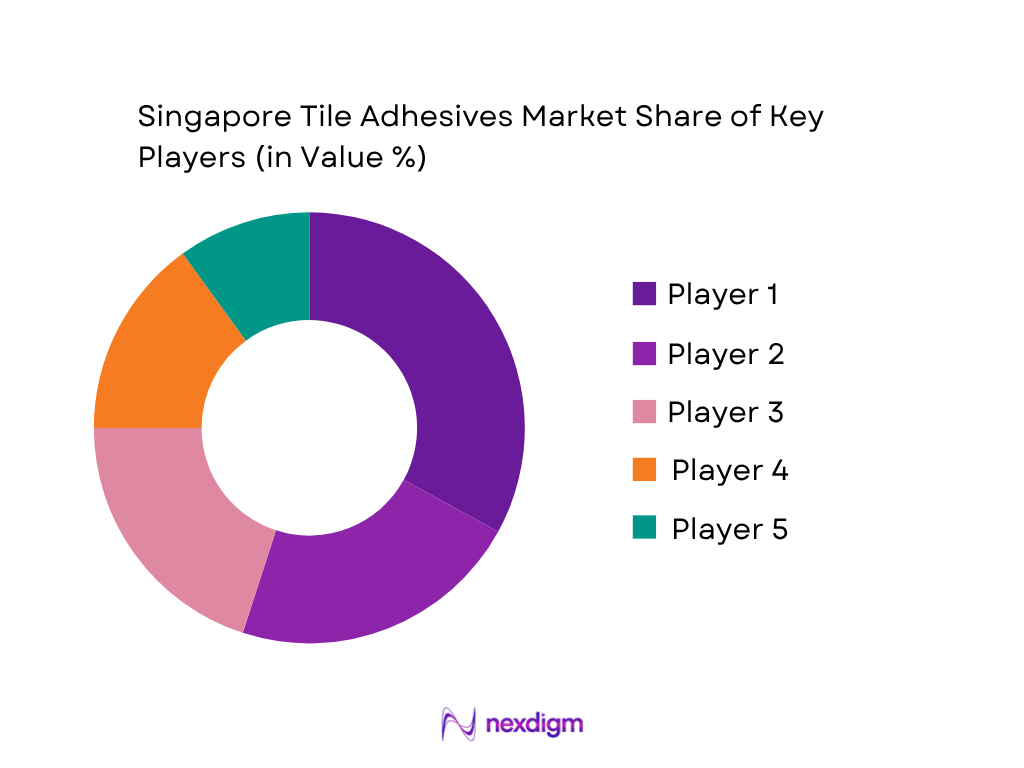
Singapore Tile Adhesives Market Analysis
Growth Drivers
HDB Upgrading and Bathroom Renovation Are Creating Recurring Adhesive Demand
Singapore’s large public-housing renovation base is a direct growth driver for tile adhesives used in bathrooms, toilets, kitchens and replacement flooring. HDB reported that about 410,000 flats had been selected for the Home Improvement Programme as of June 2024, with approximately 370,000 flats already upgraded; a further more than 53,000 flats were added in the latest selection. The Government had spent approximately S$4 billion on HIP by that point, while the latest batch alone was allocated more than S$742 million for upgrading works. These projects create recurring demand for wet-area tile adhesives, waterproofing-compatible mortars, rapid-setting products and tile-on-tile systems, particularly where older bathrooms require faster refurbishment with controlled disruption. HDB’s programme also spans estates including Jurong West, Hougang, Woodlands and Pasir Ris, broadening demand geographically. The underlying macroeconomic environment remains supportive: World Bank data place Singapore’s 2024 GDP at USD547.39 billion, GDP per capita at USD90,674.1, and population growth at 2.0. Singapore’s combination of a mature installed housing stock, government-funded upgrading and high household purchasing power therefore creates a durable renovation-driven demand base for factory-mixed tile adhesives.
Private Residential and High-Specification Construction Support Premium Tile Systems
Private residential development and high-specification construction are increasing demand for polymer-modified, large-format and deformable tile adhesives. URA recorded 10,617 private residential and executive-condominium units completed in 2024, following 21,284 units completed in 2023, while the 2024 resale market generated 14,053 transactions, compared with 11,329 in the preceding year. BCA separately reported total construction demand of S$44.2 billion in 2024, with certified construction output reaching S$38.4 billion. This activity spans housing, healthcare, educational facilities, transport infrastructure and commercial redevelopment, creating diverse requirements for porcelain, homogeneous, stone and large-format tile systems. BCA guidance classifies large-format ceramic tiles as surfaces above 3,600 cm², while large ceramic panels exceed 1 m² and may reach approximately 3.6 m by 1.5 m, increasing the need for flatter substrates, greater adhesive transfer and flexible mortars. World Bank data record Singapore’s 2024 GDP at USD547.39 billion and GDP per capita at USD90,674.1, supporting continued specification of higher-performance construction materials rather than basic cement-sand bedding alone.
Market Challenges
Large-Format Installation and Limited Working Space Increase Execution Risk
Singapore’s dense urban construction environment creates installation challenges where large-format tiles, restricted work areas and tight renovation schedules increase sensitivity to substrate condition and workmanship. BCA defines large-format ceramic tiles as surfaces exceeding 3,600 cm², while large ceramic panels exceed 1 m² and can reach approximately 3.6 m in length and 1.5 m in width. These dimensions require more even substrates, higher adhesive transfer and stricter control of trowel technique than conventional smaller tiles. In HDB renovation, these technical requirements intersect with occupied-building constraints: approximately 370,000 flats had already undergone HIP upgrading as of June 2024, and more than 53,000 additional flats were selected for another upgrading batch. Poor surface preparation, incomplete back-buttering, inadequate coverage or excessive mortar skinning can therefore cause debonding or lippage while also increasing rework in small bathrooms and kitchens where contractor access is limited. BCA’s 2024 construction output reached S$38.4 billion, indicating the scale over which consistent execution is required. World Bank data place Singapore’s 2024 GDP at USD547.39 billion and GDP per capita at USD90,674.1, reinforcing expectations for high-quality, technically compliant installation across residential and commercial projects.
Imported Specialty Inputs and Green-Product Compliance Raise Supplier Complexity
Tile adhesive manufacturers and importers in Singapore face a more demanding supply and compliance environment as product selection increasingly incorporates sustainability alongside bond performance. The Singapore Green Building Product certification framework evaluates construction materials through a 1-to-4-tick sustainability rating system, while certified products can contribute to project Green Mark performance. The Green Mark for Interiors scheme also became effective from 1 November 2025, extending sustainability assessment across commercial offices, restaurants, retail spaces, supermarkets and laboratories. This creates additional requirements for suppliers developing polymer-modified mortars, low-emission products and adhesives containing recycled materials. Formulators simultaneously depend on specialized polymer, cellulose and rheology inputs that may be sourced regionally or internationally rather than from a fully domestic chemical feedstock base. BCA recorded S$44.2 billion of construction demand in 2024, meaning suppliers must manage these technical and sustainability requirements at substantial project scale. World Bank data place Singapore’s 2024 GDP at USD547.39 billion, GDP per capita at USD90,674.1, and economic growth at 4.4. Suppliers therefore need strong formulation control, import planning, documentation and certification capability to compete effectively in the Singapore Tile Adhesives Market.
Market Opportunities
C2TE, S1/S2 and Large-Format Adhesives Can Capture Higher-Specification Projects
C2TE and deformable S1/S2 systems offer a strong future opportunity as Singapore increasingly uses larger porcelain and ceramic formats in residential, commercial and institutional buildings. BCA currently distinguishes large-format tiles above 3,600 cm² and large ceramic panels above 1 m², with panel dimensions reaching roughly 3.6 m by 1.5 m. These formats require stronger wetting, better transfer and greater movement accommodation, creating a technical advantage for higher-performance polymer-modified mortars over conventional cement-sand bedding. The opportunity is supported by current construction activity rather than future projections: total construction demand reached S$44.2 billion in 2024, while construction output reached S$38.4 billion. Private residential development added 10,617 completed units, creating new bathrooms, kitchens, balconies and interior floors suitable for premium adhesive systems. Large institutional and infrastructure projects also expand the specification base for deformable and water-resistant mortars. World Bank data record Singapore’s 2024 GDP at USD547.39 billion, GDP per capita at USD90,674.1, and growth at 4.4. These current project volumes and macroeconomic indicators support future expansion of C2TE, S1/S2 and large-format adhesive technologies without relying on projected market-size figures.
HDB Renovation and Green-Certified Adhesives Create a Premium Replacement Opportunity
HDB renovation, tile-on-tile installation and environmentally certified products provide another strong future avenue for the Singapore Tile Adhesives Market. HDB had selected approximately 410,000 flats for the Home Improvement Programme by June 2024, with about 370,000 upgraded, and subsequently added more than 53,000 flats under another selection. This large installed base creates future replacement demand for bathroom and kitchen finishes, where tile-on-tile and rapid-setting systems can reduce demolition, shorten downtime and limit disruption in occupied homes. Sustainability requirements strengthen the opportunity further. The Singapore Green Building Product scheme uses a 1-to-4-tick certification structure, while Green Mark for Interiors applies to multiple commercial interior categories from 1 November 2025 onward. By 2026, Green Mark Version 7 had also been introduced as the latest national green-building framework. These developments increase the relevance of recycled-content, low-emission and certified adhesive formulations. World Bank data place Singapore’s 2024 GDP at USD547.39 billion, GDP per capita at USD90,674.1, and growth at 4.4. Combined with the large renovation stock, these current indicators support future premiumization toward rapid-renovation and sustainability-oriented tile adhesive systems.
Future Outlook
The Singapore Tile Adhesives Market is forecast to expand at approximately ~X.X% CAGR during 2026–2035. Growth is expected to be shaped by HDB upgrading, new public housing, private residential projects, commercial redevelopment, transport infrastructure and increasing specification of large-format and green-certified tile installation systems. Construction activity provides a strong underlying pipeline. Preliminary actual construction demand reached S$44.2 billion in 2024, compared with S$33.8 billion in 2023. BCA attributed the increase to institutional projects and public and private housing, illustrating the importance of building construction to tile adhesive demand.
Major Players
- Sika Singapore / Davco
- Saint-Gobain Weber / E.MIX Singapore
- MAPEI Singapore
- LATICRETE South East Asia
- Bostik Singapore / Arkema
- ARDEX Singapore
- Fosroc Singapore
- QUICSEAL Construction Chemicals
- Global Construction Chemicals
- CLP International
- BuildBond
- ParexGroup Singapore / Sika
- MC-Bauchemie Singapore
- Terraco Singapore
- Cemkrete Products
Key Target Audience
- Tile Adhesive and Dry-Mix Mortar Manufacturers
- Ceramic, Porcelain and Natural Stone Suppliers
- Property Developers and Main Contractors
- HDB Upgrading and Renovation Contractors
- Tile, Stone and Interior Installation Contractors
- Building Material and Construction Chemical Distributors
- Investments and Venture Capitalist Firms
- Government and Regulatory Bodies (Building and Construction Authority, Housing & Development Board, Urban Redevelopment Authority, Singapore Green Building Council)
Research Methodology
Step 1: Identification of Key Variables
The initial phase involves constructing an ecosystem map encompassing cement and polymer suppliers, tile adhesive producers, tile distributors, developers, contractors and tilers. Desk research identifies critical variables including adhesive class, tile format, substrate, HDB renovation intensity, private housing completions, wet-area requirements, green certification and local manufacturing availability.
Step 2: Market Analysis and Construction
Historical information for the Singapore Tile Adhesives Market is analyzed through top-down and bottom-up methodologies. Top-down assessment uses construction demand, housing activity and renovation programmes, while bottom-up modelling evaluates installed tile area, adhesive coverage, application thickness, tile format and the proportion of conventional versus factory-mixed installation systems.
Step 3: Hypothesis Validation and Expert Consultation
Market hypotheses are validated through computer-assisted telephone interviews with adhesive manufacturers, building-material distributors, tiling contractors, renovation companies and project procurement professionals. These consultations test assumptions regarding C2 penetration, flexible adhesive usage, large-format applications, HDB renovation demand, green-product preference and installation practices.
Step 4: Research Synthesis and Final Output
The final phase triangulates BCA construction information, HDB upgrading data, URA housing statistics, technical standards, manufacturer documentation and primary research. Bottom-up adhesive-consumption models are reconciled against construction and renovation activity to determine segmentation, competitive positioning, customer requirements and the strategic outlook for the Singapore Tile Adhesives Market.

- Executive Summary
- Research Methodology (Market Definitions and Assumptions, Singapore Tile Adhesives Market Boundary, Cementitious Dispersion and Reaction-Resin Adhesive Classification, EN 12004 Classification Mapping, EN 12002 Deformability Assessment, ISO 13007-1 Alignment, C1 and C2 Adhesive Assessment, C2TE Performance Assessment, S1 and S2 Deformability Assessment, Large-Format Tile Adhesive Assessment, Homogeneous and Porcelain Tile Assessment, Natural Stone Adhesive Assessment, Wet-Area Adhesive Assessment, Swimming Pool Adhesive Assessment, Tile-on-Tile Renovation Assessment, HDB Upgrading Demand Assessment, CONQUAS Tiling Practice Mapping, Green Mark and SGBC Product Assessment, Distributor and Contractor Mapping, Supply-Side Assessment, Demand-Side Assessment, Top-Down Market Sizing, Bottom-Up Market Sizing, Primary Industry Interviews, Construction Pipeline Assessment, Renovation Pipeline Assessment, Data Triangulation, Forecasting Framework)

- Definition and Scope
- Evolution of Tile Fixing Practices in Singapore
- Transition from Conventional Cement-Sand Bedding to Thin-Bed Tile Adhesives
- Development of Polymer-Modified Cementitious Adhesives
- Evolution of Homogeneous and Porcelain Tile Installation
- Growth of Large-Format Ceramic and Porcelain Tiles
- Emergence of Large Ceramic Panels and Slabs
- Expansion of HDB Bathroom and Wet-Area Renovation Systems
- Development of Tile-on-Tile Renovation Adhesives

- Growth Drivers (HDB Home Improvement Programme, Bathroom Renovation, Private Residential Development, Homogeneous Tile Installation, Porcelain Tile Adoption, Large-Format Tile Installation, Commercial Fit-Out, Hospitality Refurbishment, Wet-Area Upgrading, Factory-Mixed Mortar Adoption, Skilled-Labor Productivity Requirements, Specification-Based Construction)
- Market Challenges (Traditional Cement-Sand Bedding Competition, Limited Installation Space, Incorrect Adhesive Selection, Poor Substrate Preparation, Insufficient Coverage, High Humidity Conditions, Applicator Skill Variation, Large-Format Tile Lippage, Tile Debonding Risk, Imported Specialty Polymer Dependence, Green Product Compliance, Renovation Downtime Constraints)
- Market Opportunities (C2TE Tile Adhesives, S1 and S2 Flexible Adhesives, Large-Format Tile Adhesives, Tile-on-Tile Renovation Systems, Rapid-Setting Adhesives, Wet-Area Adhesives, Epoxy Tile Systems, Natural Stone Adhesives, Recycled-Content Tile Adhesives, Low-VOC Products, HDB Renovation Systems, Contractor Training and Certification)
- Market Trends (C2-Class Adhesive Adoption, Flexible S1/S2 Systems, Large-Format Tile Installation, Large Ceramic Panels, Recycled-Content Mortars, Green-Certified Products, Tile-on-Tile Renovation, Rapid-Setting Systems, High-Water-Resistance Adhesives, Complete Waterproofing-Tiling Systems, Contractor Training, Application-Specific Adhesives)
- Government Regulations and Standards (BCA CONQUAS Ceramic Tiling Guidance, EN 12004 Classification, EN 12002 Deformability, ISO 13007-1 Classification, Green Mark Requirements, Singapore Green Building Product Certification, HDB Tiling Work Specifications, Workplace Safety Requirements, Building Control Requirements)
- SWOT Analysis
- Porter’s Five Forces Analysis
- PESTLE Analysis

- By Market Value (2020-2025)
- By Tile Adhesive Consumption Volume (2020-2025)
- By Standard Cementitious Tile Adhesive Consumption (2020-2025)
- By Polymer-Modified Tile Adhesive Consumption (2020-2025)
- By C2 High-Performance Adhesive Consumption (2020-2025)
- By C2TE Adhesive Consumption (2020-2025)
- By S1 and S2 Flexible Adhesive Consumption (2020-2025)

- By Adhesive Technology (In Value %)
Standard Cementitious Tile Adhesives
Polymer-Modified Cementitious Tile Adhesives
C2 High-Performance Tile Adhesives
C2TE Extended Open-Time Adhesives
S1 Flexible Tile Adhesives
S2 Highly Deformable Tile Adhesives
Large-and-Heavy-Tile Adhesives
Rapid-Setting Tile Adhesives
Tile-on-Tile Renovation Adhesives
Dispersion Tile Adhesives
Epoxy and Reaction-Resin Adhesives
Ready-to-Use Tile Adhesives
White Tile and Stone Adhesives
Recycled-Content Tile Adhesives - By Tile and Stone Type (In Value %)
Ceramic Tiles
Homogeneous Tiles
Porcelain Tiles
Large-Format Porcelain Tiles
Large Ceramic Panels
Natural Stone
Marble
Granite
Glass Mosaic
Ceramic Mosaic
Engineered Stone
Existing Tile Substrates - By Application (In Value %)
Internal Floor Tile Installation
Internal Wall Tile Installation
Bathroom and Wet-Area Installation
Kitchen Tile Installation
Large-Format Tile Installation
Tile-on-Tile Installation
Balcony and Terrace Installation
Exterior Wall Tile Installation
Swimming Pool Tile Installation
Natural Stone Installation
Commercial Flooring Installation
Public Housing Renovation
Transport Infrastructure Installation - By Performance Class (In Value %)
C1 Normal Cementitious Adhesives
C1T Slip-Resistant Adhesives
C1TE Extended Open-Time Adhesives
C2 Improved Cementitious Adhesives
C2T Slip-Resistant Adhesives
C2E Extended Open-Time Adhesives
C2TE High-Performance Adhesives
S1 Deformable Adhesives
S2 Highly Deformable Adhesives
Rapid-Setting Adhesives
Water-Immersion-Resistant Adhesives
Heavy-Tile and Large-Format Adhesives - By Construction Activity (In Value %)
New HDB Residential Construction
Private Residential Construction
Commercial Construction
Institutional Construction
Hospitality Construction
Public Infrastructure Construction
HDB Home Improvement Programme Works
Residential Renovation
Bathroom Renovation
Commercial Refurbishment
Hotel Renovation
Tile Replacement - By Building Type (In Value %)
HDB Flats
Private Condominiums
Landed Residential Properties
Commercial Offices
Shopping Malls and Retail
Hotels
Healthcare Facilities
Educational Buildings
Transport Stations
Airports
Public Buildings
Mixed-Use Developments
Industrial and Business-Park Buildings - By End User (In Value %)
HDB Upgrading Contractors
Main Contractors
Tiling Contractors
Renovation Contractors
Interior Fit-Out Contractors
Developers
Institutional Contractors
Hospitality Contractors
Facility Management Companies
Individual Homeowners - By Distribution Channel (In Value %)
Building Material Distributors
Tile and Sanitaryware Dealers
Construction Chemical Distributors
Direct Project Sales
Renovation Contractor Channel
Tiling Contractor Channel
Hardware and Building Material Retailers
Modern Home Improvement Retail
Online and E-Commerce
Institutional Procurement - By Planning Region (In Value %)
Central Region
East Region
North-East Region
North Region
West Region
HDB Mature Estates
HDB Non-Mature Estates

- Market Share of Major Players (By Singapore Revenue, Tile Adhesive Volume, Polymer-Modified Portfolio, C2/C2TE Portfolio, S1/S2 Portfolio, Large-Format Adhesive Portfolio, Porcelain and Homogeneous Tile Exposure, HDB Renovation Exposure, Wet-Area Exposure, Commercial Project Exposure, Local Manufacturing Footprint, Distributor Network, Contractor Network, Green Product Certification, Technical Support)
- Cross Comparison Parameters (Tile and Stone Adhesive Portfolio Breadth, EN 12004 ISO 13007 C1 C2 and C2TE Performance Capability, S1 S2 and Large-Format Ceramic Panel Capability, Wet-Area Tile-on-Tile Natural Stone and Rapid-Setting Capability, Singapore Dry-Mix Manufacturing Warehousing and Supply Footprint, Building Material Distributor Renovation Contractor and Tiler Network Reach, Recycled-Content Low-VOC Green-Certified and Premium Polymer Technology Capability, BCA Specification Applicator Training and Jobsite Technical Support Capability)
- SWOT Analysis of Major Players (Technology Portfolio, Local Supply, Contractor Reach, Green Product Positioning, Specification Strength)
- Major Companies
Sika Singapore / Davco
Saint-Gobain Weber / E.MIX Singapore
MAPEI Singapore
LATICRETE South East Asia
Bostik Singapore / Arkema
ARDEX Singapore
Fosroc Singapore
QUICSEAL Construction Chemicals
Global Construction Chemicals
CLP International
BuildBond
ParexGroup Singapore / Sika
MC-Bauchemie Singapore
Terraco Singapore
Cemkrete Products

- HDB Upgrading Contractor Requirement Assessment
- Main Contractor Requirement Assessment
- Tiling Contractor Requirement Assessment
- Renovation Contractor Requirement Assessment
- Interior Fit-Out Contractor Requirement Assessment
- Property Developer Requirement Assessment
- Architect and Specification Requirement Assessment
- Tile Supplier Partnership Assessment
- Building Material Distributor Requirement Assessment

- By Market Value (2026-2035)
- By Tile Adhesive Consumption Volume (2026-2035)
- By Standard Cementitious Tile Adhesive Consumption (2026-2035)
- By Polymer-Modified Tile Adhesive Consumption (2026-2035)
- By C2 High-Performance Adhesive Consumption (2026-2035)
- By C2TE Adhesive Consumption (2026-2035)
- By S1 and S2 Flexible Adhesive Consumption (2026-2035)


 Request a Sample
 Ask for Customization
 Get a Quote
 Enquire Now
