
 Download PDF
Market Overview
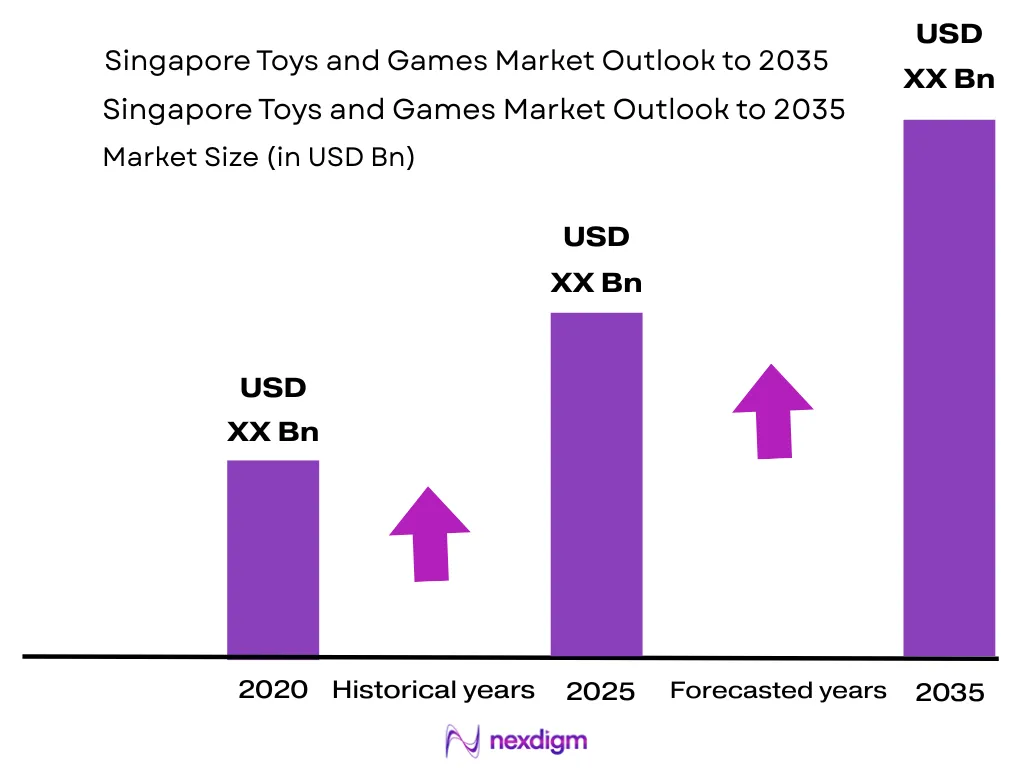
The Singapore Toys and Games Market is valued at USD ~ billion, based on the latest base-year market assessment, while the narrower toys-and-games retail market recorded USD ~ million in retail revenues. Growth is driven by action figures, collectibles, educational toys, licensed IP merchandise, and online-led discovery. The market also benefits from a resident population base of ~ million, total population of 6.04 million, and citizen births of 28,877, supporting recurring parental toy spending.
Singapore’s toy demand is concentrated across Central Singapore, Orchard, Marina Bay, Jewel Changi, Sentosa, and mature suburban mall clusters because these areas combine premium mall footfall, family retail, tourist spending, specialty stores, and collectibles-led impulse purchases. Tourism strengthens airport and attraction-led toy sales, with Singapore recording 16.5 million international visitor arrivals and SGD 22.4 billion in tourism receipts from January to September, compared with a prior-year recovery base.
Market Segmentation
By Product Type
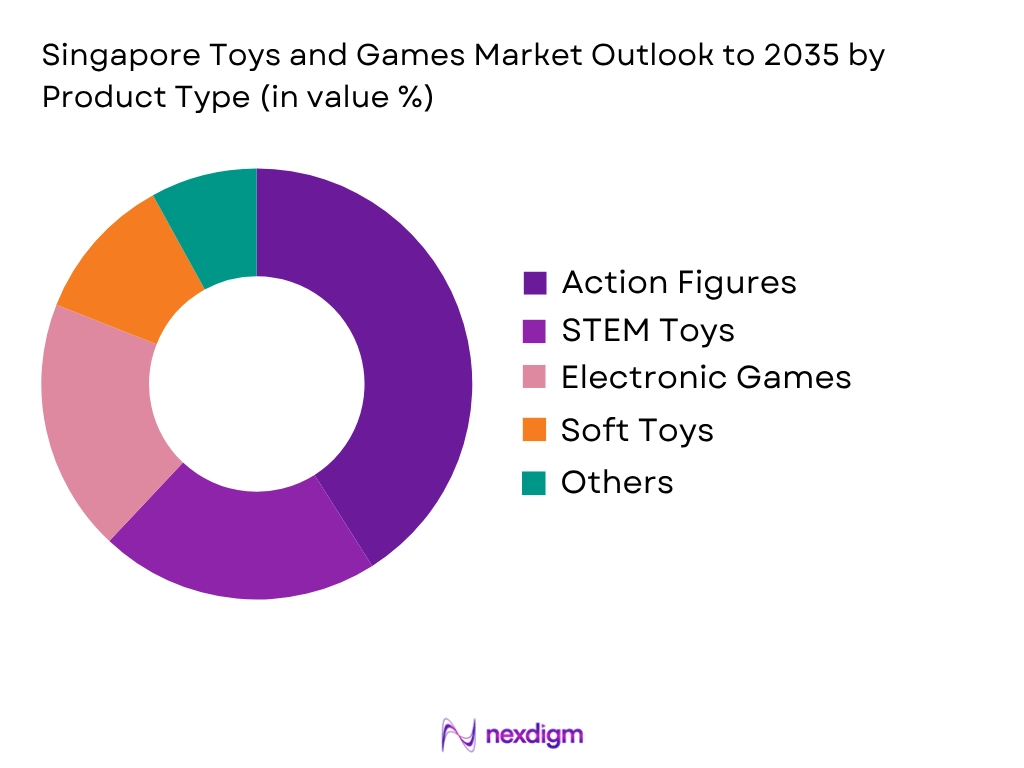
Singapore Toys and Games Market is segmented by product type into action figures and hero play, educational and STEM toys, electronic games and interactive toys, dolls, plush and soft toys, and games, puzzles and board games. Recently, action figures and hero play have held the dominant share in Singapore under product type, supported by the high pull of licensed franchises, anime merchandise, superhero universes, gaming IP, and collectible figurines. Published market data identifies action figures as the largest product segment, with disclosed value of USD 0.69 billion against the total market value of USD 1.67 billion. This dominance is strengthened by kidult consumers, hobby-store ecosystems, mall-based specialty retail, and pre-order/drop-led demand for limited-edition figures.
By Age Group
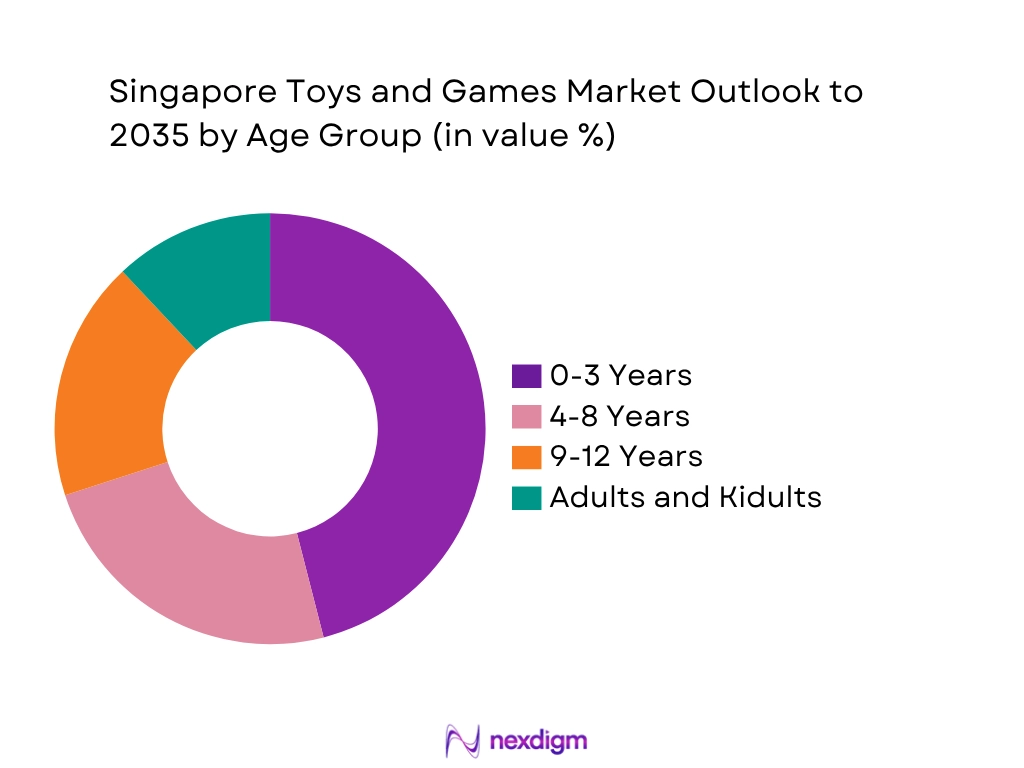
Singapore Toys and Games Market is segmented by age group into 0-3 years, 4-8 years, 9-12 years, and adults and kidults. The 0-3 years segment has the dominant share because infant, toddler, pre-school, developmental, sensory, musical, and early-learning toys are purchased directly by parents and caregivers with stronger safety, brand-trust, and gifting considerations. Published data discloses the 0-3 years segment at USD 0.76 billion, making it the largest age-group category. The segment is supported by baby and childcare retailers, parent-led premiumization, early-learning purchases, and repeat gifting occasions. However, adult collectors remain strategically important because blind boxes, designer toys, anime figurines, LEGO adult sets, and display collectibles are reshaping value growth beyond the child-only market.
Competitive Landscape
The Singapore Toys and Games Market is fragmented across global toy manufacturers, local specialty retailers, licensed-IP distributors, e-commerce marketplaces, and collectible-focused brands. LEGO, Mattel, Hasbro, Bandai Namco, and POP MART are influential because they combine strong IP portfolios, premium pricing power, specialty-store visibility, and online discoverability. Euromonitor notes that LEGO and POP MART gained ground in a fragmented landscape, with blind boxes, social media trends, kidult demand, and collector psychology supporting growth.
| Company | Establishment Year | Headquarters | Core Singapore-Relevant Categories | Licensing/IP Strength | Channel Presence | Collectibles/Kidult Exposure | Pricing Positioning | Singapore Market Role |
| LEGO Group | 1932 | Billund, Denmark | ~ | ~ | ~ | ~ | ~ | ~ |
| Mattel | 1945 | El Segundo, United States | ~ | ~ | ~ | ~ | ~ | ~ |
| Hasbro | 1923 | Pawtucket, United States | ~ | ~ | ~ | ~ | ~ | ~ |
| Bandai Namco | 1955 | Tokyo, Japan | ~ | ~ | ~ | ~ | ~ | ~ |
| POP MART | 2010 | Beijing, China | ~ | ~ | ~ | ~ | ~ | ~ |
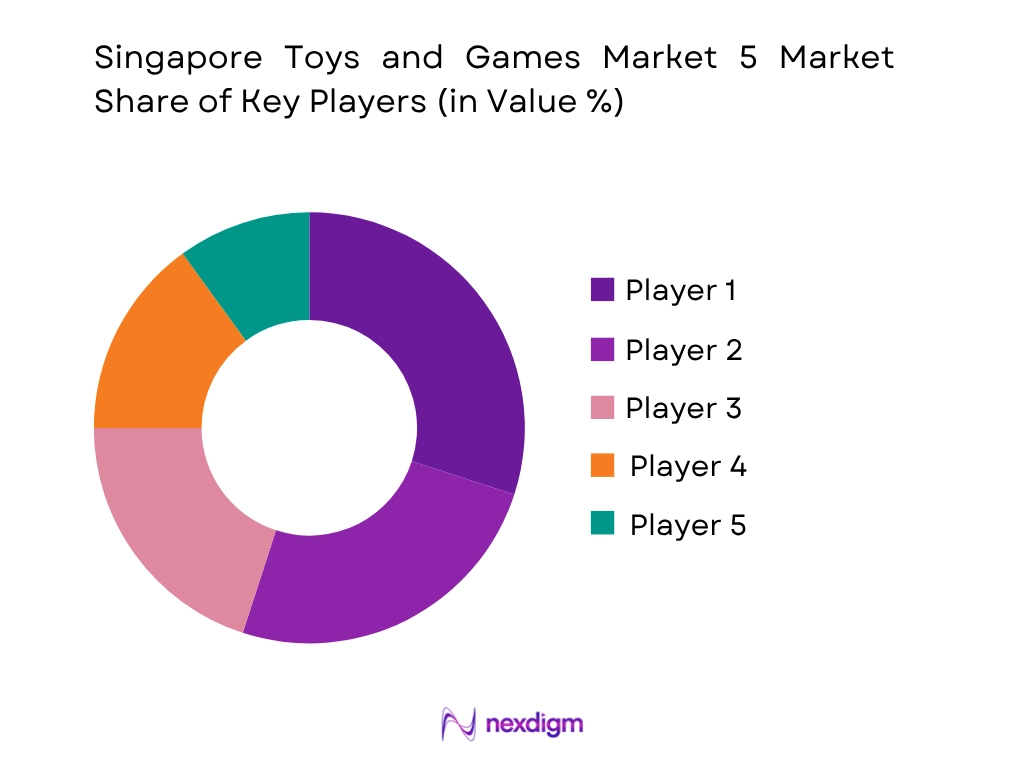
Singapore Toys and Games Market
Growth Drivers
Family Household Base Supporting Infant, Preschool and Educational Toy Demand
Singapore’s toys and games demand is supported by a concentrated family-household base, particularly for infant toys, preschool toys, learning kits, puzzles, role-play sets and STEM-oriented products. The country had 6,036,860 people in 2024, while the resident population stood at 4.18 million in 2024 and 4.20 million in 2025, giving toy retailers a dense urban consumer base with short fulfilment routes and high mall accessibility. Singapore also had 1,463,400 resident households in 2024, including 681,900 married couple-based households with children, 143,700 households with youngest child below 6 years, 112,700 households with youngest child aged 6-11 years, and 73,000 households with youngest child aged 12-15 years. This directly supports recurring demand for developmental toys, school-readiness toys, construction toys, art-and-craft kits, board games and gifting-led toys across birthdays, festive occasions and school holidays. The demand environment is also backed by strong macroeconomic capacity, with Singapore’s GDP recorded at USD 547.39 billion and GDP per capita at USD 90,674.1 in 2024, supporting premium toy purchases, branded licensed products and higher-value educational play categories.
Tourism, Airport Retail and Digital Discovery Expanding Toy Purchase Occasions
Singapore’s toy market benefits from non-resident and visitor-led retail occasions, especially for plush toys, licensed merchandise, collectibles, travel gifts, Singapore-themed souvenirs, LEGO sets, anime figures and blind-box toys sold in airport, attraction and mall locations. Singapore recorded 16.5 million international visitor arrivals in 2024, with Mainland China contributing 3.08 million arrivals, Indonesia 2.49 million, and India 1.20 million. Tourism receipts reached SGD 22.4 billion from January to September 2024, while Changi Airport recorded international seat capacity of over 41 million in 2024, strengthening toy sales opportunities in Jewel Changi, airport retail, Sentosa, Orchard and family attraction precincts. Online discovery also reinforces toy demand, especially for collectibles, pre-orders and licensed SKUs. World Bank data shows 94 individuals using the internet per 100 people in Singapore in 2024, while SingStat’s services dashboard recorded the retail sales index at 107.2 in March 2026 and total services business receipts of SGD 1,324,598 million in the first quarter of 2026, supporting omnichannel toy retail, marketplace browsing and social-commerce-led impulse purchases.
Market Challenges
Heavy Import Exposure and Foreign-Supplier Dependence in Toy Assortment
Singapore’s toys and games market is structurally import-dependent because the domestic market is retail- and distribution-led rather than manufacturing-led. This creates risk for retailers and distributors handling construction toys, plush toys, action figures, puzzles, collectibles and licensed merchandise, as product availability depends on overseas production schedules, freight reliability, customs documentation and regional allocation from global brand principals. WITS/World Bank trade data shows Singapore imported USD 226,796.97 thousand worth of “Toys nes” under HS 950390 in 2024, with import quantity of 13,858,000 kg. At the same time, Singapore exported USD 72,806.90 thousand of the same product category in 2024, with export quantity of 2,591,900 kg, indicating a trade structure where inbound toy flows are substantially larger than outbound flows. China’s export base is also important for Singapore’s supply chain, as China exported USD 1,351,354.04 thousand of HS 950390 toys to Singapore in 2024, with quantity of 49,745,000 kg. This concentration exposes Singapore toy retailers to stock-outs, launch delays, parallel-import gaps, compliance documentation issues and inventory planning risk for seasonal gifting cycles and franchise-linked product drops.
Safety Compliance Burden for Toys, Children’s Products and Online Sellers
Toy suppliers in Singapore operate under a strict safety environment, which is necessary for children’s products but creates compliance burden for importers, distributors, marketplace sellers and retailers handling small parts, magnets, batteries, chemical materials, water-play products, soft toys and activity kits. The Consumer Product Safety Office states that the Consumer Protection (Consumer Goods Safety Requirements) Regulations 2011 cover unsafe general consumer goods including toys and children’s products, and products must comply with applicable standards from bodies such as ISO, IEC, EN or ASTM, along with additional safety requirements. The CPSO also conducts active post-market surveillance and can direct suppliers to stop sales of unsafe goods, while non-compliance can lead to fines and imprisonment. This is particularly market-specific for Singapore because the toy market relies heavily on cross-border SKUs, licensed imports and marketplace listings, where sellers may not always have complete test reports or age-grading documentation. The challenge is intensified by the scale of family demand: Singapore had 681,900 married couple-based households with children in 2024 and 143,700 households with youngest child below 6 years, making toy safety especially material for infant, toddler and preschool products.
Market Opportunities
Premium Collectibles, Licensed Toys and Regional Re-Export Positioning
Singapore has an opportunity to deepen its role as a premium collectibles and licensed-toy hub, particularly for anime figures, designer toys, trading cards, blind boxes, character merchandise and limited-edition construction sets. Current trade data supports this opportunity because Singapore already acts as a regional redistribution node for toys. WITS/World Bank data shows Singapore exported USD 72,806.90 thousand of HS 950390 “Toys nes” in 2024, including USD 16,556.15 thousand to Poland, USD 14,656.83 thousand to Indonesia, USD 12,869.65 thousand to Malaysia, USD 5,646.56 thousand to Hungary and USD 3,487.39 thousand to Brunei. This confirms that Singapore is not only an end-consumption market but also a regional logistics and distribution point for selected toy categories. The opportunity is strongest for brands that can use Singapore for authenticated collectibles, regional pre-orders, exclusive drops and IP-led launches. Singapore’s high-income consumer base strengthens this positioning, with World Bank reporting GDP per capita of USD 90,674.1 in 2024 and GDP of USD 547.39 billion in 2024. These indicators support premium product assortment, limited-edition launches and collector-focused retail formats without relying only on mass-market child toy demand.
STEM, Early-Learning and Preschool Toy Expansion Through Childcare and School Ecosystem
Singapore offers a strong opportunity for STEM toys, early-learning toys, coding kits, puzzles, Montessori-style toys, sensory toys and school-readiness products because the education and childcare ecosystem provides structured demand around child development. Government-linked data shows total childcare enrolment of 154,173 and total childcare places of 200,847 in the latest available childcare dataset, while resident household data shows 143,700 households with youngest child below 6 years, 112,700 households with youngest child aged 6-11 years and 73,000 households with youngest child aged 12-15 years in 2024. Primary-school demand also provides a direct base for educational games, logic kits, science sets, puzzles and construction toys, with official SingStat/MOE-based data indicating 237,966 primary-school students and 37,785 Primary 1 intake in 2024. This creates scope for toy brands and retailers to position products around cognitive development, bilingual learning, fine-motor skills, STEM exposure, collaborative play and parent-led enrichment. The opportunity is market-specific because Singapore’s high urban density allows efficient distribution through childcare retailers, bookstore-learning chains, preschool procurement channels, e-commerce platforms and suburban family malls, while World Bank’s 2024 GDP per capita of USD 90,674.1 supports willingness to purchase higher-quality developmental products.
Future Outlook
The Singapore Toys and Games Market is expected to grow steadily, supported by premium collectibles, educational toys, STEM-based learning products, licensed character merchandise, and omnichannel retailing. Demand will increasingly move from child-only toy buying to a dual-consumer structure that includes parents and kidult collectors. E-commerce, social commerce, and official brand stores will improve discovery, while mall-based toy stores will remain important for product trial, gifting, and impulse purchases. Compliance, authenticity, and counterfeit control will become more important as cross-border online listings expand.
Major Players
- LEGO Group
- Mattel
- Hasbro
- Bandai Namco
- Spin Master
- MGA Entertainment
- TOMY
- Moose Toys
- Funko
- POP MART
- Mighty Jaxx
- Toys“R”Us Singapore
- Kiddy Palace
- Simply Toys
- Playmobil
Key Target Audience
- Toy manufacturers and global toy brand owners
- Licensed IP owners and entertainment companies
- Toy distributors and importers
- Specialty toy retailers and hobby-store operators
- E-commerce marketplaces and official online toy stores
- Baby, childcare and family retail chains
- Investments and venture capitalist firms
- Government and regulatory bodies, including Enterprise Singapore, Consumer Product Safety Office, Singapore Tourism Board, and Singapore Department of Statistics
Research Methodology
Step 1: Identification of Key Variables
The initial phase involves constructing an ecosystem map of the Singapore Toys and Games Market, covering toy manufacturers, distributors, importers, retailers, online platforms, licensing companies, parents, children, and adult collectors. Desk research is used to identify market variables such as product category mix, price bands, channel structure, safety compliance, licensed-IP pull, and collectible demand.
Step 2: Market Analysis and Construction
Historical market data is compiled from published market reports, retail sales sources, company disclosures, tourism data, population data, and channel-level observations. The market is then structured through top-down sizing using published market value and bottom-up validation through product-category, age-group, channel, and retail-format mapping.
Step 3: Hypothesis Validation and Expert Consultation
Market hypotheses are validated through interviews with toy distributors, specialty retailers, e-commerce sellers, licensing managers, store operators, and category buyers. These consultations are used to validate SKU-level pricing, category velocity, brand positioning, channel margins, and the strength of collectibles, STEM toys, and licensed character merchandise.
Step 4: Research Synthesis and Final Output
The final stage synthesizes secondary data, expert inputs, product audits, marketplace observations, and competitive benchmarking. The output includes market size, segmentation, competitive landscape, future outlook, target audience mapping, and analyst recommendations for manufacturers, retailers, investors, and regulatory stakeholders in the Singapore Toys and Games Market.

- Executive Summary
- Research Methodology (Market definitions and scope, toys and games taxonomy, consumer age-band assumptions, retail sales value approach, SKU-level price benchmarking, import shipment triangulation, channel margin mapping, primary interviews with distributors/retailers/importers, parent and kidult consumer survey approach, marketplace listing analysis, brand-store audit, limitations and future conclusions)

- Definition and Scope
- Market Genesis and Evolution
- Timeline of Major Players
- Business Cycle and Demand Seasonality
- Supply Chain and Value Chain Analysis

- Growth Drivers (Retail sales acceleration, consumer spending, brand availability, licensing demand, online discovery, premiumization, collectible culture)
- Market Challenges (Compliance risk, inventory risk, counterfeit exposure, high retail rent, fragmented demand, import dependency)
- Market Opportunities (Expansion of Online Channels and E‑Commerce Penetration, Local Manufacturing & Indigenous Toy Innovation, Partnerships with Schools & Educational Institutions)
- Market Trends (Consumer behavior, product innovation, retail formats, channel shift, fandom monetization, sustainability)
- Stakeholder Ecosystem
- Inventory and SKU Management

- By Retail Sales Value (2020-2025)
- By Units Sold (2020-2025)
- By Average Selling Price (2020-2025)

- By Product Category (In Value %)
Construction Toys and Building Sets
Dolls, Plush and Soft Toys
Action Figures and Hero Play
Games, Puzzles and Board Games
Infant, Toddler and Pre-School Toys - By Consumer Age Group (In Value %)
Infant and Toddler
Pre-School Children
Primary School Children
Tweens and Teens
Kidult and Adult Collectors - By Distribution Channel (In Value %)
Toy Specialty Chains
Department Stores and Mall Retailers
Baby and Childcare Retailers
Bookstores and Learning Stores
E-Commerce Marketplaces - By Geography (In Value %)
Central Area and Orchard Retail Belt
North-East Residential Retail Cluster
East and Airport Retail Cluster
West Residential and Education Cluster
Sentosa and Attraction-Led Retail Cluster
Online-Nationwide Fulfilment

- Market Share of Major Players (Retail sales value, units sold, category contribution, channel presence, licensed IP portfolio, specialty store footprint)
- Cross Comparison Parameters (Product category coverage, licensed IP portfolio depth, omnichannel presence, Singapore store footprint, marketplace official-store strength, average selling price band, collectible/drop capability, safety and authenticity
- Pricing Analysis by SKU Tier (Entry-level toys, mid-priced branded toys, premium LEGO sets, limited-edition collectibles, blind boxes, trading card packs, STEM kits)
- SWOT Analysis of Major Players
- Detailed Profiles of Major Companies
LEGO Group / Bricks World
Mattel
Hasbro
Bandai Namco
Spin Master
MGA Entertainment
TOMY
Moose Toys
Funko
POP MART
Mighty Jaxx
Toys“R”Us Singapore
Kiddy Palace
Simply Toys
Playmobil

- Parent and Family Buyer Analysis
- Child and Teen Preference Analysis
- Kidult and Collector Cohort Analysis
- Tourist and Souvenir Buyer Analysis
- Institutional Buyer Analysis

- By Retail Sales Value (2026-2035)
- By Units Sold (2026-2035)
- By Average Selling Price (2026-2035)


 Request a Sample
 Ask for Customization
 Get a Quote
 Enquire Now