

 Download PDF
Market Overview
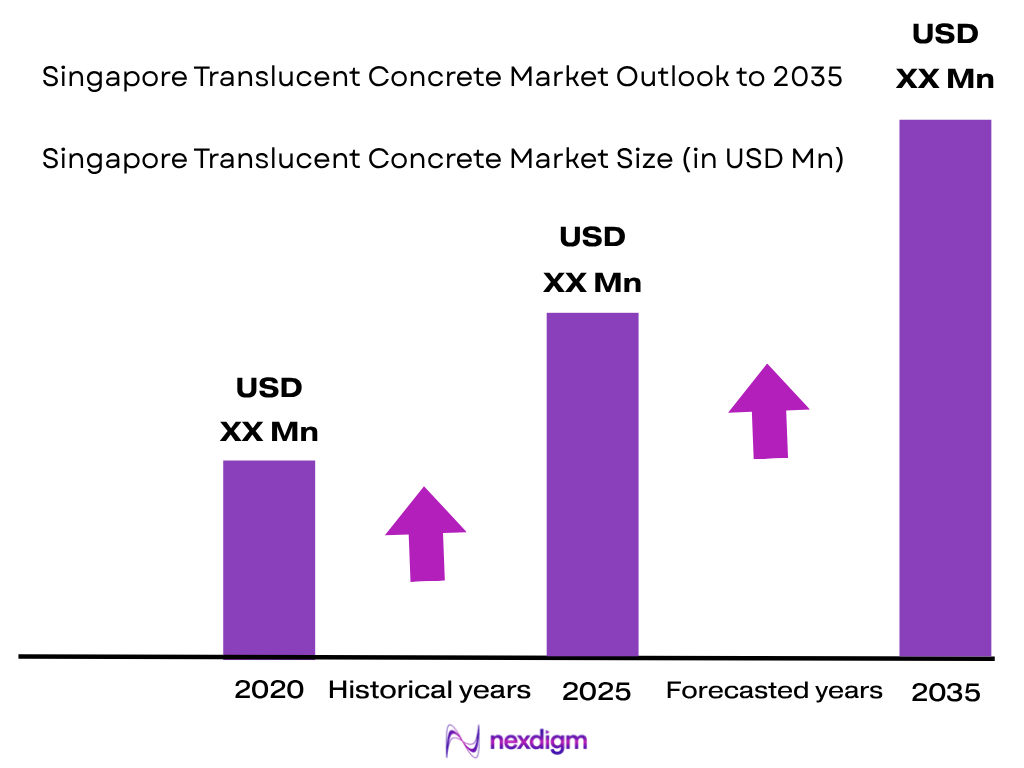
The Singapore Translucent Concrete Market is valued at approximately USD ~XX million, based on a five-year historical analysis. Underlying construction demand increased from S$33.8 billion to S$44.2 billion, while construction output reached S$38.4 billion in the latter period. Demand is supported by premium architecture, sustainable construction, daylighting applications and advanced concrete innovation. Singapore-based Pan-United has also demonstrated locally developed translucent concrete through its PanU Illuma product and architectural installations.
Downtown Core, Marina Bay, Changi, Jurong Lake District and other major commercial and infrastructure clusters represent important demand locations for the Singapore Translucent Concrete Market. Construction demand expanded from S$33.8 billion to S$44.2 billion, with S$36.6 billion of the latter total attributable to building works. These locations benefit from premium commercial buildings, transportation infrastructure, Government Land Sales developments, hospitality assets and stringent Green Mark requirements that encourage innovative building-envelope and architectural-material solutions.
Market Segmentation
By Light-Transmitting Technology
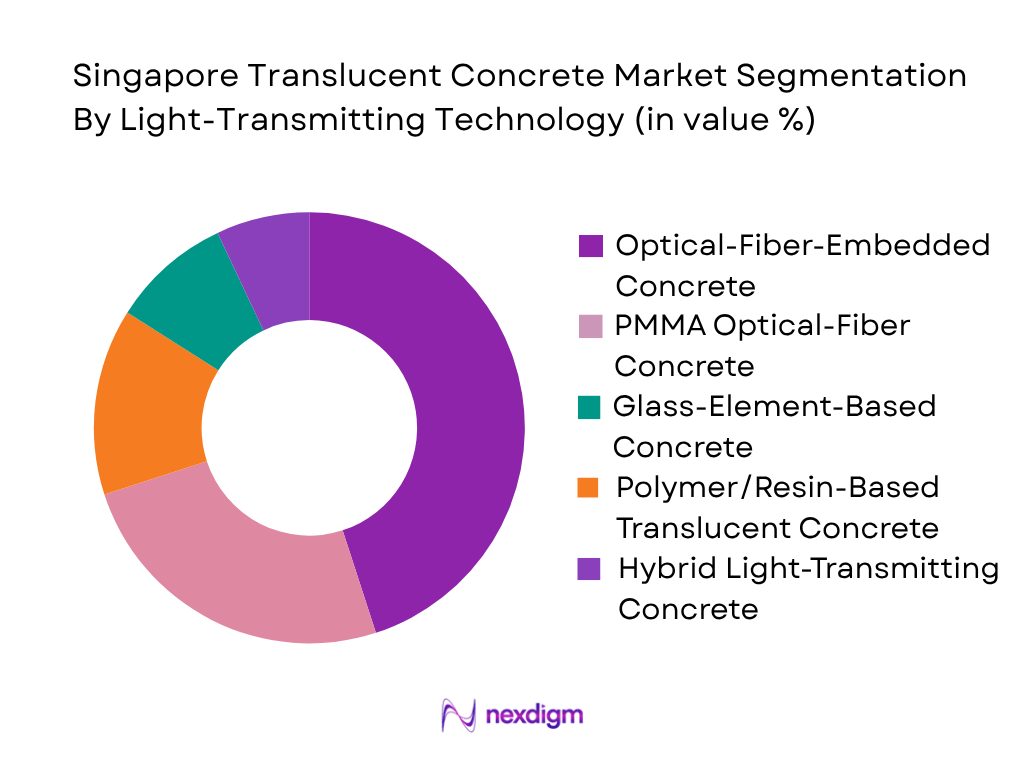
The Singapore Translucent Concrete Market is segmented into Optical-Fiber-Embedded Concrete, PMMA Light-Guide Concrete, Glass-Element-Based Concrete, Polymer/Resin-Based Systems and Hybrid Light-Transmitting Concrete. Optical-fiber-embedded concrete represents the dominant placeholder segment because the technology combines a cementitious matrix with embedded optical fibers capable of transferring light through otherwise opaque concrete. This architecture is particularly relevant to Singapore’s dense urban environment, where designers continuously balance daylighting, privacy, durability and architectural differentiation. Research specifically modelling translucent concrete for a Singapore building has examined optical fibers as a daylight-delivery mechanism. Commercial precedent also exists locally: Pan-United developed translucent concrete and publicly demonstrated the material through an illuminated installation at the Singapore Night Festival. International systems reinforce the technology’s commercial maturity; Fibrobeton’s translucent panels, for example, combine concrete with PMMA elements and can be manufactured as reinforced prefabricated panels. The combination of recognizable technology, design flexibility and compatibility with precast construction supports optical-fiber/light-guide systems as the principal segment for market modelling.
By Application
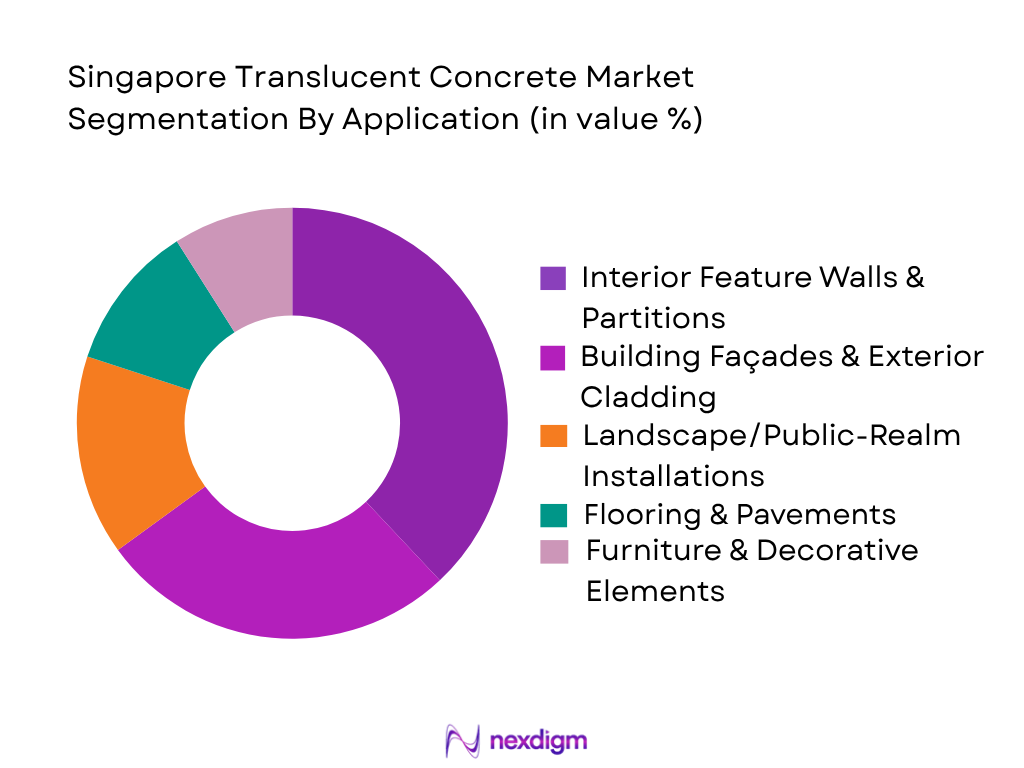
The Singapore Translucent Concrete Market is segmented into Interior Feature Walls & Partitions, Building Façades & Exterior Cladding, Landscape/Public-Realm Installations, Flooring & Pavements, and Furniture & Decorative Elements. Interior feature walls and partitions represent the dominant placeholder application because translucent concrete’s strongest commercial proposition is often architectural rather than conventional structural volume. Interior environments allow developers to exploit transmitted or backlit patterns while reducing the weathering and façade-engineering complexity associated with external installations. Singapore’s premium offices, hotels, retail environments, integrated developments and institutional buildings provide suitable settings for illuminated partitions, reception walls, branded surfaces and decorative architectural elements. Pan-United’s local translucent-concrete installation demonstrates the material’s ability to function as an illuminated design element, while Fibrobeton identifies partitions, illuminated urban furniture, counters, raised flooring and façade elements among practical applications. Interior deployment can also combine concrete’s visual mass with controlled illumination, making the technology relevant to architects seeking differentiated surfaces without relying exclusively on conventional glazing or stone.
Competitive Landscape
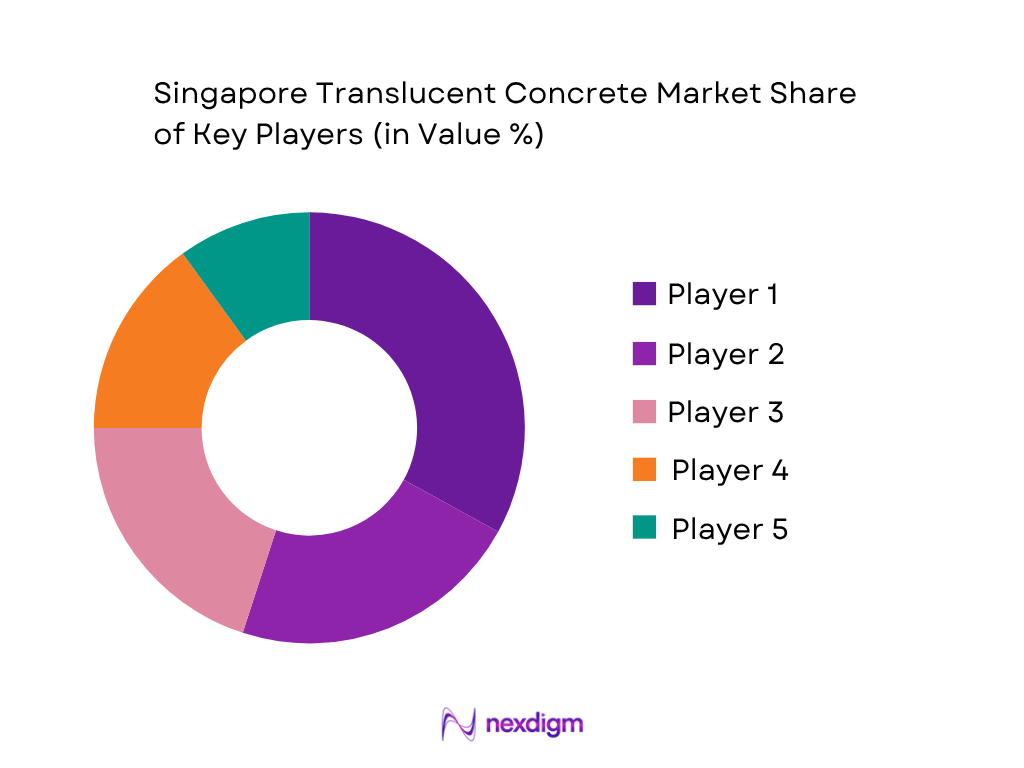
The Singapore Translucent Concrete Market combines a notable domestic concrete-technology participant with international specialist light-transmitting concrete manufacturers and architectural façade suppliers. Singapore-headquartered Pan-United provides particularly relevant domestic capability: it developed translucent concrete locally and publicly showcased its PanU Illuma solution through an illuminated installation. International specialists compete through optical-fiber technology, prefabricated panels, customization, exterior/interior application capability and light-transmission performance. The competitive environment is consequently technology- and project-driven rather than characterized by standardized mass-market concrete products.
| Major Player | Establishment Year | Headquarters | Core Technology | Product Form | Light-Transmission Approach | Façade Capability | Customization Capability | Singapore/Regional Relevance |
| Pan-United Corporation Ltd. | 1958 | Singapore | ~ | ~ | ~ | ~ | ~ | ~ |
| LUCEM GmbH | 2007 | Aachen, Germany | ~ | ~ | ~ | ~ | ~ | ~ |
| LiTraCon / Litracon | 2004 | Csongrád, Hungary | ~ | ~ | ~ | ~ | ~ | ~ |
| FİBROBETON | 1987 | Istanbul, Türkiye | ~ | ~ | ~ | ~ | ~ | ~ |
| Fapinex LLC | 2016 | Dubai, UAE | ~ | ~ | ~ | ~ | ~ | ~ |
Singapore Translucent Concrete Market Analysis
Growth Drivers
Strong Construction Pipeline Supporting Advanced Architectural Concrete Adoption
Singapore’s sustained construction pipeline creates a substantial project base for translucent concrete in façades, feature walls, partitions, illuminated surfaces and public-realm architecture. The Building and Construction Authority recorded S$44.2 billion of construction demand in 2024, representing contracts awarded across public and private developments, while construction output reached S$38.4 billion. Activity strengthened further, with preliminary construction demand reaching S$50.5 billion in 2025 and construction output reaching S$41.7 billion. BCA’s 2026 outlook places construction demand at S$47 billion–S$53 billion and output at S$43 billion–S$46 billion, supported by Changi Airport Terminal 5, Marina Bay Sands expansion, Tengah General and Community Hospital, Downtown Line 2 Extension and Thomson-East Coast Line Extension. These projects create specification opportunities for translucent concrete where architects require daylight-transmitting panels, illuminated walls and distinctive precast elements. The macroeconomic base is equally supportive: the International Monetary Fund recorded Singapore’s nominal GDP at S$731.4 billion, equivalent to US$547.5 billion, in 2024, with GDP per capita at US$90,689. This combination of large construction workloads and high-value economic activity provides a strong environment for specialized architectural materials that can differentiate premium commercial, transportation, hospitality and institutional developments.
Green Building Transformation and Industrialized Construction Supporting Translucent Precast Solutions
Singapore’s shift toward industrialized, sustainable construction supports translucent concrete because optical-fiber panels are particularly compatible with controlled off-site precast manufacturing. The Building and Construction Authority identifies Design for Manufacturing and Assembly as a central construction-transformation mechanism, encouraging building components to be manufactured in controlled factory environments before site assembly. This environment is becoming increasingly relevant as construction volumes rise: BCA recorded S$44.2 billion in construction demand and S$38.4 billion in construction output in 2024, followed by S$50.5 billion in preliminary construction demand during 2025. BCA subsequently projected S$43 billion–S$46 billion of construction output for 2026. Its Productivity Solutions Grant had already supported more than 1,100 Built Environment firms since 2020 by the 2026 policy update, while the enhanced scheme introduced advanced equipment capable of delivering up to 50 workers saved for every 100 workers otherwise required in a construction trade activity. Singapore’s macroeconomic capacity reinforces the opportunity: the IMF recorded S$731.4 billion in nominal GDP and US$371.4 billion in gross official reserves in 2024. For translucent concrete, factory-based production enables controlled optical-fiber placement, repeatable panel dimensions, surface finishing and quality inspection, making Singapore’s broader movement toward prefabrication and automation directly relevant to commercialization.
Market Challenges
Small Domestic Geography Requires Translucent Concrete Suppliers to Target High-Value Applications
Singapore presents a specialized commercialization challenge because its construction sector is financially substantial but geographically concentrated, meaning translucent concrete suppliers must secure high-value architectural specifications rather than depend on extensive territorial construction volumes. The IMF recorded Singapore’s population at approximately 6.0 million people in 2024, within an economy generating S$731.4 billion in nominal GDP, equivalent to US$547.5 billion. Construction demand nevertheless reached S$44.2 billion in 2024, while output stood at S$38.4 billion, according to the Building and Construction Authority. Preliminary demand subsequently increased to S$50.5 billion in 2025, but the compact domestic market means specialist suppliers must compete intensively for individual commercial, hospitality, institutional and infrastructure specifications. BCA’s 2026 outlook of S$47 billion–S$53 billion in construction demand confirms that project availability remains significant, although much of the pipeline includes conventional residential, transport, healthcare and infrastructure works where translucent concrete would represent only a limited architectural component. Suppliers therefore need to target suitable applications such as feature walls, entrance structures, illuminated partitions, façade accents and public installations rather than treat total concrete consumption as addressable demand. The challenge is intensified by competition from glass, conventional precast concrete, GFRC, UHPC and metal façade systems that already possess established engineering, procurement and installation ecosystems in Singapore.
Global Trade Exposure and Project-Schedule Uncertainty Increase Specialized Material Supply Risk
Singapore’s highly externally connected economy creates supply-chain considerations for translucent concrete because specialized optical fibers, PMMA light guides, proprietary panel technologies and selected architectural components may need to be sourced internationally. The IMF recorded US$371.4 billion in Singapore’s gross official reserves in 2024, equivalent to approximately 5.5 months of following-year imports of goods and services, while nominal GDP stood at US$547.5 billion. The country’s construction sector simultaneously handled S$44.2 billion of construction demand and S$38.4 billion of construction output in 2024, according to BCA, creating substantial requirements for building materials and specialist systems. BCA subsequently recorded S$50.5 billion of preliminary construction demand in 2025 and projected S$47 billion–S$53 billion for 2026. However, BCA explicitly notes that medium-term project schedules and phasing remain subject to global economic risks. For translucent concrete, schedule changes can be particularly significant because panels are commonly customized around architectural drawings, optical patterns, dimensions, anchorage and lighting integration. Imported specialist inputs must therefore arrive in coordination with precast fabrication and installation windows. Suppliers require resilient procurement strategies, alternative optical-component sources and sufficient local fabrication capability to avoid delays affecting façade packages, interior fit-outs and public-space installations.
Market Opportunities
Local Fabrication and Automation Can Expand Commercial Viability of Translucent Concrete
Singapore’s continuing push toward automated and off-site construction creates an opportunity to localize more stages of translucent-concrete production, including casting, optical-fiber positioning, finishing, CNC processing and panel assembly. The Building and Construction Authority recorded S$44.2 billion in construction demand during 2024, while certified construction output reached S$38.4 billion. Preliminary demand subsequently reached S$50.5 billion in 2025, providing a sizable current project ecosystem against which manufacturers can invest in specialized capabilities. BCA reported in 2026 that its Productivity Solutions Grant had supported more than 1,100 Built Environment firms since 2020, and the enhanced program expanded support to robotics and advanced equipment capable of reducing manpower requirements by as many as 50 workers for every 100 workers otherwise required for a trade activity. The macroeconomic environment provides additional industrial capacity: IMF data put Singapore’s 2024 nominal GDP at S$731.4 billion, gross official reserves at US$371.4 billion, and gross capital formation materially higher than the preceding period. These conditions create a future pathway for translucent-concrete suppliers to combine imported optical fibers or light guides with Singapore-produced cementitious matrices and local precast expertise. Automated fiber placement and controlled factory casting could improve repeatability while enabling customized panels suited to Singapore’s commercial, hospitality, transportation and institutional architecture.
Major Infrastructure and Urban Redevelopment Pipeline Expands Future Specification Opportunities
Singapore’s active infrastructure and redevelopment pipeline creates future opportunities for translucent concrete because upcoming high-specification projects require architectural materials capable of combining durability, design differentiation and advanced fabrication. Current activity provides the supporting evidence: the Building and Construction Authority recorded S$44.2 billion of construction demand in 2024, rising to preliminary demand of S$50.5 billion in 2025. BCA’s 2026 assessment identifies S$47 billion–S$53 billion of construction demand and S$43 billion–S$46 billion of construction output, with major activity supported by additional Changi Terminal 5 packages, Marina Bay Sands Integrated Resort expansion, Tengah General and Community Hospital, Downtown Line 2 Extension and Thomson-East Coast Line Extension. These developments provide potential application environments for translucent concrete in transportation interiors, public concourses, feature walls, entrance structures, hospitality spaces, wayfinding installations and selectively illuminated façades. The macroeconomic platform supporting these investments remains substantial: the IMF recorded Singapore’s nominal GDP at S$731.4 billion in 2024, equivalent to US$547.5 billion, while GDP per capita reached US$90,689 and gross official reserves stood at US$371.4 billion. For suppliers, the opportunity is therefore concentrated in architecturally important portions of large developments where custom precast panels, optical-fiber surfaces and integrated lighting can provide functional and visual differentiation.
Future Outlook
The Singapore Translucent Concrete Market is expected to expand at a placeholder CAGR of approximately ~XX% during 2026-2035, supported by sustained construction activity, Green Mark requirements, building redevelopment, low-carbon construction and demand for differentiated architectural materials. Future adoption is likely to remain specification-led, concentrating on commercial, hospitality, institutional, transportation and public-realm projects rather than commodity concrete applications.
BCA expects construction demand to remain substantial over the medium term, supported by Changi Airport Terminal 5, public housing, the Cross Island Line, Downtown Line Extension, Tengah General and Community Hospital, Woodlands North Coast, commercial redevelopment and broader urban rejuvenation. These developments enlarge the potential specification base for advanced architectural concrete, particularly where design teams require customized façades, illuminated public spaces or visually distinctive interior elements.
Major Players
- Pan-United Corporation Ltd.
- LUCEM GmbH
- LiTraCon / Litracon
- Heidelberg Materials / Italcementi
- Fapinex LLC
- FİBROBETON
- Dupont Lightstone
- CRE Panel GmbH
- LCT GesmbH
- Beton Brož
- Glass Block Technology Ltd.
- Florack Bauunternehmung GmbH
- Concrete LCDA
- Gravelli / LiCrete
- DITON s.r.o.
Key Target Audience
- Translucent Concrete and Specialty Concrete Manufacturers
- Precast Concrete and Architectural Panel Manufacturers
- Real Estate Developers and Commercial Asset Owners
- Construction Contractors and Façade System Integrators
- Architects, Façade Designers and Architectural Lighting Companies
- Investments and Venture Capitalist Firms
- Government and Regulatory Bodies (Building and Construction Authority, Urban Redevelopment Authority, Housing & Development Board, JTC Corporation)
- Building Material Importers, Distributors and Technology Licensees
Research Methodology
Step 1: Identification of Key Variables
The initial phase constructs an ecosystem map covering specialty concrete manufacturers, optical-fiber suppliers, precast manufacturers, architects, façade specialists, developers, contractors, building-material distributors and project owners participating in the Singapore Translucent Concrete Market. Secondary research is used to identify variables including installed area, product form, light-transmission technology, construction pipeline, application mix, Green Mark exposure, import dependence and local fabrication capability.
Step 2: Market Analysis and Construction
Historical analysis combines top-down and bottom-up approaches. The top-down framework evaluates Singapore construction demand, building works, commercial and institutional development and sustainable-building activity. Bottom-up analysis maps suppliers, relevant projects, estimated installed surface area, panel requirements, application categories and project-level translucent-concrete consumption. Results are triangulated to establish a consistent historical market framework without relying on a single demand indicator.
Step 3: Hypothesis Validation and Expert Consultation
Market hypotheses are validated through computer-assisted telephone interviews and structured discussions with concrete manufacturers, precast producers, architects, façade specialists, contractors, distributors and developers. Primary research focuses on specification frequency, optical-fiber requirements, preferred panel dimensions, material approval, local manufacturing feasibility, project lead times, application preferences and competitive substitutes. Findings are used to validate segmentation assumptions and identify discrepancies in secondary information.
Step 4: Research Synthesis and Final Output
The final stage reconciles construction statistics, supplier information, project mapping and primary interviews. Demand-side findings are cross-checked against manufacturing capabilities, product specifications, Green Mark requirements and application potential. Top-down market indicators are compared with bottom-up project and installed-area calculations, allowing inconsistencies to be investigated before finalization. The resulting framework supports market sizing, segmentation, competitive positioning and long-term opportunity analysis for the Singapore Translucent Concrete Market.

- Executive Summary
- Research Methodology (Market Definition and Scope, Singapore Translucent Concrete Market Classification, Light-Transmitting Concrete Technology Mapping, Optical-Fiber-Embedded Concrete Assessment, PMMA Optical Fiber Concrete Evaluation, Glass-Fiber Light-Transmitting Concrete Analysis, Resin and Polymer-Based Translucent Concrete Assessment, Precast Translucent Concrete Panel Evaluation, Translucent Concrete Block Assessment, Architectural Panel Performance Mapping, Light Transmission Efficiency Analysis, Compressive Strength Assessment, Flexural Strength Evaluation, Optical Fiber Density Analysis, Panel Thickness and Dimension Assessment, Surface Finish Evaluation, Façade Application Mapping, Interior Application Assessment, Building Type Demand Mapping, Green Building Demand Mapping, Precast Manufacturing Assessment, Architectural Specification Analysis, Import Dependency Assessment, Local Manufacturing Capability Assessment, Supply-Side Assessment, Demand-Side Assessment, Top-Down Market Sizing, Bottom-Up Market Sizing, Primary Industry Interviews, Data Triangulation, Forecasting Framework)

- Definition and Scope
- Singapore Translucent Concrete Industry Evolution and Development of Optical-Fiber-Embedded Concrete, Light-Transmitting Cementitious Materials, Precast Translucent Concrete Panels, Architectural Façade Systems, Interior Feature-Wall Applications, Daylighting Solutions, High-Performance Concrete Matrices, PMMA Optical Fiber Integration, Glass Light-Guide Technologies, Custom Architectural Elements, Smart Concrete Surfaces, LED-Integrated Concrete, Low-Carbon Concrete Matrices, Automated Fiber Placement, Digital Fabrication and Advanced Precast Manufacturing
- Translucent Concrete Value Chain Analysis
- Translucent Concrete Supply Chain Analysis
- Cement and Binder Suppliers, Fine Aggregate Suppliers, Optical Fiber Manufacturers, PMMA Fiber Suppliers, Glass Light-Guide Suppliers, Admixture Manufacturers, Translucent Concrete Technology Developers, Precast Concrete Manufacturers, Architectural Panel Fabricators, Façade System Suppliers, Specialty Building Material Importers, Construction Material Distributors, Architects, Façade Consultants, Lighting Designers, Green Building Developers, General Contractors, Specialty Installers, Property Developers and Building Owners

- Growth Drivers (Expansion of Green Mark Buildings, Strong Construction Demand, Increasing Demand for Low-Carbon Building Materials, Premium Commercial Redevelopment, Growth of Sustainable Architecture, Increasing Demand for Daylighting Solutions, Adoption of Signature Building Façades)
- Market Challenges (High Translucent Concrete Production Cost, High Optical Fiber Cost, Dependence on Imported Optical Fibers and Specialized Components, Limited Dedicated Local Commercial-Scale Production, Labor-Intensive Fiber Placement, Complex Precast Manufacturing Requirements, Tropical Humidity and Weathering Performance Requirements, Limited Architect and Contractor Familiarity)
- Market Opportunities (Local Translucent Concrete Fabrication, Localization of Precast Panel Production, Technology Licensing and Manufacturing Partnerships, Green Mark Project Specifications, Automated Optical Fiber Placement, Lightweight Translucent Concrete Panels, Low-Carbon Cementitious Matrices, Integrated LED Concrete Systems)
- Market Trends (Increasing Adoption of Optical-Fiber-Embedded Concrete, Growth of Custom Precast Panels, Integration of LED Backlighting, Development of Lightweight Panels, Increasing Use in Feature Walls and Signature Façades, Growing Interest in Locally Fabricated Architectural Concrete, Adoption of Digital Fabrication)
- Government Regulations and Standards (Building Control Act Requirements, Building Control Regulations, BCA Green Mark Requirements, Environmental Sustainability Regulations, Structural Concrete Requirements, Construction Product Conformity Requirements, Structural Anchorage Requirements, Façade Inspection Requirements, Fire Code Requirements, Building Energy Efficiency Requirements)
- SWOT Analysis
- Porter’s Five Forces Analysis
- PESTLE Analysis
- Stakeholder Ecosystem
- Competition Ecosystem

- By Market Value (2020-2025)
- By Installed Volume (2020-2025)
- By Installed Surface Area (2020-2025)
- By Average Selling Price per Square Meter (2020-2025)
- By Precast Translucent Concrete Panel Consumption Volume (2020-2025)
- By Optical-Fiber-Embedded Concrete Consumption Volume (2020-2025)
- By Translucent Concrete Block and Tile Consumption Volume (2020-2025)
- By Exterior Façade Application Volume (2020-2025)
- By Interior Architectural Application Volume (2020-2025)

- By Light-Transmitting Technology (In Value %)
Optical-Fiber-Embedded Cementitious Concrete
PMMA Optical-Fiber Concrete
Glass-Fiber and Glass-Element-Based Concrete
Polymer and Resin-Based Translucent Concrete
Hybrid Light-Guide Concrete Systems
Integrated LED Translucent Concrete
Alternative Light-Transmitting Cementitious Systems - By Product Form (In Value %)
Precast Translucent Concrete Panels
Translucent Concrete Slabs
Translucent Concrete Blocks and Bricks
Translucent Concrete Tiles
Custom Architectural Elements
Decorative Concrete Components
Furniture and Interior Elements
Bespoke Formed and 3D Elements - By Application (In Value %)
Building Façades
Exterior Wall Cladding
Interior Feature Walls
Partitions and Space Dividers
Flooring and Pavements
Staircases and Vertical Circulation Elements
Reception Desks and Countertops
Signage and Branded Architectural Surfaces
Landscape and Public-Realm Installations
Furniture and Decorative Applications - By End-Use Building Type (In Value %)
Grade-A Offices and Corporate Buildings
Luxury Hotels and Integrated Resorts
Premium Residential Developments
Retail Malls and Luxury Stores
Airports and Transportation Facilities
Healthcare Facilities
Educational and Institutional Buildings
Museums, Galleries and Cultural Buildings
Data Centres and High-Specification Industrial Buildings
Government and Civic Buildings
Mixed-Use Developments
Entertainment and Leisure Facilities - By Project Type (In Value %)
New Construction
Major Infrastructure Projects
Commercial Redevelopment
Major Renovation
Façade Retrofit
Interior Fit-Out
Green Building Retrofit
Public-Realm Redevelopment
Landmark and Signature Architecture
Integrated Resort and Hospitality Development - By Region (In Value %)
Central Region
East Region
West Region
North-East Region
North Region
Downtown Core and Marina Bay
Jurong Lake District
Changi and Airport Corridor
Greater Southern Waterfront
Rest of Singapore

- Market Share of Major Players (By Singapore Revenue, Translucent Concrete Product Portfolio, Optical-Fiber Technology Capability, Precast Panel Portfolio, Light Transmission Performance, Panel Size and Thickness Range, Exterior Façade Capability, Interior Application Coverage, Customization Capability, Integrated Lighting Capability, Manufacturing Capacity, Singapore and ASEAN Distribution Network, Architectural Specification Reach, Green Building Qualification Capability, Project Portfolio, Technical Support Capability)
- Cross Comparison Parameters (Light Transmission Efficiency, Compressive and Flexural Strength Performance, Panel Size and Thickness Range, Optical Fiber and Light-Guide Technology Capability, Singapore and ASEAN Project and Distribution Presence, Tropical-Climate Façade Application Capability, Customization and Integrated Lighting Capability, Manufacturing Scalability and Project Lead-Time Capability)
- SWOT Analysis of Major Players
- Competitive Positioning Matrix
- Translucent Concrete Technology and Architectural Application Benchmarking
- Panel Performance, Anchorage and Building System Integration Assessment
- Singapore Distribution, Architectural Specification and Technical Support Assessment
- Detailed Profiles of Major Companies
Pan-United Corporation Ltd.
LUCEM GmbH
LiTraCon / Litracon
Heidelberg Materials / Italcementi
Fapinex LLC
FİBROBETON
Dupont Lightstone
CRE Panel GmbH
LCT GesmbH
Beton Brož
Glass Block Technology Ltd.
Florack Bauunternehmung GmbH
Concrete LCDA
Gravelli / LiCrete
DITON s.r.o.

- Architectural Façade Requirement Assessment
- Exterior Wall Cladding Demand Analysis
- Interior Feature-Wall Requirement Assessment
- Green Mark Building Demand Analysis
- Grade-A Office and Corporate Building Demand Analysis
- Luxury Hotel and Integrated Resort Application Assessment
- Luxury Retail Application Requirement Analysis
- Airport and Transportation Facility Demand Assessment
- Healthcare Facility Application Analysis
- Museum and Cultural Building Application Analysis
- Government and Civic Building Requirement Assessment
- Data Centre and High-Specification Industrial Building Application Analysis

- By Market Value (2026-2035)
- By Installed Volume (2026-2035)
- By Installed Surface Area (2026-2035)
- By Average Selling Price per Square Meter (2026-2035)
- By Precast Translucent Concrete Panel Consumption Volume (2026-2035)
- By Optical-Fiber-Embedded Concrete Consumption Volume (2026-2035)
- By Translucent Concrete Block and Tile Consumption Volume (2026-2035)
- By Exterior Façade Application Volume (2026-2035)
- By Interior Architectural Application Volume (2026-2035)


 Request a Sample
 Ask for Customization
 Get a Quote
 Enquire Now