

 Download PDF
Market Overview
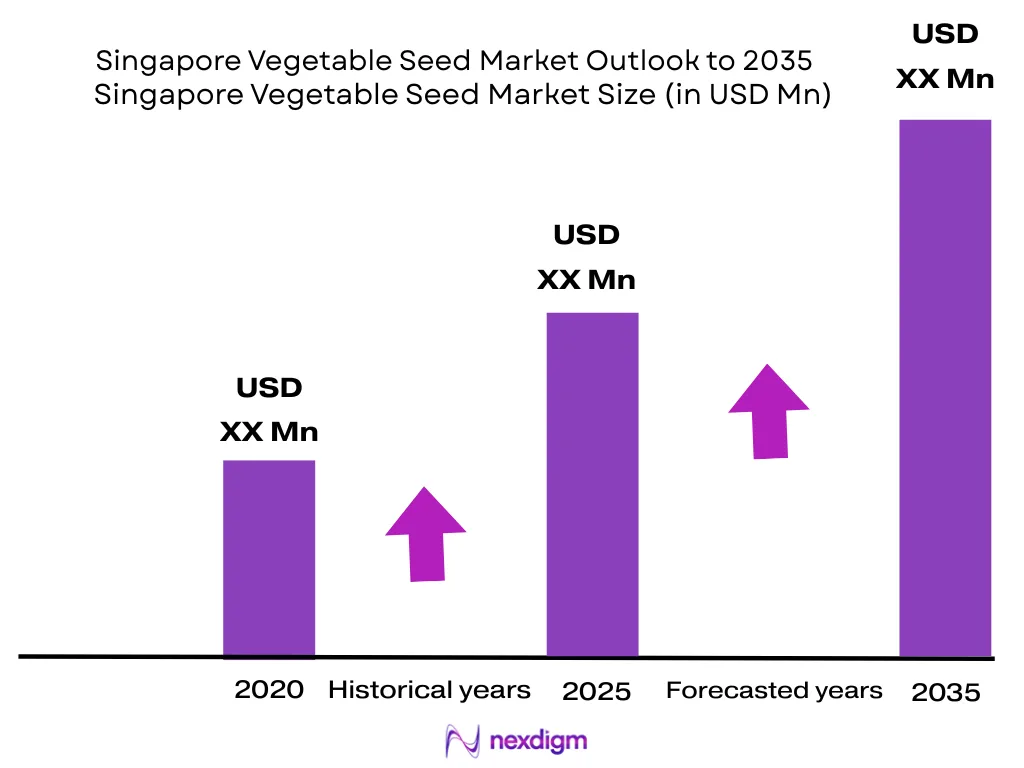
The Singapore Vegetable Seed Market is valued at USD ~ million, based on a five-year historical analysis. Demand is driven by hydroponic farms, vertical farms, indoor farms, rooftop cultivation, imported hybrid seeds and home-garden seed packs. Singapore imports more than 90% of its food supply, while vegetable farms contributed around 3% of total food consumption. Vegetable farm productivity improved from 227.2 tonnes to 231.4 tonnes per hectare per year, supporting demand for high-germination leafy-green, herb and microgreen seeds. Lim Chu Kang, Sungei Tengah, Kranji, Western Agri-Food Zone, Jurong, Tampines, Punggol and the Central Business District dominate the Singapore Vegetable Seed Market because they combine farm zoning, indoor-farm projects, logistics access, foodservice demand and home-garden retail. SFA awarded four land parcels at Lim Chu Kang and Sungei Tengah for vegetable farming, while more than USD 60 million supported 101 Agri-Food Cluster Transformation projects. These clusters drive commercial demand for hydroponic lettuce, Asian greens, herbs and microgreens.
Market Segmentation
By Crop Family
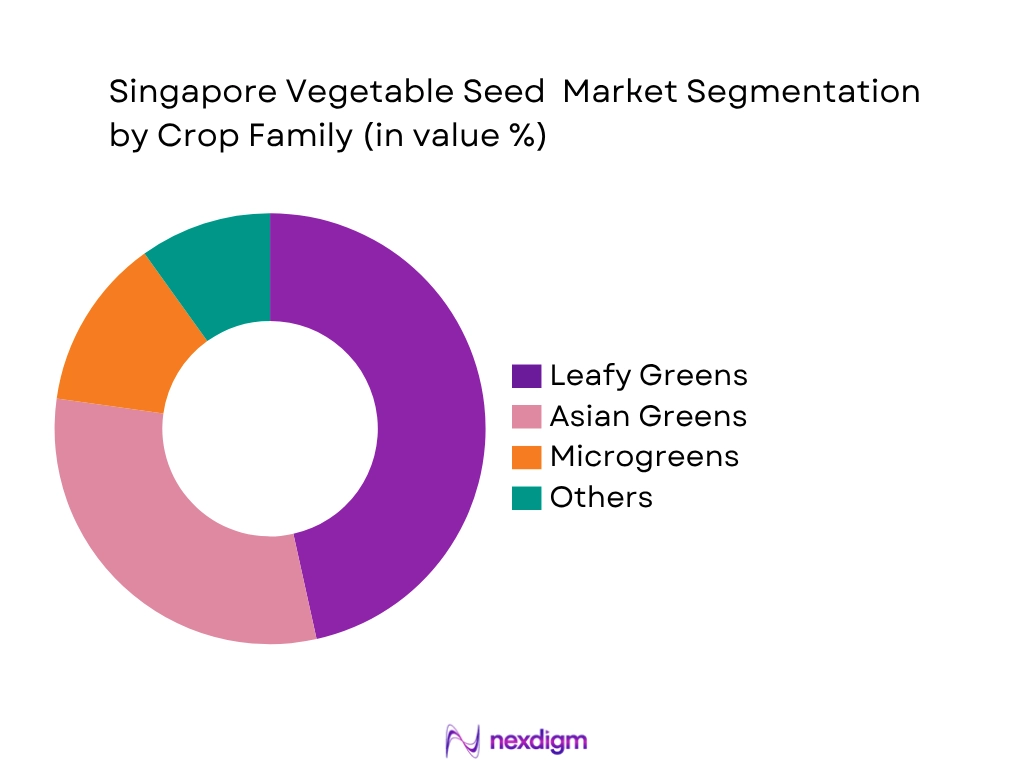
Singapore Vegetable Seed Market is segmented by crop family into leafy greens, Asian greens, herbs and microgreens, tomato and cucumber, and pepper, brassicas and specialty vegetables. Recently, leafy greens have a dominant market share in Singapore under the crop family segmentation because hydroponic and indoor farms prioritize lettuce, romaine, baby leaf, spinach, arugula and kale due to short crop cycles, high planting density and stable supermarket demand. These crops suit Singapore’s land-scarce farming model because they can be cultivated in stacked systems, nutrient-film systems and controlled environments with predictable harvest scheduling. Asian greens also remain important due to local consumption habits, especially chye sim, xiao bai cai, pak choi, kai lan and kang kong. Herbs and microgreens are gaining relevance in foodservice and premium retail, but leafy greens dominate because they combine recurring seed replacement, broad retail acceptance and strong compatibility with hydroponic systems.
By Cultivation Mechanism
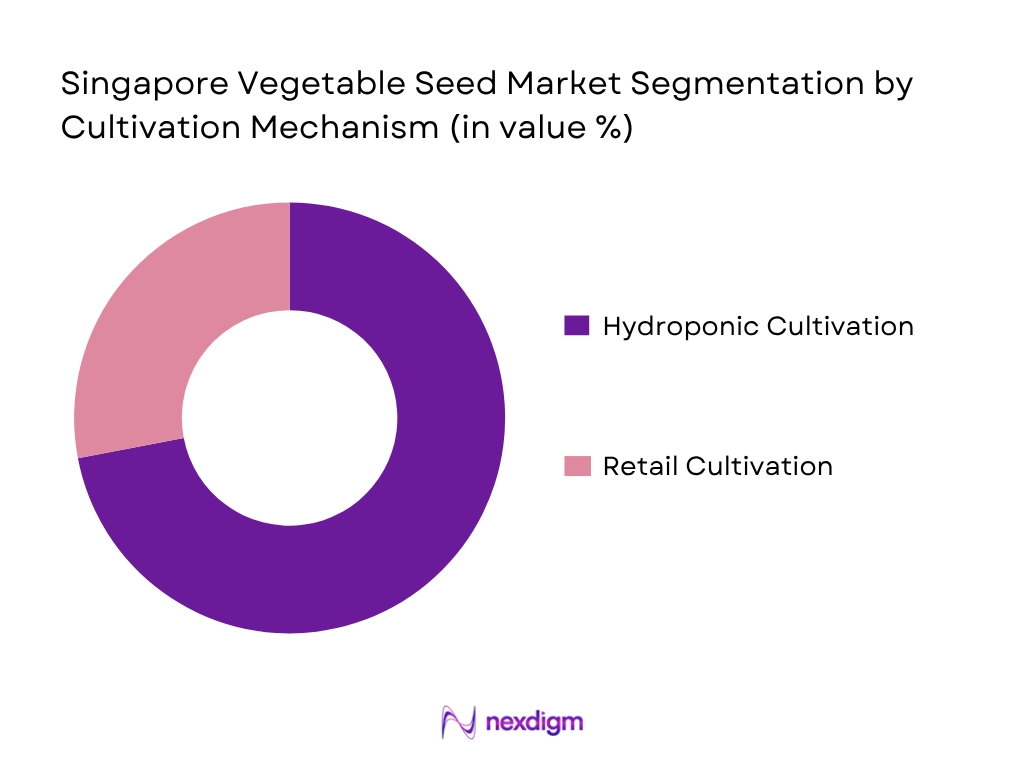
Singapore Vegetable Seed Market is segmented by cultivation mechanism into hydroponic cultivation, vertical and indoor farming, greenhouse and rooftop farming, soil-based urban and community farming, and home garden and retail cultivation. Recently, hydroponic cultivation has a dominant market share in Singapore under cultivation mechanism segmentation because local vegetable farming is increasingly structured around high-yield, water-efficient and space-efficient systems. Hydroponics supports lettuce, Asian greens, basil, coriander, mint, cucumber and tomato production with consistent nutrient delivery and shorter crop cycles. The system also reduces dependence on soil quality, which is critical in a land-constrained city-state. Vertical and indoor farming is expanding because it enables production in multi-tier systems, but it remains more energy- and technology-intensive. Soil-based and home-garden cultivation remain relevant for community farms, balcony gardening and retail packets, but commercial seed demand is led by hydroponic farm operators.
Competitive Landscape
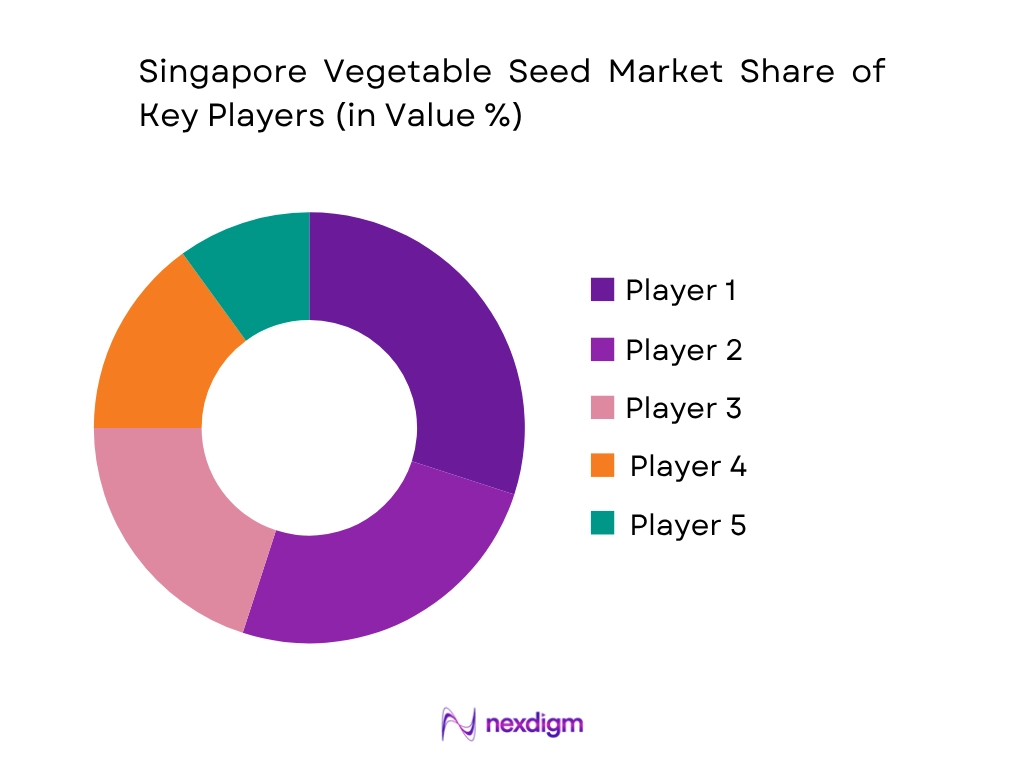
The Singapore Vegetable Seed Market is served by global vegetable-seed companies, Southeast Asian seed distributors, hydroponic solution providers and garden retail channels. Rijk Zwaan, Enza Zaden, Syngenta, Bayer/Seminis and BASF/Nunhems compete in premium hydroponic, greenhouse and controlled-environment seed categories. Local and regional distributors influence commercial adoption because Singapore depends heavily on imported seeds, technical catalogues and crop-system compatibility. Competition is shaped by leafy-green performance, LED response, hydroponic suitability, microgreen seed hygiene, SFA/NParks import compliance, local trial support and availability through farm-technology suppliers.
| Company | Establishment Year | Headquarters | Key Singapore Vegetable Seed Focus | Main Crop Families | Distribution Strength | CEA Portfolio | Seed Technology Focus | Market Positioning |
| Rijk Zwaan | 1924 | De Lier, Netherlands | ~ | ~ | ~ | ~ | ~ | ~ |
| Enza Zaden | 1938 | Enkhuizen, Netherlands | ~ | ~ | ~ | ~ | ~ | ~ |
| Syngenta Vegetable Seeds | 2000 | Basel, Switzerland | ~ | ~ | ~ | ~ | ~ | ~ |
| Bayer CropScience / Seminis | 1863 | Leverkusen, Germany | ~ | ~ | ~ | ~ | ~ | ~ |
| BASF Vegetable Seeds / Nunhems | 1865 | Ludwigshafen, Germany | ~ | ~ | ~ | ~ | ~ | ~ |
Singapore Vegetable Seed Market Analysis
Growth Drivers
Hydroponic Vegetable Farming Supports Demand for High-Germination Leafy Green Seeds
Singapore Vegetable Seed Market is supported by hydroponic and controlled-environment vegetable farms that require high-germination seed lots for lettuce, chye sim, xiao bai cai, pak choi, basil, coriander and microgreens. SFA reported vegetable farm productivity rising from 227.2 tonnes per hectare per year to 231.4 tonnes per hectare per year, showing technology-led improvement in local vegetable farming. SFA also stated that local production works as a buffer against overseas supply disruptions. Singapore’s macro base supports premium seed adoption, with World Bank reporting GDP of USD 547.39 billion, GDP per capita of USD 90,674.1, and population of about 6 million.
Local Production Policy Creates Demand for CEA-Specific Vegetable Seeds
Singapore Vegetable Seed Market is driven by food-security policy and local production capacity building, which increase demand for CEA-specific leafy green, Asian green, herb and microgreen seeds. SFA reported that local vegetable farms contributed around 3 units out of every 100 units of total food consumption, while local vegetable productivity improved from 227.2 tonnes to 231.4 tonnes per hectare per year. SFA also noted that 2025 and 2026 will see the set-up and ramp-up of a few large-scale indoor vertical farms. World Bank data shows Singapore’s GDP at USD 547.39 billion and GDP per capita at USD 90,674.1, supporting investment capacity for premium hydroponic seed inputs.
Market Challenges
Limited Land Base Restricts Conventional Vegetable Seed Demand
Singapore Vegetable Seed Market faces structural constraints because conventional open-field vegetable cultivation is limited by land scarcity, pushing commercial demand toward hydroponic, vertical and indoor seed systems. Singapore’s official land-area dataset is maintained by the Department of Statistics, while World Bank describes Singapore as a city-state with a population of about 6 million. SFA reported local vegetable farm productivity of 231.4 tonnes per hectare per year, indicating the need to grow more output from limited farm space. For seed suppliers, this restricts broad open-field seed demand and shifts focus to compact, fast-cycle, pelleted, primed and CEA-compatible seeds. World Bank reports GDP per capita of USD 90,674.1.
Seed Import and Biosecurity Rules Increase Operational Complexity
Singapore Vegetable Seed Market is exposed to import-compliance complexity because the country depends on imported seed genetics for leafy greens, Asian greens, herbs, cucumber, tomato and microgreens. NParks states that importers must comply with requirements before importing plants or plant products, and Singapore Customs states that importers must obtain an NParks import permit for plants and plant products, along with phytosanitary certification where required. The traveller exemption is limited to 250 grams of seeds per person under specified conditions, indicating strict plant-health control. World Bank reports Singapore’s GDP of USD 547.39 billion and population of about 6 million, making uninterrupted seed logistics important for local farm continuity.
Market Opportunities
Indoor Vertical Farms Create Scope for LED-Compatible Vegetable Seed Portfolios
Singapore Vegetable Seed Market has an opportunity in indoor vertical farming because SFA states that 2025 and 2026 will see the set-up and ramp-up of a few large-scale indoor vertical farms. These farms require seeds with compact architecture, predictable germination, short crop cycles, uniform canopy and compatibility with LED-lit crop recipes. SFA’s reported productivity increase from 227.2 tonnes to 231.4 tonnes per hectare per year supports the case for higher-yielding hydroponic and indoor varieties. World Bank data shows Singapore GDP at USD 547.39 billion, GDP per capita at USD 90,674.1, and population near 6 million, supporting high-tech farm investment and premium seed procurement.
Microgreen and Food-Safe Seed Lots Can Serve Premium Urban Channels
Singapore Vegetable Seed Market has an opportunity in food-safe microgreen, herb and sprouting seed lots because urban farms and foodservice buyers require reliable germination, traceability and pathogen-risk control. SFA reported local vegetable production of 22,720 tonnes in the official annual local production dataset, and SFA’s food statistics highlight local production as a buffer against supply disruptions. NParks also regulates imported plant products to prevent plant pests and diseases from entering local ecosystems. This creates scope for documented seed lots for basil, coriander, radish microgreens, pea shoots, broccoli sprouts and lettuce. World Bank reports Singapore GDP per capita at USD 90,674.1 and GDP at USD 547.39 billion, supporting premium urban food channels.
Future Outlook
The Singapore Vegetable Seed Market is expected to grow at around 5.1% CAGR during 2026–2035, supported by hydroponic farms, vertical farming, local food-security policy, urban farming technology and premium local fresh-produce demand. Over the next phase, the market will shift toward seeds designed for controlled environments, short crop cycles and crop-recipe compatibility. Hydroponic lettuce, chye sim, pak choi, basil, mint, coriander, arugula and microgreens will remain the strongest opportunity areas because they fit Singapore’s land-scarce, high-yield production model. Vertical and indoor farms will create demand for compact varieties with uniform canopy structure, fast germination, LED response and predictable harvest windows. Microgreen and sprouting seed demand will grow among restaurants, hotels, specialty grocers and home-grow consumers, but it will require stronger food-safety documentation and batch traceability. Seed suppliers will increasingly compete through localized variety trials, SFA/NParks import compliance, food-safe microgreen seed lots, pelleted seeds, primed seeds, digital crop recipes and hydroponic advisory. The strongest future opportunity lies in CEA-specific leafy green and Asian green seeds that can improve productivity per square metre while reducing labour, crop failure and import dependence.
Major Players
- Rijk Zwaan Southeast Asia
- Enza Zaden Southeast Asia
- Syngenta Vegetable Seeds
- Bayer CropScience / Seminis / De Ruiter
- BASF Vegetable Seeds / Nunhems
- Sakata Seed
- HM.CLAUSE
- Bejo Seeds
- Hazera Seeds
- East-West Seed
- Takii Seed
- Known-You Seed
- Pacific Agriscience
- Ban Lee Huat Seed
- Far East Flora / Garden Retail Seed Channel
Key Target Audience
- Vegetable Seed Manufacturers
- Hybrid Vegetable Seed Breeding Companies
- Hydroponic Farm Operators
- Vertical and Indoor Farming Operators
- Seed Importers and Agri-Input Distributors
- Farm Technology and Hydroponic Solution Providers
- Investments and Venture Capitalist Firms
- Government and Regulatory Bodies
Research Methodology
Step 1: Identification of Key Variables
The initial phase involves constructing an ecosystem map for the Singapore Vegetable Seed Market, covering seed companies, importers, hydroponic farms, vertical farms, rooftop farms, nurseries, retail channels and regulators. The objective is to identify key variables including crop family, CEA adoption, seed import dependence, pack size, seed treatment and farm-system compatibility.
Step 2: Market Analysis and Construction
In this phase, historical data is compiled for local vegetable production, farm productivity, food-import dependence, controlled-environment farm adoption and crop-wise seed usage. The market is constructed through bottom-up modelling based on crop cycles, seeding density, farm type, seed format, distribution channel and premium CEA seed requirements.
Step 3: Hypothesis Validation and Expert Consultation
Market hypotheses are validated through structured interviews with seed importers, hydroponic farm managers, indoor farm operators, nurseries, garden retailers and farm-technology suppliers. These consultations support assumptions on crop preference, seed replacement, germination standards, microgreen seed demand, import lead times and local trial requirements.
Step 4: Research Synthesis and Final Output
The final phase integrates secondary research, primary inputs, company portfolio mapping and bottom-up demand modelling into a validated market report. The output is cross-checked across market size, segmentation, competitive landscape, future outlook and regulatory framework to provide a business-focused view of the Singapore Vegetable Seed Market.

- Executive Summary
- Research Methodology (Market Definitions and Assumptions, Vegetable Seed Taxonomy, Hybrid/Open-Pollinated/Organic/Untreated/CEA-Specific Seed Classification, Market Sizing Approach, Top-Down Seed Revenue Validation, Bottom-Up Farm System and Crop Cycle Requirement Model, Primary Interviews with Seed Importers/Distributors/Indoor Farms/Hydroponic Farms/Nurseries/Retail Buyers, SFA and NParks Import Compliance Review, Dealer and Farm-Input Channel Mapping, Limitations and Future Conclusions)

- Definition and Scope
- Overview Genesis
- Evolution of Vegetable Seed Demand in Land-Scarce Urban Agriculture
- Timeline of Major Players
- Business Cycle

- Growth Drivers (Food Security Policy, Hydroponic Adoption, Vertical Farming, Local Fibre Production Target, Retail Demand, Short-Cycle Crop Demand)
- Market Challenges (Land Scarcity, Seed Import Dependency, Farm Closures, High Operating Cost, Biosecurity Risk, Limited Crop Diversity)
- Opportunities (CEA-Specific Genetics, Microgreen Seeds, Hydroponic Asian Greens, Seedling Systems, Food-Safe Seed Lots, Digital Crop Recipes)
- Trends (CEA Specialisation, Hybridisation, Seed Enhancement, Food-Safe Microgreens, Urban Farming, Digital Farm Support)
- SWOT Analysis
- Porter’s Five Forces
- PESTLE Analysis

- By Value (2020-2025)
- By Volume (2020-2025)
- By Average Realization per Kilogram/Thousand Seeds (2020-2025)

- By Crop Family (In Value %)
Leafy Green Seeds
Asian Green Seeds
Herb Seeds
Microgreen Seeds
Tomato Seeds - By Distribution Channel (In Value %)
Direct-to-Farm Sales
Seed Importers and Local Distributors
Hydroponic Solution Providers
Farm Technology Suppliers - By End User (In Value %)
Hydroponic Farms
Vertical Farms
Indoor Farms
Rooftop Farms
Commercial Greenhouses - By Farm and Demand Cluster (In Value %)
Lim Chu Kang
Sungei Tengah and Kranji
Western Agri-Food Zone
Tampines, Punggol and Housing Estate Urban Farms
Central Business District and Orchard Foodservice Demand

- Market Share of Major Players (Commercial Vegetable Seed Revenue, Crop-Family Share, Hybrid Share, CEA Presence)
- Cross Comparison Parameters (CEA-Specific Hybrid Portfolio Breadth, Hydroponic Leafy Green Seed Strength, LED/Vertical Farm Variety Suitability, Food-Safe Microgreen Seed Capability, SFA/NParks Import Compliance Capability, Seed Treatment/Pelleting Capability, Distributor and Technical Support Network, Local Trial and Crop Recipe Support)
- SWOT Analysis of Major Players
- Detailed Profiles of Major Companies
Rijk Zwaan Southeast Asia
Enza Zaden Southeast Asia
Syngenta Vegetable Seeds
Bayer CropScience / Seminis / De Ruiter
BASF Vegetable Seeds / Nunhems
Sakata Seed
HM.CLAUSE
Bejo Seeds
Hazera Seeds
East-West Seed
Takii Seed
Known-You Seed
Pacific Agriscience
Ban Lee Huat Seed
Far East Flora / Garden Retail Seed Channel

- Hydroponic Farm Operator Analysis
- Vertical Farm Operator Analysis
- Indoor Farm Operator Analysis
- Rooftop and Community Farm Analysis
- Commercial Greenhouse Operator Analysis

- By Value (2026-2035)
- By Volume (2026-2035)
- By Average Realization per Kilogram/Thousand Seeds (2026-2035)


 Request a Sample
 Ask for Customization
 Get a Quote
 Enquire Now