

 Download PDF
Market Overview
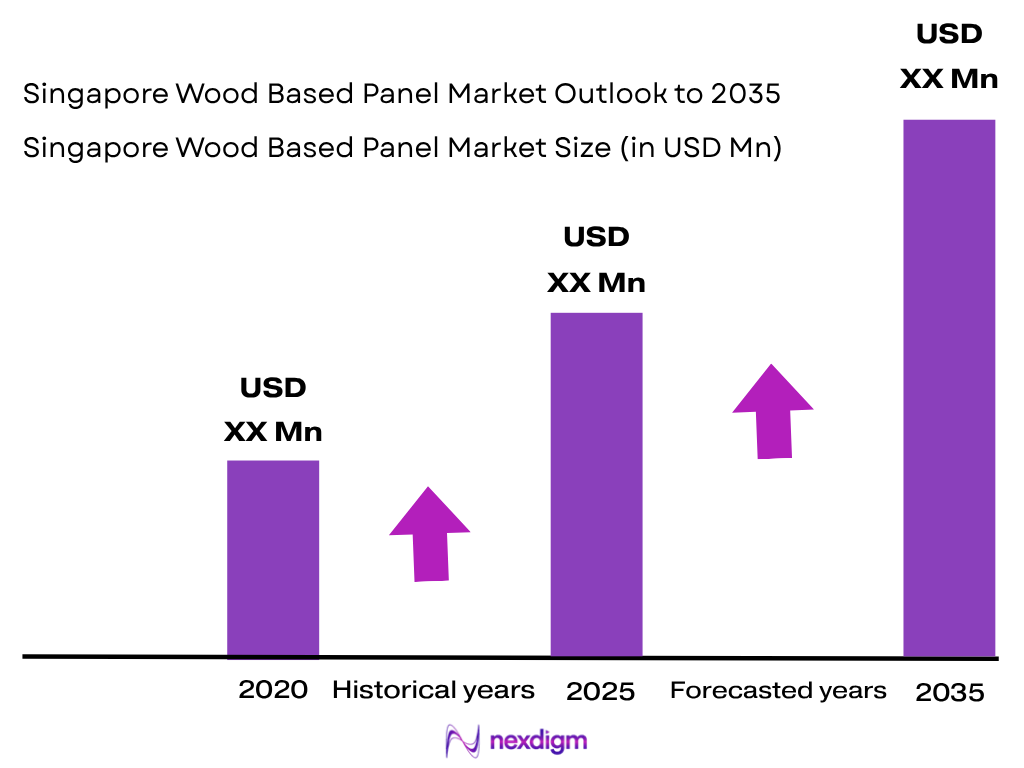
The Singapore Wood Based Panel Market is valued at approximately USD ~ million, based on the report framework, compared with USD ~ million in the preceding period. Demand is supported by residential construction, commercial refurbishment, furniture, cabinetry and interior fit-outs. Construction demand increased from S$33.8 billion to S$44.2 billion, while construction output increased from S$34.8 billion to S$38.4 billion, strengthening downstream requirements for plywood, MDF and decorative panels.
Singapore is the principal domestic consumption, distribution and project-specification hub, while Vietnam, China, Indonesia and Malaysia are important supply countries. Singapore imported USD 34.47 million of one major plywood and laminated-panel category, including USD 12.97 million from Vietnam, USD 10.04 million from China and USD 8.76 million from Indonesia, while the comparable market was supported by construction demand of S$33.8 billion in the preceding period.
Market Segmentation
By Product Type
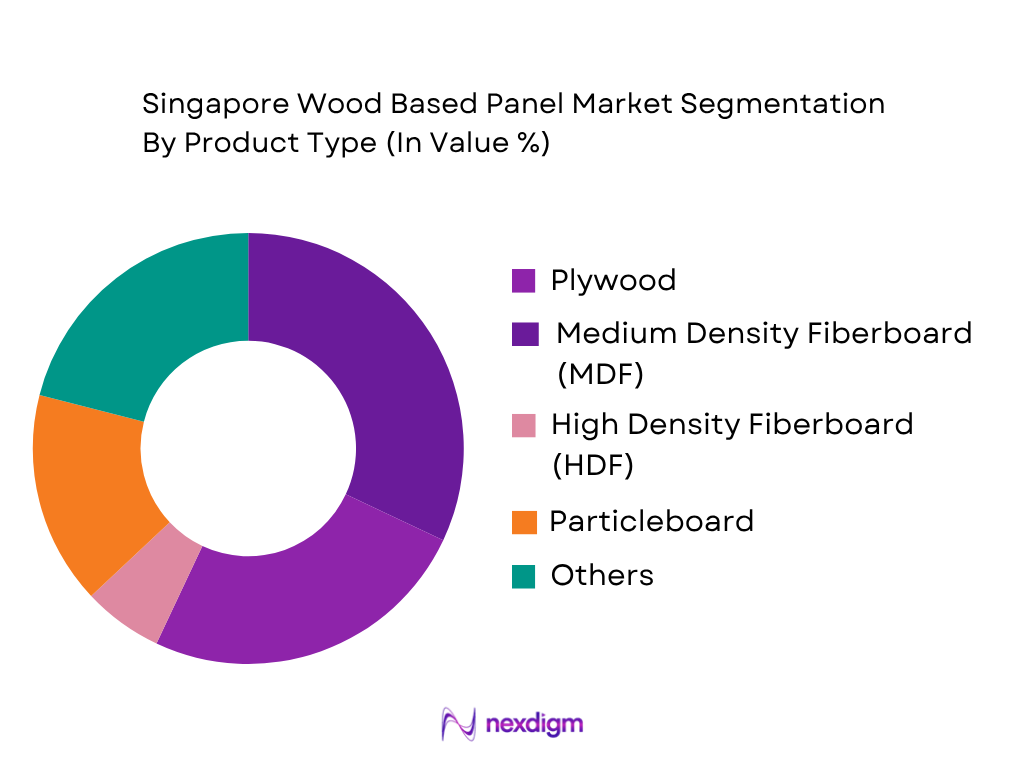
The Singapore Wood Based Panel Market is segmented into plywood, medium-density fibreboard, particleboard, high-density fibreboard, oriented strand board, decorative and melamine-faced boards, and other engineered panels. Recently, plywood has a dominant market share under the product-type segmentation in the report framework, supported by its broad applicability across carpentry, cabinetry, interior construction, furniture, partitions and project-based fit-outs. Singapore’s trading position also enables importers to source multiple plywood specifications from regional manufacturing centers. Plywood is particularly relevant where contractors require strength, screw-holding capability and dimensional performance across built-in furniture and interior applications. MDF remains important for painted and decorative furniture surfaces, while particleboard is suited to standardized cabinetry and economical furniture applications. The growing specification of moisture-resistant, fire-performance and lower-emission panels is also widening product differentiation, particularly in commercial, hospitality and residential interiors where material performance and indoor environmental quality influence procurement.
By Application
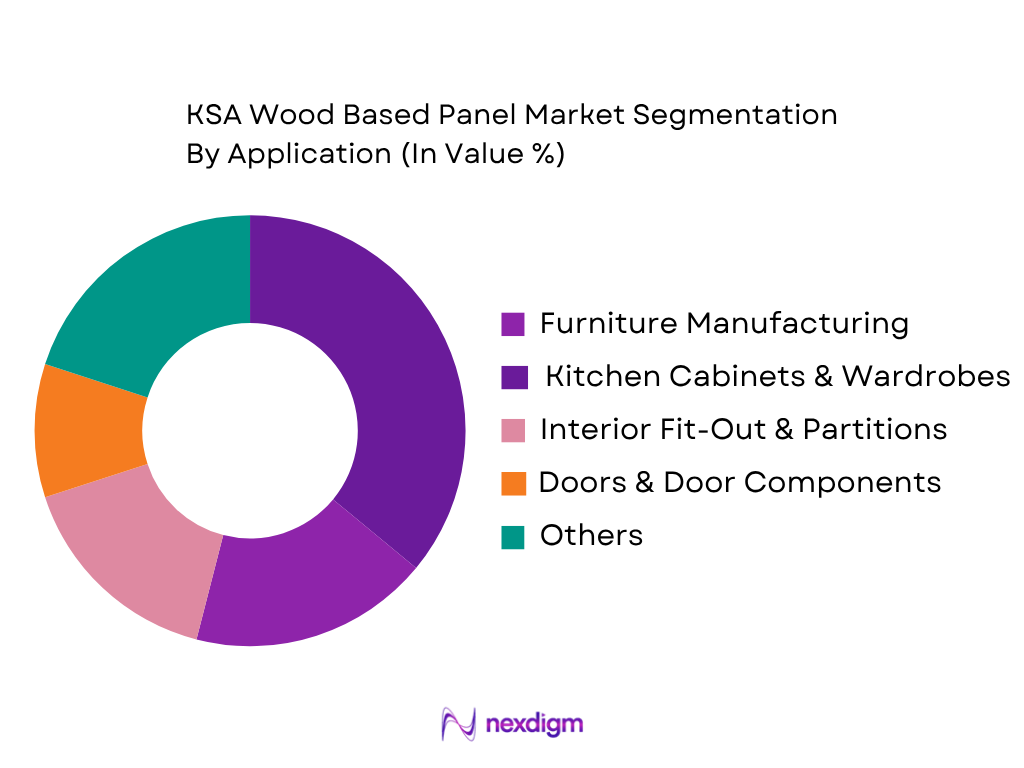
The Singapore Wood Based Panel Market is segmented into furniture and cabinetry, residential interiors, commercial office fit-outs, hospitality interiors, retail fixtures, doors and partitions, construction applications and other industrial uses. Recently, furniture and cabinetry has a dominant market share under the application segmentation in the report framework because Singapore’s compact residential and commercial spaces create requirements for built-in wardrobes, kitchen cabinets, shelving, storage systems, workstations and customized joinery. MDF and melamine-faced particleboard support precision machining and decorative consistency, while plywood is frequently selected where structural integrity and fastening performance are required. Commercial renovations and hospitality projects additionally support feature walls, counters, partitions and fitted furniture. Singapore’s interior industry increasingly requires panels that combine decorative performance with moisture resistance, durability and lower emissions. This environment favors suppliers capable of providing multiple thicknesses, finishes and technical grades while supporting CNC processing, edge banding, laminating and project-specific fabrication.
Competitive Landscape
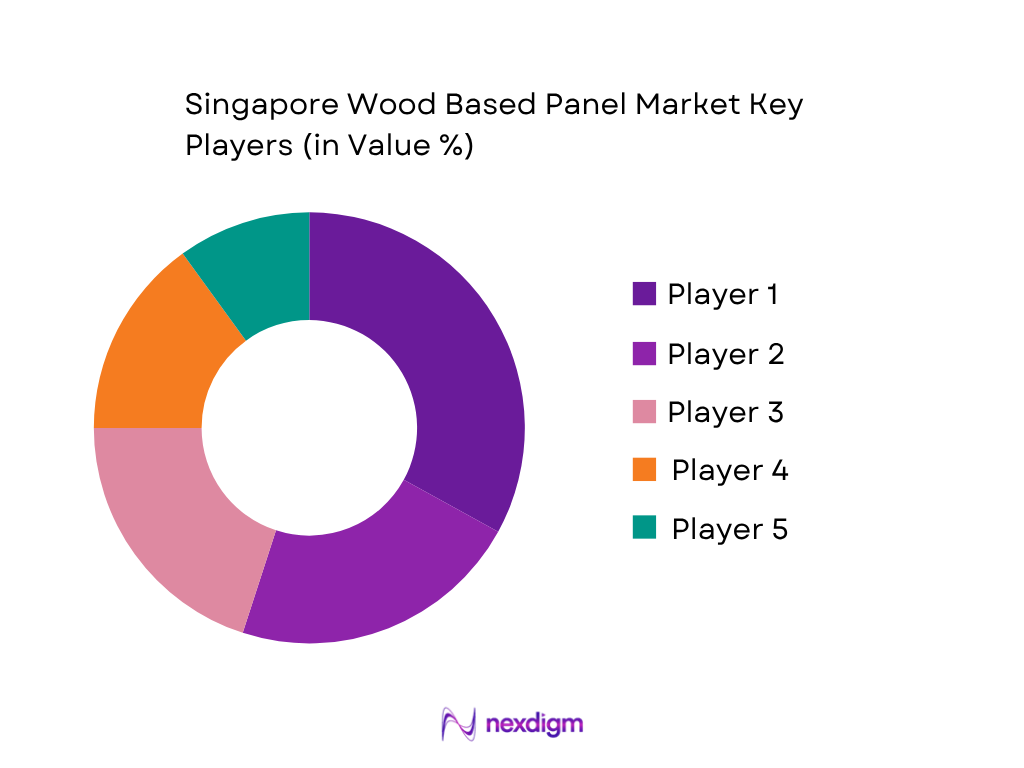
The Singapore Wood Based Panel Market has a highly import-oriented competitive structure involving international engineered-wood producers, Southeast Asian manufacturers, timber merchants, distributors and value-added panel processors. Competition is influenced by plywood and MDF availability, decorative portfolio breadth, environmental certification, formaldehyde performance, moisture-resistant grades and local inventory. Regional sourcing is particularly significant: Singapore’s imports of one major plywood and laminated-panel category reached USD 34.47 million, predominantly sourced from Vietnam, China, Indonesia and Malaysia.
| Company | Established | Headquarters | Core Panel Portfolio | Decorative Capability | Moisture-Resistant Products | Sustainability Positioning | Furniture/Joinery Focus | Singapore/Regional Reach |
| Kronospan | 1897 | Salzburg, Austria | ~ | ~ | ~ | ~ | ~ | ~ |
| EGGER Group | 1961 | St. Johann in Tirol, Austria | ~ | ~ | ~ | ~ | ~ | ~ |
| Sonae Arauco | 2016 | Maia, Portugal | ~ | ~ | ~ | ~ | ~ | ~ |
| Evergreen Fibreboard Berhad | 1972 | Johor, Malaysia | ~ | ~ | ~ | ~ | ~ | ~ |
| Kastamonu Entegre | 1969 | Istanbul, Türkiye | ~ | ~ | ~ | ~ | ~ | ~ |
Singapore Wood Based Panel Market Analysis
Growth Drivers
Residential Renovation Activity
Residential renovation and upgrading activity provides a direct demand base for plywood, MDF, particleboard, laminated boards, decorative panels and other wood-based interior materials in Singapore. The country had 1.46 million resident households in 2024, with an average household size of 3.09 persons, while 90.8% of resident households were owner-occupied. HDB dwellings represented 77.4% of resident households, creating a large installed housing base where renovation, kitchen replacement, wardrobe installation, storage optimization and interior refurbishment can generate recurring panel consumption. Singapore’s construction sector also recorded S$44.2 billion in preliminary construction demand in 2024, comprising S$25.9 billion from the public sector and S$18.3 billion from the private sector. Residential construction represented S$15.1 billion, including S$7.9 billion of public residential demand and S$7.2 billion of private residential demand. The construction pipeline remained substantial in 2025, with preliminary construction demand reaching S$50.5 billion, while BCA projected S$47–53 billion of construction demand for 2026. These conditions support continued requirements for interior-grade panels in HDB upgrading, private-home renovation, built-in furniture, kitchen systems and space-efficient storage. Singapore’s 4.4% real GDP growth in 2024, compared with 1.8% in 2023, also indicates an economy capable of supporting construction and household-related activity, although the IMF projected more moderate growth for 2026.
Commercial Interior Refurbishment and Furniture Demand
Commercial refurbishment, hospitality fit-outs, office upgrading, retail interiors and furniture production create recurring demand for MDF, particleboard, plywood, veneered panels and decorative boards. Singapore’s construction demand reached S$44.2 billion in 2024, with S$4.7 billion of private commercial construction demand and S$0.3 billion of public commercial construction demand, alongside S$10.6 billion of public institutional and other building demand. BCA identified redevelopment of commercial premises, mixed-use properties and industrial facilities as important contributors to private-sector activity, while major projects included hospitality and integrated-resort developments. The subsequent construction pipeline remained strong: preliminary construction demand reached S$50.5 billion in 2025, with projects including the Marina Bay Sands expansion, Changi Airport Terminal 5 and high-specification industrial buildings. This creates opportunities for panels used in wall systems, partitions, cabinetry, counters, doors, acoustic treatments and furniture components. Singapore’s manufacturing-intensive economy also supports specialized interior and equipment applications; the IMF reported that machinery and transport equipment represented 65.0% of non-oil goods exports in 2024, reflecting the importance of advanced manufacturing and technology-related activity to the economy. For wood-based panel suppliers, this environment favors products offering dimensional consistency, machinability, decorative finishes, moisture resistance and reliable fire-performance documentation. The combination of commercial redevelopment and high-specification facilities therefore supports demand beyond conventional residential applications.
Market Challenges
High Import Dependency and Regional Supply Chain Exposure
Singapore’s limited domestic timber-resource base means the Wood Based Panel Market is structurally dependent on international and regional supply chains for plywood, MDF, particleboard, veneers, decorative boards and specialized panel products. This creates exposure to shipping disruptions, supplier concentration, regional manufacturing interruptions, customs requirements and changes in international logistics conditions. The importance of external trade to Singapore is substantial: the IMF reported US$547.5 billion of nominal GDP in 2024, a population of approximately 6.0 million, and machinery and transport equipment accounting for 65.0% of non-oil goods exports. Although these figures are not wood-panel-specific, they demonstrate the highly trade-dependent structure within which panel procurement operates. The construction market simultaneously creates significant material requirements, with preliminary construction demand reaching S$44.2 billion in 2024 and S$50.5 billion in 2025. Higher construction activity can increase requirements for imported panel inventories and place pressure on distributor lead times. The market therefore requires reliable regional sourcing, diversified suppliers and sufficient inventory planning for different thicknesses, grades, finishes and performance classes. Import dependence is particularly relevant for low-emission MDF, fire-retardant boards, moisture-resistant panels and premium veneered products, where product specifications can be supplier-specific. Regional supply-chain exposure consequently remains a structural consideration for contractors, furniture manufacturers, interior specialists and panel distributors operating in Singapore.
Humidity, Fire-Safety and Technical Performance Requirements
Wood-based panels used in Singapore’s buildings must satisfy application-specific requirements relating to moisture resistance, dimensional stability, fire performance, formaldehyde emissions and indoor environmental conditions. The challenge is particularly relevant because Singapore’s building stock encompasses residential, commercial, institutional, industrial and hospitality applications with different technical requirements. BCA recorded S$44.2 billion of construction demand in 2024, including S$10.6 billion of public institutional and other building demand and S$4.7 billion of private commercial demand, demonstrating the breadth of building environments in which panel products can be specified. Singapore’s sustainability requirements add another layer of product-selection criteria. BCA reported 2,590 Green Mark-certified buildings as of March 2025, with these buildings collectively saving more than 4.2 billion kWh of energy annually. While Green Mark certification does not automatically determine wood-panel specifications, the scale of certified building activity reinforces the importance of documented environmental and material-performance attributes. Panel suppliers therefore need consistent technical documentation covering emissions, moisture performance, fire classification, adhesives, surface finishes and responsible sourcing where specified. Products that cannot provide the required documentation may face limitations in institutional, commercial or premium interior applications. This increases qualification requirements and can make product substitution more difficult than in less specification-intensive markets.
Market Opportunities
Low-Emission, Moisture-Resistant and Fire-Retardant Panels
The market provides opportunities for suppliers to expand higher-performance wood-based panel categories, particularly low-emission MDF and particleboard, moisture-resistant boards and fire-retardant panels. Singapore’s building environment creates a substantial specification base: preliminary construction demand reached S$44.2 billion in 2024, construction output reached S$38.4 billion, and preliminary construction demand increased to S$50.5 billion in 2025. BCA’s pipeline includes residential, commercial, institutional, industrial and infrastructure projects, allowing specialized panels to address multiple end-use environments. Residential applications can use low-emission and moisture-resistant boards in kitchens, wardrobes, bathroom-adjacent cabinetry and storage systems, while commercial and institutional projects can require fire-performance documentation for partitions, doors, wall systems and interior fit-outs. Sustainability considerations further strengthen the opportunity for products with documented environmental attributes. Singapore had 2,590 Green Mark-certified buildings as of March 2025, and these buildings collectively generated annual energy savings exceeding 4.2 billion kWh. Green building activity does not itself quantify wood-panel demand, but it indicates a mature market for products evaluated against broader building-performance criteria. Suppliers can therefore differentiate through formaldehyde-emission documentation, moisture-resistant formulations, fire-retardant treatment, recycled content, certified timber inputs and transparent environmental documentation. Such products can command greater specification relevance in renovation and new-build projects where compliance and building performance are prioritized.
Decorative Panels, Modular Interiors and Prefabricated Joinery
Decorative melamine boards, premium veneered panels, modular furniture components and prefabricated joinery represent opportunities because Singapore’s compact urban environment requires efficient use of interior space and supports high-density residential, commercial and hospitality development. The country had 1.46 million resident households in 2024, while HDB dwellings accounted for 77.4% of resident households. This large apartment-oriented housing base supports applications such as built-in wardrobes, kitchen systems, storage units, wall panels and space-efficient furniture, where factory-cut and pre-finished boards can reduce installation time. The commercial market adds another demand channel: 2024 construction demand included S$4.7 billion in private commercial contracts, while 2025 preliminary construction demand reached S$50.5 billion. BCA’s identified pipeline includes commercial redevelopment, hospitality projects, institutional buildings and high-specification industrial facilities. These projects can require coordinated prefabricated interior components with repeatable dimensions and consistent surface quality. Modular panel systems can also reduce on-site cutting and installation requirements, making them relevant to projects operating within constrained urban sites. The opportunity therefore extends beyond basic panel supply toward value-added products such as pre-laminated boards, CNC-ready panels, edge-banded components, veneered panels and factory-assembled joinery. The combination of dense housing, renovation activity and commercial redevelopment provides multiple channels for these higher-value panel applications.
Future Outlook
The Singapore Wood Based Panel Market is forecast to expand at approximately ~% CAGR during 2026–2035, with the figure retained as a placeholder for the final market model. Growth is expected to be supported by public housing, urban rejuvenation, commercial redevelopment, hospitality upgrades and demand for customized interior solutions. Product development will increasingly center on lower-emission composite wood, certified sustainable panels, moisture-resistant boards, fire-performance products and decorative surfaces. The underlying construction pipeline provides a supportive demand environment. BCA recorded S$44.2 billion of preliminary construction demand and S$38.4 billion of construction output in 2024. Its subsequent outlook identifies public housing, Changi Airport Terminal 5, commercial redevelopment, healthcare projects and other urban developments among important construction activities.
Major Players
- Kronospan
- EGGER Group
- Sonae Arauco
- Pfleiderer Group
- FINSA
- Kastamonu Entegre
- ARAUCO
- Evergreen Fibreboard Berhad
- HeveaBoard Berhad
- Mieco Chipboard Berhad
- Greenpanel Industries
- Century Plyboards
- Greenlam Industries
- Merino Industries
- Swiss Krono Group
Key Target Audience
- Wood Based Panel Manufacturers
- Wood Panel Importers and Distributors
- Furniture and Cabinetry Manufacturers
- Carpentry and Joinery Companies
- Interior Fit-Out Contractors and Property Developers
- Timber Merchants and Decorative Material Suppliers
- Investments and Venture Capitalist Firms
- Government and Regulatory Bodies (Building and Construction Authority, National Environment Agency, Enterprise Singapore, Singapore Customs)
Research Methodology
Step 1: Identification of Key Variables
The initial phase involves developing an ecosystem map covering manufacturers, importers, timber merchants, panel distributors, furniture companies, joinery contractors, interior fit-out companies, architects and property developers within the Singapore Wood Based Panel Market. Key variables include panel type, origin country, thickness, density, surface finish, moisture resistance, emission performance, certification and end-use application.
Step 2: Market Analysis and Construction
Historical analysis of the Singapore Wood Based Panel Market combines import flows, re-exports, apparent consumption, product categories and downstream requirements from construction, furniture and interior applications. Bottom-up analysis evaluates product and distributor-level activity, while top-down analysis assesses trade and built-environment demand. Both approaches are reconciled to construct the final market framework and segmentation.
Step 3: Hypothesis Validation and Expert Consultation
Market hypotheses are validated through computer-assisted telephone interviews and structured consultations with importers, distributors, furniture manufacturers, joinery operators, contractors and procurement specialists. Discussions evaluate sourcing countries, product specifications, purchasing patterns, inventory requirements and substitution between plywood, MDF and particleboard. Findings are triangulated against government trade information, company disclosures and construction-sector indicators.
Step 4: Research Synthesis and Final Output
The final stage synthesizes supply-side and demand-side findings across furniture, residential interiors, offices, hospitality, retail and construction applications. Primary insights are cross-validated with product-level trade flows and supplier information. Forecast assumptions incorporate construction activity, renovation requirements, environmental specifications, regional sourcing, low-emission products and value-added processing to develop the final Singapore Wood Based Panel Market outlook.

- Executive Summary
- Research Methodology (Market Definitions and Assumptions, Wood Based Panel Product Classification, HS Code Mapping, MDF and HDF Assessment, Particleboard Assessment, Plywood Assessment, OSB Assessment, Decorative Panel Assessment, Melamine-Faced Board Assessment, Structural and Non-Structural Panel Classification, Panel Thickness and Density Mapping, Moisture-Resistance Assessment, Fire-Performance Assessment, Formaldehyde Emission Assessment, Sustainable Timber Certification Assessment, Furniture and Joinery Demand Assessment, Construction and Interior Fit-Out Demand Assessment, Import Dependency Assessment, Re-Export Assessment, Country-of-Origin Mapping, Supply-Side Assessment, Demand-Side Assessment, Top-Down Market Sizing, Bottom-Up Market Sizing, Primary Industry Interviews, Trade Flow Assessment, Data Triangulation, Forecasting Framework)

- Definition and Scope
- Singapore Wood Based Panel Industry Evolution and Development of Plywood, MDF, HDF, Particleboard, OSB, Melamine-Faced Boards, Veneered Panels, Laminated Panels, Fire-Rated Boards, Moisture-Resistant Panels, Low-Emission Composite Wood, Decorative Panels, Furniture Boards and Sustainable Engineered Wood Products
- Wood Based Panel Value Chain Analysis
- Wood Based Panel Supply Chain Analysis
- Regional Timber Suppliers, Wood Fibre Suppliers, Panel Manufacturers, Decorative Surface Manufacturers, Importers, Re-Exporters, Timber Merchants, Panel Distributors, Warehousing Companies, CNC Panel Processors, Furniture Manufacturers, Carpentry and Joinery Companies, Interior Fit-Out Contractors, Main Contractors, Architects, Interior Designers, Property Developers, Hospitality Operators and Building Owners

- Growth Drivers (Residential Renovation Activity, Commercial Interior Refurbishment, Furniture and Built-In Cabinet Demand, Hospitality Fit-Out Activity, Office Renovation, Retail Interior Development, Compact-Space Storage Solutions, Modular Furniture Adoption, Prefabricated Interior Components, Sustainable Building Material Adoption)
- Market Challenges (High Import Dependency, Limited Domestic Timber Resources, Regional Supply Chain Exposure, Formaldehyde Emission Concerns, Humidity and Moisture Performance Requirements, Fire-Safety Requirements, Competition from Alternative Interior Materials, Limited Warehousing Space, Panel Inventory Complexity, Construction Cycle Volatility)
- Market Opportunities (Low-Emission MDF and Particleboard, Certified Sustainable Panels, Moisture-Resistant Boards, Fire-Retardant Panels, Decorative Melamine Boards, Premium Veneered Panels, Modular Interior Components, Prefabricated Joinery, Circular and Recycled-Wood Panels, Hospitality Refurbishment, Commercial Renovation, Green Building Specifications)
- Market Trends (Low-Formaldehyde Composite Wood, Green-Certified Panels, Prefabricated Joinery, CNC-Processed Furniture Components, Decorative Surface Innovation, Compact-Space Furniture Systems, Moisture-Resistant MDF, Fire-Performance Boards, Recycled Wood Content, Biophilic Interior Design, Digital Panel Cutting and Nesting, Material Traceability)
- Government Regulations and Standards (Building Control Act and Regulations, BCA Green Mark Requirements, Singapore Green Building Product Certification, Singapore Green Labelling Scheme, SS 554 Indoor Air Quality Guidance, Formaldehyde Emission Considerations, Fire Code Requirements, Composite Wood Product Requirements, Sustainable Timber Procurement, Import and Customs Requirements, Workplace Safety Requirements)
- SWOT Analysis (Regional Sourcing Access, Established Timber Trading Ecosystem, Import Dependency, Limited Domestic Feedstock, High-Value Interior Demand, Sustainable Panel Opportunities)
- Porter’s Five Forces Analysis (Supplier Bargaining Power, Buyer Bargaining Power, Import Competition, Substitute Material Threat, Distributor Competition)
- PESTLE Analysis (Construction Policy, Economic Activity, Interior Lifestyle Trends, Digital Fabrication, Building Regulations, Sustainability Requirements)
- Stakeholder Ecosystem (Manufacturers, Importers, Distributors, Timber Merchants, Furniture Producers, Joinery Companies, Interior Contractors, Architects, Developers, Regulators)

- By Market Value (2020-2025)
- By Panel Consumption Volume (2020-2025)
- By Import Value (2020-2025)
- By Import Volume (2020-2025)
- By Re-Export Value (2020-2025)
- By Re-Export Volume (2020-2025)

- By Product Type (In Value %)
Medium Density Fibreboard (MDF)
High Density Fibreboard (HDF)
Particleboard
Plywood
Oriented Strand Board (OSB)
Melamine-Faced Boards
Veneered Panels
Laminated Panels
Decorative Engineered Wood Panels
Other Composite Wood Panels - By Panel Grade (In Value %)
Standard Interior Grade Panels
Moisture-Resistant Panels
Fire-Retardant Panels
Exterior Grade Panels
Structural Grade Panels
Furniture Grade Panels
Low-Formaldehyde and Low-Emission Panels
Certified Sustainable Wood Panels - By Surface and Finish Type (In Value %)
Raw and Unfinished Panels
Melamine-Faced Panels
Natural Veneer-Faced Panels
High-Pressure Laminate-Faced Panels
Painted and Lacquered Panels
Acrylic-Faced Panels
PET-Faced Panels
Wood-Grain Decorative Panels
Textured Decorative Panels
Solid-Color Decorative Panels - By Application (In Value %)
Furniture Manufacturing
Kitchen Cabinets and Wardrobes
Interior Partitions
Wall Paneling and Feature Walls
Doors and Door Components
Retail Fixtures and Displays
Office Fit-Out
Hospitality Fit-Out
Flooring Substrates
Ceiling and Interior Architectural Applications
Construction and Temporary Works
Industrial and Packaging Applications - By End User (In Value %)
Residential Interiors
Commercial Offices
Hospitality and Hotels
Retail and Shopping Centers
Furniture Manufacturers
Carpentry and Joinery Companies
Kitchen and Cabinet Manufacturers
Interior Fit-Out Contractors
Healthcare Facilities
Educational Buildings
Institutional Buildings
Industrial and Commercial Facilities - By Distribution Channel (In Value %)
Timber and Panel Importers
Wood Panel Distributors
Timber Merchants
Furniture OEM Direct Procurement
Carpentry and Joinery Procurement
Interior Fit-Out Contractor Procurement
Main Contractor Procurement
Project-Based Direct Sales
Specialty Decorative Material Distributors
Online B2B Building Material Channels - By Source Country (In Value %)
Malaysia
China
Vietnam
Indonesia
Thailand
European Union
Other Asia-Pacific Countries
Rest of World

- Market Share of Major Players (By Singapore Revenue, Panel Sales Volume, MDF Portfolio, Particleboard Portfolio, Plywood Portfolio, OSB Portfolio, Decorative Panel Portfolio, Low-Emission Product Portfolio, Sustainable Panel Portfolio, Furniture and Joinery Presence, Interior Fit-Out Presence, Distribution Reach, Stock Availability, Project Specification Presence)
- Cross Comparison Parameters (MDF and Particleboard Portfolio Breadth, Plywood and Specialty Panel Range, Decorative and Melamine-Faced Board Capability, Moisture-Resistant and Fire-Retardant Product Capability, Low-Formaldehyde and Green-Certified Panel Portfolio, Singapore Distribution and Inventory Availability, Furniture and Joinery Customer Penetration, Commercial Fit-Out and Project Specification Capability)
- SWOT Analysis of Major Players (Panel Portfolio, Distribution Capability, Brand Positioning, Green Certification, Project Specification Strength)
- Detailed Profiles of Major Companies
Kronospan
EGGER Group
Sonae Arauco
Pfleiderer Group
FINSA
Kastamonu Entegre
ARAUCO
Evergreen Fibreboard Berhad
HeveaBoard Berhad
Mieco Chipboard Berhad
Greenpanel Industries
Century Plyboards
Greenlam Industries
Merino Industries
Swiss Krono Group

- Furniture Manufacturer Panel Requirement Assessment
- Carpentry and Joinery Requirement Assessment
- Kitchen and Wardrobe Panel Requirement Assessment
- Interior Fit-Out Contractor Requirement Assessment
- Architect and Interior Designer Specification Assessment
- Commercial Office Panel Requirement Assessment
- Hospitality Panel Requirement Assessment
- Residential Renovation Panel Requirement Assessment
- Panel Selection Criteria Assessment

- By Market Value (2026-2035)
- By Panel Consumption Volume (2026-2035)
- By Import Value (2026-2035)
- By Import Volume (2026-2035) (2026-2035)
- By Re-Export Value (2026-2035)
- By Re-Export Volume (2026-2035)


 Request a Sample
 Ask for Customization
 Get a Quote
 Enquire Now