

 Download PDF
Market Overview
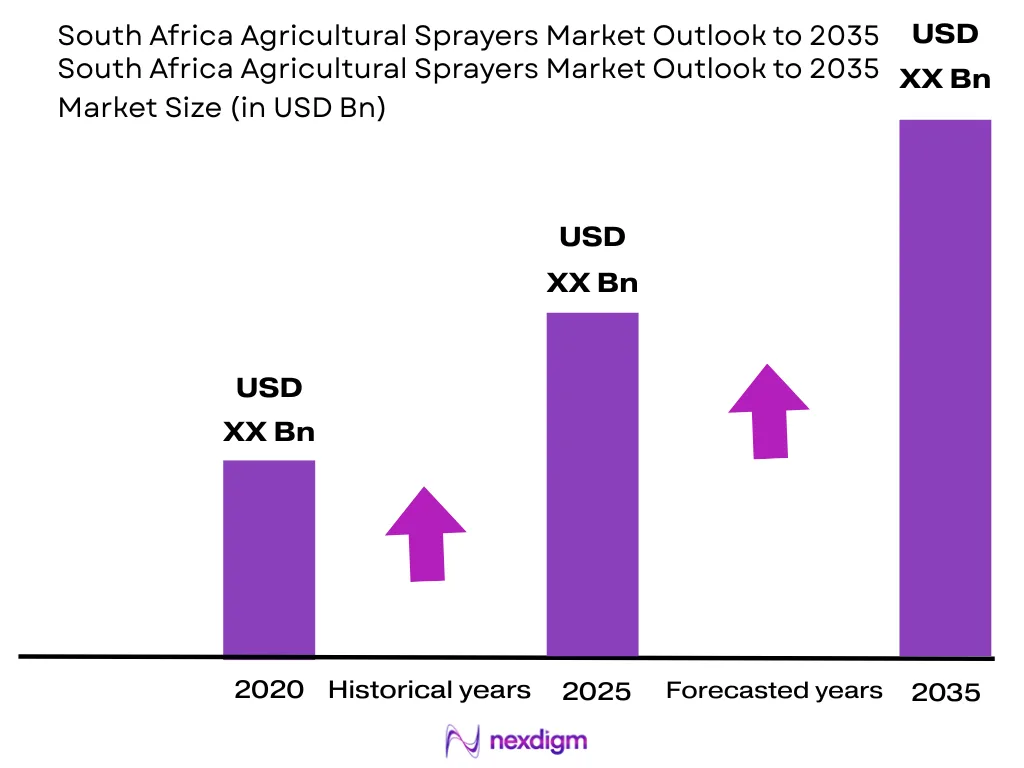
The South Africa Agricultural Sprayers Market was valued at approximately USD ~ billion in 2024 based on a comprehensive assessment of agricultural machinery sales, crop protection equipment demand, and mechanisation trends across major farming regions. The market is primarily driven by South Africa’s well-established commercial agricultural sector, which produces significant volumes of maize, wheat, soybeans, sugarcane, wine and table grapes, and citrus fruits. According to data published by the Department of Agriculture, Land Reform and Rural Development (DALRRD) and the South African Grain Information Service (SAGIS), total grain and oilseed production remained substantial, with maize alone regularly exceeding 14 million metric tonnes and soybean production expanding steadily in recent crop years. South Africa’s dual agricultural economy, characterised by a highly mechanised commercial farming sector alongside a large smallholder and subsistence farming population, creates a distinctly segmented demand structure for spraying equipment. Rising precision agriculture adoption among commercial farmers, growth in the export horticulture sector, and increasing investment in crop protection chemical usage have collectively accelerated demand for advanced spraying systems across major agricultural provinces.
Market Segmentation
By Sprayer Type
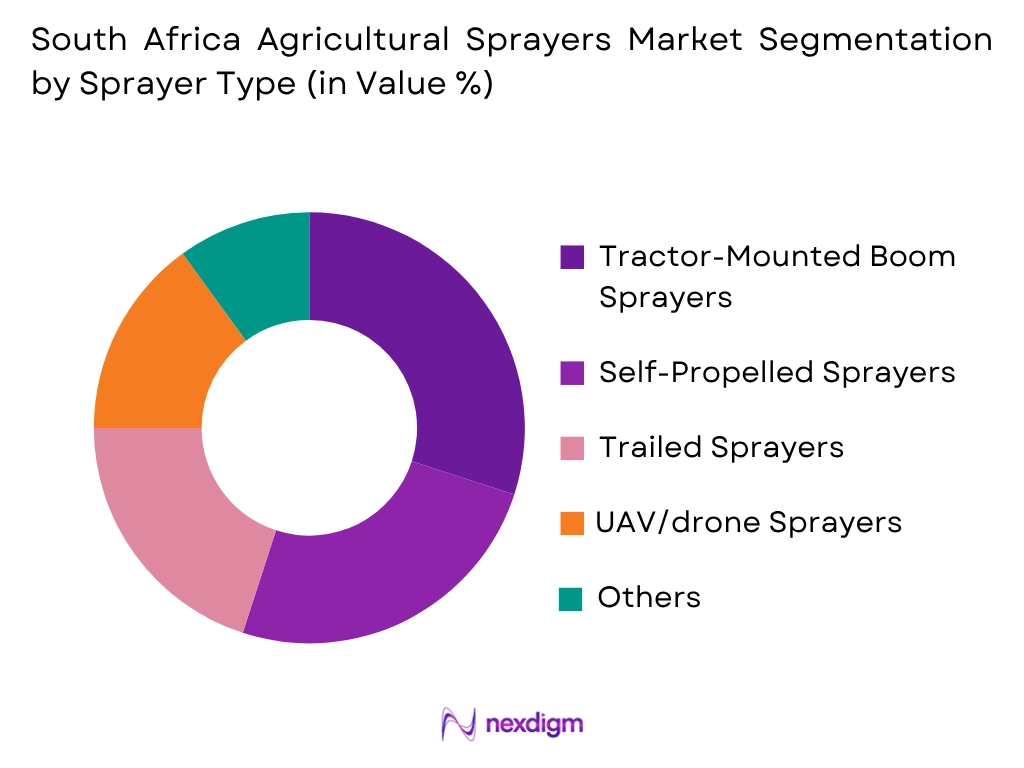
South Africa Agricultural Sprayers Market is segmented by sprayer type into self-propelled sprayers, trailed sprayers, tractor-mounted boom sprayers, power knapsack sprayers, manual knapsack sprayers, motorised mist blowers, orchard and vineyard sprayers, and UAV/drone sprayers. Tractor-mounted boom sprayers and trailed sprayers dominate the commercial farming segment, reflecting the large-scale grain and oilseed production enterprises concentrated in the Free State, North West, and Mpumalanga provinces where maize, wheat, and soybean cultivation extends across tens of thousands of hectares per farm operation. These sprayers offer high tank capacities, wide boom widths, and compatibility with the powerful tractors commonly operated on South African commercial grain farms. Self-propelled sprayers are gaining traction among the largest grain producers seeking maximum field coverage rates and operational independence from tractor availability. In contrast, power knapsack and manual knapsack sprayers dominate by unit volume in the smallholder and emerging farmer segment, particularly across KwaZulu-Natal, Limpopo, and Eastern Cape where small-scale vegetable and subsistence crop production is prevalent. Orchard and vineyard sprayers constitute a specialised and growing segment, particularly in the Western Cape where wine grape and deciduous fruit farming demands precision canopy application equipment.
By Crop Type
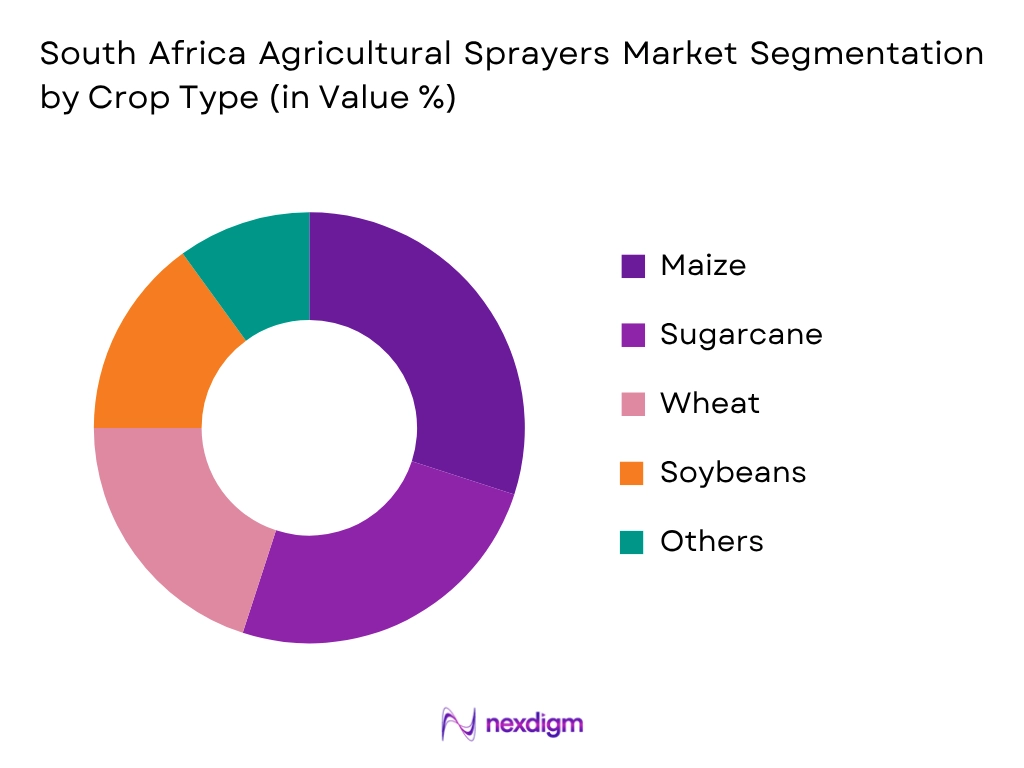
South Africa Agricultural Sprayers Market is segmented by crop type into maize, sugarcane, wheat, soybeans, wine and table grapes, citrus fruits, deciduous fruits, and other field and horticultural crops. Maize cultivation accounts for the largest market share, reflecting its status as South Africa’s most widely grown field crop and primary staple food. According to SAGIS and DALRRD data, maize is cultivated across approximately three million hectares annually, predominantly in the Free State, North West, and Mpumalanga provinces, requiring multiple herbicide, fungicide, and insecticide applications throughout the growing season. The concentration of large-scale commercial maize farms in these regions drives consistent demand for high-capacity tractor-mounted and trailed boom sprayers. Sugarcane cultivation along the KwaZulu-Natal coastline and Mpumalanga lowveld generates the second largest segment of sprayer demand, requiring specialised equipment suited to tall and dense crop canopies. The Western Cape’s viticulture and deciduous fruit sectors, which are strongly export-oriented and subject to strict international food safety and maximum residue limit requirements, drive significant demand for precision orchard and vineyard sprayers equipped with air-assisted and canopy-adapted application systems.
Competitive Landscape
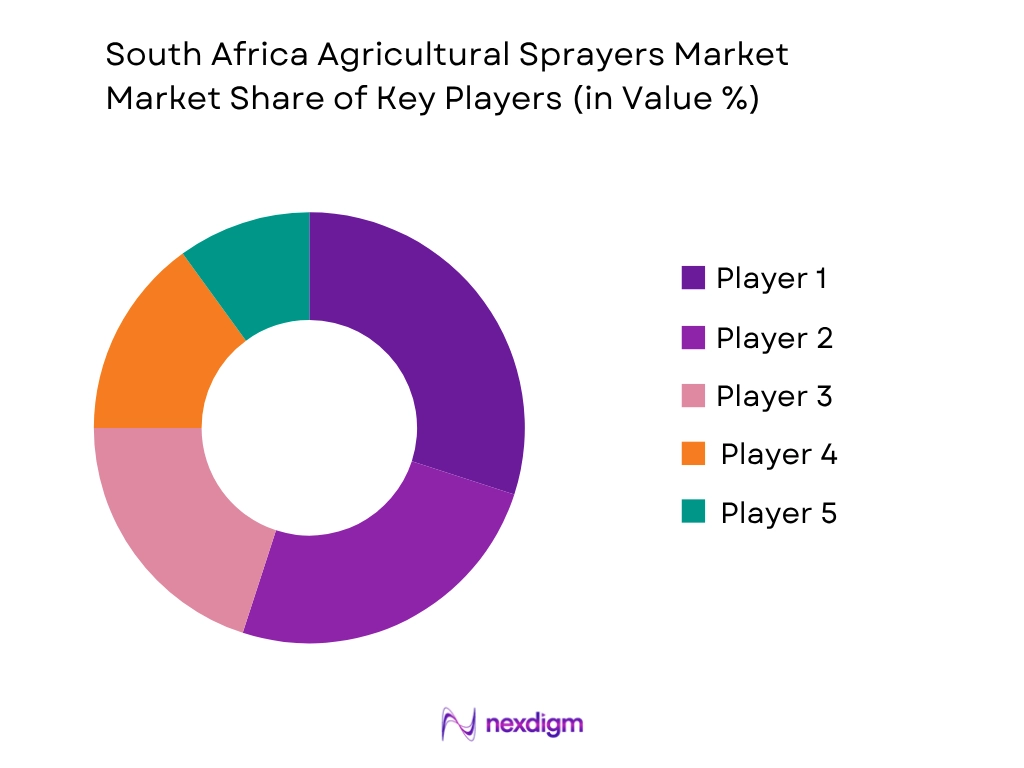
The South Africa Agricultural Sprayers Market is characterised by a combination of international agricultural equipment brands distributed through established dealer networks and a small number of domestic manufacturers and assemblers serving specific market segments. The commercial farming sector is well served by international brands including John Deere, Case IH, Massey Ferguson, Hardi, and Amazone, which maintain strong positions through extensive dealer and agricultural cooperative networks across major grain, sugarcane, and horticultural producing provinces. Local manufacturers and importers occupy competitive positions in the mid-market and smallholder segments, offering cost-effective equipment suited to South African farming conditions and supported by accessible service infrastructure. The agricultural cooperative sector, represented by entities such as NWK, Senwes, and Afgri, plays a significant role in equipment distribution and financing, particularly across the grain belt provinces of the Free State, North West, and Mpumalanga.
| Company | Establishment Year | Headquarters | Product Portfolio | Precision Agriculture Integration
|
Tank Capacity Range | Dealer Network Strength | After-Sales Support | Innovation Capability |
| John Deere South Africa | 1837 | ~ | ~ | ~ | ~ | ~ | ~ | ~ |
| CNH Industrial (Case IH SA) | 2013 | ~ | ~ | ~ | ~ | ~ | ~ | ~ |
| AGCO Corporation (Massey Ferguson SA) | 1990 | ~ | ~ | ~ | ~ | ~ | ~ | ~ |
| Hardi South Africa | 1957 | ~ | ~ | ~ | ~ | ~ | ~ | ~ |
| Murtagh Equipment | 1965 | ~ | ~ | ~ | ~ | ~ | ~ | ~ |
South Africa Agricultural Sprayers Market Analysis
Growth Drivers
Expanding Commercial Grain and Oilseed Production with High Crop Protection Requirements
The South Africa agricultural sprayers market is strongly underpinned by the country’s established commercial grain and oilseed production sector, which demands intensive and recurring crop protection activities throughout each growing season. According to SAGIS and DALRRD, South Africa produces approximately 14 to 16 million metric tonnes of maize annually, with planted area typically ranging between 2.5 and 3.0 million hectares across the Free State, North West, Mpumalanga, and Gauteng provinces. Soybean production has expanded significantly over the past decade, surpassing 2.5 million metric tonnes in recent seasons, driven by domestic crushing demand and favourable commodity prices. Wheat cultivation across the Western Cape and Free State further contributes to sprayer utilisation intensity. Commercial grain farms in South Africa’s summer and winter rainfall regions require multiple herbicide applications for weed management, fungicide programmes for grey leaf spot, northern corn leaf blight, and Fusarium control in maize, and insecticide treatments for aphids, stalk borers, and fall armyworm, which has become a significant and widespread pest since its arrival in the country. The scale of South Africa’s commercial farming operations, with individual farm sizes frequently exceeding several thousand hectares, creates consistent demand for high-capacity tractor-mounted and self-propelled sprayers equipped with precision application technologies, making grain and oilseed production the primary driver of commercial sprayer market activity.
Growth of Export Horticulture and International Food Safety Compliance Requirements
South Africa’s export horticulture sector, which encompasses citrus, wine and table grapes, deciduous fruits including apples, pears, and stone fruit, as well as subtropical fruits and vegetables, is a significant and growing driver of demand for precision and compliance-oriented spraying equipment. South Africa is one of the world’s leading exporters of citrus, with export volumes regularly exceeding 2.5 million tonnes annually destined for European, Asian, and Middle Eastern markets. The Western Cape wine and deciduous fruit sector, centred on the Boland, Overberg, and Langkloof regions, supplies major retail chains and importers across the United Kingdom, the Netherlands, Germany, and Scandinavia. International food safety standards including the European Union’s maximum residue limits (MRLs), Global G.A.P. certification requirements, and United Kingdom import phytosanitary standards impose stringent requirements on pesticide application practices, dosing accuracy, spray timing, and record-keeping. These compliance obligations drive investment in advanced spraying equipment capable of delivering precise and traceable applications. Orchard and vineyard sprayers equipped with electronic rate controllers, section control, and boom height management systems are increasingly specified by export-oriented fruit and wine producers seeking to demonstrate regulatory compliance and protect market access. The continued growth of South Africa’s export horticulture sector and tightening international residue standards represent a durable and expanding demand driver for precision spraying technology.
Market Challenges
Rand Volatility, High Import Costs, and Equipment Affordability Constraints
The South Africa agricultural sprayers market faces significant structural challenges arising from the country’s dependence on imported agricultural equipment and the persistent volatility of the South African rand against major international currencies. The majority of commercial-grade sprayers, precision agriculture components, and advanced application technologies sold in South Africa are imported from European, American, and increasingly Chinese manufacturers, with pricing denominated in US dollars or euros. Rand depreciation episodes, which have been frequent and at times severe, directly translate into substantial price increases for imported equipment in rand terms, constraining farm purchasing budgets and extending equipment replacement cycles. According to the South African Agricultural Machinery Association (SAAMA), agricultural machinery sales volumes are sensitive to rand exchange rate movements and farm commodity price cycles, with equipment demand declining during periods of currency weakness or low crop prices. The combination of high equipment purchase prices in rand terms, elevated interest rates applicable to agricultural finance facilities, and rising input costs across fuel, labour, and chemicals creates significant pressure on farm profitability and capital expenditure budgets. Smaller commercial and emerging farmers face particular challenges accessing finance for premium spraying equipment, limiting market penetration of advanced systems to the larger commercial farming segment.
Dual Agricultural Economy and Electricity Supply Constraints
South Africa’s deeply entrenched dual agricultural economy, characterised by a capital-intensive and highly productive commercial farming sector operating alongside a large and predominantly subsistence-oriented smallholder farming population, creates a structurally fragmented demand environment for agricultural spraying equipment. The smallholder and land reform beneficiary farming sector, which operates across communal land and land reform farms in the Eastern Cape, Limpopo, KwaZulu-Natal, and North West provinces, largely lacks the financial resources, credit access, and technical capacity to invest in mechanised spraying equipment beyond basic manual and power knapsack models. Government agricultural support programmes for emerging and smallholder farmers, while addressing some access gaps through equipment grants and subsidised inputs, have achieved uneven results in improving sprayer adoption within this segment. Additionally, South Africa’s persistent electricity supply constraints, driven by the structural capacity shortfall of Eskom and the ongoing load-shedding programme, have increased operational costs for farm businesses dependent on electric-powered irrigation, grain drying, and cold storage infrastructure. Higher diesel and generator fuel expenditure as a consequence of load-shedding reduces discretionary capital available for equipment investment. These twin structural challenges of agricultural duality and energy insecurity create ongoing headwinds for broad-based market growth beyond the established commercial farming sector.
Market Opportunities
Precision Agriculture Technology Adoption among Commercial Grain Farmers
Precision agriculture presents one of the most significant growth opportunities for the South Africa Agricultural Sprayers Market, particularly within the large-scale commercial grain and oilseed farming sector. South African commercial farmers, especially in the maize and soybean belt of the Free State and North West, are among the most technologically progressive in sub-Saharan Africa, with meaningful adoption of GPS guidance systems, variable rate fertiliser application, and yield monitoring technologies already established. The extension of precision farming principles to sprayer management, including variable rate herbicide and fungicide application, automatic boom section control, and telematics-based fleet management, represents a natural and commercially compelling next step for these operations. Agri-input companies, equipment dealers, and precision agriculture service providers operating in South Africa have made meaningful investments in farmer education, demonstration, and technology support infrastructure. The adoption of satellite-based crop monitoring, drone-based field scouting, and prescription mapping services creates upstream demand for sprayers capable of executing variable rate application protocols. As input cost pressures intensify and farm profitability management becomes increasingly important, the return on investment case for precision spraying technologies is strengthening among South Africa’s commercial farming community, creating a growing addressable market for advanced sprayer systems and retrofit precision agriculture components.
Drone Sprayer Adoption in Sugarcane, Citrus, and Grain Production Regions
Agricultural UAV/drone sprayers represent an emerging and commercially promising growth opportunity for the South Africa market, with several crop and terrain-specific applications creating compelling adoption cases. Sugarcane cultivation along the KwaZulu-Natal north and south coast and the Mpumalanga lowveld presents significant operational challenges for conventional ground-based spraying equipment due to steep terrain, soft soils during the wet season, and the height and density of mature sugarcane stalks. Drone sprayers offer meaningful operational advantages in these conditions, enabling targeted ripener and growth regulator applications and reducing soil compaction concerns. The South African Civil Aviation Authority (SACAA) has established regulatory frameworks for Remotely Piloted Aircraft Systems (RPAS) commercial operations, providing a legal basis for agricultural drone service providers to operate. Citrus orchard management in the Limpopo, Eastern Cape, and Western Cape regions similarly presents terrain and canopy access challenges where drone-based applications offer operational flexibility. Additionally, fall armyworm scouting and targeted spray response across large grain farming areas in the Free State and North West represents an emerging use case for drone-based precision applications. As drone hardware costs decline, local service and maintenance infrastructure develops, and farmer awareness of drone spraying economics improves, UAV-based crop protection services are expected to gain progressive market traction across South Africa’s diverse agricultural regions.
Future Outlook
The South Africa Agricultural Sprayers Market is expected to experience moderate but sustained growth over the forecast period, driven by continued investment in precision agriculture technologies among commercial grain and horticulture farmers, growth of the export fruit and wine sector, and emerging adoption of drone-based spraying services across sugarcane, citrus, and grain regions. Demand for advanced spraying systems is anticipated to strengthen as variable rate application, automatic section control, and telematics integration become standard expectations among larger commercial farm operations. Technological developments including autonomous and GPS-guided self-propelled sprayers, AI-enabled spray optimisation, and agricultural drone platforms are expected to gain progressive market acceptance. However, rand exchange rate volatility, electricity supply challenges, and the persistent gap between commercial and smallholder mechanisation levels will continue to shape the pace and distribution of market growth across South Africa’s diverse agricultural landscape. Government investment in emerging farmer support and land reform mechanisation programmes will remain a critical factor in determining the long-term breadth of market development.
Major Players
- John Deere South Africa
- CNH Industrial (Case IH South Africa)
- AGCO Corporation (Massey Ferguson South Africa)
- Hardi South Africa
- Murtagh Equipment
- Amazone (South Africa Distribution)
- Agri-Spreaders
- Kuhn Group (South Africa)
- GEA Farm Technologies South Africa
- Berthoud (South Africa Distribution)
- Condor Sprayers
- ARAG Group (South Africa)
- DJI Agriculture (South Africa Operations)
- SkyHarvest (Agricultural Drone Services)
- Agri4Cast Technologies
Key Target Audience
- Agricultural Equipment Manufacturers and Importers
- Agricultural Machinery Dealers and Distributors
- Large-Scale Commercial Farming Enterprises
- Agricultural Cooperatives (NWK, Senwes, Afgri, TWK, Griekwaland-Wes Ko-op)
- Precision Agriculture and AgriTech Solution Providers
- Crop Protection Chemical Manufacturers and Distributors
- Investments and Venture Capitalist Firms
- Government and Regulatory Bodies (Department of Agriculture Land Reform and Rural Development, Land Bank, South African Civil Aviation Authority, South African Bureau of Standards, Agricultural Research Council)
- Agricultural Equipment Rental and Contract Application Service Companies
Research Methodology
Step 1: Identification of Key Variables
The initial phase involves constructing an ecosystem map encompassing all major stakeholders within the South Africa Agricultural Sprayers Market. This process includes extensive secondary research through industry publications, government agricultural databases, the South African Grain Information Service, South African Agricultural Machinery Association records, manufacturer and distributor reports, and agricultural trade association data. The objective is to identify critical market variables including equipment sales volumes, crop acreage, mechanisation rates across commercial and smallholder segments, technology adoption trends, and purchasing behaviour patterns within South Africa’s dual agricultural economy.
Step 2: Market Analysis and Construction
Historical market data relating to agricultural machinery sales, crop production trends, farm equipment penetration, and spraying technology adoption are collected and analysed. Demand-side assessment focuses on commercial farmer purchasing patterns, agricultural cooperative procurement activity, and crop protection requirements across grain, sugarcane, and export horticulture production systems. Supply-side analysis evaluates manufacturer and importer revenues, dealer sales volumes, production and assembly capacities, and distribution network coverage across South African agricultural provinces. Both approaches contribute to market size estimation and forecasting.
Step 3: Hypothesis Validation and Expert Consultation
Preliminary market findings and assumptions are validated through structured interviews with industry participants including agricultural equipment manufacturers, importers, dealers, cooperative procurement managers, commercial farm operators, agronomists, precision agriculture specialists, drone service providers, and industry associations. These consultations provide practical insights regarding market trends, technology adoption dynamics, foreign exchange and import cost impacts, export horticulture compliance requirements, and future demand outlook specific to South African farming conditions, thereby strengthening the reliability of research findings.
Step 4: Research Synthesis and Final Output
The final stage involves triangulating information collected from primary interviews, secondary research sources, trade statistics, and proprietary databases. Market estimates are refined through cross-verification across multiple data points and stakeholder perspectives. Forecast models are developed using agricultural production outlooks, crop area estimates, mechanisation trend data, exchange rate assumptions, and government support programme trajectories to generate comprehensive and reliable market intelligence for the South Africa Agricultural Sprayers Market.

- Executive Summary
- Research Methodology (Market Definitions and Assumptions, Abbreviations, Market Sizing Approach, Top-Down Analysis, Bottom-Up Analysis, Demand-Side Assessment, Supply-Side Assessment, Primary Industry Interviews, Distributor and Dealer Validation, Farm-Level Survey Assessment, Data Triangulation, Forecasting Framework, Limitations and Future Conclusions)

- Definition and Scope
- Industry Evolution and Market Genesis
- Timeline of Technological Advancements in Agricultural Spraying
- Agricultural Equipment Value Chain Analysis
- Agricultural Sprayer Supply Chain Analysis

- Growth Drivers (Expansion of Commercial Grain and Oilseed Production, Growth in Crop Protection Chemical Usage, Rising Mechanisation among Commercial Farmers, Precision Agriculture Adoption, Export Horticulture Sector Growth)
- Market Challenges (High Equipment Import Costs and Rand Volatility, Dual Agricultural Economy Disparities, Limited Smallholder Mechanisation Access, Electricity Supply Constraints Affecting Equipment Operations, Prolonged Drought Cycles and Climate Variability)
- Market Opportunities (Drone Sprayer Adoption in Sugarcane and Grain Regions, Biological Input Application Equipment, Precision Farming Technology Investments, Smallholder Mechanisation Support Programmes, Sustainable Export-Compliant Crop Protection Practices)
- Market Trends (Variable Rate Application Technology, Automatic Boom Section Control, Telematics and Fleet Management Integration, AI-Based Spray Optimisation, Low-Drift Nozzle Technology Adoption)
- Government Regulations (Department of Agriculture Land Reform and Rural Development Equipment Standards, Fertilisers Plant Feeds Farm Feeds and Agricultural Remedies Act, Civil Aviation Authority Drone Regulations, South African Bureau of Standards Equipment Certification, Land Bank Agricultural Finance Programme Guidelines)
- SWOT Analysis
- PESTLE Analysis
- Stakeholder Ecosystem
- Porter’s Five Forces Analysis
- Competition Ecosystem

- By Market Value (2020-2025)
- By Units Sold (2020-2025)
- By Average Selling Price (2020-2025)

- By Sprayer Type (In Value %)
Self-Propelled Sprayers
Trailed Sprayers
Tractor-Mounted Boom Sprayers
Power Knapsack Sprayers
Manual Knapsack Sprayers
Motorised Mist Blowers
Orchard and Vineyard Sprayers
UAV/Drone Sprayers - By Application (In Value %)
Herbicide Application
Fungicide Application
Insecticide Application
Foliar Fertiliser Application
Biological Inputs Application - By Crop Type (In Value %)
Maize
Sugarcane
Wheat
Soybeans
Wine Grapes and Table Grapes
Citrus Fruits
Deciduous Fruits (Apples, Pears, Stone Fruit)
Other Field and Horticultural Crops - By Distribution Channel (In Value %)
OEM Direct Sales
Agricultural Equipment Dealers
Agri-Input Retail Networks and Agricultural Cooperatives (Agri-Co-ops)
Equipment Rental and Contract Application Services
Online Agricultural Equipment Platforms - By Province (In Value %)
Free State
Mpumalanga
North West
Western Cape
KwaZulu-Natal and Other Provinces

- Market Share of Major Players (By Value, Units Sold, Sprayer Type, Crop Segment, Province)
- Cross Comparison Parameters (Boom Width Portfolio, Tank Capacity Range, Field Coverage Efficiency (ha/hr), Precision Spraying Capability, Variable Rate Application Integration, Dealer Network Strength, After-Sales Service Reach, Spray Drift Reduction Technology)
- Competitive Positioning Matrix (Technology Leadership, Pricing Competitiveness, Brand Recognition, Regional Presence)
- SWOT Analysis of Major Players
- Pricing Analysis by Sprayer Category and Capacity
- Detailed Profiles of Major Companies
John Deere South Africa
CNH Industrial (Case IH South Africa)
AGCO Corporation (Massey Ferguson South Africa)
Hardi South Africa
Murtagh Equipment
Amazone (South Africa Distribution)
Agri-Spreaders
Kuhn Group (South Africa)
GEA Farm Technologies South Africa
Berthoud (South Africa Distribution)
Condor Sprayers
ARAG Group (South Africa)
DJI Agriculture (South Africa Operations)
SkyHarvest (Agricultural Drone Services)
Agri4Cast Technologies

- Farm Equipment Ownership and Utilisation Analysis (Hours of Operation, Spraying Frequency, Fleet Age, Seasonal Utilisation Rate)
- Farm Mechanisation Assessment (Mechanisation Index, Equipment Density per Hectare, Technology Adoption Rate)
- Purchasing Power and Investment Capacity Analysis (Farm Income, Access to Land Bank and Commercial Agricultural Finance, ROI Expectations, Capital Expenditure Trends)
- Crop Protection Spending Analysis (Chemical Input Spend, Application Cost per Hectare, Spray Frequency by Crop)
- Farmer Needs and Pain Point Assessment (Labour Availability, Input Efficiency, Downtime Reduction, Coverage Accuracy, Fuel and Electricity Costs)

- By Market Value (2026-2035)
- By Units Sold (2026-2035)
- By Average Selling Price (2026-2035)


 Request a Sample
 Ask for Customization
 Get a Quote
 Enquire Now